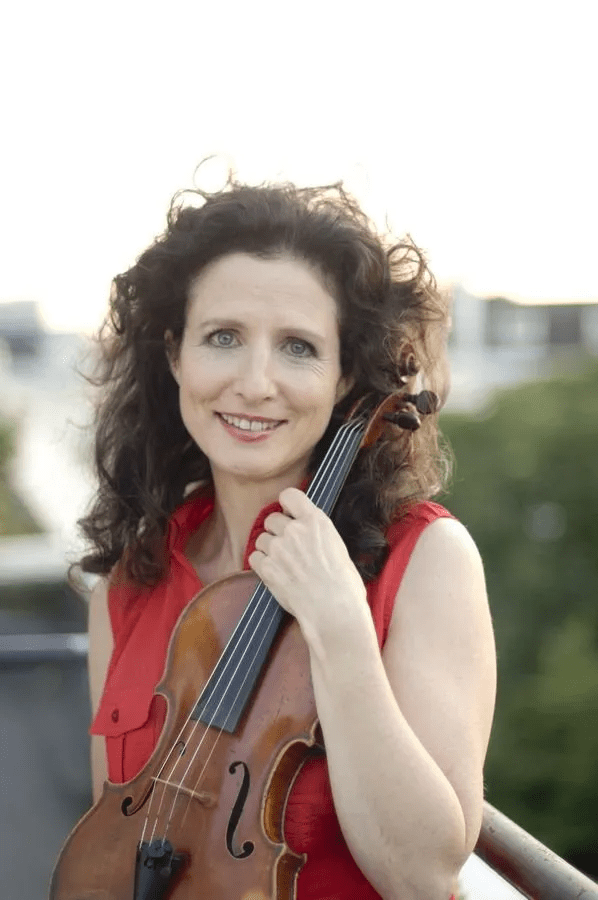
FLA 20: Madeleine Mitchell (09/07/2023)

© Rama Knight

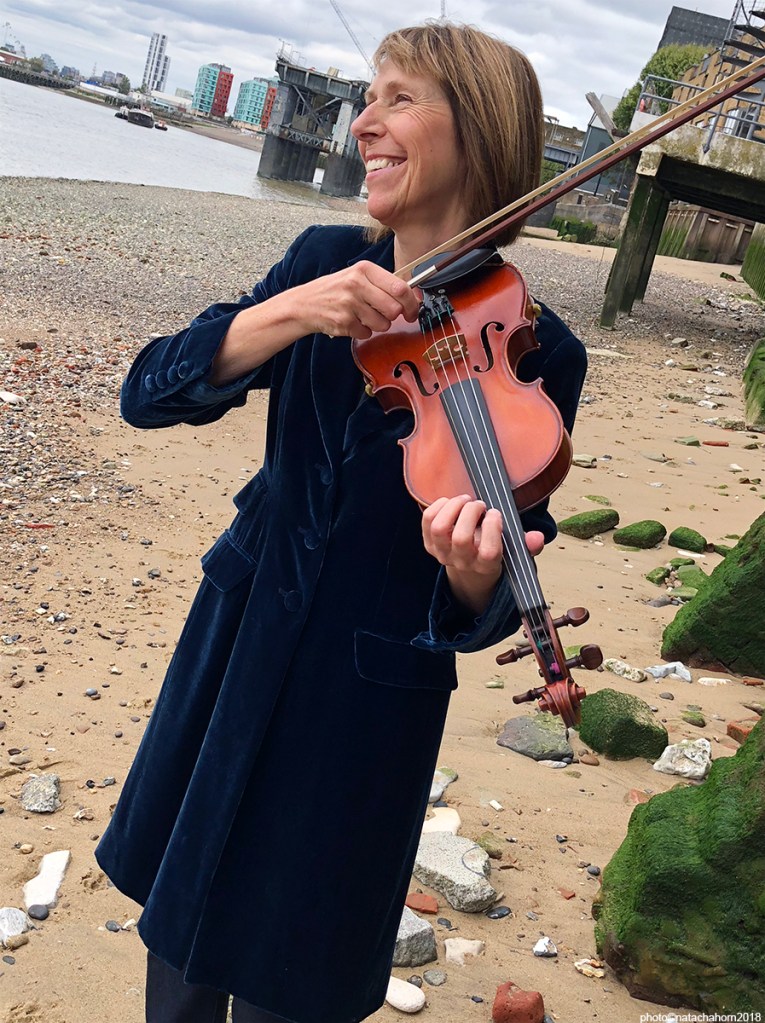
I first saw the award-winning violinist Madeleine Mitchell on television in 1979, when I was nine. At the time she was one of the rising stars at London’s Royal College of Music, and the leader of its orchestra. Since then, she has had the most varied of professional careers, initially joining Sir Peter Maxwell Davies’s (1934–2016) ground-breaking group of 6 players, The Fires of London in the mid-1980s, at the same time as winning prizes giving her solo recitals and concerto performances in Europe. She toured and recorded with the Michael Nyman Band, before founding the London Chamber Ensemble in 1992 for a performance of Messiaen Quartet for the End of Time with Joanna MacGregor which they went on to perform at the BBC Proms in 1996 and record. In 2006 Madeleine was asked to put together a chamber music album of the music of William Alwyn for Naxos and in 2019, Madeleine and the LCE released an album of the Chamber Music of the Welsh composer Grace Williams (1906–77), to great acclaim.


Simultaneously, Madeleine’s career as a soloist has been equally illustrious, as concerto soloist and in recitals, on radio and television, and on numerous recordings, including a series of highly acclaimed albums: British Treasures (2003), In Sunlight: Pieces for Madeleine Mitchell (2005), the popular Violin Songs (2007), FiddleSticks (2008, an ACE award-winning collaboration with percussionists ensemble bash), and Violin Muse (2017). In this strand of her catalogue, she has often showcased new, neglected, or previously unrecorded works.


Her terrific new album, Violin Conversations, released by the Naxos label on 23 June 2023, is no exception. It assembles two rarely recorded violin sonatas (by Alan Rawsthorne, and Thea Musgrave) with a programme of approachable newer compositions for violin and piano, by Douglas Knehans (a pupil of Musgrave’s), Errollyn Wallen, Howard Blake, Martin Butler, as well as solo pieces by the late Joseph Horovitz, Wendy Hiscocks and Richard Blackford, and a piece for violin and tape by Kevin Malone. 


I spoke to Madeleine on Zoom on the eve of the album’s release to discuss all of its musical conversations and connections, and to look back and indeed forward at her varied career. She shares her memories of the remarkable Yehudi Menuhin (1916–99), of the creation of her Red Violin Festival – a celebration of this most versatile of instruments – and her surprising connection to the cinematic output of David Bowie. And plenty more besides.


We also discuss a concert she was about to perform with her London Chamber Ensemble, which took place in London on 29 June 2023. The programme comprised Franz Schubert’s Cello Quintet (his only string quintet, written in 1828) – which she tells me she had the honour of performing with Norbert Brainin (1923–2005) – and the newly recovered original version of Herbert Howells’ String Quartet No 3 (In Gloucestershire), written in 1916–20, but long thought to have been lost. (A later version, from 1923, has survived.)


But we begin at the beginning with the question I usually ask: the music she first heard when young. We hope you enjoy our violin conversation.


—-

MADELEINE MITCHELL

I heard just classical music at home. My mother was an amateur pianist and Welsh, so came from the singing tradition. She continued to play the piano in her nineties, and we used to play piano duets, even one of the last times I saw her… when she was 96.


My parents were never pushy or anything like that, but they had the radio on: Radio 3 or the Third Programme as it was called then. I remember at my very ordinary primary school in Essex, standing up in class, and saying, ‘I don’t like Dave Clark Five, I like Mozart!’


I started the piano when I was six and loved it, as I did music theory. When I was ten, I played the Mozart Fantasia in D minor from memory for the whole school. It was an absolute thrill even though my friends weren’t really from that sort of background. My mother said to me, ‘If you played an orchestral instrument, you could have fun making music with the other children.’ And I thought, ‘She’s right and I’d like to play the violin.’ Fortunately, you could learn violin free at school.

—- 

FIRST: EDWARD ELGAR: Violin Concerto in B minor

Yehudi Menuhin, soloist, London Symphony Orchestra, conductor Edward Elgar, 1932 recording

Extract: 1st movement: Allegro

MADELEINE MITCHELL

My dad was an engineer and was very skilled at that sort of thing. He had a reel-to-reel tape recorder, which was also how I heard quite a bit of music. One recording he had on reel-to-reel was the legendary recording from 1932 of Yehudi Menuhin, aged sixteen, playing the Elgar Violin Concerto with Elgar himself conducting – and I was really taken with this. Unlike most of the great composers, who were keyboard players, Elgar was a violinist, and he wrote this work in 1910 for Fritz Kreisler.


Amazingly, my local library, the Havering Central Library had the sheet music for it, so I borrowed it. And at the same library I also found this book that had been discarded, which was called Theme and Variations by Yehudi Menuhin (published 1972). It wasn’t just about music. There were chapters on architecture and Indian music and organic food… It was fascinating.


JUSTIN LEWIS

The impact that Menuhin had is almost impossible to overstate. When I was a child in the 70s, everybody knew who he was. He appeared on Morecambe and Wise, he guested on Parkinson (BBC1, 18 December 1971) – which I would not have seen at the time – but I saw the clip of him and Stéphane Grappelli, much repeated since, on other programmes. (The two made a return appearance on the Parkinson show on 17 November 1973.)


MADELEINE MITCHELL

Playing Tea for Two? Yeah. I loved Grappelli. He would be in my top ten violinists along with Heifetz and Oistrakh and Kreisler. But with Menuhin, I think it’s the emotion in his sound that Menuhin gets – in German they call it “innigkeit – inner feeling and it’s very moving.


I once gave a recital in Russia at the St Petersburg Festival of British Music, and afterwards the agent came up to me and suggested I play the Elgar Violin Concerto. I thought: ‘Wow! First of all, you know it, and secondly, you’re asking me to do it!’ So she sent me off to a place called Samara, one and a half hours east of Moscow by plane, where Shostakovich wrote his Seventh Symphony, and where they all went during the Second World War because it was safer than Moscow.


This was in the February, and I imagined it would be so cold there, but everything was very well heated. There was a very good conductor called Ainārs Rubiķis, who had won the Mahler Competition and the orchestra were fabulous. And after the first rehearsal, the flautist came up to me and she said, in broken English, ‘We didn’t know this piece. We knew the Elgar cello concerto. But we love this violin concerto. It’s so emotional.’ I said, ‘You’ve absolutely got it. That’s exactly what Elgar said. He said, “It’s so emotional, too emotional. But I love it.”’


And that’s what I love. And that’s what Menuhin gets in the music. When I heard his recording, I got the music as a teenager and tried to play the second subject, working out what fingering Menuhin did. Years later, at the Royal College of Music, I had lessons with Hugh Bean (1929–2003), a student of Albert Sammons (1886–1957), who worked closely with Elgar (1857–1934), and when I came to learn the concerto properly, to perform it, in 1993 I asked Hugh Bean if I could  play it for him and I remember him saying, ‘Oh Albert said that Elgar said’, and I thought, I must write this down, this is really important. In fact, Hugh used more simple fingerings in places, in a more English kind of way. Menuhin loved England, he lived in London, founded the Menuhin School and became Lord Menuhin, so he took up those English ways, while there was that Jewish/Russian/American thing going on as well. Fascinating.


JUSTIN LEWIS

These connections and conversations, stretching back into history, are so striking. But you have another connection with Menuhin, because in the 1990s you started a festival, right?


MADELEINE MITCHELL

Yes, towards the end of his life, in 1997, he agreed to be the Patron of my Red Violin festival, [a celebration of the violin and violin playing across different genres] – Gwyll Ffidil Goch in Welsh, a ten-day festival in Cardiff – which was dear to his heart. I was thrilled. I was invited to Menuhin’s studio in central London to record an hour’s interview for the BBC and because he couldn’t make the launch, he did this lovely video message – you can see it on YouTube.

Madeleine Mitchell and Yehudi Menuhin: Red Violin Festival, 1997

MADELEINE MITCHELL

I had with me the photograph of him when he was 16, in 1932, on the steps of Abbey Road [which had in fact only just opened, as EMI Recording Studios]… having just recorded this concerto… And he signed the photograph and then he embraced me. Very touching. So it sort of came full circle, it was a huge endorsement for my creative idea, which I’m keeping going. We’re doing another Red Violin festival in October 2024 in Leeds.
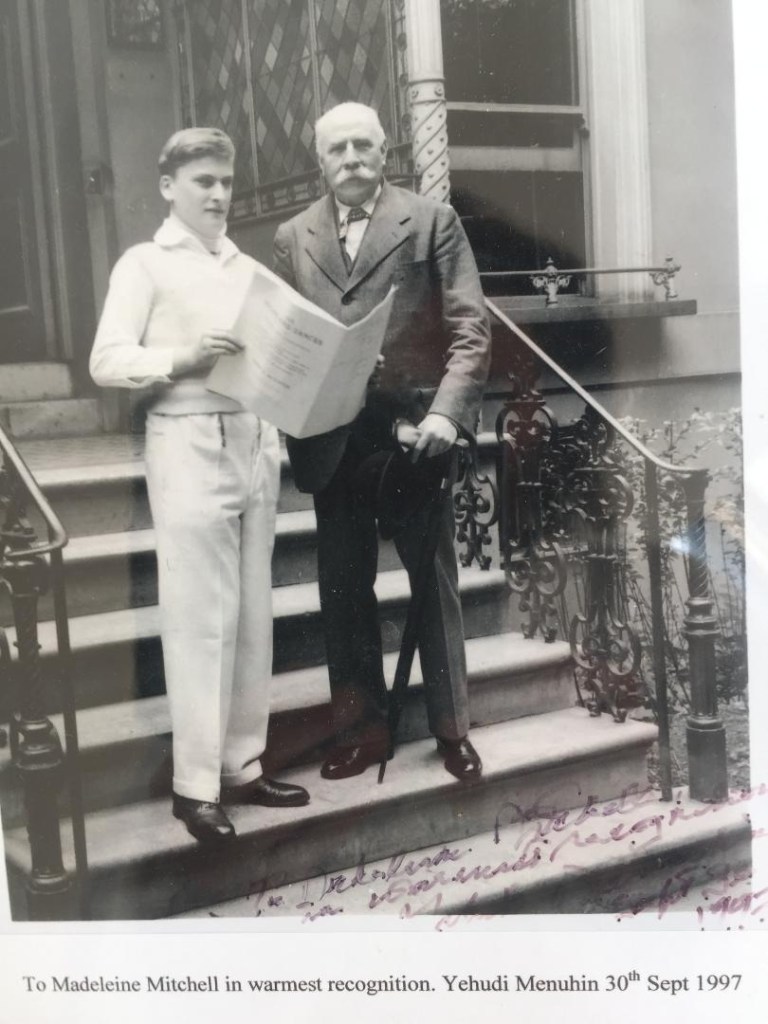
Photo of Yehudi Menuhin, age 16, with Sir Edward Elgar, after their legendary EMI recording of the Elgar Violin Concerto, on the steps of Abbey Road. Signed by Menuhin for Madeleine Mitchell when she interviewed him at his home, for the BBC Radio 2 documentary about her Red Violin festival of which he was the Founder Patron. 

Photograph supplied by MM with Yehudi Menuhin, 1997, Red Violin, credit ITN

JUSTIN LEWIS

Tell me, then, about how you originally came up with the idea for the festival.


MADELEINE MITCHELL

The title came from the titles of the paintings, Le Violon Rouge (The Red Violin) by Raoul Dufy (1948) and Jean Pougny (1919). My mother was more of an artist than a musician and so we were surrounded by her art as well as reproductions of fine paintings at home such as Cézanne, and I collected cards of violin paintings –Picasso, Chagall and Matisse as well as Dufy etc.


I had the idea at Christmas 1994 while all was quiet. I had just played in The Soldier’s TaleL’Histoire du Soldat – by Stravinsky, this tale of the soldier who sells his soul, represented by the violin, to the devil. Obviously the violin is the foundation of the orchestra and it struck me how the violin had inspired not only composers in all sorts of music but also painters and writers etc and I thought how wonderful it would be to have a festival celebrating the violin across the arts.


JUSTIN LEWIS

It’s such a magical, versatile musical instrument. It not only has a different voice in all these different genres of music, but I can remember as a child thinking that a group of orchestral violinists made a sound that felt different from a solo violinist sound. I know all instruments have that ability to some extent, but the violin for me does it more than most. But how did you progress on violin and piano after your early lessons?


MADELEINE MITCHELL

I had shared lessons with a peripatetic music teacher, and was loaned a very ordinary school violin. But when I was eleven, I had one year of private lessons, and was awarded an Exhibition to the Junior Department of the Royal College of Music, and got in on piano first study. But I think they thought I was very promising on the violin. So then I became joint principal until I was eighteen. And when I got a scholarship at the Royal College of Music (on a violin for which my parents paid £20), they said, ‘How are you going to have time for both and the graduate course?’ So at that point I decided to do piano second study, and then I studied viola as well at College.


JUSTIN LEWIS

I was a flautist when I was growing up. I was fascinated by the violin as a child, even though I never learned to play it. It always looked far too complicated! [Laughter] I couldn’t imagine finding the level of coordination that’s required.


MADELEINE MITCHELL

It’s very difficult!


—-
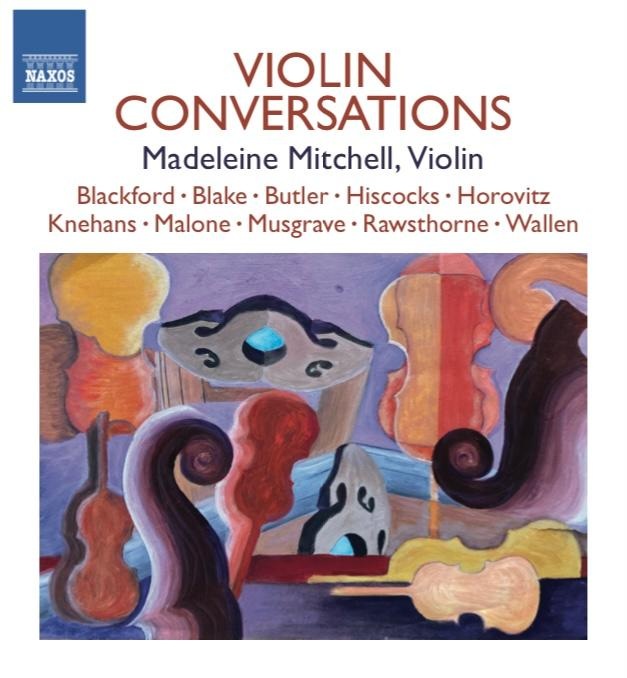
Violin Conversations: Cover painting by Evelyn Mitchell née Jones (1924–2020)

JUSTIN LEWIS

Your new album, Violin Conversations, really does cover a great deal of ground. How did you decide on its running order?


MADELEINE MITCHELL

It happened gradually. In the back of my mind was my duo partner, the pianist Andrew Ball (1950–2022). I really loved playing with Andrew. We made four albums and we did a lot of broadcasts and concerts for twenty years in a whole range of repertoire. He’d play the César Franck Violin Sonata marvellously, but also new music too. A very intelligent, lovely person. And he got Parkinson’s; absolutely tragic, so couldn’t play anymore. It was such a loss. But while he was still alive, I thought, ‘We’ve got this recording of this live broadcast of the Alan Rawsthorne Violin Sonata’ [broadcast, BBC Radio 3, 11 July 1996] which went very well. It’s a good piece, but it’s hardly ever been recorded, as opposed to another recording of a Brahms sonata or the Ravel, two other favourites we did in the same concert.


Meanwhile, I had put Thea Musgrave’s Colloquy into my programme: ‘A Century of British Music by Women’ in 2021, only to discover there was no available recording. It was recorded at the time of the première in 1960 by the performers who recorded it for vinyl, but it’s not available, and it wasn’t reissued. I thought, that’s a strong piece by an important composer, we really ought to record that.


So we’ve got two 20th century classics. In fact, I didn’t actually know until I researched it that the Musgrave and the Rawsthorne were both premiered at the same concert, the Cheltenham Music Festival in 1960, even though the Rawsthorne had been written in 1958, two years earlier.


JUSTIN LEWIS

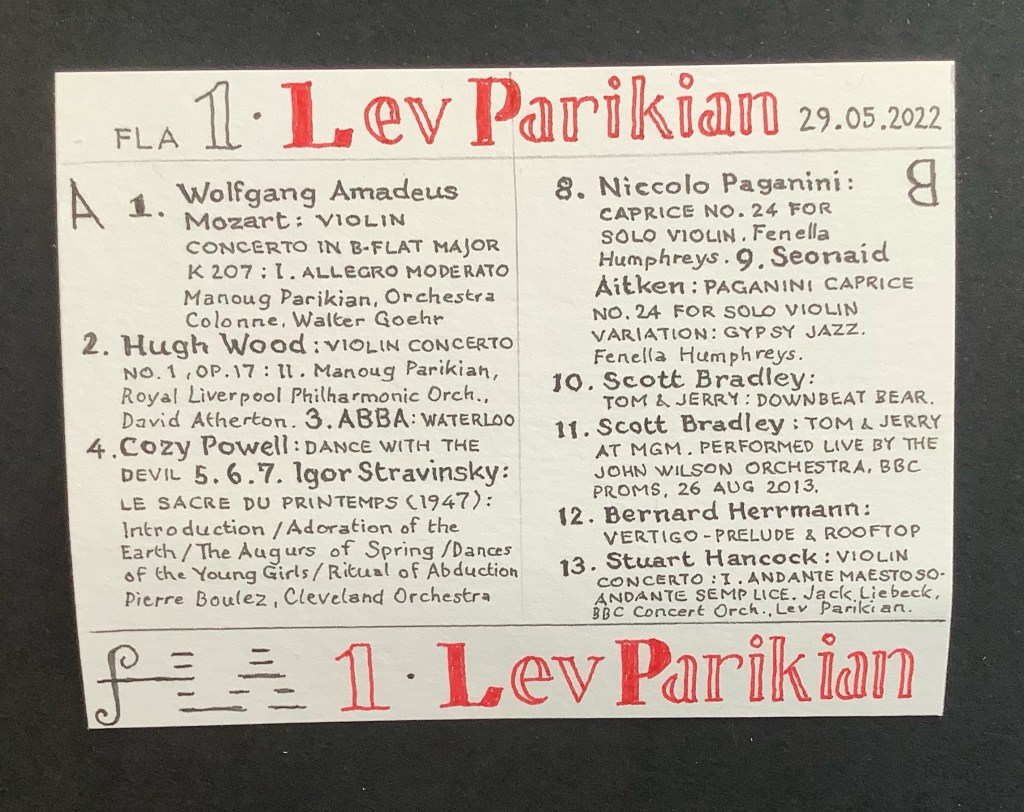
The Musgrave and Rawsthorne has an extra neat connection with this series, in that the violin soloist for both was Manoug Parikian, whose son Lev was First Last Anything’s very first guest!


MADELEINE MITCHELL

I knew Manoug slightly, but I actually did play with Lamar Crowson, who was the pianist.


JUSTIN LEWIS

Let’s talk about some of the more recently composed works on Violin Conversations, then. Many written specially for you.


MADELEINE MITCHELL

I knew all the composers. I met Richard Blackford in 2003 at the centenary celebration of the Royal College of Music’s Tagore Gold Medals, the award for the most distinguished student of the year. We won it in different years, but that’s how we met and became friends. During the first lockdown in 2020, when I went back to completely solo violin – there was nothing else you could do – I agreed to contribute to a charity album, Many Voices on a Theme of Isolation, to help raise money for Help Musicians UK and I asked Richard, who sure enough, wrote me, very quickly, a solo violin piece called Worlds Apart, to pay homage to those people who were not able to be together because of the lockdown. It’s a haunting little piece. Three minutes. But I’ve re-recorded it for Violin Conversations, to get better quality.


A lot of the pieces were gifts. Martin Butler also wrote me a piece that grew out of lockdown, because composers were quite active during that period. So he wrote me Barcarolles; it just appeared out of the blue as a present, and he lives near the sea in Sussex, so the wateriness of it… it all goes together.


JUSTIN LEWIS

Errollyn Wallen’s Sojourner Truth also has a connection with lockdown, doesn’t it?


MADELEINE MITCHELL

I met Errollyn twenty years ago. We became friends, I’d see her from time to time, and about three years ago, she wrote me a piece, Sojourner Truth, commissioned with a grant from what was the RVW Trust, now the Vaughan Williams Foundation. He was a very generous composer, who bequeathed a lot of his estate to setting up this foundation for other British composers, for new music, and for neglected composers – like Grace Williams (one of his former students).


I went to stay with Errollyn at her lighthouse recently in the north of Scotland, and when I gave the première of Sojourner Truth in March 2021, she was in her lighthouse during lockdown. I was able to rehearse with a pianist in London, two metres apart, while Errollyn was on FaceTime, hearing it and telling me things. So it was really wonderful to finally meet up with her and play it with her. It took a bit of persuading because she said she was a bit out of practice, but you know, it was her particular style of a jazzy singer-songwriter. She probably wrote it at the piano and then she was able to say things to me – ‘take more time here’, or whatever it was. I found it really interesting.


JUSTIN LEWIS

I was watching the video conversation you two had about Sojourner Truth, in which you discuss one of the greatest things about commissioning a new composer – you can directly talk to the composer!


MADELEINE MITCHELL

It’s a no brainer, isn’t it? It’s wonderful! You can just ask some things, and they’ll tell you things, and they’re very happy to do so. And I’m so pleased to have been able to commission Errollyn Wallen, to celebrate this extraordinary woman, Sojourner Truth (c. 1797–1883), the American abolitionist. Who I had not heard of. What an extraordinary life. You know, it’s great that that she will live on in perpetuity in the title of that piece and on this recording.

Errollyn Wallen and Madeleine Mitchell perform and discuss Sojourner Truth.

JUSTIN LEWIS

I’m sure one reason I’m increasingly immersed in classical music more profoundly, admittedly belatedly in life, is the way that it now feels much more inclusive, in a way it didn’t used to. How have you seen this change over your professional career, that awareness of diversity?


MADELEINE MITCHELL

It’s got a lot better, for sure. There’s much more focus on it on it now. With women composers, it’s very important to still retain the quality, so it’s not just tokenism for the sake of it. But it’s good that composers like Grace Williams, who were rather self-critical and didn’t push themselves forward and didn’t really have a powerful publisher, are now getting the recognition that they deserve.


JUSTIN LEWIS

Tell me about some of the other composers on Violin Conversations.


MADELEINE MITCHELL

Joseph Horovitz, who died last year, was a brilliant lecturer in my first year at the Royal College of Music, who became a friend. Dybbuk Melody was a piece he gave me on a piece of manuscript, but it hadn’t been recorded.


JUSTIN LEWIS

Wasn’t it written for a production of S. Ansky’s The Dybbuk (BBC1, 24 February 1980)?


MADELEINE MITCHELL

It was, you’re absolutely right, it was for the closing credits. A very Jewish piece. So I had that. Wendy Hiscocks, the Australian composer, had these two pieces which hadn’t been recorded. One is Caprice – in a slightly Vaughan Williams-y idiom, if you like. There’s Kevin Malone’s Your Call is Important to Us, a piece for violin and tape. And while Thea Musgrave is a sort of granite-like grit in the oyster in the middle of the album, you have the spacious piece by her former student Douglas Knehans (b. 1957), Mist Waves, which he wrote for me in 2019.


JUSTIN LEWIS

And to round off, there’s a collaboration with Howard Blake. There’s quite a story behind how you first met him!


MADELEINE MITCHELL

I met Howard in 1982, the year that he composed The Snowman, so I was very young then. I was invited to audition for the part of the young violinist in the film The Hunger, with David Bowie and Catherine Deneuve. I went to the home of Tony Scott, the film’s director and Howard Blake was there as the Musical Director. Unfortunately, I wasn’t quite young enough, or didn’t look quite young enough to play the 13-year-old girl in the film. But Howard really liked my playing at the audition, so unbelievably, he invited me to record two solo tracks at the legendary Abbey Road Studios, for the film. So although I’m not visually in the film, my playing is: the violin part of the slow movements of the Lalo and Schubert E flat piano trios. Just me and Howard in this huge Studio 1 at Abbey Road. It was incredible.

Years later, I saw Howard again at the Chester Music Christmas party, and he said, ‘I’ve reworked my Violin Sonata, which I wrote years ago. Would you like to come and try it?’ So I did and we worked well together. His music has a lot of jazz influence, which appeals to me, and we ended up making an album of this Violin Sonata for Naxos [2008], along with his Penillion, and an arrangement he made for us of his of Jazz Dances for violin and piano.  


We then did lots of concerts together. And at lunch, he’d tell me all these stories, how he was in the studios in the 70s, playing for Eartha Kitt. And you know, he has a very particular style of playing the piano. He arranged Walking in the Air for me as well, in 2010, but then he came up with The Ice Princess and the Snowman, a really beautiful piece, and we originally did it for a Classic FM live video at St John’s Smith Square, where he talks about it as well:

The Violin Conversations album is mostly new music, but what strikes me – compared to 40 years ago – is it’s much wider and broader, different styles being more readily accepted. So, Howard Blake’s is unashamedly tonal romantic music, and the Horovitz Dybbuk Melody and the Wendy Hiscocks Caprice – it’s all tonal music really. There was a time when all that was shunned and it was out of fashion… But what’s happened during those four decades is there’s a wider brief for contemporary music where all sorts of things are accepted: violin and tape, electronics, as on the Kevin Malone, or something that you might say is quite traditional – Errollyn’s piece is based on a slave song – but written very recently.


JUSTIN LEWIS

One of the best things about the digital world is how we can connect up all this material. New music, or even just previously unheard music, is easier to find.


MADELEINE MITCHELL

What occurs to me, joining up the dots of this conversation: Yehudi Menuhin seemed quite an elderly, ethereal sort of person, but actually he really had his finger on the pulse. He said to me – and this was 30 September 1997, just before the Red Violin festival: ‘Young people have a short attention span. It’s good what you’re doing because you know you’re giving them the taste of jazz and folk fiddle and classical, and pictures.’ And this was 1997, before we all had mobile phones. With this album, there are four pieces that are three minutes long. People can give it a try. It doesn’t require a huge investment, you know. Richard Blackford – three minutes; Wendy Hiscocks’ Caprice – three minutes. Howard’s piece is four minutes.


JUSTIN LEWIS

We’ve all got four minutes to spare to listen to something.


MADELEINE MITCHELL

And one movement of the Rawsthorne, even. I mean, I think it’s a spectacular opening. That wonderful cluster on the piano, very dramatic. And then this soaring violin line. It’s very arresting. I hope people will respond to it.


JUSTIN LEWIS

Obviously you’ve been doing commissions from contemporary composers a long time, from the mid-80s, I think. How does that commissioning process work? Do people come to you; do you go to them?


MADELEINE MITCHELL

It’s a mixture. I wasn’t just a kind of virtuoso violinist when I was growing up, I was an all-round musician in lots of ways: I loved music theory, I loved harmony, and I would write little pieces myself when quite young, thinking maybe I’d like to be a composer. Then the violin took over, and I just loved the expressivity of its sound.


But composing was in the back of my mind somehow. In the early 1980s I was asked to lead the contemporary ensemble at the Aspen Music Festival in Colorado when I had a fellowship there as a student, so I met Philip Glass and Ned Rorem there. And when I came back from America, I was invited to audition for a position in Sir Peter Maxwell Davies’s very prestigious group, the Fires of London. It was a very tough audition. Two rounds. I had to play viola, as well, and had to play from memory a big violin solo of one of his pieces: Le Jongleur de Notre Dame (1978). So I was invited to join the Fires of London, and it was a baptism of fire.


JUSTIN LEWIS

What do you think you learned from Peter, in terms of ensemble playing as well as solo playing? Because that must have been an incredible thing to be doing, those sorts of performances.


MADELEINE MITCHELL

It was, it was. It was absolutely extraordinary. I really liked Max – we always used to call him Max. He asked me to look over the manuscript of the violin concerto he was writing for Isaac Stern and I stayed friends with him until the end of his life; he always used to call me ‘love’ and he even signed my daughter’s trumpet music to his Sonatina, not just with a signature but a message thanking her for playing it!  But one of the first things I did with him was a five-week tour of the States with The Fires of London in 1985 for Columbia Artists Management, with Max conducting. We started off in Toronto, we sold out Lincoln Center. We sold out UCLA in Los Angeles, we played at Kennedy Center in Washington. We were on the cover of Time magazine. We had receptions with the British Ambassador… It was really amazing.


Some of the music was absolutely fiendish to play; I remember the cellist in the group said to me, ‘I just look at the music and work out where the beats go’, because it was very complex. It was a sort of intellectual challenge, which I did actually quite enjoy, just to work out how it fitted together.


And Max had these amazing eyes, like a fire, talking of Fires of London, now I come to think of it. He may not have been a born conductor, but just to have him there – there was something about the energy. And of course I was the new girl, and I was joining this incredible group. The clarinettist in the group David Campbell remained friends with me, and I invited him to join me for my first recording, which was the Messiaen Quartet for the End of Time, with Joanna MacGregor (piano), and Christopher Van Kampen, marvellous cellist, who sadly died.


Meanwhile, I’d won some competitions and was very busy, going off to play the Brahms Violin Concerto for the first time. All this was happening at the same time. But it was really through Max that I met composers, including Brian Elias who wrote a piece for the Fires called Geranos (1986), for the six of us.


One competition I won was the Maisie Lewis Young Artist Award from The Worshipful Company of Musicians which gave me a South Bank recital and as well as playing Brahms and Bartok I thought it’d be good to commission a piece, so I commissioned Brian Elias for my début and his ‘Fantasia’ has worn well. I met other composers like James MacMillan, who after I commissioned a piece – Kiss on Wood, wrote me a second piece as a present – A Different World (both on the album In Sunlight: Pieces for Madeleine Mitchell, along with Elias Fantasia). And I suppose it’s snowballed, because I’ve met lots of composers and they come to me, and sometimes, out of the blue, they write me pieces as presents.


JUSTIN LEWIS

What new pieces are you planning to perform or record next?


MADELEINE MITCHELL

The composer George Nicholson heard me play at Sheffield University in 2019, and wanted to write me a piece, which I thought would be a short piece. But no! It’s a seven-movement Suite for solo violin, which I’m premiering in November at the St Andrew’s Music Festival in Sheffield. I’ll have to work at that – it’s a big piece. And there have been a couple of concertos: Piers Hellawell wrote Elegy in the Time of Freedom me in 1989 which I premiered at the Queen Elizabeth Hall in 1992 and Guto Pryderi Puw’s Violin Concerto, Soft Stillness, which I recorded with the BBC National Orchestra of Wales in 2016.


But coming back to this business about wanting to be a composer, I like to do arrangements. I don’t have time or inclination to compose – I’m too busy with playing – but I do like arranging, it’s the next best thing. And I also like creative projects. I won a Royal Philharmonic Society Enterprise Award for my proposal to combine art with music in an intelligent, relevant way with specific reference to the Victoria & Albert Museum’s exhibition of Carl Fabergé (1846–1920), From Romance to Revolution. My quartet gave the performance in January 2022, coming out of lockdown, and I made a film, with the images of Fabergé (courtesy of Wartski, Chairman Nicholas Snowman OBE), combined with music of the time and place.


Fabergé came to London in 1903. And then, of course, there was the Revolution in 1917. So we started off with the Russian music from St Petersburg – Borodin and contemporaries – but then I remembered that there was this Herbert Howells’ Luchinushka, which is a Russian Lament from 1917. It’s originally a violin and piano piece, which I’d played a lot all over the place, Sri Lanka, California… And I got permission from the Howells Trust to arrange it for string quartet. So that’s on the film, it’s on YouTube, the Fabergé film. They heard that, they liked it, and they’ve asked me to record that now with the original Howells Quartet no.3 we just premiered with my London Chamber Ensemble. So that’s my next project…

Madeleine Mitchell on Music & Art

V&A Fabergé and Anglo-Russian Quartets, London Chamber Ensemble

(Fabergé images in the above film courtesy of Wartski, Chairman Nicholas Snowman OBE)

Herbert Howells: Luchinushka (arrangement)

Madeleine Mitchell live with Rustem Kudurayov, piano in Firenze

JUSTIN LEWIS

And speaking of Herbert Howells, there’s been quite an exciting find of one of his works! Tell me about that.


MADELEINE MITCHELL

Yes, we have been invited, as the London Chamber Ensemble – which lately is really focused on the core string quartet – to give the première performance and recording of Herbert Howells’ String Quartet No. 3, In Gloucestershire, which was thought to be lost.


JUSTIN LEWIS

The score was thought to be lost?


MADELEINE MITCHELL

It was left on a train in 1916 and never recovered – and he rewrote it some years later. But it’s not the same; The third movement is most similar, but the rest is really different. The early string parts were found recently, and I was very pleased that the Howells Society got in touch and asked, ‘Would your group like to do this?’ Yes, of course!


—-

LAST: AMADEUS QUARTET: FRANZ SCHUBERT: String Quintet in C Major, D.956

Extract: II. Adagio

MADELEINE MITCHELL

Coupled with the Howells première, we’ll also be playing the Schubert Cello Quintet. The concert is for the Schubert Society of Great Britain, a little bastion of culture in London W2, near Paddington. [JL: The concert took place on 29 June 2023, at St James’s Sussex Gardens. It was a superb afternoon of music, and it was a privilege to be there.] The Cello Quintet is interesting because, years ago, I went to the International Musician Seminar as a young professional violinist, and the idea was that young musicians would spend a week playing with veteran musicians. I had the honour of working next to Norbert Brainin, the legendary leader of the Amadeus Quartet, and in a trio with the cellist Zara Nelsova.
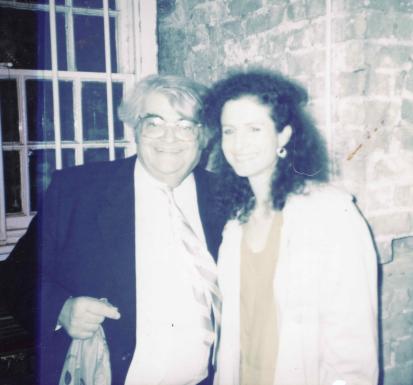
Madeleine Mitchell with Norbert Brainin, Prussia Cove, 1993

I loved playing with Norbert – we got on like a house on fire – and years later I was so honoured that he asked me to be the second violinist, to join him for his 80th birthday concert at the Wigmore Hall, which was sold out. He oozed music, he had such warmth and sparkle. I love that group’s playing, and although Norbert wasn’t born in Vienna, the other three members were, and they’ve got that unique Viennese spirit. I find when some of the groups play that piece now… it’s a bit fast, it doesn’t quite have the space to breathe and sing.


But people have chosen the second movement of the Schubert Quintet for Desert Island Discs, with Norbert Brainin, because it’s so special. So I wanted to choose that recording as a recent thing I’ve been listening to because we’ve just been performing it.


—-

ANYTHING: BILL EVANS: Everybody Digs Bill Evans (NOT2CD299 – Not Now Music Limited compilation 2009)

Extract: ‘Easy Living’

MADELEINE MITCHELL

I don’t know where this comes from because I don’t think it was particularly part of my home background. But I really got into jazz, I loved jazz when it wasn’t fashionable and I was a member of Ronnie Scott’s and the 100 Club when I was in my twenties. I love Grappelli, of course, but I particularly like piano jazz. You obviously listen to a lot of classical music, and for my leisure and recreation, I go to art galleries and the opera, but I also like to listen to jazz, so maybe on a Friday night I’ll put on my favourite, which is this double album from Bill Evans, Everybody Digs Bill Evans. My daughter will say, ‘Oh, not again, you know, I’ve got this!’ But then I made a Bill Evans playlist on Spotify.


JUSTIN LEWIS

Which you sent me. I’ve been enjoying that.


MADELEINE MITCHELL

Autumn Leaves and When I Fall in Love. I can’t put my finger on why I like it so much. It’s subtle. I love the chords. I love the sound. It’s sophisticated. It’s quite romantic as well. I play a lot of new music, but actually I’m a real romantic. I absolutely love playing Brahms and Bruch and maybe that’s what I like about this music I’ve selected. I started as a pianist, I really like the piano so maybe that’s a contributing factor.


—-


MADELEINE MITCHELL

Another composer who relates to several pivotal moments in my career is Alban Berg. I first heard his Die Nachtigall, from his Seven Early Songs, on an LP which was chucked out of the same Romford library as the Menuhin book. It was an anthology of Pierre Boulez favourites, and it included this, performed by Heather Harper with an orchestra. Years later, in 1992, I arranged this for my début at the Huddersfield Festival of Contemporary Music, and my first concert with Andrew Ball for a late-night recital programme I devised about Night Music. The lighting was by Ace McCarron, the original lighting designer for The Fires of London, then Music Theatre Wales.


And there’s another Fires of London connection! Max and Harrison Birtwistle – two of the Manchester Five – were influenced by the Second Viennese School, of which Berg and Arnold Schoenberg were the key players, with Anton Webern. Max and Harry originally co-founded The Pierrot Players in 1967 – with the same instrumentation as Schoenberg’s Pierrot Lunaire (which happened to be the first piece I ever performed for the BBC), plus percussion, which became The Fires of London in 1971.  


But also, the first opera I ever saw was Berg’s Wozzeck at Covent Garden when I was sixteen; a friend from my local Youth Orchestra had just got a job in the Royal Opera House violin section and invited me. I was bowled over by it and I have loved opera ever since.


—-


JUSTIN LEWIS

You were in the Michael Nyman Band for a while, weren’t you?


MADELEINE MITCHELL

That’s right. A couple of years after the Fires of London disbanded in 1987, I was asked if I would join Music Theatre Wales Ensemble as their principal violinist because it sort of naturally grew out of the Fires in a way. One of the pieces we did was Michael Nyman’s The Man Who Mistook His Wife for a Hat in Swansea, at Taliesin Arts Centre. Michael came all the way to that theatre to hear the performance and he said he liked my gutsy playing, and asked if I would come and play in his band. So I did, for a couple of tours, and got to know him really well, and then he arranged three pieces for me called On the Fiddle, which I recorded for the In Sunlight album. And then he wrote two more pieces for me, Taking It as Read on my Violin Muse album.


JUSTIN LEWIS

You need to write a memoir to cover this career!


MADELEINE MITCHELL

I’ve never specialised. I don’t like the idea of musicians or people being put in boxes. You know, you tend to get known for the premières because they’re more newsworthy than you playing your favourite Beethoven Sonata (for me no.10 opus 96) – but that sonata is the one which is what inspired Geoffrey Poole to write his Rhapsody for me. It all came out of a mutual love of that piece and wanting to play it together.


JUSTIN LEWIS

I think I saw you on television when I was a child. Could you have been on the schools programme, Music Time (BBC1, c. 1979)? Which I think Chris Warren-Green did as well.


MADELEINE MITCHELL

Yes, it’s very interesting. A lot of people saw that because it went out live. I was a student, and I was asked by the Royal College of Music to go and do this. And I remember exactly what I had to play, and exactly what I had to say. I had to play a solo violin bit from Saint-Saëns’ Carnival of the Animals, just a few bars, and I had to say, ‘I can make sounds which slide up and down.’


JUSTIN LEWIS

Oh yes, the donkey. [Carnival of the Animals, Part VIII. People with Long Ears]


MADELEINE MITCHELL

I wasn’t nervous about the playing, but I was a bit nervous about the words because it was going out live and I wasn’t used to doing it. I remember going into a telephone box to practise my lines to make sure I had them fluent. When I became a professional and I would start talking to audiences, they would give me feedback that they really liked that. And gradually I became more and more confident and fluent about the speaking so that I’ve got to love talking to audiences.


When I was in charge of the Graduate Solo and Ensemble Performers at the Royal College of Music, I instigated seminars where I would coach the students about the whole performance including walking on, bowing and speaking to the audience. Sometimes they didn’t have English as a first language, but I’d say, ‘practise speaking slowly and clearly’, just as my parents used to say to me before I went on the radio. It is very important to do that.


Sometimes if you’ve started playing at an early age and grown up with it, you forget that some people don’t have that, and it’s lovely to help them get into it, so they have a human connection. Even if they don’t know how to play the violin or they don’t ‘understand’ the music, it doesn’t matter because, as I always say to them, you just have to listen. You don’t have to be able to read music or know the history, because if you’re open to it, it’s about being moved by music, isn’t it? And I feel if that’s what I can do for even one or two people in an audience, then I’ve done a good job.


JUSTIN LEWIS

Yes, I know you can’t always talk to the audience in a concert, but I came to see you and Nigel Clayton play at St John’s Smith Square at Easter, and I really loved the section where you paid tribute to Nicholas Snowman, who had just died, as you introduced the piece written for you in his memory by Michael, Lord Berkeley.


MADELEINE MITCHELL

That audience at St John’s Smith Square was lovely. Straight away, there was a feeling of warmth, and excitement at times. I find often the end of the concert, with the encore, is the best bit.


JUSTIN LEWIS

But I find classical music easier to absorb now. It might just be because I’m older, but I used to feel – maybe incorrectly – there were a lot of formalities, and I feel there aren’t quite as many now. It feels more accessible.


MADELEINE MITCHELL

Maybe now you can go to concerts again you don’t take it for granted. I remember when I premiered Kevin Malone’s Your Call is Important to Us (for violin and tape) which he’d written me, in May 2022, it was soon after the second lockdown and it was such a joy and such a relief to walk out into that concert hall at Manchester University and see a sea of people’s faces. I kept going during lockdown with livestreamed concerts, but it just isn’t the same at the end of a livestreamed concert when you’ve given your all, but there’s no applause and you can’t see anyone. People can send you comments and things, but it isn’t the same. I think that performing is a three-way process.


JUSTIN LEWIS

I found this really great quote from an American newspaper. It was around the time of The Fires of London touring the States in ‘85. And Peter Maxwell Davies describes this relationship between the composer, the performer and the audience, and how vital that is, no matter how the piece is played.


MADELEINE MITCHELL

I always say this to people when they come up to me after concerts and they say, ‘Oh, I wish I’d kept up with the violin when I was a child…’ – that sort of thing. They’re a bit disparaging about themselves and I say, ‘Look, you’re really important. You’re the audience.’ The audience is a very valued one-third of the triangle, if you like: the composer at the top, then the performers as the conduit, the channel, and the audience not only receiving the music, but also giving back. You can pick up the energy of an audience. It’s very palpable. It’s an exchange.

—-
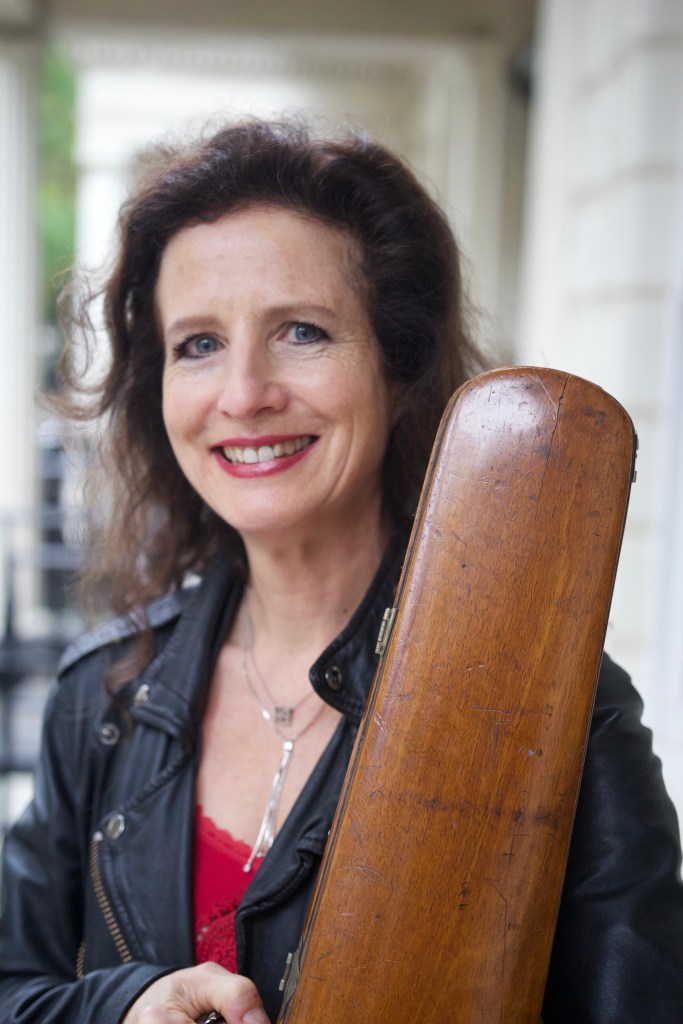
With Madeleine once more as Artistic Director, The Red Violin festival was again staged to much acclaim, over five days in Leeds, in October 2024.

For further news, information and links on Madeleine’s career and upcoming concerts, visit her website and sign up to the mailing list: www.madeleinemitchell.com.

Madeleine is performing at Leighton House on Tuesday 24 June 2025, London W14, with Julian Milford, piano and Kirsten Jenson, cello. They will be playing Brahms’ Piano Trio in B major op.8, Mel Bonis’s Soir – Matin for piano trio, and salon pieces by Sir George Dyson. For tickets, click here: https://www.eventbrite.co.uk/e/madeleine-mitchell-friends-concert-leighton-house-246-tickets-1233078804899

Madeleine’s Violin Conversations was released on the Naxos label in June 2023. In August 2023, shortly after its release, Ivan Hewett gave it a glowing review in the Telegraph. Read here: https://www.madeleinemitchell.com/is-madeleine-mitchell-the-future-of-classical-music

You can follow Madeleine on Twitter at @MadeleineM_Vln, and on both Instagram and Threads at @madeleine_mitchell_violin. She is on Bluesky at @madeleinemitchell.bsky.social.

Subscribe to her youtube channel at https://www.youtube.com/@ViolinClassics

And her Facebook page is here:  https://www.facebook.com/MadeleineMitchellViolinist

FLA PLAYLIST 20

Madeleine Mitchell
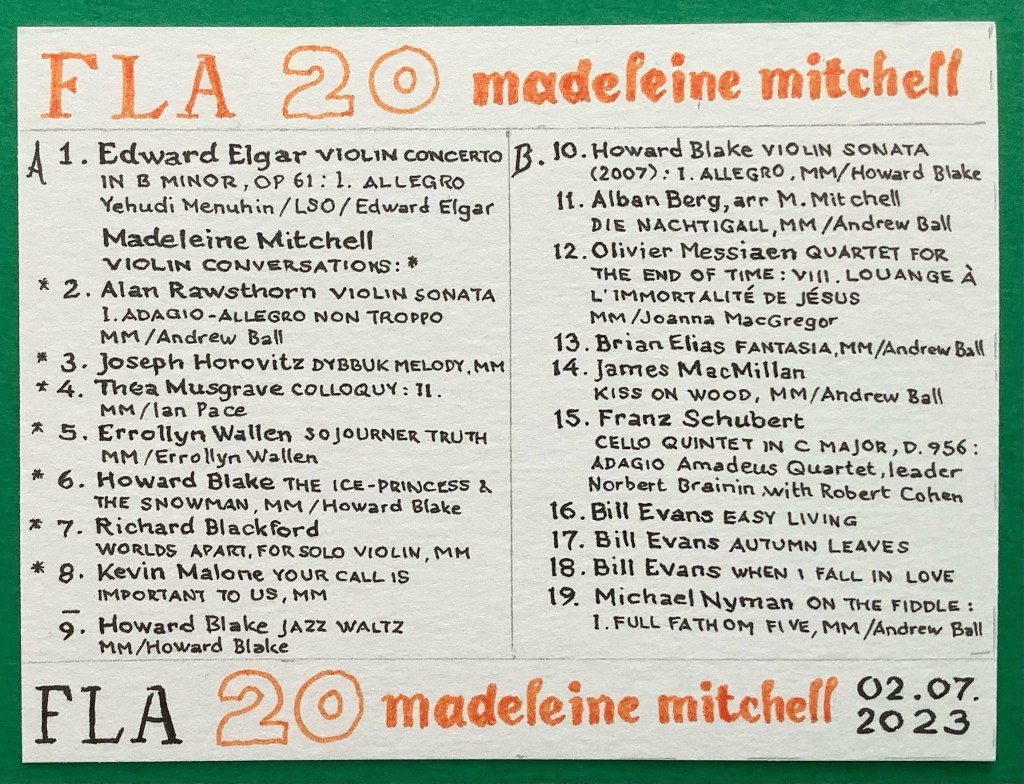
(For the time being, this site and project uses Spotify for the conversation playlists, but obviously I disapprove that Spotify doesn’t pay artists and composers properly, and other streaming platforms are available, as are sites to buy downloads and buy recordings. For consistency, you can also listen to the selections via YouTube (where available), and links are provided in each case, below.)

Track 1: EDWARD ELGAR: Violin Concerto in B Minor – 1st Movement

Yehudi Menuhin, London Symphony Orchestra, conducted by Edward Elgar: https://www.youtube.com/watch?v=tJQVXr6jvBc


Track 2: ALAN RAWSTHORNE: Violin Sonata: I. Adagio – Allegro non troppo

Madeleine Mitchell, Andrew Ball piano: https://www.youtube.com/watch?v=muwwopo3Ays


Track 3: JOSEPH HOROVITZ: Dybbuk Melody

Madeleine Mitchell: https://www.youtube.com/watch?v=tIxKggZNaTQ


Track 4: THEA MUSGRAVE: ‘Colloquy’: II.

Madeleine Mitchell, Ian Pace piano: https://www.youtube.com/watch?v=mrdn49VcE18


Track 5: ERROLLYN WALLEN: Sojourner Truth

Madeleine Mitchell, Errollyn Wallen piano: https://www.youtube.com/watch?v=r1391EMDUCI


Track 6: HOWARD BLAKE: The Ice-Princess and the Snowman, Op. 699

Madeleine Mitchell, Howard Blake piano: https://www.youtube.com/watch?v=4mul3zdJnds


Track 7: RICHARD BLACKFORD: Worlds Apart for solo violin

Madeleine Mitchell: https://www.youtube.com/watch?v=MT5gSlQRsbQ


Track 8: KEVIN MALONE: Your Call is Important to Us for solo violin and tape

Madeleine Mitchell: https://www.youtube.com/watch?v=MzTFMVn4PNE


Track 9: HOWARD BLAKE: Jazz Waltz

Madeleine Mitchell, Howard Blake piano: https://www.youtube.com/watch?v=WXR_76y6UF4


Track 10: HOWARD BLAKE: Violin Sonata, Op. 586 (2007 Version of Op. 169): I. Allegro

Madeleine Mitchell, Howard Blake piano: https://www.youtube.com/watch?v=75JUIJUQdek


Track 11: ALBAN BERG: Die Nachtigall (arr. M. Mitchell) from Violin Songs album Divine Art

Madeleine Mitchell, Andrew Ball piano: https://www.youtube.com/watch?v=KmpX0BkPCtQ


Track 12: OLIVIER MESSIAEN: Quartet for the End of Time:

VIII. Louange à l’Immortalité de Jésus

Madeleine Mitchell violin, Joanna MacGregor piano: https://www.youtube.com/watch?v=3pJ9qIZxIfQ


Track 13: BRIAN ELIAS: Fantasia [from In Sunlight: Pieces for Madeleine Mitchell NMC]

Madeleine Mitchell, Andrew Ball piano: https://www.youtube.com/watch?v=rbcNnw-A1yg


Track 14: JAMES MACMILLAN: Kiss On Wood

[from In Sunlight: Pieces for Madeleine Mitchell NMC]

Madeleine Mitchell, Andrew Ball piano: https://www.youtube.com/watch?v=9JzsTA5OKAE


Track 15: FRANZ SCHUBERT: Cello Quintet in C Major, D.956: 2. Adagio

Amadeus Quartet, leader Norbert Brainin with Robert Cohen, cello: https://www.youtube.com/watch?v=GvtvfolsClM


Track 16: BILL EVANS: Easy Living: https://www.youtube.com/watch?v=T0ZwAJAgBFM

Track 17: BILL EVANS: Autumn Leaves: https://www.youtube.com/watch?v=r-Z8KuwI7Gc

Track 18: BILL EVANS: When I Fall in Love: https://www.youtube.com/watch?v=adPpG0Dnxeg

Track 19: MICHAEL NYMAN: On The Fiddle: I. Full Fathom Five

Madeleine Mitchell, Andrew Ball piano: https://www.youtube.com/watch?v=OoWywOdPYHY

FLA 15: Helen O’Hara (18/09/2022)

(c) Natacha Horn

In the spring of 1982, the violinist Helen O’Hara had two job offers. One was to join the Bilbao Symphony Orchestra; the other was to join Kevin Rowland’s Dexys Midnight Runners as part of their string trio, the Emerald Express. The release of the single ‘Come On Eileen’ and album Too-Rye-Ay made up her mind; the single alone would sell well over a million copies in Britain, and top the charts all over the world, even in the United States. Helen became Dexys’ musical director for their third album, Don’t Stand Me Down (1985), which received a mixed reception on release but has become widely and justly regarded as a masterpiece.


Though best known for her work with Dexys, Helen has had a busy life and career in music both before and after. For five years in the mid-1970s, she was an integral part of the Bristol music scene in bands like Gunner Cade and Uncle Po, but then turned her back on pop to study at the Birmingham School of Music (now the Birmingham Conservatoire). After the dissolution of Dexys, she went on to work extensively with Tanita Tikaram – most famously on her breakthrough single ‘Good Tradition’ – and most recently with Tim Burgess. In the summer of 2022, Helen and Dexys returned to the spotlight, performing ‘Come On Eileen’ at the closing ceremony of the Birmingham Commonwealth Games.


Helen has an excellent new memoir published this autumn, entitled What’s She Like, and I was delighted that she accepted my invitation to come on First Last Anything to choose some milestone recordings. As well as talking about her experiences in both the classical and pop worlds, she reveals why she stopped playing music for 20 years – and why she resumed.


JUSTIN LEWIS

In the opening chapter of What’s She Like you mention singles in your house that your siblings had and so on. But what records did your parents have when you were growing up?


HELEN O’HARA

Mainly classical records. Nothing unusual – Beethoven, Mozart… Tchaikovsky – whose Piano Concerto No 1 played by Van Cliburn was a particular favourite of mine. Nobody has beaten that version for me. Not just because it was very good, but because I heard it so much, it becomes ingrained in you at a very young age that ‘this is the best’.


My brother Tony, seven or eight years older than me, was the one buying the records and a big influence on what I heard. And Top of the Pops was on telly so I was exposed to other pop music which was making a huge impression on me, over classical music.


FIRST: PJ PROBY: ‘Maria’ (Liberty Records, single, 1965)

JUSTIN LEWIS

So the first record you bought yourself: PJ Proby. A kind of forgotten name now, really, but in his time, an absolutely massive pop star.


HELEN O’HARA

I can see why I was drawn to it. It really stuck out, mainly because of the orchestration but also because of his voice. He’s very theatrical. In fact, he was an actor for a while, I think, so his diction is absolutely amazing, but he’s got this drama in his voice, and he sings it as if he’s in a musical or an opera, telling the story. And of course, the song is from West Side Story.


It just blew me away really. Because I hadn’t heard anything like that before. Because my brother was already buying music like the Stones and the Pretty Things, which were my favourites anyway, I could buy this because it was more unusual.


I would have been nine, which is quite young to wander down to a record shop that’s about a mile away, with your pocket money and buy a record by yourself. It was just that incredible, proud feeling of owning this record – and he was a very good-looking bloke as well, so maybe that was part of it too! He had his hair in a ponytail, didn’t he? And then he got banned – from TV, radio, theatres – for splitting his trousers onstage, twice.


JUSTIN LEWIS

There’s a few versions of that story, but I read that apparently it was ‘accidental’ the first time, and perhaps ‘not so accidental’ the second time.


HELEN O’HARA

So he was well ahead of his time in terms of ‘how do I get publicity and censure?’


JUSTIN LEWIS

I think it was the ABC theatre chain that threw him off the package tour, but his replacement was some bloke, then unknown, called Tom Jones.


HELEN O’HARA

And Tom was pretty wild, wasn’t he? Probably didn’t deliberately split his trousers, but came close to it!


JUSTIN LEWIS

So you started playing the violin when you were about nine?


HELEN O’HARA

Nine, yeah.


JUSTIN LEWIS

You say in the book that you didn’t find it easy to play early on, indeed, have never found it easy. Presumably part of the appeal with the instrument is that that you can’t really take your eye off the ball. It requires commitment. It requires constant practice.


HELEN O’HARA

I think I just accepted that it was my instrument, and it was going to be difficult. I was so sure of it. It is a difficult instrument to play well, but I’m also extremely critical of myself. I wish I wasn’t, because I beat myself up an awful lot about any performance I do. And then when I listen to other people, I never have that criticism of them, I can be objective! Because it’s live, it’s human. 


JUSTIN LEWIS

Obviously you started in the classical world, and you were in youth orchestras as a teenager. It sounds like you were already interested in ensemble playing, but perhaps individual expression within a group of some kind. Did you ever think you would be a solo violinist, in the classical world?


HELEN O’HARA

No, never. Never thought that. I always thought of myself within a group, preferring to be embedded in the group. I mean, if you’re the leader of an orchestra, as I sometimes was, you might have to take a little solo or something. But I much preferred being part of an ensemble.


JUSTIN LEWIS

And clearly you still love classical music, but I sensed in What’s She Like that the classical world back in the 60s and 70s could be a bit stifling, with little tolerance for any other type of music.


HELEN O’HARA

That’s how it felt, especially later at music college, because nobody seemed to listen to pop music. It was very rigid – it was just classical. Now music colleges, from what I can see, are open to all sorts of music – for example, they might have a jazz department. They recognise that instrumentalists could go in many directions – as much as anything, it’s about getting work, and so you’d be encouraged to play in musicals, or opera, or be a session violinist or whatever. I think they’re a lot more open minded now. I was still at college when I was recording Too-Rye-Ay with Dexys [in spring 1982], and we never mentioned it to the college, partly because they wouldn’t have given us the time off to do it, but another was that they’d have been horrified. Now, it’s very different.


JUSTIN LEWIS

It’s interesting how your memoir reflects these compartments of your life. You’re fully committed to something for two to three years, and then you move on to something else completely different. And that’s the pattern. But there’s still this sense of continuity throughout – you go back to things, to work with people again, after a long period of time.


HELEN O’HARA

I think you’ve got it. Yeah. Hadn’t thought of it like that, but yes, although not intentionally.


JUSTIN LEWIS

What also occurred to me: you come from quite a large family anyway, but all your musical exploits for years came with groups, large groups, orchestras. I might even suggest Dexys was an orchestra, certainly at the point you joined, with all the different sections.


And you write a lot about the people in music who have inspired you – some of them famous names, but others are fellow students, teachers… In fact, I don’t know if you remember this, but when you first got into the charts with ‘Come On Eileen’, you did a Q&A with Smash Hits magazine and they asked you your biggest musical inspiration. And most people in those Q&As would say David Bowie or Bryan Ferry or whoever. And you said Andrew Watkinson, your violin teacher. Who’s gone on to quite a career himself.


HELEN O’HARA

Oh, that’s really sweet. He was a real inspiration. Yes, he plays with the Endellion String Quartet now.


JUSTIN LEWIS

It really chimed with me at the time because I loved pop music, loved reading Smash Hits, but I also was in orchestras, I was a flautist, and I used to wonder how I could be in a pop group playing an orchestral instrument. But I thought that was such a cool answer – you didn’t choose a pop star, but your teacher. And to see you on Top of the Pops playing an instrument associated with the orchestra, I thought it was so cool.


In fact, in your book, you recall being about 13, trying to imitate the violin part on ‘Young Gifted and Black’ by Bob and Marcia. Well, when I was 13, I would – on the flute – try and imitate your violin parts on Dexys records, especially ‘Come on Eileen’ and ‘Let’s Get This Straight From the Start’.


HELEN O’HARA

Oh wow, that’s amazing.


JUSTIN LEWIS

I would try and bend the notes the way you would, try and work out how to do that. I’ve waited forty years to tell you that!


HELEN O’HARA

Ah, thank you so much, Justin. But it’s a great way to learn, isn’t it? When you play along. I remember playing along to some Roxy Music when Eddie Jobson was on violin.


JUSTIN LEWIS

Yes! The Country Life album.


HELEN O’HARA

I was even doing that in the 80s when The Waterboys’ Fisherman’s Blues came out, trying to imitate Steve Wickham, who’s a very different player to me. I still do it now, play along, because you can always learn a lot from somebody else’s style, can’t you?


JUSTIN LEWIS

Absolutely. What also comes across very clearly in What’s She Like is the importance of communality in music. How at secondary school, your music teacher ensured that all 600 pupils took part in the school concert, not just the really musical ones. Do you agree there’s musical potential in everyone?


HELEN O’HARA

Yes, I do. We’ve all got a heartbeat. Some people will be more musical than others, but often it’s whether you get the chance. I was also very lucky, when I was growing up, that we had free peripatetic music lessons, and everybody was offered a free lesson on whatever instrument, so that was amazing. My secondary school music teacher was quite young, probably in his mid-20s when he took on the job as head of music and he just seemed to spend all this time at school, encouraging everybody, and he would get cross with us if he thought we weren’t giving 100%. But that was cool, he was showing his passion for the subject. So, everyone had to sing in the concert we did, at the Colston Hall in Bristol. A lot of the boys didn’t like it – but they still all turned up! However, I think everyone admired him, and it felt good in that ensemble. It’s like being at a football match – you feel good when everyone sings together.


JUSTIN LEWIS

All the while, you were influenced by violinists in bands: Jimmy Lea in Slade, Don ‘Sugarcane’ Harris in Frank Zappa’s Mothers of Invention. And when you joined bands in Bristol, in your late teens, long before Dexys, where each album would be radically different from the last, you were already in groups that would change their style a lot. For instance, Uncle Po – with our mutual friend Gavin King… you’re a soul band (under the name Wisper), then you’re jazz rock for a bit, and about 1977 you become a new wave band. Did it feel easy to reinvent the band’s sound like that?


HELEN O’HARA

Very easy, very easy. Uncle Po were good musicians, good singers, good harmony singers – and we were very serious about what we did. We rehearsed for long hours, and we played live so much, and if you’re a good musician, you can adapt to different musical styles. I mean, it wasn’t like we had to be outright jazz or something, but within the different genres of pop or rock, we didn’t find that difficult. When punk and new wave happened, it shook everybody up, didn’t it? It was really exciting, people seemed to come out of nowhere, venues were packed and there was a real energy from the crowd. I’m very grateful that I was around at that time, and all that touring with Uncle Po prepared me for what was to come later, with Dexys, and gave me confidence. I would otherwise have been a bit nervous. I also learned a lot from the other guys in these bands, who were older and more experienced than I was.


JUSTIN LEWIS

So then in 1978, you enrol at the Birmingham School of Music. Suddenly you’re back in the classical world. What elements of the classical world do you think have helped you in the pop world, and vice versa?


HELEN O’HARA

From youth orchestras, I learned to work as part of a team, and to listen, but also to take directions from the conductor. I suppose Kevin in Dexys was like a conductor in many respects, with the ideas he was asking us to play. Because as you know, one piece of classical music can sound very different depending on who the conductor is. I’ve just finished making a playlist of all the music mentioned in my book – 209 pieces. What I found fascinating was deciding which version of a Beethoven symphony or violin sonata I should use. I went to Spotify and there are loads of different versions, so finding the ‘right one’ that touched me… It was extraordinary how different they all were, different tempos, different moods. And working with different conductors and different teachers as well also taught me about various approaches, to respect differences, and be open to trying things.


Also, in classical music, focusing on detail is absolutely crucial – dynamics, subtleties… and so when I came into the Dexys world, it really was like a pop equivalent of classical music in how they approached rehearsing. Incidentally, I did notice in college that a lot of classical musicians didn’t have a very good sense of rhythm. I remember in violin sections, people speeding up a lot, and finding that quite irritating. I think I probably had a pretty good sense of rhythm – drummers in Uncle Po and before them Gunner Cade helped to solidify that.


At the School of Music, I did feel different to the other students. I went in at 21, 22, and I hadn’t played with an orchestra for five years, and that’s quite a long time. I wasn’t feeling very confident, and I was aware of having to do a lot of work beforehand to catch up. I didn’t know what the standard was going to be like, so I was practising for hours and hours – I had this real fear I would be rubbish compared to everybody else. And I was fine, actually, but you don’t know that when you’re going into the unknown. And I hadn’t been reading music for four or five years – I’d been playing by ear. There were things that surprised me there – some musicians found it hard to do things like put chords to a melody. I thought everybody could do that, but obviously not!


I learned so much from other students, particularly one called Adrian, who I shared a desk with in my third year, who was the most beautiful player. I was really lucky going to Birmingham – it wasn’t too daunting. I don’t know whether I’d have got into the Royal Academy of Music or the Royal College of Music, but say I had, I think I would have found that quite intimidating, because they apparently had the best players, and the standard might have been so incredible. Birmingham, I felt I could fit in, the staff and students were lovely, so I’m really grateful about that.


JUSTIN LEWIS

And you felt you could be yourself?


HELEN O’HARA

I kept my past very secret, really, because I didn’t think anybody would get it. I really felt I had to be in the classical world to improve, and I didn’t want to be tempted back into pop music. I had made this decision to do three years of hard study.


JUSTIN LEWIS

In your final year, 1981/82, out of the blue, there was a knock on your door, and it was two guys from the Blue Ox Babes, the Birmingham band, and who had an affiliation with Dexys Midnight Runners. Did what happen next, in those two bands, come as a surprise to you? Because presumably you were thinking you might stay in the classical world?


HELEN O’HARA

I kept an open mind, but the reality of it was, by that post-graduate year, the fourth year, I hadn’t been playing or even listening to any pop music, and I knew I would have to try and earn a living through music. I didn’t want to teach, and so the obvious course was to get a job in an orchestra. That’s why I started doing auditions. I’d have probably been quite happy doing that, being the sort of musician I am. I would have probably tried to engineer situations where the music was interesting and stimulating. I was offered a job from the Bilbao Symphony Orchestra, and had I gone to Spain, it would have been great, I think. I’d have probably played a lot of Spanish music, learned Spanish, seen a bit of the country, and travelled through music. In that fourth year, I bought a Teach Yourself German book. That was my thinking: learn different languages, travel the world playing my violin.


But the Blue Ox Babes and then Dexys a little while later just blew everything out of the window. Because I am a pop musician. The music I mostly listen to is pop music. I absolutely love classical music and I go to classical concerts, but in my heart… if I had to choose… it would be pop music.


Sometimes I think you put yourself in situations where these things can happen, and the doors open, and you seize the moment and go with your gut feeling. Even if people are saying, ‘Don’t do that’, or ‘I’m not sure’, you listen to your heart and make a reasoned judgement.


JUSTIN LEWIS

And even if things don’t work out the way you expected, or how you wanted, you still learn something along the way.


HELEN O’HARA

Exactly, Justin, exactly. For instance, my first teacher at music college was a guy called Felix Kok [1924–2010] who was the leader of the City of Birmingham Symphony Orchestra. A great teacher, and he offered me a gig with some members of the CBSO and other players, a freelance gig playing songs from films like Star Wars, at the Town Hall in Birmingham. I accepted. At the rehearsal, I realised I was way out of my depth. It was a three-hour rehearsal, sight-reading the music, and you might remember in those days, music for films and musicals were handwritten, not printed out – so it was very hard to read handwritten music for the first time.


JUSTIN LEWIS

I remember that very well!


HELEN O’HARA

After the rehearsal, I stayed on at my music stand to work on the music a bit more, and the conductor came over and said something like, ‘You could do with a bit more practice’. And it was such a horrible way he said it, but he was right, and that was a very hard lesson, but one that made me really think about what I should accept in the future. That is what the professional world was like with orchestras. I grew up a lot that day.

LAST: DEXYS MIDNIGHT RUNNERS & THE EMERALD EXPRESS: ‘Come On Eileen’ (Mercury/Phonogram, single, 1982)

HELEN O’HARA

Dexys’ record label at the time, Phonogram, was in New Bond Street, in London, and we’d get a bunch of copies of ‘Come On Eileen’ – but I would end up giving them away to friends or family. And then one day I realised I didn’t have any myself! Which I thought was a bit of a shame. I mean, I could have bought one on eBay, I suppose.


But one day, recently, I went into my local Oxfam shop in Greenwich, to buy a birthday card. On the way out, I saw this rack of albums and singles and for some reason – because I don’t do it normally – I flicked through them. And halfway through, there was the ‘Come On Eileen’ single sleeve staring at me. And I smiled, it just felt so amazing. I picked it up, it was in perfect condition. And it was weird, because you know, it’s 40 years on, and there’s also a remix of it out now as well. It felt magical. So, I’ve got my ‘Come On Eileen’ single back.


JUSTIN LEWIS

We’re so familiar with this song now, but I can distinctly remember when I first saw and heard it. It was on Top of the Pops, 15 July 1982, it was number 31 in the charts, and would soon be number one. I was already aware of Dexys from a previous few hits: ‘Geno’ and ‘Show Me’, although I somehow hadn’t heard ‘Celtic Soul Brothers’, your debut with the group.


But I had never heard ‘Come On Eileen’ and that Top of the Pops, in the best possible way, was a complete shock. Years later, one journalist wrote that ‘Come On Eileen’ had now joined the pantheon of songs – like ‘Good Vibrations’ and ‘Bohemian Rhapsody’ – that are so familiar you forget how unusual they are. Was there a moment when you thought, ‘This is it, then’?


HELEN O’HARA

When we got that first Top of the Pops, I think, the one you saw. Everything did happen very fast then, became a bit of a whirlwind. Yeah, it is an extraordinary record when you really start analysing it. 


JUSTIN LEWIS

In terms of structure, especially.


HELEN O’HARA

The music is so orchestrated, cleverly written. The use of instruments… it could be a modern piece of classical music. Kevin is a genius, really, and Jim [Paterson] and Billy [Adams] and Mickey [Billingham], they wrote it too. But I don’t think any of us thought it was going to be a hit. We wanted it to be!


JUSTIN LEWIS

I know everyone says pop music was brilliant when they were twelve, but I was twelve in 1982, when some fairly leftfield records could become unexpected massive hits. Did you ever think of yourself as a pop star? Because to me, you were one.


HELEN O’HARA

You know, I never really thought of myself as a pop star. I was a musician in a band, that’s always what came first. I’ve always found the issue of clothes and image quite hard, and I was glad that Kevin took control of that.


JUSTIN LEWIS

It actually takes a lot of energy, that side of thinking.


HELEN O’HARA

It’s a huge amount of energy, and I admire people like Kevin and Roxy Music, who come up with these amazing clothes and outfits and things – it’s part of their art.


JUSTIN LEWIS

With pop, it is about the music, but with so many bands I’ve loved over the years, it’s also about the record sleeve and the band’s attitude, and so on. In the book, you mention how you kept sending back the Don’t Stand Me Down album sleeve again and again because it wasn’t quite right, and this kind of thing really does matter, I think. Because you’re making something that people are going to treasure.


HELEN O’HARA

Especially in those days, absolutely, Justin – because we were mainly buying albums then, as it was pre-CD. It’s like those covers the Stones did – the 3D cover of Their Satanic Majesties’ Request, or Sticky Fingers with the zip. But yes, it was great to be a part of a band where, as well as the music, all the visual aspects – the clothes, the artwork, the choreography – were very important. Equally, you can play music with somebody who says, just wear what you like – and that’s fine too.


JUSTIN LEWIS

Another thing with Dexys – the mythology. I remember the story that was ‘designed’ for you, that Kevin saw you at a bus stop in Birmingham holding your violin case, and he asked you to join the band. And I bought into that completely at the time.


HELEN O’HARA

Did you? Oh, that’s amazing. Brilliant.


JUSTIN LEWIS

And obviously it didn’t happen like that, although the way you joined the Blue Ox Babes the year before was pretty out of the blue. That there was a knock on the door and two guys asking if you’d like to join a band. It’s not what you expect.


HELEN O’HARA

With me resisting initially. 


JUSTIN LEWIS

What did it feel like to be famous, so suddenly?


HELEN O’HARA

I found it very strange. When ‘Come On Eileen’ was number one, I was still living in my student flat in Birmingham, still getting the bus, and you find people talking about you and pointing at you. I felt extremely awkward in that situation.


JUSTIN LEWIS

Because what do you do?


HELEN O’HARA

Exactly. Really, all you can do is get out of where you are. It didn’t feel like a threat, but it’s a very different sort of attention to when people are at a concert, listening to you, even if they might be shouting or screaming or whatever… But when it’s ‘real life’ and you just popped out to get some milk… It wasn’t the kind of attention Kevin was getting, but the bits I did experience felt uncomfortable. And I felt it again much later, when my boys were at primary school and I was anonymous. I’d agreed to do this interview for a TV documentary [Young Guns Go for It: Dexys Midnight Runners, BBC2, 13/09/2000]. The next day I went into school, and people were bringing albums in [to be signed]. I was totally shocked they’d found out, and they were also beginning to treat me slightly differently and I just thought, I’m the same as I was yesterday.


JUSTIN LEWIS

It must be weird. There’s a version of you out there that is you, but it kind of isn’t you. It’s not even a distortion… it’s just that you were in that video, but that’s not the full, real you.


HELEN O’HARA

It’s one reason some people can’t cope and why they get out of this business, I suppose. But I liked that theatrical element that Kevin had created – the Emerald Express name for the string section, the fact we had all different names. It was a bit like being in a musical. It was just a slightly different character, but nothing too different.


JUSTIN LEWIS

People rather like stories like the bus stop story, because of that idea that anything could happen.


HELEN O’HARA

It’s quite romantic, isn’t it, as well. You can meet anyone at the bus stop.


JUSTIN LEWIS

In August this year, you were performing ‘Come On Eileen’ at the closing ceremony of the Commonwealth Games. What keeps it fresh, playing it, do you think? You’ve rearranged it a number of times now, right? It’s in a different key, for a start.


HELEN O’HARA

Yes, it’s a bit lower, when we did it in Birmingham, we took it down a few tones. ‘Eileen’ is incredibly high originally, something Kevin said he hadn’t considered when he first wrote it. He didn’t really consider the keys for his voice when he wrote anything in the old days, so to suit his voice now, we re-recorded the track. Kevin was the only one performing live, at the Commonwealth Games. I went into a studio to record the three violins for the track. And you know what, Justin? When I played, I felt like I was twentysomething again. When I came home, I sent a message to Kevin and to Pete Schwier, the engineer, telling them I just couldn’t help playing with the same energy and excitement that I felt when I originally recorded it. And it will always be like that. I was on a high after that concert for days afterwards.


What’s interesting is that Tanita Tikaram has changed a lot of her keys as well. Exactly like Kevin. They’re mostly lower keys but with one song, she’s moved it up a tone, interestingly.


JUSTIN LEWIS

We’ll talk a little bit more about Tanita in a moment, but I wanted to just ask you about Don’t Stand Me Down. And what becomes clear, reading about the making of that album, was despite the length of time it took to make – and obviously your relationship with Kevin ended during its making – it still sounds like there was an immensely harmonious working relationship with that record. And it was completely different to everything else in 1985.


HELEN O’HARA

I think a lot of people were probably not surprised that it was a bit different, but it was radically different. And the conversation thing, the talking, having a 12-minute song [‘This Is What She’s Like’]. We knew it was different, but it just felt right. We were so immensely proud of it, and still are. So when it came out, and didn’t get the reaction we’d hoped for, it was disappointing.


JUSTIN LEWIS

And you did a fair bit of promotion too for it. You were on Wogan, big live BBC1 show, 7 o’clock [13/09/1985. Fact! The other guests were Jackie Collins, Penelope Keith, Fascinating Aida and Kenneth Williams].


HELEN O’HARA

We played ‘Listen to This’ on Wogan, which in hindsight, perhaps should have been the single because it was three minutes, and a great song. I had to count it in to Kevin – I had a little earpiece – because it starts with Kevin singing before the band comes in. I had to give him a count-in, on live television. I remember thinking, I’ve got to get this right!


JUSTIN LEWIS

And am I right in saying that on Don’t Stand Me Down, you were Dexys’ musical director as well as their violinist? Can you outline what that role entailed?


HELEN O’HARA

Apart from co-writing some of the songs with Kevin and Billy [Adams], I would discuss the arrangements with them, and rehearse the band before Kevin came to rehearsals, to go through the basics of each song, to run through the parts and write out parts for musicians. Kevin didn’t have to be there all the time, he was often doing promotion, so the MD could often get a lot of the work done, fine-tuning things. It also meant that Kevin didn’t wear his voice out.


Often Billy and I auditioned musicians without Kevin being there. We had problems finding the right drummer for the album. We went to America, to Nashville at one point. After rehearsals, in the evenings, I would listen back to recordings I made that day and pick up on points where I thought we could improve the next day. And because it was a big band, with musicians from America, I would help to answer their queries. I took on a liaising role as well, between musicians and the management, which wasn’t my job, but that was fine. And then with live work, the MD’s job is to make sure everyone’s on it every night. Anything that wasn’t quite right the night before, you might rehearse in the next soundcheck. Kevin gave me a lot of responsibility and trusted me to look after the music.


JUSTIN LEWIS

And how did you start working with Tanita Tikaram, a few years later?


HELEN O’HARA

Paul Charles had been Dexys’ agent, and he had discovered Tanita at the Mean Fiddler, in Harlesden, a really great music club. After I left Dexys, he called me up to tell me he’d found this amazing singer/songwriter and they wanted violin on her single called ‘Good Tradition’. I was working on my own album project, and I wasn’t a session player as such, because you just didn’t do that with Dexys, but I thought, This does sound exciting. Paul sent me her demo and I really liked the song. So I agreed to the session. It was recorded at Rod Argent’s studio, he of Argent and the Zombies, who was producing it with Peter Van Hooke, the drummer from Mike and the Mechanics. I played my parts, made up a solo which they liked, and they liked all the other parts I’d written for it. From there, ‘Good Tradition’ became a hit, and then Tanita and Paul put a band together. I was with her for two to three years, and I played on her next two albums.


Then after the hiatus of my not playing for 20 odd years, and getting back with Dexys, Tanita asked me if I would be musical director and violinist for her Ancient Heart retrospective show at the Barbican. So it came back full circle. She’s great, it’s like when I work with Tim Burgess now. With both of them, when they walk into the room, the sun comes out. I can be myself when I work with them.


JUSTIN LEWIS

So why did you stop playing for 20 years? Was it a case of ‘all or nothing’?


HELEN O’HARA

There was an element of that. When I had my first son. I was still doing a little bit of playing in the first few months, for example with Graham Parker. And then, quite quickly, a few months later, I was pregnant with my second son, Billy, and I was exhausted. There were only 15 months between my two sons. I was tired, and work had been very intense for many years, but also, I just wanted to be home with them. I didn’t want anyone else looking after them or bringing them up. I didn’t want to tour and be apart from them for weeks on end. The other reason is that when I was in my 30s, I was beginning to feel a bit old being in a group, a weird thing to say now, but it’s how quite a lot of us felt at the time. Also, the violin is difficult, particularly if you’re not practising it a lot, and I felt every day I was losing more and more of my ability.


JUSTIN LEWIS

And what was the catalyst that made you go back to the violin?


HELEN O’HARA

Both my sons went to the Guildhall School of Music and Drama. My elder son Jack studied technical theatre and my younger son Billy was studying the drums. I was going to watch shows that they were involved in. Billy had been in bands at school, so I was seeing teenagers in bands again, which brought back memories, of course. So, I was missing it, but not really admitting it.


Then I went with Billy to see a Dexys show at the Barbican, for the One Day I’m Going to Soar album. It was great, but I felt like I could be back on stage because I knew all the old songs. It just made me think, I’m really missing this, my children are doing what I used to do. I heard a song before the gig, The Band’s ‘The Night They Drove Old Dixie Down’. Back at home, I put that CD on and that was the point when it got beyond my control; I got the violin out, and I sort of knew then that I was ready to embark on a slow journey back. But it also felt really exhilarating. I knew I’d be rubbish and I was rusty but, in my heart, I was still that musician. It was about muscle memory and confidence. I don’t regret stopping for a minute. Every second I was with my kids, I just really treasure that, and maybe – as you suggested earlier – I do compartmentalise stuff in my life. Maybe that’s just how I operate. I had been doing other things as well, part-time jobs – and studying a humanities degree for the Open University. That made me come out of my shell a bit more and meet people, as I’d lost confidence with people as well. It was a bit of a slow comeback, but I knew I’d be alright.


ANYTHING: PHILIP GLASS: Akhnaten: ‘Hymn to the Sun’ (Decca Gold/UMG, 2018)

Anthony Roth Costanzo, Jonathan Cohen, Les Violons du Roy

HELEN O’HARA

An opera singer I know was singing in the chorus of Akhenaten a few years ago. And she said, it’s really great, I can get you a cheaper ticket in a good seat. I didn’t know anything about it, but it sounded interesting. Within the first few minutes, I was just knocked out, I couldn’t believe this wash of sound. I was just mesmerised, under a spell. But also, this particular production used the Gandini Jugglers. They are part of the rhythm and they’re juggling in interesting ways, in time to the music. And then there are the costumes and the beautiful countertenor voice of Anthony Roth Costanzo. The opera hasn’t got any violins in it – it’s violas, cellos, double basses, so it’s this very dark, rich sound. That’s part of the incredible scoring. Anyway, it’s coming again, early 2023. I thoroughly recommend it, Justin, it’s at the Colosseum, English National Opera. The same production, with jugglers.


JUSTIN LEWIS

That sounds fantastic, I must make a note of that. And you’ve also selected ‘Belle’ by Al Green, and I believe this was a big influence on how you approached creating and writing Don’t Stand Me Down.


HELEN O’HARA

Yes, in 1983, when Kevin and I were going out together, he played me ‘Belle’ and some other Al Green songs, and I really started to understand the groove, and the sort of drummers that he was using, and that style of playing. There’s a lot of space in the music, and so when we were working on Don’t Stand Me Down, Kevin was saying, ‘Well this is the rhythm section we want, we want that style of drumming.’ It was a real eyeopener for me. I’d always been into drummers – Charlie Watts was one of my favourites, he’s not really an Al Green-type drummer, although he sort of is because he plays behind the beat. I think I had a natural disposition towards that sort of playing, rather than – say – heavy metal drummers which is not really my thing, much as I admire that style of playing.


So that’s how that came about. And then we were lucky enough to find Tim Dancy who had played with Al Green, when we saw them at the Royal Albert Hall [13/07/1984, with the London Community Gospel Choir]. I said to Kevin, ‘That’s our drummer’, and Tim came over, recorded a few songs with us, and did the tour as well.


JUSTIN LEWIS

What’s so clear throughout What’s She Like is you remain a fan. When you remember encounters or meetings with people or collaborations, whether it’s Willie Mitchell or Vincent Crane or Nicky Hopkins, your excitement and awe really comes over.


HELEN O’HARA

I still can’t believe that Nicky and I worked together. It’s almost like two lives. ‘Did I really play with him?’ I still pinch myself. Now I’m working with Tim Burgess! I’ve never taken it for granted. I still feel the same excitement I felt when I first heard ‘Get Off Of My Cloud’ in the sixties, and I hope it continues.


Helen’s memoir, What’s She Like, was published by Route on 1 October 2022.


You can access her related 209-song playlist on Spotify at https://open.spotify.com/playlist/55tJslj4iEEvdX2X4hIgcz?si=0b9498e1cc804c8a


To mark the 40th anniversary of Dexys Midnight Runners’ Too-Rye-Ay, a remixed version of the album, subtitled As It Should Have Sounded, was released by Mercury Records on 14 October 2022. 


Helen continues to collaborate, on record and live, with both Tim Burgess and Tanita Tikaram.


You can follow Helen on Twitter at @oharaviolin, and on Bluesky at @oharaviolin.bsky.com.

FLA PLAYLIST 15

Helen O’Hara

(For the time being, this site and project uses Spotify for the conversation playlists, but obviously I disapprove that Spotify doesn’t pay artists and composers properly, and other streaming platforms are available, as are sites to buy downloads and buy recordings. For consistency, you can also listen to the selections via YouTube (where available), and links are provided in each case, below.)

Track 1: PYOTR ILYICH TCHAIKOVSKY: Piano Concerto No. 1 in B-Flat Minor, Op. 23:

Allegro non troppo e molto maestoso

Van Cliburn/Kirill Kondrashin: https://www.youtube.com/watch?v=frxZjSG8lMs

Track 2: PJ PROBY: ‘Maria’: https://www.youtube.com/watch?v=OX1wDV3ENF8

Track 3: FRANZ SCHUBERT: String Quartet No. 14 in D Minor, D 810:

‘Death and the Maiden’: I. Allegro

Endellion String Quartet: https://www.youtube.com/watch?v=CNULkV5lyHE

Track 4: BOB AND MARCIA: ‘To Be Young Gifted and Black’: https://www.youtube.com/watch?v=yscozSAumgs

Track 5: DEXYS MIDNIGHT RUNNERS: ‘Let’s Get This Straight from the Start’: https://www.youtube.com/watch?v=BqJlhXcW8X4

Track 6: SLADE: ‘Coz I Luv You’: https://www.youtube.com/watch?v=ONQPB9HTP5c

Track 7: MOTHERS OF INVENTION: ‘Directly From My Heart to You’: https://www.youtube.com/watch?v=KB3HdC-Iums

Track 8: UNCLE PO: ‘Screw My Friends’ – Demo: https://www.youtube.com/watch?v=GGNeg0beo4s

Track 9: BLUE OX BABES: ‘Walking on the Line’ – 1981 Demo: https://www.youtube.com/watch?v=XFkDGkyLZQI

Track 10: DEXYS MIDNIGHT RUNNERS AND THE EMERALD EXPRESS: ‘Come On Eileen’: https://www.youtube.com/watch?v=6BODDyZRF6A

Track 11: DEXYS MIDNIGHT RUNNERS: ‘Listen to This’: https://www.youtube.com/watch?v=1fRW4g52a7w

Track 12: TANITA TIKARAM: ‘Good Tradition’: https://www.youtube.com/watch?v=SAbgrq4TPT8

Track 13: TANITA TIKARAM: ‘Thursday’s Child’: https://www.youtube.com/watch?v=3RRCXqO8i9M

Track 14: THE BAND: ‘The Night They Drove Old Dixie Down’: https://www.youtube.com/watch?v=w69ZVHpjYAk

Track 15: PHILIP GLASS: Akhnaten: ‘Hymn to the Sun’

Anthony Roth Costanzo/Jonathan Cohen/Les Violons du Roy: https://www.youtube.com/watch?v=s8dEk1KXu0g

Track 16: AL GREEN: ‘Belle’: https://www.youtube.com/watch?v=kjEHoz1r3bs

Track 17: DEXYS MIDNIGHT RUNNERS: ‘Old’ (As It Should Have Sounded 2022): https://www.youtube.com/watch?v=UtWtJbelz7o

Track 18: DEXYS MIDNIGHT RUNNERS: ‘This is What She’s Like’: https://www.youtube.com/watch?v=o94-YJlyCa4

FLA 5: Fenella Humphreys (03/07/2022)

(c) Matthew Johnson

Fenella Humphreys is one of the most acclaimed, technically dazzling and imaginative violinists in Britain. In 2018, she won the BBC Music Magazine Instrumental Award, and her performing and recording career has seen her playing a wide range of concertos, chamber music and solo work. She has collaborated with numerous other artists including the pianists Martin Roscoe, Peter Donohoe and Nicola Eimer, singers Sir John Tomlinson and Sir Willard White, the oboist Nicholas Daniel, and the conductor (and previous FLA guest) Lev Parikian.

She is committed not just to keeping the music alive of such established composers as JS Bach, Vaughan-Williams, Tchaikovsky, Sibelius and Paganini, but of championing new works – the many composers whose works she has premiered in her career include Sally Beamish, Sir Peter Maxwell Davies, Adrian Sutton and Cheryl Frances-Hoad. A typical concert of hers, and indeed a typical CD running order, will pinball between the past and the contemporary, to terrific effect, and her recordings regularly receive five-star reviews in the classical music press.

Fenella’s working schedule is almost as jaw-dropping as her playing, and so I consider myself very fortunate that she took time out to talk to me on First Last Anything about her music career. As well as discussing her choices, we talked about her working life as a contemporary musician, about the pros and cons of perfectionism, about how to practise music, about how the memory of music can survive ‘in one’s fingers’ – and about how lockdown changed her perception of concert audiences for the better.

I learned such a lot about music performance and interpretation in this conversation, and I hope you find it as interesting and enlightening as I did.  


FENELLA HUMPHREYS

My dad was a painter, an artist, he worked from home, and he listened to Radio 3 unless the cricket was on, in which case it was Test Match Special. For him, anything that wasn’t classical music was not music! He hated pop music, he hated anything else. He loved Mozart, he loved loads of later composers, but [for him] the best music was Bach – after Bach it went slightly downhill! But he had an enormous record collection, and he wanted me to listen seriously to classical music.


He was always giving me music to listen to. The first recording that really made an impression was the Britten Violin Concerto. I remember sitting in the car on the way to borrow a new violin from a trust, and listening to it, mind blown. It remains one of my favourite works to perform. He also used to take me to the Festival Hall, so that’s always a special place to be. Just that walk across the bridge from the Embankment to the South Bank, with him holding my hand, just the two of us. If life is being difficult, I will go and stand on that bridge – because there’s a sense of comfort standing there, with those memories.


But really from the beginning, he would sit me down at home, to play me something, and every week it was something different. Very occasionally, it was Shakespeare plays – but mostly it was music. And he was very much choosing the piece of music. For years, he wouldn’t let me listen to Beethoven’s Violin Concerto because he thought the music was so perfect, and he didn’t think I had the attention span or that I would understand it. He thought that I shouldn’t be allowed to destroy it for myself by listening to it when I wasn’t yet ready for it. It became almost a block for me – it was too perfect to go near. But when I learnt it, I thought, ‘It’s wonderful music – no question about that, but no more perfect than a lot of other pieces of music, it’s just a bit longer.’


JUSTIN LEWIS

Did it feel like, ‘Right, you’re ready for this piece, now you’re ready for that piece’?


FENELLA HUMPHREYS

There was a bit of that. But with Beethoven, for my dad, that one work was on such a massive pedestal that he was scared to let me break it.


JUSTIN LEWIS

I got a bit stuck with perfectionism, especially when I was young, and especially with playing music. That I could never be quite good enough.


FENELLA HUMPHREYS

Perfectionism makes me think about Mozart. When I was growing up, everybody would say how perfect he and his music was, all so beautiful and crystalline… and so I grew up thinking you couldn’t put a foot wrong with Mozart, and so I never played Mozart well. Then I had some coaching with [the conductor] Colin Davis, who had the absolute opposite attitude: Mozart was a human being. The characters in his operas have huge variety, and if you’re so trained on never being wrong and always being perfect, you can’t explore those characters. But also reading Mozart’s letters, you discover he was not this saintly, godly person… [Laughs] …quite the opposite. So, without that humanity, you’re never going to play it to the best of your ability, and certainly not to the best of the music’s ability. That was an amazing lesson to me, and it changed everything for me overnight when that happened.


JUSTIN LEWIS

How old would you have been when you had that epiphany, roughly?


FENELLA HUMPHREYS

Probably about eighteen or nineteen. It was brilliant to suddenly think, Oh, you’ve had it wrong all these years. Now you can go and enjoy playing Mozart! [Laughs]


JUSTIN LEWIS

Your latest CD recording, Caprices, was, I believe partly inspired by overcoming another block. That a violin teacher when you were younger told you that you ‘couldn’t’ play Paganini. Do you know why he said that?


FENELLA HUMPHREYS

He was kind of old school. Once, four of us from school went on this amazing concert tour abroad, and we were discussing what repertoire we were taking. And when I said, ‘I really want to play this piece’, he said, ‘No, because people I know are going to hear you, and basically they’ll judge me on the way you play.’ That really knocked me – I spent the whole tour worrying that I was going to give my teacher a bad reputation, just by playing the violin. Which I find both shocking, that any teacher would say that to a student, but also funny, to be teaching with that attitude. So, with Paganini, I’d already been playing that with a previous teacher, but he didn’t think I was good enough. And then later, I did one Paganini caprice with him – and it was like pulling teeth. So, rather than just sucking it up and going away and practising, I stopped doing it. But I was perfectly good enough to be doing it – when I look at the other repertoire I was doing at the time. It wasn’t any different – it just didn’t have Paganini’s name attached to it.


JUSTIN LEWIS

As I’m somebody who doesn’t play violin, can you explain what it is about Paganini that is so difficult, or at least is seen as so difficult?


FENELLA HUMPHREYS

He built such a name for himself, and became world famous by being such an extraordinary virtuoso, and having this amazing stage presence, like a rock star. It wasn’t that nobody did technically difficult stuff prior to him – because they did – but maybe not quite in the same way for a while. The thing is, it’s a very specific show-off technique, and his caprices really are the pinnacle of that sort of virtuoso work. There are great virtuoso works from people like Pablo de Sarasate (1844–1908), later on, but there’s certainly not anyone from Paganini’s era who’s remained in our knowledge of that history. Paganini’s still a household name, and none of the violinists who followed him were. So there’s that massive spotlight shone on him, for very good reasons.


When you think about works like Tchaikovsky’s Violin Concerto [composed 1878], which comes a bit later, which was seen as unplayable by the person it was written for, Leopold Auer, I don’t think it’s probably all that less difficult than Paganini. But with Tchaikovsky, you come to it thinking about the music, whereas certainly growing up, with Paganini, you think it’s all about the technique. So there was that block for me, that it was all about the virtuosity, not the music.


JUSTIN LEWIS

A more contemporary musician and composer you’ve recorded for Caprices is the American Mark O’Connor. How did you come across him?


FENELLA HUMPHREYS

That was recent. I knew of him as a bluegrass violinist. My producer Matthew Bennett had been concerned that an album of caprices would be all fast and loud and virtuosic, and I knew I had to be more and more searching in my attitude to the programming. I spent a lot of time on Google, and found the O’Connor Caprices. I was so excited, and I realised you could download the music from his website. I played some friends the beginning of each track to choose one, because I couldn’t decide, and I could only have one on the album. But they’re all really good. He’s an amazing musician.


JUSTIN LEWIS

I first saw him, funnily enough, on a TV series in the 80s called Down Home. It was Aly Bain, the Scottish fiddler, doing a travelogue documentary series…


FENELLA HUMPHREYS

Oh!


JUSTIN LEWIS

…You’d love it. Don’t know if it’s online now.


FENELLA HUMPHREYS

Someone will have uploaded it.


JUSTIN LEWIS

I hope so. A compilation CD came out as well [The Legendary Down Home Recordings, Lismor Recordings, 1990]. It was him visiting Nova Scotia, the Appalachians, Nashville, Louisiana and finding and playing with all the fiddlers who lived in these places. And that’s how I first saw Mark O’Connor.

Aly Bain and Mark O’Connor, from Down Home (Pelicula Films for Channel 4, first broadcast Mar/Apr 1986)

FENELLA HUMPHREYS

I discovered people like Aly Bain at music college, when I met Seonaid Aitken, whose work also appears on Caprices. She introduced me to Scottish fiddle music – we’d sit in corridors and she’d teach me tunes. I would love to take a year’s sabbatical, and go and learn how to play fiddle music properly from different people. But it’s never gonna happen – it’s a language to them, and I’m always going to be ‘a classically trained violinist who’s trying to play fiddle music’. So I guess I try and find a mid-ground, almost the way I approach Bach. With both Bach and Scottish fiddle music, I know how the people who know what they’re doing play it. I know I have a specific technique that’s very hard to walk away from. And I don’t want to play it in the way that my contemporary classical training tells me I should play. 


JUSTIN LEWIS

Do you think the nature of classical music, whatever the instrument, is the interpretative nature of it? That it’s still notes on a page, and folk is generally taught aurally?


FENELLA HUMPHREYS

It’s like, if someone’s been classically trained, in ballet, and they try and do another dance form, there’s almost this stiffness, and trying to break out of that would be extremely difficult. Similarly, if you’ve been classically trained as a violinist, you’ve been perfecting this technique for years, and suddenly somebody’s saying, ‘Yeah but forget all that, because that doesn’t work here’, and so it’s finding new ways. But for instance, playing the really fast triplets in some folk fiddle reels – if I try and do that with my classical bow technique, I can’t do it. I have to find a new way of holding my bow, holding my arm. It’s something way more relaxed, that isn’t focused on projection. Letting go of trying too hard, actually.


JUSTIN LEWIS

And it’s a risk. You’ve spent all this time, this is your career, this is what you’ve wanted.


FENELLA HUMPHREYS

But then Seonaid is an incredible classical violinist, and also an incredible folk fiddler. And I met this incredible Finnish violinist, Pekka Kuusisto, on a music festival course when I was still in college. In Finland, they have both traditions and he’s as comfortable in either. He did this amazing performance at the Proms where he played some Finnish folk music and got the audience singing along.

Pekka Kuusisto: Encore – My Darling is Beautiful (BBC Proms, 5 August 2016)

JUSTIN LEWIS

In 2022, as well as Caprices, you’ve also released an album with the pianist Joseph Tong, of violin and piano music by Sibelius. I adored that album. You mentioned to me that you came across those when you were a student.


FENELLA HUMPHREYS

This is Pekka again! [Giggles] At that same festival, he said to me, ‘Didn’t you know that Sibelius wrote all of this music for violin and piano?’ I knew the [violin] concerto, the Sonatina, and the Humoresques, but nothing else. So I looked up all this other music, very expensive, but I ended up slowly piecing together all these collections and sets of music, and programming and performing them. And everybody was loving the music, but nobody ever performs it, although the ‘Romance’ (Opus 78) is often given to students. Maybe it’s expensive to buy the parts. But because nobody plays it, you don’t hear it, therefore you don’t know that it’s there. That was the case for me. So when Joe asked me to record it all, I was definitely going to say yes to that! Until Opus 81, Sibelius wrote them as bread-and-butter music, salon pieces for his publisher, so he could earn a living. Once he’d got his stipend, he didn’t have to worry about feeding himself, he was always going to be looked after, so everything after that, he wrote because he wanted to. They get really odd, but in a really wonderful way.

—-

FIRST: R.E.M.: Out of Time (1991, Warner Bros.)

Extract: ‘Shiny Happy People’

JUSTIN LEWIS

Going back a bit, let’s talk about your first purchase.


FENELLA HUMPHREYS

As I say, my dad wouldn’t listen to anything non-classical.


JUSTIN LEWIS

This was a rebellion for you.


FENELLA HUMPHREYS

Absolutely. I think I was in upper fifth at school, and we had a common room where Capital Radio was always on. But already, before that, in the art room, our art teacher had a record collection, and would let us put music on to listen to. He had loads of 60s and 70s stuff. That was my introduction to Police and Sting… and loads of non-classical music, while at home, I would play generally-loud-and-annoying pop and rock in my bedroom. I felt like a mega-rebel for buying an REM album, from HMV. I think someone in my class at school had played it to me. And I just wanted to keep listening to it, which meant having my own copy.


JUSTIN LEWIS

Did you listen to much pop subsequently?


FENELLA HUMPHREYS

On youth orchestra tours, I was introduced to Beatles albums on the coach. I know Beatles 1 very well. [Laughs] And then I went to study in Germany, where I was listening to German radio a lot, but I was mostly buying things like Rachmaninoff playing Rachmaninoff, and the great pianists of the first half of the twentieth century. Ancient music!


I went through a period of not being very happy, and the more unhappy I was, the less I listened to music. Although little things shone through. I played in a tango festival, and the double bass player copied me some CDs, one of which was John Coltrane’s Ballads. I listened to that relentlessly, and I still go back to that album whenever I just need a hug.


Then about six years ago, my whole life kind of changed, and as I was coming out of this darkness, I was really beginning to listen to other music I didn’t know. When I started seeing my boyfriend, one of the first things he did – because he couldn’t believe I didn’t know loads of music – was he did a Spotify playlist for me of all his favourite tracks. It introduced me to so many bands, so many musicians, got me going out, buying albums, and listening to this whole wealth of music that I just didn’t know about. It just makes life so much more colourful.


JUSTIN LEWIS

It sounds like what’s happened to you with pop, discovering more, has happened to me with classical. I knew bits, but not lots. And sometimes, you’re just looking or listening in a different direction anyway. It’s not like you can be immersed in everything.  


FENELLA HUMPHREYS

When you’re doing music for a living, you can get to the point where, if you’ve been focused on playing music all day, you don’t want to listen to any more, even another sort of music… Quite often, I want to veg, and if I’m listening to classical music, then I’m concentrating.


JUSTIN LEWIS

Is it possible for you to listen to classical music and not have an analytical head on?


FENELLA HUMPHREYS

I have to be in the right frame of mind, listening to musicians I really trust so I can sit back from that analytical mindset. When it’s people I don’t trust, that’s more difficult, and I start thinking, ‘Why did you do that?’ I hate that attitude, though – if we all came and did the same carbon-copy performance, it’d be no good for anybody. At the same time, when something then becomes nonsensical because of musical decisions or because they’ve ignored something in the score, the performance isn’t going to make sense. But I love concerts, where I can just sit. Especially with new music you don’t know, or with supporting composer/performer friends. You’re sitting there waiting, to listen in a generous way. You’re not going to sit there, picking them apart!

LAST: ELLA FITZGERALD: Best Of (Decca)

Extract: ‘It’s Only a Paper Moon’ (1945 recording, with the Delta Rhythm Boys)

ENELLA HUMPHREYS

I’ve taken to trawling the charity shops for LPs, mostly for jazz albums. The last I got was Best of Ella Fitzgerald. When I was young, when my dad wasn’t looking, we’d get my mum’s little box of records out: Tom Lehrer, Ella Fitzgerald and Louis Armstrong. I loved them all, but all the jazz standards were amazing, and Ella and Louis doing songs from Porgy & Bess were so great. When I was twelve or so I started learning some Jascha Heifetz arrangements of the Porgy & Bess songs on violin, and then I could listen to their recording as much as I wanted! But I was in love with the quality of Ella’s voice – it was like nothing else. I did have some of these on CD later, but it wasn’t the same. So now when I see them in vinyl, I grab them.

—-


JUSTIN LEWIS

On your Patreon, you share clips of some of your practice sessions. I don’t know if this is how you see it, but it feels like a demystification of practice. Because I think of people such as yourself, and think, ‘You’re amazing’, but obviously when you’re in practice mode, it’s still always, in a sense, work in progress. I’ve started practising the flute again recently, after a very long break away from it, and it’s been very inspiring, from watching your practice videos, to realise that it’s about slow improvement from wherever you currently are. You’ve been a big inspiration!


FENELLA HUMPHREYS

Oh, thank you. It doesn’t matter who you are, what level you’re at, it’s all about the practising – and little and often. Obviously, for me, it’s dependent on what my day brings – not every day can be, like, seven hours of practice – but for kids learning or adults coming back to music, five minutes of good, solid work a day is way better than one hour, one day a week. However good that hour is. Because with five or ten minutes, you’re training your brain, your fingers, your ears, in a really concentrated way. With practice, as long as it’s done in a focused, thinking, ears-open sort of way, you’re always improving. Even if it doesn’t feel like it in the minute, and you feel like you’re going one step forward, two steps back… If you don’t do that, then nobody – whether you’re a beginner or Itzhak Perlman – can get away without doing the work.


JUSTIN LEWIS

Your Twitter bio reads ‘mostly chained to a hot violin’ – is it about keeping the instrument warm?


FENELLA HUMPHREYS

There is a saying in the music world: You don’t practise one day, you can hear it. You don’t practise two days, the critics can hear it. You don’t practise three days, the audience can hear it. There’s a real truth in that. If I don’t play today, and I go and do a concert tomorrow without having practised, I’ll really know about it.


JUSTIN LEWIS

Even if nobody else does?


FENELLA HUMPHREYS

I don’t think anyone else would. But I’d know about it. If I go in with the approach of ‘Don’t be hard on yourself, if you mess anything up’, then you probably won’t mess anything up. But if I know I haven’t practised, the flexibility in my fingers doesn’t quite feel the same, or the way the strings feel under the fingers, or the way the bow feels in my hand. I’m sure a lot of it’s psychological. Because how, when you’re doing it constantly, could two days of not touching the instrument have that effect, and I’m sure it can’t. But we’re so used to the idea of ‘you can’t go on stage if you haven’t put the hours in’…


JUSTIN LEWIS

Especially when everything is so demanding, technically.


FENELLA HUMPHREYS

Yeah. And everything is on this tiny knife-edge. The increments, for something to be right or wrong, on the violin, especially the higher up [the fingerboard] you get, and with so much double-stopping as well, running around like crazy, lots of massive shifts… There’s such a tiny difference between something being right and wrong. So you have to give yourself the best chance of it being right.


JUSTIN LEWIS

When I interviewed the conductor Lev Parikian in episode 1 of this series, who’s worked with you a lot, he mentioned a phrase you use when discussing repertoire or programming a concert: ‘Let me see if it’s in the fingers.’


FENELLA HUMPHREYS

Yes.


JUSTIN LEWIS

Now, that ties in with what you were just saying, about the link between the brain and the hands. You’ve got the mental memory of the repertoire, in your head, much of it you’ve probably carried around for many years, but also there’s the memory that’s in your fingers.


FENELLA HUMPHREYS

Yes. When you talk to people who know anything about science, or psychology, quite often they’ll tell me that everything I say is complete nonsense, but I know how it feels! For example, yesterday, I had to play this very virtuosic piece by Sarasate called ‘Navarra’, which is for two violins and either piano or orchestra. I’d been asked at quite short notice to do this – and I thought, I’ll make it work, because it was at Buckingham Palace! I’d not performed inside there before – I had been to the galleries but that’s all. I decided I’d do it, and I remembered the piece being really tricky, but I could vaguely remember it by ear. So I got them to send the music to me, because my music’s in storage at the moment.


JUSTIN LEWIS

It hadn’t seemed like a priority piece?


FENELLA HUMPHREYS

No, there was no sense that I would ever have played it again. They sent me the music, I started reading through it, and I thought, ‘It’s like I played this last week.’ But I hadn’t since I was 13, maybe 14. Yet somehow, my fingers remember it so well. And I would never have played it very well as a kid, I don’t think, because I wasn’t good enough at that age. I find that just utterly random – that your brain has internalised something so well, from when you were a child…


Whereas I recently went back to a Bach concerto that I studied very seriously with my first proper teacher. My old copy was so full of markings I could barely read the music, so I got a new copy. I was practising it, thinking, ‘Why am I shifting like this? This is very strange.’ I checked my old copy, and clearly written in the music is my teacher telling me exactly how to do that shift. So even the mechanics of something like that can be retained by your muscle memory. Some people say muscle memory doesn’t exist, but it HAS to, because otherwise I wouldn’t have been doing that. Unless my subconscious is telling me.


JUSTIN LEWIS

I’m not a scientist either! Sometimes you retain unexpected versions of memory. With the flute practice I mentioned earlier, I’d kept all the sheet music from my teens. So I went back, opened the box. I’ve not had a lesson since 1990! When I was twenty. I’m being kind to myself at the moment: ‘Let’s get the Grade V pieces right first.’ And I was really surprised by how much I remembered, how much came flooding back very quickly. But all the way along, the past thirty years, my fingers have often been playing, without the instrument being there. That fingers stuff has still been there, subconsciously. Do you do that?


FENELLA HUMPHREYS

All the time. Subconsciously, but also purposefully. Weirdly, if I’m struggling to get off to sleep, I find if I just sit and play something on my arm, I quite often find that lulls me. Which is the opposite of what it should be doing, of course. [Laughs]


JUSTIN LEWIS

But it’s a kind of release or reassurance, I guess?


FENELLA HUMPHREYS

You can just lull yourself into a piece, and concentrate on it because you’re playing it, but gradually, quietly, it goes into your subconscious mind. Sometimes I’ll do it with something I’m actually playing, but often I’ll do it with Bach’s Chaconne, because even though the overall structure is huge and changeable, because there’s this repeated eight-bar ground bass line underpinning it all the way through, there’s something quite lulling about concentrating on that.


JUSTIN LEWIS

So how quickly did you or people around you start to think, ‘You know what? You’re musical’?


FENELLA HUMPHREYS

Musically, when I was teeny-tiny. We didn’t have a piano, but my dad was really into Early Music, and he’d made a kit spinet, like an early form of a keyboard instrument. And if I was teething, and grouchy, the only thing which would placate me was playing notes on the keyboard. A little bit later, somebody gave me one of these plinkety-plonk boxes, like a one-octave piano keyboard on the front. My mum says that nobody could figure out how to play a tune on it, but I’d just sit there for hours playing tunes that sounded like tunes.


And with the violin, my brother was learning, and I probably had tantrums about not being allowed to play the violin. So eventually they let me have lessons as well. [My first teacher was] a bit of a disaster, but when I went to the next teacher, who was a wonderful violinist, I think I was learning really quickly, and was obviously extremely keen, and loved it. When I was asked what I was going to be when I grew up, I’d always say, ‘I’m going to be a violinist, a pianist, a singer and a ballet dancer.’ Because I’d started dancing way before playing a musical instrument. I did ballet shows from when I was two. That was what I really wanted to do – but I wasn’t good enough!


JUSTIN LEWIS

Has dancing helped you with violin playing, just in terms of movement and physicality?


FENELLA HUMPHREYS

Definitely with posture, and stage presence, so I was used to presenting myself on stage. When I was little, in ballet class, they would bang on about how the first foot you put on stage is the beginning of your performance. If you slope on stage, like you’re sorry to be there, immediately that’s giving a certain impression of your playing to the audience. But also, anything that gives you knowledge of your muscles, knowledge of how to use your limbs, has to help.

—-

ANYTHING: JOSEF HASSID: Teenage Genius (2017 compilation, Digital Grammophon)

Extract: ‘Hebrew Melody’


 JUSTIN LEWIS

Growing up, were there particular musicians you regarded as role models?


FENELLA HUMPHREYS

I tended to be interested in people who moved me with their playing. So when I was little, as far as the violinists went: Fritz Kreisler (1875–1962), and also this guy called Josef Hassid (1923–50). He totally changed my life.


JUSTIN LEWIS

I was just reading up about Josef Hassid yesterday. A Polish-born violinist in England who was diagnosed with schizophrenia when he was just seventeen.


FENELLA HUMPHREYS

What an extraordinary talent, and what an extraordinary waste. If he’d been born just fifty years later, when people had a bit more understanding about the brain, that the answer wasn’t always to cut bits out of it. You just think of what we lost.


JUSTIN LEWIS

I checked newspaper archives but couldn’t find obits. The Wikipedia page alone is a horrifying read. But the recordings I just sampled were remarkable.


FENELLA HUMPHREYS

There are just eight little pieces. That’s all we have left of him. But at least with those recordings, we can hear just how extraordinary that playing was – that vibrato, that sound. The whole musicality is just unforgettable.


JUSTIN LEWIS

Some of these recordings from so long ago can really cut to you. From the dawn of recorded sound. Obviously by the standards of later recording techniques, it sounds primitive but…


FENELLA HUMPHREYS

My dad had a lot of these recordings, not just Hassid, but much earlier ones. Unfortunately, a lot of the recordings from the early 1900s, people like Joseph Joachim, were of people at the end of their careers. You look at the writing of the time, people who knew Joachim, saying, ‘This is not how he sounded when he was playing with Brahms’, when they were working on the concerto together [in the late 1870s]. His hands were older, to some extent had seized up, so you can’t presume that’s how vibrato sounded then. That’s how an old man was playing vibrato. And we all know that, as we get older, and our hands seize up a bit, you physically can’t do it. The recordings are an amazing thing to have, but we can’t take them as what it was really like, or as a guide.


JUSTIN LEWIS

It’s the closest we’ve got.


FENELLA HUMPHREYS

Yeah. I also loved the French violinist Ginette Neveu (1919–49) and I’m sure a little bit of that was ‘one woman in a sea of men’. For me growing up, there was no question that women shouldn’t be violinists, because there were so many contemporary women violinists with amazing careers… But I tended to listen to violinists from the first half of the twentieth century, and they were all men, except for Ginette Neveu.


JUSTIN LEWIS

And she died very young, didn’t she, in a plane crash?


FENELLA HUMPHREYS

Yes, with her brother, and I think there was a boxer on the plane as well. And then you get these people saying, ‘Oh yes and her violin was in the crash as well’ – well, if you’d lost the violin and kept the violinist, I’d be happy with that!


JUSTIN LEWIS

I first discovered you and your work during lockdown in 2020, when you were doing concerts from your home. I can’t imagine the impact that lockdown had on someone like yourself, whose livelihood is performance. Presumably the idea to do home concerts online came from: Necessity is the mother of invention?


FENELLA HUMPHREYS

Yes. Most musicians I know do some teaching, some session work, they had other things they could still earn money from, during lockdown. And I didn’t. All I had was performing – so when that stopped, I had no earning capability. When it was becoming abundantly clear that lockdown wasn’t only going to be a couple of weeks, I was panicked. So my boyfriend persuaded me into doing a livestream. He said, ‘Look, loads of people support you, loads of people suddenly don’t have their live music fix. If it’s awful, you don’t have to do it again. Try it.’ I didn’t want to put it all behind a paywall because I wanted to be accessible not just to people like my mum, but also people who were in the same dire financial situations as me. I wanted those videos to be available to everyone. So I put them on YouTube.


With the first video, the sound was decent because we had a good mic plugged in, but the video quality’s appalling. But we carried on doing them, learning the tech, because people were so supportive, and it meant that I could still pay the rent, and eat! The basics – because I had no money and nothing to fall back on.


So it was borne out of necessity. But I also wanted to make sure new music was represented in these home concerts, especially as it was unaccompanied violin music. Introducing people to composers they might not know, and younger composers. And people started sending me scores, and writing music for me. Normally in real life, pre-covid, you’d have to put your concert programme together a year, 18 months ahead. But suddenly, someone could send you a score on Tuesday, and you could play it on Wednesday in the home concert.


Having said that, I found those concerts incredibly nerve-wracking. A live performance, but no audience there. This constant fear of ‘Maybe nobody’s even listening’ – am I going through all this for nothing?! If you’re used to playing live in the In Tune studio (on Radio 3), where there’s a couple of producers and a presenter, but no audience as such, at least you’ve got used to that mentality. But in your own living room, there’s no acoustic, the microphone’s really quite close, and there isn’t a proper engineer dealing with the sound. So soundwise, it took a while to learn how to play well, but also… is anyone listening?


JUSTIN LEWIS

You’re communicating into the ether, and you don’t know if anything will come back! That must be very disconcerting.


FENELLA HUMPHREYS

It is. Doing those livestreams, I suddenly realised I had never stood back and thought about the role of an audience in my playing, in real time. Especially as I’d subconsciously always seen the audience as judging me. I’d had a very uncomfortable relationship with an audience, pre-covid. But when I started doing these livestreams, which I hated doing, all these people were, yes, sending money so I was able to eat, but also sending me beautiful messages. I realised all these people really cared about what I was doing, and that they genuinely wanted to hear me playing that music.


I had been very nervous doing those livestreams, and a part of me was worried that when I did start performing live again, I’d bring that discomfort to the stage with me. I remember the first concert after lockdown, at the Chiltern Arts Festival. I think it had been seven months since I’d had a live audience. I walked out onstage and I heard the applause and I felt this utter joy in my stomach – that there were real people to share the music with.


I realised then that my whole attitude towards the audience had completely changed. I didn’t go out there expecting to be judged, I just went out to enjoy performing. And I’ve been so much happier since – everything to do with my performance is now so much healthier. I mean, it’s stupid that it took that long to realise that, in a way, but I suppose when things have been inbuilt when you’re a child, and people are constantly judging you, it’s very difficult if you don’t realise that that’s how you’re feeling about it.


JUSTIN LEWIS

As an audience member, I’ve only so far been to a few concerts this year, but I’ve felt – and you know this! – that most people who come, the vast majority, are there to have a good time. We’re not there with our notebooks. We love it.


FENELLA HUMPHREYS

I know. But five years ago, I’d have said that was what an audience member was there to do. Unwittingly, I’d carried this burden, of being judged, or being afraid of making a mistake. Because that’s what it was like at school! And I realise that I’d had that inside me the whole time. I had no idea – until it all changed! It’s that imposter syndrome that we all have. I knew I had it, but I assumed nobody else does. And then you realise everybody does.


Also, during the last few years pre-covid, I’d been learning how to do my own thing at concerts with unaccompanied performances. I wasn’t relying on anyone else. It was just me, and I learned how to have my relationship with an audience, and with different audiences in different ways. And I enjoyed not just playing the music, but also talking to audiences – it’s fun, actually. As long as they react! [Laughter]


JUSTIN LEWIS

So you introduce the repertoire, what you’re going to play?


FENELLA HUMPHREYS

Yes, doing a solo concert, I always talk to the audience. Unless I’ve specifically been asked not to. Because what I’m playing can be challenging, but actually giving them things to hold on to.

If somebody’s giving you a way into it, you’re more likely to listen to it with open ears. I want to make sure there’s variety there – that people will come for something, but they’ll also hear something else. I still have imposter syndrome – ‘What are they going to think?’ – but as soon as I start performing, and I’ve developed that relationship with the audience, I’m usually fine.


JUSTIN LEWIS

Are you preparing for the fact it might go wrong, even though the chances of that are tiny?


FENELLA HUMPHREYS

I suppose there is a bit of ‘You’re only as good as your last concert’. People might hate it. Suddenly, in the middle of everything, you might get an audience who can’t stand you. And part of it’s pure perfectionism. As a violinist, you grow up knowing that everything has to be perfect. ‘If it’s not perfect, it’s not good enough.’


JUSTIN LEWIS

Do you think you’ve become such a spectacular, thoughtful musician because of that sense of perfectionism, or despite that?


FENELLA HUMPHREYS

Definitely despite it. But you have to have perfectionism. For a start, you have to have that personality type who has that focus and drive and is willing to repeat something three billion times, to make sure it’s always going to be right in the context of a concert.


The real problem with perfectionism is when it creates blocks. With my first proper violin teacher – yes, it was about perfectionism, but it was also about building me as a human being, and as a musician, as a violinist. And that’s not damaging, because it makes you focus in practice. But if you get a teacher who says it’s a disaster if it’s not perfect – that can take a long time to get over. It did in my case.


JUSTIN LEWIS

Do you think audiences have changed – in the sense of being more receptive?


FENELLA HUMPHREYS

I love that I get to talk to my audience. I kind of miss that when I play a concerto, you can’t really go, ‘Hey, high-five!’ [Laughter] Although with something like Tchaikovsky’s concerto, I will often know at the end of the first movement if they like me, because quite often they’ll clap. But with a lot of concertos, I only really know for sure that they’re enjoying it right at the end of the performance.


Whereas when I am talking to the audience, I know immediately. Usually my first piece in a solo programme will be quite short – it gives people a way to get their focus started, rather than with something hugely long. If you’ve just walked off the street, after a long busy day, it helps to have something short and sweet at the start. So in most programmes I do, within the first five or ten minutes, I’ve already got that validation from my audience!


[So yes, the relationship between performers and audiences has changed.] Nobody would have expected Heifetz to talk to an audience. Can you imagine, in the first half of the twentieth century, if you’d had Twitter, and if you’d had all these Q&As after concerts?


(c) Matthew Johnson

Fenella’s Caprices album, released in March 2022, is available from Rubicon Classics. It went on to win the BBC Music Magazine Premiere Award in 2023. In spring 2024, another equally rich collection of unaccompanied violin works, Prism, was also released by Rubicon.

Her album of Sibelius: Works for Violin and Piano, with the pianist Joseph Tong, was released in January 2022, through Resonus Classics.

In June 2023, Fenella performed the world premiere of Adrian Sutton’s Violin Concerto at London’s Southbank Centre with the Royal Philharmonic Orchestra, as part of a celebration of Adrian’s career so far, called Seize the Day. Adrian wrote the concerto especially for Fenella, and she has since recorded it with the BBC Philharmonic Orchestra and conductor Michael Seal. In April 2025, the recording won the BBC Music Magazine 2025 Premiere Award.

Among Fenella’s upcoming events during the summer of 2025, look out in particular for the premiere of Mark Boden’s violin concerto, Chasing Sunlight. She will be performing this with Sinfonia Cymru in Cardiff (twice on 5 June – as part of World Environment Day), in Bradford (6 June) and at the Southbank Centre, London on Sunday 6 July. See her website for information and links to these live events, festival engagements and latest news: Fenella Humphreys : Violinist. Do go and see her play – she truly is amazing.

During autumn 2025, Fenella will be Artist in Residence at the Wigmore Hall, London.

Fenella is represented by Cambridge Creative Management: www.cambridgecreativemanagement.co.uk/fenellahumphreys-ccm

You can follow Fenella on Twitter at @fhvln.


FLA Playlist 5

Fenella Humphreys

(For the time being, this site and project uses Spotify for the conversation playlists, but obviously I disapprove that Spotify doesn’t pay artists and composers properly, and other streaming platforms are available, as are sites to buy downloads and buy recordings. For consistency, you can also listen to the selections via YouTube (where available), and links are provided in each case, below.)

Track 1: BENJAMIN BRITTEN: Violin Concerto Op. 15: 1. Moderato con moto

Mark Lubotsky, English Chamber Orchestra: https://www.youtube.com/watch?v=sgJV0M_7l6o

 [NB Fenella also recommends the recording by Anthony Marwood, released by Hyperion. This was not on Spotify at the time of our conversation in May 2022, but it is now. You can also hear it on YouTube: https://www.youtube.com/watch?v=d1SIbRJY8Io]

Track 2: MARK O’CONNOR: Caprice No. 1

Fenella Humphreys: https://www.youtube.com/watch?v=Wc5neCQPQ9U


Track 3: SEONAID AITKEN: Glasgow Reel Set

Fenella Humphreys: https://www.youtube.com/watch?v=sKOeNX4HyNQ


Track 4: JEAN SIBELIUS: Four Pieces, Op. 78: I. Impromptu

Fenella Humphreys, Joseph Tong: https://www.youtube.com/watch?v=tbmGvl5ho2s


Track 5: R.E.M.: ‘Shiny Happy People’: https://www.youtube.com/watch?v=JpOQoLZQUPc

Track 6: THE BEATLES: ‘Yellow Submarine’: https://www.youtube.com/watch?v=ZhxJAxa77sE


Track 7: JOHN COLTRANE QUARTET: ‘Say It (Over and Over Again)’: https://www.youtube.com/watch?v=oRh0hxV1_SU


Track 8: ELLA FITZGERALD & THE DELTA RHYTHM BOYS: ‘It’s Only a Paper Moon’: https://www.youtube.com/watch?v=rnx8bohIqkA


Track 9: J.S. BACH: Partita No. 2 in D Minor, BWV 1004: V. Ciaccona

Rachel Podger: https://www.youtube.com/watch?v=6XnXQOZd0ZI


Track 10: JOSEPH ACHRON: Hebrew Melody, Op. 33

Josef Hassid, Gerald Moore: https://www.youtube.com/watch?v=DmfCjgI50Fo


Track 11: JOSEF SUK: 4 Pieces for Violin and Piano, Op. 17: No. 1, Quasi Ballata

Ginette Neveu, Jean Neveu: https://www.youtube.com/watch?v=GbagMgNvr1E

FLA 1: Lev Parikian (29/05/2022)

(c) ADRIAN CLEVERLEY

It was such a privilege to have Lev Parikian as my first guest on this series of conversations. He is a birdwatcher, an author, a musician, and a conductor, as well as one of the finest, most dryly funny tweeters I know.

One morning, in April 2022, we talked about his musical background and career, and about his First/Last/Anything musical choices, which encompass: one of the best-loved pop groups; a formidable and imaginative soloist and collaborator; and a pioneering composer in the world of animation.

We also discussed some of his experiences as a conductor, but we began by talking about his father Manoug Parikian (1920–87), one of the most celebrated British classical musicians of his day.


LEV PARIKIAN

My dad was a violinist, so my early life was listening to him play the violin very, very well indeed.  One of my memories is of sitting cross-legged on the floor of his music room, just listening to him practise. So that obviously goes in at a kind of deep level. There were times when he was away and not around, but at other times, he would be rehearsing with other very fine musicians, so there was music being made to a greater or lesser degree quite often.

And we had a record player, you know, so 33s and 45s and 78s, on which there would be things like Colin Davis Conducts the Highlights of The Marriage of Figaro, or Beethoven 9 conducted by… Karl Böhm, I think it was. But interestingly my dad wasn’t a recording fetishist; he made recordings, though not as many as he might have done, and he recorded quite a lot for BBC Radio 3, a lot of which has been deleted over the years. But when those were broadcast on the radio, he’d record them on reel-to-reel tapes. So, from the parental side of things, it was very much a classical upbringing.

But I was a child, this was the early 70s, and my brother is four years older than me, so I’d get influences from him, and we’d listen to Radio 1 and the Top 40 on Sunday afternoons. Later, by around 1977/78, my brother was very into new wave and punk, and played bass in a band, and I was twelve, thirteen, and had been listening to things like Genesis’s The Lamb Lies Down on Broadway. So suddenly I’m listening to Siouxsie and the Banshees and The Clash and the Ramones, and listening to John Peel at night, thinking, Okay, this is good music. And then my brother suddenly did a complete right turn, and started listening to funk and soul – and that has really stuck with me, I remain a big fan.


JUSTIN LEWIS

Were there crossovers between your parents’ taste in music and yours? Did your dad ever poke his head round the door, and go, That’s rather good?


LEV PARIKIAN

He never did that. I do remember that on Thursday evenings, he would sit down with us to watch Top of the Pops. He didn’t really go for it. And then, in my teens, I was getting into jazz. We had had these eight-track cartridges for car journeys – one by Louis Armstrong, and one by Herb Alpert and His Tijuana Brass – so I got it into my head: ‘Oh! He likes jazz.’ But I started getting into more outré, difficult jazz, and when Carla Bley (certainly more ‘difficult’ than Louis Armstrong!) was on the telly late one night on BBC2, I assumed because Dad listened to Louis Armstrong, he’d be well into Carla Bley. But he said, ‘I don’t really like it.’

Dad’s musical tastes really were straight classical. Mozart was revered above all else. But he was also a great champion of contemporary British classical composers.


JUSTIN LEWIS

So did he commission people with new works?


LEV PARIKIAN

He did – there were some commissions that were written with him in mind as a soloist: Sandy Goehr, Elizabeth Maconchy – and Hugh Wood (1932–2021), who died recently. Dad recorded his violin concerto in the early 70s, and while Hugh was writing it, he basically came on holiday with us! He was a bit Douglas Adams with deadlines. ‘If we spend two weeks with him, then he will have to [finish it].’


JUSTIN LEWIS

You didn’t have to lock him in his room, did you?


LEV PARIKIAN

No, we didn’t have to have a bodyguard for him, like Adams did! But I remember, much later on, ten, fifteen years later, Hugh wrote something for my dad’s piano trio, and that literally came page by page. Hugh was a lovely man. When I started conducting, with the Brent Symphony, our local amateur orchestra, he used to come to my concerts. This was at the church on the St John’s Wood roundabout, which was his local church. And after the first half he would come into the vestry, where I was changing, knock on the door, and say, ‘Very good, very very good…. So far…’ [Laughter] Puppy-like enthusiasm, but: ‘I’ve got my eye on you’. He became a friend of mine after Dad died. As I grew up, we kept in touch.

FIRST: ABBA: ‘Waterloo’ (Epic Records, Single, 1974)

JUSTIN LEWIS

So, where do ABBA fit into all this, then? How did you get to buy ‘Waterloo’ as your first record?


LEV PARIKIAN

1974, I was nine years old, and I had pocket money, and they had probably just won Eurovision, and it was being played everywhere, and I wanted to have my own record. We had some things knocking about that my parents had bought. But that’s not the same, you know.


JUSTIN LEWIS

It’s a decision you’ve made.


LEV PARIKIAN

‘This is my record.’ That ABBA choice has stuck with me, those early records of theirs I think of as my favourites. They can really divide people – I know people who say, ‘Oh god, they’re so tedious’ or ‘I hate that big sound’, but I always found them incredibly life-affirming and uplifting. I had no idea how they made that sound, and how they constructed their songs – but something about it definitely stuck.


JUSTIN LEWIS

Yes, the arrangements. I’ve come to realise that one of my obsessions is with arrangements, and yet it’s the aspect that is often overlooked. People tend to discuss lyrics, or the tune…


LEV PARIKIAN

Sometimes harmonies, ‘that’s a beautiful chord progression’, or the hook or ‘the middle eight’s brilliant’. For an obvious example with ABBA: ‘Dancing Queen’. The decisions that they make at every stage of recording that song, of how they’re going to build the sound. It’s multi-tracked, all sorts of things are producing that big, bright, completely infectious sound, and it’s quite hard work to build something like that. It’s not just going into the studio and playing and recording it and that’s what comes out. Instead, it’s voicing this, and doubling that line, even quadrupling it.


JUSTIN LEWIS

You know what one of the inspirations for ‘Dancing Queen’ was? It was that George McCrae record, ‘Rock Your Baby’.


LEV PARIKIAN

There’s nothing original under the sun, is there?! And around the same time as ‘Waterloo’, there was Cozy Powell. ‘Dance With the Devil’. And I just loved the rhythm of it, the drums.


JUSTIN LEWIS

Well, you became a percussionist…


LEV PARIKIAN

This is all foreshadowing! I was eight, so it obviously started somewhere. Because I was playing the piano a little bit, in a desultory kind of way. I started with the violin when I was four or five and that was a dead loss. Listening to my dad doing it, and thinking, Well I’m never going to be able to do that.

But with percussion, in the first instance, I think I got a term’s worth of free lessons because they were starting it up. I went to the local prep school in Oxford, I’d been singing in the choir, and they’d started teaching percussion lessons. I thought, A term of free lessons – great, and I get to hit things.

During my teens, I was dabbling with a drum kit – not well, but enjoying it – and I was playing timpani and percussion in orchestras. And then there was a sort of moment of revelation – I was about to do A levels, had been doing no work at all, was predicted really bad results. And I was playing in a concert, playing the timps and thought, Oh – this is good. I like doing this. I was already 17, 18. So I wanted to get into music college, but realised how good you have to be, to get in. So there was a period of hiatus, in between leaving school and going on to the Royal Academy. Playing in a jazz band with friends in Oxford where I lived – but also trying to get into music college to do classical percussion.


JUSTIN LEWIS

Let’s talk about conducting. How did you make the leap from being a musician to being a conductor?


LEV PARIKIAN

I was studying at the Royal Academy of Music, and I wanted to be a freelance orchestral timpanist, percussionist, whatever. They’d also just started a jazz course there, and I was dabbling in that, and playing in the big band, but when you’re playing timpani and percussion, especially in the classical repertoire, you’ve got a lot of bars’ rest, a lot of time sitting around. So you could either be pissing around, which I did a lot, or just gazing into the distance. Or observing the orchestra and the conductor, and I don’t think I did it consciously, but I think I must have noticed the difference that conductors make.

We played Mahler’s First Symphony, and Colin Davis came to conduct it, and we’d been playing other stuff – not just with student conductors, but with the regular conductors of the Academy. And you just suddenly go: This sounds like a different orchestra. They’re the same people that were playing last Tuesday but suddenly it sounds like a better orchestra. How did that happen? Because it’s just one person at the front. So there was an interest there.

But also, I remember an earlier conversation with my mum, when I was going through my terrible teen years of doing nothing at all. I wanted to give up playing piano – I wasn’t getting anywhere, wasn’t doing any practice, and [my parents] were paying for my lessons and it was just kind of pointless. And my mum said, ‘Well if you’re not enjoying it, then obviously you shouldn’t be doing it, but it’s a shame because I think it’ll come in useful – because I think you’re going to be a conductor.’ And this is when I was fourteen.


JUSTIN LEWIS

That’s fascinating.


LEV PARIKIAN

Yes, it is, but I don’t know whether that implanted the seed in my head or whether she had the foresight… Whether she turned me into a conductor via a time machine, you know?


JUSTIN LEWIS

Have you ever analysed what you had that turned you into a conductor? Did people ever say, or have you worked out what you had?


LEV PARIKIAN

I don’t know. They might have seen that I was not dedicated enough to really master an instrument [laughs]. I was dedicated to playing percussion in orchestras, which is a slightly different thing. I think, also at that time the idea of being a solo percussionist – multipercussion and marimba and so on – was very fledgling and niche. But I just think they probably they spotted some sort of musical curiosity.

Being a drummer in a band meant being the driver of things, and I suppose that links to conducting. And in the same way that a really good drummer drives without being obtrusive, then a really good conductor will do a similar sort of role.

I also remember when I was about sixteen, I became fascinated by Stravinsky’s Rite of Spring, by the sound of it, the size of it. My dad had a shelf full of miniature scores, and he had a score of that. I couldn’t read scores at all and a lot of it’s really complex, but there’s one bit which is just kind of repeated chords, changing a few notes at a time, and I just played that over and over again at the piano, reading the different staves. So it was clear that I was interested in orchestras and that was the direction that it could go.


JUSTIN LEWIS

Studying music at A level was the first time I’d ever really seen full scores of things, which you’d follow as you listened. Prior to that, as a soloist or an orchestral player, you’d mostly only see your own part. Obviously you were listening to what else was going on and you’re watching the conductor or whatever, but you never really saw or heard what the conductor sees or hears, which is basically everything. As a conductor, you’re a director, but it’s like being a film director.


LEV PARIKIAN

Yes. And part of the job, if you’re equating it to directing a film or theatre, is to tell the whole story. There are different techniques at your disposal. On a pragmatic level, you’re the one that’s best placed to hear everything, because you’re standing in a position where the musicians are around you, and you don’t have an instrument underneath your ear. So you’re in the position that’s closest to what the audience is hearing. Often the job is just to make sure that the balance is right – it’s a producer’s job.


JUSTIN LEWIS

With the baton, it’s like you’ve got this series of faders.


LEV PARIKIAN

And of course the better the orchestra, the better their ability to do that for themselves and so the better your ability has to be. Obviously there’s spotting mistakes and correcting rhythms and encouraging certain facets of the music by what you say and what you do. But a lot of it is boringly pragmatic, in a sense! [Laughter] It seems kind of unromantic to say it – it’s so easy to think of the conductor as some sort of magician, with the tailcoat and a wand. What we do is so intangible, people might think, Oh it’s some sort of magic.

There is obviously an element of inspiration, personality on the music. But if you take away a conductor from most orchestras, even amateur ones that I mostly work with, you’ll see they can play pretty well without a conductor. Especially if the music is familiar, and it doesn’t have complex tempo changes, they can play pretty well at least 85, 90 per cent of the time, without a conductor. But then your job is to know: What is that 10 per cent? How can you add to it?  


JUSTIN LEWIS

With non-professional or amateur orchestras, by the way – do we say ‘amateur’?


LEV PARIKIAN

‘Non-professional’ can encompass students and youth orchestras and so on as well. ‘Amateur’ is fine – a good thing in my view because it comes from ‘to love’ in Latin. Although, also as an amateur cricketer myself, I understand the connotations of the word amateur!

LAST: FENELLA HUMPHREYS: Caprices (Rubicon CD, 2022)

(Extract: Niccolo Paganini: Caprice No. 24 in A Minor. Fenella Humphreys (violin))

JUSTIN LEWIS

This was one of my recent purchases too. It’s phenomenal, a collection of solo violin works, but I hadn’t realised it was crowdfunded.


LEV PARIKIAN

I was one of the crowdfunders. I have probably worked with Fenella more than any other soloist over the last ten years at least. So we’re friends, and we’ve always got on really well musically and socially – but I was thinking about what makes me want to keep working with her as an artist. She plays the violin brilliantly, that’s the first thing, but what makes her playing special is that blend of intellectual rigour and showpersonship – I don’t know if that’s really a word, and it’s clumsy, but you know what I mean – so she’s a performer.

There’s also that word ‘collegiate’, she’s a great collaborator. She gets the amateur orchestra ethos –she always plays with the musicians who happen to be in the room. She understands what we’re doing.

And Fenella is flexible and spontaneous, with strong musical ideas, and as a conductor and collaborator, I never worry, working with her, ‘Oh god, is this going to be okay? There are moments that in a spontaneous way can be quite exhilarating, but you just feel like you’re in safe hands and so you can just relax, and know that the musicians in the room play better as a result. And I think that’s quite a rare thing.


JUSTIN LEWIS

I first became aware of her when she was performing concerts from her home during lockdown. And then I discovered her recordings. I find it fascinating how some musicians just find a way to your heart. Because, obviously, there are loads of brilliant violinists but there are ones who you find really, really special, and you think, I really want to hear them play that concerto. And she’s one of them. (And that doesn’t mean the others aren’t good!) But I see the range and volume of repertoire she performs at concerts, and it’s completely different stuff at each one. Now, is that common? I don’t get the sense it is. 


LEV PARIKIAN

Well, she’s pretty driven!


JUSTIN LEWIS

She must have the most incredible memory for a start.


LEV PARIKIAN

And it’s not that she’s taking these things on, and going to give them half measure. And my treat – and this applies to any concerto accompaniment – is I get to stand right next to it. There’s something quite special about standing next to a really good musician when they’re playing. And for me obviously the violin is extremely important because a good violin sound has been in my head for 50 years from my dad, so even though I don’t play myself, you know it when you hear it. And she’s got it in spades.


JUSTIN LEWIS

So with the Caprices album itself, I mean. What stands out for you? Can we discuss the sequencing? There’s so much variety.


LEV PARIKIAN

What’s great to see is so many young, contemporary, and living composers in there. It’s slightly disconcerting to see birthdates from the 1990s.


JUSTIN LEWIS

Yes, that keeps the ego in check. But with a number of names on that, I think, I must check more of their work out. And some surprising choices too. And Paganini himself, who I think sometimes gets a rough ride, gets dismissed as fluff.


LEV PARIKIAN

‘It’s all flashy.’


JUSTIN LEWIS

But I certainly don’t think that’s true of the 24 Caprices. I first properly heard them when I was about eighteen – I borrowed a CD out of the library, I think it was Michael Rabin’s version. First you hear the fireworks, and then…


LEV PARIKIAN

There is depth there, yes, and they are incredibly difficult and technical. They could just be this monumental technical exercise: ‘I can play these sixths, I can play the thirds, I can play the octaves…’ But to actually make a coherent musical piece, I think that’s an art as well. And that’s true of all 24 of them.


JUSTIN LEWIS

Fenella’s performance is just fearless. Completely liberated. And as well as the inclusion of the 24th Caprice, probably Paganini’s most famous piece of music, you get a sequence of brand new variations of that theme, each one contributed by a contemporary composer or artist. All extraordinary in their different ways. Rounding off with a gypsy jazz interpretation composed by Seonaid Aitken. 


LEV PARIKIAN

Yes, the ordering on the disc is interesting. It’s great to see some people I know a little bit and have heard before and have followed their careers. It’s seeing her playing all this new music and just saying: this is great music and it all lives together. Like her Bach to the Future discs, this is innovative, interesting programming for a CD – it makes sense as an album. Listening through this with shuffle turned off is rewarding. It’s not just a case of: Here’s a nice one, and oh here’s another nice one.

ANYTHING: SCOTT BRADLEY: Tom and Jerry and Tex (Apple Music, digital download album, 2010)

Extract: ‘Tom and Jerry: Downbeat Bear’ (1956)

JUSTIN LEWIS

Obviously I’m familiar with the music of Tom and Jerry.


LEV PARIKIAN

If someone said, ‘Tom and Jerry music’, you can hear the shape of it, the feel of it, the character of it. In the 70s it felt like Tom and Jerry was on every afternoon. And the Christmas one, every year, and they were funny and brilliant, and fast and slapstick.


JUSTIN LEWIS

Did you know that before BBC1 started showing Tom and Jerry, April 1967, it had never been on television before, not in Britain anyway. Just cinema.


LEV PARIKIAN

Really? That’s fascinating. And because you watched the credits, you’d see Fred Quimby’s name, the producer, with that little flourish on the Y. And the name of Scott Bradley, who composed the music for all of them. 

I don’t know a lot about composing music for cartoons, but what was brilliant about it, even at the time, was how the music fitted and dictated the action on the screen. You’d get BANG and what sounded like a swanee whistle but was actually two clarinets going up on a glissando, in semitones – or playing ‘the Petrushka chord’, I now understand! I was watching one of them earlier, ‘Putting on the Dog’, and there’s just a tiny little thing on the trombone when it goes boooeerrroom, and it’s the glissando bar from Stravinsky’s Firebird.


JUSTIN LEWIS

That’s a defining cartoon, ‘Putting on the Dog’. Certainly musically.


LEV PARIKIAN

He uses twelve-tone techniques in that as well. So he does Schoenberg – ‘here’s a bit of Schoenberg, but you don’t know it’s Schoenberg’ – and he’s got the Petrushka chord, twelve-tone stuff, and a bit of the Firebird, as well as these popular songs in great zippy arrangements.


JUSTIN LEWIS

You can hear ‘Old McDonald’ in there, and I noticed there was one Tom and Jerry cartoon called ‘Downbeat Bear’ from 1956, which seems to have not only a section of The Blue Danube in it, but also – fleetingly – ‘Rock Around the Clock’, which had just come out.


LEV PARIKIAN

And it all happens in two seconds, and it’s gone. And it’s all completely associated with the action on the screen, so it’s not him showing off, he’s demonstrating how to portray that moment of slapstick on the screen in music, which is all played with breathtaking brilliance by a group of twenty musicians. I know people who played in the John Wilson Orchestra who did that compilation at the Proms [2013]. And they said, ‘You have no idea how hard this is. This is the hardest music I’ve ever played in my life.’

JUSTIN LEWIS

I was watching the clip – rows of string players playing for their lives.


LEV PARIKIAN

And you don’t even realise it, because you’re watching Tom and Jerry. If I ever need to be cheered up, then that Proms clip is seven or eight minutes of pure joy.


JUSTIN LEWIS

I love that this music is so light on the face of it, and playful, but played seriously and absolutely straight. Have you ever had to conduct anything like cartoon music?


LEV PARIKIAN

For years, I had this idea we should play Tom and Jerry music live to the cartoon. But as far as I could find out there was no way to get hold of the musical materials – if they even existed at all. So the idea never came to fruition. But luckily John Wilson was rather more committed to the idea than me!


JUSTIN LEWIS

The Proms performance is a compilation, isn’t it. Helpfully itemised on YouTube.


LEV PARIKIAN

I’d still love to do it, but you need players of the highest calibre.


—-


JUSTIN LEWIS

As a conductor, what do you think is the biggest misconception about the profession?


LEV PARIKIAN

A lot of people simply don’t understand what a conductor does, why they exist, and what is difficult about it. And I include in that, not just non-musicians but also musicians – and also, dare I say it, some conductors. [Laughter] With a violinist, it’s obvious what the job is – you play the violin. With a writer, you write books, or plays, or sketches or whatever. But with a conductor, it’s not entirely clear what they’re doing and what would happen if you took the conductor away.

Do you remember the programme Maestro (2008)?


JUSTIN LEWIS

In which celebrities learned to conduct an orchestra.


LEV PARIKIAN

Yes, David Soul, and Goldie… and Sue Perkins won it, and they had the BBC Concert Orchestra playing. I know a few people who play in that orchestra, and one of them told me: ‘Obviously they’re making it for telly so it’s a broken-up process, but the one thing they never did at any stage was to just take all the conductors away and allow us musicians to play by ourselves without a conductor.’ Just to show people that this is what an orchestra can do – so the job of the conductor, especially as the playing level gets higher, becomes more about the ears, and is about how to get a group of people to play better – by whatever means that takes.


JUSTIN LEWIS

Reality TV covering music generally can be a problem, because it’s never about music, it’s about television. A completely different thing.


LEV PARIKIAN

They had quite a big audience on BBC2, and it was an opportunity to slightly demystify what the job is, but it didn’t seem to me that they really did that. And I can’t remember how many conductors they had on the panel, but they had orchestral musicians on the panel, so the focus was on the relationships between the mentors and the pupils, and the journey of the pupils. But it kind of underestimated its audience – it never actually addressed what they were doing and why. It never explained, ‘This is why this gesture doesn’t work, and why this gesture does work’, you know?


—–


JUSTIN LEWIS

We touched on this earlier, but in the 70s, you had pop over there, jazz over there, classical over there. They were like islands that weren’t connected. And now – they’ve almost connected round the back somewhere.


LEV PARIKIAN

I think this is a good thing, and speaking as a bloke in my mid-fifties, I’ve noticed that younger musicians in general I think are much more into cross fertilising in what they’re exposed to, the things they play, the things they listen to. That’s definitely changed since I was young.

At the Royal Academy in the early 80s, when I was studying timpani and percussion in orchestras, I was also interested in jazz. I was listening to quite a lot of funk and I remember listening to Level 42 quite a bit – partly because of Mark King’s bass playing. Their drummer, Phil Gould studied percussion at Royal Academy of Music a few years before me, and apparently, what happened – he’d put together a kit from a suspended cymbal and a snare drum and other bits, and started playing around, and the reaction was, ‘We don’t do that here.’

Meanwhile, this jazz course had been started by Graham Collier, who had also been instrumental in starting the [big band/orchestra] Loose Tubes. So that was a fledgling thing that I was well into, and I know several musicians, friends of mine who were also there as classical players, but were also in big bands and small bands. And nowadays I think it’s just taken for granted that classical musicians will not just be interested in Mozart and Beethoven.


JUSTIN LEWIS

When I used to go to concerts, when younger, I used to find it quite a difficult experience in that I didn’t feel like I belonged there. To go now, you feel much more welcome. There isn’t that formalised restriction anymore. Sometimes, the musicians now will talk to you, introduce the music they’re going to play.


LEV PARIKIAN

For some players that can be quite a daunting thing. I do talk to audiences at concerts, sometimes very briefly, but fairly recently, I did a film music concert, with nine big pieces of film music, each one of them benefiting from an introduction. And for the last two minutes of any piece I’m conducting, my mind is already thinking: Okay. What am I going to say about the next piece? I didn’t want to do that nine times, so I thought of Neil Brand, because we were doing [Bernard Herrmann’s] Vertigo suite, which is his favourite thing – he’s done a whole thing on his YouTube channel about it. I thought, What this needs is Neil Brand telling us what the music is doing before we play it. It was brilliant – it just took the pressure off me, and he was focused on communicating the music.

But yes, musicians talking to audiences, even if we just say, ‘Uh, hello, thanks for coming. It’s lovely to see you all. I hope you enjoy this. It’s eight minutes long.’ [Laughter]


Lev Parikian’s book, Light Rains Sometimes Fall, was published in paperback in 2022. His other books include Music to Eat Cake By, Into the Tangled Bank, and Why Do Birds Suddenly Disappear?

Since our conversation, Lev’s superb and highly acclaimed book Taking Flight was published by Elliott and Thompson in May 2023, and was shortlisted for the Royal Society Science Book Prize.

He also writes a lot about birds, and his regular Six Things round-up at his Substack: levparikian.substack.com

Much more at levparikian.com, and you can find him on Bluesky as @levparikian.bsky.social.

———————

FLA Playlist 1

Lev Parikian

(For the time being, this site and project uses Spotify for the conversation playlists, but obviously I disapprove that Spotify doesn’t pay artists and composers properly, and other streaming platforms are available, as are sites to buy downloads and buy recordings. For consistency, you can also listen to the selections via YouTube (where available), and links are provided in each case, below.)

Track 1: WOLFGANG AMADEUS MOZART: Violin Concerto No. 1 in B-Flat Major, K.207: I. Allegro moderato

Manoug Parikian, Orchestra Colonne, Walter Goehr: https://www.youtube.com/watch?v=bgQHvH-cWMI

Track 2: HUGH WOOD: Violin Concerto No. 1, Op. 17: II

Manoug Parikian, Royal Liverpool Philharmonic Orchestra, David Atherton: https://www.youtube.com/watch?v=Kpmlo7D3uyY

Track 3: ABBA: Waterloo

https://www.youtube.com/watch?v=Sj_9CiNkkn4

Track 4: COZY POWELL: Dance with the Devil

https://www.youtube.com/watch?v=7IpfZnBvBF0

Tracks 5, 6, 7: IGOR STRAVINSKY: Le Sacre du Printemps (1947):

Introduction / Adoration of the Earth / The Augurs of Spring / Dances of the Young Girls / Ritual of Abduction

Pierre Boulez, Cleveland Orchestra

(Track 5): https://www.youtube.com/watch?v=3gfnF6gdNi8

(Track 6): https://www.youtube.com/watch?v=Pc1wX7MTRaI

(Track 7): https://www.youtube.com/watch?v=LvQ1aTlPqe8

Track 8: NICCOLO PAGANINI: Caprice No. 24 for Solo Violin

Fenella Humphreys: https://www.youtube.com/watch?v=6Vx-jsXx4h4

Track 9: SEONAID AITKEN: Paganini Caprice No. 24 for Solo Violin Variation: Gypsy Jazz:

Fenella Humphreys: https://www.youtube.com/watch?v=y11pZfeMdII

Track 10: SCOTT BRADLEY: Tom and Jerry: Downbeat Bear

https://www.youtube.com/watch?v=rRBU0nS9W4A&t=58s

Track 11: SCOTT BRADLEY: Tom and Jerry at MGM

Performed live by the John Wilson Orchestra, BBC Proms, 26 Aug 2013

https://www.youtube.com/watch?v=kYrUWfLlYI0

Track 12: BERNARD HERRMANN: Vertigo – Prelude and Rooftop

https://www.youtube.com/watch?v=RPSZuzW5IG0


Track 13: STUART HANCOCK: Violin Concerto: I. Andante maestoso – Andante semplice:

Jack Liebeck, BBC Concert Orchestra, Lev Parikian

https://www.youtube.com/watch?v=oireCP8yLrE