
Ian Wade is a pop writer and DJ who is obsessed by its past, its present and its future. His superb and acclaimed book 1984: The Year Pop Went Queer, first published in the summer of 2024, has been a Guardian Book of the Year and a Clash Book of the Year. It documents a twelve-month period in which, despite a largely homophobic mass media, bands and artists like Frankie Goes to Hollywood and Bronski Beat became best sellers by being themselves. High-energy music popular in gay clubs crossed over to the top ten to be absorbed by the work of future hit machines Stock Aitken Waterman and Pet Shop Boys, while emerging figures like Madonna and Cyndi Lauper championed tolerance and awareness in a mostly hostile climate when it came to sexuality.
After training as a chef, and working at Our Price Records, Ian’s real entrance into popworld came in the 1990s at the age of 24 when, as part of a media course at Suffolk College, he landed some work experience at Melody Maker in London, where he worked alongside the likes of Caitlin Moran, Pete Paphides, David Stubbs and the late Neil Kulkarni, and set about making himself useful to the point of being indispensable. Stints at Vox, Smash Hits and The Face followed, as well as on the Music 365 website, before he became a press officer, which led to work on Later… with Jools Holland, Top of the Pops, and BBC Radio. He currently writes for Classic Pop, The Quietus, Record Collector and MusicOMH, among others. He also occasionally DJs at various joints around London, is very slowly working on a new Blood Everywhere album, ‘helps out’ at What A Fucking Record and has begun writing another book.
In short, Ian is a busy bee, and is fantastic and funny company. I was so grateful that he spared quite a bit of time to talk to me over two sessions in one day in late August 2025, about his career, his book, his passion of pop, and just some of his numerous key record purchases. We hope you enjoy it as much as we did.
—
JUSTIN LEWIS:
First question I ask every guest: What’s the earliest music you remember hearing in your home, what did your parents have in their collections?
IAN WADE:
It was a mixture. There was a piano, which was there for my mum, although she never played it when I was growing up. My dad was like an ‘MFP [Music for Pleasure] and instrumental ‘nice-bit-of-music’ type chap. And I was the youngest of five kids. My eldest sister, Janet, was about sixteen when I was born – and so in the early 70s she was into Deep Purple, Rod Stewart, Alice Cooper, that kind of thing. Next there was Pauline, very into Motown, and reggae – lots of Trojan compilations. With Christine, I always think of Hot Chocolate, Real Thing and Stylistics, but all that mid-70s pop and soul. And then Cathryn came in with disco, Chic, Shalamar, ‘Rapper’s Delight’ and stuff like that.
JUSTIN LEWIS:
So you’ve got four sisters.
IAN WADE:
Yeah, well, there’s only two now, sadly. But all of them fed into my love for music, early on. Each birthday Pauline would ask me what I liked in the chart and would buy me three singles. Christine took me to my first record shop and also bought me the Guinness Hit Singles books. Janet bought me my first copy of Smash Hits, and when she moved out and got married, she gave me some of her singles, and had written ‘IAN’ on about ten of them – things like Sparks’ ‘This Town Ain’t Big Enough for Both Of Us’ and ‘Hey Rock’n’Roll’ by Showaddywaddy, which is a banger.
—-
FIRST (1): VARIOUS ARTISTS: 22 Dynamic Hits Volume II (K-Tel, compilation LP, 1972)
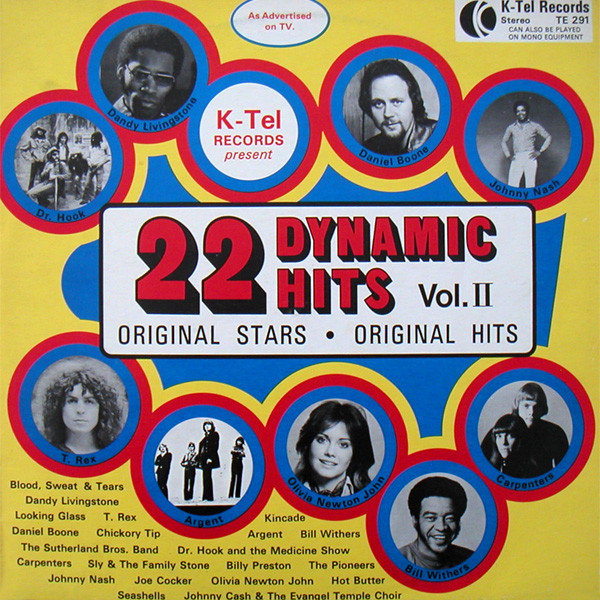

Extract: ‘Son of My Father’ by Chicory Tip (CBS, single, 1972)
IAN WADE:
But the first album I remember being obsessed by was 22 Dynamic Hits Volume II. I must have been about three or four. I remember everything on this LP sounded so quiet, obviously later realising that that’s because they were trying to get eleven tracks on each side.
JUSTIN LEWIS:
And unedited too, I believe, is that right? There’s a couple of five-minuters on there. And it has a most unlikely opening track.
IAN WADE:
Yeah, ‘Sylvia’s Mother’, which is not terrifying, but still slightly disturbing for young ears.
JUSTIN LEWIS:
Feels like it should be a side-ender. Yes, the sequencing feels like the FA Cup third round draw panel are just fishing records out of a hat.
IAN WADE:
But then, when I looked at it again a few years later, I thought, ‘Oh this is all over the place’ probably because K-Tel was in its infancy in the UK and there was no real care taken. K-Tel and Arcade had this rivalry in the early 70s in the album charts with these compilations, a bit like the NOW/Hits Albums [in the 80s]. And in Christmas week 1972, the top three albums were all K-Tel compilations. Number one was 20 All-Time Greats of the Fifties, which was flicking back to records that were fifteen years old, the equivalent of looking back to 2010 now. Number two was this 22 Dynamic Hits compilation. Number three was 25 Rockin’ and Rollin’ Greats which we had as well. Oh and number four was Arcade’s second volume of Fantastic Hits.
We weren’t an artist albums family as such – it was Motown Chartbusters, Joe Loss having a crack at stuff or Marble Arch. Oh and lots of Hammond or Tijuana brass things – but there wasn’t a copy of Hunky Dory or The Dark Side of the Moon. The only one I really remember like that was Bridge Over Troubled Water, which I think everyone had to own by law.
JUSTIN LEWIS:
That or Simon & Garfunkel’s Greatest Hits.
IAN WADE:
And the rest of that album chart had David Cassidy and Slade, but I would be interested to know what the music industry’s vibe towards it all was at the time, whether they thought these compilations were good or bad.
JUSTIN LEWIS:
But also… November 1972 was the 20th anniversary of the first NME charts. So pop has its own proper history by now, it’s been growing, and then you get these what I suppose you’d call post-modern bands. Roxy Music quoting old riffs, 10cc, Steely Dan in America to some extent – all taking the influences and mixing them up. And Charlie Gillett had just written Sound of the City [first published in the US in 1970]. The first of those story arcs about pop music, no-one had quite done that before.
IAN WADE:
And meanwhile, around the same time, you had the big rock’n’roll festivals at Wembley with people like Wizzard and they unearthed Little Richard.
JUSTIN LEWIS:
And Chuck Berry at the Lanchester Arts Festival. But going back to this compilation… I mean there are two Chicory Tip singles here – which is like the two Kajagoogoo singles on the first NOW album. But apart from the weird sequencing, I was struck by how many straight lines go from this album to the other records you’ve selected for this, the things I know you’re really into. There’s some reggae here, there’s some funk – Billy Preston’s ‘Outa Space’, fantastic record, but I don’t think a ‘hit’ as such.
IAN WADE:
When I look at this album, this is where all my essential music food groups throughout my life come from. Chicory Tip, well the whole Giorgio Moroder thing [starts there]. T Rex, who, whenever your favourite pop stars in Smash Hits did a ‘My Top Ten’, T Rex and Bowie and Roxy were always in there. And there’s tracks I love by Sly & the Family Stone, Carpenters, Bill Withers, and like Hot Butter’s ‘Popcorn’…
JUSTIN LEWIS:
Having that straight after Johnny Cash’s ‘One Piece at a Time’!
IAN WADE:
I might actually have to go on to Spotify and make it more palatable. Because it’s… just off. I seem to remember Joe Cocker[‘s ‘With a Little Help From My Friends’] going on for about eight hours.
—-
FIRST (2): CHICAGO: ‘If You Leave Me Now’ (CBS, single, 1976)
JUSTIN LEWIS:
Tell me about buying your first single, then.
IAN WADE:
Yeah, Chicago’s ‘If You Leave Me Now’. It was meant to be ‘Dancing Queen’ by ABBA, which in retrospect might have been a bit too on the nose for me.
JUSTIN LEWIS:
Had the shop sold out of that?
IAN WADE:
Yes. So that was like: Uh, typical! But this was the first time I was taken to a record shop, so the disappointment wasn’t huge as I was overwhelmed. Lots of previous times, I’d like a song, and people would buy it for me. But this was the first time I was taken to a record shop. It was Debenhams in Ipswich, and it felt like this glorious dark silvery cave of wonder. My mind was blown. ‘This is where all the records are. This is everything.’ Of course, we learn later… But I remember following my sister Christine around this shop. She was showing me bits and pieces, and she bought this Invictus Chartbusters album, which had this amazing mirrory sleeve. And I got ‘If You Leave Me Now’ – this must have been just after my birthday when my sister Pauline had got me ‘Couldn’t Get It Right’ by Climax Blues Band, Sherbet’s ‘Howzat’ and Lalo Schifrin’s ‘Jaws’.
JUSTIN LEWIS:
That completely conjures up the soundtrack to the Swap Shop swap top ten. And this would have been autumn 1976, the point where I would have properly been watching Top of the Pops every week. I remember with Chicago, they didn’t come into the studio, they had some film clip of them performing it somewhere, with a full orchestra behind them.
IAN WADE:
Yeah, and it always looks slightly out of focus and kind of cosy and warm because, I mean, yeah, that’s sort of September, October… When seasons were seasons, Justin.
JUSTIN LEWIS:
A ‘clocks going back’ record.
—-
JUSTIN LEWIS:
I’m just going to read out a quote from your book – 1984: The Year Pop Went Queer – which you move on quickly from. ‘Music was going well once I’d binned the violin’. Now – had you got so far with it, and realised it wasn’t for you?
IAN WADE:
When I started school, I thought, ‘I’ll learn violin’ but also during that ‘autumn of the futurists’, in 1981, I wanted to learn keyboards because obviously synth-pop was in the air. I wanted to be Ian Burden in the Human League and pressing buttons, or Adrian Wright [with his slides]. And so my parents took me to do organ lessons, because I felt like piano was perhaps too difficult, but also because organs had built-in beats and melody. Plus my dad was a huge fan of the sound of the Hammond organ.
So, with electronic music, I found it was so much easier to put on a little beat as there were always these pre-programmed rhythms and basslines. And I realised it was far easier to make a piece of music with this than scraping across a couple of strings on the violin, though I got up to Grade 5.
JUSTIN LEWIS:
That’s not bad. It’s a hard instrument.
IAN WADE:
But that was more by applying my keyboard skills to the violin. I managed for about a year, but the teacher would say, ‘You haven’t practised’. And I hadn’t. But with the organ, there were these The Complete Organ Player books and I managed to go through those a lot quicker than the stuff at school.
JUSTIN LEWIS:
What sort of repertoire are we talking here, with The Complete Organ Player? Was it a bit of everything?
IAN WADE:
It was. My dad always loved me playing ‘Amazing Grace’, and that was in Book 1, so it got slightly harder after that. ‘I Love You Because’ by Jim Reeves, ‘Hava Nagila’ which was a favourite because it just gets frantic. ‘El Condor Pasa’ as well. I did feel, though, none of this was particularly recent, given I wanted to be the Human League.
JUSTIN LEWIS:
On the upside, you could easily have won the £1000 jackpot on Name That Tune.
IAN WADE:
But when I was at high school… we’re similar ages, so did you have options, after the third year?
JUSTIN LEWIS:
O levels [now GCSEs]? Yeah, that’s right.
IAN WADE:
Four people wanted to do Music as a first choice, but apparently they needed another person, otherwise it was pointless them doing it. So, I think I was only the fifth person in the rest of the year to put Music as one of my five options, and as art was oversubscribed they asked me to consider changing.
But my music teacher was really switched on. A real cool cat, he wasn’t ‘hey kids’ and he wasn’t trying to be a mate, but he knew what to teach us. For the final exam, you had to make your own music, come up with a piece.
JUSTIN LEWIS:
Wow, that’s extraordinary. We were never asked to compose anything, it was so weird.
IAN WADE:
I was trying to play guitar, but guitars hurt your hands, you know. Whereas at home, I’d been mucking around with tapes and things, and I had this tape-to-tape, which also had a voice recorder and stuff. I was into things like Art of Noise, Cabaret Voltaire… so I was making these little soundscapes, and taping my organ beats, like that Hammond/Jerry Dammers thing. I made all these tapes under the name Industry and brought one in to play to my music teacher, and he was like, ‘Whoa, yes! You can enter this!’ We’d have these one-to-one chats where he’d talk to me about Music Concrete, [Edgard] Varèse and [Karlheinz] Stockhausen… It’s like I’d unlocked something in him about his passions which were off the curriculum. And he could see that the people I liked, like Art of Noise, were equally inspired by those figures. He played Stimmung by Stockhausen in the class once, which made you giggle but you were also almost in awe that somebody’s managed to have this idea and do it. But I haven’t really sat down properly with actual keyboards for years.
—-

JUSTIN LEWIS:
1984 – The Year Pop Went Queer seems such an obvious subject for a book, it feels faintly incredible that no-one had really done it before. And the only thing I could put that down to might be that for a long time, music criticism wasn’t very keen on the 80s – and certainly not the mid-80s unless it was the indie scene. And yet, 1984 is the top selling singles year of the decade in Britain. Six singles sold at least a million copies, which had never happened before. So, had you been waiting or wanting to write a book like this for a while?
IAN WADE:
I always felt like 1984 was my year growing up after 1981. The book I wanted to do, first of all, was like a Gay Jukebox. To coincide with 50 years of Stonewall [in 2019], I wanted to do one of those 1001 Albums projects or the records of each year, covering people like Bowie, or Suede, or kd lang almost like the LGBTQ+ Record Collection. I listed all the years in a document, and then went through everyone who I might write about in those particular years. So,1970: Kinks, ‘Lola’, you know… And Jobriath and Bowie and Lou Reed, ‘Walk on the Wild Side’ and glam… But for 1984, that was the section that was growing and growing and growing. There wasn’t just Frankie Goes to Hollywood and obviously Bronski Beat… there was the rise of high-energy, Madonna, all these sorts of things. And so when I mentioned this to my publisher, he said, ‘Yeah, focus on that.’
You see, some people have said, ‘But there was already Annie Lennox and Boy George and Soft Cell [before ‘84]’ but I think 1984 was the most explicit year for gay acts. Boy George and Marc Almond were still perceived as ‘still haven’t met the right girl yet’.
JUSTIN LEWIS:
And it wouldn’t have occurred to me that George Michael, for instance, was in the closet.
IAN WADE:
I look at this book very much through two lenses: there was what they were saying at the time, and there was what we were seeing. So, you’d get Holly Johnson’s Personal File in Smash Hits [January 1984] where he’d talk about going to sex shops – whereas two years earlier, you had Marc Almond and ‘Sex Dwarf’ and all that and yet none of that was kind of hinted at anything other as ‘disgusting’ or whatever. And then you had Bronski Beat who were so revolutionary, by talking unapologetically about being gay, but there were no frills. There was no drag or eyeliner – they just looked like you, or your neighbours or your relations. And so those two acts – Frankie and Bronski Beat – just seemed like the big ones. Then there’s high-energy coming through, and Stock Aitken Waterman getting together at the start of 1984. During that year, they have their first big chart entry with Divine [‘You Think You’re a Man’], their first top five single with Hazell Dean [‘Whatever I Do (Wherever I Go)’] and by the end of the year, they’ve made ‘You Spin Me Round’ with Dead or Alive – previously this chart-allergic band – which is on its way to Number one in 1985, and so they’re preparing to revolutionise pop for the rest of the decade.
I wanted the book to be very much from a chart point of view. Everybody in it had to have actual chart hits that year, and that allowed me to bring in Sylvester, who came back with this really amazing album [M-1015], but everyone was just asking him about Boy George, you know. And he was a bit pissed off by that.
But then, people like Rob Halford and Judas Priest, and especially George Michael, through the benefit of hindsight, when you see what they were up to at that time. During research, I discovered that George had come out to Andrew and Shirlie on the set of Wham!’s ‘Club Tropicana’ video [summer 1983]. I realised that with Wham! in 1984, you can see in George a very, very driven person wanting to be as huge as possible in pop regard. So he’s parking his sexuality, because you look at ‘Wake Me Up Before You Go-Go’… Even when you look at the videos, and you look at his eyes while he sings to you… he’s so driven. It’s like he’s got everything planned, even down to splitting up.
JUSTIN LEWIS:
Some of it’s confidence, too, isn’t it. Andrew is arguably the real pop star at the beginning of Wham!, I think, he understood image really well, and pop in general. He wasn’t a songwriter but he was as lucid and thoughtful about the presentation as George was. You can see he’s been watching everything. But I guess the other thing about Wham! in ’84 is they had that terrible recording contract they’ve managed to extricate themselves from, and there’s that feeling of ‘Right, we’re going to do this properly now’.
IAN WADE:
Yeah – ‘We’ll show you.’
JUSTIN LEWIS:
I love the first album, Fantastic!, but it’s clear in retrospect that that’s everything they’re prepared to put out for the time being, they’re holding back a lot of the best stuff for later. To know that you’ve already got ‘Careless Whisper’, for instance.
IAN WADE:
That’s what I love about Fantastic! John Peel likes them, the NME likes them, but it isn’t really till ‘Club Tropicana’ when Smash Hits puts them on the cover, and they actually look like a pop pin-up force. So then it all goes to shit because of all the legal stuff, but what felt like forever then was only, what, six months.
But yeah, with George, I wanted to reflect on how a lot of gay people live and work and exist – do you have to park your true self, and your sexuality in order to become successful? It’s like that for a lot of people in general. Even though there were these bitchy barbs from Boy George towards George Michael when you read between the lines.
JUSTIN LEWIS:
Oh, looking back, you can see it, can’t you?
IAN WADE:
Oh yeah, and I also wanted to include people like Madonna and Cyndi Lauper… both of who would do so much for gay causes and AIDS awareness, that’s why I used ‘queer’ as the angle of the book. ‘Queer’ was something that suggested something else rather than the sex.
JUSTIN LEWIS:
Going back to Frankie Goes to Hollywood and Bronski Beat… it’s interesting to consider how Radio 1 reacted so differently to those two acts breaking through. Once they realised what ‘Relax’ was about, and banned it after playing it quite a lot for two months, and yet I remember being slightly surprised that they had no problem with Bronski Beat whatsoever, who also promoted ‘Why?’ on Saturday Superstore. Was it because the Frankie approach was hedonistic and the Bronski approach was… responsible?
IAN WADE:
That’s possibly it. Because a lot of the arguments, certainly part of Mike Read’s reasons, for banning ‘Relax’ were about the video. ‘Relax’ as a record is an exuberant disco romp, really. But when you see the video, when you see what’s going on with some of the extras… And also the cover art. ZTT were perhaps testing the waters and didn’t quite realise what they were doing, but yet they went with it. Whereas, with Bronski, when you watch the video for ‘Smalltown Boy’, which is like a Mike Leigh-type clip, there’s homophobia there and you can see the message going on – hanging round a swimming pool mooning over a hot guy in Speedos, you know. But I guess, as you say, because it wasn’t quite so explicit, and wasn’t about the sex… But both those videos are directed by the same guy.
JUSTIN LEWIS:
Really?! Bernard Rose also directed ‘Smalltown Boy’?! And he did UB40’s ‘Red Red Wine’ before ‘Relax’. While we’re on the subject of ‘Relax’, I’ve never managed to track down a recording of Mike Read announcing on air that he wasn’t going to play it [c. 8am on Wednesday 11 January 1984].
IAN WADE:
It’s weird. I remember hearing it.
JUSTIN LEWIS:
There are no direct quotes in the papers of the time of what he said, just press statements afterwards. No-one seemed to record it, although I suppose why would you be recording medium-wave era Radio 1 at breakfast time?
IAN WADE:
So, is Chris Barrie’s Mike Read impression taking the piss out of the ban on the ‘Power of Love’ 12” version [released November 1984] the only citation?
JUSTIN LEWIS:
And even that isn’t strictly correct, because Barrie’s impression claims that ‘Relax’ is number thirty-five, whereas on the day of the ban, it was at number six.
—-
LAST: SAINT ETIENNE: International (Saint Etienne/PIAS, album, 2025)
Extract: ‘Glad’
[Note: Ian and I spoke on 26 August 2025, ten days before the official release of this record, on 5 September. You can read his review for The Quietus here.]
JUSTIN LEWIS:
As you’ve selected this, I’d like to talk about farewell records. Because if something is trailed as ‘this is our last record’, you can’t help but listen with different ears, as opposed to a band splitting six months or a year after an album release. So obviously, Wham! spring to mind [‘The Edge of Heaven’ single, 1986] and The Jam [‘Beat Surrender’ single, 1982] – but, given that you have heard an advance copy of this, and I haven’t yet, apart from two tracks, how did it feel listening to International, the final Saint Etienne album?
IAN WADE:
Strange and sad and yet happy. When Saint Etienne first came along, in 1990, their ideas and references suggested so much, they were setting out their stall on records like Foxbase Alpha [1991] and So Tough [1993] – ‘This is who we are.’ Now, 35 years on, they have their own club. They’ve explored all those areas really well. It’s not like they kept themselves in a rut – and this has got a nice circular element with its in-between track references from people like Katie Puckrik. There are lots of little motifs in various tracks which remind you of this or that [from their back catalogue]. So whether that was a conscious decision when they were making this, because I know they were making the previous album, The Night, at the same time. And The Night is a very different album to International. While they’ve always been a really good pop band, this one – while not ‘He’s On the Phone’ twelve times – is very much them in ‘classic pop’ mode.
I love what’s in Bob Stanley’s head, and Saint Etienne’s outlook. There’s that spirit of having grown up with them. Foxbase Alpha was all about being in the centre of London: ‘We don’t have much money, but we’re just going to have an adventure, we’re going to have a great time.’ And that’s how I felt when I first moved to London, I went and visited all these places that were mentioned in their songs, all the tube stations and so on.
JUSTIN LEWIS:
Sometimes I wonder why weren’t they bigger than they actually were. I think you put your finger on it when you said they didn’t stay with one thing for too long. But also, most of their records have got a weird bit in them. Even ‘Glad’, the first single off this, has a dead stop after the first chorus, which you wouldn’t get on, say, a Sophie Ellis-Bextor single. Saint Etienne never lost that indie ethos of making things a bit odd.
IAN WADE:
There’s that thing in your own pop world where Saint Etienne are number one, whereas they’re sadly nowhere near in the real world. There was a recent interview where they said, ‘Oh it’s a shame we never had a top ten single.’
JUSTIN LEWIS:
‘He’s on the Phone’ (1995) and ‘Sylvie’ (1998) came close.
IAN WADE:
Yeah, it seems silly that Cola Boy [a Saint Etienne alias project] did manage it [‘7 Ways to Love’, summer 1991], but they never managed it as Saint Etienne.
JUSTIN LEWIS:
Unless you count ‘Tell Me Why’, the Paul van Dyk collaboration (#7 in 2000).
IAN WADE:
But I think eventually there wasn’t anything for new fans to get hold of. They didn’t seem to attract new people. ‘He’s on the Phone’ was a major crossover in terms of being a banging top record, but…
JUSTIN LEWIS:
I wonder why they disappeared for two years after that, although they did that weird thing of putting out an album only in Japan [Continental, 1997, but out as a deluxe edition everywhere now], when if they’d put it out here as well, that could have taken off. Why didn’t they put out ‘Burnt Out Car’ as a single in early ’96? Surely a lost massive hit!
IAN WADE:
They were their own A&R team, they’ve always picked canny remixers for their remixes. But there’s also the indie ethos where they wouldn’t pull loads of singles off an album. I wish they’d been a lot bigger. It amazed me that I’ve Been Trying to Tell You (2021) was their first top twenty album in over twenty years [since 1998’s Good Humor].
JUSTIN LEWIS:
I must say, I love that side of them, I loved I’ve Been Trying to Tell You – and I loved Sound of Water, which I know divided the fanbase somewhat.
IAN WADE:
All the people I know and love a lot: friends and lovers and whatnot, we’ve been there together through Saint Etienne, but yet I’ve rarely known of anyone coming into that circle. Saint Etienne’s way is curating and keeping that audience going. It’s not like Oasis, where suddenly a whole new generation of kids gets into them, or even Blur when I saw them live a couple of years ago – I was surprised how many youngsters were there.
I sound ancient, but I think that’s been the downside with Saint Etienne. They could have crossed over, could have pulled in more people, but after ‘He’s On the Phone’, they deliberately kept away from the whole Britpop thing, even though they were initially mentioned when the term was first coined in that Select feature [spring 1993]. When Britpop encompassed the Auteurs, and Denim and Pulp. Also, they never really slogged themselves around the live circuit – even the past 10 or 15 years – they’ve not done massive tours. And there have been quite big gaps between albums.
But to me, they are superstars, for everything they represent, and the people I know through them. You know, even I, I guess my partner is kind of somebody I’ve got into Saint Etienne and that was kind of make-or-break. But there hasn’t been anything for a while that’s brought people in.
JUSTIN LEWIS:
I remember a few years back, when Graham Norton still did Saturdays on Radio 2, one morning he played ‘Only Love Can Break Your Heart’, their very first and probably still their most played record from 1990. And it sounded exciting to hear it there, but it sounded lo-fi, it sounded weird, it sounded indie. It really didn’t sound like it belonged there.
IAN WADE:
And that’s the thing. They don’t really fully sit anywhere, but that’s pop. The catalogue is all very shifty, good in a way, and bad in a way. It’s a shame, really. But they’ve said, ‘Look, we’re not splitting as such, we just decided [to stop]…’
JUSTIN LEWIS:
Because they are still friends.
IAN WADE:
Yeah, and maybe more people should know when to stop. We’ve all been fans of bands where eventually we’ve collected the albums on autopilot. Yet you don’t get that with Saint Etienne. Nothing sounded automatic. And with Saint Etienne, they’ve all got kids, they’re all about sixty, well Bob is. Virtually everyone I know has been facing various challenges to do with age recently with illnesses and bereavements and all that, and Saint Etienne have reminded a lot of those people of that kind of post-ecstasy carefree time…
JUSTIN LEWIS:
What really scares me is that the song ‘Teenage Winter’, a song about growing older, is itself now 20 years old.
IAN WADE:
Exactly! And ‘He’s On the Phone’ is 30 this year.
—-
ANYTHING (1): CHICKS ON SPEED: Will Save Us All (Unicat Records, album, 2000)
Extract: ‘Euro Trash Girl’
JUSTIN LEWIS:
I didn’t know this at all, I must confess. I’d heard of them, but I’d not heard them, I don’t think. It’s brilliant.
IAN WADE:
This dates back to a period in the late 90s when I first heard like a split single with them and DJ Hell covering [The Normal’s] ‘Warm Leatherette’. I liked them as they felt a bit like The Slits where it was art and ideas over ability, and I just absolutely loved it. It’s pre-electroclash… almost just pre-Internet, really. I didn’t even have an email address until around then. Around 2000 I was working at Music 365 and Angus the reviews editor would say, ‘Look on the review shelf and see if there’s anything you fancy covering’. I saw Chicks on Speed Will Save Us All, and convinced Angus to let me write about it as he had no idea of what it was and was won over by me being a bit deranged about it. I reviewed it under the name ‘Dixon Crack’ [Laughter]. That was around the time I reviewed Glastonbury while on E, so… ah, halcyon days.
It’s just so amazing though. ‘Euro Trash Girl’, the cover of The B-52’s’ ‘Give Me Back My Man’. At the same sort of time, Peaches were coming through, and then eventually Fischerspooner became seen as the big electroclash act with ‘Emerge’ a few months later. But it definitely felt as if there was something happening, you know? This kind of European art-pop thing.
JUSTIN LEWIS:
I don’t know if this is just because it was from abroad, but it made me think of Pizzicato 5 from Japan. I’m not sure how I missed this at the time though.
IAN WADE:
I think that there’s a line from this sort of thing, via mash-up culture, then to the sort of Xenomania stuff being made for people like Rachel Stevens and Sugababes and it leads to something like Charli XCX’s Brat album – that kind of ‘up yours, I don’t care what you think’ vibe. I guess, although Chicks on Speed might be horrified by all that.
JUSTIN LEWIS:
Did you know that ‘Mind Your Own Business’ was a cover back then [Delta 5, post-punk classic from 1980]? I don’t think I’d have known.
IAN WADE:
No, it sounded familiar but I had no idea that ‘Euro Trash Girl’ was a cover of the record by Cracker, who’d been Camper Van Beethoven. I didn’t realise that half these songs were covers, but when you hear the originals, you can see what the attraction was.
There’s a boxset of electroclash coming out in October [When the 2000s Clashed], compiled by Jonny Slut, who ran the Nag Nag Nag club. It’s got all this kind of stuff on it but also people like Kylie, LCD Soundsystem and Soulwax. And the fifth and final disc has the origins, so like Cabaret Voltaire and Human League and so on. Electroclash felt like a very American-European thing, and the nearest British act to the scene felt like Ladytron. And then maybe Goldfrapp a bit later, that kind of sexy electronic sound. But I’m really glad electroclash is having this revival. Felix da Housecat, and Chicks on Speed have both recently come back with new stuff. But we’re also getting a throwback to it with current people like Decius – sexy, randy dance music with minimal electronics, which seems and feels very 1981, 1988 and 2001.
JUSTIN LEWIS:
We’ve used the term ‘perfect pop’ but I often think of this kind of thing as ‘imperfect pop’, this element of the music that threatens to sabotage it. It might be a strange sound, or humour, or the singer might not be technically brilliant. Do you know what I mean?
IAN WADE:
Yeah! It’s like The Hacker and Miss Kittin track, ‘Frank Sinatra’, it just makes me laugh, the bleak humour of it. Kittin goes ‘You know Frank Sinatra? He’s dead’, and she sort of laughs this really cold laugh, this dominatrix lick-my-legs-in-an-airport-lounge vibe. Or maybe it’s nervous laughter, maybe it’s not meant to be as cold as that, but yet it is so perfect for that.
—-
ANYTHING (2): AMANDA LEAR: Sweet Revenge (Ariola Records, album, 1978)
Extract: ‘Follow Me’ (Single Version)
JUSTIN LEWIS:
How to define Amanda Lear – forming the connection between Salvador Dali and Bryan Ferry. How has there not yet been a full-length biography of Amanda Lear?
IAN WADE:
It is an amazing story.
JUSTIN LEWIS:
And we still don’t entirely know which bits are true, and which bits aren’t.
IAN WADE:
Not officially, no. For years, I’ve been fascinated by the kind of artists who are huge in certain territories. A few years ago, during lockdown, Steve Wright – God bless him, but at the time, I was furious – played ‘Do It Do It Again’ by Raffaella Carrà, and he was taking the piss, as if it was this comedy naff piece of shit. And while that record is not ‘full’ Raffaella, when you watch things like the performances of ‘Rumore’ where she’s just really going for it, it’s just incredible. There’s a documentary which was on Disney [Raffa, 2023], and you realise she was bigger than Madonna and Elvis combined. Massive. But over here, there’s just this one song. And then there’s people like Dalida, in France, who has statues and areas of Paris named after them. I follow this account on Instagram called Disco Bambino, which puts clips of late 70s/early 80s performances from Italian entertainment shows. And Amanda Lear is always on those and she always looks absolutely amazing, fantastic. She would really benefit from a book, yes, but also the type of compilation Grace Jones got with Island Life [in 1985], because people knew all the Nightclubbing songs…
JUSTIN LEWIS:
Yes – I didn’t know her early disco stuff at all.
IAN WADE:
No. But that really contextualised her work in how she got to ‘Slave to the Rhythm’. But Amanda only had her first chart hit in the UK a couple of years ago because ‘Follow Me’ (which peaked at #68 in November 2023) was on the Coco Chanel Mademoiselle advert. And then there’s ‘Enigma (Give a Bit of Mmh to Me)’, which is on a dog food advert. And both of them are on this album, Sweet Revenge. Early last year, I didn’t have any of her records other than on download, and when me and my other half went to Stockholm, we were in one record shop, and the guy had a Discogs account, and I left with five singles and an album – and this was in Sweden! And then a few weeks ago, when my boyfriend was out of town, and I could spend more than five minutes in a record shop, I was in Crystal Palace, digging through the crates, and I found another Amanda Lear album. So suddenly I had gone from zero to about a dozen Amanda records. I mean, they’re an acquired taste, you know. Her cover of ‘Back to Black’ is… quite something.
JUSTIN LEWIS:
I really enjoyed listening to Sweet Revenge for this.
IAN WADE:
I do love that Eurodisco pop from the late 70s, there’s that kind of space fantasy about it.
JUSTIN LEWIS:
Yes, yes, it is like everyone’s in space. There’s Space’s ‘Magic Fly’…
IAN WADE:
Nightflight to Venus by Boney M…
JUSTIN LEWIS:
‘Automatic Lover’ by Dee D. Jackson.
IAN WADE:
It’s a kind of cosmic disco. Every time I do a Eurodisco compilation, I find there’s another hundred things to discover on the playlist.
JUSTIN LEWIS:
For a long time, we tended to look down on European pop in this country. We were even pretty grudging about ABBA, or at least the music gatekeepers were. But I wanted to mention this Seaside Special special from August 1979, recorded in Belgium – you might have seen clips from this on that Instagram account, actually. It went out on BBC1, and ITV was on strike at the time, so there was almost nothing else to watch on TV at all, so this must have got huge ratings. But it was a cast of European pop stars in one venue. So you’ve got the Gibson Brothers, Dalida who you mentioned earlier, Plastic Bertrand, Eruption… and Amanda Lear. And the whole kaboodle was linked by, of all people, Rod Hull and Emu.
IAN WADE:
Oh my god, I’ve got to see this.
JUSTIN LEWIS:
Michael Hurll, the entertainment producer at the BBC, was often trying out these pan-European specials.
—-
ANYTHING (3): KING TUBBY & AUGUSTUS PABLO: King Tubby Meets Rockers Uptown (Yard Music International, album, 1976)
Extract: ‘Keep on Dubbing’
IAN WADE:
Lately, I’ve been finding myself listening to lots of minimal music because I want to have something to drown out my own thoughts. After my sister Cathryn dying suddenly in February, and then my mum died in April, it’s been no end of family history and obsessions and collections to go through clearing out the house. Mum was ninety-five and had been there 68 years and so it was just heartbreaking as first I cleared all the stuff of mine I had there – about 90 per cent of my record collection and all sorts – then her everyday stuff, and then we’re going through cupboards, where you’ve got family stuff – cards, letters, photos, no end of things that mum kept hold of. So I’ve been almost assaulted by all this ephemera and memories that I grew up with… all these associations, like a crash course. And a family record collection that had all our names on whose record belonged to who, so it’s been an onslaught of memories.
I found myself wanting to listen to something detached from it, something which didn’t throw up any of those memories. I don’t want to sound too Bobby Gillespie about this record, but in a way, for all his faults, sometimes he’s on to something with what he recommends, and this really is amazing.
Also, as if this year hasn’t been difficult enough, I had an operation on my ear, and had a grommet put in. For years and years, I thought my hearing had been affected by seeing My Bloody Valentine at UEA in Norwich on the Loveless tour. I was at the front even when my mates fled to the back. I assumed it was that, and I thought, ‘Well it’s a small price to pay, at least I lost my hearing to something worthwhile eh’.
But over the years, I’d be in bed listening to the radio, and when lying on one side, the sound was getting increasingly mumbly. And with sinuses and colds in recent years, it was becoming really painful. It turned out that my ear canal is very strange and there’s a couple of tiny bones that are fused together, which has actually stopped me being able to use my ear properly. I could hear around the ear, but not directly through it.
But since the grommet’s been put in, I can hear things again! I feel like I have to apologise for all the albums and artists I’ve slagged off over the years because my ears have been impaired. I was also tested for my ears when I was five or six because my parents thought I couldn’t hear properly even then, but I’d never really thought about it. I just played everything really loud.
So anyway, I’ve been re-listening to music because of going through all that, and dub – because of all the space in the music – was something I wanted to try and get lost in again. This particular King Tubby album has got lots of space, echo, dimension, and it also just took my mind off everything else going on.
I’ve always been a toe-dipper with dub. If you remember those Blood and Fire compilations which Mick Hucknall bankrolled, the King Tubby things – I had those and loved them. And there’s lots of Lee Scratch Perry and Adrian Sherwood stuff I like. It’s also the perfect music, I find, when you’re on a plane. I don’t know why, but hearing Prince Jammy as the plane was just taking off sounded perfect.
JUSTIN LEWIS:
Listening to what you’ve just been saying, looking at my prep notes, do you know the first thing I’ve written for this bit? ‘Is this the music I find most comforting when I’m grieving?’
IAN WADE:
Oh my God.
JUSTIN LEWIS:
In my case, the record I listened to a lot after my father died, which was late 1994, was the Mad Professor version of Massive Attack’s Protection album. The Massive Attack singles at the time always had some dub versions on them, slightly unsettling some of them, but I loved that album. I loved the original Protection album as well, but I loved the way this emphasised different things in the music. I loved how dub takes things away, or amplifies something else. And what I find charming about this King Tubby album is how tracks just stop, it’s like a tape has run out, you don’t get these elegant fade-outs.
IAN WADE:
It’s like they’ve been uncovered and done on the hoof. There doesn’t seem to be any ego in it. There isn’t a main singer, or a key vocal, and I’ve always liked minimal dance and acid house in the same vein for the lack of ego. I mean, it drives my other half mad if I’m listening to something for about twelve minutes and nothing is happening. He looked like he wanted to open a vein when we were out the back in Space Hall in Berlin where they keep all the dance stuff.
JUSTIN LEWIS:
But the other thing I wanted to mention with dub is that when I started buying 12” singles in the 80s, they’d often have a ‘dub version’ on the other side, or in the case of Scritti Politti singles, they’d call it ‘version’, and I didn’t at that point know what all this was referencing. I didn’t know the tradition, I barely owned any reggae at that point. In fact, Scritti’s ‘The Word Girl’ – the flip side which was called ‘Flesh and Blood’ with Ranking Ann – was where the penny dropped and I went, Oh okay, that’s what this means.
IAN WADE:
I didn’t really think of it as dub at the time, but we had things in the house like the Dave and Ansel Collins singles, ‘Double Barrel’ and ‘Monkey Spanner’, which had ‘Part 2’ on the other side, which was either a continuation or a version minus the words.
JUSTIN LEWIS:
And obviously something like Love and Dancing by the League Unlimited Orchestra, effectively a dub version of Dare by the Human League. Which I don’t think I knew about for quite a long time after it came out (1982).
IAN WADE:
Dare is my favourite album of all-time, and I’m so in awe of Love and Dancing – the fact that it was all manually done.
JUSTIN LEWIS:
Martin Rushent trapped in a room for weeks sticking bits of tape together.
IAN WADE:
The way he became so obsessed with that record. They’ve just reissued the first two Pete Shelley albums – Homosapien and XL-1 – and Martin Rushent produced the first one. I knew the ‘Homosapien’ single, but I’d never really known the albums. They sound so fresh for things that are nearly 45 years old. Probably my favourite reissues this year.
—-
IAN WADE:
My ethos, my worldview… I’ve always wanted to be a DJ, I guess, in a club or on the radio. In writing about music or making playlists, and I’ve always been making tapes and stuff like that throughout my life, saying to people, ‘Listen to this.’ I like being enthusiastic about things. This morning, my other half was telling me about when we first met, and the CDs I made for him, where I was basically saying, you know, ‘Here are twenty songs that say a bit more than me talking for an hour and boring you.’ And that’s been the icebreaker for how I’ve made half my friends. I was always a bit awkward and shy, but music helped me with all that.
—-
Ian Wade’s 1984: The Year Pop Went Queer is published in paperback by Nine Eight Books/Bonnier Books. It will be published in the US in October 2025. You can order it from loads of places, but let’s say Bookshop.org.
You can follow Ian on Bluesky at @wadeywade.bsky.social and on Instagram at @ianedwardwadeywade.
—-
FLA 30 Playlist
Ian Wade
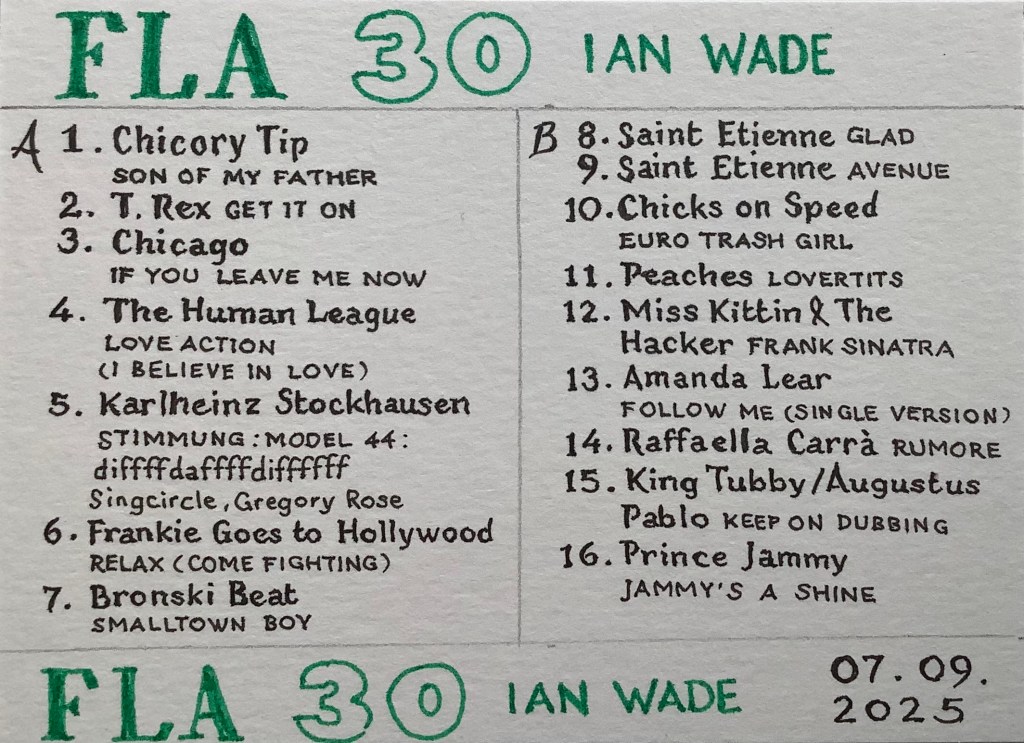
(For the time being, this site and project uses Spotify for the conversation playlists, but obviously I disapprove that Spotify doesn’t pay artists and composers properly, and other streaming platforms are available, as are sites to buy downloads and buy recordings. For consistency, you can also listen to the selections via YouTube (where available), and links are provided in each case, below.)
Thanks to Tune My Music, you can also transfer this playlist to the platform or site of your choice by using this link: https://www.tunemymusic.com/share/CLVcuTUYfY
Track 1:
CHICORY TIP: ‘Son of My Father’: https://www.youtube.com/watch?v=x8mf4i_10mE&list=RDx8mf4i_10mE&start_radio=1
Track 2:
T REX: ‘Get It On’: https://www.youtube.com/watch?v=GuIOfvAFQqs&list=RDGuIOfvAFQqs&start_radio=1
Track 3:
CHICAGO: ‘If You Leave Me Now’: https://www.youtube.com/watch?v=-9_d-sFhmRM&list=RD-9_d-sFhmRM&start_radio=1
Track 4:
THE HUMAN LEAGUE: ‘Love Action (I Believe in Love)’: https://www.youtube.com/watch?v=wRo27TwTaWg&list=RDwRo27TwTaWg&start_radio=1
Track 5:
KARLHEINZ STOCKHAUSEN: ‘Stimmung: Model 44: diffffdaffffdiffffff’
Singcircle, Gregory Rose: https://www.youtube.com/watch?v=y3EU35xWLrw&list=RDy3EU35xWLrw&start_radio=1
Track 6:
FRANKIE GOES TO HOLLYWOOD: ‘Relax (Come Fighting)’: https://www.youtube.com/watch?v=AKBbMlp0nEA&list=RDAKBbMlp0nEA&start_radio=1
Track 7:
BRONSKI BEAT: ‘Smalltown Boy’: https://www.youtube.com/watch?v=E5i2Wa7daDA&list=RDE5i2Wa7daDA&start_radio=1
Track 8:
SAINT ETIENNE: ‘Glad’: https://www.youtube.com/watch?v=h5fWxY9IHkw&list=RDh5fWxY9IHkw&start_radio=1
Track 9:
SAINT ETIENNE: ‘Avenue’: https://www.youtube.com/watch?v=AAjgW-q-IeQ&list=RDAAjgW-q-IeQ&start_radio=1
Track 10:
CHICKS ON SPEED: ‘Euro Trash Girl’: https://www.youtube.com/watch?v=JBXoZQmZoQw&list=RDJBXoZQmZoQw&start_radio=1
Track 11:
PEACHES: ‘Lovertits’: https://www.youtube.com/watch?v=wZz5nBc2_Bw&list=RDwZz5nBc2_Bw&start_radio=1
Track 12:
MISS KITTIN & THE HACKER: ‘Frank Sinatra’: https://www.youtube.com/watch?v=yXN2UrmdRHY
Track 13:
AMANDA LEAR: ‘Follow Me’ (Single Version): https://www.youtube.com/watch?v=F9ajaniHukc&list=RDF9ajaniHukc&start_radio=1
Track 14:
RAFFAELLA CARRA: ‘Rumore’: https://www.youtube.com/watch?v=nD8Gb8VkhME&list=RDnD8Gb8VkhME&start_radio=1
Track 15:
KING TUBBY & AUGUSTUS PABLO: ‘Keep on Dubbing’: https://www.youtube.com/watch?v=spD6nZehlzI&list=RDspD6nZehlzI&start_radio=1
Track 16:
PRINCE JAMMY: Jammy’s a Shine’: https://www.youtube.com/watch?v=7zknELG5yQE&list=RD7zknELG5yQE&start_radio=1


 FIRST LAST ANYTHING