FLA 36: Jamie Muir (14/12/2025)

To round off series three of First Last Anything conversations, it was an utter delight to chat to producer, director and filmmaker Jamie Muir. Jamie has worked for fifty years in television, joining ITV company London Weekend Television in the mid-1970s as a researcher on the weekly arts series Aquarius. He was part of both the respective teams that created and developed Aquarius’s successor, Melvyn Bragg’s The South Bank Show for LWT from 1977, and The Late Show, a nightly BBC2 arts magazine that ran for six years from 1989–95. He also produced Book Four, a regular books series in the early years of Channel 4, hosted by Hermione Lee.

Since 1992, Jamie has made a wide variety of documentary films and series, for BBC, ITV and Channel 4, on arts, factual and history, fronted by figures including Lucinda Lambton, Simon Schama, Alan Yentob, Tom Holland, and David and Jonathan Dimbleby.

There was a lot to ask Jamie, as you can well imagine – and there was the small matter of discussing music as well, plus early family life, especially with his dad Frank Muir, the extraordinary comedy writer and executive with a notable broadcasting career of his own. But over Zoom, one afternoon in late November 2025, we talked about some of Jamie’s notable record purchases, as well as the power of photojournalism, why humour in arts television is underrated, and even music that turns up too often in documentaries. We hope you enjoy our chat – and wish you the merriest of Christmases. See you in 2026.

—–

JUSTIN LEWIS:

What music do you remember first hearing at home? You mentioned when we were setting this up things like comedy records, musicals.

JAMIE MUIR:

Yes, definitely comedy records, so Peter Sellers, Songs for Swingin’ Sellers, and then things like Bernard Cribbins’ ‘Hole in the Ground’, Lance Percival’s ‘Riviera Caff’: those kind of things which we found hilarious. And then probably My Fair Lady, Oliver!, Carousel – those were the kinds of records my parents had. They also loved French chanson, so Edith Piaf, Charles Trenet… which they had on old 78s until I used them for target practice, and shot them up with an air rifle.

JUSTIN LEWIS:

You were how old at this point?

JAMIE MUIR:

Ten.

JUSTIN LEWIS:

This is about the time you’d have started buying records yourself, if I’ve got the maths right. It’s interesting you mention Peter Sellers. Your dad Frank co-wrote things with Denis Norden, like ‘Balham – Gateway to the South’, a very famous sketch Sellers did on record.

JAMIE MUIR:

Yes he did, he wrote two or three things for Sellers with Denis, and there’s one about a young pop star [Twit Conway], ‘So Little Time’, which is sort of based on Elvis. It’s got some great jokes in it:

‘Now I’ve got some money I’ve been able to move my old mum and dad into a small house.’

‘I bet they’re delighted.’

‘No, they ain’t, they was in a big house.’

JUSTIN LEWIS:

Your dad was one of the most familiar faces on TV when I was growing up in the 70s and 80s: Call My Bluff, My Music, all sorts of things. As with Denis Norden: I didn’t know there was this whole writing career that came before it. How aware were you as a child of all this?

JAMIE MUIR:

I was very small, but every Sunday afternoon, he would disappear, to record the weekly episode of Take it From Here for radio. And then during the week, he would go and write with Denis, who we knew as children. They were incredibly long runs, something like 35 or 40 episodes.

JUSTIN LEWIS:

For twelve years!

JAMIE MUIR:

Yeah, for twelve years. It was a ridiculous, extraordinary work rate. Then in summer breaks, they’d go off and script-doctor Norman Wisdom films.

JUSTIN LEWIS:

Oh my god, so it didn’t stop.

JAMIE MUIR:

No, it didn’t. And of course, because nothing was recorded… jokes had no long tail.

Talbot Rothwell was in the same writing stable, and when the series was over, he asked if he could borrow some jokes. Someone had typed all their jokes up in a book, they lent them to him, and that’s how ‘Infamy, infamy, everyone’s got it infamy’ ended up in Carry on Cleo.

JUSTIN LEWIS:

So that started in Take It from Here?

JAMIE MUIR:

They just said, ‘Sure, we don’t need it anymore.’

JUSTIN LEWIS:

There was probably this thought back then that this was all ephemeral.

JAMIE MUIR:

[With Denis], my dad also wrote something for television that’s a bit dubious, I suppose: Jimmy Edwards [from Take It from Here] as the headmaster of a school, who was very free with the cane.

JUSTIN LEWIS:

Oh yes, Whack-O!

JAMIE MUIR:

Which I remember loving as a child. And one of the boys in the film spin-off of that [Bottoms Up, 1960] went on to be a member of the Jimi Hendrix Experience. Mitch Mitchell, the drummer.

JUSTIN LEWIS:

What I was going to say about your dad’s connection with television and pop is that he was on things like Juke Box Jury [1962].

JAMIE MUIR:

He did quite a lot. When television came back after World War II [in 1946], I think he was an announcer. I’ve always meant to ask John Wyver about this because he’s about to publish a book called Magic Rays of Light: The Early Years of Television [out on 8 January 2026].

JUSTIN LEWIS:

Which I must get!

JAMIE MUIR:

I think Dad worked at Alexandra Palace really quite early on. And we were certainly unusual amongst my friends growing up. We were a telly household very early on too, I think late 50s.

JUSTIN LEWIS:

Oh, so ITV was up and running.

JAMIE MUIR:

Yup, and because Dad was an executive [in comedy] at the BBC in the 60s, he would watch everything, and we’d sit and watch with him and he’d ask us what we thought of it. So we were a family that watched television critically which was, again, quite unusual. [One night], I’d gone to bed and he got me up and said, ‘There’s a play on you might enjoy. It’s by a writer called Harold Pinter. And it’ll be quite strange, but it’ll also quite funny. So we watched the Tea Party [BBC1, 25 March 1965, repeated BBC2, 30 April 1965]. And that was magic.

And we’d also seen a production of Hamlet Live from Elsinore [BBC1, 19 April 1964, the night before the chequered launch of BBC2], with Christopher Plummer [and Michael Caine as Horatio]. That is etched in my memory as an early example of watching grown-up television.

JUSTIN LEWIS:

One thing I remember Denis Norden saying about his writing partnership with Frank: he recalled that Frank thought comedy was essentially a kindly medium whereas Norden, in his own words, ‘liked the bastards, the WC Fields and Larry Sanders’, the untrustworthy characters.

JAMIE MUIR:

There was a sort of slight Lennon and McCartney thing about the two of them. But what we sometimes forget is that back in those days, the comedy had to suit all ages, eight to eighty. Dad used to say, ‘It would have been nice to have been able to write for my peers.’ He was quite envious of the freedoms that came with alternative comedy later.

JUSTIN LEWIS:

I had often wondered what he thought of that era. Did he keep up with all that too?

JAMIE MUIR:

Oh god, yes. He loved Steve Coogan, The Young Ones, The Fast Show. He just didn’t like anything that he felt was a bit lazy – recycling old gags.

—-

JUSTIN LEWIS:

When did you start to think you’d like to work in television yourself?

JAMIE MUIR:

A bit later on – once I’d started watching arts programmes, I think, because I’d watch Monitor and then one presented by James Mossman called Review [BBC2, 1969–71], with this exploding television screen in the opening titles.

JUSTIN LEWIS:

And were you watching pop shows, entertainment shows?

JAMIE MUIR:

Absolutely. That Hughie Green show…

JUSTIN LEWIS:

Opportunity Knocks

JAMIE MUIR:

That’s right: ‘Sincerely, folks!’ Crackerjack, obviously.

JUSTIN LEWIS:

Well, that’s where a lot of the pop groups would go.

JAMIE MUIR:

And then Sunday Night at the London Palladium on ITV. And I was there watching at home when John Lennon said on the Royal Variety Performance [4 November 1963]: ‘Those of you in the posher seats, rattle your jewellery.’ I saw those kinds of things go out, rather than see them in clip form later on.

JUSTIN LEWIS:

Because you wouldn’t have known, you couldn’t have known, that would happen.

JAMIE MUIR:

Yes, so that was incredibly exciting, to grow up in a household where something like television was just taken as a really valuable experience in terms of educating us.

JUSTIN LEWIS:

And did your parents observe what was going on in pop music because the generation gaps in those days were wider than they might be now? Were your parents up for rock’n’roll, generally?

JAMIE MUIR:

Yeah, they absolutely loved it, because the big influence – The Beatles – happened when I was nine or ten. I remember hearing ‘Love Me Do’ on a tiny little transistor radio. They kind of lived pop music through our enthusiasm.

And then very touchingly, Justin, after my sister and I left home, for many years, they’d carry on watching Top of the Pops because it had been part of our family life, sitting around commenting on the bands. So they just carried on. Dad, he died when he was 77 [in 1998], but even in those last few years, he could name all the members of Oasis. He had no kind of hierarchies in terms of knowledge, he was interested in everything. Each day, he’d get the Times, the Daily Mail and the Daily Mirror for the TV reviewing. So he would know what the poshos thought and also what the Mirror thought. Again, a big influence on my sister and I – the photojournalism in the Mirror. Taking the news in through images, rather than through masses of text.

JUSTIN LEWIS:

Well, in those days, with television, you’d see something and the chances are you wouldn’t see that again, or at least nobody expected to. So a photograph in a newspaper, that would be important. Which leads us neatly into the first record you bought, then…

FIRST: ELVIS PRESLEY: ‘Wooden Heart’ (1961, single, RCA Records)

JUSTIN LEWIS:

…because obviously Elvis never came to Britain – save for that ten-minute stop at Prestwick Airport – so how did you first become aware of Elvis? Did you see him on television somehow, was footage being shown there?

JAMIE MUIR:

Do you know, I think it was in either Egham or Virginia Water, in the newsagents, seeing Elvis Monthly, a little fan booklet, and I think I started asking Mum to buy me copies of that. And I possibly knew of Elvis through that magazine, these strong images – and then hearing ‘Wooden Heart’ on the radio. I fell in love with that and went out and bought it. So I think I came to Elvis through images rather than hearing the music. Then later on, my sister Sal and I became big fans of the films, and we’d go and see Girls, Girls, Girls or whatever.

JUSTIN LEWIS:

Because ‘Wooden Heart’ is from GI Blues, the first film after he left the army, isn’t it?

JAMIE MUIR:

Exactly. It’s quite interesting, because this song is safe, exactly what you would buy when you’re eight or nine, rather than ‘Jailhouse Rock’.

JUSTIN LEWIS:

It’s that middle section of his career where he’s an all-round entertainer, in between the rock’n’roll period and the Vegas period. It’s the in-between bit, not often discussed now, but he was selling absolutely zillions of records.

JAMIE MUIR:

I’m absolutely sure this was the first thing I bought with my own money. The next stage came when I bought ‘Concrete and Clay’ by Unit 4 Plus 2 (1965) – I just thought the lyrics to that were wildly romantic. Of course, The Beatles were romantic, but somehow, they were inextricably a part of my childhood. ‘Concrete and Clay’ was the beginning of my understanding older adult emotions in song, I suppose.

JUSTIN LEWIS:

I think Salman Rushdie heard this in his formative years too – you know he wrote a novel called The Ground Beneath Her Feet (1999), which led to a collaboration with Bono, but which started as the inspiration from ‘Concrete and Clay’. But you never know what records will cut through and stay with you, do you?

JAMIE MUIR:

I’m trying to be as honest as one can be all these years later.

JUSTIN LEWIS:

It’s a series of accidents, really. [JM agrees] And for once in this series, we’re going to switch round the order of Last and Anything, because I’m intrigued to know how you get from ‘Concrete and Clay’ to this, just a couple of years later?

ANYTHING: THE DOORS: Strange Days (1967, Elektra Records)

Extract: ‘Strange Days’

JUSTIN LEWIS:

It must have been incendiary to hear this at the time.

JAMIE MUIR:

The Beatles were becoming more and more surreal, but because I had grown up with them, they were never shocking. Not even Sergeant Pepper because it was clearly a continuum, and these were people you heard about through the newspapers or the telly – you were familiar with them as characters, and so the surrealism of the lyrics didn’t really strike me as something outrageously new.

JUSTIN LEWIS:

Also, the Beatles and George Martin have that connection with The Goons, the British sense of absurdism. George Martin even produced the Peter Sellers records we talked about earlier. But this, from America – that’s a different thing altogether.

JAMIE MUIR:

Probably through friends at school, I heard about this band called The Doors, and I asked for it for Christmas. The lyrics were something close to poetry, a poetry that you couldn’t quite understand.

JUSTIN LEWIS:

That feeling of ‘What does it mean?’ but also ‘Does it matter if I don’t know?’

JAMIE MUIR:

And that was kind of thrilling.

JUSTIN LEWIS:

Would you have gone to the Roundhouse concert (1968), because they didn’t play Britain very often?

JAMIE MUIR:

I saw the film [The Doors Are Open, Granada, December 1968], not at the time, I don’t think, but I do remember seeing a proto-pop video for ‘Five to One’ off the next album, Waiting for the Sun.

JUSTIN LEWIS:

I really hadn’t listened to The Doors for a long time before preparing for this interview, but I was at college when the film came out in 1991, the Oliver Stone film.

JAMIE MUIR:

Oh, where he shoots rock concerts like they’re battlefields.

JUSTIN LEWIS:

I always think of that bit where they’re noodling around, trying to come up with the ‘Light My Fire’ organ riff, and we chuckled a lot at that back then. Although watching Get Back, I’ve realised that sometimes that is exactly how a riff comes about. But some of Strange Days is absolutely terrifying.

JAMIE MUIR:

The spoken word interlude, ‘Horse Latitudes’, is so odd.

JUSTIN LEWIS:

That’s exactly the track I was thinking of.

JAMIE MUIR:

‘When the still sea conspires an armour…’

JUSTIN LEWIS:

Which Jim Morrison wrote at high school.

JAMIE MUIR:

Oh did he?

JUSTIN LEWIS:

I gather. So over here, this record must have seemed terribly exotic.

JAMIE MUIR:

And kind of adult, as opposed to the Beatles – who obviously were adult but came out of childhood… They were something you were beginning to grow out of. And after the Doors came Cream and Jimi Hendrix…

JUSTIN LEWIS:

On Strange Days, you get the Moog synth, the idea that the studio itself becomes an instrument. Apparently, they’d heard an acetate of Sergeant Pepper and decided, ‘We should do something like that’ because their first album had not been like that.

JAMIE MUIR:

Often people’s second album is a pale version of the first, but there really is a shift of gears with this, isn’t there?

—-

JUSTIN LEWIS:

So how did your career in TV start? Was Aquarius at London Weekend Television your first thing, ’74, ‘75ish?

JAMIE MUIR:

I did a history degree at University College in London and had no idea what I wanted to do, but right at the end of my time there, I was a kind of roadie for a poetry festival at Southbank [1973 at the Young Vic], just putting the leaflets on chairs. And Aquarius did an omnibus edition [eventually broadcast on ITV, 25 May 1974] where they took the best acts from the festival. I met the team then, and Humphrey Burton, the programme editor and presenter, was about. I said, ‘I’d love to work on Aquarius.’ And he said, ‘Well, I never take people straight out of university.’ I could see why, so I went off and got a job as an archaeologist – even though I don’t have any theoretical knowledge – working on Roman timber waterfront sites on the banks of the Thames.

Literally a year later, I rang up Aquarius and Humphrey said, ‘Okay, well you’d better come and have lunch, then. Can you come now?’ Which was kind of impressive. I said, ‘I’m not really dressed for it.’ He said, ‘No, come on, we’re very broad minded.’ I literally went in gumboots, and a jersey with a great hole in it. And he said to me, ‘Actually, we could do with some extra help with picture research.’ So I went in to do that once a week.

From there, I went to three days a week, and then full time for a couple of months. But then, to carry on, I had to be formally boarded, go through that process, because obviously it was very unionised in those days. But I got through that, and that’s when I joined properly as a researcher [1975] and had a fantastic 18 months with Humphrey and Russell Harty, and Peter Hall as well.

JUSTIN LEWIS:

What’s the earliest Aquarius film you can remember working on? The other day, I was watching a really nice little feature (via YouTube) about Erik Satie where LWT’s graphic designer Pat Gavin had made this animation [ITV, 2 July 1977].

JAMIE MUIR:

I wrote the script for that!

[Pat Gavin’s animation in full on Satie, Passing Through, can be seen here: https://www.youtube.com/watch?v=3Xa4gGXE7YQ&list=RD3Xa4gGXE7YQ&start_radio=1]

JUSTIN LEWIS:

And that led me to other Aquarius items. I saw the Kyung Wha-Chung interview with Humphrey, after which she plays the Bruch Violin Concerto [ITV, 29 September 1974], which I feel almost certain I saw at the time. Because it had a spell on Sunday afternoons, that series, rather than late Saturday nights.  And I even found this send-up of sports commentators that John Cleese and Eric Idle made for the strand [ITV, 14 August 1971). It’s interesting how arts programmes could be quite irreverent. People can often misunderstand arts TV, I think, they assume nobody involved has a sense of humour.

JAMIE MUIR:

Yes, later on [in the 1990s] I was able to make humorous documentaries with Lucinda Lambton, which were good fun to do, to have the licence to make something that was intentionally light-hearted and funny.

JUSTIN LEWIS:

People rightly talk up the Jonathan Meades documentaries, but Lucinda Lambton was also making a lot of things in that same spirit.

JAMIE MUIR:

I made a series with Lucy called Alphabet of Britain.

JUSTIN LEWIS:

I was watching the episode about concrete last night! [BBC2, 27 February 1995].

JAMIE MUIR:

‘These are stirring times for concrete…’ – it’s great being able to do a documentary where you can just put silly puns in. But anyway, in the early days, at LWT, I was taken on, along with a researcher called Nigel Wattis. And one of the early films the show made was about Andrew Lloyd Webber’s album Variations [made with his cellist brother Julian]. And we – Alan Benson the film’s director and I – suggested to Melvyn that it would make a good theme for The South Bank Show.

JUSTIN LEWIS:

Yes, one of the many variations of Paganini’s 24th Caprice.

[The Lloyd Webber film appeared in the second-ever South Bank Show, broadcast on ITV, Saturday 21 January 1978]

JUSTIN LEWIS:

It’s interesting how The South Bank Show made a virtue of popular arts – it might do abstract art one week, but pop another week. I mean, Paul McCartney’s in the opening episode. Was that the intention, to make the spectrum as broad as you could?

JAMIE MUIR:

Yes, but us researchers were quite amused by the Paul McCartney choice because although it was a huge thing for Melvyn’s generation to make a gesture by interviewing McCartney first, really there was punk rock by 1978 [in fact Wings were at number one with ‘Mull of Kintyre’ as The South Bank Show premiered], so quite soon we had Patti Smith in the studio, my fellow researcher David Hinton worked on a film with Talking Heads and also a film about Rough Trade Records.

In that first year of South Bank Show, there was a slightly uneasy mixture between a shortish film of 20–25 minutes, and a panel review, like Saturday Review or Late Review later on. Melvyn and guests would review a book or play or something, and then he’d introduce the film. And, actually, none of us could manage that balance, we needed a bigger team for something like that.

JUSTIN LEWIS:

What would happen at the start of a series, then? You’d meet up and all suggest people or subjects to make films about?

JAMIE MUIR:

Exactly. That was interesting – there were four or five researchers on the team. Melvyn suggested we should hire consultants to feed what was going on into the programme. But I said, ‘I think we should be your consultants’, because I thought we’d be doing ourselves out of a job otherwise. So we divided the subject areas up between us and we made ourselves authorities in the different subject areas.

And then we’d have these seminars where we’d go up to the meeting room, there’d be cheese, grapes, a bit of wine, and we’d pitch ideas. It was a terrific process that Melvyn devised, because we’d be pitching against each other, and he’d say, ‘Don’t just suggest Spielberg, what’s the angle?’ So you were bringing him an idea, but also trying to conceptualise it. We had really good discussions out of that, he built a wonderful team – and we’re all still friends to this day. Because it wasn’t silly competitiveness, it was genuine intellectual competitiveness. ‘Is this the right moment to do William Golding or should we do a film on Coppola?’

JUSTIN LEWIS:

The other night, I was watching the film on Philip Larkin, screened [ITV, 30 May 1982] to mark his 60th birthday, but actually made a year earlier. And Larkin refused to be shown on camera, right?

JAMIE MUIR:

It was funny. Melvyn went up to see him in Hull. There was a lot of correspondence about where they were going to meet. They settled on the Station Hotel. And they had a bottle or two. Of course, in those days, closing time was rigorously enforced, and Melvyn said, ‘Come on, you’ve got to let us finish’, and Larkin said, ‘I do have a professional reputation in the town.’ I think the publican said he was going to call the police. Anyway, Larkin said he’d take part, but he didn’t want to appear. Though in fact, if you notice, the tip of his nose is in shot.

JUSTIN LEWIS:

I was thinking about how arts programmes would often be on after comedy shows. I think of Arena being on after Fry & Laurie. And The South Bank Show more often than not seemed to be on after Spitting Image on Sunday nights. There was something about both arts programmes and comedy shows that had this kind of playfulness, striving for innovation.

JAMIE MUIR:

I had a real salutary lesson early on with that. If you worked after a certain time, you were allowed to get a cab home, and cab drivers pulling into London Weekend were always interested in what shows we made. One asked me, ‘What show do you work on?’ I said, ‘The South Bank Show’, perhaps thinking maybe he wouldn’t watch it, and he said, ‘Oh! I saw the programme about Harold Pinter – I didn’t know he grew up in Hackney!’ So, never try to match people to subject matter. There are an infinite variety of ways in to a subject. And as a young person, that was a really important lesson. I often found that with The South Bank Show, people watched it for a whole variety of reasons.

JUSTIN LEWIS:

You’d be working on, what?, four or five films a series, because there seemed to be 26 a year.

JAMIE MUIR:

It felt like hard work, certainly.

JUSTIN LEWIS:

You’d be working on more than one at once, though.

JAMIE MUIR:

And they were pretty thoroughly researched. We didn’t have the internet then. It was all books and going to talking to people, and writing a careful brief, and then being on hand in the cutting room for any stills or extra visual material the director wanted. So it was a very rich and fulfilling role, researching in those days.

JUSTIN LEWIS:

Do you have particular favourite films that you worked on from those days?

JAMIE MUIR:

I think the most exciting was the programme with William Golding [broadcast on ITV, 16 November 1980 – his first interview in 18 years]. Because he’d sort of vanished. And I’d read Lord of the Flies, when I was about 13, 14, but hadn’t read anything else, and [in my mid-twenties] I read my way through the others. It was a fantastic body of work, and because I was working on the programme, I decided to ring up and see what he was up to. And Faber said, ‘He’s just finishing a novel, but he doesn’t want to do any publicity for it’ – it was a book called Darkness Visible [1979]. There’d been a ten-year gap before that one. And then they said, ‘But he has just started on a new novel, set on a ship [which became Rites of Passage, 1980], and he’s very upbeat about it – keep in touch.’

So every four months, I’d ring up: ‘How’s he getting on?’

‘Oh, he’s motoring away.’

And then, at one of these pitching sessions for the next series, I said to Melvyn, ‘Golding’s got a new novel out. I think this is the one we should cover.’

And Melvyn said: ‘Yes, but Anthony Burgess has got Earthly Powers. He’s a great talker.’

‘Yes, but Golding hasn’t done interviews for ages. He’s like a lost figure.’

So Melvyn wrote to him and Golding wrote back this brilliant letter: ‘What it amounts to is this.  I’ve no objection to being filmed down here in what are my own surroundings so to speak; and no objection to talking in general terms on general topic (whither China, whatever happened to flying saucers, waterlilies, dragonflies and Homeric poetry,) but a quarter-of-a-century of churning out dreary answers to the dreary examination questions on my books or book has made me determined to give it, give it, up up up.’

Melvyn could see that he wasn’t actually objecting to a programme, so he went down to see him, and they got monumentally pissed. When he came back, I asked, ‘What have you agreed?’ And he said, ‘I can’t remember. All I remember is he dared me to walk along the wall around the pond in his garden.’

From the letter, we appreciated that he didn’t want to talk about the books, so I constructed a shape for the programme that would take them to places [around Wiltshire] which would then provoke discussion of the themes of the novels. We’d go to Stonehenge, Marlborough, and then Salisbury [which inspired The Spire]. And then the night before filming began, he said, ‘I will talk about the books as well.’ So I quickly had to prepare some questions about the books too. It was great because he wasn’t on the publicity circuit, and he responded incredibly openly to Melvyn’s questions. And then he went on to win the Booker Prize for Rites of Passage. I was personally extremely proud of landing a programme at exactly the right time.

JUSTIN LEWIS:

And also getting a kind of trust from the interviewee, not so much that their guard is down, but they’ve worked out this could be a different kind of interview.

JAMIE MUIR:

We really got to know contributors through their work, which I suppose is flattering for most artists. We’d done a programme on Scorsese in the States quite early on [22 February 1981 – there was a second profile in September 1988] and he then told other filmmakers, ‘Oh, The South Bank Show is a good place to go, if they contact you.’

[From 1988, the Bravo cable channel in the USA began broadcasting selected editions of The South Bank Show.]

JUSTIN LEWIS:

As we’re having this conversation [in late 2025], Melvyn Bragg has retired from In Our Time on Radio 4 after 26 years and over a thousand episodes – Misha Glenny is succeeding him as host in January. He’s had an incredible career what with that and decades of The South Bank Show and so many other things. What do you think you learned about programme making from Melvyn in those early days at LWT and from the team he assembled for the series?

JAMIE MUIR:

He was a hard task master – at one time or another we all got a bollocking, particularly in the first year when the programme was finding its feet. But he believed in teams, in working collaboratively.  I think he consciously modelled The South Bank Show on Monitor where he had thrived. The big lesson we researchers learned from him was to think through the elements of a programme rather than just shout out names of possible interviewees. That and the value of research, which was a very LWT thing. Because there was also John Birt and Peter Jay on programmes like Weekend World and in newspaper articles [for The Times], developing the ‘Mission to Explain’ – [giving a subject context, less emphasis on sensationalism and presenting a greater understanding of a story’s issues]. That was influential.

—–

JUSTIN LEWIS:

How did it feel to be producing a programme on the opening night of Channel 4 in 1982?

JAMIE MUIR:

Bloody terrifying.

JUSTIN LEWIS:

You were like the fifth programme ever on Channel 4. This was Book Four, with Hermione Lee, just before the first ever Channel 4 News.

JAMIE MUIR:

It was scary because there were so many different publicists involved and we were just trying to steer our way through it. It had to be a studio-based show, although actually, it would have been better if we’d gone to authors’ homes, I think. It was quite formal, being in the studio, in a way that was beginning to seem old fashioned.

JUSTIN LEWIS:

It feels incredible to think how books coverage was once such an integral part of television, and how that’s mostly gone now.

JAMIE MUIR:

I resolve not to be bitter, or nostalgic about the past, but it’s true.

JUSTIN LEWIS:

It’s such a shame, because if you look at the archive from the sixties to the nineties, that extraordinary inventory of arts television, you wonder how the arts of the 2020s will be represented in the archives. I know we still have radio, and podcasts, but the visual content is vital too.

JAMIE MUIR:

What is the Adam Curtis of thirty years’ time going to draw on? That’s the sadness, that richness of archive isn’t going to be there.

—-

JUSTIN LEWIS:

In 1988, you moved from LWT to the BBC, and began working as a producer on a new nightly format for BBC2, The Late Show. How did that come about?

JAMIE MUIR:

It had been a very fixed world in arts television, there’d been Omnibus and Arena on the BBC, us on LWT, and then that summer Signals had begun on Channel 4. So the plates started to shift, and Kevin Loader – who’s gone on to be a film producer – rang up several of us at LWT. I think Mary Harron, who also went on to make feature films, was the one he rang first – a good friend of mine. And then Kevin rang me, and I thought, ‘This is the time to make a move’. Because the way the union worked, in order to direct, everyone had to go on a formal directing course either at LWT or at the Short Course Unit at the National Film School. And because I’d been doing Book Four, I was the last to get this kind of formal training. I’d managed to make one film, about Eric Gill, through the religious department at Channel 4 because they had slightly more money – and that had been a tremendous experience.

So after Kevin rang me, I joined the team that was conceptualising The Late Show. We spent an autumn devising it.

JUSTIN LEWIS:

Because Alan Yentob had just become BBC2 controller, a particularly rich period for the channel.

JAMIE MUIR:

It was a fantastic time, and the launch editor Michael Jackson [future BBC2 controller and also later head of Channel 4] was an inspiring person to work with. I was a nightly producer on The Late Show, a tough job, but I got the opportunity to make films and I made as many as I could.

JUSTIN LEWIS:

What you were saying earlier about the early multi-item era of The South Bank ShowThe Late Show was four or five items a night wasn’t it? A film report, studio interview, bit of live music… So you were producer one night a week?

JAMIE MUIR:

Yeah, although it was mostly going into cutting rooms and saying to people, ‘Could you cut two minutes out?’ And they’d say, ‘Which two minutes?’ And I’d say, ‘Any two minutes, we’re going on air in six minutes.’ The pace was so hectic, compared with The South Bank Show. It was often quite difficult to work out what the elements of that night’s show would be – because somebody could die and [you’d have to react to that].

JUSTIN LEWIS:

And you were on straight after Newsnight.

JAMIE MUIR:

I think I would have benefited from a spell on Newsnight first.

JUSTIN LEWIS:

You also helped bring back Face to Face, with Jeremy Isaacs in the John Freeman role.

JAMIE MUIR:

Yes, I did two or three, and then Julian Birkett produced them thereafter. There was a studio producer called John Bush [another South Bank Show producer/director] who worked out the direction, because there’s a very small number of angles that they used in Face to Face. So that was learning from the past.

JUSTIN LEWIS:

You pointed me towards the Late Show film on Julian Cope [BBC2, 6 March 1991], which you made with Mark Cooper. And I remember seeing it at the time. I’ve always enjoyed him in interview mode – he goes from grand pronouncement to humorous to self-effacing to sincere and back again. An absolutely perfect interviewee because you’ll always get something different.

JAMIE MUIR:

I’d loved the Teardrop Explodes, ‘Treason’ and things like that. We made it just up the road from where I lived.

JUSTIN LEWIS:

I recognised the Brixton streets!

JAMIE MUIR:

He seemed very home-based. So I thought I’d make it as close to a home movie as possible, and not stray too far from his area.

JUSTIN LEWIS:

That’s a wonderful version of ‘Las Vegas Basement’ in that. Why do you think The Late Show came to an end? I know you’d already moved on.

JAMIE MUIR:

I suspect it was cost. It was expensive to run, and by then, I think the BBC was starting to think it needed to be competing with the output of the Discovery Channel. So the trend in arts programmes was to go for big CGI epics, do you remember that? The thing that was deemed to be incredibly successful was Jeremy Clarkson’s film about Isambard Kingdom Brunel [in Great Britons, 2002], and that was perceived to have cut through on a much bigger scale. Arts programmes were retooled to try and emulate its success.

JUSTIN LEWIS:

A bit like how if you make a science film, not to denigrate the people who make them, you have to have someone standing next to a volcano. Or something. You have to have the thought, ‘How’s this going to look spectacular on television?’

JAMIE MUIR:

Yes. There was also a fascination with that man who used to do lectures about storytelling, Robert McKee. And trying to get documentaries to conform to the three-act structure. I thought it would have been nice to have a crack at making that kind of thing, but then it vanished because of the banking crash in 2007, and the BBC was back to the middle ground again, which is where I flourished, the presenter-led programmes, that kind of thing.

JUSTIN LEWIS:

One thing that’s definitely increased in documentaries is the amount of music. It used to be that music was used quite sparingly, even in documentaries that were already about music. Were you choosing a lot of music clips yourself?

JAMIE MUIR:

Yes, both LWT and the BBC had these music departments with fantastic resources where more or less anything was available in physical form to listen to, but they’d also done these deals…

JUSTIN LEWIS:

There were blanket agreements?

JAMIE MUIR:

Yes, that was kind of thrilling. You could discover a favourite composer or song and work them in.

JUSTIN LEWIS:

Can you isolate one or two particularly special examples?

JAMIE MUIR:

A friend recommended a contemporary classical composer called Howard Skempton. His work, anything he did, worked so beautifully with images. I loved working with his music. He wrote a piece called ‘Small Change’ that has got the inevitability of a Beatles tune, it’s so perfect. You feel it’s existed forever. He also wrote a magnificent orchestral piece called ‘Lento’ (1991).

When I made a film for Imagine… about Barbara Hepworth (BBC1, 18 June 2003)…

JUSTIN LEWIS:

Oh that was an excellent film, was rewatching it in preparation for this…

JAMIE MUIR:

…I rang him up to ask if I could use a piece of music he had written in memory of Barbara Hepworth. When I called he said, ‘Oh I know you! You’re the one who’s always using my music.’ I said, ‘Oh God, has it always been appropriate?’ And he said, ‘That doesn’t matter. It’s just good that it’s in circulation.’

JUSTIN LEWIS:

Oh, that’s nice.

JAMIE MUIR:

He was so generous. I wish I’d pushed it a bit further and asked him to compose original music for a project.

What was funny was the people who worked in the BBC music department put up this list, pinned to the wall, of Music We’d Like to Ban [from documentaries etc]. It said, ‘All Michael Nyman.’

JUSTIN LEWIS:

I was about to ask, is Philip Glass on that list? Who I love, but I’m sure his work has been in everything by now.

JAMIE MUIR:

Yeah, all Philip Glass. ‘Ferry Cross the Mersey’ for any programme about Merseyside. ‘Let’s Make Lots of Money’ for any consumer programme about the 80s. It was so accurate, that list. I hope somebody keeps that list when they close the department.

——

LAST: LAURA CANNELL: The Rituals of Hildegard Reimagined (2024, Brawl Records)

Extract: ‘The Cosmic Spheres of Being Human’

JUSTIN LEWIS:

I know a little about Laura Cannell, I bought one of her albums a little while back, The Sky Untuned (2019), which was quite violin-centric. And this, which I’ve come to late, but which I’ve been playing a lot, is much more recorder-centric. How did you discover this? Did you know her stuff?

JAMIE MUIR:

No – it was good old BBC Radio 6 Music. I heard it when I was cooking one evening. I love the fact this draws on the past but is contemporary. I thought that balance of the two is tremendously appealing. And as well as the music, the fact it was recorded in an old church. I love that sort of gesture.

JUSTIN LEWIS:

It occurred to me, as with The Doors earlier but in a different way, it’s got that element of sound distortion, the treatment of the instrumentation… You’ve got her playing a bass recorder, a twelve-string knee harp, a delay pedal. And that’s it. And as on The Sky Untuned, the instruments start to sound quite otherworldly, not like themselves.

JAMIE MUIR:

Yes, it could have strayed off into New-Agey yoga music, but I found that weight of history behind it very attractive.

JUSTIN LEWIS:

It’s quite ghostly, isn’t it.

JAMIE MUIR:

It is. I am drawn to that kind of Ghostbox sound.

JUSTIN LEWIS:

Me too.

JAMIE MUIR:

I love the wit of it, I think. But I do also have a kind of seasonal taste in music. In autumn and winter, I’ll listen to more classical, more English folk-rock – the music of my teenage years, like Shirley Collins. I love her album Heart’s Ease, especially ‘Locked in Ice’. Then in the spring and summer, I’ll listen to ska – The Skatalites’ version of ‘I Should Have Known Better’ is a favourite – and reggae, and the things that my children recommend. It’s quite a profound yearly cycle.

JUSTIN LEWIS:

What are your children recommending you at the moment?

JAMIE MUIR:

They’re very big Harry Styles fans, I love playing that in the car. My middle one is a big fan of Florence and the Machine and she grew up quite near where I live, so we all recognised quite a lot of the references in a song like ‘South London Forever’. What else do they like? Quite a lot of jazzy things at the moment.

JUSTIN LEWIS:

Ezra Collective?

JAMIE MUIR:

Exactly. Oh, and that band Haim.

JUSTIN LEWIS:

When you were saying earlier about how your parents carried on watching Top of the Pops for many years… you’re also keeping that connection going, of keeping up to date. How old are they?

JAMIE MUIR:

They’re 33 to 26.

JUSTIN LEWIS:

And what are you working on now? Because you’ve done fifty years of television.

JAMIE MUIR:

I thought I’d reinvent myself as a small-scale filmmaker. I bought a Blackmagic camera, which is the price of a laptop, but actually, it’s quite difficult to operate and you spend all your time fiddling with it rather than talking to the person you’re filming. And while you could shoot a feature film on it, it seemed to be taking me forever to learn the camera.

So at the moment, I’m making things on my phone, which is fantastic because it’s quick. My neighbour is a historian called Tom Holland, who does The Rest is History.

JUSTIN LEWIS:

You’ve made some films with him before, haven’t you?

JAMIE MUIR:

Yeah. And he led the campaign to try and stop the Stonehenge tunnel going through the World Heritage Site. We shot this thing in half a day, and there was an article in The Times that linked to this tiny little film. Which was extraordinary. And I also made a film on my phone with my wife –Caroline’s a fundraiser – who wanted a short video for the charity she works for. So that kind of thing is what I’m doing now. Learning how to do that, doing charity videos, things with Tom, a range of bits and pieces.

—–

JUSTIN LEWIS:

Just looking at my questions list. We’ve covered most of it, I think. What’s left?

JAMIE MUIR:

The other Jamie Muir!

JUSTIN LEWIS:

Oh yes – have you ever been confused with the Jamie Muir in King Crimson?

JAMIE MUIR:

Yes, all the time. Because I was doing programmes about books, I was in a pool of people who’d be invited to book launches by Faber & Faber. And I was invited to the launch of the Faber Book of Political Verse, which had been edited by the then-Home Secretary, Kenneth Baker. Joanna Mackle at Faber introduced us:

‘So this is Jamie Muir who works on The South Bank Show.’

Kenneth Baker says, ‘Jamie Muir? My brother-in-law’s called Jamie Muir. He’s the percussionist with a band called King Crimson. Do you know Larks’ Tongues in Aspic?’

JUSTIN LEWIS:

It’s not a sentence you’re expecting from the Home Secretary, really. Especially not then.

JAMIE MUIR:

There’s been a film quite recently about King Crimson, a really good one [In the Court of the Crimson King, 2022]. The director Toby Amies rang me up, wondering whether I was that Jamie Muir, and I suggested he included a section on people who were mistaken for him. Sadly, he’s died now, but I wondered if people had ever asked him what it was like working with Simon Schama.

——

You can follow Jamie Muir on Bluesky at @jamiembrixton.bsky.social.

——

FLA Playlist 36

Jamie Muir

(For the time being, this site and project uses Spotify for the conversation playlists, but obviously I disapprove that Spotify doesn’t pay artists and composers properly, and other streaming platforms are available, as are sites to buy downloads and buy recordings. For consistency, you can also listen to the selections via YouTube (where available), and links are provided in each case, below.)

Thanks to Tune My Music, you can also transfer this playlist to the platform or site of your choice by using this link: https://www.tunemymusic.com/share/xj8YbZXFOI

Track 1:

PETER SELLERS: ‘So Little Time’:

https://www.youtube.com/watch?v=FacRB8U0xiI

Track 2:

ELVIS PRESLEY: ‘Wooden Heart’:

https://www.youtube.com/watch?v=k5RO_RSI8QM&list=RDk5RO_RSI8QM&start_radio=1

Track 3:

UNIT 4 PLUS 2: ‘Concrete and Clay’:

https://www.youtube.com/watch?v=1CEQ640sHr8&list=RD1CEQ640sHr8&start_radio=1

Track 4:

THE DOORS: ‘Strange Days’:

https://www.youtube.com/watch?v=tHOK87ozcho&list=RDtHOK87ozcho&start_radio=1

Track 5:

THE DOORS: ‘Horse Latitudes’:

https://www.youtube.com/watch?v=oVWNkW21BeA&list=RDoVWNkW21BeA&start_radio=1

Track 6:

THE DOORS: ‘Five to One’:

https://www.youtube.com/watch?v=oOzpncIHCLs&list=RDoOzpncIHCLs&start_radio=1

Track 7:

ANDREW LLOYD WEBBER: ‘Theme and Variations 1–4’ (based on Paganini’s 24th Caprice in A Minor):

https://www.youtube.com/watch?v=0WnX5zYznIc&list=RD0WnX5zYznIc&start_radio=1

Track 8:

THE TEARDROP EXPLODES: ‘Treason’:

https://www.youtube.com/watch?v=cn9zRk_2-GE&list=RDcn9zRk_2-GE&start_radio=1

Track 9:

JULIAN COPE: ‘Las Vegas Basement’:

https://www.youtube.com/watch?v=Sdeu37Focqc&list=RDSdeu37Focqc&start_radio=1

Track 10:

HOWARD SKEMPTON: ‘Small Change’:

https://www.youtube.com/watch?v=ZQIoW_iFPlE&list=RDZQIoW_iFPlE&start_radio=1

Track 11:

HOWARD SKEMPTON: ‘Lento’:

https://www.youtube.com/watch?v=BCGhH_N_Ovc&list=RDBCGhH_N_Ovc&start_radio=1

Track 12:

LAURA CANNELL: ‘The Cosmic Spheres of Being Human’:

https://www.youtube.com/watch?v=uCy6y8VKwYI&list=RDuCy6y8VKwYI&start_radio=1

Track 13:

LAURA CANNELL: ‘The Rituals of Hildegard’:

https://www.youtube.com/watch?v=Fb8GXhsDBRs&list=RDFb8GXhsDBRs&start_radio=1

Track 14:

SHIRLEY COLLINS: ‘Locked in Ice’:

https://www.youtube.com/watch?v=ekmpu0ippKY&list=RDekmpu0ippKY&start_radio=1

Track 15:

THE SKATALITES: ‘I Should Have Known Better’:

https://www.youtube.com/watch?v=p7SL5iO0x1c&list=RDp7SL5iO0x1c&start_radio=1

Track 16:

HARRY STYLES: ‘Golden’:

https://www.youtube.com/watch?v=enuYFtMHgfU&list=RDenuYFtMHgfU&start_radio=1

Track 17:

FLORENCE & THE MACHINE: ‘South London Forever’:

https://www.youtube.com/watch?v=lua-N4OrPKA&list=RDlua-N4OrPKA&start_radio=1

Track 18:

KING CRIMSON: Exiles:

https://www.youtube.com/watch?v=nMeFafKx7GI&list=RDnMeFafKx7GI&start_radio=1
FLA 35: Michael Gillette (07/12/2025)

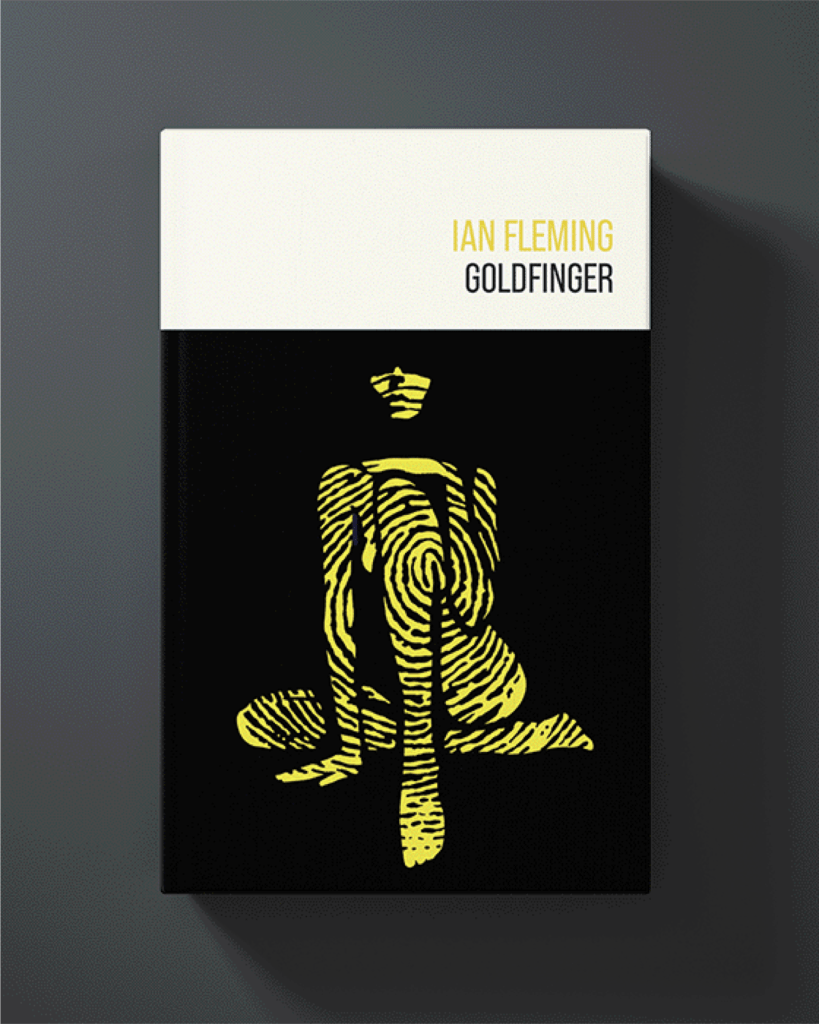
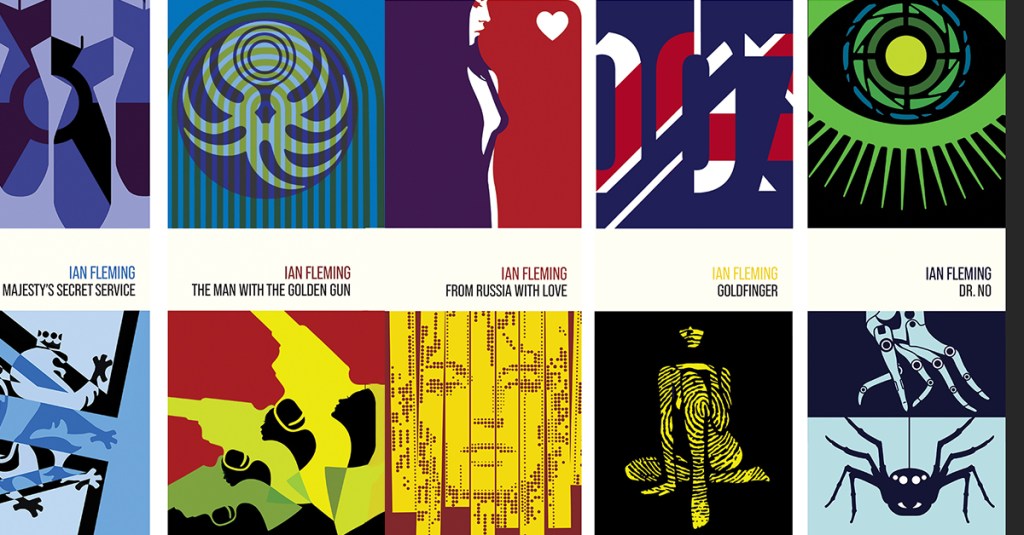
Michael Gillette is an artist, a true artist. Over the past thirty-five years or so, as a painter, illustrator, cartoonist, designer and creative mind, he has produced a boggling torrent of material – in range and volume – primarily inspired by pop music and pop culture. His clients over the years have included Saint Etienne, Elastica and the Beastie Boys, and his work has appeared in a wide range of newspapers and magazines ranging from Select and Q to The Observer and the New Yorker. If you’ve bought any or all of Ian Fleming’s James Bond novels since 2008, chances are Michael’s done the cover art. But it’s a challenge to summarise that kind of career in a single paragraph, so in the first instance, I urge you to check out his website, michaelgilletteart.com, and a book of some of his many highlights, Drawn in Stereo, published in 2015.

I always sensed Michael would flourish as an artist. The clues were there early on, when we were at junior school in Swansea. Just watching him draw anything was captivating. He was amusing and thoughtful. At the turn of the 1980s, just as the lure of pop history dragged me in, so he’d seen the BBC2 season of Beatles films, and connected profoundly with that pop history’s ultimate figureheads. From then on, for several years, we discussed pop a lot. I now realise this was one of the main reasons to go to school.

At sixteen, Michael moved to Somerset with his family, and then gravitated to Greater London, graduating from art school in the early 90s, and soon finding his skills, talents and wit in considerable demand. As an obsessive reader of the music press and broadsheet newspapers, I saw his work everywhere – and yet somehow still didn’t quite connect this with the talented friend I’d known early on. For reasons that will be explained in the conversation that follows.

The penny dropped when I found Michael’s website in the early 2000s. By then, he was living in San Francisco. We had a long catch-up chat on the phone, and have kept sporadically in touch ever since – and then finally, this year, we had a catch-up in person, in the pub. Which inspired me to ask him if he’d like to do First Last Anything. I was thrilled when he agreed, and so one day in November 2025, we spoke via Zoom: me in Swansea, Michael in St Louis, Missouri, where he now lives with his family. Coming up, amongst other things: what it’s like to house-share with Aphex Twin, the outcome of a commission for Paul McCartney (yes, Paul McCartney), and living and working as an artist and how to share that kind of experience as a teacher and educator.   

—-

JUSTIN LEWIS:

So, to begin at the beginning, what music do you remember early on in your home?

MICHAEL GILLETTE:

With mum and dad… Mum was listening to mostly classical music, Schubert’s The Trout, and Holst’s The Planets, I recall… and maybe a few pop albums. The Beatles ‘Red’ and ‘Blue’ albums, and the Greatest Hits of the Carpenters on repeat. Oh! And the The Beach Boys, 20 Golden Greats with an airbrushed painting of a surfer on the front. The musical equivalents of having a dictionary in the house.

Dad, I was not aware of his musical preferences. He saw Gene Vincent and Eddie Cochran play in Birmingham as a teen but in those days, you were only allowed to be a teenager for about fifteen minutes, right? He packed it away. He listened to Jimmy Young who would have been on Radio 2, or Radio 1…

JUSTIN LEWIS:

He was on Radio 1 in the mid-mornings when that started and then around 1973 moved to Radio 2.

MICHAEL GILLETTE:

So it would have been wall-to-wall Radio 2, that’s what I can remember.

JUSTIN LEWIS:

You’d have Terry Wogan on in the morning.

MICHAEL GILLETTE:

Oh yeah, for sure. And apart from that, it was just the homogeneity of the 1970s TV –  Top of the Pops for Goalposts.

JUSTIN LEWIS:

It keeps coming up in these conversations for those of us in that generation. And there wasn’t a lot else, really.

—–

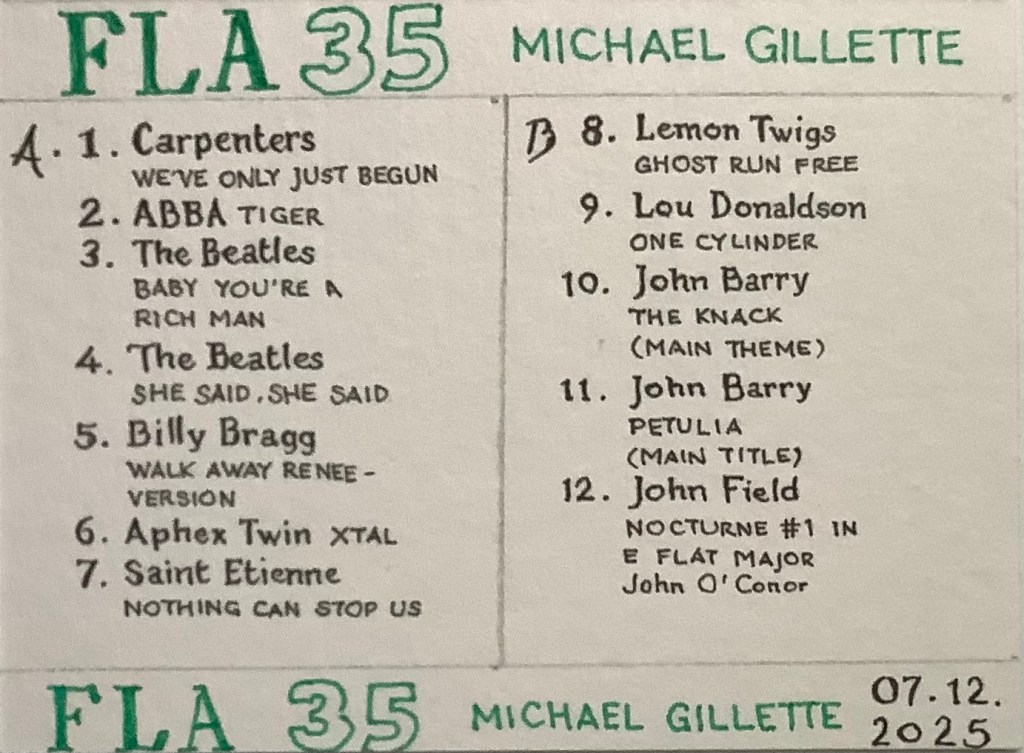
FIRST: ABBA: Arrival (1976, Epic Records)

Extract: ‘Tiger’

JUSTIN LEWIS:

We had this album as well in the house, although I think my dad borrowed it off someone for a while. But we were playing it a lot. But I remember coming to your house at the time and you had this album, along with – if I remember correctly – the first Muppet Show album.

MICHAEL GILLETTE:

Yeah, that makes sense.

JUSTIN LEWIS:

Which we put on. So how did you come to Arrival, then?

MICHAEL GILLETTE:

I think I had it for my seventh birthday, so I must have asked for it. I just think it was in the culture: Look-In, posters on the wall etc.. I’m sure they were on Seaside Special and things like that. Unavoidable, right? Utterly fantastic. And immediately sticky [laughs].

JUSTIN LEWIS:

The people who are ten years older than us thought ABBA were ridiculous.

MICHAEL GILLETTE:

They must be deaf.

JUSTIN LEWIS:

Because, firstly, ‘it’s Europe’ and unless it was Kraftwerk, no pop from Europe was meant to be any good, apparently. And then punk rock happened in Britain, even though ABBA were already making brilliant singles, and the Sex Pistols liked ABBA, for instance. And subsequently, there was a critical revival with ABBA – I remember Elvis Costello saying of ‘Oliver’s Army’… I’m sure you know this…

MICHAEL GILLETTE:

You can hear it – the piano.

JUSTIN LEWIS:

He used to cover ‘Knowing Me Knowing You’, live.

—–

JUSTIN LEWIS:

Towards the end of junior school – so this is 1980, 1981 – I remember two or three massive Beatles fans in our year, and you were one of them, and I remember talking to you about it. So you had the ‘Red’ and the ‘Blue’ albums in your house, but what was the next step for you with Beatles fandom?

MICHAEL GILLETTE:

Aw – BBC, Christmas 1979 – they showed all the films. I remember the Shea Stadium one, and especially Magical Mystery Tour

JUSTIN LEWIS:

Which I don’t think had been on since the first showings [over Christmas 1967 – once on BBC1 which was still monochrome, and days later on BBC2 which had just begun broadcasting in colour].

MICHAEL GILLETTE:

I remember watching that in my grandparents’ house in my Cub Scout uniform [Friday 21 December 1979, BBC2, 6.10–7.00pm], and looking at it – because there’s a bit with a stripper in it which I was watching via a convex mirror because I thought ‘I can’t just turn around and watch this!’

That Christmas was the introduction, really.

JUSTIN LEWIS:

You having your Cub Scout uniform on suggests we must have been to some Cub event, because we were in the same pack. I’m trying to think what that might have been.

[The other showings of Beatles films that Christmas:

Sat 22/12/79, BBC2 1835–2000: Help!

Sun 23/12/79, BBC2, 1740–1830: The Beatles at Shea Stadium [first showing since 1966]

Mon 24/12/79, BBC2, 1740–1900: Yellow Submarine

Tue 25/12/79, BBC2, 1500–1625: A Hard Day’s Night

Wed 26/12/79, BBC2, 1750–1910: Let It Be]

MICHAEL GILLETTE:

They just made me never want to wear a uniform again. It sparked off something :‘What on Earth is this? How do people get to live like this?’ It was the whole package – to see the comedy and the style. I’ve always had these two things together – visual/musical – and seeing them [together] made a massive difference. No regular job plans after that.

JUSTIN LEWIS:

One of the themes of your career, really, is how you’ve channelled pop music into artwork, but with the Beatles, I feel as if you’ve particularly latched on to the fantasy and mythology over the reality of them. I’m not suggesting you haven’t studied the latter! But it’s about setting the imagination free, and Magical Mystery Tour certainly encourages that. As much as something like Get Back would show them making a record in real time, you get this other side to them which has them having adventures. Like they’re comic book characters.

MICHAEL GILLETTE:

Yeah. Perfect for children, as a gateway. It was the scarcity of it. Even though it was on at Christmas that year, after that, it was gone. Until John Lennon died.

Just before he died [December 1980], I remember you used to write the charts out every week, and I saw that John Lennon was in with ‘Starting Over’, [a brand-new single]. And I was like, ‘What do you mean, John Lennon’s got a new single out?’ When I heard it, I couldn’t equate it with The Beatles, it seemed like a dimmed bulb. So when he died, part of me felt, ‘Oh great, The Beatles are now everywhere!’ I was spending all my pocket money on everything I could get, all that merchandise that appeared!  It’s a terrible way to think about it really.

JUSTIN LEWIS:

But he’d also been away for five years, of course, prior to that single, which is a long time. And were you a John fan or a Paul fan?

MICHAEL GILLETTE:

I didn’t know who sang what until later. When I started buying their records, I would look for the albums with the least amount of music that I already knew, to get the best value out of it. The first one I bought was Revolver.

JUSTIN LEWIS:

Funnily enough, the critic David Quantick once pointed out [on the superlative Beatles podcast, Chris Shaw’s I Am the Eggpod] that Revolver (along with the ‘White Album’) is probably the least well represented album on ‘Red’ and ‘Blue’.

MICHAEL GILLETTE:

Yeah, that’s why I would have bought it. ‘She Said, She Said’ – that song really opened things up for me, it’s in my DNA. I don’t think Paul McCartney’s even on that song. 

JUSTIN LEWIS:

An enduring Beatles mystery, so many conflicting accounts and fragments of evidence.

MICHAEL GILLETTE:

I read a lot of philosophy and psychology. Partly it’s helped me understand and justify pop’s importance rather than its triviality. Pop’s taken up a lot of my bandwidth!

I learnt a lot from René Girard, who, as an anthropologist at Stanford in the eighties, coined theories around mimetic desire. We’re all porous to suggestions and mimic others. We desire what other people desire. We can also hate what other people desire. This causes tribalism and scapegoatism. Girard’s warnings are important because many Silicon Valley bros, including Peter Thiel, took his class. They saw his cautions as business models. Look at how that’s played out with social media… 

Anyhow, I thought, ‘oh, this is kind of what happened to me with the Beatles and pop music.’ The Sergeant Pepper cover – it’s a mimetic map of culture, religion, art, everything. Probably 90 per cent of my interests all connect back to the Beatles. Ultra mimetic.

We both grew up during the high watermark of youth cults [JL agrees]… music with distinct looks and styles…These are explained by mimetic theory too. We were kind of outside it in Wales – couldn’t get the right clothes [laughs], but it saturated those impressionable years for our generation, right?

JUSTIN LEWIS:

Yeah – you’d look at London or Manchester and you’d think, ‘How do you get to go there then, a city where it’s all happening?’ Because nice beaches that there are, amazing coastline, Swansea didn’t really have that kind of magic. Bands didn’t come very often, and it wasn’t easy to go and see people if you were under eighteen.

MICHAEL GILLETTE:

Billy Bragg I managed to see in Swansea, a miners benefit gig [7 April 1985 – Easter Sunday, in fact]. At the Penyrheol Leisure Centre. I saw The Alarm there too [16 November 1987].

JUSTIN LEWIS:

Just before we move on from The Beatles, though I’m sure we won’t move too far, can you tell the story about your Paul McCartney album sleeve commission? Because this is extraordinary.

MICHAEL GILLETTE:

I’d done some work for the Beastie Boys, an animation for their [To the 5 Boroughs] tour (2004/05). They were signed to Capitol Records. The lady I was dealing with there rang me one Friday afternoon, and said, ‘Paul McCartney is coming in on Monday and we’re going to do a “Greatest Love Hits” – for the first time, a compilation of his Beatles and post-Beatles work.’ They were very specific: ‘We want him doe-eyed and lovely, from ’67, ’68…’ I was like, ‘Can do.’ So I worked over that weekend, so confused at how this had happened. Anyway, I did it, and the next week they got back to me: ‘Oh he’s just come in, and no Love album for him, he’s getting divorced.’ So that was the end of it. They said, ‘Oh he says it’s really great, he really likes it!’ They tried to buy the artwork. That was the closest brush with my obsession.

JUSTIN LEWIS:

I knew you as a brilliant artist even at school, but what sort of sleeve art was inspiring you back then?

MICHAEL GILLETTE:

Well, anything to do with the Beatles!, so, Klaus Voorman, Peter Blake and then Richard Hamilton – there’s three. My mum would buy me bargain bin books from WHSmiths in Swansea. One of the first was a Rick Griffin monograph. He was one of the San Francisco psychedelic hippy poster artists – all imagery inspired by music. Another was by the artist David Oxtoby, Oxtoby’s Rockers. He was a contemporary of David Hockney, from Bradford. He did incredible paintings of rock stars. I was twelve and had chicken pox when I got it – after two weeks off school itchily looking at this book, this massive door had opened in my mind. I thought, ‘Oh, this is also possible’ [laughs].

When I eventually visited San Francisco for the first time in 1997, the posters of the ‘60s had acted as sirens. I ended up living just a couple of streets away from where Griffin made most of his famous work in the late sixties. I used to pass his old house every day. He was long gone by then. He died in a motorbike accident in the 1990s, he’d been doing covers for The Cult just previously. He became a born-again Christian in 1969 and moved down to Southern California and became a massive influence in that world. An amazing character.

—–

JUSTIN LEWIS:

I’m going to quote from your excellent collection of artwork, Drawn in Stereo. ‘Art wasn’t my first career choice. I wanted to be a pop star.’ Now, I knew you were a good guitarist, that’s what I remember, but I hadn’t quite realised you had that in mind, so I was quite surprised to read that.

MICHAEL GILLETTE:

Yeah, I wasn’t that good at music. When we moved to Somerset, I did my art foundation year in Taunton. The West Country had a good music scene. PJ Harvey came out of that time and place. In Taunton, bands were everywhere… When I got to Kingston Art School, no-one was interested in forming groups. Disappointing. The thing about getting into colleges that are ‘good’ is people are focused on the job at hand! I wasn’t. I was in a band for the first year… but I just knew: Nope – you don’t got it.

JUSTIN LEWIS:

The thing about being in a band – maybe even if you’re a solo artist – is there’s a career arc you’re expected to follow, and it’s all about compromise. Whereas if you’re an artist, you can surprise yourself. You’ve got the freedom to be inventive. And it seems to me, given what you’ve gone on to do, you’ve just kept changing. You’ve never stuck to one thing for too long.

MICHAEL GILLETTE:

I was reared on that Beatles or Bowie [arc] to keep changing and evolving. The visual side of music is such a rich seam to mine – you can tap into two completely disparate things like, say, two-tone and psychedelia and evolve something fresh. But yeah, you’re right. It’s a control thing, and you don’t have that in a band. I didn’t much enjoy being on stage. I got very nervous, I’d play real fast.

JUSTIN LEWIS:

Were you trying to write songs, by the way?

MICHAEL GILLETTE:

A bit, with bands, but I didn’t have that gift on my own. I thought I would join a successful band at art school. Instead, I graduated off a cliff. At the end of Kingston, in ’92, some student friends knew Richard – the Aphex Twin and we all moved to Islington together. I didn’t know his music at the time, but holy WOW!

JUSTIN LEWIS:

The first time I heard him, that first album [Selected Ambient Works 85–92, 1992]: ‘What the hell is that?’ I was listening to quite a lot of electronic music at the time, but that felt like a real departure from everything.

MICHAEL GILLETTE:

I knew he was groundbreaking – anyone with half a tin ear could tell that. I think the groups I was involved with, during Britpop, were fantastic fun, but there was already so much of the guitar pop canon established. Richard was off the maps making his own worlds.

JUSTIN LEWIS:

Yes, I love Blur, but… a lot of it was good pastiche, but pastiche nonetheless.

MICHAEL GILLETTE:

I can understand pastiche, I personally don’t re-invent the wheel, I just put new rims on.

Oasis… I never saw them as Beatles-like, more Slade in Cagoules.

JUSTIN LEWIS:

But they weren’t going to reinvent themselves with every record like the Beatles did. We’ll come back to Aphex Twin in a second, but I just wanted to ask you about something else that happened in summer ‘92 when you’d just graduated from Kingston. You stuff an envelope of your stuff through the letterbox of Saint Etienne’s house in north London. I know that you’d really enjoyed Foxbase Alpha, their first album, but what made you think of choosing them to approach?

MICHAEL GILLETTE:

When did that album come out?

JUSTIN LEWIS:

October ’91. I remember I bought it the day it came out.

MICHAEL GILLETTE:

Okay, I must have too. In late 1991, I was in Russia on a month-long student exchange, I had it on tape, and listened to it there. That album’s very atmospheric and kaleidoscopic – it fit Moscow. Back in London, I listened to it driving around, it fit there too. ‘Nothing Can Stop Us’, what a fantastic song. Bob Stanley told me they paid £1,000 to clear the Dusty Springfield sample. Money very well spent.

Meanwhile, I fell out of Kingston. I wasn’t ready to leave college, I’d been expecting to do an MA – at the Royal College of Art, but they passed. In that last month of Kingston, I realised I’d better start approaching people. It was almost a desperate thing. I knew Saint Etienne were working on another album. But there was some magic involved, definitely – Foxbase Alpha, finding their home address on the back of the ‘Join Our Club’ single, picking them to stalk … They understood my fandom.

JUSTIN LEWIS:

Yeah, that first album, in the booklet, you’ve got all these photographs of icons, so Micky Dolenz is there, Billy Fury, Marianne Faithfull… Eight or nine of them.

MICHAEL GILLETTE:

It’s another mimetic gateway. The glamour of formica caffs that’s open to all. It wasn’t like the eighties, where you needed a zillion dollars to go into the studio and make some shit, atmosphere-free record; all boxy drums and Next suits with padded shoulders. Instead, it was the longings of the fan, lost treasures and pop theories. That record has a dreamy hiraeth.

I stuffed that envelope through the letterbox, went back to Surbiton for the last couple of weeks college. Next, I went up to Heavenly, their record company, rang the bell. Martin Kelly, their manager, opened the door and said, ‘Oh, they told me about you. Come on up!’ I thought, ‘My god, it’s this easy?! This is great! Is this how it’s going to work?’ And of course it doesn’t often work like that. Magic was afoot. You have to knock though.

JUSTIN LEWIS:

They’ve always been very interested in the contemporary, but shot through with something of the past at the time.

MICHAEL GILLETTE:

Yeah. Reinterpreting the past, excavating and curating. Bob Stanley was like meeting an older cousin who knew everything about pop. So anyway, that’s what happened, and they paid me £2,000 which was a lot of money straight out of college. I didn’t see money like that again for a long time.

JUSTIN LEWIS:

And then you started to do bits for Select magazine, right? Which was a sort of indie-dance version of Q magazine, for those who may not remember.

MICHAEL GILLETTE:

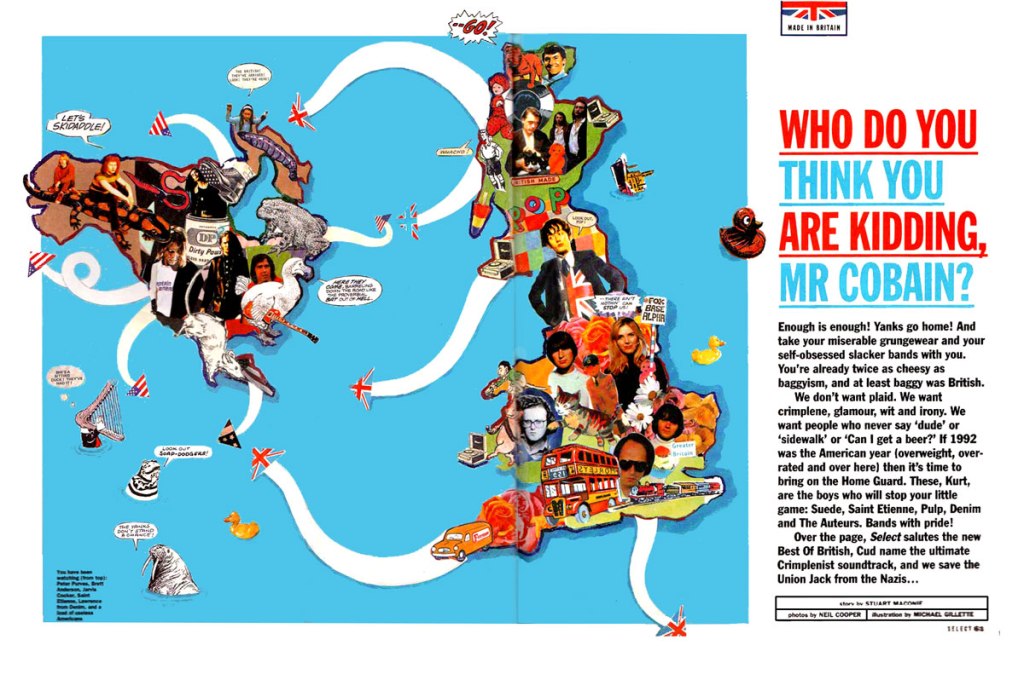
My flatmate Stu’s brother [Andrew Harrison] was the editor of Select. Andrew had a ‘no nepotism’ rule, he couldn’t be seen giving jobs for the boys. But when he found out I’d worked for Saint Etienne, he was like, ‘You must be bona fide.’ So that’s how I got the job doing the illustration for the Stuart Maconie article about Britpop [Select, April 1993 issue].

JUSTIN LEWIS:

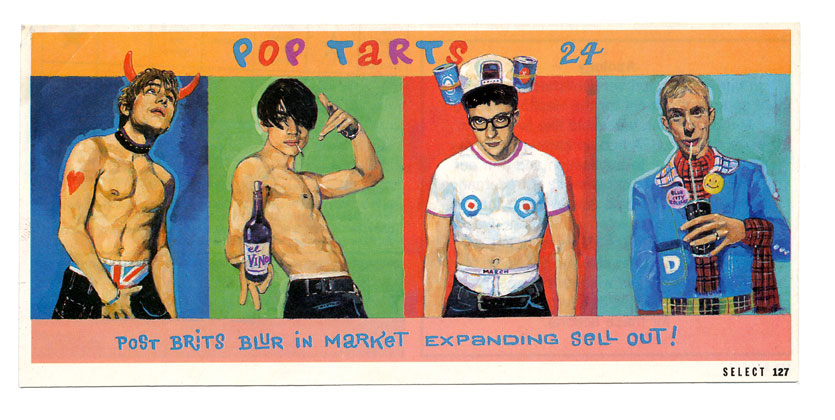
And then you did this regular feature called Pop Tarts, every month, and it’s reminded me how much you made me laugh in schooldays. Because you found room for humour and irreverence as well in many of these pieces.

MICHAEL GILLETTE:

Definitely. When I left college, I was a headless chicken, didn’t know what to do, and was thinking, ‘I’m only going to make serious work, try and do stuff for Faber & Faber’. Then I thought: ‘That’s not who I am – humour is really important.’  That’s yet another lesson from the Beatles – they could reach the highest rung of an artform and still be silly.  I can’t bear serious pretension – when the scene gets pretentious, I get really uncomfortable. I did fifty Pop Tarts. By ’96 I couldn’t take it anymore, but it was a good calling card for a while.

JUSTIN LEWIS:

That might be the longest-running thing you’ve ever done, then.

MICHAEL GILLETTE:

It probably is, yeah.

JUSTIN LEWIS:

And then you’re doing newspaper commissions, you’re in a lot of the broadsheets in the late nineties, doing accompanying illustrations for things. I found a thing in the Telegraph archive of all places, a culinary feature.

MICHAEL GILLETTE:

I did The Observer for a year, too. I did their back page column called ‘Americana’. Louis Theroux wrote many of the articles. I came back to London this last summer, went to Bar Italia, and there’s a drawing I did – maybe for the Telegraph – framed on the back wall! It was about Italian clothes culture, and I had decided to include Bar Italia. Not a work of genius, but when I saw it, I was thrilled [laughs]. I couldn’t think of a better place to hang!

JUSTIN LEWIS:

How do you feel in general now, seeing work you did thirty years ago or longer?

MICHAEL GILLETTE:

I’m just glad to be alive, and to have been able to make a creative living. Sometimes I have barely any recall of pieces – the Bar Italia picture for example. I’ve made so much stuff, it’s a rodeo schedule. I chose pop media – magazines, books, records, videos – rather than gallery art where ten people might see it. I wanted to be seen. It’s a really proletarian art form. Masses of art for the masses.

JUSTIN LEWIS:

Your stuff did get everywhere, and I saw a lot of it, although somehow I didn’t make the connection that it actually was you for some time. I should explain here that your surname has grown an extra ‘e’ at the end since we were at school.

MICHAEL GILLETTE:

Either Select added that to my name or maybe Saint Etienne.

JUSTIN LEWIS:

Was it in error?

MICHAEL GILLETTE:

It was, yeah. But I wasn’t going to argue with that. I just let it go. Everyone was dropping Es in the nineties. I picked one up.

JUSTIN LEWIS:

So what did you do for Saint Etienne’s So Tough album? You certainly came up with the logo, right? And you designed the cover?

MICHAEL GILLETTE:

I initially did a painting of the 1970s photo of Sarah, which her father took. They went with his photo for the cover, which was the right decision. I did paintings of Bob and Pete for the inner sleeve. I wasn’t match fit yet. I hadn’t advanced much at college. I comped together some logos and they went with one set in a font called Bunny Ears.

JUSTIN LEWIS:

And that was the logo they used when they first went on Top of the Pops, for ‘You’re in a Bad Way’.

MICHAEL GILLETTE:

I was so excited: ‘My logo is up there.’ A little bit of me is on TOTP.

JUSTIN LEWIS:

So, with Aphex Twin, you were living in the same house around this time, 1992–95, three years or so. Was that a creative environment, a chaotic one, or both?

MICHAEL GILLETTE:

Both, definitely. We lived in two different locations. In the first one, he and his girlfriend lived above us. So my introduction to him was through the floorboards, really. He was right above my bedroom, it would be very quiet for long periods of time, when he was listening through headphones making stuff, and then it would be uproariously loud and sometimes terrifying, sometimes beautiful.

Then we moved to Stoke Newington and he had a tiny studio in the midst of the flat, so there was no separation. There were a lot of people coming and going, hangers on, and basic early twenties bad behaviour from young creative types. We all wore each other out because we were so much in each other’s pockets. But everybody was interesting and funny. And for all that people think of Richard, he was not a pretentious human being.

JUSTIN LEWIS:

I always think there’s quite a lot of humour in what he does anyway.

MICHAEL GILLETTE:

Yeah, often puerile!

JUSTIN LEWIS:

How did his remix for Saint Etienne’s ‘Who Do You Think You Are?’ come about? Is it true you were a sort of messenger with that?

MICHAEL GILLETTE:

I asked him, yeah. I hadn’t known him for long – and I wouldn’t say I had the capability to sway him in any way, but he was open to doing stuff at that time. I think he did a good job.

JUSTIN LEWIS:

I find it quite funny he did it, given the choice of song. Because I can imagine him being offered ‘Avenue’ to remix, for instance, but ‘Who Do You Think You Are’ (nothing to do with the Spice Girls by the way, this was earlier!) was a cover version of a song recorded by the Opportunity Knocks-winning comedy showband Candlewick Green in 1974, and the Saint Etienne remake had the potential to be a huge hit. And it’s not a remix you’d expect from a commercial single at all. But then Saint Etienne were great at being leftfield pop stars.

MICHAEL GILLETTE:

I’m sure they were elated with that remix. I don’t think they were looking for a Fatboy Slim banging track.

JUSTIN LEWIS:

And you did some video work for Elastica too.

MICHAEL GILLETTE:

I did two animations for their videos, which was very stressful, and some sleeve work for them too.

JUSTIN LEWIS:

The ‘Connection’ single.

MICHAEL GILLETTE:

I did a painting for that, so I saw them from lift off to stratosphere. Justine [Frischmann] moved to Northern California in the noughties. We wound up living in the same neighbourhood – she helped us out to move there after we left San Francisco, so that was an enduring connection from that time.

JUSTIN LEWIS:

In 1997-ish, you finally got to visit San Francisco because, as I understand it, you had a show on at the Groucho Club in London and lots of wealthy people bought lots of your work, and so you could afford to go. Is that true?

MICHAEL GILLETTE:

Yes, that is exactly what happened. I had a show at the Groucho the same week that Labour were elected – a high watermark and possible end of Britpop – and I sold 14 out of 20 pictures.

JUSTIN LEWIS:

And Jarvis Cocker bought one?

MICHAEL GILLETTE:

Well, you know Ant Genn? He played with Elastica, he’d been in Pulp [and now writes scores for film and TV, including Peaky Blinders]. He bought three, one of which was for Jarvis, but Jarvis ended up paying for all three. I don’t know why. Who else bought one? Graham Linehan, who was then working at Select, Damon Hirst’s manager…’90s Soho.

JUSTIN LEWIS:

Do you ever miss Britain? You’ve been living in America a long time now.

MICHAEL GILLETTE:

Yeah, twenty-four years. Pound for pound, Britain punches harder than anywhere else. Music, comedy, history… I do love it. I feel a bit claustrophobic there now. I wish I’d spent more time visiting antiquity. I guess you always want what you haven’t got, right? Here, I want something pre-Victorian. I want to get my hands on something ancient!

—–

LAST: THE LEMON TWIGS: ‘Ghost Run Free’ [2023, from Everything Harmony album, Captured Tracks Records]

JUSTIN LEWIS:

Lemon Twigs have come up before on this series, and rightly so [FLA 24, Alison Eales]. What was it about ‘Ghost Run Free’ in particular?

MICHAEL GILLETTE:

Well, it’s like the offspring of The La’s and Big Star, isn’t it? I’d adopt that kid and bring them up as my own. Just instant ear candy, pressing all my buttons. I’ve played that song a lot – I like the rest of the album, but something about that song absolutely chimes. I was lucky to see them play here in St Louis – people tend to skip over the Midwest. I decided to wear a hat and stand at the back, not to spoil the kids’ fun. But the audience were all older than me! It was almost like a vampiric ritual… the band’s so young, what must it be like for them, looking out at the Night of the Living Gen Xers?

JUSTIN LEWIS:

It’s a breath of fresh air, this album, and while there’s lots of stuff I like at the moment, you don’t tend to get things that are big on chords, harmonies or melodies charting particularly highly. It’s unusually tuneful – the last time they got picked on this, I was referencing early seventies Beach Boys and Todd Rundgren, but now I can also hear Crosby Stills Nash and Young in it, even Roy Wood’s Wizzard.

MICHAEL GILLETTE:

They can all play, the band’s been together a while. They look like they were made in a pop culture laboratory. Live, they’re all swapping instruments. And then you’ve got the two D’Addario brothers, like the Everlys, Kinks or the Bee Gees. I’m going to quote Noel Gallagher here – ‘brothers singing is an instrument you can’t buy in a shop’. Like ABBA, where harmony and melody is absolutely everything. There’s always a chorus with multiple voices, so you feel like you’re included in the song. That’s one of Brian Eno’s pop observations/recipes.

Most songs I really love have got harmonies. Apart from The Smiths – I don’t know why they never had that.

JUSTIN LEWIS:

That’s a good point. I suppose with them, the harmonies are in the guitars.

MICHAEL GILLETTE:

Yeah, but Johnny Marr can sing – he’s got a good voice. Why did they never sing together? I suppose Morrissey won’t share his crisps.

—–

ANYTHING: JOHN O’CONOR: Nocturnes of John Field [1990, Telarc/Concord Records]

Extract: ‘Nocturne #1 in E flat Major’

MICHAEL GILLETTE:

I came to a point where pop music was just frazzling me. To quote that ‘Alfred Prufrock’ poem by TS Eliot: ‘I’ve measured my life out in coffee spoons’, whereas I’ve measured my life out in poppy tunes. There just came a time, especially working and reading, for [something else] and hearing these Nocturnes…

JUSTIN LEWIS:

What sort of age were you?

MICHAEL GILLETTE:

Oh, late forties. I’d always listened and worked to lots of soundtrack stuff, John Barry, Lalo Schifrin… But here, just the solo piano is so peaceful. Going from a world where I know everything about a musician, to this, where I didn’t know anything. I just listened without any baggage – a blank slate.

JUSTIN LEWIS:

Can you remember how you came across it, then?

MICHAEL GILLETTE:

I really don’t know. Maybe through YouTube’s algorithms… do you know anything about John Field? [Born in Dublin, 1782, lived till 1837] He had a riotous life. He was basically a rock star. His life would make a great film, Barry Lyndon-esque. Eventually I looked him up, but for years I knew nothing but the music.

JUSTIN LEWIS:

I knew the name, but it transpires he invented the nocturne form. Chopin was a fan. So he’s an innovator.

MICHAEL GILLETTE:

Yeah, I’m no connoisseur. I’ve listened to Chopin’s Nocturnes, I don’t enjoy them as much. Satie’s are good too, but Field’s are like an instant warm bath, reliably calming.

I’ve been thinking about the Aphex Twin this last couple of weeks because one of my students at college was drawing his logo over and over.

‘Oh, the Aphex Twin,’ I said.

‘Do you know that guy?’

‘Actually, yeah, I do know that guy.’

Then yesterday, my screen printer was wearing a homemade Aphex Twin T-shirt, with a picture of Richard in the Stoke Newington house studio. I’ve found folks want to keep the mystique of him intact. We are so overloaded with information. I think the mystery allows for purer engagement.

I feel like that about classical music. I won’t reach the point where I need to know what the third horn player had for his tea and how that affected anything. You know what I mean?

JUSTIN LEWIS:

When we were at school, the running joke about pop trivia knowing no bounds would be ‘What colour socks was Paul McCartney wearing when they recorded “Get Back”’?, and now the Get Back film exists, you can bloody well find out! It’s ridiculous really. I suppose thirty, forty years of reading the pop music press has created this frame of mind, and you can’t do that with everything. One of the nice things about new music now is I often come to things and I don’t know anything about them, who they are, nothing beyond the bare bones. It’s like being eight again.

MICHAEL GILLETTE:

It is. What I see with my children is they’re not interested in context, it’s all delivered scrolling on a phone. Recently, my daughter learnt to play ‘Love Grows Where My Rosemary Goes’ on the violin, and I asked:

‘How do you know that song?’ 

‘Instagram… How do you know it?’

‘It’s from the late 1960s.’

‘Oh I thought it was new.’

It’s trending audio… stuck behind reels. Folks use trending audio, and the algorithm boosts the post. It’s kinda greasy. My daughter was humming ‘Golden Brown’’, same thing – it’s used on medieval themed reels.

We were groomed [laughs] to be obsessed with pop minutiae. Now, it’s just another bit of content in the feed. They do introduce me to some new music though, Olivia Rodrigo I enjoy.

JUSTIN LEWIS:

Well, we were in the analogue age where knowledge was difficult to come by, so you’d collect fragments of information until you had far too much of it all. [Laughs] That’s what happened.

MICHAEL GILLETTE:

YES! – the scarcity back in the day. So maybe what I’m trying to do with jazz and classical music is to go back to pre-knowledge. I love Lou Donaldson, I love his music, but I wouldn’t know him from… Donald Duck. I know he’s Mr Shing-a-Ling. But I don’t really have any interest beyond listening and enjoying.

JUSTIN LEWIS:

And it makes it more random, you can make your own connections with it. For a long time, we got used to other people shaping music history, and now I guess you can create your own experience.

MICHAEL GILLETTE:

Totally. That’s the big difference. When you used to bring Smash Hits in to school, and we’d pore over it at lunchtime, Mark Ellen was the editor at the time. That Britpop illustration I mentioned earlier… Mark Ellen [by 1993, the Managing Editor of Select] was who I handed it over to. Did the obsession bring that to pass? I suppose what you give your attention to grows.

—- 

JUSTIN LEWIS:

You’ve designed [in 2008 and again in 2024] two very differently styled series of covers for Ian Fleming’s collection of James Bond books. Did you read the Bond books as a kid, or did you connect with the films first?

MICHAEL GILLETTE:

My dad had the books, Pan paperbacks from the sixties – great covers. They were stashed away in my bedroom in a little attic space. I read them when I was probably 12, 13… but the films… apart from occasional Bank Holidays, I don’t really remember them being on much. Do you?

JUSTIN LEWIS:

I don’t think they were on TV much before the eighties.

[Note: The first Bond film to be shown on British TV was Dr No, on ITV, on Tuesday 28 October 1975. In January 1980, the UK TV premiere of Live and Let Die attracted 23 million viewers on ITV, still unbeaten for a single showing of a film on British TV.]

JUSTIN LEWIS:

The main thing I remember with Bond was going with my dad and my brother to see a double bill at the Swansea Odeon on the Kingsway [don’t look for it, it’s not there anymore], this would have been Summer ’78. It was Live and Let Die and The Man With the Golden Gun, a double-bill. Two hours long, each of them, that’s a long afternoon. Especially when you’re eight years old. It’s actually a long time since I’ve seen a new Bond film. But I was also wondering to what extent the music of Bond films inspired those designs of yours. Were you thinking a lot about John Barry scores?

MICHAEL GILLETTE:

I do absolutely adore his music, yeah. Because I’m involved in the Bondiverse, I understand people are as passionate for 007 as we are for bands. I understand the draw of Bond. My job as a designer is to translate visually as a composer would do musically. The most enduring Bond thing for me is Barry’s scores, so sophisticated and timeless.

JUSTIN LEWIS:

They really hold up, as do the themes which generally hold up better than the films. Not many duds, surprisingly.

MICHAEL GILLETTE:

With John Barry, it’s the whole score… Things like Petulia from 1967, that’s a great soundtrack, or The Knack, and The Ipcress File. I listen to those more. I’m not an obsessive in the Bond world. And that possibly helps because you can get lost in detail. It helps to take a wider view.

JUSTIN LEWIS:

I was just thinking: have you ever tried to pastiche the Beatles’ album sleeves?

MICHAEL GILLETTE:

The only thing I remember doing, and it’s in Drawn in Stereo, is Oasis as the Yellow Submarine characters for Q.

JUSTIN LEWIS:

Of course, that’s right.

MICHAEL GILLETTE:

But otherwise, for years, I felt like I didn’t have enough skills to represent what they meant to me.

JUSTIN LEWIS:

You were too close to it!

MICHAEL GILLETTE:

But record sleeves remain the same and book covers keep changing. It’s interesting why that is.

JUSTIN LEWIS:

Why does that happen, I wonder? Even modern books do that – often the paperback edition six months later looks nothing like the hardback.

MICHAEL GILLETTE:

Music and visual culture are so locked together, I can’t disassociate them. I can’t imagine 2-Tone without that Walt Jabsco image. With a book, you don’t just stare at the cover for hours while you’re reading it. But a record… think of that bus journey between HMV in Swansea and home, where all you’ve got to look at is the sleeve.

Doing the Bond covers both times… immediately the reaction from some fans was that I’d performed an act of heresy. Changing record sleeves would cause a riot, unless you are Taylor Swift, but like many things about her, she defies logic and gravity.

JUSTIN LEWIS:

What’s your working routine like now? Do you sit at the desk every day, working on something, even if you’re just sketching?

MICHAEL GILLETTE:

Things have changed since COVID. My career has been mostly that of a rodeo illustrator: showing up every day, seven days a week, moving between clients, which went on for a quarter of a century plus. I don’t quite do that anymore. Now, I teach and do more selective commissions, because the world’s changed and I’ve changed. You know what it’s like with deadlines, right? For four years I worked for the New Yorker pretty regularly. I’d be about to clock off on Friday afternoon, and they’d e-mail and that’s the weekend done. For many years of my life, I leant in very hard.

JUSTIN LEWIS:

Are there things that surprise you about the young generation of new artists – in a good way, I mean?

MICHAEL GILLETTE:

I feel that we are fed a story that this generation is ‘hopeless and weak’. It’s been the same call since biblical times. By the end of teaching a class, or seeing my kids create, I have hope for us as a species. I believe in magic. I believe there’s an indomitable spirit of creativity that everyone’s got. We’re born with it, and we’re here to represent it the best way we can. I think that’s why people get unhappy when they don’t have outlets for their creative energy.

JUSTIN LEWIS:

It worries me in this country that young people are now supposed to only foster the talents that are going to get them a job or are going to get them a way of making money for other people rather than what they might actually be good at. And that’s really kicked in, in recent years. Obviously, education and passing exams is important, but what about the imagination?

MICHAEL GILLETTE:

Well, when you saddle people with debt in college, that puts an entirely different slant on it. The two grand from Saint Etienne paid off my student debt. I worked all the way through college to keep it low, but that’s the difference – I could afford a London life, albeit a tight one. Two thousand pounds at a time when my rent in Islington was £55 a week. That kind of maths wouldn’t work now with London housing. The pay for a similar gig in 2025 would be more or less the same, and cover about five weeks’ rent.

I’ve had a career, but it wasn’t encouraged, it was unlikely even then. Most folks who studied illustration didn’t become illustrators. Not saying that being an illustrator is the high bar of anything. We’ve saddled students with middle-aged debt and the anxieties that go with it. It’s unfair. As a teacher, I try to help as much as I can. My teachers were often art school bullies who’d give you a good kicking. Maybe that was the point; maybe if you survived that, you were strong enough for the outside world! But I try to do the opposite, I hope to encourage.

JUSTIN LEWIS:

What sort of age are your students?

MICHAEL GILLETTE:

19, 20, 21. They’re super-young, but the same impulses are inherent. There’s that beauty of openness and that’s why avoid telling them ‘it’s like this’ and ‘you have to do that’. You make it up [for yourself]. I made it up by knocking on Saint Etienne’s door. 

JUSTIN LEWIS:

You find a way.

MICHAEL GILLETTE:

You find a way, be creative. Where one person will walk into a room and see nothing but walls, another will find an open door. That’s why I believe in magic – it’s very mysterious how it all works. We’ve known that from all the music stuff we’ve read, the connections and the odd chances of luck.

JUSTIN LEWIS:

Nobody really knows where ideas come from.

MICHAEL GILLETTE:

Hundred per cent, yeah. Writer’s block, artist’s block… who’s doing the blocking? It’s not the universe, it’s the writer and the artist. You can shut it down really easily. [With creativity] it was never encouraged, but now it’s probably worse, it’s harder to freelance. But where there’s a will… I needed a period of time to be able to make mistakes, be slack, be lost and not worry about finances. Talent will out, but it needs support.

JUSTIN LEWIS:

Yes, particularly the process of trying out things and making mistakes. Unless you have particularly wealthy parents now, it’s difficult to do that. And especially when you’re young, you have the energy – you can stay up till three in the morning doing creative things.

MICHAEL GILLETTE:

You get an era where you can batter yourself almost to death and continue working and somewhat thriving. I’ve lived in two of the most expensive cities in the world – London and San Francisco – and managed to survive making artwork. It’s a bloody miracle. For younger people, maybe they’ll think in a different way, and it’s not about London or San Francisco, because those are overrun with investment bankers and tech workers… St Louis, where I’m living now, is different, it’s a post-industrial city, there are opportunities to live creatively.

In London, the generation before us had studios in Covent Garden. Our generation… my studio was in Hoxton Square. Now… Pushing out people who are regular human beings, let alone artists from a metropolis like London – that’s tragic. It’s everyone’s loss. But the fundamental soul of creativity that I see in young people is exactly the same. It’s like a timeless river. That spirit always makes me feel hopeful.

————-

All images in this piece (apart from my usual FLA header and cassette inlay) are (c) Michael Gillette. Thanks so much to him for allowing FLA to include them.

Much more on Michael Gillette at his website: https://michaelgilletteart.com

You can order the book directly from his website, here: https://michaelgilletteart.com/products/drawn-in-stereo-book

You can also order art prints for Michael’s James Bond book cover designs (pictured here): https://michaelgilletteart.com/collections/prints

You can follow Michael on Instagram at https://www.instagram.com/michaelgilletteart/

——

FLA Playlist 35

Michael Gillette

(For the time being, this site and project uses Spotify for the conversation playlists, but obviously I disapprove that Spotify doesn’t pay artists and composers properly, and other streaming platforms are available, as are sites to buy downloads and buy recordings. For consistency, you can also listen to the selections via YouTube (where available), and links are provided in each case, below.)

Thanks to Tune My Music, you can also transfer this playlist to the platform or site of your choice by using this link: https://www.tunemymusic.com/share/5yuhEgpQ6o

Track 1:

CARPENTERS: ‘We’ve Only Just Begun’:

https://www.youtube.com/watch?v=xeBoRF5tgDo&list=RDxeBoRF5tgDo&start_radio=1

Track 2:

ABBA: ‘Tiger’:

https://www.youtube.com/watch?v=htziQt0pCAQ&list=RDhtziQt0pCAQ&start_radio=1

Track 3:

THE BEATLES: ‘Baby You’re a Rich Man’:

https://www.youtube.com/watch?v=i5m-sgtwFck&list=RDi5m-sgtwFck&start_radio=1

Track 4:

THE BEATLES: ‘She Said, She Said’:

https://www.youtube.com/watch?v=NZOBWYHgZjw&list=RDNZOBWYHgZjw&start_radio=1

Track 5:

BILLY BRAGG: ‘Walk Away Renee (Version)’:

https://www.youtube.com/watch?v=iHrFkSeLukA&list=RDiHrFkSeLukA&start_radio=1

Track 6:

APHEX TWIN: ‘Xtal’:

https://www.youtube.com/watch?v=2tOutF8B3f8&list=RD2tOutF8B3f8&start_radio=1

Track 7:

SAINT ETIENNE: ‘Nothing Can Stop Us’:

https://www.youtube.com/watch?v=RAZUwvYqhpg&list=RDRAZUwvYqhpg&start_radio=1

Track 8:

LEMON TWIGS: ‘Ghost Run Free’:

https://www.youtube.com/watch?v=ewKdcUl3J7c&list=RDewKdcUl3J7c&start_radio=1

Track 9:

LOU DONALDSON: ‘One Cylinder’:

https://www.youtube.com/watch?v=F8RCGr8FEt0&list=RDF8RCGr8FEt0&start_radio=1

Track 10:

JOHN BARRY: ‘The Knack (Main Theme)’:

https://www.youtube.com/watch?v=k3utY_mJjK8&list=RDk3utY_mJjK8&start_radio=1

Track 11:

JOHN BARRY: ‘Petulia (Main Title)’:

https://www.youtube.com/watch?v=qhKQ1UT-MjE&list=RDqhKQ1UT-MjE&start_radio=1

Track 12:

JOHN FIELD: ‘Nocturne #1 in E Flat Major’

John O’Conor:

https://www.youtube.com/watch?v=2YJXgmLXTew&list=RD2YJXgmLXTew&start_radio=1

FLA 32: Joanna Wyld (09/11/2025)

Of all the guests I’ve had on First Last Anything so far, Kent-born Joanna Wyld might have worn the most musical hats. Writer, musician, composer, librettist, teacher and administrator, she’s played in orchestras, concert bands and pop groups, she has a passion for everything from bellringing to soul music, and has been a prolific writer of articles, liner notes and concert programme notes for many years. Her writing is always so perceptive, thoughtful, colourful, nuanced and (underrated quality, this) informative.

In conversation, Joanna is no different. What follows, the highlights from a couple of hours on Zoom one afternoon in October 2025, could easily have run twice as long. I love it when a conversation with a guest introduces me to many new pieces, and this is certainly one of those occasions. We both hope you enjoy reading it, and sampling Joanna’s wide-ranging listening choices – not only her First, Last and wildcard selections, but all her other suggestions too.

—-

JUSTIN LEWIS:

So to begin with, what music do you first remember hearing in your home? Because I know you have a very eclectic taste – was that always there?

JOANNA WYLD:

Yes, I think ‘eclectic’ is a really good reflection of my home growing up. I didn’t grow up in what you would describe as a musical household. Everyone loved music, but my parents weren’t classically trained – my dad can’t read music but loves it, my mum can read music, and plays the piano and the organ.

We were never told that a particular genre was better than others. We had a good eclectic range of records that we enjoyed playing. I think the first record I learned to put on the record player independently was The Beatles’ ‘I Want to Hold Your Hand’. And there were quite a few Beatles singles, but also my brothers and I would use music to capture our imaginations a bit. Because we’d hear ‘Oxygene’ by Jean-Michel Jarre when we’d go to the London Planetarium, it would be on if you were waiting to go in. So [at home] we’d use those kinds of experiences – we’d use a reel-to-reel tape recorder, and – I mean, we were very little, it was very silly – we’d write a type of sci-fi script with ‘Oxygene’ playing in the background as our soundtrack.

My relationship with sound was affected by certain things growing up. My grandad and my dad were – and my dad still is – bellringers, which I think is a hugely underrated discipline. We rightly praise the Aurora Orchestra playing things by heart – I went to see them do The Rite of Spring by heart [at Saffron Hall in 2023] and it was absolutely mindblowing, they deserve all the credit for that – but bellringers do that every weekend, three hours or more of memorised mathematical permutations while handling these unwieldly bells. If we’re going to be patriotic about something, I feel like that’s something to be proud about, because it’s unusual and it’s such a skill.  

With bellringing, there are these interesting patterns, but also these slight irregularities because it’s not mechanised – there are people doing this, and there are also these spatial qualities of sound that you get when you hear it resonating in a ringing chamber. With the tunings, you get these harmonics, these overtones, and sometimes they seem to vibrate or clash.

JUSTIN LEWIS:

There’s that way that bells can sound slightly off-key, which you sometimes get with distance and echo. Do you have perfect pitch, then?

JOANNA WYLD:

No, and actually, I suspect my relationship with tuning is a little bit strange because I grew up with this sense of music being a little more fluid, not necessarily fitting within these strict parameters we’re used to thinking about in terms of pitch. And I suspect that then influenced my love for composition and contemporary and 20th century music later, made me open to it, because I’d grown up with this variety of sounds, without that sense of hierarchy about it.

JUSTIN LEWIS:

And did you do some bellringing yourself?

JOANNA WYLD:

I did learn for a short while, but then I had an experience where a rope hit me – it is quite dangerous. My dad was there, and he grabbed it and it was fine… but I was a bit put off by that. Also, I don’t think I’ve got the mathematical brain to do all the actual methods, but I love the sound of it. It could almost be rebranded as mindfulness. If you listen, it’s got enough patterns to keep your brain interested – but it’s also quite mesmerising. I think, I hope, there is a new generation of people coming through who can do it. It’s in the category of things like dry-stone walling… almost like folk traditions. These things deserve to be continued in the least jingoistic way, just because they are interesting and skilful.

I have a CD called Church Bells of England, which is an incredibly sexy thing to own, and it has all these examples of ringing in various places. None of them are perfect in terms of the ringing or the sound quality, but they give a sense of what’s hypnotic about it. The example from St Giles, Cripplegate launches straight into these complex patterns, it’s so absorbing. And then you have composers who’ve drawn on this, from William Byrd’s emulation of change-ringing in keyboard music, to Jonathan Harvey’s wonderful Mortuous Plango, Vivos Voco, which samples the tenor bell at Winchester Cathedral. I heard it played during a London Sinfonietta concert and you felt like you were surrounded by the recording of the bell, it was a visceral experience.

——

JOANNA WYLD:

Classical music came in when we were in the car, we’d put cassettes on, and I did discover then that I really loved this music. This would have been from the age of about eight onwards… that’s when I started to play the flute.

JUSTIN LEWIS:

The exact age I started too, actually. Why did you pick the flute, then?

JOANNA WYLD:

Well, it was slightly by default, because in my primary school, which was very tiny, you could learn the piano, the violin or the flute. There were three teachers who came in, and I had more of a yearning to learn the clarinet, but it wasn’t really possible. It just wasn’t very practical – this is before we got our piano. My older brother had been learning to play the violin, so I kind of ended up on the flute because that was what was available. I mean, it took ages to get a note out of it, but it wasn’t a burning ambition to learn that particular instrument.

JUSTIN LEWIS:

Yeah, I think I wanted to play the violin, but I have a feeling my parents couldn’t have coped with the idea there’d be at least three years of scraping. I seem to remember we were watching something on TV, there was someone playing the violin absolutely brilliantly, and I recall saying something like, ‘Oh I’d love to be able to do that’, and it all went very quiet in the room. So maybe that was a clue. I think with the flute, I think I liked it as a colour in an ensemble, rather than as a solo instrument. I did enjoy playing but I found solo playing quite stressful – and also I felt a bit alienated in my teens because I did want to be in bands, but I had no idea how you went about that. I learned the saxophone for a while, and that got me into bands a bit. But I told this story on a podcast recently – when I got into university, I did a music degree for a year, but obviously in the college orchestra you could only really have three flautists in there. You couldn’t really have fifteen.

JOANNA WYLD:

Yes, if you’ve got too many flutes, what do you do? I was really lucky because I grew up near the Bromley Youth Music Trust, a music hub that offers affordable music ensembles, so I grew up in a concert band system, and that’s how they deal with instruments where there are too many for a standard orchestra. That was quite a discipline in terms of ensemble playing. And so I ended up in this concert band where we’d tour and do competitions and it was quite high level, but it was a brilliant exercise in eclectic music, because in concerts you’d have stuff written for it specifically, often quite contemporary and imaginative. And then you’ve got arrangements of pop, film and classical – so a lovely kind of cross section. Music for concert band and brass band is another genre that’s oddly underrated I think. I love the ‘Overture’ from Björk’s Selma Songs (don’t watch Dancer in the Dark, it’s traumatising, but listen to the soundtrack), it’s a lovely example of rich brass writing. And the song that pairs with it, ‘New World’, is gorgeous, very powerful.

And then in the sixth form, I got into the BYMT symphony orchestra having sort of worked my way through. That was a huge experience, and I was just so lucky, because we were playing quite high-level repertoire: Britten’s ‘Four Sea Interludes’, and Bernstein’s ‘On the Waterfront’, and Dvořák symphonies, Sibelius symphonies… We played Mahler, you know! I became immersed in all this. And our teachers were phenomenal because they expected these really high standards of us, and we were living up to them. This was a lot of state-school educated people, and we were so lucky to have this affordable opportunity to make music like that. Then at university, I was exposed to more 20th century and contemporary and started to play things like the Berio ‘Sequenza’ and Messiaen’s ‘Le merle noir’, stuff which uses more kind of percussive and unusual sounds on the flute.

JUSTIN LEWIS:

Tell me about Richard Strauss, who you mentioned to me was a particularly important composer you heard at a formative age.

JOANNA WYLD:

It’s his ‘Four Last Songs’ [composed in 1948] in particular. I think, for GCSE or A level music, I had heard his ‘Morgen!’ [‘Tomorrow!’]. Back in the day, CDs were quite expensive and I wasn’t buying them lots. My birthday or Christmas was coming up and so I asked my parents for Strauss’s ‘Morgen!’. They couldn’t find that on record in our local record shop so they gave me this instead – a happy accident.

I love all of the music on that record for different reasons – you’ve also got ‘Death and Transfiguration’, [a tone poem written in 1888–89] when Strauss was quite a young man, and which in many ways is not really about death but is more life-affirming, though it’s dramatic. Whereas with the ‘Four Last Songs’ everything’s stripped back, because he did tend towards bombast and vulgarity at times, and these were written when he was really facing death. They’re just four of the most beautiful things ever written. The third one in particular [‘When Falling Asleep’] just has this incredible climactic moment and wonderful violin solo. And in the final song [‘At Sunset’], you get this pair of piccolos which are the birds representing the two souls of him and his wife, off into the ether – it’s just so beautiful.

JUSTIN LEWIS:

And ‘At Sunset’ quotes a little motif from ‘Death and Transfiguration’, doesn’t it, at one point?

JOANNA WYLD:

Yes, and there’s a horn solo at the end of [the second song] ‘September’ – his father was a very celebrated horn player. And through him, he’d been to hear lots of premieres of Wagner operas because his father was playing in them, and his father tried to discourage his interest in Wagner! [laughs] Anyway, so you feel as though that horn solo might have been just a nice little valedictory kind of farewell to that memory of his father as well.

JUSTIN LEWIS:

I know you particularly love this specific recording of the ‘Four Last Songs’, with Gundula Janowitz singing and Herbert von Karajan conducting [first released in 1974], but I take it you know who else was a fan of it as well?

JOANNA WYLD:

David Bowie [which inspired him to write four songs for his Heathen album]. Yes, I love this fact. I’m kind of thrilled that it’s that specific recording, with Janowitz – because people are divided as to which is the best. Strauss is one of those people, like Mahler, where I have different recordings of their works because I do think people can bring something different in. But yeah, I just love the fact that Bowie loved the same recording as I do!

JUSTIN LEWIS:

Bowie’s influences just seem to come from so many places. We’re back to eclectic again, as with you.

JOANNA WYLD:

I think I’m discerning about quality, but there isn’t a hierarchy of genres. Obviously, classical is my speciality, and I’m passionate about it, but it’s all there to be enjoyed, we’re complex human beings, and Bowie obviously recognised that. I understand why people specialise, but I love to embrace variety.

——

FIRST: QUEEN: ‘Bohemian Rhapsody’/ These Are the Days of Our Lives’ (EMI Records, cassette single, 1991)

JUSTIN LEWIS:

‘Bohemian Rhapsody’ was first released in 1975 when I was five, and I vividly remember the video on Top of the Pops. It’s hard to remember what the world was like before this record, because it is one of the first that’s seared into my mind.

JOANNA WYLD:

And this reissue was the first record that I can remember wanting to buy. I was eleven. I heard it on the radio. It was just unlike anything else I’d ever heard. But it’s got that context of originally coming out in the mid-seventies when there was the mainstream three-minute pop song and at the same time there was prog: people yodelling or a synth solo, sometimes quite self-indulgent. But here you’ve got something that’s both: it’s mainstream adjacent and also proggy – it’s an extended idea and a concept. I just thought it was really fun, kind of dramatic and extraordinary. And that appealed.

It wasn’t that long afterwards that Wayne’s World (1992) cemented it as well. But for me it also represents a couple of things I generally find interesting about music. One: it’s the victim of its own success – as you said, you can’t imagine it not being there. Even those who don’t like it, couldn’t imagine it not being there. That’s an extraordinary achievement. And that can lead to it becoming ubiquitous and taken for granted, almost an irritant.

A parallel for me would be Holst’s Planets suite. I fell into the same trap with that – I’d just heard it so many times. And then at university, I finally got to play in it. And I realised: this is so well written, so well orchestrated, and this would have been incredibly original at the time. And it has been emulated a lot since, but I hadn’t given it enough credit for what it was, when it was written.

The other aspect of ‘Bohemian Rhapsody’ I find interesting: it’s so of the person who wrote it. Some composers have that instantly recognisable fingerprint. Holst is one, Messiaen, Stravinsky, Copland, more recently Louis Cole and Genevieve Artadi, both separately and together as Knower, – and I think Freddie Mercury is another, in this song. It’s him, just going, ‘I’m not going to worry about what anyone else thinks, I’m not going to draw on lots of other influences, this is what I want to write.’ I admire anyone who can do that.

JUSTIN LEWIS:

There are aspects of it that remain mysterious, like nobody has ever quite nailed what it is really about. Brilliantly, someone has put up clips of Kenny Everett actually playing ‘Bohemian Rhapsody’ for the first time, on his weekend lunchtime show on Capital Radio in 1975 – have you heard this?

JOANNA WYLD:

No, but he championed it, didn’t he? I haven’t done a deep dive, I have to admit.

JUSTIN LEWIS:

I only found it the other day. Seems he had been playing extracts from it, and then he plays the whole thing.

Kenny Everett, Capital Radio, c. October 1975

We had this song in our house because it’s on their album A Night at the Opera, which has this ambitious mix of quite whimsical, almost music-hall songs, and then out-and-out rock tracks. I still think it’s probably their best record. I like to hear it as part of the album. As you just said with The Planets, it’s good to go back and play it in context.

But even with Kenny Everett’s support, it’s still really weird they put this out as the single, in a way. And obviously, you bought this re-release after Freddie Mercury had just died [24 November 1991]. How aware were you of that event?

JOANNA WYLD:

I think this was the first experience I had of a celebrity death having an impact, and of feeling incredibly sad. The AA side, ‘These Are the Days of Our Lives’, is just incredibly poignant. I can’t watch the video where he sort of says ‘I love you’ at the end. It’s just so, so heartbreaking. I think for a lot of people, it really brought home the reality of the HIV and AIDS pandemic. That this wonderful larger-than-life figure, famous and well-off and all the rest of it, had been hit by it. I don’t remember the extent to which I understood everything at that point in my life, but it definitely stayed with me. It felt like such a horrible shock and a horrible loss. 

JUSTIN LEWIS:

Until I was doing the research for this, I’d forgotten it was a charity single, for the Terrence Higgins Trust. Since when it’s been in so many other things – Wayne’s World as you mentioned, but just this summer, in September, at the Last Night of the Proms.

JOANNA WYLD:

The Prom was a lot of fun. I know it divided opinion a little bit, but it’s nice to celebrate people while they’re alive. I think Brian May and Roger Taylor deserve that moment. While I’m not the biggest Queen fan, and I don’t listen to the music loads, they do all seem fundamentally decent, and those remaining members have really championed Freddie’s memory and always mention him. There’s something quite loving there.

——

JUSTIN LEWIS:

I wanted to talk to you about writing liner notes for CD releases and programme notes for concerts, because that’s something you’ve been doing for many years. How did you first get into this sort of work?

JOANNA WYLD:

The first clue lies back in my childhood. We’d play classical music in the car, and one cassette we had was Saint-Saëns’ Carnival of the Animals suite [composed 1886, but only published posthumously in 1922], featuring lots of quite kid-friendly stuff. And when I went to secondary school, my first music assignment was to write the description of a piece of music. I remember spending ages on this, being so enthused by it. I went home, read the sleevenotes of Carnival of the Animals, got my little dictionary of music, did a bit of research and wrote it up. It was like a prototype for what I’d do later. It was just a Year 7 essay, I was about eleven, it wasn’t hugely in-depth, but it’s interesting that’s stuck with me as a memory – an early enjoyment of writing about music showed up.

But how I got into it professionally… I was working at a record company, originally called ASV, which also had some peripheral labels: Gaudeamus was an early music label, Black Box was a contemporary music label, everything on White Line was sort of middle of the road, like light music, and then Living Era was the nostalgia label. This was my first job after university, and I was the editorial assistant.

For Living Era, we used to get these liner notes written on a typewriter by these lovely old gents who were jazz experts, some of them virtually contemporary with the songs they were writing about! They were delightful to work with, but one day we were missing a liner note, and my boss said, ‘This person just forgot to file this copy and we really need it now. Can you cobble something together?’ And this was in the days before there was a huge amount on the Internet about these things. I think I used early Wikipedia. But because I’d edited and proofread so many of these notes already, I knew the style. So I was able to emulate that slightly chatty nostalgic style, as well as getting the information in. I knocked this out quite quickly and my boss was quite impressed, which was nice, and then asked me to do more and more bits of writing.

And then ASV got bought out by Sanctuary Records, which had all these associated metal artists – so you’d go into the canteen and Bruce Dickinson of Iron Maiden would be there, and they’d have Kerrang! TV on. We had a meeting interrupted because Robert Plant was in reception. It was very glamorous, quite fun – I loved it, and I got to meet some really interesting people.

But all this meant that later, still in the heyday of CD production, particularly in classical music, I was hired to do a lot of freelance writing. There was a lot of repackaging – essentially getting older recordings and repackaging them as ‘The Best of Poulenc’ or whoever it was – and new labels were being set up. So I was asked to churn out quite a lot of essays for them, and quite quickly built up a body of work. The hardest commission was when my daughter was only a couple of months old, when I was asked to do 17 liner notes in two and a half weeks, so I was a machine for that period. It was something like one essay a day. And obviously I was looking after a small child!

Then I started to get emails from various people – the BBC, Royal Liverpool Philharmonic, and others: ‘We’ve noticed your writing, we like it, would you like to send me some examples.’ And it’s slowly built from there.

I would say I’m a generalist. I’m not someone who’s done a PhD in a specific area, I always treat myself as someone who’s not really an expert, but I will do the research when I’m writing a programme note, as thoroughly as possible, as is relevant for that programme note, but I’m always kind of standing on the shoulders of people who’ve done that in-depth research. But equally, I’m trying to bring my perspective, and the way I hear it and write about it, hopefully I can bring some joy to people’s listening experience. 

JUSTIN LEWIS:

And you got to write about new commissions as well, is that right?

JOANNA WYLD:

One that was really nice – it was a premiere performance – was Mark-Anthony Turnage’s ‘Owl Songs’ as a tribute to Oliver Knussen (1952–2018). It was a real privilege to write about that because I’d met Oliver Knussen a couple of times, an absolute gem of a man and composer. His music is just these crystalline jewels of orchestral beauty, and I’d recommend something like ‘Flourish with Fireworks’ (1988) to anyone who thinks contemporary music’s a bit alienating. So he mentored Mark-Anthony Turnage who I’ve also since interviewed, and Olly was known affectionately as Big Owl – particularly Mark referred to him in that affectionate way. So the Owl Songs are these wonderful tributes.

JUSTIN LEWIS:

Are you adhering to house style with these things, or do they tend to leave you alone?

JOANNA WYLD:

There’s very little editorial interference, actually, which is lovely. And I’ve built up trust with a number of commissioners, which is great. What has changed in the style of writing for these sorts of things is it used to be much more academic, much closer to my university essays. The expectation would be that your audience would be aficionados – but it was a lot drier. Actually it’s much more fun now, because the emphasis is on something more inviting and accessible that could be read by anyone, and if you do something more technical, you just explain it in passing. You try and make it as enjoyable as possible to read and that has been fun because I can bring out my own personality a bit more, and feel freer to illuminate what’s exciting about the music.

I feel very strongly that we tend to present classical music as very polite, elegant and smooth, and it can be all of those things, but it can also be… terrifying, for example. Like with Stravinsky’s Rite of Spring, I get palpitations – it’s visceral, it’s filthy. Or Richard Strauss, which can be, to be blunt, very sexual – and I think people almost need permission to hear it in that way because they think classical is ‘all very nice’, and actually… he was a bit of a perv, you know? And if that sort of thing’s there, it’s pointless to not draw people towards that way of listening or bringing out the enjoyment of it.

JUSTIN LEWIS:

Why do you think then that happened to classical music, that the politeness of it became paramount? Is it because of how it was taught, or presented?

JOANNA WYLD:

Every possible experience you have had is all there in classical music somewhere. These are very complex people writing it, and often that’s what I enjoy exploring – their personality, their quirks, their flaws, and the rest of it.

I mean, this is a huge topic – people have done PhDs on this – but in terms of how we receive it… the Victorians have a fair bit to answer for. You know, the idea of the Opera House: people had previously been there as an everyday experience, and then it became this hierarchy of ‘who sits where’, and then obviously with different genres, you have this shift – music that was contemporary becoming historical, and then becoming classical, so it’s no longer immediate. Whereas pop music is obviously reflecting people now. So with anything historical, you can end up with this sheen of respectability and this sense of it being a museum piece, something that you have to treat with reverence.

It’s really complicated but yes, definitely the way it’s taught, even the way it’s marketed… the way even people who love classical music sometimes talk about it… it can be quite reverential, and there are bits of it that are of course sublime. But there’s plenty else in there, and it’s almost just encouraging people to go and hear it.

JUSTIN LEWIS:

So how do you strike a balance between musicology and biography when you’re writing these?

JOANNA WYLD:

There used to be more of an emphasis on musicology – perhaps the structure of a piece of music could go into a bit of detail – whereas now I tend to start with biography and history and set the scene. I try and give a bit of historical context and wherever possible bring out the interesting details about that composer that are relevant to that piece. And if possible, quotes – direct quotes are really interesting. If I can find them, if they’re reliable, just from letters or whatever, because that just tells you so much about them.

We were told at university: You mustn’t let the biography of a composer influence the way the music is interpreted too heavily. I think that’s fair, particularly from an academic perspective – that you are not there to try and tell a story through every single score. And if you’re trying to look at it on its own terms, musically, you do need to separate the two, but for a concert-going or a CD-listening experience, it brings the music to life, stops it being a museum piece. Because you realise these human beings were just as complicated as we are, and often just funny, or grumpy or whatever. Then I might go into some musical detail, and if I’ve got space, try and do a bit of a listening guide, try and draw out some highlights, some things to listen out for.

Occasionally I’ll do a deep dive, find something that isn’t widely known, or almost gives people permission to think of those composers in a slightly different way. For example, JS Bach’s ‘Musical Offering’ (1747). With Bach, he’s so revered we tend to deify him, and talk about him in reverential tones. But the story behind that piece is so fascinating. I did a lot of research from a non-classical perspective, like reading a bit of Gödel, Escher, Bach [by the US scientist Douglas Hofstadter, published 1979], and stuff about mathematical patterns. But with that piece, you also had family dynamics going on – his son [CPE Bach] was working for Frederick [the Great, King Frederick II of Prussia] who commissioned this piece, but they laid down the gauntlet in the most provocative way by saying, ‘Oh, improvise a fugue in six parts’ and no-one had ever really done that. He managed a three-part improvisation and then went away – and it was as though he had a fit of pique, producing this ridiculously vast response to this challenge, creating something out of this deliberately difficult and angular theme. And none of this that I included was new, but it was quite nice to bring out those aspects. Especially with someone like Bach who obviously had great faith and appears to be very holy… that composition came from a bit of anger and irritation.

JUSTIN LEWIS:

Yes, bringing composers to life as human beings without overemphasising to the detriment of the work. I’m sure it’s changed in school-teaching now, back stories are brought up more. I had good music teachers at school, but I don’t ever remember being taught about these composers’ lives, which now feels really weird. Or even the wider history of the time.

JOANNA WYLD:

It’s like Beethoven was a young carer, effectively. His dad descended into alcoholism after his mother’s death, so he was caring for his siblings, which prevented him from staying in Vienna to study with Mozart, which he really wanted to do. Information like that is really humanising, especially as Beethoven was perhaps the first in the 19th century to be regarded as ‘in touch with the divine’, and really cast that long shadow.

I would probably say I’m not a musicologist like, say, Leah Broad [FLA 28], but I’d call myself a music historian. The history of it is fascinating, and it helps people to get closer to the music because they realise these were normal people who might have been incredibly gifted but also worked really hard. Again, Bach was one of those people, who said, Anyone who works as hard as me can do the same thing. Which is not entirely true, but nor was he sitting there on a cloud, you know, being a genius.

JUSTIN LEWIS:

I mentioned this in the Leah Broad chat, about hearing Radio 3 say in passing about how Felix Mendelssohn essentially revived JS Bach’s music around 1830 – it had hardly been played for about eighty years after Bach’s death.

JOANNA WYLD:

It had really gone out of fashion, it’s sort of staggering. Although Mozart and Beethoven had studied Bach, and actually the sort of contrapuntal depth they learnt from him is one thing that elevates their music above the more lightweight stuff of the time. So his influence was still there at key moments, although in terms of performance it wasn’t until Mendelssohn revived it.

——

JUSTIN LEWIS:

Something else I discovered from your website: you’ve been a librettist. Can you tell me about your work with Robert Hugill?

JOANNA WYLD:

That was a wonderful opportunity. A friend put us in touch. It was called ‘The Gardeners’. Robert had read this article about a family of gardeners in the Middle East, tending war graves, and it was intergenerational. So he had this idea, it was his conception, of how the generations relate to each other, and the old man of the three generations could hear the dead. So there was that metaphysical aspect to it, and so we had a chorus of the dead, and the youngest is quite a rebellious character. All of this was fictionalised – this isn’t based on the article – and it was a chamber opera, so it’s not huge scale, but it unfolded as a sort of family drama. Ultimately, the old man dies, whereupon the youngest man inherits his ability to hear the dead. Meantime, you’ve got the women of the family trying to keep the peace. So it’s a family drama with a metaphysical aspect. We performed it a couple of times, which was amazing, firstly at the Conway Hall and then at the Garden Museum with a wonderful cast.

JUSTIN LEWIS:

Is it about trying to find words that sound good as well as have meaning? When you’re writing something like that, does it become clear what doesn’t belong? Do you have a working method for something like that?

JOANNA WYLD:

I definitely think it helps that my Masters was in Composition. And I’ve set a lot of words myself. So I know the kind of thing I would set, and it’s not always the choice you might expect. It has to be something where the words lend themselves to musical treatment. Which often means there’s a rhythmic lilt to them – you’re thinking of the words rhythmically, but also making sure they don’t obstruct the music. So if it’s really overly polysyllabic and flowery, that’s going to get in the way, and it becomes about the words, not the music. But there’s also how the words sit next to each other – I remember reading a wonderful letter from Ted Hughes to Sylvia Plath about the choice of two words in one of her poems. It was two quite punchy words next to each other, and I think he suggested weighting them differently but also talking about them as if they were physical objects. I relate to that. So when I’m writing something like that, and I’m not saying it’s on that level, I try and think in terms of the weight of the words, and how they’ll then sit in someone’s mouth.

JUSTIN LEWIS:

Because just as there’s a musicality in music itself, there’s a musicality in words too, so you’ve got to match the two up. Do you still write music yourself, as well?

JOANNA WYLD:

I’ve written a couple of songs with bands I’ve been in, I enjoyed that. I had a really lovely teacher at university, Robert Saxton, but you really have to pursue it, you have to be so obsessed with it, and I also realised I’m probably better at writing about music than writing music.

JUSTIN LEWIS:

What sort of music were you writing for the bands you’ve been in?

JOANNA WYLD:

One song started out as a sort of Hot Chip parody really, almost like a joke – and then I added some influences from LCD Soundsystem; it’s quite a fun track, which we once played at a wedding, and a conga formed, which was one of the biggest compliments.

JUSTIN LEWIS:

That’s brilliant.

JOANNA WYLD:

And then I’ve written a sort of cathartic song called ‘Prufrock’, where I drew on TS Eliot’s ‘Love Song of J. Alfred Prufrock’.

JUSTIN LEWIS:

So you were singing these?

JOANNA WYLD:

Yeah. Another one was called ‘The Air’ which was my attempt at layering stuff together in a sort of Brian Wilson fashion.

JUSTIN LEWIS:

And what were your bands called? Were you gigging?

JOANNA WYLD:

One was called Fake Teak, and we recorded ‘Prufrock’. It’s my brother’s band, named after the equipment that our dad had when we were growing up. That’s now evolved into something called Music Research Unit, which is a similar line-up, but more fluid and with new songs. We had our first rehearsal just yesterday! Then I’m in another band called Dawn of the Squid, and I don’t write for them, and they’re hard to describe, but they’re kind of… indie-folk, and there’s comedy in there.

JUSTIN LEWIS:

Is this out there to hear?

JOANNA WYLD:

There’s a new Dawn of the Squid album, which I didn’t play on, I can’t take any credit, but that’s out. There’s quite a bit of Fake Teak on Spotify. I play synthesisers and flute in these groups, and to go back to what we were discussing earlier – about sounds not being strictly in tune – what I find lovely about some synthesisers is they feel much closer to acoustic instruments; they can go out of tune, and you can make unpleasant as well as pleasant noises on them. I play this instrument sometimes called an ARP Odyssey [analogue synthesiser introduced in 1972] and it can go out of tune on stage, it’s a real rarity, and it’s been used in loads of pop like Ultravox. But I have had gigs where it’s gone a bit out of tune, and in a weird way I kind of enjoyed that more than digital instruments where it’s got presets and everything’s tidy, because it feels much closer to my experience of other instruments.

—–

LAST: THE UNTHANKS: Diversions, Vol. 4: The Songs and Poems of Molly Drake (2017, RabbleRouser Music)

Extract: ‘What Can a Song Do to You?’

JOANNA WYLD:

I’m not a folk expert, I’m getting into it more, but like a lot of people, I came to this because I heard Unthanks do the ‘Magpie’ song on Detectorists. Then I went to a concert, locally, on the strength of that, and that’s where they performed some of these Molly Drake songs. I loved the whole concert – one of my prevailing memories of it is my crying my contact lens out during one of the Molly Drake songs, and just having to sit there with it in my palm, kind of half-blind.

JUSTIN LEWIS:

These songs are amazing to hear because we know so much, or at least we think we do, about Nick Drake’s life, but obviously the Molly Drake archive hasn’t been pored over by scholars too much. I think most of these songs are from the Fifties, and the Unthanks have covered them, apparently, because they wanted to make better quality recordings. And the Molly Drake versions are out there too. But there’s something about these songs that are both public creativity – as in the Drake family being aware of these songs – and private creativity too as it wasn’t out in the public domain for years. And you keep having to remind yourself that these songs were written before Nick Drake got into music himself, not afterwards. 

JOANNA WYLD:

Yes, so many women composers are talked of in relation to their male relative, but you’re right that she was doing this first. It clearly influenced Nick Drake, and the almost painful shyness is a clear link, so it illuminates his music, which I also love, but I think on its own terms Molly’s music is phenomenal and yet, incredible that she was so shy that I think her husband bought her a reel-to-reel and set her up in a room on her own with it. He recognised her talent so there was this idea of ‘Let’s get this down for posterity’, but there was no concept in her mind that anyone would ever hear it, which seems really alien to us now, but there’s a real beauty to that.

JUSTIN LEWIS:

I think there can be a pressure when you’re writing something that you know is going to be for public consumption in some way. But I found a great Rachel Unthank quote:

‘Her work shares her son’s dark introspection, but in Molly we get a clearer sense of how those who understand depths of despair can do so only by understanding happiness and joy too. Through Molly’s work, we see the soulful, enigmatic lonesomeness as a person who is also a member of a loving and fun-loving family.’

I think that’s really important because Nick Drake – and his work – tends to be defined by what happened to him, and not all of him and his work is like that. I mean, the Molly song that feels like it could have been written in response to his early death – ‘Do You Ever Remember?’ – was written much earlier.

JOANNA WYLD:

You mentioned family, but obviously on the Unthanks recording, you’ve also got Gabrielle Drake reciting the poetry. I went to the Nick Drake Prom, with the Unthanks performing with Gabrielle Drake, which was phenomenally moving – and brave of her as well, I thought. And it’s a rich combination to listen to – you’ve got the sugared almond sound of the Unthanks’ voices, and the woodier timbre of her delivery. The whole thing really cuts to your heart, similar to Nick Drake, but it’s even less crowded in metaphor, it cuts to the heart with a deceptive simplicity. The first track, ‘What Can a Song Do to You?’, has one of those melodies that feels like it’s always existed, and then this tremendous bit of poetry. I really admire people who can pick and use very few words to convey something. I was lucky enough to interview Michael Morpurgo many years ago, and he blew my mind in terms of how to write. He used to say, ‘We don’t need to teach kids lots of florid words, but to be direct.’ That lyrical and nuanced but straightforward vocabulary can be more powerful and it’s something I aspire to, [but] I don’t always find it easy.

JUSTIN LEWIS:

I feel the same way. As an editor and sometime writer, I find that writing a simple sentence is actually quite hard.

JOANNA WYLD:

The poem I was going to mention at the end of ‘What Can a Song Do to You?’: ‘Does it remind you of a time when you were sad? (So in other words, why? Why is this person crying?) Does it remind you of the time when you were sad? Ah, no. But it reminds me of a time when I could be. It reminds me of a time when I could be…

And I sort of think that’s… mindblowing.

JUSTIN LEWIS:

That particular song has been going around my head for the last few days. Going back to what you were saying with Detectorists making you aware of Unthanks, film and TV does seem to be a major way for people to connect with people now. I sometimes look at the streaming stats for tracks at random, wonder how that’s become the biggest thing, and it’s nearly always some film or TV programme I wasn’t aware of.

JOANNA WYLD:

I guess it’s a route in. I recognise this with classical music as well – I’m lucky enough to have grown up with enough that I’ve absorbed bits and learned about it, done my degrees in it. If I hadn’t done that, that might be my way in as well. And as I don’t have that background with folk song – I like the genre in a broad sense, but I wouldn’t know where to start looking. There’s too much out there, and there are playlists but they can be a bit too rambling.

——

ANYTHING: THE CARDINALL’S MUSICK / ANDREW CARWOOD / DAVID SKINNER: Cornysh, Turges, Prentes: Latin Church Music (1997, Gaudeamus/ASV Records)

Extract: William Cornysh: ‘Salve Regina’

JOANNA WYLD:

This ties a few things together. This is the William Cornysh recording of ‘Salve Regina’, which is my favourite work on that album, but it’s on the Gaudeamus label which I mentioned earlier. I worked with some of the people on that label, but I also know about this repertoire because I was lucky enough at university to study early music with David Skinner, who’s one of the two founders of The Cardinall’s Musick [the other being Andrew Carwood]. They’ve since gone in different directions and David now conducts [a consort] called Alamire. So this is going back a bit, but it was through that university experience that I got to hear this. It’s funny – we were talking about church music earlier but this is English Catholic music of the Tudor era and it’s sad to me that the Catholic Church in this country doesn’t have that kind of choral tradition because we’ve got these riches but for some reason it’s not performed in that church context very often, but nor is it often sung in the concert hall either. Slightly later you get Thomas Tallis and William Byrd, in the Elizbaethan era, that gets mentioned a bit more. But for some reason the Eton Choir Book doesn’t get as much attention and I think it deserves it, so I thought it might be quite fun to bring that in. Because particularly with the Cornysh ‘Salve Regina’, it’s incredible.

JUSTIN LEWIS:

In fact, I’ve got a quote from David Skinner here, from the 1990s: Henry VIII had destroyed most of the musical manuscripts and he says ‘there are literally only two of the choir books I worked from when originally there would have been hundreds.’

JOANNA WYLD:

Yes, Lambeth is the other one, I think?

JUSTIN LEWIS:

He mentions the Eton Choir Book, and the other was Caius?

JOANNA WYLD:

I will have to check my facts because the history of this area is so complex!

JUSTIN LEWIS:

I’m glad you said that! I merely skimmed this, and it felt quite complicated!

JOANNA WYLD:

Really complicated, and I’m sure some of the complexities of how it was written have gone out of the window for me… I learned them a long time ago. I do, very geekily, have a facsimile copy of the Eton Choir Book. I occasionally try and follow along, and it’s quite tricky to follow because instead of it being arranged in score, you’ve got the four parts written separately.

But when I heard the ‘Salve Regina’ at university, it stuck out for me. It’s incredibly beautiful, it takes a bit of time to get into the language and it’s interesting to me that a lot of people who love early music and love contemporary music overlap because early music predates a lot of ‘the rules’ that dominate so much of Western music. With this piece, it’s like you’re walking through a cathedral, meandering, just wandering, but then you get these cadences or these chords, very vivid moments, that feel like light coming through stained glass. And it’s quite a long piece, but right at the end, it just builds and builds up to that high note, which then drops down, and then you have these glorious last two chords. At that point, it’s almost like you’re at the rose window… Even if you’re not religious, music does reflect every facet of who we are, and spirituality is one facet of who we are as human beings. So it’s powerful even if we don’t specifically believe in something. It’s a sense of time travel. It takes you out of yourself and takes you back, but it also kind of elevates as well.

———–

JOANNA WYLD:

At school, I don’t recall learning much pop at all. It wasn’t that I wasn’t exposed to it, but in terms of my actual education, the emphasis was on the history of Western music, classical and symphonic music and so on. My daughter did have to analyse pop – I remember Fleetwood Mac’s ‘The Chain’ being one example. I’ve been a primary school teacher, and I do remember teaching some Stevie Wonder because any excuse, I absolutely love Stevie Wonder, but it was Black History Month and so I brought in his songs about social history, and they all knew ‘Happy Birthday’ but we could talk about how that brought in Martin Luther King Day, which was a lovely way of giving the pupils a sense of the impact music can have.

JUSTIN LEWIS:

Interesting that they knew the song, it’s not one of his you hear that often now.

JOANNA WYLD:

They all knew the chorus, when I sang that bit, they knew that, but they didn’t know the verses or the lyrics so they just thought of it as generic. It’s not my favourite Stevie song – I’ve got so many – but it’s an example of how powerful music can be.

———

You can find out more about Joanna, and her work, at her website, Notes Upon Notes: https://www.notes-upon-notes.com

You can follow her on Bluesky at @joannawyld.bsky.social.

Also, find out more about Dawn of the Squid at their website: https://dawnofthesquid.co.uk

—–

FLA PLAYLIST 32

Joanna Wyld

For the time being, this site and project uses Spotify for the conversation playlists, but obviously I disapprove that Spotify doesn’t pay artists and composers properly, and other streaming platforms are available, as are sites to buy downloads and buy recordings. For consistency, you can also listen to the selections via YouTube (where available), and links are provided in each case, below.)

Thanks to Tune My Music, you can also transfer this playlist to the platform or site of your choice by using this link: https://www.tunemymusic.com/share/QWjXV28T8E

Track 1:

THE BEATLES: ‘I Want to Hold Your Hand’:

https://www.youtube.com/watch?v=XT4pwRi2JmY&list=RDXT4pwRi2JmY&start_radio=1

Track 2:

JEAN-MICHEL JARRE: ‘Oxygène, Part IV’:

https://www.youtube.com/watch?v=_PycXs9LpEM&list=RD_PycXs9LpEM&start_radio=1

Track 3:

ST GILES, CRIPPLEGATE BELL RINGING TEAM: ‘Cambridge Surprise Maximus’: https://www.youtube.com/watch?v=o8rwhJHt9Ds&list=RDo8rwhJHt9Ds&start_radio=1

Track 4:

JONATHAN HARVEY: ‘Mortuos Plango, Vivos Voco’:

https://www.youtube.com/watch?v=0T-H-fVlHE0&list=RD0T-H-fVlHE0&start_radio=1

Track 5:

BJÖRK: ‘Overture’:

https://www.youtube.com/watch?v=6k4xT0qjUW4&list=RD6k4xT0qjUW4&start_radio=1

Track 6:

BJÖRK: ‘New World’:

https://www.youtube.com/watch?v=eNma-h_urvs&list=RDeNma-h_urvs&start_radio=1

Track 7:

LEONARD BERNSTEIN: ‘On the Waterfront Suite’

Bournemouth Symphony Orchestra, Marin Alsop:

https://www.youtube.com/watch?v=t4isx_tGYwM&list=RDt4isx_tGYwM&start_radio=1

Track 8:

OLIVIER MESSIAEN: ‘Le merle noir’:

Emmanuel Pahud, Eric Le Sage:

https://www.youtube.com/watch?v=hT8MQpg7oTo&list=RDhT8MQpg7oTo&start_radio=1

Track 9:

RICHARD STRAUSS: ‘4 Letzte Lieder [Four Last Songs], TrV 296: No. 3: Beim Schlafengehen’:

Gundula Janowitz, Berliner Philharmoniker, Herbert von Karajan:

https://www.youtube.com/watch?v=t5n0DqFlpMY&list=RDt5n0DqFlpMY&start_radio=1

Track 10:

QUEEN: ‘Bohemian Rhapsody’:

https://www.youtube.com/watch?v=xG16sdjLtc0&list=RDxG16sdjLtc0&start_radio=1

Track 11:

LOUIS COLE, METROPOLE ORKEST, JULES BUCKLEY: ‘Shallow Laughter: Bitches – orchestral version’: https://www.youtube.com/watch?v=bEmMAG4C1BE&list=RDbEmMAG4C1BE&start_radio=1

Track 12:

AARON COPLAND: ’12 Poems of Emily Dickinson: No. 10: I’ve Heard An Organ Talk Sometimes’:

Susan Chilcott, Iain Burnside:

https://www.youtube.com/watch?v=SvKLlCf2TWE&list=RDSvKLlCf2TWE&start_radio=1

Track 13:

OLIVER KNUSSEN: ‘Flourish with Fireworks, op. 22: Tempo giusto e vigoroso – Molto vivace’:

London Sinfonietta:

https://www.youtube.com/watch?v=wLkTfXPC-TU&list=RDwLkTfXPC-TU&start_radio=1

Track 14:

IGOR STRAVINSKY: ‘The Rite of Spring, Part 1: V. Games of the Rival Tribes’:

Seiji Ozawa, Chicago Symphony Orchestra:

https://www.youtube.com/watch?v=XiAr76Qs8WY&list=RDXiAr76Qs8WY&start_radio=1

Track 15:

IGOR STRAVINSKY: ‘The Rite of Spring, Part 1: VI. Procession of the Sage’:

Seiji Ozawa, Chicago Symphony Orchestra:

https://www.youtube.com/watch?v=nvBog5Tej2I&list=PL-XNw6p4EDBv7-H-z2Vo_c3sB3rvIxt7-&index=6

Track 16:

JOHANN SEBASTIAN BACH: ‘Musical Offering, BWV 1079: Ricercar a 6 – Clavecin’:

Pierre Hantaï:

https://www.youtube.com/watch?v=5K07rF5xOvQ 

Track 17:

FAKE TEAK: ‘Prufrock’:

https://www.youtube.com/watch?v=L5-1prkhHjU&list=RDL5-1prkhHjU&start_radio=1

Track 18:

THE UNTHANKS: ‘What Can A Song Do to You?’

[Poem read by Gabrielle Drake]:

https://www.youtube.com/watch?v=Jzqb_78LUkI&list=RDJzqb_78LUkI&start_radio=1
Track 19:

WILLIAM CORNYSH: ‘Salve Regina’:

The Cardinall’s Musick, Andrew Carwood, David Skinner:

https://www.youtube.com/watch?v=pQprxgtbk4E&list=RDpQprxgtbk4E&start_radio=1
Track 20:

STEVIE WONDER: ‘Happier Than the Morning Sun’:

https://www.youtube.com/watch?v=S4PcSOLtf-U&list=RDS4PcSOLtf-U&start_radio=1

FLA 25: Matthew Rudd (03/08/2025)

Matthew Rudd pic (c) Jamie Stephenson

If you work Mondays to Fridays, Sunday nights don’t have a good reputation. They’re about winding down the weekend, and about preparing for another week of grindstone. Creeping into the late Sunday night routine in recent years, though, has been a reassuring but often adventurous radio show, tapping into a generation’s nostalgia for the 1980s. For two hours every week, from 9pm UK time, Forgotten 80s gathers together listeners’ requests for the underplayed and the undervalued from all kinds of pop music genres.

Forgotten 80s’ creator, presenter and producer is Matthew Rudd, who has worked in radio for 30 years, initially at stations in the North of England including Hallam FM in Sheffield, Viking FM in Hull, and Stockport’s Imagine FM.

But he has since reached a national audience via Q Radio and since 2013, Absolute 80s, the decade-specific offshoot of Absolute Radio, and it was my pleasure to invite him on to First Last Anything to launch this third series of conversations on music. Over two Zoom sessions in June 2025, we discussed how he puts Forgotten 80s together, how it all came about, and how it continues to link together a loyal band of listeners on a variety of social media platforms every Sunday.

Matthew also talked to me about how he first got into music, about a band who put his home city of Hull on the map, although Hull was already generally on maps obviously, and about some of the other acts who have floated his musical boat down the years. We hope you enjoy our conversation.   

—–

JUSTIN LEWIS:

Let’s start with the question I ask everyone. What music would have been playing in your house in your formative years?

MATTHEW RUDD:

I was raised in East Yorkshire and my parents are both from East Yorkshire. I love my parents dearly, but I’ve always felt they were brought up in a period where so much exciting stuff was going on and it completely passed them by. Either because they didn’t get access to it, but more likely because of the influence of their own parents; I think that they were told ‘this isn’t for you’ and therefore ‘stay away from it’.

My dad was born in 1940 and my mum in 1942, both still with us, and so both teenagers when Elvis Presley came along. The immediate reaction of their own parents was ‘this is not good’ – you know, like all parents are with new stars. But of course this was more than that – the advent of rock’n’roll, the beginning of what we would now call a modern world.

My dad’s only experience of music – I don’t know this for certain – was hearing a transistor radio while he was at work, as a motor mechanic, fixing a car. Most places where they’re providing a service and the customer has to stay for a while or the service involves the staff being in the same place for a long time, they’re going to have the radio on in the background, and I don’t think that was any different back in the 50s and 60s.

My mum, though, did notice stuff. Her parents were much more musically minded, they liked going dancing between the wars, when they first met and then, after the war when my mum and my auntie were little, they didn’t have a lot of money, but they treated themselves by going to a dance club. But also my granddad was always into Perry Como. And so, the very first record I remember in the house – I was preschool, so 76/77 – was a Perry Como LP. Couldn’t tell you what it was called, but it had ‘It’s Impossible’ on it.

JUSTIN LEWIS:

He had that revival, that second little run of hits in the 70s, didn’t he, that and ‘And I Love You So’.

MATTHEW RUDD:

Now my granddad died in 1991; he was nearly 80. We’re almost 35 years later and my mum who’s now in her 80s, still says, ‘Oh, my favourite was always Perry Como.’ And I’m like, ‘Yeah, but it was his music.’

Later, when I was a teenager, I found this 7-inch singles box stowed away somewhere. There was Elvis Presley’s ‘Rock-A-Hula Baby’, the double A-side with ‘Can’t Help Falling in Love’ (1961). Now, neither of my parents remembers buying it. So whose was it, where did it come from? And did they have anything to play it on? I’m convinced my granddad on my dad’s side, who died when I was ten, would not have had a record player. But there was also a copy of Louis Armstrong’s ‘What a Wonderful World’ (1968), and the other albums included a Leo Sayer album [Leo Sayer, 1978], with the Buddy Holly song ‘Raining in My Heart’ on it… and Arrival by ABBA (1976). And I remember my mum was particularly keen on one of that album’s tracks, ‘When I Kissed the Teacher’.

But, apart from that Perry Como LP, I’ve never known who owned these records. I’m guessing it’s my mother, though my dad is not a music ignoramus. He’s a good singer. And this is something that he will be known for, by every member of his family all his life – he knows the first line to every single song that’s ever been recorded – and no more.

So to answer your question about the music that I grew up with, I had to learn about it myself and I learned more from my elder brother – same age as you, born 1970, and a completely fervent and loyal rock fan – who went to a Motörhead gig at Hull City Hall at the age of 13.

He had a friend who was a year older, really into heavy rock. Motörhead were on tour. His mate got two tickets – and he wanted to go, obviously – but he’s 13 and it’s Motörhead, they’ve been massive with ‘Ace of Spades’ et al, and it’s Hull City Hall in the middle of the city centre, on a school night. And he was allowed to go on one condition: that my dad drove him there, parked outside the City Hall and stayed there for however long the gig was – two hours, whatever. And then, when the gig’s over, Dad expects his first-born son to be out of the door and straight back into the passenger seat immediately. And that’s exactly how it transpired.

That he was allowed to go to that, though, is amazing. My mum would have made the final decision, but it’s a tribute to my dad because he had a father who really did not rate anything about the modern world and didn’t actually rate his son very much. They had a very difficult, awkward relationship, which only got better when he left home and got married and produced grandchildren with his surname. That was important.

Meanwhile, my mum’s younger sister, my auntie, is a baby boomer, born in 1946. My granddad had been out to war. And like an awful lot of couples, as soon as my grandparents reunited, when the war was over, another child was soon on the way. So when The Beatles became really prominent, she was 16 years old.

In 1963 or ‘64, my auntie got tickets to go and see The Beatles, at the old ABC cinema on Ferensway. So she’s 17 or 18, but she’s living at home. And my grandma just said, ‘You’re not going’. And that was it. That was the end of the debate. Nowadays, there’d be bartering, bargaining, pleading, third party gets involved. But: no. My auntie’s always been quite generous about it – ‘Well, it’s just the way things were, so I didn’t go’ – but I can’t help but think she never forgave my grandma for that. Because the Beatles never came back to Hull.

——

FIRST (1): SHAKIN’ STEVENS: ‘This Ole House’ (Epic Records, single, 1981)

MATTHEW RUDD:

I was not quite eight years old, so clearly Shakin’ Stevens was going to appeal to me. I was the right age for purchasing this record, with the help of my parents. Every major city has a local record store of great repute, and ours in Hull was called Sydney Scarborough. The address was ‘under the City Hall, Hull’, and that was enough. And I think that’s where my mum had gone to buy it for me.

That was my first record that I had bought for me. And over the next year or two, Mum would continue to buy the odd record for me, from town.

——-

FIRST (2): HOWARD JONES: ‘What is Love?’ (WEA Records, single, 1983)

MATTHEW RUDD:

But the first record that I bought myself was Howard Jones, ‘What is Love?’, in January ’84-ish. It got to number two, his biggest hit. And 1984… I can’t put into words how important that year was for me.

JUSTIN LEWIS:

That sounds like my 1980. Pop music became everything.

MATTHEW RUDD:

Well, there is this phenomenal period between the summer of 1980 and the end of 1981 where so many artists who defined the whole decade had their first hits – it’s incredible. You’ve got UB40, Joy Division, OMD, The Cure, Spandau Ballet, Linx, Ultravox, Bad Manners, Adam and the Ants in the second half of 1980, and then look at 1981: The Teardrop Explodes, Toyah, Duran Duran, Visage, Kim Wilde, Altered Images, Level 42, Depeche Mode, ABC, Human League, Freeez, Echo and the Bunnymen, Japan, U2, Imagination, Haircut 100, Soft Cell, Fun Boy Three… it almost goes on forever. I was seven and eight years old, I only noticed bits and bats, and didn’t see any bigger picture, and just liked Shakin’ Stevens because I was a child. If I’d been 11 then I don’t know how I would have
kept up, but I’d have had a good go.

And by the beginning of 1984, I’d started to be quite obsessed with the Top 40. I’d listen to the new chart on Tuesday, six o’clock [Radio 1, Peter Powell]. And that obsession came from the first Now That’s What I Call Music album, which was incredibly heavily advertised at the end of ‘83. And on that album was Howard Jones with ‘New Song’, which I’d seen him do on Top of the Pops.

By the time I started secondary school in September ‘84, I began to become known for my pop obsession, and also get slightly teased for it – but in particular my Howard Jones obsession had gone through the roof. I got the Human’s Lib album on cassette for my birthday – my grandma, the one who wouldn’t let my auntie go to see The Beatles, still managed to get herself to HMV and buy that for me.

I interviewed Howard Jones, in 2013, not long after I joined Absolute 80s. I was such a fanboy. It’s a good interview, I’m pleased with it – but I sound like somebody who knows slightly too much about him! He’s a lovely man, which is one of the reasons I liked him – he wasn’t controversial, but for 1983, ’84, he still looked relevant. He was a bit older, of course – he was twenty-eight when he had his first hit. He was a classically trained musician who ditched his boring square piano, and got this massive synth stack. He ditched his normal hairdo from his prog rock days, and his music teaching days and spiked it and turned it orange. And he found this mime artist geezer, Jed, with a bald head and stuck some chains on his wrist and said, you know, ‘Act like a div in front of me and let’s see what happens’. What can I say? I was ten years old and looking for somebody to idolise, and there he was.

JUSTIN LEWIS:

And you have something in common with him. Because obviously you’ve worked on overnight radio shifts…

MATTHEW RUDD:

Yes. He used to go to Piccadilly Radio in Manchester and he wasn’t allowed to use his real name because of something to do with the Musicians’ Union or something like that.

JUSTIN LEWIS:

He was billed as John Howard.

MATTHEW RUDD:

Well, his real name is John Howard Jones. His real first name is John. He studied at the Royal Northern College of Music in Manchester… And he used to go into what was then called Piccadilly Radio – became Key 103 later – and do songs on the overnight show.

JUSTIN LEWIS:

Apparently a psychedelic version of ‘Lucy in the Sky with Diamonds’.

MATTHEW RUDD:

Well he was a big prog man.

JUSTIN LEWIS:

Tell me how you got into radio, then.

MATTHEW RUDD:

I had two obsessions as a child. One was music and one was football. I wasn’t a musician and I wasn’t a good enough footballer, [but I was] so determined that these things were going to rule my adult life as much as my childhood. So I decided to go into journalism, because in any case, I was also quite a news and current affairs junkie. I took A levels in both English subjects and then after sixth form I went to Darlington College of Technology and did the NCTJ pre-entry certificate in newspaper journalism.

Prior to that, in 1989, when I was sixteen, I joined Kingstown Hospital Radio in Hull, at the Kingston General Hospital, which isn’t there anymore, but which was the original hospital radio station in England, started by a guy called Ken Fulstow (1920–83), who came up with the idea of setting up a radio station within a hospital to play music and requests and give messages to patients. [In 1969, Fulstow helped to set up NAHBO (the National Association of Hospital Broadcasting Organisations) and became its vice-president.] I learned the craft there, eventually well enough to get onto Hallam FM in Sheffield [1996]. Meanwhile, after I did my newspaper journalism qualification, I was a newspaper journalist, living in Huddersfield, and I worked for a news agency doing news and sport. But I was also doing what they called RSLs, Restricted Service Licences, which were 28-day FM stations handed out by the Radio Authority to people who wanted to put on a station in a town where the Radio Authority were considering advertising a permanent licence. So you basically got this opportunity to run your own 28-day radio station, see if it works, see what the reaction was. And then when the licence was advertised, you could apply for it permanently.

JUSTIN LEWIS:

Isn’t that how the original XFM [now Radio X] got started?

MATTHEW RUDD:

Yeah, that’s right.

JUSTIN LEWIS:

So where did the format of Forgotten 80s, your Sunday night show, come from, then? Because it began – and this is how I first became aware of you – as something called Q the 80s.

MATTHEW RUDD:

At the turn of the 21st century, in commercial radio, most FM stations, certainly ones that were targeting the slightly older adult contemporary audience, 25-to-44 year olds, would always have an 80s show. Friday evening, kickstart the weekend, nonstop 80s for four hours. And it was: ‘Come On Eileen’, ‘Don’t You Want Me’, ‘Don’t Leave Me This Way’, ‘The Only Way is Up’, etcetera etcetera. Every week. Which was taking the piss out of the people with a liking and a memory of this era because they were just playing the stuff that got overplayed in the first place. I mean, most commercial radio to this day (outside the one I work for) still thinks that Depeche Mode only had one hit single in the 1980s.

JUSTIN LEWIS:

‘Just Can’t Get Enough’, presumably.

MATTHEW RUDD:

Yes. At the time, Q Radio was run by an old chum of mine from Hallam FM called James Walshe, who was also the programme director of Kerrang! Radio, and Q was in the same building. Some Kerrang! presenters used to host voicetracked shows on Q, their own little pet projects, because nobody was calculating who was listening so they could put on whatever they liked that fitted in with the idea of what a Q magazine reader was.

So I emailed James with a treatment for a three-hour eclectic 80s show, Q the 80s, listed about half a dozen 80s songs, and I promise you, I got an e-mail back within 45 seconds saying, ‘When can you start?’ There was no money in it. I never got paid for Q the 80s, and I did 138 shows [September 2010 – April 2013], Sunday nights 6 till 9. I was still working for a living as a full-time presenter on stations all around the north as a freelancer, but I had this chance now to put together my own 80s programme, showing my image of who I was as a listener and as an adolescent.

Because I had been obsessed with music in the 80s, listening to everything, but not necessarily liking everything. But with my radio sensibilities, I knew that what the presenter likes isn’t necessarily what the listener will like, and vice versa. I persuaded myself that you can put on what you don’t like because somebody out there will really appreciate it because they do like it.

In fact, the biggest influence on both Q the 80s and then Forgotten 80s was a brilliant local show called Good Times, Great Oldies, hosted by a guy called Tim Jibson, who passed away earlier this year. He did it on BBC Radio Humberside, then on Viking Radio when they launched in the mid-80s, and then with his wife producing, much later on KCFM, the station that he ran which launched in Hull in 2007 (and I was on the launch team of that). I have no idea how they actually picked the music from different eras, 50s through to 80s, maybe the odd 90s track… but there would be detailed research on the songs and that made all the difference, plus they were often choosing less obvious songs from quite well-known artists. I’ve always wanted to be somebody who wants to pass on the basic facts about a record, or something they didn’t already know about the song in question. I got that inspiration from this show, and it was a big precursor to what I’ve done since.

When we started Q the 80s, we had a tiny cult audience almost entirely on social media because, Q wasn’t using RAJAR, so it had no calculation of audience figures. It wasn’t on DAB, you could only listen to Q on Freeview and online, and this is before smart speakers and before apps – so it was only on Freeview and its own website.

JUSTIN LEWIS:

And this is when I started listening, quite soon after it began. It started to trend well on social media, especially Twitter – did that surprise you?

MATTHEW RUDD:

Yeah, massively. I mean it. It thrilled me to bits because it was the only type of radio I wanted to do at this stage. I was otherwise eking out a living covering other people’s programmes on standard commercial radio and just phoning it in, you know, show and go as they call it.

JUSTIN LEWIS:

Then, in 2013, the Q the 80s format was tweaked for Forgotten 80s, on Absolute 80s. Tell me how that came about. 

MATTHEW RUDD:

Q Radio was coming to a halt, but the format of Q the 80s was mine. My name was above the door as the producer, as well as the presenter – and I was desperate for that to continue. And Absolute said yes, you can continue that. I was giving up the industry at this point because I was retraining – and suddenly I’d been offered the biggest gig of my career.

Initially Forgotten 80s had no profile, it had to start somewhere – so I was quite cautious with music choices. When I joined in 2013, the station was only three and a half years old, and DAB was still fairly fledgling as a platform. We started to get more traffic when we put the show on a Mixcloud page after broadcast, and then eventually the app and smart speaker technology gave us more platforms to aid the show’s growth.

There’s only room for 24 tracks in a two-hour show, but I will get upwards of 150 requests a week, on e-mail alone, as well as all the stuff that comes in on social media during and after the show has been on. And then there’s all the stuff that comes in later, on the socials, with people who consume the show via Listen Again.

JUSTIN LEWIS:

For people who may not know the show, we should probably explain that it’s not just a standard 80s show, is it? Forgotten 80s, as its name suggests, treads a slightly different path.

MATTHEW RUDD:

It’s an 80s programme but it plays an awful lot that otherwise doesn’t get onto standard ‘80s radio. One or two selections scrape through on the Absolute 80s daytime schedule or during the rest of the weekend, but the vast majority of tracks don’t get on the station’s peak slots, and certainly not on other 80s stations, certainly not mainstream ones.

The opening night for Forgotten 80s was 26 May 2013, which was two days after my 40th birthday – the symmetry is wonderful. So every year, we do an anniversary show. This year, we’d done 12 years in May, we did songs that got to number 12 in the charts – a wide range of things… ‘Tower of Strength’ by The Mission; ‘Ever So Lonely’ by Monsoon; ‘Thinking of You’ by The Colour Field; ‘Easier Said Than Done’ by Shakatak.

But with Forgotten 80s I made sure I had features from day one. In fact, from the beginning of this year, I revived the one we started with, an hourly feature called ‘The Nobody’s Diary’, where we play singles from artists who charted between number 41 and number 100 but never actually made it to the Top 40, the route into the Radio 1 chart show and potentially Top of the Pops. ‘The Nobody’s Diary’ was the one feature I brought with me from Q the 80s.

JUSTIN LEWIS:

What are some of the other ones you’ve done? There have been several, haven’t there?

MATTHEW RUDD:

With ‘When Will I Be Famous?’, we’d play acts who became really big but whose initial singles flopped. ‘Dreaming of Me’ by Depeche Mode, for example, that sort of thing.

Then we did a couple of tie-ins with the retro chart shows that precedes us in the Absolute 80s schedules: Sarah Champion doing two 80s singles charts from 4 till 7, and Chris Martin doing the equivalent albums charts from those same two years from 7 till 9. So we’d find a couple of records that didn’t make those Top 40 singles charts or weren’t in the Top 20 album charts.

Another time, we did ‘Calling America’, selections from the Billboard Hot 100 from that week in two different years that never made the charts here – some of the stuff there never even got a UK release.

With ‘Flaunt the Imperfection’, people picked album tracks from two favourite albums of the 1980s. And finally last year, we did ‘Song for Whoever’ – cover versions released in the 1980s. Most of these features ran for two years at a time, though ‘Song for Whoever’ was just a year – and now we’ve gone back to ‘The Nobody’s Diary’.

JUSTIN LEWIS:

Do people suggest features to you from time to time?

MATTHEW RUDD:

They have done. ‘B-sides’ is one. I also get a lot of suggestions for ‘12-Inch Versions’.

JUSTIN LEWIS:

I remember suggesting that one myself, very early on! You explained why not, and I understood.

MATTHEW RUDD:

Because if you take a song that people already may not like very much, and then play the seven-minute version, which takes forever to start, you’re just going to piss people off. It’s too divisive.

JUSTIN LEWIS:

A surprising number of 12-inch versions are terrible, it must be said. Long for the sake of it, sometimes.

MATTHEW RUDD:

And we’ve had people suggesting a ‘novelty records feature’, which is a straight no. My first executive producer of Forgotten 80s, Martyn Lee, was incredibly supportive – he said: ‘As long as you’re not ridiculous.’ And by that, I think he meant: Don’t play any novelty records.

I get requests for novelty records all the time, but I’m not going to play them, partly because ultimately it’s my head on the block, but also because it’s counterproductive. The person who wants them: fine. But everyone else is going to go, ‘What’s he playing this shit for?’ And they’ll switch off. I can’t afford for that to happen. And I wouldn’t blame them for switching off, because I’d do the same. 

JUSTIN LEWIS:

What is a novelty record, then? How would you define that?

MATTHEW RUDD:

If it’s designed to make people laugh, or if it’s an obvious parody, or if the artist is very obviously not taking it seriously. I’ve played the odd one which people say is a novelty record – the one that always comes up which I’m now looking forward to seeing on your playlist at the end of this is ‘John Kettley (Is a Weatherman)’ by A Tribe of Toffs (1988). A teenage band having a go, mentioning lots of celebrities, and it’s all a bit playful. It’s not offensive, it’s funny but it’s not laugh out loud – just random celebrities and random rhyming.

But there’s a ‘mini campaign’ on Facebook for ‘Seven Tears’ by the Goombay Dance Band [#1, 1982]. [JL gasps] Yeah, exactly. Your reaction says it all. But generally, I’m not complaining. Long-time listeners know what I’m going to play and what I’m not and they get it completely.

——

LAST: BROTHERS OSBORNE: ‘Might as Well Be Me’ (from Brothers Osborne album, EMI Records Nashville, 2023)

JUSTIN LEWIS:

Not to be confused with the bluegrass act the Osborne Brothers, especially popular in the 60s and 70s, this is the Brothers Osborne, an entirely different act – and current, too.

MATTHEW RUDD:

I was listening to Planet Rock, and what I like about it as a radio station is that they take the word ‘rock’, and they look at every single subgenre with the word ‘rock’ in it – they’ll play hard rock, soft rock, prog rock, spandex rock, glam rock, Celtic rock, roots rock, a little bit of punk rock, and then they’ll play an awful lot of country rock. And that’s where these guys come in, because Planet Rock played this song, ‘Might as Well Be Me’. I thought it was great. I don’t know anything about them, it’s just two brothers, obviously American. Ultimately, with Planet Rock, if it’s got a guitar and a raucous vocal and a heartfelt lyric or whatever else, they think, ‘Our listeners are going to like it.’

JUSTIN LEWIS:

When we were setting this up, you acknowledged that you’re not listening to a lot of contemporary stuff, instead tending towards music that’s unfamiliar to you from different eras. And you mentioned that that started to kick in maybe about 15 years ago. It occurred to me that coincides with the creation of Q the 80s. So do you think that the 80s shows have necessitated you doing more listening research, or did you in any case find you were getting less satisfaction from new music – or both?

MATTHEW RUDD:

Well, certainly I was doing the research for the shows because it’s the professional thing to do. There are always going to be gaps in your knowledge and when somebody requests an unfamiliar song, you go off and look down the usual Spotify or YouTube rabbit holes and find a million other things at the same time…

But also, by 2013, by the time I came off daily commercial radio, it was my own choice. I lost a lucrative nightclub gig thanks to the premises closing which meant that my DJ work was no longer paying the bills on its own. I did love being on the radio, I loved prepping, the geeky side of it, working the desk, hitting the news on time, doing all the professional things. But the music – and a lot of jocks of this era will tell you this, depending on the station you’re on – was incidental. And repetitive. Your own taste never came into it – never does with formatted commercial radio, you play what you’re told, and you play it in that order…

JUSTIN LEWIS:

And with that frequency too.

MATTHEW RUDD:

Yes. And I was only forty, but I just felt too old for the majority of stuff. I didn’t mind most of it, but I can’t say I loved any of it. One genre that I’ve always found a struggle is R&B and that was dominating radio playlists. An awful lot of new music was R&B. Even the new music that wasn’t R&B was being pushed to one side. And there’s plenty of good R&B and I used to love playing it if I was doing a more modern club night – because I knew the audience would like it. There are records like ‘Yeah!’ by Usher, which I will always turn up if I hear it. But the majority of it was insipid, bland, boring – and I just didn’t like it. And unfortunately, it really dominated radio playlists at the turn of the century.

——

ANYTHING (1): THE HOUSEMARTINS: London 0 Hull 4 (Go! Discs album, 1986)

Extract: ‘Happy Hour’

MATTHEW RUDD:

I don’t know how much airplay they got before ‘Happy Hour’ – but that video became part of the psyche, and it became national as much as it became local. But I’d never seen them live – I was too young, and also, I always lived in the East Riding, so the city centre and the music venues were always at least a bus ride away. And I think my dad had, by now, gone beyond the stage of ferrying his lads into town to watch bands anymore. Plus, it was a different era for me, I was doing other things in the evening. I was a competitive swimmer and that dominated things.

JUSTIN LEWIS:

So how quickly did you get round to buying this album? It came out at the end of June 1986, just as ‘Happy Hour’ was in the top three. 

MATTHEW RUDD:

I’m pretty certain I saved my pocket money, and bought the cassette – cassettes were just handier and you could play them in the car. And I bought it in the summer holidays, so if it came out in June, I got it within a month or so. But I’d heard about the Housemartins not from the teenage music press that I read but from the local paper – they were in the Hull Daily Mail all the time, and were interviewed on BBC Radio Humberside. They were playing the Adelphi, still a very famous venue. Paul Heaton lived around the corner from it for years – even at his most famous in the Beautiful South, he was still living on Grafton Street and talking about the Grafton pub and the Adelphi Night, the Adelphi Music Club, still a brilliant going concern to this day.

JUSTIN LEWIS:

It’s very interesting to see, in that period, ’85–88, even at the height of their fame, they’re talking to the local press, the Hull Daily Mail, much more than the national press. When they decided to stop, Norman Cook did quite a long interview with the paper, and you get a completely different side of them to how they ended up being marketed in the national media, in which they were portrayed as first ‘wacky’ and then attacked for daring to have opinions on things. The ‘Happy Hour’ video, and it’s brilliant, does unfortunately and unwittingly pigeonhole them as The Wacky Housemartins. And of course, on this album – they’re not that at all.

MATTHEW RUDD:

No, they’re not. They’re ‘wacky’ because of that video, but that video is a massive pisstake of people in the City, making too much money and being obnoxious and being unpleasant to bar staff, especially female members of staff. London 0 Hull 4 is wonderful – nearly every song is brief but the lyrics hit you hard, and the musicality is fantastic. Only ‘Lean On Me’ goes on for any length of time, and that’s more an epic piano track.

JUSTIN LEWIS:

And ‘Flag Day’’s a very different arrangement on the album to how it was as the single, their first single which Norman wasn’t on. Ted Key, the original bassist, is on that. Norman joined after that.

MATTHEW RUDD:

‘Think for a Minute’ was like ‘Flag Day’ in that it was very different in arrangement when released as a single. I don’t remember hearing ‘Flag Day’ as a single – it didn’t chart, and therefore it fell by the wayside. ‘Sheep’, my first experience of them, nearly made the Top 40. But ‘Happy Hour’ was when I realised I liked them, and they remain a favourite band. And that album means so much to me because they’re ours.

Hull’s musical history – and there’s half a million people here – is not considered outstanding. That’s not to say there weren’t great people making music from here; they just never got the breaks or got the chance. Whatever, you know… life happened for them, presumably. We did have David Whitfield [light operatic tenor, was #1 for 10 weeks in 1954 with ‘Cara Mia’], whose granddaughter was in the year below me at school. Joe Longthorne, brilliant entertainer, was from Hull. Mick Ronson – now more revered in the city than I think he ever was when he was alive. There’s a stage in Queen’s Gardens named after him, a memorial in East Park and a mural on a wall in Cranbrook Avenue, in the middle of the student belt. 

JUSTIN LEWIS:

Do you claim Everything But the Girl as Hull, as obviously they were at university there?

MATTHEW RUDD:

Oh yeah, because they formed there. The Housemartins, similarly – Paul Heaton’s formative years were spent in Manchester, Peterborough and Sheffield – and then he moved to Hull where the Housemartins formed. But Everything But the Girl – who famously took their name from a local furniture shop in the city, a shop I used to walk past every week to get to the hospital radio station – are one of the three bands from Hull who Paul Heaton claimed were better than the Housemartins because they used to label themselves ‘the fourth best band in Hull’.

JUSTIN LEWIS:

Red Guitars were one of the other two, I think, and…?

MATTHEW RUDD:

The Gargoyles. I’m assuming Kingmaker hadn’t formed at that point. But also, the Housemartins called themselves Christian socialists. They had the little crucifixes shaved into their heads. How religious they really were, I don’t know. But they combined Christian values with left-wing politics. And whether you agreed with them or not, it was just completely infectious.

I can’t put into words just how much my class at school talked about that album over the rest of 1986. And at the end of the year, when ‘Caravan of Love’, which wasn’t on the album, got to number one… you could have asked the Lord Mayor of Hull to give everybody a day off work and he would probably have said yes. It was that important, Justin. I can’t emphasise it enough – their impact on the reputation of a city that still hasn’t got, hasn’t had for a long time, a good reputation, even though most people who say that Hull’s a shithole have never been there.

They’re still revered around here, the Housemartins. They’ll never get back together again – not properly anyway. I remember publicly saying I’d hope they would reconvene after Hull got awarded the City of Culture status for 2017, but it never happened, although Paul and Jacqui Abbott did a gig at Craven Park, home of one our rugby league teams, during that year. They were supposed to reform when the Adelphi had a big anniversary a couple of years ago and they nearly managed it. But Norman got delayed and had to pull out. Paul, Stan and Dave Hemingway were there. But then Norman did Glastonbury, didn’t he, last year, with Paul, playing ‘Happy Hour’. I’d have loved to have seen Stan and Dave there as well.

—–

ANYTHING (2): JESUS JONES: Doubt (Food Records, 1991)

Extract: ‘Trust Me’

MATTHEW RUDD:

The first time I knew about Jesus Jones was ‘Info-Freako’, great record, which just missed the Top 40 in ’89. And then ‘Real Real Real’ came out [spring 1990] and I just thought, What a brilliant song. It’s no more scientific than that! I bought this album, on CD, I had a CD player by then, early 91, while I was doing my A levels. I went to Sydney Scarborough again, and bought that and Mixed Up by The Cure on the same day. I had a part-time job in a pizza takeaway at this stage, so I had a little bit more money, bit more disposable income, and saved for a CD player and then started getting CDs.

Doubt is still a great album. It opens with this two-minute jam, ‘Trust Me’, which starts with this little sound of a door opening or something. And then in the background, a voice: ‘Trust me, I know what I’m doing.’ And then immediately this noise starts up. They actually put a warning on the album notes that some of the music could cause damage to speaker equipment! Some of the songs had been deliberately recorded slightly louder than the recommended level for recorded music played on stereo systems or hi-fis. And ‘Trust Me’ is so loud – it’s a noise but it’s a musical noise. Adrian Edmondson always said that the Sex Pistols were the best punk band because they made the best noise and I know what he means.

The second song is ‘Who? Where? Why?’, a much better version than the one that came out as a single. A guitar part that bangs you right between the ears. And that was a track that I could play at full volume on my hi-fi. I made a point of it, especially when I was a student in Darlington and had my own digs, I loved blasting that. And coming straight after ‘Trust Me’… it was a loud, relentless, unforgiving guitar song, but with a with a singer, with a melody, with an electronic element. I liked that Jesus Jones were a fusion band, electronic as well as guitar led, which attracted me more than bands like the Stone Roses, who I’ve never really had much time for. Although I also liked Inspiral Carpets because I love the organ motif on most of their records, and they had the best singer of the era in Tom Hingley.

Also, on Doubt, later on, you get ‘Right Here Right Now’, Mike Edwards’ effort at talking about the revolutions in Eastern Europe at the end of the 80s. The fall of Romania. The split of Czechoslovakia into two separate states. Lech Walesa had done his job in Poland, the fall of the Berlin Wall, and of course the breakup of the USSR in the early 90s.

JUSTIN LEWIS:

Which was not a particularly big hit here, but was massive in America [#2 on Billboard, in fact].

MATTHEW RUDD:

And at the end of the album there’s this song called ‘Blissed’, their kind of ambient track, with bleeps on it that sounds a bit like the pips on the radio.

JUSTIN LEWIS:

I was very interested to discover that while making this album they’d been listening to the KLF’s ambient album, Chill Out. That and Janet Jackson.

MATTHEW RUDD:

There’s not a lot of ambience on the album – ‘I’m Burning’ is one, ambient but still a sort of fusion track.

JUSTIN LEWIS:

But there are quite a few samples. And I think when they were doing remixes as well, they were really interested in all that, I think they got a lot of inspiration from Pop Will Eat Itself and people like that.

MATTHEW RUDD:

They were influenced by dance music, but they had guitars in their hands as well and as songwriters and as performers they could marry the two. In turn, Jesus Jones heavily influenced EMF, who were younger, a little bit less mature, more tabloid fodder.

JUSTIN LEWIS:

Also massive in America, briefly [‘Unbelievable’ was a US #1 single].

MATTHEW RUDD:

Yeah, at the same time – the two bands became sort of touring mates.

—-

JUSTIN LEWIS:

How do you put each Forgotten 80s together, then?

MATTHEW RUDD:

When it comes to picking the music, for the main body of the show, I have three rules.

The first rule – and it has to be my decision in the end – is that the record in question is underplayed. The show’s called Forgotten 80s, but if you’ve been listening for ten years or more, nothing’s forgotten anymore, because I’ve kind of played everything. So ‘underplayed’ is a better word now – a song from the 1980s that you think doesn’t get on the radio often enough, if at all. That’s the first rule, kind of the main rule.

The second rule: to guarantee that we don’t get too much repetition, so that the artists are spread around in the various genres and that the individual years are evened out, there’s always a thirty-show gap between each play of a song. Once I’ve played the song, I have to wait at least thirty shows – usually longer, depending on requests – before I’ll play it again.

And the third rule: no artist is repeated two weeks in a row. So I wouldn’t play, say, Ultravox two weeks running – although when it comes to solo careers of group members, I could play Midge Ure – or Visage for that matter.

But mainly, it’s about gut feeling: ‘Those two tracks will sound good together.’ It’s about mixing it up and representing as many people as possible who put requests in.

JUSTIN LEWIS:

And you really do mix genres up – not always to everyone’s satisfaction! There was a running joke that certain listeners would announce they were putting the bins out whenever a heavy metal record would start, but I quite enjoy that element, not least because it evokes what an 80s top 40 chart was like. Heavy metal was part of the mix.

MATTHEW RUDD:

Yeah, though I have a soft spot for those tracks because they bled through my bedroom walls throughout my childhood via my brother’s collection. People also do the bins joke with a lot of dance records from the end of the 80s. But I’ve got the nerve to play almost anything – as long as there are no obscenities – if it fits those three rules. I do like a mad segue, and they often get picked up by people on the socials – my most memorable one was putting The Fall next to Elaine Paige and Barbara Dickson, and then imagining the number of programme directors throughout my career who were obsessed with pigeonholing and compartmentalising music and presenters and audiences that would now be tearing their hair out! But nobody at Absolute has ever come to me after a show and told me not to do something again.

Generally, I’m not one who dislikes. Of 1980s bands, I’m known for not liking Simple Minds and New Order, but between them, they’ve been played on the show 124 times in over 600 shows. As we’re speaking, I’m putting show 627 together. So about a fifth of the shows have featured at least one of those two groups. Because people ask for them and I’m not quite so pompous to say, ‘Well, I don’t like that band, so I’m not going to play their record.’

JUSTIN LEWIS:

The request element of it is very important. Because, especially via social media… you’ve created a community through that show, there’s no question about it.

MATTHEW RUDD:

Well, we’ve had one Forgotten 80s wedding. I think at least two other couples have got together through the show, if not got married. But the weirdest thing, though, which I still can’t get my head around: every year, maybe twice a year, some listeners have a tweet-up or meet-up. They meet in a pub somewhere and do karaoke and quizzes – and these are all people who largely didn’t know each other. They’ve come together because they’ve met on social media through this tatty two-hour show that appears on their radios at the end of the weekend. It’s brilliant. It’s a huge, magnificent compliment – but it’s also a bit of a mindblower.

I count my blessings literally every week, because – something that isn’t always known and certainly isn’t common within the industry – not only do I present this show, I produce it as well. It’s the most privileged job in radio, as far as I’m concerned.

—–

You can hear Forgotten 80s with Matthew Rudd every Sunday on Absolute 80s between 9 and 11pm (UK time). You can stream Absolute 80s here: https://radioplayer.planetradio.co.uk/ab8, or tune in via your DAB radio.

Here’s how you can get involved in suggesting tracks for the show:

Via the Facebook page ‘Forgotten 80s – Requests.

Or email Matthew via Absolute Radio here: matthew.rudd@absoluteradio.co.uk

Before you do that, take a look at the Forgotten 80s blog, with details of every show’s set list since it began in 2013: https://forgotten80s.blogspot.com/.

And search ‘matthewjrudd’ on Spotify to find playlists of every Forgotten 80s feature, and most of the show’s special editions.

Check out the archive of Disco Dancing 80s, a show Matthew sold around commercial and community stations a few years back. The tracks chosen were selected from the Disco/Club charts in the music press during the 1980s. The shows (50 editions, arranged chronologically and all anniversary based) are available to listen to here: https://www.mixcloud.com/DD80s/

Matthew is also a columnist for Classic Pop magazine: https://www.classicpopmag.com/

Finally, please consider donating to Matthew’s favourite charity: Parkinson’s UK – https://www.parkinsons.org.uk

Follow Matthew on Bluesky at @matthewjrudd.bsky.social

——

FLA PLAYLIST 25:

Matthew Rudd

Spotify playlist link: https://open.spotify.com/playlist/5iv1pSVvbqiqpSuCPJ3yTu?si=e13576b945554b3d

(For the time being, this site and project uses Spotify for the conversation playlists, but obviously I disapprove that Spotify doesn’t pay artists and composers properly, and other streaming platforms are available, as are sites to buy downloads and buy recordings. For consistency, you can also listen to the selections via YouTube (where available), and links are provided in each case, below.)

Thanks to Tune My Music, you can also transfer this playlist to the platform or site of your choice by using this link: https://www.tunemymusic.com/share/KMEXs4aWEH

Track 1: PERRY COMO: ‘It’s Impossible’:

https://www.youtube.com/watch?v=X8yzk5wuNTk&list=RDX8yzk5wuNTk&start_radio=1

Track 2: ELVIS PRESLEY: ‘Rock-a-Hula Baby’:

https://www.youtube.com/watch?v=nMIdBzQcsy8&list=RDnMIdBzQcsy8&start_radio=1
Track 3: ABBA: ‘When I Kissed the Teacher’:

https://www.youtube.com/watch?v=8dW8XRt5-hY&list=RD8dW8XRt5-hY&start_radio=1

Track 4: MOTORHEAD: ‘Ace of Spades’:

https://www.youtube.com/watch?v=PMavhk16FJU&list=RDPMavhk16FJU&start_radio=1
Track 5: SHAKIN’ STEVENS: ‘This Ole House’:

https://www.youtube.com/watch?v=dRvcrWGUmR4&list=RDdRvcrWGUmR4&start_radio=1
Track 6: HOWARD JONES: ‘What Is Love?’:

https://www.youtube.com/watch?v=w34vnz_LEX4&list=RDw34vnz_LEX4&start_radio=1

Track 7: DEPECHE MODE: ‘Dreaming of Me’:

https://www.youtube.com/watch?v=DeRezaKB_os&list=RDDeRezaKB_os&start_radio=1

Track 8: A TRIBE OF TOFFS: ‘John Kettley (Is a Weatherman)’:

https://www.youtube.com/watch?v=XJRdsqMvBgE&list=RDXJRdsqMvBgE&start_radio=1
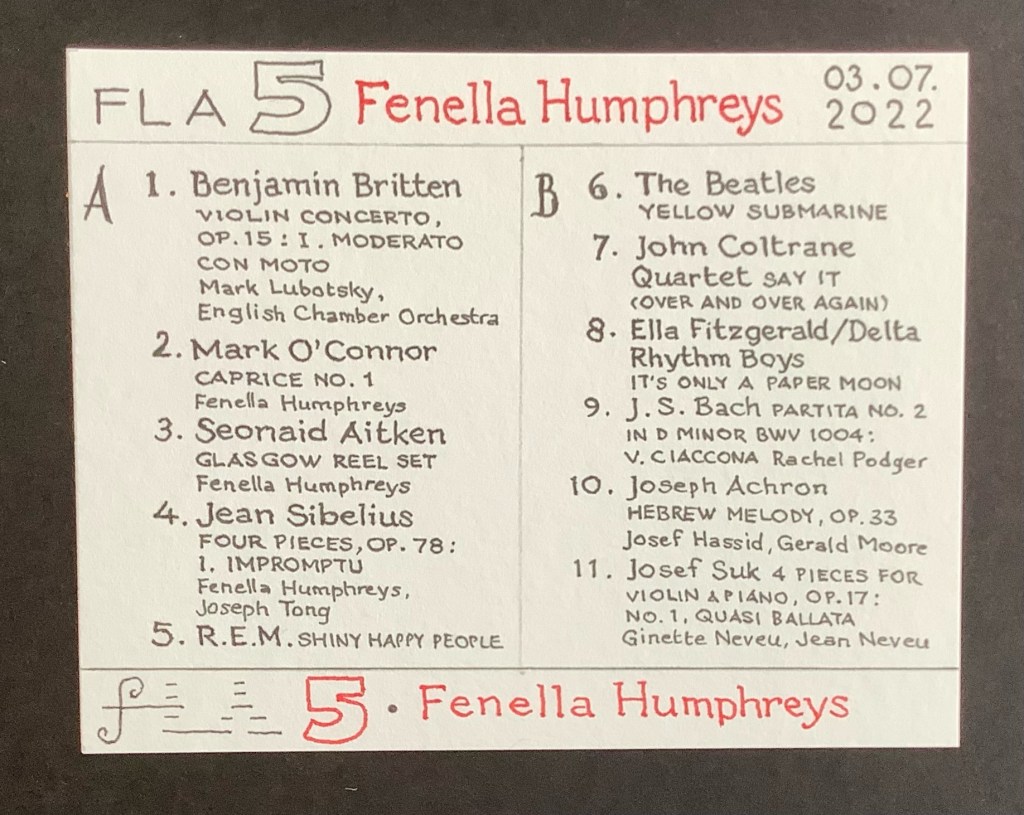
Track 9: BROTHERS OSBORNE: ‘Might As Well Be Me’:

https://www.youtube.com/watch?v=rCuNc3XfFVA&list=RDrCuNc3XfFVA&start_radio=1

Track 10: USHER featuring LIL JON, LUDACRIS: ‘Yeah!’:

https://www.youtube.com/watch?v=GxBSyx85Kp8&list=RDGxBSyx85Kp8&start_radio=1

Track 11: THE HOUSEMARTINS: ‘Happy Hour’:

https://www.youtube.com/watch?v=I9-_0RJYGl0&list=RDI9-_0RJYGl0&start_radio=1

Track 12: THE HOUSEMARTINS: ‘Caravan of Love’:

https://www.youtube.com/watch?v=ehfiQd7lcPY&list=RDehfiQd7lcPY&start_radio=1

Track 13: JESUS JONES: ‘Trust Me’:

https://www.youtube.com/watch?v=CK3C9XZcTbM&list=RDCK3C9XZcTbM&start_radio=1

Track 14: JESUS JONES: ‘Who? Where? Why?’ (Album Version):

https://www.youtube.com/watch?v=fidPRriWTrQ&list=RDfidPRriWTrQ&start_radio=1

FLA 21: Sangeeta Ambegaokar (16/07/2023)

When I was first thinking about First Last Anything, I knew I wanted to include a range of guests, including those who were learning and performing music at amateur level. And so I thought of my friend Sangeeta Ambegaokar, a medic based in Birmingham whose spare time outside her day job is these days dominated by music. She has weekly saxophone lessons and plays in an amateur orchestra for mixed ability players, called The Rusty Players Orchestra. She also sings in four different choirs in the city – and is a member of a bell choir.


Sangeeta kindly and helpfully shared her experiences of all these groups with me when we spoke on Zoom in the early spring of 2023 – since when she has achieved distinctions in her Grade 3 and 5 theory examinations. We both hope this conversation may inspire you, whether at beginner, intermediate or lapsed level, to seek out amateur or community groups in your area.


Sangeeta and I also talk about her formative years in the UK and the United Arab Emirates, about the Absolute 80s Sunday night show Forgotten 80s – which is how we met, as fellow listeners! – and of course discuss her first, recent and wildcard record choices. But as usual, I started with one question: what music was being played at home before she started buying records?


—-


SANGEETA AMBEGAOKAR

I was born in Newport, in South Wales. I don’t remember us having music in the house much, although the radio and Top of the Pops always featured highly, but early on, I can remember at bedtime – I don’t know if you’d call it a lullaby – my dad singing ‘All My Loving’ by The Beatles. We had the ‘Red’ and the ‘Blue’ albums.


I was three when ‘Save Your Kisses for Me’ by Brotherhood of Man came out, and at the end it goes, ‘Even though you’re only three’. You’re very egocentric about age then – you think everything would be about you, so I was of course convinced that it was written about me as a three-year-old.


ABBA was a big thing. I can remember being absolutely terrified of ‘Tiger’ [from Arrival]. ‘I am behind you, I always find you, I am the tiger.’ And Showaddywaddy as well, ‘Under the Moon of Love’, that kind of sticks.


I also remember going to a childminder, who had a record player, and things like ‘I Love You Because’ by Jim Reeves, and a copy of ‘The Laughing Policeman’ which had a scratch on it at a really inopportune time, on the last word – the last laugh in fact, on and on and on, so even more terrifying, and it’s quite terrifying anyway.


JUSTIN LEWIS

It really is. The guy who did that record, Charles Penrose, had a career of making all these records about laughing. Even though ‘The Laughing Policeman’ was 50 years old in the 1970s, they were still playing it on Junior Choice on Radio 1. I suspect that it was people writing in and requesting it for their grandchildren. Because I never met a child who liked it.


SANGEETA AMBEGAOKAR

When I was five, so from 1978 to 1991, we moved to the Middle East. And although from 1983 I went to boarding school back in the UK, for those first four years I’ve got this real gap in popular culture. In the UAE, we got quite a weird selection of things available to watch and to listen to. But the two ‘local bangers’ that everyone who lived in the UAE in the late 70s and 80s will recall are ‘Life in the Emirates’ and ‘Back in Dubai’.

‘Life in the Emirates’, The Establishment (1979)

‘Back in Dubai’, The Establishment & Sal Davies (1984)

By about 1982, around the time we got a video player, we used to go to the local video rental place. Somebody had recorded all the episodes of Top of the Pops in the UK and they’d send them over, so you’d get like a month’s worth of Top of the Pops to watch, four episodes, and then a great month when there were five episodes. It must have been summer ’82 – ‘Happy Talk’ by Captain Sensible was number one.


JUSTIN LEWIS

Were these official BBC tapes?


SANGEETA AMBEGAOKAR

I don’t think there was anything official about anything that went on over there! [Laughter]


JUSTIN LEWIS

Ah, I just wondered if it was a BBC World Service thing.


SANGEETA AMBEGAOKAR

I used to listen to the charts on the World Service, but it was really hard to hear. Before that, there used to be a programme on Dubai Television called Pop in Germany, which was all in German, and occasionally you’d see a band you’d recognise, like Boney M… which would figure, given it was from Germany. And we had a radio station that played music from all over. But with Top of the Pops, I vividly remember seeing one of these tapes of the 1000th episode, with Spandau Ballet’s ‘True’ at number one (original broadcast BBC1, 5 May 1983).


JUSTIN LEWIS

Oh yes, when they’d celebrate the programme, and say, ‘Let’s now look back at the old days, the five clips from the sixties we haven’t burnt.’ Cue ‘Pictures of Matchstick Men’ by Status Quo.


SANGEETA AMBEGAOKAR

And with these tapes of Top of the Pops, something similar happened again later with Live Aid (13 July 1985), though as you can probably imagine, this stretched to about five different video cassettes, and came in Part 1, Part 2, and so on. So we did manage to watch the whole of Live Aid in the UAE, but not actually in the correct order!


JUSTIN LEWIS

I saw you tweet a picture of one of your 80s compilation tapes yesterday. One of the tracks was by ‘TMTCH’ – presumably The Men They Couldn’t Hang?


SANGEETA AMBEGAOKAR

I seemed to have a cassette of them playing live so I must have taped it with one of those double cassette recorders. The song’s called ‘A Night to Remember’. I don’t want to upset any Men They Couldn’t Hang fans but in my view, the live version is much better. The album version sounds quite clunky.


JUSTIN LEWIS

The reason we know each other is because of something called Forgotten 80s, a radio show on Absolute 80s on Sunday nights, hosted and compiled by Matthew Rudd, with a considerable listener input, and quite a social media community has sprouted up around that over the years. With that show, have you found yourself joining dots you couldn’t join during the 80s? How did you discover that show?


SANGEETA AMBEGAOKAR

My other half was a fan of Forgotten 80s. At that time they used to repeat it on a Thursday, he’d be doing the ironing, and listening to it, and saying, ‘This is a great show, loads of forgotten tunes from the 80s’. I had imagined – nothing against The Fall – but that it would be that kind of obscure stuff which I wasn’t really into. And then one week, I heard them play ‘The Last Film’ by Kissing the Pink. And I thought, ‘God, I haven’t heard this on the radio for years.’ So I thought this show might actually be quite good. That must have been eight, nine years ago. Not quite since the beginning!


In 1983, I came to boarding school in the UK, in Monmouth, so from then, I’d see Top of the Pops when it went out, and there was Radio 1 so I was an avid listener. Mike Read was on the breakfast show at the time, and the signal to go to school was this feature he did called ‘First Love’.


JUSTIN LEWIS

Yes, with Scott Walker and the Walker Brothers’ record, ‘First Love Never Dies’, as the jingle!


SANGEETA AMBEGAOKAR

I’d latch on to any kind of music then. On TV, Fame. In those days, if you missed an episode, and we didn’t have a video recorder at school, then that was it. So I remember buying the cassette of the Kids from Fame album, really liking ‘It’s Gonna Be a Long Night’, and being really gutted I’d missed the episode that song was played in. But at the start of lockdown, I got the whole series on DVD, and started watching them.


JUSTIN LEWIS

So was Fame shown on television in the UAE?


SANGEETA AMBEGAOKAR

Yeah, on Dubai Television, which used to start at five o’clock with the reading from the Holy Quran.


JUSTIN LEWIS

Fame was massive in Britain because it was on straight after Top of the Pops, wasn’t it? In fact it did much better than in America, where I think it might otherwise have been cancelled because the ratings weren’t great there. And there were all these Kids from Fame albums. Were there two or three, a live one?


SANGEETA AMBEGAOKAR

I think I might have four of them!

—-

FIRST: FUN BOY THREE: ‘Tunnel of Love’ (Chrysalis, single, 1983)

JUSTIN LEWIS

So your first purchase was this, which comes from this same period.


SANGEETA AMBEGAOKAR

I’m renowned for liking this song so much. People now tweet me to tell me when it’s on.

I first saw them do it on Top of the Pops. I was mesmerised by the whole thing – the song, and also all the musicians they had playing with them, who were all women. So that really drew me to them. The cello player [the great Caroline Lavelle]! I don’t think I’d ever seen a cello on Top of the Pops before. I remember us being out at the shopping centre in Dubai, God knows how much it cost, because it was real, not pirate. My sister bought Orange Juice’s ‘Rip It Up’. So we each bought a single. And then my sister had a pirate cassette of Fun Boy Three’s first album, which I got a copy of as well, and then I got Waiting, their second album.


But the charts in general were a big thing. Remember when Simon Mayo on the Radio 1 breakfast show used to do Highest New Entry, Highest Climber and Number One at about 7.45? My life was run by bells when I was at boarding school. At twenty to eight, there was a bell: ‘Make sure you get over to breakfast, 7.45.’ And you couldn’t have music on during breakfast, but by then you could get these ear-pod-type headphones, and I’d have my Walkman in my pocket with a radio on it. I’d have the wire going down my sleeves and into my hand, so I’d tell everyone on the breakfast table what Mayo was announcing.


JUSTIN LEWIS

It’s hard to explain that era to anyone young now. There wasn’t music everywhere then. Radio 1 wasn’t even 24 hours a day. I remember at secondary school, taking a tiny little radio in on a Tuesday lunchtime, and Gary Davies would announce the brand-new chart. I don’t know what this says about me, but people from school still remember this about me! This stuff felt important then. But meanwhile, what was your involvement in music at school during this time?


SANGEETA AMBEGAOKAR

[I did various things at school.] At primary school, when I was five or six, I started playing the piano, my sister had lessons. So I looked at her piano book, it was John Thompson’s Teaching Little Fingers to Play. I think everyone had those back in the day. I started going through it, and teaching myself how to play the piano – probably not very well. And then mum and dad decided they should probably pay for lessons for me as well. Then, at secondary school, I started learning the violin because of ‘Come On Eileen’. But I quickly realised I was awful at the violin and it was never going to happen.


JUSTIN LEWIS

It’s a hard instrument. Professional violinists say this!


SANGEETA AMBEGAOKAR

I don’t think I have the patience either, because I think I’ve got quite a good ear for music, so I could hear it wasn’t in tune, and it was all about moving my fingers. I got really fed up with that. But I carried on with the piano, I was in the choir at school. And I’d played the recorder in primary school as everybody did. I was probably one of the better players at school, so a couple of us got to play a duet in a concert.


So I always had an aptitude for music, I guess, but then after that, year 10/11, it was all ‘you ought to be in the school opera and school performances’. It all looked a bit much, so I didn’t do any music at all after that.


JUSTIN LEWIS

There’s a lot of extracurricular activity, isn’t there, and it requires a lot of commitment. Not unlike being in sports teams. You have to give up evenings, and after school – if you’re going to take this seriously, I suppose.


SANGEETA AMBEGAOKAR

I had a brief foray into playing percussion in the orchestra in sixth form. They needed percussionists, and there were four of us. It was hilarious because I think a couple of us were okay, we had a decent sense of rhythm, but one of my friends, they put on cymbals, and she never quite came in on time. I stuck to tambourine and castanets – those were my specialities.

—-

LAST: DEPECHE MODE: Black Celebration: The 12” Singles (Venusnote/Sony Music, vinyl box set, 2022)

Extract: ‘Stripped (Highland Mix)’

JUSTIN LEWIS

We should perhaps explain that this isn’t the album of Black Celebration. This is a lavish repackaged box set that assembles all the 12” singles released from that album in 1986: ‘Stripped’, ‘A Question of Lust’ and ‘A Question of Time’, some of them released in multiple formats with extra mixes, B-sides and live tracks. They really seemed keen to give the fanbase value for money, and it’s beautifully packaged too.


SANGEETA AMBEGAOKAR

I’ve got this real affinity to the Black Celebration era of Depeche Mode. When we were in the USA in summer 2022, we were staying in Los Angeles, and nearby there was this big record shop called Amoeba Records. On our last day, we went in, and just as when I used to go into record shops, went straight to the Depeche Mode section. There were a few box sets of the different albums’ respective singles, but Black Celebration was the one. I was wondering: ‘Should I get this, because it’s expensive. And do I really need it?’


JUSTIN LEWIS

How much was it? Because it’s, what, five 12” singles? £100?


SANGEETA AMBEGAOKAR

It was less than £100, but it didn’t take a lot to talk me into it. It was an unexpected impulse buy. Depeche Mode was my first ever concert as well, at Newport Centre [The opening date of the Music for the Masses tour’s UK leg, 9 January 1988.] ‘Behind the Wheel’ had just come out, they started off with that.


JUSTIN LEWIS

So you saw them on the same tour at Newport that ended up in California, where they recorded the 101 live album, because it was the 101st and final date of the tour [18 June 1988]. Which of course led to a live album and a film, and you see this stadium of people all singing the ‘Everything Counts’ chorus at the end. And they become huge in America. But how did you first get into them?


SANGEETA AMBEGAOKAR

The first song I remember was ‘Get the Balance Right!’ on Top of the Pops, ’83, but just before I started boarding school the same year, if you bought a pair of Start Rite shoes, you got a free single from the top ten, and so I got ‘Everything Counts’ by Depeche Mode. I kept up with their singles – I remember Lenny Henry reviewing ‘Love in Itself’ in Smash Hits.

JUSTIN LEWIS

It was his Single of the Fortnight, I think.


SANGEETA AMBEGAOKAR

Yeah, and he was bowled over by it sounding like it had some proper instruments on it, rather than just synths. So he went, ‘Guys, are you okay?’ The other thing about ‘Love in Itself’ – I’m the sort of person who, if somebody says a word, I break into a song with the word in it. When I was a student, there was a bloke – it usually was a bloke – saying something like ‘You can’t come out with a song with the word “insurmountable” in it.’ And I went, ‘Well, actually…’


I got Some Great Reward (1984), then the Singles 81–85 compilation (1985), and then in Year 9, we had to do a project at school on music. I originally started doing my project on the Thompson Twins, but then I lost the book I was using, so I decided to do it on Depeche Mode, and nobody else seemed to like them, which I suppose drew me towards them even more. When I was writing their biography for the project, on how they came to be, I asked other people to write comments about them, and they’d either put, ‘They’re really boring and depressing’, or ‘I think their music is fab, but I don’t think much of their image.’


Their next album was Black Celebration, which I played over and over. Another girl who started at the school about then, was really into them as well, so we bonded over them.


JUSTIN LEWIS

You mentioned just now that you have teenagers. Do you keep up with new stuff through them?


SANGEETA AMBEGAOKAR

They’re 18 and 14. Yes, it’s a bit of a standing joke as to which songs that me and my other half have heard of that they’re listening to. Watching the Brit Awards with your teenagers is always quite amusing. Even my 18-year-old said, ‘You complain that all the songs sound the same’ – in fact she complained herself that all new music sounds the same! Which is quite interesting because our generation remembers our parents used to say that as well.


JUSTIN LEWIS

We’ve established that you had these forays into music at school. But then, years later, you are in an orchestra playing the saxophone. Tell me about how that came about.


SANGEETA AMBEGAOKAR

I’ve always been drawn to the saxophone, I guess. Especially with Spandau Ballet, the Steve Norman sax bits, and then ‘Your Latest Trick’ by Dire Straits. So it was always in my head. And then, one day, in around 2000, I bought a saxophone from a second-hand music shop near where we lived in Birmingham. I had one lesson at the time, and worked out that the fingering was the same as the descant recorder.


JUSTIN LEWIS

Yes, tuned to E flat rather than C, but otherwise similar. I learned alto saxophone when I was a teenager. And the flute, which I already played, was similar fingering, although again in C.


SANGEETA AMBEGAOKAR

Yeah. After that one lesson, work and life took over for a time. But we have this [organisation] called Birmingham Music Services, which goes into schools and does music lessons and has loads of ensembles, which are all free to join, they have them for all standards from beginners up to Grade VIII symphony orchestra. So if you play an instrument you can join any of the ensembles.


When they started doing lessons in the evenings at our local school and they opened it up to adults, I thought, This is my opportunity. I can actually have saxophone lessons now. At first they were full, but a couple of weeks before term started, I got a phone call: ‘We’ve got a space, someone’s dropped out.’ This was 2019, so a few months before lockdown, whereupon they switched over to Teams. And because of the singing, and having a good ear, and reading music, my teacher said after a few months, ‘It would be really good if you could join some sort of ensemble, you’ll progress much more if you’re playing with people.’ There was a real gap for adults in ensembles, as the Birmingham Music Service ensembles are only for school age children. If you feel you’re really, really good, obviously there are orchestras, but if you’re a learner or beginner, there’s a real gap.


After that, a friend sent me a link to an orchestra they found on Facebook, called the Rusty Players Orchestra, which was an offshoot of the People’s Orchestra, a charity based in West Bromwich. As you know, in orchestras, saxophones aren’t a central instrument, but as they were a saxophone-welcoming orchestra… So it’s for people who used to play when they were younger and would like to go back to playing or for people who are kind of beginner or intermediate and want to play in an orchestra.


I went along to rehearsal, in January or February 2020, and there was quite a motley crew of us. They’d welcome any instrument at all, they’d find music for you. So we had concertinas that were playing the violin part, for instance. It’s a proper range of ages too – our youngest player is from year 10 (so he must be 14 or 15) and our oldest player has just turned 80! Some started learning recently, but quite a lot were a good standard at school and are coming back to play.


JUSTIN LEWIS

Do they have similar projects elsewhere in Britain?


SANGEETA AMBEGAOKAR

They do, in places. There are two branches in South Wales actually: in Barry and Carmarthen.


JUSTIN LEWIS

Not in Swansea, unfortunately?


SANGEETA AMBEGAOKAR

Not at the moment, by the look of it, no.


JUSTIN LEWIS

I’ve been thinking about this a lot recently. I went back to the flute last year, after a long time away from it, and I thought, What on earth do I do with this now? Because I don’t yet feel good enough again to go and audition for a proper orchestra. And of course, with an instrument like the flute, they only have two or three in an orchestra anyway. But it sounds like there’s no formal audition process for the Rusty Players Orchestra.


SANGEETA AMBEGAOKAR

No, you just turn up. The first week I went, I probably played about three notes! I was too scared to play any more than that. I remember we were playing ‘Moon River’, me and a clarinet player. Both of us quite new, she was newer than me, but I was still anxious. We were both supposed to come in at a particular point, but neither of us did, we were too scared!


But now, our conductor is a student at the Birmingham Conservatoire and it’s a bit more relaxed. You come along, you have a go, it doesn’t matter if you can or can’t play, but the following week, you’re likely to be able to play more notes – and then you just keep going. So there’s really no pressure at all.


JUSTIN LEWIS

What are your plans in the near future with the saxophone?


SANGEETA AMBEGAOKAR

I’m lining myself up to do the Grade 6 exam.


JUSTIN LEWIS

Wow, you really are coming on in leaps and bounds. So what sort of things are you learning in your lessons? What’s your repertoire in those?


SANGEETA AMBEGAOKAR

A mixture, really. One of my pieces is Scott Joplin. I often just turn up with things, but one thing I really want to be able to play is the sax solo from ‘Will You’, the Hazel O’Connor song. It’s really really hard.


JUSTIN LEWIS

It’s a long solo too. Two minutes or so!


SANGEETA AMBEGAOKAR

And with Grade 6, you’re first starting to learn those top notes anyway. So that’s a bit of a work I progress. And in the orchestra, we’re playing a lot of film stuff: Hamilton, Chicago, Blues Brothers. It’s quite a nice range.


—-


SANGEETA AMBEGAOKAR

As well as the Rusty Players Orchestra, I’m in four choirs and a bell choir. The biggest choir is called So Vocal, and it’s the community choir of the City of Birmingham Symphony Orchestra, which is 150, up to 200 singers in that. And we’d sing with the CBSO every Christmas in the Christmas Concerts which is amazing. We started off being the free performance before the concert, and then we graduated to singing in the concert. Clearly, they thought, ‘Actually, they’re not too bad!’ We ended up going on tour to Poland.


I’ve made some really good friends through that. About two years ago, me and a friend went to an experience day with the London Community Gospel Choir. You have a day of learning songs, and in the evening, you join one of their rehearsals. A few of us go to this summer school as well, which is called Sing for Pleasure. It’s a three-day course, you learn some songs, and then there’s a concert at the end. You don’t have to think at all for three days, it’s like a holiday from life! One year, our group was taken by Themba Mvula, who runs a gospel choir in Lichfield, and he’s just out of this world. When you sing, you’re encouraged to go a little bit off-piste if you want to, make your own stuff up, sing as you feel. And though I’m not somebody who really does that, actually you find yourself coming out with stuff.


JUSTIN LEWIS

Is it like improv?


SANGEETA AMBEGAOKAR

Sort of. It’s like pretending you’re a bit of a diva. It’s quite a lot of fun, actually. You have that moment, and everyone else – who are all like-minded – has a bit of a go.


JUSTIN LEWIS

The first time I actually met you in person, it was at a Forgotten 80s event, and there was a karaoke bit, and you seemed well into that. Have you always been?


SANGEETA AMBEGAOKAR

I don’t do karaoke, generally. If there is karaoke, I could be persuaded to join in. But I would never say, Let’s go and do karaoke.


JUSTIN LEWIS

Does that mean, then, that you like having rehearsal and preparation time? The learning process.


SANGEETA AMBEGAOKAR

Not specifically. I think it’s just, you might have had a day at work where your brain is full of stuff. It’s just doing something totally different from that – singing and making music with people. You’re using a different part of the brain, so all the things you were doing earlier are forgotten.


The choir I’ve been in the longest is a Ladies Choir called Bournville Vocal Ease which is based close to where I live. When my daughter started at the local school, one of the parents was talking about a choir there, and I thought, God, I’d love to join a choir. Within the school is a carillon, and they’ve got a set of handbells they lend the school. In Year 6, all the children learn how to play the handbells, and so when our Ladies Choir conductor decided to form a bell choir, I joined that. I’ve been in that about six years or so. We play with bell plates.


JUSTIN LEWIS

I was watching the YouTube clip where your group does ‘Singing in the Rain’. That would require a particular kind of co-ordination, even if you’ve only got two bells to play.

SANGEETA AMBEGAOKAR

Well, not necessarily only two! Sometimes you’ll have five bells, and you have to swap and pick up the right one and they change key often. And then sometimes the person next to you can’t play that bell because they’ve got too many notes, too many bells already, so someone else has to step in and play their bell temporarily! It can be quite complicated – and you have a proper musical score as well, so you go through and highlight your bells. What’s really amazing, though: there’s a couple of people in the bell choir that actually can’t read music, but they’re playing from a score and they’re actually just learning what their notes look like and highlighting them and learning how to count.

ANYTHING: RICHARD SMALLWOOD: ‘Total Praise’ (composed 1996)

London Community Gospel Choir, ‘Total Praise’

SANGEETA AMBEGAOKAR

In one of the choirs I’m in, the So Vocal choir, we sing a real mixture of stuff, and our conductor introduced us to this piece by Richard Smallwood, ‘Total Praise’. I think this was our first real foray into gospel singing, although we’re not a gospel choir and I’m not religious at all. But singing gospel music, something about it takes you somewhere else, so when we all sang it together, it was a powerful experience. We sang it in a few concerts, and then a choir member passed away, and at the next rehearsal after we heard the news, we all decided we wanted to sing it as a tribute to him. It’s something that feels like it draws us all together, wherever we are. All the arrangements that I’ve heard of it blow you away.


Some of the choirs I’m in are relatively straightforward, but I’m also in this a capella choir, Cantoras. Really challenging, and I had to audition on Zoom. We sing in Latin and German, even Norwegian, all sorts.


JUSTIN LEWIS

I found a clip on YouTube, which I enjoyed watching.

‘Sing My Child’, composed by Sarah Quartel, performed by Cantoras Upper Voices Chamber Choir

SANGEETA AMBEGAOKAR

I went to a taster day. You could go along and sing, and then if you wanted to audition, then you could. And I realised: I know I can sing, I can read music. A lot of the people in Cantoras are musicians or singers who do it for a living or teach music, so it’s a different sort of group. In some of the choirs, I’m one of the stronger musicians, whereas in Cantoras, I’m one of the weaker ones. But that lifts you, it stretches you, and I guess doing the other choirs has given me the confidence to do something new and exciting and challenging that I wouldn’t have done before.


Interestingly, I’m a different voice part in each choir: Soprano 1, Soprano 2, Alto 1 and Alto 2. Just because, for various reasons, the first choir I went to, I was a soprano because they didn’t have enough of them. Second choir, they said, ‘Soprano or alto?’ and I said, ‘I don’t mind’, and they were, ‘Well, we need more sopranos.’ With the third choir, they had too many sopranos, and I fancied a change, so I was an alto.


JUSTIN LEWIS

Where would you say you belong most naturally in terms of vocal range?


SANGEETA AMBEGAOKAR

I’m probably not quite a Soprano 1. I’m a fairly comfortable Soprano 2, but I can sing low as well. With the choir I auditioned for, where I’m an Alto 2, she did a range test, and I could hit the Alto 2 notes.


With the Cantoras group, we went to see an a capella group recently called Papagena – an all-female vocal quintet. They’re well worth looking up, and quite an inspiration because one thing we try and do is sing songs by female composers or arrangers, and we’ve sung a song that they’ve done as well, called ‘When the Earth Stands Still’. I don’t know if that’s on the YouTube channel. It’s nice to do things for fun, but also to stretch yourself. You might be at an age where you think your best days are behind you, but perhaps that isn’t the case! 


—-


You can follow Sangeeta on Bluesky at @mango24.bsky.social. She is also on Threads at @mango___24.

 For more on The Rusty Players, visit The People’s Orchestra website, where you can also find information on The People’s Show Choir. They have branches around the country. https://thepeoplesorchestra.com/the-rusty-players-orchestra/

If you’d like to know more about Sing For Pleasure, who organised the singing summer school Sangeeta mentioned, see here: https://singforpleasure.org.uk/. The charity focuses on the enjoyment of singing, trains choral leaders, publishes some excellent songbooks, and runs events for singers. 

This is an excellent resource for details of amateur orchestras across the UK: https://amateurorchestras.org.uk

The radio show we mentioned, Forgotten 80s, hosted by Matthew Rudd, is broadcast on Absolute Radio’s Absolute 80s station every Sunday night between 9 and 11pm. You can listen to episodes here.

 —-

FLA 21 PLAYLIST

Sangeeta Ambegaokar

(For the time being, this site and project uses Spotify for the conversation playlists, but obviously I disapprove that Spotify doesn’t pay artists and composers properly, and other streaming platforms are available, as are sites to buy downloads and buy recordings. For consistency, you can also listen to the selections via YouTube (where available), and links are provided in each case, below.)

Track 1: THE BEATLES: ‘All My Loving’: https://www.youtube.com/watch?v=LdajVoRgx3w

Track 2: BROTHERHOOD OF MAN: ‘Save Your Kisses for Me’: https://www.youtube.com/watch?v=5yJUi6ke71I

Track 3: ABBA: ‘Tiger’: https://www.youtube.com/watch?v=htziQt0pCAQ

Track 4: THE MEN THEY COULDN’T HANG: ‘A Night to Remember’ [5 Go Mad on the Other Side Version]: https://www.youtube.com/watch?v=dtV1m_UjD-8

Track 5: KISSING THE PINK: ‘The Last Film’: https://www.youtube.com/watch?v=WuRdrAoroSw

Track 6: THE WALKER BROTHERS: ‘First Love Never Dies’: https://www.youtube.com/watch?v=KszX9WAas-0

Track 7: THE KIDS FROM FAME: ‘It’s Gonna Be a Long Night’: https://www.youtube.com/watch?v=tWLwcfw3C-s

Track 8: FUN BOY THREE: ‘Tunnel of Love’: https://www.youtube.com/watch?v=Qi7BXqmYxiw

Track 9: DEPECHE MODE: ‘Stripped’ (Highland Mix): https://www.youtube.com/watch?v=_Dx9ZvpUD8U

Track 10: DEPECHE MODE: ‘Behind the Wheel’: https://www.youtube.com/watch?v=VEAuMiKqP-4

Track 11: DEPECHE MODE: ‘Love in Itself’: https://www.youtube.com/watch?v=1pi_egc6qkY

Track 12: DIRE STRAITS: ‘Your Latest Trick’: https://www.youtube.com/watch?v=blPf0-WphFQ

Track 13: HAZEL O’CONNOR: ‘Will You?’: https://www.youtube.com/watch?v=PDa-uPzlzDg

Track 14: DONNIE McCLURKIN & RICHARD SMALLWOOD: ‘Total Praise’: https://www.youtube.com/watch?v=U8NIr9fqLBQ

Track 15: DON MacDONALD AND PAPAGENA: ‘When the Earth Stands Still’: https://www.youtube.com/watch?v=tJmbEecjjMA

FLA 17: Bernard Hughes (11/06/2023)

Born in London, the composer and educator Bernard Hughes studied Music at St Catherine’s College, Oxford during the 1990s, where he also was in the Oxford Revue with amongst others, a young Ben Willbond. After graduating, Bernard studied composition at Goldsmiths College and was awarded his PhD by the University of London in 2009. As well as his work as a composer, he is Composer-in-Residence at St Paul’s Girls’ School in London.


Although Bernard is probably now most renowned for his work in choral music – I particularly have enjoyed the Precious Things collection released by Dauphin in 2022, with the Epiphoni Consort – much of his canon of piano works has been recorded and newly issued by the soloist Matthew Mills, on a CD called Bagatelles.


To coincide with the release of Bagatelles, Bernard and I had an exhilarating and fascinating conversation one morning in April 2023 to discuss that, his long association with the BBC Singers, his formative years in London and Berlin, and some of his favourite recordings, as well as his first, last and anything selections. We hope you enjoy this first instalment of First Last Anything’s second series. 


BERNARD HUGHES

When I was a child, my dad conducted the choir at the Catholic Church at the end of our road. So I would be in the organ loft a lot, hearing him conducting and singing various pieces, a couple of which in particular, as an adult, I can think: Yes, my judgement as a five-year-old was spot on. They were Mozart’s ‘Ave verum corpus’, a very late a cappella piece [1791, the year of Mozart’s death], and a brilliant anthem by Henry Purcell, ‘Rejoice in the Lord, alway’ [c. 1683–85].


My dad had trained as a singer, and had been offered a contract with what became the English National Opera. He didn’t pursue the singing career, but he had a very, very fine voice, and as he conducted, he would sing the bass line of the hymn. I think that’s been very influential on my understanding of harmony – hearing the whole thing but particularly him coming through on the bass line.


JUSTIN LEWIS

I remember my own father doing that. He had a record with that Purcell anthem on it, by the way. He loved lots of different types of music, but he liked church music very much and he used to harmonise a bass part underneath a piece of music quite often.


BERNARD HUGHES

I think that’s a useful music skill – see what the bassline is going to do, that’s always been a thing I can hear. My son is extraordinary, he has perfect pitch, and he can just play chords because he’s hearing those pitches. Whereas I’m working out the bassline in abstract terms from the degrees of the scale, of the qualities, as opposed to specifically D flat, you know. Having perfect pitch is a two-edged sword. It’s not an unalloyed blessing in that sense. It makes me work a bit harder, because I don’t listen and think, That’s an F.


BERNARD HUGHES

I’m absolutely not a religious person, but it’s worth mentioning something about church music at that time. In the 1960s, the Second Vatican Council had opened up and got rid of the Latin mass and the mass in the local language, and this applied to music as well: there was a vacancy, if you like, in the 1970s for new Catholic and liturgical music in English. So there was a new generation of composers around – in fact, there was someone writing this stuff who my dad had worked with in that choir.


I didn’t know that a lot of what I was hearing was quite new. I’ve pieced it together retrospectively. The harmonies are kind of modal, and there are elements of dissonance. So the Catholic Church is not the most progressive organisation, but if it was progressive in any sense, it was in its approach to music in the 70s and 80s.


JUSTIN LEWIS

That’s really interesting, piecing it together later, and connecting these things. Back in the day, I was trying to work out where I belonged in listening to classical music. I was in a state comprehensive, and we were lucky to have a music department, we had quite a good school orchestra, which I was in, but nothing quite felt fully connected up or explained. Also, mine was the last but one year of O level before they changed to GCSE. It’s really weird it modernised slightly for the GCSE because it was under a Conservative government. 


BERNARD HUGHES

They brought in this three-part of Listen Perform Compose.


JUSTIN LEWIS

Right. There was no composing when I did O level.


BERNARD HUGHES

Exactly. I was the first year of GCSE (1988), and obviously that suited me down to the ground in terms of writing music. But a generation of music teachers had got well established in their careers without ever teaching composition – and suddenly it was one-third of the GCSE course. Subsequently, when I did A level music, it was an option, you could do it as an option – and then from 2000 it became compulsory. So again, A level students who would previously have got A level without doing a note of composing, found it a compulsory part of the course.


JUSTIN LEWIS

It makes me smile when people are a few years younger and did GCSE rather than O level: they’ll say, ‘Oh well, of course we studied The Works by Queen’, whereas for us, there was no pop; there was barely acknowledgement that jazz existed.


BERNARD HUGHES

When I was teaching GCSE Music around 2008, they introduced a Britpop option for teaching as a history topic. And I was having to explain – in 2008! – the Labour government of 1997, because by 2008 the people’s perception of Tony Blair, for example, was very different.


JUSTIN LEWIS

I always felt when I was at school, the teachers were good but there didn’t seem to be so much explanation of context and history, why some of these pieces came to be, what caused them.


BERNARD HUGHES

My degree was quite history-based, and my teaching now has that dimension: ‘What was happening in the wider world at this time?’ These things didn’t happen in a vacuum. And as a school music teacher, you can’t shrug off pop music – and in fact I’ve picked up a lot of things over the years from my students. One lent me a cassette of the second Ben Folds Five album, Whatever and Ever Amen. I looked at the cover and thought, Oh god it’s a boy band, this is gonna be really awkward. But obviously I fell in love with it within the first two bars [of ‘One Angry Dwarf and 200 Solemn Faces’], it’s got these brilliant openings. And Ben Folds has gone on to be one of my absolute favourites.


JUSTIN LEWIS

I find it so interesting he was a drummer originally.


BERNARD HUGHES

Yeah, he had that autobiography out during lockdown [A Dream About Lightning Bugs]. A very interesting character, extraordinary musician and pianist. But I came to him through a recommendation from a student. I like to keep an open mind. That’s how you find things.


BERNARD HUGHES

I got started on piano lessons when I was about five or six. This really cranky old machine, which the convent round the corner were getting rid of, but it got me started. And then, when I was about seven, there were these blank manuscript sheets which I would start writing on, without anyone suggesting to me that I should. Quite odd, because they were four-line staves rather than five – they were used for chants. So I would add in a fifth line with a ruler, and start writing music. I would write a key signature where I did a mixture of sharps and flats within the key signature. And my dad would say, ‘You’re not allowed to do that!’ Although I found out later that somebody like Bartók would write an F sharp next to an E flat. So I was writing music with not much idea of how it sounded, before knowing what a composer was, or that I should be a composer.


When I was about eight or nine, we had a cassette player in the car for the first time. We got four cassettes from WHSmiths, which went round and round for the next ten years:

Buddy Holly’s Greatest Hits, an album called Elvis Sings Leiber and Stoller, a Louis Armstrong tape, and this cassette of Revolver by The Beatles… in an unusual order.


JUSTIN LEWIS

Yeah, they often rejigged the track listings for the cassettes, so that side one and two had roughly equal running times.


BERNARD HUGHES

For me, to this day, Revolver should begin with ‘Good Day Sunshine’, as opposed to ‘Taxman’, because that was the first song on that cassette copy. Although it still finished with ‘Tomorrow Never Knows’.


[NB: Compare the cassette running order of Revolver, with its LP original:


CASSETTE                                                    LP      


Side One:                                                        Side One:

Good Day Sunshine                                   Taxman

And Your Bird Can Sing                           Eleanor Rigby

Doctor Robert                                             I’m Only Sleeping

I Want to Tell You                                       Love You To

Taxman                                                          Here, There and Everywhere

I’m Only Sleeping                                       Yellow Submarine

Yellow Submarine                                       She Said She Said


Side Two:                                                       Side Two:

Eleanor Rigby                                              Good Day Sunshine

Here, There and Everywhere                   And Your Bird Can Sing

For No One                                                  For No One

Got to Get You Into My Life                  Doctor Robert

Love You To                                                 I Want to Tell You

She Said She Said                                        Got to Get You Into My Life

Tomorrow Never Knows                         Tomorrow Never Knows

 —-

FIRST: LONDON PHILHARMONIC ORCHESTRA: Favourites of the London Philharmonic (Music for Pleasure, 1980)

Excerpt: Litolff: ‘Concerto Symphonique No 4 in D minor: II. Scherzo’

BERNARD HUGHES

My aunty Celia, my mum’s sister, gave me this compilation cassette and I found it again when my parents cleared out their house. I just played this over and over again, found it very inspiring. It’s hard to tell now whether I love them because they’re ingrained on me – many of them stand up as really great pieces.


JUSTIN LEWIS

Long deleted, I think, but I found it on Discogs. The photograph is not a very good reproduction of the cover and inlay but I managed to squint at the liner notes, and it seems it was compiled based on melodic strength. And all 19th century – I think the Weber is the earliest, about 1820. 


BERNARD HUGHES

Yes, clearly it’s a collection of lollipops: here’s some fun things to get you into music.


JUSTIN LEWIS

Compilations can be very helpful, especially when you’re just starting to get into something.


BERNARD HUGHES

And if you said to the compiler to this, ‘There’s a child out there who’s gonna hear this compilation and it’s gonna change their life…’, they’d be delighted. I had trouble tracking down some tracks for years.


But the one in particular that grabbed me then was by this guy called Henry Charles Litolff (1818–91), who’s completely obscure now. It’s called ‘Concerto symphonique: Scherzo’. It had been huge in the 1940s – it’s about five minutes long, so I think it fitted well on to records in the early days of the very short 78rpm records. On this compilation it’s played by Peter Katin (1930–2015). I think the radio used to play it when it was ‘Well, we’re slightly early for the news’, you know. For whatever reason, it’s not even one piece, but just one movement of one piece. And it never gets played as a piece anymore – if I’d known it had been programmed for a concert in the UK in the last 30 years, I’d have dropped everything to be there.


I absolutely love it, it’s full of energy, it’s fun, and one bit suddenly goes very simple: Ding. Ding. Ding. I remember thinking at that young age, ‘I could play that bit’, but recently I found a YouTube film where it scrolls through the sheet music and even ‘the easy bit’ is phenomenally hard. But it made me specifically think: I want to grow up and be able to play that piece. And I have never got anywhere remotely close to it.

FIRST (Part II): PRINCE AND THE REVOLUTION: Purple Rain (Warner Bros, 1984)

Excerpt: ‘Let’s Go Crazy’ 

JUSTIN LEWIS

Fast forward a few years, and you first hear this. Purple Rain. Tell me about this.


BERNARD HUGHES

This would have been ’85 or so. We were living in what was then West Germany [of which more, later]. My friend Patrick got the tape of it first. And I had no concept of it at the time, because we still had Elvis and Buddy Holly in the car, so I had no idea if it was old or just a collection like my London Philharmonic cassette. But we listened to this album over and over in his parents’ house.


JUSTIN LEWIS

In the UK, it felt – with ‘When Doves Cry’ – that he became famous very suddenly. ‘1999’ had made the charts before that, but not particularly high (#25, early 1983), and then with Purple Rain, he became very famous. Whereas in America, he’d done it more incrementally – it was his sixth album, and each one had made him that bit more prominent. It felt weird that there was a film behind it, that felt massive, although admittedly it’s not a great film. Apart from the performances… there’s that really long version of ‘Let’s Go Crazy’ (on the 12” single) which they edited down for the LP.


BERNARD HUGHES

They had to go back and re-record a lot of that live footage, because it wasn’t quite right when they recorded it. And bits of it are from the day they launched it, when they went to the club.


JUSTIN LEWIS

Yes, the last three songs on the album: ‘I Would Die 4 U’, ‘Baby I’m a Star’ and ‘Purple Rain’ itself. Before I ever saw the film, I thought, ‘Why is there applause at the end of “Baby I’m a Star”?’ And of course it was because they recorded those three songs live on the same day.


BERNARD HUGHES

It does have an incredible energy. When the deluxe release of it came out, with most of the stuff they had cut, I think they had been right to. Except for the 10-minute version of ‘Computer Blue’ which is brilliant – the version on the original LP is horribly edited, there’s a real clunky jumpcut. But of course that editorial sense was what he lost later, in the 90s… that sense of quality control – when he just released everything that came into his head. Although lately, through a friend who lent me the CD, I have come round to Chaos and Disorder.


JUSTIN LEWIS

Oh yes, the last contractual obligation for Warners (1996), so it was seen as a ‘cupboard’s nearly bare’ record.


BERNARD HUGHES

I’d always written it off as that, but he’s got together with his pals and they just absolutely jam. It’s brilliant.


But going back to Purple Rain, and listening to that over and over again… When I went away to university, I knew far less music than any of my students do now, or than my son does now. I knew a small amount, but I knew it really, really well. And I’m not sure now whether people listen so heavily to something: you listen to something, then it’s ‘Let’s move on to something else, what’s next?’


JUSTIN LEWIS

So how did you develop your composing into a career?


BERNARD HUGHES

I was just always writing. When I was about 15, the teacher at school got me to write the incidental music for a school production of A Midsummer Night’s Dream. And I had a composition teacher, but I didn’t really meet any other composers my age. I didn’t know much about contemporary music. At university, I didn’t really take it very seriously, I got a third in the composition paper in my finals because I was doing comedy stuff with the Oxford Revue.


But when I did a Masters in London and started taking it more seriously. If at any stage I’d stopped, nobody would particularly [have noticed]. You know, lots of people write music and then don’t anymore. I think I just never stopped.


JUSTIN LEWIS

It’s interesting you’re most associated, or at least I associate you, with choral music. But it wasn’t what you were composing early on, is that right?


BERNARD HUGHES

Having said that my dad was a singer, I was very sniffy about people singing. I never sang in a choir myself, or wanted to sing, and so I had no interest in the big choral scene around the chapel choirs of Oxford. But then, very late, I accidentally got into it. In about 2002, my late twenties, I wrote and sent in a piece for a BBC Singers workshop. That led to a commission from them, which led to another workshop and so on.


JUSTIN LEWIS

What was that first commission for them?


BERNARD HUGHES

There was this big contemporary music festival, the Huddersfield Festival in 2003, and I wrote this very ambitious piece based on 150 aphorisms. I spent ages researching and getting permission for these aphorisms, everything from Francois de La Rochefoucauld right up to Spike Milligan and Jeanette Winterson. This massive 15-minute tapestry only ever had one performance, but the next workshop with the BBC Singers led to the idea of a piece called ‘The Death of Balder’. It was this Norse myth from a book of translations which I inherited from my godfather.


I proposed this piece as five to seven minutes but it became clear it was more like 25 minutes. This big choral piece, and in fact, it’s had quite a lot of outings, considering new pieces often get done once and never again. But this one did, and it ended up as the backbone of the first of my albums, I Am the Song.


This was 2006, 2007 – and from there I became a choral composer. Once I started doing it, I realised I loved doing this, working with choirs and the sounds they make. It was something I could do. I could sometimes feel with an instrumental piece that I didn’t know where to start or what to write, but I’ve never really been stuck on a choral piece.


JUSTIN LEWIS

What’s your starting point, then, with a choral piece?


BERNARD HUGHES

I often go for a little walk before I start, just hear them in the abstract. I get away from the keyboard as quickly as I can and on to the computer. Writing for a choir, you don’t want to be too influenced by what you happen to be able to play on a piano. When you’re singing, you can have one low note down there, and one high note up there. You don’t have to be able to play it.


Also, I collect texts… I’ll skim books of poetry, looking for texts. One thing I do with text, almost a kind of trademark, is I use a lot of changeable time signatures which will often go with the rhythm of the words – and often the rhythm of words is uneven. On my Precious Things album of choral music (2022), there’s a piece called ‘Psalm 56’, which goes, ‘My enemies will daily swallow me up’ – that’s an example of letting the text actually drive the rhythm, rather than imposing an artificial rhythm on it. Or on the BBC album, ‘The Winter It is Past’, which is a Robert Burns poem. It is strictly metric, but I put it into 5/4, which can sound quite jagged and uneven, but when you’re dealing with text, you wouldn’t say that sounds odd or out of kilter.


JUSTIN LEWIS

The BBC Singers have been much in the news this year. Do you think everyone understands the full extent of why these cuts made by the BBC on their Singers and also their Orchestras need to be taken seriously?


BERNARD HUGHES

When the news came out, I thought, This is terrible news for me in my niche – but will it have cut through to people who aren’t in this world? And it has done – all this amazing work the Singers have been doing for years is now being publicised. They’ve not been doing anything different [since March], but now they’re out there tweeting about it, they’re getting some coverage.


There’s a 50/50 gender split in their commissions. I don’t know this for sure, but over the past three years, I think the BBC Singers, as a group, has performed more music by women composers than any other group in the world. They do a concert every Friday, and 50% of every concert will be by women composers. But then they’ve been doing that anyway; they’ve just not had the recognition for it.


So some of it made a splash and it needed to. It was partly people like me saying ‘The BBC Singers need to be saved’, because that’s my world, devastating for people within it. And it was partly people saying, ‘If we don’t put our foot down or do something now, one thing after another will go, like the orchestras, until there’s nothing left.’


I started out in a workshop with the BBC Singers, which led to commissions, having a full album by them in 2016, then in 2020 there was a portrait concert that was 75% my music, and that culminating in a Proms commission in 2021. I am a shining example of that process working well, and closing the BBC Singers means that no-one else follows that path.


And even for people who aren’t looking to follow that path: they do workshops with undergraduates where they sing undergraduates’ music and workshop it. And if you’re an undergraduate who’s got no plans to go on and become a composer, you’ve had your piece sung by the BBC Singers, you’ve got a record of that piece – that’s incredible, and the idea that would be taken away from future generations is awful. So while I know a lot of the Singers personally, I’m friendly with them, in a broader context, culturally, this is something that the BBC should be shouting about proudly, and not [hiding it] shamefully.


JUSTIN LEWIS

While it’s not just the BBC’s responsibility to keep something like this alive, I do think one of the roles of the BBC is to do what nobody else would do.


BERNARD HUGHES

Exactly, yeah.


JUSTIN LEWIS

And they have less money than they used to, and we know why that is!


BERNARD HUGHES

That is full stop the fault of Nadine Dorries, who froze the licence fee, when they put the World Service on to the licence fee, when it used to be paid by the Foreign Office, when they made all the licence fees for the over-75s free… All of those things. Those are all governmental decisions that the BBC have had to deal with.


JUSTIN LEWIS

Radio still tries but I find television has basically given up on the arts in general, and I’m really struck by how you mostly only really get music coverage on television now when it’s a competition, when there’s a competitive element.


BERNARD HUGHES

There’s a British classical music writer, Andrew Mellor, who now lives in Denmark. And when the BBC Singers story appeared, he wrote a piece for Classical Music, in which he said that in Denmark, there’s an equivalent of the BBC Singers, the Danish Radio Vocal Ensemble. They have a slot, every weekday, three minutes before the six o’clock news, [called Song for the Day] where they’ll sing something, like a traditional Danish folk song, recorded and filmed. So everybody in Denmark is aware of their existence and of what they do and what they sound like. Whereas here, recently, lots of cultured and educated people have said to me, ‘I didn’t really know who the BBC Singers were or what they did.’

At the moment, the jury’s out on the ultimate decision, but I owe my career as a choral composer, that I am one at all, to the BBC Singers, to their current producer Jonathan Manners, and the producer who originally took a punt on me, Michael Emery, and who gave The Death of Balder a chance. So I’m really exercised about this, and really want it to be resolved, not just for me, but for the wider ecosystem.


JUSTIN LEWIS

So it’s not just a question of money.


BERNARD HUGHES

No, it’s not, it’s a lack of awareness of what they do – if they got rid of them, no-one would really notice. The BBC head of music who made the decision comes from a pop background – not in itself a problem, but they have zero understanding of what the singers do, presumably sees them as a bunch of old fuddy-duddies in suits singing old music, whereas they do a phenomenal range of stuff, from the very old to the contemporary. But I think on their part, it was ignorance of a) what the singers do, and b) what the singers mean to people.


JUSTIN LEWIS

Absolutely. My question was more a general one about cuts, in that it seems to me music coverage is now events-led. So they’ll do the Proms, they’ll do Glastonbury, and very well, but there’s barely any regular music series on television now. Later’s about the only thing left, and that isn’t year-round. Certainly very little serious music.


BERNARD HUGHES

Although, like you say, there is a stronger argument for there being classical programming than pop music because other people aren’t putting out classical concerts and that’s what they should be doing.

—- 


ANYTHING: ANNA MEREDITH: Varmints (Moshi Moshi, 2016)

Extract: ‘Nautilus’

BERNARD HUGHES

I had been aware of Anna Meredith, a very successful Scottish classical composer, who had written a piece for First Night of the Proms. And then about five or six years ago now, she suddenly brought out this hybrid of dance, electronic, classical and rock music.


JUSTIN LEWIS

It really does defy categorisation.


BERNARD HUGHES

Absolutely. My son and I have this category of music we call ‘love at first sight music’. Things that, within a few bars, you just know. There’s a few other things like that: the first Scissor Sisters album, Ben Folds, and also my other great enthusiasm, The Divine Comedy, which I loved within five bars. And it’s true of this too: Anna Meredith’s Varmints. I thought: ‘This is where it’s at.’


JUSTIN LEWIS

So was this the opening track, ‘Nautilus’? I think I either first heard it on Radio 3 or 6Music, because both stations made a point of championing it.


BERNARD HUGHES

It was ‘Nautilus’, yeah. She’d actually introduced that piece about two years before, although I hadn’t heard it then, but it was an incredible statement of intent. You think you know what the pulse is – and then halfway through, the drums kick in.


JUSTIN LEWIS

Oh yes!


BERNARD HUGHES

And it’s a completely different pulse. Astonishing and it answers a question I’d always had which is: ‘Could a classical musician do pop?’ You get certain crossovers the other way, but this shows her classical thinking: ‘What kind of polyrhythm can I pull out of this?’ And yet it still sounds like dance music. It’s got an extraordinary opening.


JUSTIN LEWIS

I saw Frank Skinner live a couple of years ago and he came on to that intro.


BERNARD HUGHES

There’s a phenomenon in pop music where intros have got shorter. They cut to the vocals quicker, and now it’s not 25 seconds, or 20, it’s now 5 seconds. And ‘Nautilus’ starts with the same chord for about a minute before anything else happens, it’s like: ‘This is my territory, and if you don’t like it, go away, because this is what it is.’ It’s an amazing courageous statement of intent which I just love.


On the same album, ‘The Vapours’, which I love [JL agreement], and which partly inspired a piece I wrote for my school orchestra concert band called ‘Gooseberry Fool’ which we released as a charity single. We meant it to have the same joyous kind of energy.


I took my son to a live concert, with orchestra, of Varmints, and it was one of those nights, which you don’t often get from classical music, where we walked out really buzzing from it. And her next album, Fibs (2019), again has some beautiful, wonderful, extraordinary songs on it. So in terms of not getting stuck in my ways, there’s something. Sometimes I hear people and I think, ‘That’s great, but that’s the kind of thing I could do.’ I couldn’t do Anna Meredith’s stuff – I love it, and I couldn’t do it.


JUSTIN LEWIS

I really need to see her live.


BERNARD HUGHES

I was lucky to be at the launch concert of Fibs. The band are phenomenally tight, because there are all these time signature changes and counterrhythms and polyrhythms. It’s virtuoso stuff. She plays the clarinet and bashes her drum… and there’s one brilliant bit, in ‘The Vapours’ where it’s in 7/4, so she bangs her drum and she’s on the beat, and then when it goes to the next bar, she’s suddenly off the beat. So she’s just doing a semi-beat, but it becomes the off-beat and then it gets back on the beat. It’s a mind-blowing trick.

LAST: BJARTE EIKE / BAROKKSOLISTENE: The Alehouse Sessions (Rubicon Classics, 2017)

Extract: ‘I Drew My Ship’

JUSTIN LEWIS

And while we’re on the subject of defying categorisation, that could be said about another of your selections – The Alehouse Sessions.


BERNARD HUGHES

I’ve never been a fan of what you might call folk music. The younger me might have turned my nose up at this, but I heard this first during one of those lovely Radio 3 mixtapes they play from 7 to 7.30 before their evening concerts. So I went and looked this up afterwards, and it was this Purcell overture – not actually the track I’ve specified, but I got the whole album. It’s not only a brilliant fresh way of looking at music, mixing folk songs with more classical material, like Henry Purcell, but it’s also a nod to the fact that Purcell would have been in the ‘proper’ theatre, and had his posh performance, and then would have gone to the bar and played his popular stuff.


I find ‘I Drew My Ship’ just unbelievably moving. First of all, it’s so bare. Maybe it’s a young man thing to throw everything, bells and whistles, at a piece of music, but as I get older… [I love] the sheer simplicity of that beginning, with just those harmonics on the strings and then about four-fifths of the way through the playing stops and there are all these singers who are not trained singers, they’re just the instrumentalists who happen to be singing. It’s that untrained dimension that’s so captivated, so touching.


JUSTIN LEWIS

It’s very striking and with the vocals, there’s this interesting way of using the voices that are off-mic sometimes.


BERNARD HUGHES

I haven’t seen them live yet, but they apparently perform it like a kind of happening or jam session. They wander around, singing from whenever they are. I believe they don’t particularly plan what they’re going to do in what order. It’s just very freestyle. And Bjarte, the violinist leader of the group, is brilliant.


I did an arrangement of this, actually, for my choir at school, which we’re doing at the moment. It works really well for unaccompanied voices – very different from that recording.


As a musician, studying and working in music for 35 years, and still having an enthusiasm for it, I can still get home from my job teaching music, and find exciting new music that I like. [I never want to lose that feeling. ‘I Drew My Ship’ can reduce me to tears, quite, quite easily – and I’m not someone who weeps very often.


—-

BERNARD HUGHES

As I mentioned, when we were talking about Prince, when I went to university I knew very little, but I knew it very well, and my enthusiasm got me through that process as much as knowing anything! At my interview, the interviewer who went on to be my tutor said, ‘Tell me about a piece you’ve found recently that you really love.’ And I must have gone off on one about The Rite of Spring (premiered 1913). But I’d struggle to choose between that and another Stravinsky piece in my desert island discs: I first heard Symphony of Psalms (1930) when I was about eighteen, around Christmas time, this James O’Donnell performance at Westminster Cathedral.


JUSTIN LEWIS

Symphony of Psalms is perhaps the lesser-known piece.


BERNARD HUGHES

They’re very different, [hard to believe] they’re by the same composer. It seems quite unlikely, but it’s an astonishingly powerful piece. And since then, Stravinsky has been my absolute guiding star, in musical terms, I must have read every book about him, from Stephen Walsh’s to Richard Taruskin’s. If I did a specialist subject on Mastermind, it would be Stravinsky – although he’s a bad one to choose because he lived to be about ninety and lots happened to him.


JUSTIN LEWIS

As I was listening to Symphony of Psalms, I was thinking, Something about this sounds particularly unusual, and I suddenly realised there are instruments not present. There’s no upper strings, for instance – no violins, no violas. There’s no clarinet.


BERNARD HUGHES

And it has two pianos – and two harps! And the pianos particularly give that ‘Dunk! Dunk!’ sound at the very beginning – which Leonard Bernstein described as ‘two gunshots’. 

Who starts a religious piece with two gunshots?! Yes, it’s a unique sound, lots of flutes and oboes, and then this choir coming in… Stravinsky really could make a piece sound his own. There’s another Bernstein quote: ‘When you’re listening to a Stravinsky piece: “YES, this is the best Stravinsky piece.” And then you listen to another Stravinsky piece and you think: “YES, this is the best.”’ Whichever piece you’re listening to by him, that’s the best one. 


JUSTIN LEWIS

Symphony of Psalms has made me think of the connection with Prince’s ‘When Doves Cry’.


BERNARD HUGHES

Which is what?


JUSTIN LEWIS

There’s no bass part on ‘When Doves Cry’.


BERNARD HUGHES

Of course. The upside-down version!


BERNARD HUGHES

When I’m reviewing, for the Arts Desk, I like to go to smaller or lower profile events – often with younger musicians, or things that just don’t get covered in mainstream coverage. Especially since lockdown. I’m by no means a straightforward cheerleader, but I do go in with a view to not slagging people off. I will be honest, but I’ve chosen which things I’m gonna go to, so they’re things I’m expecting to enjoy.


The reason for this is I’d been going to concerts which were just washing over me. So when I have to give an opinion, I sit there in a different way. Not just about the music, but how the concert is being presented.


Last week, I saw this screening, with a live orchestra, at the Barbican of this Alexander Korda sci-fi film Things to Come (1936), with a score by Arthur Bliss. It had been the first fully orchestral score for a film, the first soundtrack album, and the first film the London Symphony Orchestra did, who went on to a huge tradition of soundtracks, things like Star Wars. So, with Things to Come, I was thinking: Am I at a film screening which happens to have a live orchestra, or am I at an orchestral concert which happens to have a screen? At times, they had to project the dialogue as subtitles on to the screen, because the music was too loud – because obviously in a film, you can’t turn down the [volume on the] orchestra. And there’s a limit to how low you can turn down an orchestra.


So I’ve found it’s really increased my enjoyment of going to things, with a friend, either a musical or general friend because you can bounce ideas off them. ‘What did you think?’, you know.


JUSTIN LEWIS

Your new album is not one of choral music, but of piano music: Bagatelles.


BERNARD HUGHES

Matthew Mills, a long-time friend and colleague, and a wonderful pianist, had offered to record my complete piano music. It’s nearly the complete piano music – I realised I left one thing off the list I sent to him, and then in the recording sessions, we decided to ditch one item because it was just too much.


But it’s a real range of pieces, some really virtuosic, some very avant-garde and quite dramatic, and then some very simple melodic pieces: a couple of pieces I wrote for my children before they were born, when they were in utero, and I played them to them when they were little. There’s one piece that’s a sequence of pieces from beginner to Grade 5 in the course of eleven pieces. I like writing complex music, but I like writing simple music. I don’t have a style.


There’s also a new suite of pieces where I’ve reworked some old pieces – I’m always interested in repackaging, transforming, rewriting old pieces of music, often in quite inappropriate ways. So, the final movement of JS Bach’s St Matthew Passion (1727) – this great statement of religious faith, this shattering last movement at the end of three hours of music, and I’ve turned it into a little cheeky kind of piano tango. That new piece, the Partita Contrafacta, is entirely made-up of reimaginings of old pieces of music, by Baroque composers. As with Precious Things, it’s varied. That’s my watchword. I don’t want to be doing the same thing over and over again.


JUSTIN LEWIS

And do you strive for that variety when composing for your secondary school pupils too?


BERNARD HUGHES

Yes, I always do. I know them, I know what they can do, and so I can place their strengths. If there’s a particularly strong singer who can do a solo…


JUSTIN LEWIS

And you can learn from them as well.


BERNARD HUGHES

Absolutely. There’s nothing quite like that feedback. Sometimes you can write something you think will be really obvious in terms of what you want from it, and then the players play it, and you realise that you’ve not communicated accurately what you want, it’s your fault. The players aren’t being difficult.


It’s difficult to predict what people are going to find hard, but as you get older, you get better at knowing the pitfalls, particularly in choral writing. There are some things that are hard to do, and then there are some things that sound impressive, but actually aren’t that hard to do. I really like writing for the school, I’ve been there eight years, and just about every single ensemble in the school has had something by me during that time. It’s a real privilege.


JUSTIN LEWIS

As we mentioned earlier, you spent some of your childhood in Berlin.


BERNARD HUGHES

The family moved over in 1983, me and my two sisters, for three years, so when I was between nine and twelve. It was in the middle of the Cold War.


JUSTIN LEWIS

Of course! The Wall was still there.


BERNARD HUGHES

Absolutely, a very heavily militarised city, big military presence. I went to the British military school there. My big regret is I didn’t really learn German, although in the last five years, I’ve been properly learning it as a hobby.


JUSTIN LEWIS

Are you using Duolingo?


BERNARD HUGHES

I am, and I have an online teacher as well. My Duolingo streak is 1169 days [by the time this piece was edited: 1216!]. I’m grateful that I have a perspective on my time in Germany. You can read all you want about the Wall, but I was there, I saw it. You could look up and see a watchtower with an East German guard, carrying a gun, looking around. Even as I describe it, I can’t capture what that was like. We’d do school trips to East Berlin, and see the greyness and bleakness of it, buildings with bullet holes in them. It was a very formative few years, and I could have stayed another year, but me and my big sister were approaching secondary school age, and my parents wanted to come back and get us into schools in the UK.


JUSTIN LEWIS

You went to some quite noteworthy concerts in that period.


BERNARD HUGHES

Yes, Herbert von Karajan (1908–89) was still conducting the Berlin Philharmonic, and my parents would have regular tickets. My dad took me on several occasions. And I had no real concept at the time that Karajan was quite as famous as he was, but he was a very old man by then. He would be helped to the podium and he sat down when he conducted, and would barely move. He was just about keeping going, just by force of will. But he had a charisma, even at that age.


This would have been ’86-ish… What would I have seen? I can remember hearing the Mendelssohn Violin Concerto, Daniel Barenboim playing Beethoven… admittedly, I equally remember hearing a Shostakovich symphony and absolutely hating it. But the really memorable one was Mozart’s 21st Piano Concerto (1785), with Walter Klien (1928–91) as the soloist. And in those days, at the Berlin Philharmonie, on your way out you could buy the cassette and the score of what had been played in the concert.


I was absolutely seized by this piece, and I’m sure my dad must have noticed. So on the way out, he brought me the score of it and the cassette of Walter Klien playing it. Number 21 is known as ‘Elvira Madigan’, because the second, slow movement was in the film of the same name (1967).


With that cassette, I worked out something and no one told me to do this. I had a double cassette player. I played one of the parts in, recorded it on to the cassette, played that cassette out loud, and bounced it across to the other cassette player, while playing the next part in. I built this score up, bouncing it backwards and forwards between the two cassettes, adding a line at a time on the score – and then, when I had the full orchestral backing, I could play the solo piano part over the top. I’m kind of impressed, looking back, that I worked out how to do that all for myself.


JUSTIN LEWIS

That’s really ingenious.


BERNARD HUGHES

I also used to record myself improvising, on to cassette, these long 15-minute improvisations. Sadly, those are lost – although maybe they were terrible!


But the other thing about Berlin: my mum was in this local circle of parents and they put on a concert of their kids playing music in this judge’s front room. I wrote a piece for that, for piano. I’ve still got the programme. It’s 13 January 1985 [see below].

JUSTIN LEWIS

How fantastic!


BERNARD HUGHES

But I had a big panic on the day. It was around the time that ‘Together in Electric Dreams’ came out, and my piece had the same chord pattern with the descending arpeggio. Now, none of these people would ever have heard of this song, my parents wouldn’t have known, so they weren’t going to point any fingers. And it’s a very standard chord progression, I now know. But I remember having a genuine panic, thinking, God, people are going to think I’ve stolen this tune, and I’ll be publicly unmasked.

Bagatelles – Piano Music by Bernard Hughes, performed by Matthew Mills (piano), is out now on Divine Art.

For more information on Bernard, see his website at www.bernardhughes.net

You can follow him on Bluesky at @bernardhughes.bsky.social and on Instagram at https://www.instagram.com/bernardlhughes/

FLA PLAYLIST 17 

Bernard Hughes

(For the time being, this site and project uses Spotify for the conversation playlists, but obviously I disapprove that Spotify doesn’t pay artists and composers properly, and other streaming platforms are available, as are sites to buy downloads and buy recordings. For consistency, you can also listen to the selections via YouTube (where available), and links are provided in each case, below.)

Track 1: WOLFGANG AMADEUS MOZART: ‘Ave verum corpus’, K. 618

Roger Norrington, Schütz Choir of London, London Classical Players: https://www.youtube.com/watch?v=hW4px6avEwg&list=PLcZMzs1nkFiv6fFQJEqSa6NUM5QUcm53b&index=20


Track 2: HENRY PURCELL: ‘Rejoice in the Lord Alway’

Edward Higginbottom, Choir of New College, Oxford: https://www.youtube.com/watch?v=_a27JP_6yI4


Track 3: BEN FOLDS FIVE: ‘One Angry Dwarf and 200 Solemn Faces’: https://www.youtube.com/watch?v=GwFBshjGe8I

Track 4: THE BEATLES: ‘Good Day Sunshine’: https://www.youtube.com/watch?v=R9ncBUcInTM

Track 5: HENRY CHARLES LITOLFF: ‘Concerto Symphonique No. 4 in D minor, Op. 102: II. Scherzo’

Peter Katin, London Philharmonic Orchestra, Colin Davis: https://www.youtube.com/watch?v=FxBX3pu1D4g

[NB The Katin recording on the original album dates from 1970, and was conducted by John Pritchard, but that recording is currently neither on Spotify nor easily traceable on the web. Bernard would also recommend the recording by Peter Donohoe and the Bournemouth Symphony Orchestra, conducted by Andrew Litton, released in 1997, and available on the Hyperion label, cat. no. CDA 66889. You can find it here: https://www.youtube.com/watch?v=JAPucIV6Pa4]

Track 6: PRINCE AND THE REVOLUTION: ‘Let’s Go Crazy’: https://www.youtube.com/watch?v=WGtCC7bUkIw

Track 7: PRINCE: ‘Chaos and Disorder’: https://www.youtube.com/watch?v=6bQmVk4Otw8

Track 8: BERNARD HUGHES: ‘The Death of Balder: Interlude’

BBC Singers, Paul Brough: https://www.youtube.com/watch?v=1gmIKXrQG34

Track 9: BERNARD HUGHES: ‘Psalm 56’

The Epiphoni Consort, Tim Reader: [Currently not on YouTube]

Track 10: BERNARD HUGHES: ‘The Winter It Is Past’

BBC Singers, Paul Brough: https://www.youtube.com/watch?v=xqETmNZaa9w

Track 11: ANNA MEREDITH: ‘Nautilus’: https://www.youtube.com/watch?v=b7Ak8PBlO4I

Track 12: ANNA MEREDITH: ‘The Vapours’: https://www.youtube.com/watch?v=bdjHrahr2XY

Track 13: BERNARD HUGHES: ‘Gooseberry Fool’

St Paul’s Girls’ School: https://www.youtube.com/watch?v=sZ3RJKFtfYk

Track 14: TRAD/BJARTE ELKE/BAROKKSOLISTENE/THOMAS GUTHRIE:

The Alehouse Sessions: ‘I Drew My Ship’: https://www.youtube.com/watch?v=4S_hHg0CFfY

Track 15: IGOR STRAVINSKY: ‘The Rite of Spring: Part I, The Adoration of the Earth – Dance of the Earth’

Esa-Pekka Salonen, Los Angeles Philharmonic Orchestra: https://www.youtube.com/watch?v=iB4Jd42vyLM

Track 16: IGOR STRAVINSKY: ‘Symphony of Psalms: Exaudi orationem meam’

John Eliot Gardiner, London Symphony Orchestra, Monteverdi Choir: https://www.youtube.com/watch?v=_PgtW3IS2AU

[Bernard also recommends the James O’Donnell recording with the Westminster Cathedral Choir and City of London Sinfonia. Again, it is on the Hyperion label, released in 1991, with the cat. no. CDA 66437. You can find that here: https://www.youtube.com/watch?v=0BeRtgg0br0]

Track 17: ARTHUR BLISS: ‘Things to Come: I. Prologue, Maestoso’

Rumon Gamba, BBC Philharmonic Orchestra: https://www.youtube.com/watch?v=HWrHdUhCZmI

Track 18: BERNARD HUGHES: ‘Partita Contrafacta: II. Tango – instead of an Allemande (after JS Bach)’

Matthew Mills: https://www.youtube.com/watch?v=gjbia46Qwps

Track 19: BERNARD HUGHES: ‘Song of the Walnut’

Matthew Mills: https://www.youtube.com/watch?v=Bx9gm00otwQ

Track 20: WOLFGANG AMADEUS MOZART: Piano Concerto No. 21 in C., K. 467: II. Andante

Alfred Brendel, Academy of St Martin in the Fields, Sir Neville Marriner: https://www.youtube.com/watch?v=TLyD9oHbz7E

[In our chat, Bernard mentioned Walter Klien’s interpretation, a recording of which can be found on YouTube: https://www.youtube.com/watch?v=EKOFyabRbfc]

FLA 16: Jonathan Coe (25/09/2022)

(c) Josefina Melo

Jonathan Coe, born in Bromsgrove near Birmingham in the early 1960s, is one of the great contemporary comic chroniclers of British life and society. His highly enjoyable, incisive and thoughtful novels frequently include material about films, television, politics, the media – and from time to time, music, of which he is an enthusiastic listener and sometime participant.


He read English at Cambridge University’s Trinity College at the turn of the 1980s, before completing an MA and PhD at the University of Warwick. His first novel, The Accidental Woman, was published in 1987, and his subsequent acclaimed titles have included What a Carve Up! (1994), The House of Sleep (1997), The Rotters’ Club (2001) and its sequel The Closed Circle (2004), The Rain Before It Falls (2007), The Terrible Privacy of Maxwell Sim (2010), Expo 58 (2013), Number 11 (2015), Middle England (2018) and Mr Wilder and Me (2020).


I should also mention here that Jonathan wrote one of the most remarkable literary biographies I have ever read: Like a Fiery Elephant: The Story of BS Johnson (2004), which won the Samuel Johnson Prize for Non-Fiction the following year.


Jonathan is one of my favourite authors, and I have met him in person a few times, so you can imagine what a thrill it was for me when – with the impending publication of his fourteenth novel, Bournville, this autumn – he accepted my invitation to come on First Last Anything. We discuss his love for progressive rock and French classical music, as well as how he began creating music of his own in his teenage years, and why music can be more powerful than words.


It felt like the ideal way to end this first run of FLA, although may I assure you it will return, in 2023. I hope you’ve enjoyed all these conversations. Thank you for reading them. And thank you to all my guests.


—-


JUSTIN LEWIS

When you were growing up, before you started buying music yourself, what music did your parents have in your house?


JONATHAN COE

My main memory is easy listening. Radio 2 would be on – this is in the 60s.


JUSTIN LEWIS

Was this pre-Radio 1, when it was still the Light Programme?


JONATHAN COE

I suppose so. Radio 1 started 1967. But the first piece of music I can remember my parents having on single and me liking, was ‘Tokyo Melody’, the theme music – probably the unofficial theme music – for the 1964 Tokyo Olympics, by a German guy called Helmut Zacharias. That was on heavy rotation in our house at that time. So I would have been three.


I also have a memory, probably my earliest memory, of being in a pushchair, and my mother singing a Beatles song as she pushed me down the street, but maddeningly, I can’t remember whether it was ‘I Wanna Hold Your Hand’ or ‘She Loves You’. It was one of those two – probably ‘I Want to Hold Your Hand’.


The first piece of music that I can really remember getting excited about, which was as much a visual as a musical thing, was seeing Arthur Brown singing ‘Fire’ on Top of the Pops in the summer of ‘68, when I was seven. That just blew my mind. I’d never seen or heard anything like that.


JUSTIN LEWIS

It’s quite an arresting sight, that ‘Fire’ clip, one of the very few Top of the Pops extracts from the 60s that still exists in the archive. I’m trying to imagine seeing that at the age of seven.


JONATHAN COE

Yes, it was the sight of Arthur Brown in his flaming helmet, but also the music as well – the heavy organ sound, that sinister Gothic sound, which I suppose set me on the road to prog, in a way.


JUSTIN LEWIS

There’s a fork in the road in popular music around 1968, isn’t there: pop or rock. There was another fork in about 1986: house and hip-hop or everything else. But there definitely seemed to be that crossroads in ’68.


JONATHAN COE

Although I then did go into pop, because I became a huge Marc Bolan and T Rex fan in the early 70s, my first real musical love. My first gig, in fact, was T Rex at the Birmingham Odeon in ’74. Just on the decline, after his glory days.


JUSTIN LEWIS

I guess by ‘74, the mass of teen pop had moved on to… The Osmonds, David Cassidy, and then the Bay City Rollers a little bit later.


JONATHAN COE

‘71–‘73 was the peak for T Rex but I worshipped them during those years. When I saw them [28/01/1974], Marc’s trousers were so tight that they split on stage, causing great excitement in the audience.


JUSTIN LEWIS

Given you saw T Rex in Birmingham, it made me think about the closing ceremony of the Commonwealth Games recently, and how they had a really wide range of Midlands bands from down the years: Black Sabbath, Dexys, Goldie, Musical Youth…


JONATHAN COE

UB40?


JUSTIN LEWIS

Of course. But it made me think how Birmingham isn’t necessarily viewed as this big musical hub, the way Liverpool or Manchester or Sheffield are.


JONATHAN COE

Well, all the names you’ve mentioned there, from Birmingham, have nothing in common really, musically. Richard Vinen has just published this big book about Birmingham, Second City and he devotes quite a few pages to the musical scene in the 70s and 80s, and it’s just very heterogenous, you know? I was never a Sabbath fan, but I would have liked The Moody Blues. And later on, Duran Duran, Dexys… there’s no real ‘movement’ there. More a coincidence that they all came from the same city.


One local musical celebrity who doesn’t get talked about much anymore was Clifford T. Ward (1944–2001), the singing schoolteacher who taught at the same school as my mum for a while. He had a hit with ‘Gaye’, and he was a really good singer-songwriter. There’d be stories about him in the Bromsgrove Messenger.


I grew up in Worcestershire, in the Lickey Hills, and didn’t know then that Roy Wood, from The Move and briefly one of the ELO’s founder members, before forming Wizzard, literally lived a mile away from us, down the road in Rednal. I would not even have known that the ELO came from Birmingham.


FIRST: THE ELECTRIC LIGHT ORCHESTRA: ELO 2 (Harvest, 1973)

Extract: ‘From the Sun to the World (Boogie No. 1)’

JONATHAN COE

At the age of 10, or so, I was a retro rock’n’roll fan. My grandparents had an original 78 of Bill Haley’s ‘Rock Around the Clock’, and this was a kind of sacred object in our family mythology, which we assumed was worth thousands and thousands of pounds. So I bought a Bill Haley compilation on Hallmark Records [Rock Around the Clock, 1968] and I also got into Chuck Berry, just buying greatest hits albums, so I knew his song ‘Roll Over Beethoven’. And then [in early 1973] I heard this weird version of ‘Roll Over Beethoven’ which started with that clip from Beethoven’s Fifth, which turned out to be by the ELO.


So I thought, Great, I love this, I’ll buy the whole album on cassette – my preferred format back then. I had no idea that what I was buying with ELO 2 was a full-blown prog album, just five tracks, all about ten minutes long, and with lots of time signature changes. And all this did something strange to my ears. I thought, ‘I want to hear more music like this’, and ‘Roll Over Beethoven’ quickly became my least favourite track on the album. So I got into all the other stuff, and I suppose I was a bit disappointed when Jeff Lynne took the band in a much poppier direction.


JUSTIN LEWIS

One of the earliest memories of TV I have – and I’ve never been able to confirm it – is that one afternoon, for some reason, there was an ELO concert on BBC1. Maybe they’d cancelled something at the last minute, sports coverage or something, because I’ve never found what it was or why it was on. This was 1975, maybe ’76. I was five or six.  


I don’t think I’d ever seen a rock concert on television before, actually. I know now that ELO had done a live LP in America, and there’s something on YouTube they did for German television, but how on earth would that have been on BBC1 in the afternoon? It’s one of those half-memories you can’t nail down. I feel like that character in your novel Number 11.


JONATHAN COE

The one who’s looking for the lost film, yeah.


JUSTIN LEWIS

So how did you fall for prog? I think you particularly gravitated towards the Canterbury Scene, right?


JONATHAN COE

The big prog bands I never particularly liked. I never had any Emerson Lake and Palmer album or Yes album – although my brother was into Rick Wakeman, so we had his solo albums. I immediately went for the fringes of prog, and in a way that chimes with my taste anyway. I always seem to be drawn to the fringe figures, who seem to then become the major figures for me.


I suppose my entry point there was The Snow Goose by Camel (1975). I can’t remember how that became such a desired object for me. I think there was a buzz around it at school. I can remember seeing it in the local WHSmiths in Bromsgrove, and I circled it for weeks and weeks thinking, Am I going to buy this album or not? Eventually I did. I really liked that record and still do.


On Radio 1, I was listening to John Peel, but also the Alan Freeman Saturday afternoon rock show which played a lot of Gentle Giant, Soft Machine, Caravan. Like a lot of people, my gateway drug to the Canterbury Scene was Caravan because they were popular and more melodic and more accessible. I heard ‘Golf Girl’ one night on the John Peel show and a Caravan compilation album had just come out, Canterbury Tales (1976), which included ‘Memory Lain, Hugh’, a particular favourite. Around that time, Pete Frame did a ‘Rock Family Tree’ of the Canterbury Scene, which suggested so many connections that it gave me my record-buying programme for the rest of the 70s.


JUSTIN LEWIS

Those incredibly detailed, beautifully realised Pete Frame Rock Family Tree illustrations were like a forerunner of the Internet, a way to make musical connections.


JONATHAN COE

Yes, you could piece it together, I suppose, by reading the music press, but those Family Trees were the only places where all the information was gathered in one place. Another thing that gave you a lot of information in one place was a book called The NME Book of Rock (1975, edited by Nick Logan and Rob Finnis), which was sort of the first British pop reference book, as far as I remember. I had a couple of paperback editions of that.


But yeah, as you say, otherwise, your findings and your quests for this kind of music were very random and haphazard, which in itself was part of the pleasure, of course. There’s this perpetual debate about whether it’s better to be able to find things within five seconds with one click, or whether it’s more exciting and romantic to have to traipse around half a dozen record shops looking for something.


JUSTIN LEWIS

It’s been interesting for us to have both those experiences. They both have good points and bad points.


JONATHAN COE

Generally speaking, I think, as consumers, as punters, we’re better off now. It’s probably not as good for the musicians, of course.


JUSTIN LEWIS

I’m trying to avoid analysing anything in your novels as autobiographical, but I was thinking about that section in The Rotters’ Club, itself named after a 1975 Hatfield and the North album lest we forget, where Benjamin visits the NME building. Did you ever do anything like that in your teens, try and get into the music press in that way?


JONATHAN COE

No. Absolutely not. I’ve seen it reported that I was one of the people who applied for the NME ‘hip young gunslinger’ job that resulted in them hiring Julie Burchill and Tony Parsons, but it’s not true. I was so untrendy back in the 70s – still am, really. I wasn’t even an NME reader or a Melody Maker reader. I was a Sounds reader. Before it turned into a kind of full-blown heavy metal paper in the late 70s, Sounds was good for Canterbury Scene stuff. It wasn’t as snobby about that as the NME was, or as serious and muso-ish as the Melody Maker was. And John Peel had a column in Sounds back then, which I have to say was a big influence on my writing style. It was one of the highlights of my reading week.


JUSTIN LEWIS

And he used to review the singles in Sounds quite often, didn’t he? He backed quite a lot of singles you might not expect him to have done. You may remember he had a nickname for Tony Blackburn, ‘Timmy Bannockburn’…


JONATHAN COE

That’s right.


JUSTIN LEWIS

Once he reviewed ‘I Can’t Stand the Rain’ by Ann Peebles, and mentioned it had been ‘Timmy Bannockburn’’s Record of the Week on the Radio 1 breakfast show, and with some sincerity said something like, ‘Quite right too’.


JONATHAN COE

One single I was obsessed with in the 70s was ‘I’m Still Waiting’ by Diana Ross, which I also heard on the Tony Blackburn show. He used to play that a lot.


JUSTIN LEWIS

That came out as a single because of him. He’d been playing it as an album track and persuaded the Motown label in Britain to put it out as a single. Funnily enough, that single wasn’t a success in America at all, and nor was her other British number one, ‘Chain Reaction’.


JONATHAN COE

I had a real fascination for those rare, occasional, slightly melancholy minor key songs that made it into the British charts. ‘Long Train Running’ by the Doobie Brothers is another song I’ve always loved – again, there’s a minor key.


JUSTIN LEWIS

On the subject of ‘I’m Still Waiting’, those records in the early 70s where they use orchestras, especially woodwind. You hear lots of oboes on American soul records. That Stylistics record, their best one really, ‘Betcha By Golly Wow’.


JONATHAN COE

I bought very few singles in the 70s. I was an album buying person, but you’ve just reminded me, I did like ‘The Poacher’ by Ronnie Lane, precisely because it has a beautiful oboe figure, running, running through the song that grabbed my attention immediately.


Though clarinet and bassoon, there’s not so much of those on pop records. ‘Tears of a Clown’, that’s got a bassoon.


JUSTIN LEWIS

I’m trying to think. [During the editing of this piece, I discovered that the bassoon on ‘Tears of a Clown’ was played by Charles R. Sirard (1911–90), from the Detroit Symphony Orchestra. I also suddenly remembered a second number one hit featuring a bassoon: ‘Puppet on a String’. It feels a shame that there aren’t more bassoons in pop music.]


JUSTIN LEWIS

You mentioned in one piece of writing, a while back, that your ideal early profession was ‘composer’. Obviously, that’s interesting given that you write novels, have done for decades. I’m struck by the similarities and differences between composing and writing. They can both liberate you in different ways. They can both do something that the other cannot. Is that how you feel about the two things, and were you composing in the early days, as well as trying to write novels?


JONATHAN COE

The key thing is that I was intensely shy as a teenager. Part of the reason I went for fringe music, I think, was to sidestep all the musical arguments that were going on at school, and not be a part of that. I could like bands that no-one could criticise me for liking because they’d never heard of them and they didn’t know what they sounded like. The other kids at school were forming bands, but I couldn’t really handle that social dimension of rehearsing together in a room and asking people to join.


I was having classical guitar lessons, and my teacher wanted us to play a duet, so I started wondering how to practise for it, between the lessons. I had an ITT portable cassette player, recorded my teacher’s part on the tape, and then played along with it. As soon as I did that, I realised: Wow – even if I can’t play in a band, I can play with a tape recorder. And then if I get another tape recorder, and recorded those two parts, then I could bounce them down and then start multitracking. So I started working on these ever more elaborate duets – at first – and then trios, and then quartets. And then my mother traded in her piano for an electric home organ, so we had one of these terrible home organs in the corner of the sitting room.


I never composed, really, because although I can read and write music on paper, I find it a very difficult, time-consuming process. But when I started multitracking, in the mid-70s, and I was modelling myself on Mike Oldfield – who wasn’t one of my favourite artists, but I did like his records. And that’s what I realised I was doing: solo composed and solo performed music. I carried on doing that for years, until the late 80s when my first novels started getting published. And I still have all these recordings from that period, which I’ve digitised, so there’s about 40 or 50 hours of music there – in terrible sound quality. [Laughs]


JUSTIN LEWIS

And there are three albums of your compositions that are out there now.


JONATHAN COE

On my bandcamp page, there are two albums, if you like: Unnecessary Music and Invisible Music. And there’s a little EP of other pieces an Italian producer heard and remixed. But what I must talk about for a few minutes is something incredible that’s happened in the last couple of years:


Those bandcamp albums are mainly digital re-recordings of some of those old pieces, and an Italian musician, a drummer and bandleader called Ferdinando Farao, heard them and liked them. He runs a twenty-piece orchestra in Milan called the Artchipel Orchestra, and they specialise in doing big band arrangements of Canterbury music, Robert Wyatt and Soft Machine tunes and so on. And to my amazement, they took half a dozen of these pieces and did new arrangements of them – and they’ve performed them four times in concert now. The last time was in Turin in June this year. They even persuaded me to come on stage and play keyboards with them. So finally, in my sixties, I’ve become a live performer. There’s a little clip of the Turin show on YouTube. It was a fabulous night, one of the best nights of my life:

JONATHAN COE & ARTCHIPEL ORCHESTRA at Torino Jazz Festival, 12 June 2022

JUSTIN LEWIS

The first novel of yours I ever read was The House of Sleep in May 1998. I was given the beautiful hardback edition of that as a birthday present, and tore through that, and then I quickly worked backwards, bought and read What a Carve Up!, and then your much earlier, first three novels – which were quite hard to find at that point.


I wanted to ask you about two of those very early novels because they both touch on the subject of music. In your first novel, The Accidental Woman (1987), there’s a footnote near the end of the book which says, ‘Instead of reading this section, you should just play the end of the first movement of Prokofiev’s Violin Sonata in F Minor.’ Now, at the time, I didn’t see this as a joke at all – but I was not in a position to take it completely seriously, on the grounds that I had no immediate access to this piece of music! [JC chuckles] More recently, I’ve been able to read it again and play that sonata – thanks to the Internet. Does it feel strange to look back at your pre-Internet work with the sense that things were out of reach at the end of the last century?


JONATHAN COE

Well, there’s a couple of things there. It’s very interesting that you read that passage in The Accidental Woman in 1998. Soon after that, Penguin bought the rights to those books and reissued them, in 1999 or 2000.


JUSTIN LEWIS

Yes, I think my copy was published by Sceptre.


JONATHAN COE

And for those Penguin editions, which are the editions now still in print 22 years later, I changed that passage; I looked at it again and thought that was a bit pretentious and wanky. But now I’d like to change it back because I kind of stand by it! In the Penguin edition, it just says something like ‘At this moment, what was running through Maria’s head was the last movement of Prokofiev’s Violin Sonata.’ Whereas, in the (original) Duckworth version and Sceptre version, it actually says to the reader, in a footnote, ‘Don’t read this, just listen to this piece of music instead.’ Which is more what I really meant, because of the tone of the book – it sounds like a kind of arch joke. But actually, I was perfectly serious about it.


What I was trying to express there, was that you can say something much purer and more powerful in music than you can in words. It’s as simple as that, really. Words get in the way because they carry meaning, they’re semantic, whereas music brings you much closer to the emotion that the composer is trying to express. So the music that I play or improvise – because I’m kind of embarrassed to use ‘compose’ – and the books that I write are actually completely separate from each other. As you may know, I’ve made attempts over the years to combine words with music, working with the High Llamas and with Louis Philippe, always fascinating, enjoyable and fruitful collaborations. But in the end I decided that didn’t really work for me, because the two things, I think, are so different that it’s best to keep them apart.


JUSTIN LEWIS

I must admit, I always sigh with relief slightly when other people who work with words say that they prioritise music over lyrics. [Agreement] Am I right in saying that it’s the music you go for first?


JONATHAN COE

If I’m listening to a song which engages me musically, I just don’t hear the lyrics – the singer might as well be singing ‘lalala’. I don’t notice the words at all. It’s not that I don’t like Bob Dylan, but it’s why I didn’t listen to Bob Dylan because everybody said, ‘He’s a genius lyricist’…


JUSTIN LEWIS

I didn’t get him for years – I do now – on the grounds that he was ‘lyrics first’. But the lyric is the thing I get to last. I probably get the arrangement sooner.


JONATHAN COE

I listen to quite a bit of French pop music – Orwell, for instance – and one thing I like about that is I don’t really know what they’re saying. [Laughs]


JUSTIN LEWIS

It’s incredibly liberating, that. Well, hopefully, they’re not saying something terrible! But you get a sense that really you’re reacting to the sound.


Another of your early novels that I revisited recently, having not read it for a long time, was The Dwarves of Death (1990). And that one was written when you’d actually been in a band in London.


JONATHAN COE

We were called The Peer Group, a band I formed with some student friends in the mid-80s. The idea was to play a jazzy Canterbury, Caravan-y kind of music, but for various reasons, that didn’t work out. We weren’t really skilful enough musicians, I think that was the problem. Because I was writing quite tricksy music in odd time signatures, which I thought was a clever thing to do – so we mutated into sounding a bit like Aztec Camera or Prefab Sprout or The Smiths at their most melodic. Melodic, jangly guitar music, I guess. We did very few gigs, really, I don’t even know whether they got into double figures, actually. We just seemed to rehearse endlessly in cold, draughty South London rehearsal studios, which was the atmosphere I was trying to capture in The Dwarves of Death.


JUSTIN LEWIS

In that novel, you write about the detail of music in a humorous way, without trying to get too bogged down in technicalities. What were some of the challenges there, and do you think you’ll ever write a directly musical novel again?


JONATHAN COE

It’s a long time since I read The Dwarves of Death. I always think of it as my weakest novel, so I don’t like to look at it. But what you’re saying rings a distant bell with me now. There is quite a lot of technical stuff about the writing of music in there, and I think there’s a tune called ‘Tower Hill’, which is threaded throughout the novel, [and which appears in the form of musical notation]. I was very young, you know, and I thought I was being very adventurous and doing something terribly interesting by putting a lot of technical stuff about writing a jazz tune into a novel. It just feels a bit gauche to me now.


If I was to do something like that again, I would do it differently. For instance, Calista in Mr Wilder and Me is a composer, but you hear very little about the kind of music she writes, or how she writes. I think it’s better really to leave it to the reader’s imagination – but I remember being quite insistent at the time with Fourth Estate, the publishers of The Dwarves of Death, that they should include the musical notation in the text, and they were very accommodating about that. Because really I was an unknown writer, it was a low print run, and there was nothing much to lose by doing it. When I met and interviewed Anthony Burgess around that time, I had a copy of The Dwarves of Death with me, and when I showed him the musical notation, he was very jealous: ‘My publishers won’t allow me to put music in my books! How did you persuade them to do that?’ I think it was because, you know, I was just Jonathan Coe; he was Anthony Burgess and there was probably more at stake in his publications!


JUSTIN LEWIS

Not long after I read that book, I discovered BS Johnson, because a friend gave me his novel Christie Malry’s Own Double-Entry as a birthday present, and of course that led me not only to his other books but your terrific biography of Johnson’s life and work, Like a Fiery Elephant (2004). Which I urge everyone to read! In its introduction, you talk about how novelists can put anything into a novel, the form determines it. I used to be obsessed by form, even more than I am now, perhaps. I suspect had Johnson written about music in depth, he might have tried to do something like you did in The Dwarves of Death. I know you were very influenced by him in your early novels – was formal experimentation at the forefront of your mind with that one?


JONATHAN COE

Yeah, subconsciously, that was very much going on, I think. Also, I was young, still in my twenties, and kind of hilariously, I thought of myself as a slightly rebellious literary figure who was going to shake things up. And throwing a whole lot of stuff about music into a novel was part and parcel of that aesthetic for me.


For me, though, what is more significant about The Dwarves of Death: it was the first time I wrote a book where some of the passages read a little bit like stand-up routines. I know this isn’t an interview about comedy, which is my other great love aside from music, but although I was never really going to shake up the form of the novel the way BS Johnson had done – I was never as adventurous as that – I knew I was trying to bring some of the energies of British pop culture, and especially comedy, into the literary novel. Which I think I continued with the next novel, What a Carve Up!, basing it on an old early 60s Kenneth Connor movie  of the same name. That was my little stab at doing something new and radical.


JUSTIN LEWIS

One of my favourite things you did in terms of form was the footnotes section in The House of Sleep.


JONATHAN COE

I remember the spur for that. It was about 1996, I was doing some research for The House of Sleep in the British Library, reading a book about sleep. And I just jumped from the number in the text to the footnote at the bottom of the page, and landed on the wrong footnote – and what I read was comically inappropriate. So I thought it would be funny if that happened again and again and again.


JUSTIN LEWIS

It’s brilliant. It feels in a similar spirit to that Two Ronnies ‘Mastermind’ sketch written by David Renwick [BBC1, 01/11/1980] where the contestant keeps answering the question before last.  


JONATHAN COE

I never thought about that sketch when I was writing it. I can see the similarity now. But the thing I’ve done that is closer to a Two Ronnies sketch, or was more consciously influenced by them, is the crossword scene in The Rotters’ Club. The character named Sam is trying to do the crossword and his wife is reading the love letter from the horny art teacher, and they’re working at cross purposes. And there is a great Two Ronnies sketch [Christmas special, BBC1, 26/12/1980] – they’re in a railway compartment with the bowler hats on and everything, and Barker is doing The Times crossword, and Corbett is doing The Sun crossword, and the two things keep getting mixed up. Do you not know that sketch?


JUSTIN LEWIS

I should know it. It’s been a while since I’ve properly watched them back.


LAST: LOUIS PHILIPPE & THE NIGHT MAIL: Thunderclouds (2020, Tapete Records)

Extract: ‘When London Burns’

JUSTIN LEWIS

You’ve worked with Louis on and off for many years, and indeed you cited a section of his lyrics in What a Carve Up!


JONATHAN COE

I did, yes.


JUSTIN LEWIS

A song called ‘Yuri Gagarin’.


JONATHAN COE

In the late 80s, when I was in The Peer Group, the student group I mentioned earlier, we were sending demo cassettes around to record labels. And we sent one to Cherry Red, because we thought we sounded like a Cherry Red band. But for some reason, it fell into the hands not of the main label, but to Mike Alway at él records, which was a division of Cherry Red. And he gave a curious kind of response to this; he said, ‘I think you’re trying to sound like a few artists on my label, so here’s a bunch of their records.’ I think he was trying to say, ‘Try and sound a bit more like this.’ The artists were Marden Hill, Anthony Adverse… and Louis Philippe.


I listened to this Louis Philippe record, Appointment with Venus, and just thought it was beautiful. I could hear in it not just the pop sensibility that I loved, but lots of echoes of Ravel and Fauré and Poulenc – my favourite classical composers. So I started following his career and then I wrote to him and asked, ‘Can I use these lines from your song, as an epigraph to What a Carve Up!’ He was very happy about that, said yes, and then a few years later we met at one of his gigs, and became good friends. I wrote some lyrics for a couple of songs on his albums, and then we did a record together for Bertrand Burgalat’s Tricatel label called 9th and 13th (2001). He also made an album called My Favourite Part of You (2002), for which I wrote the lyrics for a song called ‘Seven Years’. He’s now joined up with a band called The Night Mail, and a couple of years ago they made this beautiful album, Thunderclouds.


JUSTIN LEWIS

I’m so glad you’ve recommended this, because I’ve been playing little else, these past few days.


JONATHAN COE

He’s a great songwriter. The strange thing is, he now has this parallel career as a football journalist and this huge following on Twitter.


JUSTIN LEWIS

Football is not something I follow, so I knew nothing about that side of his career!


JONATHAN COE

I’m just so glad that he’s back making records and doing gigs again – as is he, I think.


JUSTIN LEWIS

How do you discover new music now?


JONATHAN COE

I was thinking about this. You know, for everything that the Internet offers us, for me it doesn’t seem to work as a way of discovering new music, unless it’s personal recommendations that people have passed my way on Twitter. But I’m a bit sad and ashamed that I’ve discovered so little new pop music in the last 10 or 15 years really, and a lot of what I have discovered is old stuff that I’ve just never heard before. For instance, I just started listening to Brian Auger – how have I never heard him before? There’s this vast discography to explore, but a lot of it is, you know, 50 years old now. So I rely a lot on the kindness of strangers, really, and people just sometimes sending me CDs that they think I might like. A journalist in Spain a few years ago pressed into my hands a CD by the Montgolfier Brothers. Do you know them?


JUSTIN LEWIS

It rings a bell, but…


JONATHAN COE

Roger Quigley (who died in 2020) and Mark Tranmer, You’d really like them, I think.


JUSTIN LEWIS

Must check them out.


JONATHAN COE

That led me to discover all their records. The person who wrote the music for them is called Mark Tranmer, who also had a band called gnac, who do ambient instrumentals… But it was just a chance encounter with a journalist in Spain who was kind enough to read some of the things I had written about music and think, Oh, maybe Jonathan would like this.


I use the Spotify algorithm and if I like an album on there I will scroll down and click on the other things that it recommends. Sometimes it works – sometimes it doesn’t.


JUSTIN LEWIS

In the past, you’ve described music you listen to when you’re writing, and that’s ranged from Steve Reich to drum’n’bass instrumental music like LTJ Bukem. What seems to work for you during that writing process now, or do you now in fact prefer silence sometimes?


JONATHAN COE

It’s kind of stopped working for me, the idea of listening to music while I write. I nearly always write with silence. Sometimes a piece of music, usually a piece of classical music, will get me into a mood which is appropriate for the scene or the chapter that I’m writing next – but I will then turn it off and write the scene in silence. The way music and writing combine for me now is, I sit here at this desk to write and I have a piano [to my right] so I can swivel around to play the piano if I get bored with writing. So those two activities complement each other, but I rarely listen now to music while I’m writing.


You know, I’ve even become increasingly grumpy about the whole idea of having music on in the background anywhere. Even muzak, library music, lounge music. A lot of thought and creativity and talent and inventiveness goes into that music. And you should sit and listen to it, rather than just using it as background.  

ANYTHING: HELGA STORCK: The Harp and the French Impressionists (1969, Turnabout Records)

Extract: Claude Debussy: Sonata for Flute, Viola and Harp in F Major, L. 137: II. Interlude. Tempo di Minuetto (Wilhelm Schwegler (flute), Fritz Ruf (viola), Helga Storck (harp))

JONATHAN COE

I went to King Edward’s School in Birmingham, quite a posh school, and we had a dedicated music building which was full of practice rooms and a concert hall. And upstairs, there was a place called the Harold Smith Studio. I don’t know who Harold Smith was! But that had a library in it, a record library, and that was where I lived really, for two years in the sixth form, even though I wasn’t studying music at A level or anything like that. Which is where I discovered this record called The Harp and the French Impressionists, which included Ravel’s ‘Introduction and Allegro’ and Debussy’s ‘Sonata for Flute, Viola and Harp’.


I put this on, and just thought it was the most beautiful thing I’d ever heard. And also, all these records I had been listening to, like The Snow Goose by Camel or certain Genesis albums… I thought, they’d basically been ripping off all their best bits from these guys, these French classical composers from the turn of the 20th century. And at the same time, I discovered Erik Satie’s Gymnopedies, via an album by the group Sky, remember Sky?


JUSTIN LEWIS

I do, my dad had one of their albums.


JONATHAN COE

My mum had one of their albums. I didn’t think much of it really, but in the middle of one side, there was this one tune, which was just fantastic and I thought, wow, one of the guys in this band is a really good composer. So I looked at the credits, and it was someone called Erik Satie, who apparently had written this piece 100 years before, but which still sounded incredibly modern.


JUSTIN LEWIS

I knew the ‘Gymnopedie No. 1’ because I was studying it for flute. Thinking about it, that might have been my introduction to French classical music. I think the Debussy sonata is meant to be the first prominent work for that specific combination of three instruments, flute, viola and harp – it’s not absolutely the first, but the first major work. A real breakthrough.


JONATHAN COE

Yeah, it’s just an absolute masterpiece. I mean, I have lots of big blind spots in music, I hardly listen to 19th century classical music at all, but from 1888, as soon as Satie uses those major seventh chords in those Gymnopedies… everything starts to make sense for me again, and then that led me into Poulenc and into Honegger and all those other French composers of that period. And it always makes perfect sense to me that Vaughan Williams studied with Ravel in France, because although there’s a kind of a deep-rooted Englishness in his music, through the folk tunes and so on. I also hear a kind of Ravel-like delicacy in a lot of his orchestrations. So I fell in love with Vaughan Williams’ music at that time as well, and have been listening to him constantly ever since.


JUSTIN LEWIS

Your next novel, Bournville, is out shortly, right?


JONATHAN COE

There’s almost nothing about music in that book! A bit of Herbert Howells and that’s it. No, actually – I tell a lie – there’s a huge section about Messiaen and his Quartet for the End of Time.


JUSTIN LEWIS

If you’re into music, you can’t help it!


JONATHAN COE

I can’t. It’s everywhere, isn’t it?


—-

Bournville was published by Penguin Books in November 2022.

Jonathan’s fifteenth novel, The Proof of My Innocence, was published by Viking in November 2024.

Jonathan’s website, with further details of all of his books, can be found at jonathancoewriter.com

To hear some of his music, you can visit his bandcamp page: sparoad.bandcamp.com

You can follow Jonathan on Bluesky at @jonathancoe.bsky.social.


FLA PLAYLIST 16

Jonathan Coe

(For the time being, this site and project uses Spotify for the conversation playlists, but obviously I disapprove that Spotify doesn’t pay artists and composers properly, and other streaming platforms are available, as are sites to buy downloads and buy recordings. For consistency, you can also listen to the selections via YouTube (where available), and links are provided in each case, below.)

Track 1: HELMUT ZACHARIAS: ‘Tokyo Melody’: https://www.youtube.com/watch?v=ZteHNQZcQQM

Track 2: CRAZY WORLD OF ARTHUR BROWN: ‘Fire’: https://www.youtube.com/watch?v=RLG1ys2CGcI

Track 3: T REX: ‘Get It On’: https://www.youtube.com/watch?v=FyzWDl0nz00

Track 4: CLIFFORD T. WARD: ‘Wherewithal’: https://www.youtube.com/watch?v=pBMGg6dNT90

Track 5: THE ELECTRIC LIGHT ORCHESTRA: ‘From the Sun to the World (Boogie No. 1)’: https://www.youtube.com/watch?v=wVGv-avRA64

Track 6: CAMEL: ‘The Snow Goose’: https://www.youtube.com/watch?v=cs0cJVEtxJo

Track 7: CARAVAN: ‘Memory Lain, Hugh/Headloss’: https://www.youtube.com/watch?v=-7ReI3YpEzs

Track 8: DIANA ROSS: ‘I’m Still Waiting’: https://www.youtube.com/watch?v=gTAZh4Sccsk

Track 9: RONNIE LANE: ‘The Poacher’: https://www.youtube.com/watch?v=hFvN1i8m4bU

Track 10: SMOKEY ROBINSON & THE MIRACLES: ‘The Tears of a Clown’: https://www.youtube.com/watch?v=4heHLbchPKk

Track 11: SERGEI PROKOFIEV: Sonata for Violin and Piano in F Minor, Op. 80: I. Andante

Viktoria Mullova, Piotr Anderszewski: https://www.youtube.com/watch?v=Pe76VJ1NsIk

Track 12: THE HIGH LLAMAS: ‘Green Coaster’: https://www.youtube.com/watch?v=54XhZYSYv4c

Track 13: LOUIS PHILIPPE: ‘Seven Years’: https://www.youtube.com/watch?v=Tha_vQz_ZBA

Track 14: ORWELL: ‘Courbes’: https://www.youtube.com/watch?v=-0YxqCew8_Q

Track 15: JONATHAN COE: ‘Tower Hill’: https://www.youtube.com/watch?v=7e8AFPk2wp8

Track 16: LOUIS PHILIPPE & THE NIGHT MAIL: ‘When London Burns’: https://www.youtube.com/watch?v=oQi4hpr8f2s

Track 17: THE MONTGOLFIER BROTHERS: ‘Be Selfish’: https://www.youtube.com/watch?v=zag2USOkcOA

Track 18: MAURICE RAVEL: ‘Introduction and Allegro’, M.46

Gerd Starke, Helga Storck, Konrad Hampe, Endreas Quartet

Track 19: CLAUDE DEBUSSY: Sonata for Flute, Viola and Harp in F Major, L. 137:

II. Interlude. Tempo di Minuetto

Wilhelm Schwegler, Fritz Ruf, Helga Storck:

Track 20: ERIK SATIE: Gymnopedie No. 1, Lent et douloureux

Anne Queffélec:

Track 21: JONATHAN COE: ‘Empty Mornings’


FLA 12: Ian Greaves (28/08/2022)

Fifteen years ago, the writer and editor Ian Greaves and myself were going mad. We were spending most spare minutes of our lives researching and eventually writing a 700-page book about the long-running BBC Radio 4 topical sketch series, Week Ending. We know. The BBC Written Archives Centre at Caversham, Berkshire, became a semi-regular workstation for our frankly ludicrous project.


Prime Minister You Wanted to See Me? – A History of Week Ending took us a whole year to complete. Two things, I believe, kept us going. One was the knowledge that we were undertaking a subject that genuinely interested us – how do you find new and exciting creative talent in radio comedy? The other was the amusement that we were obsessively cataloguing and analysing every single episode (1132 of them) of a programme that we never actually liked that much. The writer and critic David Quantick (FLA 6) was kind enough to give it (we think) a glowing review for it in The Word magazine in early 2009, ending his piece with the phrase, ‘makes the Domesday Book look like Baby Spice’s autobiography.’ There’s one for our headstones.


I first met Ian Greaves, online and then in person, in 2000. He was and is much younger than I am, and was already frighteningly well-informed on broadcasting in particular. He appeared to have seen far more television than even I had. We would work together regularly over the next decade or so, on articles, doomed book pitches and ultimately Prime Minister, You Wanted to See Me? We often take the piss out of ourselves for writing that book, but we remain immensely proud of it.


Together we also worked as consultants on Lucian Randall’s acclaimed Chris Morris biography, Disgusting Bliss (2010), and separately we contributed chapters for No Known Cure (2013), an assembly of new, exclusive essays on all things Morris.


Subsequently, Ian has contributed to many Radio 4 documentaries and series, and to BFI Screenonline. Plus he has compiled and edited some magisterial anthologies. The Art of Invective (2015, with David Rolinson and John Williams) presents highlights and curios from the playwright Dennis Potter’s extensive archive of non-fiction, while One Thing and Another (2017) is an incredible collection of Jonathan Miller’s writing on everything from humour to opera to surgery to theatre. ‘This stunning collection is a must,’ was US talk show legend Dick Cavett’s reaction. Dick Cavett!  


One subject Ian and I have always chatted about sporadically, although we’ve rarely written collaboratively on the subject, is music, and so I knew I wanted Ian as a guest on First Last Anything. Partly because I’ve often wondered how he became so immersed in what can be some of the noisiest and most uncompromising music around. But also because he is forever tremendous company and makes me laugh a lot.


In August 2022, one Sunday, we spent about 90 minutes exploring Ian’s itinerary from novelty childhood records, through pop epics, towards what you might call The Music of Sound. Enjoy!


——

IAN GREAVES

My persistent memory of the first record I had was ‘The Birdie Song’ [by The Tweets]. I’ve got a cousin, Mark, who’s a few years older than me and my elder sister, and I know him very well these days, but back in the Eighties he was this sort of distant figure who would ask for a Tom Waits album at Christmas from the family. He’s remained good on music ever since, but I’m sure he delivered ‘The Birdie Song’ to me. Maybe he didn’t want it in the house!


I’d listen to the charts with my sister. Keith Harris and Orville, ‘Orville’s Song’, that was a record we very much approved of. I’ve never really had any snobbery about novelty records, and I’ve always quite liked comedy records.


JUSTIN LEWIS

You’ve got to start somewhere, as a listener. Hardly anyone at the age of four is going to be at the 100 Club watching The Clash or whoever.


IAN GREAVES

And my parents had records. A great bone of contention in my dad’s life was that his dad got rid of all his Beatles albums as a sort of punishment – and he was a fan throughout, although I think he went off them a bit when the drugs kicked in.


But if my dad is reading this, the Beatles album in our house was Rock & Roll Music, the original double LP from 1976. And I’ve got that copy right here! [holds aloft] A weird collision of stuff. But I’ve always had sympathy with Alan in I’m Alan Partridge where he says his favourite Beatles album is ‘The Best of the Beatles’. I always say, ‘Oh I don’t own any Beatles records’ in a slightly posturing way, as if to suggest that the scenic route is more enjoyable. But it’s really because I nicked this off my dad. I think I only heard Abbey Road two years ago. They’re fine. [Laughs] I hear they’re good.


JUSTIN LEWIS

They’ll go a long way.


IAN GREAVES

So my dad had The Beatles and Ray Charles, I adore Ray Charles, my first connection with jazz really. I was slanted to the poppier end of my parents’ collection early on: ABBA, Queen, Motown compilations, there was a great 60s rock and pop CD collection… wish I could remember the name of that. Later, as a student, I was hoovering up mood albums. People like Al Caiola, who I still really love. But it transpired that my mother actually had things like George Shearing albums, Dave Brubeck. I imagine I was put off by the covers when I was younger but later I would put them on to minidisc and take them back to university with me.


JUSTIN LEWIS

Did anything happen with musical instruments and tuition?


IAN GREAVES

I probably lasted two piano lessons. Back then, if it was something I was really interested, I’d be really good at it. Anything so-so tended not to get that treatment.


JUSTIN LEWIS

What sort of age are we talking there?


IAN GREAVES

About 12.


JUSTIN LEWIS

An age where it could go either way: obsession or apathy.


IAN GREAVES

And because I was 12 in 1990, we’ve neatly arrived at the year of my first record.

——

FIRST: FRANKIE GOES TO HOLLYWOOD: Welcome to the Pleasuredome (ZTT Records, 1984, released on CD, 1985)

Extract: ‘Two Tribes (Annihilation)’

[NB: During the early years of Trevor Horn’s Zang Tumb Tuum label, especially 1983–85, numerous versions of its releases appeared in the shops, with different mixes, sleeves and contents. Frankie Goes to Hollywood’s singles and first album was no exception – the CD version of Welcome to the Pleasuredome, which came out nearly a year after the LP and cassette versions had a noticeably different running order, including this first 12” version of ‘Two Tribes’ rather than the three-minute single. More recent CD reissues of Welcome to the Pleasuredome have reverted to the running order of the original LP, and so this 12” version (subtitled ‘Annihilation’) can only currently be found on compilations.]


JUSTIN LEWIS

It’s interesting that you bought a copy of Welcome to the Pleasuredome on compact disc in 1990. Holly Johnson had been a fairly big solo artist a year earlier… but why this, and why then?


IAN GREAVES

My memory is that my dad had definitely subscribed me to the local record library. You had to be registered by an adult for some reason, so whether they were stocking Derek & Clive albums, I don’t know. But that’s how I discovered The Goons, borrowing things like Tales of Old Dartmoor, those 70s issues with loads missing off them. And I definitely heard Holly’s Blast by borrowing that, too.


But the reason for ‘Two Tribes’ is very specific. On 1 January 1990, Radio 1, they broadcast The Top 80 of the 80s, the best-selling singles of the decade, all in a six-hour block, hosted by Alan Freeman and Mark Goodier. I taped the whole thing and it was a good way of consuming pop music cheaply. A real mixed bag. Like, ‘Coward of the County’ by Kenny Rogers was number 78.


JUSTIN LEWIS

One of the darkest number ones ever.


IAN GREAVES

And very near the top was the ‘Annihilation’ mix of ‘Two Tribes’… Nine minutes. I listened yesterday to what I think is the standard version of ‘Two Tribes’, and it sounded a little ordinary. But when I listen to the ‘Annihilation’ 12-inch mix, there is no other version as far as I’m concerned.


JUSTIN LEWIS

Just before it came out as a single, in 1984, Frankie said something like, ‘Radio 1 will play it to death’, as if to over-compensate for the banning of ‘Relax’ a few months earlier. And they did. In one week alone, in July 1984, ‘Two Tribes’ was played by Radio 1 twenty-five times.


IAN GREAVES

I bought the CD of Pleasuredome with a voucher for my twelfth birthday, so this is March 1990. I dragged my dad down Woolworths, to help me use this voucher. Which I assumed entitled me to the CD automatically, but it actually entitled me to something like one-tenth of the price. My dad was slightly annoyed by this point, but we’d got this far, so he just bought it for me anyway.


I don’t know what happened to that original CD, but for recent reissues they’ve changed the running order: just the single version.


JUSTIN LEWIS

Yes, now it just duplicates the running order of the original LP and tape. But the first time I heard that ‘Annihilation’ mix of ‘Two Tribes’ was on Peter Powell’s show on Radio 1 because he used to count down the new Top 40 on a Tuesday teatime, and when he got to number one, he played this much longer version instead. Quite often, it was common with 12” versions back then to hold back the main song for as long as you possibly could – and it’s five and a half minutes before the main vocal arrives.


IAN GREAVES

I wasn’t used to remixes, and it’s actually a terrific way of discovering the art.


JUSTIN LEWIS

As a teenager I was obsessed with how things worked, how they fitted together, and the 12” mix is like laying bare the components of the song. The bassline is there, uninterrupted, there’s that guitar riff exposed, which is buried when you hear the song on the radio. And some of this was merely a way of extending the track for the sake of it, to fill the space, but it’s like an inventory of sound.


IAN GREAVES

Like an Airfix kit. It’s perfect for that age, really. Also, it was tapping into all the things that would interest me in music. It’s such a clatter of a record, so busy, so much happening that you can’t really take it all in at once. It’s got samples in it but they’re not samples.


JUSTIN LEWIS

Yes, it’s Patrick Allen re-reading or reading slightly different versions of his own commentary from the Protect and Survive government information films.


IAN GREAVES

Panorama had covered them earlier [If the Bomb Drops, 10/03/1980], they were public knowledge, and so there was nothing to stop Patrick Allen revoicing them, but it has the effect of being a sample, so it’s also commenting on something that was emerging in music at that time.


JUSTIN LEWIS

And having Chris Barrie from Spitting Image and A Prince Among Men doing his Reagan impression, but using that impression to read out extracts of statements from Castro and Hitler.


IAN GREAVES

And getting it on to Radio 1 without any citation. You either know or you don’t. I may have done more homework for this than I needed to, but I listened to the whole album again, and it is not a good album. And there’s also this 3-CD Frankie collection called Essential, which came out this year, but it’s already in the bargain bins. So many mixes. It’s got all but the last two tracks from [the second album] Liverpool which by any measure does not reflect the meaning of the word ‘essential’.


JUSTIN LEWIS

No.


IAN GREAVES

Also, I never want to hear ‘Warriors of the Wasteland’ ever again. But Welcome to the Pleasuredome’s four singles are all great, even if the title track tends to get forgotten.


JUSTIN LEWIS

Way too many covers on it.


IAN GREAVES

‘Born to Run’ is like: Can we expose ourselves to the fact that we do not have Clarence Clemons, because boy does it show.


JUSTIN LEWIS

One of ZTT’s big ideas in the early days was to have a cover version on the B-side of every single, an experiment which lasted until ‘The Power of Love’, when Frankie reportedly flat-out refused to cover The Velvet Underground’s ‘Heroin’.


IAN GREAVES

The first Frankie session for Peel, end of ‘82, is a sort of primitive funk-punk. And the early version of ‘Two Tribes’ – everything about the arrangement is all there. I wish I could hear more of that side of them because the song structures are really interesting.


JUSTIN LEWIS

The big question with ‘Relax’ was ‘how much did Frankie play on it?’ and I’ve seen Trevor Horn quoted as saying that because ‘Relax’ ‘needed to be a hit’ – because the label was getting started – it needed to have this epic production sound, and I suspect the real ‘Frankie group sound’ would not have been as big a hit.


IAN GREAVES

No, they’d have been a cult band like 23 Skidoo or something. I don’t know what my dad thought he was doing, really, letting me have this album! All the sleeve art – I’d forgotten the ‘bang’ symbolism is sperm. I wonder if that made it easier for me later to get into bands like Psychic TV and Throbbing Gristle and Coil…  who used sexual energy – and often gay sexual energy – as a central theme.


But the other thing about Frankie Goes to Hollywood, and what you said about quotations – they’re putting in references for you to work out. A more obvious version of that would be the Manics who are like a reading list with guitars. Take The Holy Bible, the only album of theirs that I really really love. Probably my first awareness of Pinter is on that album, and Sylvia Plath – and I was the right age for all of that stuff too. [“I spat out Plath and Pinter”¸ ‘Faster’]


And musical threads. If you discover The Fall, as I did when I was sixteen, then you will discover Beefheart, the Monks, Can, the Groundhogs (god help you if you get Groundhogs albums), Henry Cow…  They covered Henry Cow… How many people have covered Henry Cow?


JUSTIN LEWIS

I think I first knowingly heard The Fall in about ’84, doing ‘C.R.E.E.P.’. You were telling me that this festive John Peel Session from December 1994 was the moment you fell for them.


IAN GREAVES

I tuned in because Elastica had a session, that was pretty good, they were doing Christmassy stuff. And it was the first Festive Fifty I heard.


JUSTIN LEWIS

Which was the sort of listeners’ poll Peel held every Christmas.


IAN GREAVES

Where I first heard ‘Dirty Epic’ by Underworld, which was obviously thrilling. But above all, in that show I heard The Fall, with Brix Smith who I love, returning to the band and being fantastic. (I was there the night after she walked out again. My first Fall gig, and they didn’t even make it to the stage.) But no-one can truly be prepared for their Peel Session version of ‘Hark the Herald Angels Sing’ because, outside of Brix, it’s not often you hear a female voice on a Fall record. Which is Lucy Rimmer.


I put that Fall session on a tape for John, my mate, who I’ve known since ’89, and we’d swap records all the time. He became as much of a Fall fan as I did, and I do not judge him for this, but the next day he thrust the tape back in my hands and said, ‘That was shit.’ [Laughter] This horror that anyone considered that to be music. But eventually he realised that The Fall is as much a sort of organised chaos at its best as [Beefheart’s] Magic Band ever were.


JUSTIN LEWIS

Together, you will remember, we interviewed Stewart Lee live on the radio, on Resonance, nearly 20 years ago. And he said something like, ‘The first time you hear The Fall, you think, “Oh my God, what’s that? It’s awful”, and then a few weeks later you hear the same record again, and you think, “Oh my god, what’s that? It’s brilliant.”’ It’s like getting used to a cold bath.


IAN GREAVES

I did like The Fall immediately, but I thought it was absurd. I stuck with this rule for years, and it’s always true: if a Fall album doesn’t make you laugh, then it’s not a good Fall album, and sadly that began to happen in the 2000s. I think there’s still great stuff in that period, and I saw loads of gigs, but it does kind of drift for me.


JUSTIN LEWIS

So the humour is the key to it?


IAN GREAVES

Yeah, because Mark E. Smith’s a contrarian, isn’t he? So you either get into that or you don’t. But his phrasing is funny. His choice of words is funny. The noises he makes are funny. For my dissertation at university, I did ‘Lyricists from Manchester’ so I interviewed John Cooper Clarke, Howard Devoto, Vini Reilly – and eventually Mark. That was an experience. I tried to get answers from him about a couple of songs and he just refused. He could be a bit of a self-caricature at times in interviews, but it was a game for him because he wanted you to work a bit.

 —-

LAST: DEREK BAILEY: Domestic Jungle DAT (2022, Scatter)

Extract: ‘DAT Edit 5’

JUSTIN LEWIS

I had a number of thoughts on this.


IAN GREAVES

Can you tell me what you made of it?


JUSTIN LEWIS

I listened to bits and pieces. The ones I especially enjoyed was the Guitar, Drums ‘n’ Bass album he made (1996). I was just fascinated by the idea of this guy who would have been – what? – in his sixties by this point…


IAN GREAVES

He had a bus pass by the time of recording, yeah. 


JUSTIN LEWIS

…And improvising guitar over pirate radio stations in London playing drum and bass. Is that about right?


IAN GREAVES

Essentially. That album was done in a studio, and he’s playing against tapes done by someone in Birmingham to get around the whole kind of white label copyright grey area. With the release I’ve picked, Domestic Jungle DAT, no-one seems to care about that! [Laughter] And also, Shazam helps these days so we know what things are. I’m not sure if Guitar, Drums ‘n’ Bass is the first Derek record I bought, but it’s one of the earliest. It’s still got the receipt in it. It’s on John Zorn’s label Avant. I bought it in Virgin in Leeds, so I’d just started university. 4 October 1997, one minute past four. £17.99. And still to this day, if I see a first pressing of a Derek Bailey album in a shop, I just buy it. Regardless of the price, almost. I just want everything by him.


JUSTIN LEWIS

When we were setting up this conversation, you used the word ‘elemental’, so it obviously really made a fundamental impression on you.


IAN GREAVES

It cuts to the heart of my non-musicality, while also being very interested in music. You know when Blur came to John Peel’s house and he said the reason he hadn’t played their records before that was ‘dangerous amounts of melody’. [Laughter] I’m not against melody, that would be a ridiculous position, but my default is kind of noise, I suppose, and sound.


Derek Bailey, early in his career, used to work in the orchestra pit playing for Morecambe & Wise. But when I first heard him, he was playing with a very noisy Japanese group called Ruins on Radio 3’s Mixing It, recorded at the Purcell Rooms [03/04/1997, transmitted 14/04/1997]. There was this exoticism, and implied seriousness, and also people were being allowed to do this. [Laughs] And I’d listened to metal, I’d loved Iron Maiden as a kid and all that sort of thing, so that was fine, but in the middle of this maelstrom, there was this man outdoing them. And then I found out: Oh, it’s this old guy from Yorkshire. I instantly know when it’s him playing.


I am aware that people hear improvised music, and think, ‘It’s just a load of noise, they’re just making it up.’ But that line ‘between thought and expression’, as Lou Reed said – it’s such a short line with Bailey. There’s loads happening, and instantly. He joked somewhere that he’d spent almost 50 years of his life tuning up in public. [Laughs] Which is what it may sound like to people. Here he’s listening to those pirate stations, playing jungle, and remember this is a 65-year-old man in his living room in Hackney. There’s no artifice here. Later on, he referred to jungle as ‘fast as fuck and really shifting’.


There’s two things there. The ‘fast’ – that’s the speed his brain still works at. But the ‘shifting’ – he loves to perform with other people, not to trip them up or argue with them. A lot of improvisation is quite conversational, but often with Derek, he’s trying to drag everyone out of habit. There were very few musicians he would continue to play with over many, many years.


JUSTIN LEWIS

So was the frustration that collaborators would lapse into their default way of playing, and he would get impatient or bored?


IAN GREAVES

Totally, totally. He was going off to Japan in the 70s, finding guitarists, and other new people to play with. Evan Parker, the saxophonist, would do that as well. They ran a label together, were touring together. Bailey’s discography is enormous. There’s lots of good solo records, but I think his best stuff is with percussionists, and probably his best records are with Han Bennink, his most enduring collaborator, because Han would play anything. Ostensibly, he’s a drummer, but whatever happens to be in his vicinity gets played as well, so when I started to hear those records, it freed up all my notions of what music was. And it wasn’t jazz either. I think there’s this kind of interchangeability when people say ‘improvisation’ and ‘free jazz’, and they’re not necessarily the same thing. We need Philip Clark [FLA 4] here to explain that properly!


JUSTIN LEWIS

I’ve found a few really great quotes about Bailey, or from him. He wrote a book, you will know, around 1980 called Improvisation.


IAN GREAVES

A brilliant book. Based on the radio series [Tuesday afternoons, Radio 3, Feb/Mar 1974].


JUSTIN LEWIS

Aha! Like Hitchhikers Guide.


IAN GREAVES

Exactly like that.


JUSTIN LEWIS

This is from The Guardian review of the book, and it says of him, ‘He’s not interested in the competitive spirit, which drives so many jazzmen now.’ So it’s not ‘Right now I’m in the spotlight, it’s my turn’, fine as that can be, but he appears to have no interest in that. It’s all about ‘the conversation’, rather than a soliloquy.


IAN GREAVES

Yeah, and it’s important to say ‘conversation’ rather than ‘argument’. Sometimes if it’s loud, it’s assumed it’s hostile. But it’s often not.


JUSTIN LEWIS

This quote is from the LA Times, in the 1980s, which describes him as ‘pursuing sounds and textures, rather than melody and rhythm’. Melody and rhythm are prioritised in music, but the sounds, the textures, are also key, whether or not they’re connected with the melodies or the rhythms. I mean, some of the most famous pop songs ever written have all sorts of splurges of noise in them, but we don’t necessarily think about those things.


Phil Oakey once said that when they first got synthesisers in the Human League, the equipment didn’t come fully programmed or even constructed so they had to work out how to get a sound out of them.


IAN GREAVES

You know Robert Rental and Thomas Leer made this album The Bridge (1979), which got reissued by The Grey Area earlier this year. That came originally from Industrial Records: Throbbing Gristle, I think just for a laugh, gave them some money and equipment and sent them off to the studio for a week. And they literally had no idea how to get the thing to make noise. They ended up making a fairly good album at the end of it.


I should just say, by the way, because there may be pockets of Derek Bailey Twitter, who will be appalled. Guitar, Drums ‘n’ Bass is a divisive record among the fanbase because it’s not the purest stuff. And we’ve waited until 2022 to get the real thing – Domestic Jungle – which are tapes that he’d either send out to friends or make for himself of him playing along to jungle stations.


The point is: I’ve chosen a Derek Bailey record with a tune on it. And that’s unusual – he didn’t do much in the way of tunes. Gavin Bryars managed to get him to play one every now and again. But that was about it. Derek’s on ‘Jesus’ Blood Never Failed Me Yet’.


But Domestic Jungle is not just a 65-year-old keeping up with jungle. On that track I’ve picked out, ‘Edit 5’, he’s saying, in a broad Yorkshire accent, ‘Come on, lad, faster!’ [Laughter] He’s infuriated, because this kid is keeping him back. When Derek speaks on his records, and sometimes it’s him just chatting to the audience or plugging his record label, you get such a powerful sense of his personality. And he has an often comic way of playing guitar against his speech as well.


JUSTIN LEWIS

You kindly sent me a copy of the interview he did with The Wire in 1998, for the feature ‘Invisible Jukebox’, where the guests get played records with no context, or identification, and have to react… He gets asked about what it would be like to hear his own work in a lift, I think [Laughter], and he says: ‘Imagine you’ve got to pass a bit of time. It would be nice to play this in a railway station. It’s just something to listen to instead of being reminded of something.’


Now that made me think about how we react to art of all kinds. Do we react to art as ‘something new’, or as ‘this is like that other thing we know’. So much of my approach to hearing new music centres around ‘what are my reference points’, because I have so much past music in my head all the time. It’s very hard to get past that. Do you have that, or have you been able to free yourself?


IAN GREAVES

No, I haven’t freed myself from that and I think it happens retrospectively as well. I have this awful habit of listening to older music at the moment just because I’m buying so much older stuff. It sort of worries me that I’m not listening to enough new stuff. I listened to something this morning and I just thought, ‘Oh this is just that, that and that’, a combination of three things, and when I was 18, I thought that album was the bee’s knees. Which is unfair, because, you know, Bowie was a magpie. That’s pop and it’s how it goes. You could listen to, say, LCD Soundsystem’s Sound of Silver, which I think is a terrific album – and you could say, grumpily, ‘Oh, that’s just Bowie’s Lodger, and that bit’s Liquid Liquid’, but it’s a DJ trying to turn the music he plays into an original piece of music. It’s turntablism through the prism of a band. And you can ruin this kind of stuff for yourself if you overthink it.


People just have influences, and it comes through and it’s inevitable. And yeah, one thing that is increasingly obvious as I get older – and you’ll know this – is that my reference points mean nothing to anyone half my age.


JUSTIN LEWIS

Yes, this has been happening to me for some time now!


IAN GREAVES

The alarm bell was when I realised I was writing books about things that appealed to mostly people who’d be dead… So… that was a problem. I thought, I might need to just wind this back about 30 years.


JUSTIN LEWIS

And that’s going to get even weirder for the people behind us, believe me.


IAN GREAVES

It’s a common culture thing as well, isn’t it? You can’t help but key into all the stuff that you and lots of other people your age have enjoyed over the years: songs, films, catchphrases… And popular art feeds other popular arts. I don’t think this has really addressed your original question! But I still react to the past all the time, and it’s fine. I don’t get upset about it.


JUSTIN LEWIS

I find it harder to work out what I think on one listen now. Which reminds me of a direct Derek Bailey quote where he said he hated records. Once you’ve done it, what’s the point of listening to it?


IAN GREAVES

One thing missing from that Wire piece, because he hadn’t quite started doing it then, was that at the turn of this century, he was just making too much music. He would mail out CDRs to friends of him playing and talking, instead of letters, and then he started to do print-on-demand CDRs of concerts and whatever else. And I think he’d be mortified – he died in 2005 – that those CDRs still work!


JUSTIN LEWIS

That they’re supposed to have obsolescence.


IAN GREAVES

Yeah, and he probably quite contentedly used poorer resources for them as well. I just think that’s funny. But yeah, these CDRs go for a fortune, and you buy them, thinking, ‘…Is this gonna play?’ [Laughs] But then, maybe in this case, a CDR that skips and jars is fitting.


JUSTIN LEWIS

He’d probably love that.


IAN GREAVES

Yeah. I love it when people say what dead people would love! [Laughter]


—-


JUSTIN LEWIS

So roughly when did you start to explore this very different direction of music?


IAN GREAVES

I was at college. It was 1996/97. And I got a job in a record shop. A couple of years earlier, when I was getting into other bits of Radio 1, going to second hand shops… I went to a record fair, and they had a collection for sale of the first 90 issues of Q magazine [covering autumn 1986 to early 1994]. So I bought them, and honestly, I think I read them all within six months, and then – like a firecracker – I was off.


JUSTIN LEWIS

You had your map.


IAN GREAVES

I had my map, and I’m pretty sure the reason I got a record shop gig was because I now had a working knowledge of a lot of different music. I don’t think I’ve listened to George Thorogood and the Destroyers since Live Aid, but I could wing that conversation, you know?


JUSTIN LEWIS

Record shops before computers: it required a lot of knowledge from us underpaid staff.


IAN GREAVES

A copy of Music Master [big doorstop of a catalogue], that was it.


JUSTIN LEWIS

And your own memory.


IAN GREAVES

And your opinions.


JUSTIN LEWIS

And between you all, you could work out most things.


IAN GREAVES

Our folk section was very strong, Blues and prog, all that sort of thing in our back catalogue, but I was there as the young guy who knew about the ‘young stuff’. I’d get all the college kids chatting to me. One of them brought in a comic strip of me once – it was of me getting annoyed about them not knowing enough about industrial music. [Laughter] They did it in such a way that they probably thought, ‘This will wind him up.’ I actually loved it. Still got it somewhere. I was like Douglas Hurd buying a cartoon of himself.


I worked in that record shop when Be Here Now came out, and I took the day off, because I couldn’t stand the idea of serving people who’d be buying it. I went to Newcastle for the day, to my favourite record store, Surface Noise – and we just listened to Ivor Cutler and Beat Happening and whatever else. So my idea of a ‘day off’ was to go to another record shop! That’s fairly dysfunctional.


Meanwhile, I was reading The Wire magazine, listening to Mixing It. And both the Derek Bailey and the next record are sort of cheats, as my ‘Last’ and ‘Anything’ came to me – as artists – at about the same time. I like your premise for this series: what’s changed your listening, or what’s changed the way you listened. Which I think is what Tim Gane of Stereolab said about Nurse With Wound.

——

(Link to Scatter page at Bandcamp.)

https://scatterarchive.bandcamp.com/track/dat-edit-5?from=twittercard

—–

ANYTHING: STEREOLAB/NURSE WITH WOUND: Crumb Duck (1993, single, Clawfist) 

Extract: ‘Animal or Vegetable (A Wonderful Wooden Reason…)’

JUSTIN LEWIS

Now, as I understand it, you are – certainly were – a big Stereolab fan anyway. But then you’ve become perhaps a bigger Nurse With Wound fan.


IAN GREAVES

Oh god, yeah.


JUSTIN LEWIS

And we should probably give a content warning here about some of their music and certainly some of the artwork, particularly if someone is hunting down sleeve designs.


IAN GREAVES

Yeah, don’t do what I did, in the 90s, before the Internet. I asked my parents one Christmas for two Nurse With Wound albums, in amongst all the other presents and the Terry’s Chocolate Orange.


JUSTIN LEWIS

No!


IAN GREAVES

Innocently! One was A Missing Sense (1986) which has quite an odd cover, but it looks like a painting I guess so it was just about acceptable. But the other was The 150 Murderous Passions (1981), which was a collaboration with Whitehouse, and I can’t fully describe the cover. I think you’re just going to have to find it for yourself in the comfort of your own home, and definitely not on a work laptop. And that Christmas Day, I don’t think we even had a conversation about it. I think we just moved on very quickly.


JUSTIN LEWIS

Did they wrap it?


IAN GREAVES

Well, they must have done! Honestly, you’re unwrapping it, you’re thinking, ‘This isn’t very Christmassy…’ But ‘Animal or Vegetable’ is another record I’ve chosen for potential conversation purposes. This is not the best Nurse With Wound record, or the best Stereolab record, and it isn’t my favourite record of all time. But I think it does connect to a lot of things.


My first Stereolab record was Refried Ectoplasm (1995), which was a collection of seven-inch tracks and rarities, and the rarities had all had handmade sleeves or been in very limited runs and were consequently very hard to get hold of. In the middle of this compilation there are two songs. One is ‘Exploding Head Movie’, a kind of remix of part of ‘Jenny Ondioline’, which had been on the album Transient Random-Noise Bursts with Announcements (1993). What a title. And the B-side is ‘Animal or Vegetable (A Wonderful Wooden Reason…)’, the bit in brackets being a quotation from Faust’s ‘It’s a Rainy Day Sunshine Girl’.


I don’t think I’d heard of Nurse With Wound. I heard this, this 13-minute thing, and then Steve Stapleton (who essentially is Nurse With Wound) was on the cover of The Wire pretty soon after [Issue 160, June 1997], my first issue of The Wire. I was still somehow absorbing everything and hunting down everything that was being mentioned, and he sounded like an incurable record collector who was more than twice my age, so I thought, ‘Well, he’s probably alright.’ Then I was down on the Darlington town market record stall one Saturday and they happened to have this Nurse With Wound collection called Crumb Duck which also featured these two tracks from the Stereolab collaboration. So it was like this divorce, basically, with the same tracks on two separate artist collections!


Again, some Nurse With Wound fans will be very disappointed that I’ve chosen Crumb Duck because it’s got rhythm, and when Steve Stapleton had started to use rhythm, around 1992, lots of the fans thought, ‘I’m not having this’ because it had been very noisy or very weird or very cut-up music for a long time. I mean, my favourite NWW record is The Sylvie and Babs Hi-Fi Companion (1985), which is 40 minutes of just relentless cut-up – and very funny with it. It’s my ultimate record because – even though I’ve probably heard it 100 times and know it really well now – a lot of the appeal of this kind of music is that it’s so overwhelming, and it’s often so tuneless [Laughs] that you can never feel like you’ve drawn the map of it in your brain. You can’t recall it exactly, and so it always has this ability to surprise you.


JUSTIN LEWIS

It sounds like a puzzle you can’t solve, perhaps?


IAN GREAVES

A very big jigsaw, but it’s taking you ages, and every time you get up in the morning, some poltergeist’s taken all the pieces apart again and you have to put it back together. [Laughter]


JUSTIN LEWIS

You’re like Sisyphus pushing that rock up the hill every day.


IAN GREAVES

That is me getting through a Merzbow box set, that’s right.


JUSTIN LEWIS

We met in the early 2000s because of our interest in comedy, and broadcasting, and so on, and it struck me how much of 90s comedy on the fringes – late night radio and TV in particular – traded in the surprising, even the unsettling. Was that part of the appeal with this kind of music?


IAN GREAVES

It all goes back to the Goon Show records. I think you’re onto something, mainly that I have never been of the view that all avant-garde music is serious. I like it when it’s got a glint in the eye or a sense of humour, and you’ll have heard in ‘Animal or Vegetable’ those two minutes of complete madness, which are just obviously meant to be funny and astonishing. It’s not that boring Paul Merton whimsy, it’s rooted in dada. It’s got a kind of intellectual edge. It scalped me. Changed me forever.


We’ll get back to your question [Laughter], but it drives me mad when people are at concerts for this kind of stuff at places like Café Oto, where it’s a full house, and I’ve heard things that I think are hilarious yet no-one else there is laughing. Jandek – how do you describe Jandek? Every album sounds like a suicide note, but he was doing a show at Oto once where he had this kind of John Shuttleworth big keyboard, and he was playing it the way Leonard Cohen does it on I’m Your Man [the album]. There was something in his phrasing, and I just said to my mate, ‘This is clearly supposed to be funny.’ But for everyone else it was ‘We’re watching Jandek, we’re not supposed to laugh.’ No! We’re supposed to be having fun.


JUSTIN LEWIS

Music is often sold to us as relaxing, reassuring, familiar, benign – all well and good. But it tends to be written off if it’s funny, perhaps because people don’t quite know what to do with humour and music, or with the disruptive in general. It might not be for everybody, but nobody questions cinema’s role in reflecting the unsettling aspects of life.


IAN GREAVES

Loads of film music nowadays is like Nurse With Wound or industrial, quite strange or directly avant-garde music. We went to see Nope last night and that’s terrific. Mica Levi, the stuff she does, Cristobal Tapia de Veer who scored Utopia – the Channel 4 series. For a long time, we went through a period in film and television where soundtracks were ostensibly classical music. But way before that, when I was growing up, it was radiophonics… Anyone from about… 1958 onwards was subjected to that in the mainstream of the BBC. You ask the KLF and the Orb and that generation, and that’s what they were all listening to. That’s the music that corrupted them. It was the Doctor Who and the Sea Devils music – Malcolm Clarke.


David Stubbs, who wrote that book Fear of Music asked ‘Why do people get on with Rothko but they’re scared of Stockhausen?’ I think in truth people accept this stuff osmotically, but they don’t necessarily know it. What about cartoon music in the 50s and 60s! Pierre Henri would fit in on those, you know.


—-


IAN GREAVES

I don’t think I’ve told you, or anyone, this before. I was nearly blinded by a seven-inch single when I was twelve or thirteen. We were in the school assembly hall. There was a teacher at the other side of the hall. There were six or seven of us just arseing around in that pointless destructive way that children do. And there was a box of scratched seven-inch singles, which I think had been used for country dancing lessons. So already a relic of a thing to be doing. Screamadelica was out; we were doing country dancing.


There was a lad who shall not be named and also, I can’t remember his name. They’d already been snapping the edges off the records, and some of them still had airborne potential. And he just started throwing them, not in a deliberate [targeted] way like a bully would. But he just span it towards me, and it was probably one of the snapped-off bits on the edge that caught me, as near as you could have got just under the eyebrow… It cut me, not that badly, but the teacher was horrified, realised they hadn’t been paying attention. I never told my parents, I don’t think. They would have just gone spare.


I wish I could tell you what the record was. [Laughter] Does that count as my first single?


—-

Ian’s latest book is an utter treat: Penda’s Fen: Scene by Scene, about the 1974 Play for Today written by David Rudkin and directed by Alan Clarke, published on 23 June 2025 by Ten Acre Films publishing. You can order it here: https://tenacrefilms.bigcartel.com/product/pendas-fen-scene-by-scene

Prime Minister, You Wanted to See Me?: A History of Week Ending is published by Kaleidoscope.


Dennis Potter: The Art of Invective: Selected Non-Fiction 1953–94 (edited by Ian with David Rolinson and John Williams) is published by Bloomsbury.


Jonathan Miller: One Thing and Another: Selected Writings 1954–2016 is published by Bloomsbury.


You can follow Ian on Twitter at @GreavesIan. He is also to be found on Bluesky at @greavesian.bsky.social, and on Instagram as @greavesian78.

FLA PLAYLIST 12

Ian Greaves

(For the time being, this site and project uses Spotify for the conversation playlists, but obviously I disapprove that Spotify doesn’t pay artists and composers properly, and other streaming platforms are available, as are sites to buy downloads and buy recordings. For consistency, you can also listen to the selections via YouTube (where available), and links are provided in each case, below.)

(NB: Derek Bailey’s ‘Edit 5’ from the Domestic Jungle album is not currently on Spotify, but should that change in the future, it will be incorporated into this playlist. Meantime, you can access it on YouTube here: https://www.youtube.com/watch?v=xdRxUvrWUPQ&t=531s)

Track 1: THE TWEETS: ‘Birdie Song’: https://www.youtube.com/watch?v=eNcUPje_0hk

Track 2: THE BEATLES: ‘Drive My Car’: https://www.youtube.com/watch?v=alNJiR6R5aU

Track 3: GEORGE SHEARING: ‘One Note Samba (Samba De Una Nota So)’: https://www.youtube.com/watch?v=qi4rcF0Vkw4

Track 4: FRANKIE GOES TO HOLLYWOOD: ‘Two Tribes (Annihilation)’: https://www.youtube.com/watch?v=XHFPuH5iEww

(Currently not available on Spotify.)

Track 5: COIL: ‘The Anal Staircase’: https://www.youtube.com/watch?v=YH9zK8tvK6s

Track 6: MANIC STREET PREACHERS: ‘Faster’: https://www.youtube.com/watch?v=rl2Jv4dzFqg

Track 7: UNDERWORLD: ‘Dirty Epic’: https://www.youtube.com/watch?v=phWYWpu5KUQ

Track 8: THE FALL: ‘Glam-Racket/Star’ (Peel Session, TX 17/12/1994): https://www.youtube.com/watch?v=5FHpf_7SIug

Track 9: THE FALL: ‘Hark the Herald Angels Sing’ (Peel Session, TX 17/12/1994): https://www.youtube.com/watch?v=hGMpTuHSEL4

Track 10: DEREK BAILEY: ‘N/Jz/Bm (Re-Mix)’: https://www.youtube.com/watch?v=ah0MQm1Qe4w

Track 11: THE HUMAN LEAGUE: ‘Morale…/You’ve Lost That Lovin’ Feeling’’: https://www.youtube.com/watch?v=tSbLpd-SSvI

Track 12: LCD SOUNDSYSTEM: ‘Get Innocuous!’: https://www.youtube.com/watch?v=0GpLkFv-CKU

Track 13: STEREOLAB/NURSE WITH WOUND: ‘Animal or Vegetable (A Wonderful Wooden Reason…)’: https://www.youtube.com/watch?v=h56tXx8JHMI

Track 14: MALCOLM CLARKE: ‘Doctor Who: The Sea Devils’: https://www.youtube.com/watch?v=NwhTqTiOkG8

(Currently not available on Spotify.)


FLA 6: David Quantick (10/07/2022)

The Emmy-award winning David Quantick began writing for a living in the early 1980s, shortly after studying law at the University of London, and has barely stopped since. For thirteen years, he was at the New Musical Express, where he originated a torrent of reviews, articles and thinkpieces. There, his association with the late Steven Wells on such anarchic, hilarious columns as ‘Ride the Lizard!’ led to feedback from a young BBC radio producer called Armando Iannucci. Over thirty years after the astonishing On the Hour for Radio 4, David has continued to be a part of Armando’s writing team on such internationally acclaimed television projects as The Thick of It, Veep and most recently Avenue 5.

Frankly, David has written so much, there isn’t room to list it all: sketches for Spitting Image and The Fast Show, the first-ever internet sitcom (2000’s The Junkies, written with Jane Bussmann), Chris Morris’s Brass Eye and Blue Jam, and ten years of Harry Hill’s TV Burp, amongst many, many other things.


In recent years, David has turned to novel writing – his seventh novel, Ricky’s Hand, is out now – as well as writing the screenplay for the 2021 romcom feature film Book of Love, starring Sam Claflin and Verónica Echequi.


I have been a fan of David’s work since the 80s, and have since got to know him a little bit too, so was delighted when he agreed to join me on First Last Anything to discuss his love of music. And so, one morning in May 2022, he told me about his formative years in Plymouth and Exmouth, the appeal of K-pop, and how to review a new pop record. We hope you enjoy it.


DAVID QUANTICK

In the 60s, at first we didn’t have a record player, and then at some point, we got a Dansette from our neighbours Pam and Tony. For me, it was quite an influential thing because the records that came with it were some novelty singles: ‘Itsy Bitsy Teeny Weeny Yellow Polka Dot Bikini’, ‘Seven Little Girls Kissing and Hugging with Fred’, and there were some Val Doonican albums with novelty songs on like ‘Slattery’s Mounted Foot’ and ‘Paddy McGinty’s Goat’. But there were also two Goon Show albums, Best of the Goons, volumes one and two, my first exposure to recorded music.


Meanwhile, my dad used to love opera. We didn’t have any in the house, but he used to go a lot to the opera, and used to say it was rubbish if it was in English. If you could understand the words, it was no good. And he also used to go to musicals. He worked in London just after World War II, so he saw an amazing amount of original British productions of things like South Pacific and Oklahoma!


But what really takes me right back to my childhood is Nat King Cole. We had an album called The Nat King Cole Story, and it had links narrated by, I think, Brian Matthew. I still love Nat King Cole’s voice.


Later on, my parents were in the Readers Digest book and record club, so we had lots of Readers Digest box sets – country music, pop music, bit of classical. They liked Howard Keel, the light opera singer – and they liked The Carpenters, although my parents hated the fuzz guitar solo on ‘Goodbye to Love’ – I think they just thought it was a bit much.


JUSTIN LEWIS

That solo’s like something invading from a different world.


DAVID QUANTICK

It does work for me, but it is a bit like having Jimi Hendrix on the Nat King Cole record.


JUSTIN LEWIS

‘Yesterday Once More’ by The Carpenters is, I think, the first pop song I remember being a current, new record. Round about 1973. It’s weird to have, as one’s first-hand memory of pop music, a song that’s about nostalgia.


DAVID QUANTICK

The first like that I remember is ‘Hello Dolly!’ by Louis Armstrong, followed by ‘A Hard Day’s Night’, and that would have been on the BBC Light Programme. I would have been very little. 1964. Yeah, and I also remember my first TV musical memory – because we never watched Top of the Pops – was seeing John and Yoko getting off an aeroplane on the news [1969], wearing white suits like characters in The Champions.


JUSTIN LEWIS

What do you remember about school music lessons?


DAVID QUANTICK

There was ‘banging things at primary school’. The BBC used to do these schools radio programmes called Time and Tune – there’d be an accompanying magazine and you’d play along with xylophones. The one I remember was basically making space sounds.


JUSTIN LEWIS

Time and Tune ran for years. We had that at infants school. A different story project every term. This sounds like it might have been ‘Journey into Space’ (first broadcast, spring 1965, repeated spring 1968).


DAVID QUANTICK

For years, with the Carpenters, I was convinced that the song we practised in the Time and Tune lessons was ‘Calling Occupants of Interplanetary Craft’ (1977), but obviously, as I would realise later on in life, that would have been impossible.


JUSTIN LEWIS

And did you learn any musical instruments?


DAVID QUANTICK

When I was briefly at public school, I had piano lessons and the teacher asked if I was left-handed. I had oboe lessons and I got the cleaning feather stuck in that thing. I bought an acoustic guitar from the Burlington catalogue, the less famous version of the Freemans catalogue. And I think it was the obligatory Kay acoustic, because Kay made all the guitars that poor people had, and I couldn’t tune it. So I gave that up. That was my musical education as a child.


 —-

FIRST: WINGS: ‘Mull of Kintyre’ (1977, single, Parlophone)

JUSTIN LEWIS

So, the first single you ever bought. I think at the time the best-selling single there had ever been in Britain. Two million sales.


DAVID QUANTICK

Yeah, it outsold ‘She Loves You’ which made Macca very happy and Lennon less so. There was a great lie that I told for many years. When people asked me my first single, I used to tell them it was ‘Airport’ by the Motors, which was the second single I bought.


I had a school friend called Ewan, and whenever I talk about The Beatles, he still likes to say how embarrassing it was that I was a Beatles fan at school in the sixth form. This was just after punk, it was 1978, the Sid Vicious era of the Sex Pistols, Sham 69…  Now, we have this world of Beatles obsession and Beatles podcasts and remixes and all that. But back then… it wasn’t that the Beatles were loathed, but they were considered ‘boring’. They were summed up by ‘the Red and the Blue albums’, no-one had any of the other albums, and ELO had come along and stolen their crown and shat on it… Liking the Beatles, as I did, was just so naff. Ralph Wiggum would have liked The Beatles in 1978. And owning ‘Mull of Kintyre’ was even worse, I think.


JUSTIN LEWIS

When I was first obsessed with pop music in the early 80s, Lennon had just died, so there was still a lot of ‘John’s the best Beatle’, but my other big obsession was TV comedy, and it soon became clear that Paul McCartney had become the whipping boy in comedy for everything that was square in pop music. I think that only really started to move on when he collaborated with Elvis Costello at the end of the decade [on Costello’s Spike and McCartney’s Flowers in the Dirt]. Costello did this interview where he just went, ‘Why’s everyone so rude about McCartney? He’s written more great songs than almost anyone else.’ I’m paraphrasing, but that kind of thing.


DAVID QUANTICK

Flowers in the Dirt was interesting, not just for having Costello, but it marked the beginning of McCartney just going, Fuck it, I’m not gonna do records that sound like everybody else. Then there’s the production shift. Every so often now, he’ll do a record with Nigel Godrich or Mark Ronson, but he’s basically saying, ‘I’ll just do what I want.’


JUSTIN LEWIS

I wondered if Anthology (1995–96) was what really cemented The Beatles, because they’ve never really gone away since then. In the 70s, when I was a child, I don’t really remember hearing The Beatles on the radio. They might well have been played, but I just don’t remember it.


DAVID QUANTICK

It’s like if you went to a disco, as they were called then, a student disco, or a 60s night, you’d never hear The Beatles, even though some of their records are real stompers, like ‘Got to Get You Into My Life’ or ‘Get Back’… But you couldn’t play a Beatles record because it stands out too much, it’s like entering a lion in a cat show. It just doesn’t work in that context, even though in a real sixties disco, you would have followed the Kinks’ ‘You Really Got Me’ with ‘Day Tripper’ or whatever. I would love to see, actually, a transcript of a real 1966 DJ’s setlist. If there ever was such a thing.


JUSTIN LEWIS

And you rarely, if ever, get the Beatles on multi-artist compilation albums.


DAVID QUANTICK

No, absolutely, and that’s why [Starsound’s] ‘Stars on 45’ (1981) was such a hit because you could go to a disco and dance to The Beatles. I mean, the legals were probably quite powerful on Beatles stuff on compilations. Like it’s weird when you watch a film and there’s a Beatles song in it. ‘How the hell did they clear that?’


JUSTIN LEWIS

Just going back to ‘Mull of Kintyre’. You’d have been sixteen when it came out, and that does seem – if you don’t mind my saying, given what a massive fan of pop music you are – quite a late start for a first single. I mean, presumably, you were borrowing stuff from friends, or taping stuff off the radio – was there a record library?


DAVID QUANTICK

No, I didn’t have any of that. I liked comedy. As I say, it was rare for me to watch Top of the Pops, though I remember Alice Cooper’s ‘School’s Out’ because obviously I was at school. Queen’s ‘Killer Queen’ seemed a bit like a Gilbert and Sullivan or a Noël Coward song. But I would enjoy the Wurzels, the comedy records. I didn’t get rock. I literally didn’t. I preferred classical music. And I had some albums: Dark Side of the Moon which sounded amazing, and I had a Mike Oldfield box set which I loved…


I had changed schools a couple of times, felt a bit isolated, didn’t have a lot of friends, stayed in a lot. But then in the sixth form a couple of other kids came from different schools, and I became friends with them. They were popular kids and they liked punk and they liked John Peel. So I kind of skipped the entire history of rock music. I was hearing The Clash for the first time at the same time as I was hearing Motown for the first time.


JUSTIN LEWIS

So when people talk about punk as ‘year zero’, you actually experienced it like that, because in a sense, you had no reference points. Or if you did, they were all from different areas of culture.


DAVID QUANTICK

Yeah. It was easy to get into punk and I started to understand riffs and why ‘dang-dang-dang’ was good, but I also like categories, and it was easy to spot what was punk. Olivia Newton-John wasn’t punk. The Dickies were. You felt a bit cool because you didn’t like disco – though obviously now I love disco. These were my new friends, and I liked what they my new friends liked.


And you could go to Lawes Radio which was a local music shop in Exmouth, selling radios and electronic equipment, but they subscribed to the indie chart so they would have Crass singles in the window display. And they were really nice people, but they knew they couldn’t compete with [WH]Smiths. They had a ‘30p Box’ that seemed to be crammed with early XTC singles.


JUSTIN LEWIS

One of the aims of this series is to emphasise how record collections, especially early on, are almost accidents, because they’re based on how much money you have at that moment. What have the shops even got in stock? You might go to the shop expecting to buy Record X and they haven’t got it, but they have got record Y which is a bit cheaper. And also they’ve got that thing in the 10p bin which looks interesting. You’re buying a lot of things on a whim, you’re not curating it – that terrible word.


DAVID QUANTICK

It’s probably a bit more random. I would buy things that I’d heard, and I’d be embarrassed later. I had a single by a band called The Autographs called ‘While I’m Still Young’ (1978), which is great. It was a Mickie Most-concocted punk band, and it came on – I think – yellow vinyl.


JUSTIN LEWIS

I’m not familiar with this one! The mention of Mickie Most suggests it was on RAK Records.


DAVID QUANTICK

I think it was RAK, yeah. 30p. And I’d heard it on Roundtable, on Radio 1, and I loved it because I didn’t know any better. Of course I got rid of it when I realised… no-one ever told me to get rid of it, but I did. Now I look it up online and it’s not revered but it’s well-respected glam punk… It’s great. ‘While I’m Still Young’ – sung by some men who weren’t still young.


JUSTIN LEWIS

Knowing you a little bit, and hearing you on various podcasts and interviews talking about your early forays into writing, it occurs to me that you got into music journalism in the 80s, not directly because of music, but because it provided you with an outlet to write what you wanted. Because a lot of your background was liking comedy and novelists. And when you went to, particularly, the NME, in those days, you could write about authors, or cult films, or anything really. Didn’t you review the singles in the NME once as a Flann O’Brien parody?


DAVID QUANTICK

No, I wrote the gossip column as The Brother from Cruiskeen Lawn. It’s easy to parody. It’s basically: ‘This morning such and such happened’ and the other bloke who’s Flann O’Brien is going, ‘Is that a fact?’ So it’s a really good structure. I think we got one letter accusing the anonymous gossip column writer of racism. Because of course, there was no context, I didn’t explain this.


But it was great because you had to fill a weekly paper, all this space. The Thrills! section was meant to be interviews with up-and-coming bands, but there weren’t enough of those, so me and Stuart Maconie and Andrew Collins would fill it with comedy.


JUSTIN LEWIS

Somebody circulated on Twitter recently that Rock Family Trees parody the three of you worked on. An epic, incredible piece of work.


DAVID QUANTICK

They let us do anything then. And Stuart and Andrew were seconds away from being on Naked City on Channel 4 as columnists [co-hosted by the teenage Caitlin Moran], and I was a writer on that. But I hadn’t really fitted in at the NME in the 1980s, I hadn’t really liked the music. Then there was a sort of golden age when Alan Lewis and Danny Kelly were editing it [1987–92] – and I became friends with Andrew and Stuart. It was this wonderful thing when the NME was funny. You could write parodies, fake interviews. Working with Steven Wells [aka Swells] as well – we had two pages a week to write anything, which ended up with us working for Armando Iannucci.


JUSTIN LEWIS

Yes, apparently the piece he spotted was about classical music and how all stringed instruments are different-sized guitars. Like the cello is in fact a massive guitar.


DAVID QUANTICK

I’m always convinced that got us the job writing for On the Hour. Maybe because Armando didn’t like rock! Just to trot out my favourite cliché: the NME was ‘Cambridge for losers’. There’s a reason why me and Steven were one of the few writing teams in comedy who didn’t have an Oxbridge or public school education. And that’s because of Armando, you know – the back door route.


JUSTIN LEWIS

I saw you write the phrase ‘Nostalgia isn’t reviewing’ recently. As a reviewer, do you think your first impression of a record should be the one you stick with, regardless of whether you change your mind later?


DAVID QUANTICK

In real life, if you buy a record, and you play it, you love it because it’s by your favourite band, but you don’t really like it yet, because it’s a load of new music to take in. But you keep playing it, and generally the more you play it, the more you love it. You might even go back and play a record you hated but, because you’ve heard it every day, you love it.


But in terms of writing a review for a new record, you’ve only got your first impression. Your job is to try and imagine what you will think of it in the future, having heard it once. You’re livetweeting, to use a modern phrase, playing a record for the first time. What it sounds like compared to other things. Where does it fit in? And if you revisit an old review from a weekly music paper, there should be references in it that you won’t understand now. Like HERE COME THE HORSES or something. Because there should be references to where it fits that week ‘in June 89’. What I loathe, by the way, about Wikipedia, is they say things about old records like ‘allmusic.com gave it three stars’. Who cares? I want to know what Melody Maker said at the time.


JUSTIN LEWIS

When I was about 18, in the late 80s, I probably spent more on music magazines than on records. Lots of the reviews was stuff you wouldn’t hear about, unless you happened to hear Radio 1 at the right moment, so you had to rely on a critic to convey what it might be like. That review had to work on the page as a piece of writing.


DAVID QUANTICK

I would have little rules when reviewing. I would always try and describe the music, but also name some of the songs, and maybe some lyrics, to give people something to hold on to. And I’d make comparisons, so say, the Wonder Stuff’s ‘Size of a Cow’: ‘It sounds like crusties doing Madness.’


JUSTIN LEWIS

Which were useful, especially with records that Radio 1 might not play.


DAVID QUANTICK

With most of the NME bands, you could hear it on John Peel or the Evening Session. But when I started at the NME [1983], I got to interview the bands who nobody else wanted. Eddie and Sunshine, for instance, who were great. Or a bloke who’d been in Pilot. Records nobody else wanted to review. These were records you wouldn’t hear on John Peel. I reviewed Nikki Sudden records, because I’d liked Swell Maps, and they’re now re-evaluated as classic indie, but he wouldn’t get an interview in the NME because he was ‘five years ago’ and John Peel wouldn’t play it. Because he was like pre-Primal Scream. He was trying to make 60s rock music in an indie studio.


JUSTIN LEWIS

For me, as a young person, there was also Saturday morning TV, or stuff in the afternoons. Which you don’t get anymore. And you could get quite unlikely bands in there because the music bookers have to fill the space, and so you could get quite leftfield music on kids’ TV. I once saw Pere Ubu acting as the musical interlude on Roland Rat – The Series [BBC1, 25/07/1988].


DAVID QUANTICK

I remember seeing Buzzcocks on a Saturday morning show, doing ‘Are Everything’.


JUSTIN LEWIS

I think that might have been Fun Factory [Granada, 1980].


DAVID QUANTICK

I also remember going with my friends Miaow, Cath Carroll’s band, to Alton Towers where I think they were filming Hold Tight! [ITV’s quiz and music show for children filmed at a theme park. This was the last episode, TX 23/09/1987.] It was a really weird day because I met Graham Stark from Peter Sellers’ stuff, who was sitting in a car (‘Are you Graham Stark?’ ‘Yes I am’) and Miaow were on, and Thomas Lear was on who’d been on Mute Records in the early 80s. It was more NME than the NME.


—-

LAST: PSY: ‘Gangnam Style’ (2012, single, YG)

JUSTIN LEWIS

I don’t notice lots of people my age championing K-pop, but you very much do.


DAVID QUANTICK

Like millions of people who aren’t sixteen, the obvious entry point with K-pop for me, about ten years ago, was ‘Gangnam Style’ by PSY. I love a novelty record, which stands out and isn’t like anything else. And then I discovered that I really liked K-pop, because bands like Girls’ Generation of Wonder Girls had taken the Girls Aloud template: largely five-piece female bands with really good dancefloor singles, and really great choruses.


Then I was writing a book set in the world of K-pop, which gave me excuses to immerse myself in Korean culture: movies, books, history, North and South. I also became obsessed with North Korean music – which is something we won’t go into now, but one of my proud moments was watching that Michael Palin series about North Korea. He was in a cafeteria there, and I recognised the song that was on in the background. It was ‘Let’s Work’ by the Moranbong Band. That made my day.


Then my wife really got into K-pop, we watch K-dramas together, and she’s a massive BTS fan, an expert in fact. I’m less a fan of BTS as a group, but their solo stuff… they were a rap crew but in various rap teams and their solo mixtapes are astonishing. They’re downloadable for free. If you just put ‘BTS solo mixtapes’ in Google, you can get the one by Agust D which is actually Suga from BTS. There’s a brilliant song called ‘Daechwita’ which I can’t pronounce.


This is quite common now, but about four years ago, I went into HMV in Maidstone, and I was shocked to see a separate K-pop section in there. All these big boxes, costing £30, containing a CD, often just an EP and photos and notebooks and stuff. My wife tells me that BTS get in trouble with the charts for that because including promotional material makes your album non-eligible for chart status. The sales of CDs are not counted. Also, BTS have released their new hits compilation with four unreleased demos on CD, which is doing the fans’ nuts in because they haven’t got CD players – because they’re kids.


But because of these K-pop boxes, they don’t integrate into the rest of the shop, and it makes K-pop look separate in the way that The Beatles were.


JUSTIN LEWIS

What’s your perception of how British media treats K-pop?


DAVID QUANTICK

I’ve seen two approaches. The NME one, which is the current way of treating everything in the same breathless news way. And there’s the way the posh broadsheets treat it, which is like the sniffy way they used to treat pop. I’ve seen reviews of BLACKPINK and I start screaming at the computer. They don’t mention that none of the tracks from the last EP are on the album. They don’t mention the multiracial mixed line-up of the band. All they do is write, ‘I don’t really like this kind of music, but it reminds me a bit of something I do remember from the 90s’. It’s like reviewing The Osmonds. The sneer is back.


But what really gets on my nerves is that television still makes these documentaries where a light entertainment presenter goes to Seoul and has some weird food and says a few words of Korean and then goes to a karaoke bar… It just drives me absolutely spare. We’re still doing the funny foreigner approach?!


I like K-pop, not just for me to keep up with new music, but also because I find, due to my age and the circles I move in, that you’re always being dragged down by the hands of the dead. It’s so much easier for me to fill my iTunes with old stuff. I just bought a Bryan Ferry live album in 2020 in which he perfectly recreates some songs from fifty years ago. I just bought some Luxuria because I hadn’t heard much Howard Devoto stuff. I’m constantly buying old music that’s nice to have on the computer, but really I would like the percentage to be reversed: to buy 5 per cent old music, and 95 per cent new music.


But when you listen to the average pop single now, if you take off the vocals, it sounds like something John Peel would have played in 1983. Cutting things up, raps, post-post-post-sampling, post-post-Pop Will Eat Itself. Pop music now is NUTS. What I’ve been recently doing is driving around with Radio 1 on, and the records stop sounding the same when you hear them all together in a bunch.


JUSTIN LEWIS

Radio 1’s great at the moment, I think.


DAVID QUANTICK

The DJs are generally quite funny and, at worst, unobtrusive. An afternoon with Radio 1 is quite interesting these days. Yeah, there’s a lot of generic stuff, but even so.


JUSTIN LEWIS

My two favourite radio stations now are Radio 1 and Radio 3 and although they’re entirely different in presentation, I like that both stations are playing about 80 per cent stuff I don’t already know. Radio 2 drives me up the wall a bit. They have a habit of turning records you used to love into wallpaper.


DAVID QUANTICK

If you turned on Radio 2, now, any time, what’s playing? What’s the record? I’ll tell you mine.


JUSTIN LEWIS

It feels like it should be ‘We Built This City’.


DAVID QUANTICK

See for me, it’s ‘You Keep It All In’ by The Beautiful South. I’ve got no evidence for this.


JUSTIN LEWIS

In the early 90s, when Radio 2 was still quite MOR, it felt like any time it came out of a news bulletin, they’d start the next hour with ‘Going Loco Down in Acapulco’ by the Four Tops. [Laughter]

 —

ANYTHING: PADDY MCALOON: ‘I’m 49’ (2003, from I Trawl the Megahertz, Liberty Records, reissued under Prefab Sprout name, 2019, Sony Music)

JUSTIN LEWIS

Was this Paddy McAloon solo record a big surprise to you, given how different it was from usual Prefab Sprout records?


DAVID QUANTICK

It wasn’t a big surprise because I’d got used to the idea of artists doing something completely different and there were loads of reasons for Paddy doing it, to do with his health.


JUSTIN LEWIS

Now reissued under the Prefab Sprout name.


DAVID QUANTICK

That repetition of ‘I’m 49, divorced’. The way Paddy had slowed the voice down to make it sound more melancholic. It was like a Gavin Bryars record.


JUSTIN LEWIS

It really is reminiscent of ‘Jesus’ Blood Never Failed Me’.


DAVID QUANTICK

With Prefab Sprout, I hadn’t really been a fan. I liked some odd songs by them, ‘Cruel’, stuff on Swoon, the first album. But it sounded a bit old school – corporate and irritating at the same time. Like I loathe Steely Dan and that kind of jazzy pop. But then I heard ‘I’m 49’ and it was brilliant. Makes me like Prefab Sprout a bit more.


JUSTIN LEWIS

At one point on ‘I’m 49’, in this mass of sampled voices from radio phone-ins, there’s a sample of someone going ‘What’s wrong?’ Which I thought sounded not unlike your voice, strangely enough. Turns out it was apparently Jimmy Young [then of Radio 2, doing the Jeremy Vine phone-in slot]. And it also makes me think of Chris Morris’s Blue Jam series on Radio 1, which of course you wrote on, and I don’t know if Paddy had heard that. That mixture of comforting music and disturbing voices.


DAVID QUANTICK

It reminds me of Different Trains by Steve Reich as well. The voices cutting in like a countermelody. But with I Trawl the Megahertz as a whole, I’m a bit like the person who went to see David Bowie in 1970, just so they could hear ‘Space Oddity’. I play ‘I’m 49’, but I don’t really play the rest of the record.


It’s so out of character, for Paddy McAloon to do something that’s not song based, because he’s such a song obsessive. It’s obviously to do with the way he felt at that point. Middle-aged pop stars either ignoring it like Mick Jagger, or to start eating yourself like Bowie referencing himself on The Buddha of Suburbia. Or McCartney making Britpop with the Flaming Pie album. But what Paddy McAloon does here is express the way I felt about being middle-aged. Ironically now, because that was 20 years ago. But now it’s a really brilliant, really effective piece of music. The whole record, you only need that slowed down sample of a man saying, ‘I’m 49, divorced.’


JUSTIN LEWIS

There’s a new film you’ve written, Book of Love, and the composers have actually soundtracked your film with original songs. They didn’t just choose stuff from a back catalogue of hits. What was it like having your screenplay as a sort of jumping off point for their work?


DAVID QUANTICK

It was really nice to have a soundtrack. I had no consultation at all with the composers, because once they started making this film which was in Mexico and I couldn’t go, I was kind of outside the process. When I was writing the screenplay, I had different music in mind, a lot of reggaeton. But I love the soundtrack we’ve got. It’s an odd mix, but it works quite well because you know, it’s British and Mexican, and romantic and comedy as well. Romcoms are weird because you know it’s a comedy but it’s also a ‘rom’ so you have to have romantic scenes.


I do sometimes listen to music when I’m writing. With my novel, All My Colors, which was meant to be a Stephen King pastiche set in the 80s, I just listened to the Stranger Things soundtrack and that just led me to John Carpenter. When I wrote another novel, Night Train, that was fun because I listened to train songs, and none of the songs have got anything to do with each other except that they’re all about trains and quite a lot of them go dig-dig-dig-dig-dig.


JUSTIN LEWIS

Obviously you’ve also been a song lyricist – Spitting Image as far back as the 80s, and more recently 15 Minute Musical (for Radio 4) and other things too. What’s your approach to writing musical lyrical parody?


DAVID QUANTICK

I don’t know what my approach is. Brevity. It’s restrictions, really. With 15 Minute Musical, there was one, which sounds insane now… about Julian Assange being in the Embassy and it was set to a pastiche of Joseph and the Amazing Technicolor Dreamcoat.


When I wrote lyrics for Spitting Image songs, I wrote a song parodying U2, ‘I Still Don’t Know What I’m On About’ [1987], Bono talking in meaningless phrases. I wrote that solely for the one line, ‘You can change the world, but you can’t change the world.’


And I’m really pleased I wrote a rejected Pet Shop Boys parody for Spitting Image. When I told Neil Tennant the lyric, he claimed to be entertained. ‘Let’s run away together if we’re willing/Those eclairs are never a shilling.’


JUSTIN LEWIS

Very good.


DAVID QUANTICK

As they’ve written at least two songs in which Neil Tennant tells somebody else that they should run away together.


JUSTIN LEWIS

‘Two Divided by Zero’ and…


DAVID QUANTICK

‘One More Chance’.


JUSTIN LEWIS

I’m presuming with the songs, like the sketches, you weren’t on the writing team, you just sent stuff in as a freelancer.


DAVID QUANTICK

Yeah, I remember being invited up to the studio by the producer, Geoffrey Perkins, who kindly paid the train fare, and I went to see the U2 item being filmed. So I met the Bono puppet – and I was quite impressed, because they’d only just made it. They hadn’t done many groups because once you’ve made an Edge puppet, what the fuck do you do with it?


And that connection with Geoffrey led me to a weird period when I was a music suggester for Saturday Live and Friday Night Live, the Ben Elton vehicles. Geoffrey and the other producer, Geoff Posner, said, ‘You’re a music journalist. We don’t really know what bands to get.’ It was great, because their idea of a new band was not mine, and not the NME’s, so I would suggest people like The Pogues and Simply Red. I think I got a credit and fifty quid, something like that.


JUSTIN LEWIS

You’ve got a family now, obviously. Do your kids introduce you to music you’ve not heard before yet?


DAVID QUANTICK

They like The Beatles and they’re starting to like BTS. They really like The Wombles. That’s probably me pushing a bit because I know Mike Batt and I wanted to show off that I know Mike Batt.


But one of the things I loved about writing on TV Burp was that Harry Hill had older children, and was pretty up on the pop scene, and he would drop a lot of references to contemporary hits into his work, and it was nice because it wasn’t just indie. Working in comedy in the 90s for me, because I was a music journalist, all the stand-ups would make me mixtapes. And it was horrible because they just made me NME-type tapes. Don’t ever talk to a stand-up about their music collection, because it’s all fucking Pavement.

 ——

David Quantick’s novel Ricky’s Hand was published in August 2022 by Titan Books.

Book of Love can currently be streamed at NOW TV Cinema and Amazon Prime. It triumphed at the Imaagen Awards 2022, winning Best Primetime Movie.

The second series of Avenue 5 began airing on Sky in the UK in autumn 2022.

David has now written three series of BBC Radio 4’s Whatever Happened to Baby Jane Austen? starring Dawn French and Jennifer Saunders. In both 2023 and 2024, it won the British Comedy Guide’s Award for Best Radio Sitcom.

In late 2024, he began co-hosting The Old Fools, a very funny podcast series with fellow comedy writer Ian Martin and special guests every week. You can listen to it at Apple here, or wherever you listen to podcasts: https://podcasts.apple.com/gb/podcast/the-old-fools/id1774465485  

For tons more on David’s life, career and news, as well as regular new short stories, his website is at davidquantick.com

You can follow him on Bluesky at @quantick.bsky.social

—-

FLA Playlist 6

David Quantick

(For the time being, this site and project uses Spotify for the conversation playlists, but obviously I disapprove that Spotify doesn’t pay artists and composers properly, and other streaming platforms are available, as are sites to buy downloads and buy recordings. For consistency, you can also listen to the selections via YouTube (where available), and links are provided in each case, below.)

Track 1: THE GOONS: ‘Ying Tong Song’: https://www.youtube.com/watch?v=33-fVsL5Kdc

Track 2: NAT ‘KING’ COLE: ‘Dance Ballerina Dance’: https://www.youtube.com/watch?v=Rlsy4te7jY4

Track 3: CARPENTERS: ‘Goodbye to Love’: https://www.youtube.com/watch?v=YarvI9eCa8Q

Track 4: WINGS: ‘Mull of Kintyre’: https://www.youtube.com/watch?v=Plhtk_XJqhM

Track 5: THE MOTORS: ‘Airport’: https://www.youtube.com/watch?v=aS7dnNVidjA

Track 6: THE AUTOGRAPHS: ‘While I’m Still Young’: https://www.youtube.com/watch?v=o5xBh8ELOfY

Track 7: MIAOW: ‘Break the Code’: https://www.youtube.com/watch?v=9gzX2kNa7O4

Track 8: BUZZCOCKS: ‘Are Everything’: https://www.youtube.com/watch?v=fNX59sdaPcw

Track 9: PSY: ‘Gangnam Style’: https://www.youtube.com/watch?v=cGc_NfiTxng

Track 10: AGUST D: ‘Daechwita’: https://www.youtube.com/watch?v=8TWQg4z9Ic8

Track 11: BLACKPINK: ‘DDU-DU DDU-DU’: https://www.youtube.com/watch?v=IHNzOHi8sJs

Track 12: PADDY McALOON [now credited to Prefab Sprout]: ‘I’m 49’: https://www.youtube.com/watch?v=cenwtYd7HFo

Track 13: PETER EJ LEE, MICHAEL KNOWLES, JENNIFER KNOWLES: ‘Book of Love’: https://www.youtube.com/watch?v=QCg3PQuTNzw&list=PLyW-9UYLk9O2fSb_HYzGfl45t771DSTvD

Track 14: RED ONE, DADDY YANKEE, FRENCH MONTANA AND DINAH JANE: ‘Boom Boom’: https://www.youtube.com/watch?v=2a4gHAiXo7E


FLA 5: Fenella Humphreys (03/07/2022)

(c) Matthew Johnson

Fenella Humphreys is one of the most acclaimed, technically dazzling and imaginative violinists in Britain. In 2018, she won the BBC Music Magazine Instrumental Award, and her performing and recording career has seen her playing a wide range of concertos, chamber music and solo work. She has collaborated with numerous other artists including the pianists Martin Roscoe, Peter Donohoe and Nicola Eimer, singers Sir John Tomlinson and Sir Willard White, the oboist Nicholas Daniel, and the conductor (and previous FLA guest) Lev Parikian.

She is committed not just to keeping the music alive of such established composers as JS Bach, Vaughan-Williams, Tchaikovsky, Sibelius and Paganini, but of championing new works – the many composers whose works she has premiered in her career include Sally Beamish, Sir Peter Maxwell Davies, Adrian Sutton and Cheryl Frances-Hoad. A typical concert of hers, and indeed a typical CD running order, will pinball between the past and the contemporary, to terrific effect, and her recordings regularly receive five-star reviews in the classical music press.

Fenella’s working schedule is almost as jaw-dropping as her playing, and so I consider myself very fortunate that she took time out to talk to me on First Last Anything about her music career. As well as discussing her choices, we talked about her working life as a contemporary musician, about the pros and cons of perfectionism, about how to practise music, about how the memory of music can survive ‘in one’s fingers’ – and about how lockdown changed her perception of concert audiences for the better.

I learned such a lot about music performance and interpretation in this conversation, and I hope you find it as interesting and enlightening as I did.  


FENELLA HUMPHREYS

My dad was a painter, an artist, he worked from home, and he listened to Radio 3 unless the cricket was on, in which case it was Test Match Special. For him, anything that wasn’t classical music was not music! He hated pop music, he hated anything else. He loved Mozart, he loved loads of later composers, but [for him] the best music was Bach – after Bach it went slightly downhill! But he had an enormous record collection, and he wanted me to listen seriously to classical music.


He was always giving me music to listen to. The first recording that really made an impression was the Britten Violin Concerto. I remember sitting in the car on the way to borrow a new violin from a trust, and listening to it, mind blown. It remains one of my favourite works to perform. He also used to take me to the Festival Hall, so that’s always a special place to be. Just that walk across the bridge from the Embankment to the South Bank, with him holding my hand, just the two of us. If life is being difficult, I will go and stand on that bridge – because there’s a sense of comfort standing there, with those memories.


But really from the beginning, he would sit me down at home, to play me something, and every week it was something different. Very occasionally, it was Shakespeare plays – but mostly it was music. And he was very much choosing the piece of music. For years, he wouldn’t let me listen to Beethoven’s Violin Concerto because he thought the music was so perfect, and he didn’t think I had the attention span or that I would understand it. He thought that I shouldn’t be allowed to destroy it for myself by listening to it when I wasn’t yet ready for it. It became almost a block for me – it was too perfect to go near. But when I learnt it, I thought, ‘It’s wonderful music – no question about that, but no more perfect than a lot of other pieces of music, it’s just a bit longer.’


JUSTIN LEWIS

Did it feel like, ‘Right, you’re ready for this piece, now you’re ready for that piece’?


FENELLA HUMPHREYS

There was a bit of that. But with Beethoven, for my dad, that one work was on such a massive pedestal that he was scared to let me break it.


JUSTIN LEWIS

I got a bit stuck with perfectionism, especially when I was young, and especially with playing music. That I could never be quite good enough.


FENELLA HUMPHREYS

Perfectionism makes me think about Mozart. When I was growing up, everybody would say how perfect he and his music was, all so beautiful and crystalline… and so I grew up thinking you couldn’t put a foot wrong with Mozart, and so I never played Mozart well. Then I had some coaching with [the conductor] Colin Davis, who had the absolute opposite attitude: Mozart was a human being. The characters in his operas have huge variety, and if you’re so trained on never being wrong and always being perfect, you can’t explore those characters. But also reading Mozart’s letters, you discover he was not this saintly, godly person… [Laughs] …quite the opposite. So, without that humanity, you’re never going to play it to the best of your ability, and certainly not to the best of the music’s ability. That was an amazing lesson to me, and it changed everything for me overnight when that happened.


JUSTIN LEWIS

How old would you have been when you had that epiphany, roughly?


FENELLA HUMPHREYS

Probably about eighteen or nineteen. It was brilliant to suddenly think, Oh, you’ve had it wrong all these years. Now you can go and enjoy playing Mozart! [Laughs]


JUSTIN LEWIS

Your latest CD recording, Caprices, was, I believe partly inspired by overcoming another block. That a violin teacher when you were younger told you that you ‘couldn’t’ play Paganini. Do you know why he said that?


FENELLA HUMPHREYS

He was kind of old school. Once, four of us from school went on this amazing concert tour abroad, and we were discussing what repertoire we were taking. And when I said, ‘I really want to play this piece’, he said, ‘No, because people I know are going to hear you, and basically they’ll judge me on the way you play.’ That really knocked me – I spent the whole tour worrying that I was going to give my teacher a bad reputation, just by playing the violin. Which I find both shocking, that any teacher would say that to a student, but also funny, to be teaching with that attitude. So, with Paganini, I’d already been playing that with a previous teacher, but he didn’t think I was good enough. And then later, I did one Paganini caprice with him – and it was like pulling teeth. So, rather than just sucking it up and going away and practising, I stopped doing it. But I was perfectly good enough to be doing it – when I look at the other repertoire I was doing at the time. It wasn’t any different – it just didn’t have Paganini’s name attached to it.


JUSTIN LEWIS

As I’m somebody who doesn’t play violin, can you explain what it is about Paganini that is so difficult, or at least is seen as so difficult?


FENELLA HUMPHREYS

He built such a name for himself, and became world famous by being such an extraordinary virtuoso, and having this amazing stage presence, like a rock star. It wasn’t that nobody did technically difficult stuff prior to him – because they did – but maybe not quite in the same way for a while. The thing is, it’s a very specific show-off technique, and his caprices really are the pinnacle of that sort of virtuoso work. There are great virtuoso works from people like Pablo de Sarasate (1844–1908), later on, but there’s certainly not anyone from Paganini’s era who’s remained in our knowledge of that history. Paganini’s still a household name, and none of the violinists who followed him were. So there’s that massive spotlight shone on him, for very good reasons.


When you think about works like Tchaikovsky’s Violin Concerto [composed 1878], which comes a bit later, which was seen as unplayable by the person it was written for, Leopold Auer, I don’t think it’s probably all that less difficult than Paganini. But with Tchaikovsky, you come to it thinking about the music, whereas certainly growing up, with Paganini, you think it’s all about the technique. So there was that block for me, that it was all about the virtuosity, not the music.


JUSTIN LEWIS

A more contemporary musician and composer you’ve recorded for Caprices is the American Mark O’Connor. How did you come across him?


FENELLA HUMPHREYS

That was recent. I knew of him as a bluegrass violinist. My producer Matthew Bennett had been concerned that an album of caprices would be all fast and loud and virtuosic, and I knew I had to be more and more searching in my attitude to the programming. I spent a lot of time on Google, and found the O’Connor Caprices. I was so excited, and I realised you could download the music from his website. I played some friends the beginning of each track to choose one, because I couldn’t decide, and I could only have one on the album. But they’re all really good. He’s an amazing musician.


JUSTIN LEWIS

I first saw him, funnily enough, on a TV series in the 80s called Down Home. It was Aly Bain, the Scottish fiddler, doing a travelogue documentary series…


FENELLA HUMPHREYS

Oh!


JUSTIN LEWIS

…You’d love it. Don’t know if it’s online now.


FENELLA HUMPHREYS

Someone will have uploaded it.


JUSTIN LEWIS

I hope so. A compilation CD came out as well [The Legendary Down Home Recordings, Lismor Recordings, 1990]. It was him visiting Nova Scotia, the Appalachians, Nashville, Louisiana and finding and playing with all the fiddlers who lived in these places. And that’s how I first saw Mark O’Connor.

Aly Bain and Mark O’Connor, from Down Home (Pelicula Films for Channel 4, first broadcast Mar/Apr 1986)

FENELLA HUMPHREYS

I discovered people like Aly Bain at music college, when I met Seonaid Aitken, whose work also appears on Caprices. She introduced me to Scottish fiddle music – we’d sit in corridors and she’d teach me tunes. I would love to take a year’s sabbatical, and go and learn how to play fiddle music properly from different people. But it’s never gonna happen – it’s a language to them, and I’m always going to be ‘a classically trained violinist who’s trying to play fiddle music’. So I guess I try and find a mid-ground, almost the way I approach Bach. With both Bach and Scottish fiddle music, I know how the people who know what they’re doing play it. I know I have a specific technique that’s very hard to walk away from. And I don’t want to play it in the way that my contemporary classical training tells me I should play. 


JUSTIN LEWIS

Do you think the nature of classical music, whatever the instrument, is the interpretative nature of it? That it’s still notes on a page, and folk is generally taught aurally?


FENELLA HUMPHREYS

It’s like, if someone’s been classically trained, in ballet, and they try and do another dance form, there’s almost this stiffness, and trying to break out of that would be extremely difficult. Similarly, if you’ve been classically trained as a violinist, you’ve been perfecting this technique for years, and suddenly somebody’s saying, ‘Yeah but forget all that, because that doesn’t work here’, and so it’s finding new ways. But for instance, playing the really fast triplets in some folk fiddle reels – if I try and do that with my classical bow technique, I can’t do it. I have to find a new way of holding my bow, holding my arm. It’s something way more relaxed, that isn’t focused on projection. Letting go of trying too hard, actually.


JUSTIN LEWIS

And it’s a risk. You’ve spent all this time, this is your career, this is what you’ve wanted.


FENELLA HUMPHREYS

But then Seonaid is an incredible classical violinist, and also an incredible folk fiddler. And I met this incredible Finnish violinist, Pekka Kuusisto, on a music festival course when I was still in college. In Finland, they have both traditions and he’s as comfortable in either. He did this amazing performance at the Proms where he played some Finnish folk music and got the audience singing along.

Pekka Kuusisto: Encore – My Darling is Beautiful (BBC Proms, 5 August 2016)

JUSTIN LEWIS

In 2022, as well as Caprices, you’ve also released an album with the pianist Joseph Tong, of violin and piano music by Sibelius. I adored that album. You mentioned to me that you came across those when you were a student.


FENELLA HUMPHREYS

This is Pekka again! [Giggles] At that same festival, he said to me, ‘Didn’t you know that Sibelius wrote all of this music for violin and piano?’ I knew the [violin] concerto, the Sonatina, and the Humoresques, but nothing else. So I looked up all this other music, very expensive, but I ended up slowly piecing together all these collections and sets of music, and programming and performing them. And everybody was loving the music, but nobody ever performs it, although the ‘Romance’ (Opus 78) is often given to students. Maybe it’s expensive to buy the parts. But because nobody plays it, you don’t hear it, therefore you don’t know that it’s there. That was the case for me. So when Joe asked me to record it all, I was definitely going to say yes to that! Until Opus 81, Sibelius wrote them as bread-and-butter music, salon pieces for his publisher, so he could earn a living. Once he’d got his stipend, he didn’t have to worry about feeding himself, he was always going to be looked after, so everything after that, he wrote because he wanted to. They get really odd, but in a really wonderful way.

—-

FIRST: R.E.M.: Out of Time (1991, Warner Bros.)

Extract: ‘Shiny Happy People’

JUSTIN LEWIS

Going back a bit, let’s talk about your first purchase.


FENELLA HUMPHREYS

As I say, my dad wouldn’t listen to anything non-classical.


JUSTIN LEWIS

This was a rebellion for you.


FENELLA HUMPHREYS

Absolutely. I think I was in upper fifth at school, and we had a common room where Capital Radio was always on. But already, before that, in the art room, our art teacher had a record collection, and would let us put music on to listen to. He had loads of 60s and 70s stuff. That was my introduction to Police and Sting… and loads of non-classical music, while at home, I would play generally-loud-and-annoying pop and rock in my bedroom. I felt like a mega-rebel for buying an REM album, from HMV. I think someone in my class at school had played it to me. And I just wanted to keep listening to it, which meant having my own copy.


JUSTIN LEWIS

Did you listen to much pop subsequently?


FENELLA HUMPHREYS

On youth orchestra tours, I was introduced to Beatles albums on the coach. I know Beatles 1 very well. [Laughs] And then I went to study in Germany, where I was listening to German radio a lot, but I was mostly buying things like Rachmaninoff playing Rachmaninoff, and the great pianists of the first half of the twentieth century. Ancient music!


I went through a period of not being very happy, and the more unhappy I was, the less I listened to music. Although little things shone through. I played in a tango festival, and the double bass player copied me some CDs, one of which was John Coltrane’s Ballads. I listened to that relentlessly, and I still go back to that album whenever I just need a hug.


Then about six years ago, my whole life kind of changed, and as I was coming out of this darkness, I was really beginning to listen to other music I didn’t know. When I started seeing my boyfriend, one of the first things he did – because he couldn’t believe I didn’t know loads of music – was he did a Spotify playlist for me of all his favourite tracks. It introduced me to so many bands, so many musicians, got me going out, buying albums, and listening to this whole wealth of music that I just didn’t know about. It just makes life so much more colourful.


JUSTIN LEWIS

It sounds like what’s happened to you with pop, discovering more, has happened to me with classical. I knew bits, but not lots. And sometimes, you’re just looking or listening in a different direction anyway. It’s not like you can be immersed in everything.  


FENELLA HUMPHREYS

When you’re doing music for a living, you can get to the point where, if you’ve been focused on playing music all day, you don’t want to listen to any more, even another sort of music… Quite often, I want to veg, and if I’m listening to classical music, then I’m concentrating.


JUSTIN LEWIS

Is it possible for you to listen to classical music and not have an analytical head on?


FENELLA HUMPHREYS

I have to be in the right frame of mind, listening to musicians I really trust so I can sit back from that analytical mindset. When it’s people I don’t trust, that’s more difficult, and I start thinking, ‘Why did you do that?’ I hate that attitude, though – if we all came and did the same carbon-copy performance, it’d be no good for anybody. At the same time, when something then becomes nonsensical because of musical decisions or because they’ve ignored something in the score, the performance isn’t going to make sense. But I love concerts, where I can just sit. Especially with new music you don’t know, or with supporting composer/performer friends. You’re sitting there waiting, to listen in a generous way. You’re not going to sit there, picking them apart!

LAST: ELLA FITZGERALD: Best Of (Decca)

Extract: ‘It’s Only a Paper Moon’ (1945 recording, with the Delta Rhythm Boys)

ENELLA HUMPHREYS

I’ve taken to trawling the charity shops for LPs, mostly for jazz albums. The last I got was Best of Ella Fitzgerald. When I was young, when my dad wasn’t looking, we’d get my mum’s little box of records out: Tom Lehrer, Ella Fitzgerald and Louis Armstrong. I loved them all, but all the jazz standards were amazing, and Ella and Louis doing songs from Porgy & Bess were so great. When I was twelve or so I started learning some Jascha Heifetz arrangements of the Porgy & Bess songs on violin, and then I could listen to their recording as much as I wanted! But I was in love with the quality of Ella’s voice – it was like nothing else. I did have some of these on CD later, but it wasn’t the same. So now when I see them in vinyl, I grab them.

—-


JUSTIN LEWIS

On your Patreon, you share clips of some of your practice sessions. I don’t know if this is how you see it, but it feels like a demystification of practice. Because I think of people such as yourself, and think, ‘You’re amazing’, but obviously when you’re in practice mode, it’s still always, in a sense, work in progress. I’ve started practising the flute again recently, after a very long break away from it, and it’s been very inspiring, from watching your practice videos, to realise that it’s about slow improvement from wherever you currently are. You’ve been a big inspiration!


FENELLA HUMPHREYS

Oh, thank you. It doesn’t matter who you are, what level you’re at, it’s all about the practising – and little and often. Obviously, for me, it’s dependent on what my day brings – not every day can be, like, seven hours of practice – but for kids learning or adults coming back to music, five minutes of good, solid work a day is way better than one hour, one day a week. However good that hour is. Because with five or ten minutes, you’re training your brain, your fingers, your ears, in a really concentrated way. With practice, as long as it’s done in a focused, thinking, ears-open sort of way, you’re always improving. Even if it doesn’t feel like it in the minute, and you feel like you’re going one step forward, two steps back… If you don’t do that, then nobody – whether you’re a beginner or Itzhak Perlman – can get away without doing the work.


JUSTIN LEWIS

Your Twitter bio reads ‘mostly chained to a hot violin’ – is it about keeping the instrument warm?


FENELLA HUMPHREYS

There is a saying in the music world: You don’t practise one day, you can hear it. You don’t practise two days, the critics can hear it. You don’t practise three days, the audience can hear it. There’s a real truth in that. If I don’t play today, and I go and do a concert tomorrow without having practised, I’ll really know about it.


JUSTIN LEWIS

Even if nobody else does?


FENELLA HUMPHREYS

I don’t think anyone else would. But I’d know about it. If I go in with the approach of ‘Don’t be hard on yourself, if you mess anything up’, then you probably won’t mess anything up. But if I know I haven’t practised, the flexibility in my fingers doesn’t quite feel the same, or the way the strings feel under the fingers, or the way the bow feels in my hand. I’m sure a lot of it’s psychological. Because how, when you’re doing it constantly, could two days of not touching the instrument have that effect, and I’m sure it can’t. But we’re so used to the idea of ‘you can’t go on stage if you haven’t put the hours in’…


JUSTIN LEWIS

Especially when everything is so demanding, technically.


FENELLA HUMPHREYS

Yeah. And everything is on this tiny knife-edge. The increments, for something to be right or wrong, on the violin, especially the higher up [the fingerboard] you get, and with so much double-stopping as well, running around like crazy, lots of massive shifts… There’s such a tiny difference between something being right and wrong. So you have to give yourself the best chance of it being right.


JUSTIN LEWIS

When I interviewed the conductor Lev Parikian in episode 1 of this series, who’s worked with you a lot, he mentioned a phrase you use when discussing repertoire or programming a concert: ‘Let me see if it’s in the fingers.’


FENELLA HUMPHREYS

Yes.


JUSTIN LEWIS

Now, that ties in with what you were just saying, about the link between the brain and the hands. You’ve got the mental memory of the repertoire, in your head, much of it you’ve probably carried around for many years, but also there’s the memory that’s in your fingers.


FENELLA HUMPHREYS

Yes. When you talk to people who know anything about science, or psychology, quite often they’ll tell me that everything I say is complete nonsense, but I know how it feels! For example, yesterday, I had to play this very virtuosic piece by Sarasate called ‘Navarra’, which is for two violins and either piano or orchestra. I’d been asked at quite short notice to do this – and I thought, I’ll make it work, because it was at Buckingham Palace! I’d not performed inside there before – I had been to the galleries but that’s all. I decided I’d do it, and I remembered the piece being really tricky, but I could vaguely remember it by ear. So I got them to send the music to me, because my music’s in storage at the moment.


JUSTIN LEWIS

It hadn’t seemed like a priority piece?


FENELLA HUMPHREYS

No, there was no sense that I would ever have played it again. They sent me the music, I started reading through it, and I thought, ‘It’s like I played this last week.’ But I hadn’t since I was 13, maybe 14. Yet somehow, my fingers remember it so well. And I would never have played it very well as a kid, I don’t think, because I wasn’t good enough at that age. I find that just utterly random – that your brain has internalised something so well, from when you were a child…


Whereas I recently went back to a Bach concerto that I studied very seriously with my first proper teacher. My old copy was so full of markings I could barely read the music, so I got a new copy. I was practising it, thinking, ‘Why am I shifting like this? This is very strange.’ I checked my old copy, and clearly written in the music is my teacher telling me exactly how to do that shift. So even the mechanics of something like that can be retained by your muscle memory. Some people say muscle memory doesn’t exist, but it HAS to, because otherwise I wouldn’t have been doing that. Unless my subconscious is telling me.


JUSTIN LEWIS

I’m not a scientist either! Sometimes you retain unexpected versions of memory. With the flute practice I mentioned earlier, I’d kept all the sheet music from my teens. So I went back, opened the box. I’ve not had a lesson since 1990! When I was twenty. I’m being kind to myself at the moment: ‘Let’s get the Grade V pieces right first.’ And I was really surprised by how much I remembered, how much came flooding back very quickly. But all the way along, the past thirty years, my fingers have often been playing, without the instrument being there. That fingers stuff has still been there, subconsciously. Do you do that?


FENELLA HUMPHREYS

All the time. Subconsciously, but also purposefully. Weirdly, if I’m struggling to get off to sleep, I find if I just sit and play something on my arm, I quite often find that lulls me. Which is the opposite of what it should be doing, of course. [Laughs]


JUSTIN LEWIS

But it’s a kind of release or reassurance, I guess?


FENELLA HUMPHREYS

You can just lull yourself into a piece, and concentrate on it because you’re playing it, but gradually, quietly, it goes into your subconscious mind. Sometimes I’ll do it with something I’m actually playing, but often I’ll do it with Bach’s Chaconne, because even though the overall structure is huge and changeable, because there’s this repeated eight-bar ground bass line underpinning it all the way through, there’s something quite lulling about concentrating on that.


JUSTIN LEWIS

So how quickly did you or people around you start to think, ‘You know what? You’re musical’?


FENELLA HUMPHREYS

Musically, when I was teeny-tiny. We didn’t have a piano, but my dad was really into Early Music, and he’d made a kit spinet, like an early form of a keyboard instrument. And if I was teething, and grouchy, the only thing which would placate me was playing notes on the keyboard. A little bit later, somebody gave me one of these plinkety-plonk boxes, like a one-octave piano keyboard on the front. My mum says that nobody could figure out how to play a tune on it, but I’d just sit there for hours playing tunes that sounded like tunes.


And with the violin, my brother was learning, and I probably had tantrums about not being allowed to play the violin. So eventually they let me have lessons as well. [My first teacher was] a bit of a disaster, but when I went to the next teacher, who was a wonderful violinist, I think I was learning really quickly, and was obviously extremely keen, and loved it. When I was asked what I was going to be when I grew up, I’d always say, ‘I’m going to be a violinist, a pianist, a singer and a ballet dancer.’ Because I’d started dancing way before playing a musical instrument. I did ballet shows from when I was two. That was what I really wanted to do – but I wasn’t good enough!


JUSTIN LEWIS

Has dancing helped you with violin playing, just in terms of movement and physicality?


FENELLA HUMPHREYS

Definitely with posture, and stage presence, so I was used to presenting myself on stage. When I was little, in ballet class, they would bang on about how the first foot you put on stage is the beginning of your performance. If you slope on stage, like you’re sorry to be there, immediately that’s giving a certain impression of your playing to the audience. But also, anything that gives you knowledge of your muscles, knowledge of how to use your limbs, has to help.

—-

ANYTHING: JOSEF HASSID: Teenage Genius (2017 compilation, Digital Grammophon)

Extract: ‘Hebrew Melody’


 JUSTIN LEWIS

Growing up, were there particular musicians you regarded as role models?


FENELLA HUMPHREYS

I tended to be interested in people who moved me with their playing. So when I was little, as far as the violinists went: Fritz Kreisler (1875–1962), and also this guy called Josef Hassid (1923–50). He totally changed my life.


JUSTIN LEWIS

I was just reading up about Josef Hassid yesterday. A Polish-born violinist in England who was diagnosed with schizophrenia when he was just seventeen.


FENELLA HUMPHREYS

What an extraordinary talent, and what an extraordinary waste. If he’d been born just fifty years later, when people had a bit more understanding about the brain, that the answer wasn’t always to cut bits out of it. You just think of what we lost.


JUSTIN LEWIS

I checked newspaper archives but couldn’t find obits. The Wikipedia page alone is a horrifying read. But the recordings I just sampled were remarkable.


FENELLA HUMPHREYS

There are just eight little pieces. That’s all we have left of him. But at least with those recordings, we can hear just how extraordinary that playing was – that vibrato, that sound. The whole musicality is just unforgettable.


JUSTIN LEWIS

Some of these recordings from so long ago can really cut to you. From the dawn of recorded sound. Obviously by the standards of later recording techniques, it sounds primitive but…


FENELLA HUMPHREYS

My dad had a lot of these recordings, not just Hassid, but much earlier ones. Unfortunately, a lot of the recordings from the early 1900s, people like Joseph Joachim, were of people at the end of their careers. You look at the writing of the time, people who knew Joachim, saying, ‘This is not how he sounded when he was playing with Brahms’, when they were working on the concerto together [in the late 1870s]. His hands were older, to some extent had seized up, so you can’t presume that’s how vibrato sounded then. That’s how an old man was playing vibrato. And we all know that, as we get older, and our hands seize up a bit, you physically can’t do it. The recordings are an amazing thing to have, but we can’t take them as what it was really like, or as a guide.


JUSTIN LEWIS

It’s the closest we’ve got.


FENELLA HUMPHREYS

Yeah. I also loved the French violinist Ginette Neveu (1919–49) and I’m sure a little bit of that was ‘one woman in a sea of men’. For me growing up, there was no question that women shouldn’t be violinists, because there were so many contemporary women violinists with amazing careers… But I tended to listen to violinists from the first half of the twentieth century, and they were all men, except for Ginette Neveu.


JUSTIN LEWIS

And she died very young, didn’t she, in a plane crash?


FENELLA HUMPHREYS

Yes, with her brother, and I think there was a boxer on the plane as well. And then you get these people saying, ‘Oh yes and her violin was in the crash as well’ – well, if you’d lost the violin and kept the violinist, I’d be happy with that!


JUSTIN LEWIS

I first discovered you and your work during lockdown in 2020, when you were doing concerts from your home. I can’t imagine the impact that lockdown had on someone like yourself, whose livelihood is performance. Presumably the idea to do home concerts online came from: Necessity is the mother of invention?


FENELLA HUMPHREYS

Yes. Most musicians I know do some teaching, some session work, they had other things they could still earn money from, during lockdown. And I didn’t. All I had was performing – so when that stopped, I had no earning capability. When it was becoming abundantly clear that lockdown wasn’t only going to be a couple of weeks, I was panicked. So my boyfriend persuaded me into doing a livestream. He said, ‘Look, loads of people support you, loads of people suddenly don’t have their live music fix. If it’s awful, you don’t have to do it again. Try it.’ I didn’t want to put it all behind a paywall because I wanted to be accessible not just to people like my mum, but also people who were in the same dire financial situations as me. I wanted those videos to be available to everyone. So I put them on YouTube.


With the first video, the sound was decent because we had a good mic plugged in, but the video quality’s appalling. But we carried on doing them, learning the tech, because people were so supportive, and it meant that I could still pay the rent, and eat! The basics – because I had no money and nothing to fall back on.


So it was borne out of necessity. But I also wanted to make sure new music was represented in these home concerts, especially as it was unaccompanied violin music. Introducing people to composers they might not know, and younger composers. And people started sending me scores, and writing music for me. Normally in real life, pre-covid, you’d have to put your concert programme together a year, 18 months ahead. But suddenly, someone could send you a score on Tuesday, and you could play it on Wednesday in the home concert.


Having said that, I found those concerts incredibly nerve-wracking. A live performance, but no audience there. This constant fear of ‘Maybe nobody’s even listening’ – am I going through all this for nothing?! If you’re used to playing live in the In Tune studio (on Radio 3), where there’s a couple of producers and a presenter, but no audience as such, at least you’ve got used to that mentality. But in your own living room, there’s no acoustic, the microphone’s really quite close, and there isn’t a proper engineer dealing with the sound. So soundwise, it took a while to learn how to play well, but also… is anyone listening?


JUSTIN LEWIS

You’re communicating into the ether, and you don’t know if anything will come back! That must be very disconcerting.


FENELLA HUMPHREYS

It is. Doing those livestreams, I suddenly realised I had never stood back and thought about the role of an audience in my playing, in real time. Especially as I’d subconsciously always seen the audience as judging me. I’d had a very uncomfortable relationship with an audience, pre-covid. But when I started doing these livestreams, which I hated doing, all these people were, yes, sending money so I was able to eat, but also sending me beautiful messages. I realised all these people really cared about what I was doing, and that they genuinely wanted to hear me playing that music.


I had been very nervous doing those livestreams, and a part of me was worried that when I did start performing live again, I’d bring that discomfort to the stage with me. I remember the first concert after lockdown, at the Chiltern Arts Festival. I think it had been seven months since I’d had a live audience. I walked out onstage and I heard the applause and I felt this utter joy in my stomach – that there were real people to share the music with.


I realised then that my whole attitude towards the audience had completely changed. I didn’t go out there expecting to be judged, I just went out to enjoy performing. And I’ve been so much happier since – everything to do with my performance is now so much healthier. I mean, it’s stupid that it took that long to realise that, in a way, but I suppose when things have been inbuilt when you’re a child, and people are constantly judging you, it’s very difficult if you don’t realise that that’s how you’re feeling about it.


JUSTIN LEWIS

As an audience member, I’ve only so far been to a few concerts this year, but I’ve felt – and you know this! – that most people who come, the vast majority, are there to have a good time. We’re not there with our notebooks. We love it.


FENELLA HUMPHREYS

I know. But five years ago, I’d have said that was what an audience member was there to do. Unwittingly, I’d carried this burden, of being judged, or being afraid of making a mistake. Because that’s what it was like at school! And I realise that I’d had that inside me the whole time. I had no idea – until it all changed! It’s that imposter syndrome that we all have. I knew I had it, but I assumed nobody else does. And then you realise everybody does.


Also, during the last few years pre-covid, I’d been learning how to do my own thing at concerts with unaccompanied performances. I wasn’t relying on anyone else. It was just me, and I learned how to have my relationship with an audience, and with different audiences in different ways. And I enjoyed not just playing the music, but also talking to audiences – it’s fun, actually. As long as they react! [Laughter]


JUSTIN LEWIS

So you introduce the repertoire, what you’re going to play?


FENELLA HUMPHREYS

Yes, doing a solo concert, I always talk to the audience. Unless I’ve specifically been asked not to. Because what I’m playing can be challenging, but actually giving them things to hold on to.

If somebody’s giving you a way into it, you’re more likely to listen to it with open ears. I want to make sure there’s variety there – that people will come for something, but they’ll also hear something else. I still have imposter syndrome – ‘What are they going to think?’ – but as soon as I start performing, and I’ve developed that relationship with the audience, I’m usually fine.


JUSTIN LEWIS

Are you preparing for the fact it might go wrong, even though the chances of that are tiny?


FENELLA HUMPHREYS

I suppose there is a bit of ‘You’re only as good as your last concert’. People might hate it. Suddenly, in the middle of everything, you might get an audience who can’t stand you. And part of it’s pure perfectionism. As a violinist, you grow up knowing that everything has to be perfect. ‘If it’s not perfect, it’s not good enough.’


JUSTIN LEWIS

Do you think you’ve become such a spectacular, thoughtful musician because of that sense of perfectionism, or despite that?


FENELLA HUMPHREYS

Definitely despite it. But you have to have perfectionism. For a start, you have to have that personality type who has that focus and drive and is willing to repeat something three billion times, to make sure it’s always going to be right in the context of a concert.


The real problem with perfectionism is when it creates blocks. With my first proper violin teacher – yes, it was about perfectionism, but it was also about building me as a human being, and as a musician, as a violinist. And that’s not damaging, because it makes you focus in practice. But if you get a teacher who says it’s a disaster if it’s not perfect – that can take a long time to get over. It did in my case.


JUSTIN LEWIS

Do you think audiences have changed – in the sense of being more receptive?


FENELLA HUMPHREYS

I love that I get to talk to my audience. I kind of miss that when I play a concerto, you can’t really go, ‘Hey, high-five!’ [Laughter] Although with something like Tchaikovsky’s concerto, I will often know at the end of the first movement if they like me, because quite often they’ll clap. But with a lot of concertos, I only really know for sure that they’re enjoying it right at the end of the performance.


Whereas when I am talking to the audience, I know immediately. Usually my first piece in a solo programme will be quite short – it gives people a way to get their focus started, rather than with something hugely long. If you’ve just walked off the street, after a long busy day, it helps to have something short and sweet at the start. So in most programmes I do, within the first five or ten minutes, I’ve already got that validation from my audience!


[So yes, the relationship between performers and audiences has changed.] Nobody would have expected Heifetz to talk to an audience. Can you imagine, in the first half of the twentieth century, if you’d had Twitter, and if you’d had all these Q&As after concerts?


(c) Matthew Johnson

Fenella’s Caprices album, released in March 2022, is available from Rubicon Classics. It went on to win the BBC Music Magazine Premiere Award in 2023. In spring 2024, another equally rich collection of unaccompanied violin works, Prism, was also released by Rubicon.

Her album of Sibelius: Works for Violin and Piano, with the pianist Joseph Tong, was released in January 2022, through Resonus Classics.

In June 2023, Fenella performed the world premiere of Adrian Sutton’s Violin Concerto at London’s Southbank Centre with the Royal Philharmonic Orchestra, as part of a celebration of Adrian’s career so far, called Seize the Day. Adrian wrote the concerto especially for Fenella, and she has since recorded it with the BBC Philharmonic Orchestra and conductor Michael Seal. In April 2025, the recording won the BBC Music Magazine 2025 Premiere Award.

Among Fenella’s upcoming events during the summer of 2025, look out in particular for the premiere of Mark Boden’s violin concerto, Chasing Sunlight. She will be performing this with Sinfonia Cymru in Cardiff (twice on 5 June – as part of World Environment Day), in Bradford (6 June) and at the Southbank Centre, London on Sunday 6 July. See her website for information and links to these live events, festival engagements and latest news: Fenella Humphreys : Violinist. Do go and see her play – she truly is amazing.

During autumn 2025, Fenella will be Artist in Residence at the Wigmore Hall, London.

Fenella is represented by Cambridge Creative Management: www.cambridgecreativemanagement.co.uk/fenellahumphreys-ccm

You can follow Fenella on Twitter at @fhvln.


FLA Playlist 5

Fenella Humphreys

(For the time being, this site and project uses Spotify for the conversation playlists, but obviously I disapprove that Spotify doesn’t pay artists and composers properly, and other streaming platforms are available, as are sites to buy downloads and buy recordings. For consistency, you can also listen to the selections via YouTube (where available), and links are provided in each case, below.)

Track 1: BENJAMIN BRITTEN: Violin Concerto Op. 15: 1. Moderato con moto

Mark Lubotsky, English Chamber Orchestra: https://www.youtube.com/watch?v=sgJV0M_7l6o

 [NB Fenella also recommends the recording by Anthony Marwood, released by Hyperion. This was not on Spotify at the time of our conversation in May 2022, but it is now. You can also hear it on YouTube: https://www.youtube.com/watch?v=d1SIbRJY8Io]

Track 2: MARK O’CONNOR: Caprice No. 1

Fenella Humphreys: https://www.youtube.com/watch?v=Wc5neCQPQ9U


Track 3: SEONAID AITKEN: Glasgow Reel Set

Fenella Humphreys: https://www.youtube.com/watch?v=sKOeNX4HyNQ


Track 4: JEAN SIBELIUS: Four Pieces, Op. 78: I. Impromptu

Fenella Humphreys, Joseph Tong: https://www.youtube.com/watch?v=tbmGvl5ho2s


Track 5: R.E.M.: ‘Shiny Happy People’: https://www.youtube.com/watch?v=JpOQoLZQUPc

Track 6: THE BEATLES: ‘Yellow Submarine’: https://www.youtube.com/watch?v=ZhxJAxa77sE


Track 7: JOHN COLTRANE QUARTET: ‘Say It (Over and Over Again)’: https://www.youtube.com/watch?v=oRh0hxV1_SU


Track 8: ELLA FITZGERALD & THE DELTA RHYTHM BOYS: ‘It’s Only a Paper Moon’: https://www.youtube.com/watch?v=rnx8bohIqkA


Track 9: J.S. BACH: Partita No. 2 in D Minor, BWV 1004: V. Ciaccona

Rachel Podger: https://www.youtube.com/watch?v=6XnXQOZd0ZI


Track 10: JOSEPH ACHRON: Hebrew Melody, Op. 33

Josef Hassid, Gerald Moore: https://www.youtube.com/watch?v=DmfCjgI50Fo


Track 11: JOSEF SUK: 4 Pieces for Violin and Piano, Op. 17: No. 1, Quasi Ballata

Ginette Neveu, Jean Neveu: https://www.youtube.com/watch?v=GbagMgNvr1E