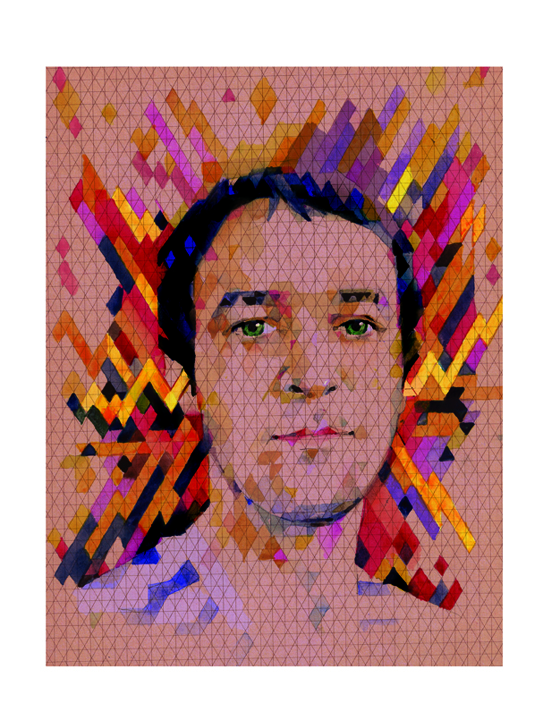
FLA 35: Michael Gillette (07/12/2025)

Michael Gillette is an artist, a true artist. Over the past thirty-five years or so, as a painter, illustrator, cartoonist, designer and creative mind, he has produced a boggling torrent of material – in range and volume – primarily inspired by pop music and pop culture. His clients over the years have included Saint Etienne, Elastica and the Beastie Boys, and his work has appeared in a wide range of newspapers and magazines ranging from Select and Q to The Observer and the New Yorker. If you’ve bought any or all of Ian Fleming’s James Bond novels since 2008, chances are Michael’s done the cover art. But it’s a challenge to summarise that kind of career in a single paragraph, so in the first instance, I urge you to check out his website, michaelgilletteart.com, and a book of some of his many highlights, Drawn in Stereo, published in 2015.

I always sensed Michael would flourish as an artist. The clues were there early on, when we were at junior school in Swansea. Just watching him draw anything was captivating. He was amusing and thoughtful. At the turn of the 1980s, just as the lure of pop history dragged me in, so he’d seen the BBC2 season of Beatles films, and connected profoundly with that pop history’s ultimate figureheads. From then on, for several years, we discussed pop a lot. I now realise this was one of the main reasons to go to school.

At sixteen, Michael moved to Somerset with his family, and then gravitated to Greater London, graduating from art school in the early 90s, and soon finding his skills, talents and wit in considerable demand. As an obsessive reader of the music press and broadsheet newspapers, I saw his work everywhere – and yet somehow still didn’t quite connect this with the talented friend I’d known early on. For reasons that will be explained in the conversation that follows.

The penny dropped when I found Michael’s website in the early 2000s. By then, he was living in San Francisco. We had a long catch-up chat on the phone, and have kept sporadically in touch ever since – and then finally, this year, we had a catch-up in person, in the pub. Which inspired me to ask him if he’d like to do First Last Anything. I was thrilled when he agreed, and so one day in November 2025, we spoke via Zoom: me in Swansea, Michael in St Louis, Missouri, where he now lives with his family. Coming up, amongst other things: what it’s like to house-share with Aphex Twin, the outcome of a commission for Paul McCartney (yes, Paul McCartney), and living and working as an artist and how to share that kind of experience as a teacher and educator.   

—-

JUSTIN LEWIS:

So, to begin at the beginning, what music do you remember early on in your home?

MICHAEL GILLETTE:

With mum and dad… Mum was listening to mostly classical music, Schubert’s The Trout, and Holst’s The Planets, I recall… and maybe a few pop albums. The Beatles ‘Red’ and ‘Blue’ albums, and the Greatest Hits of the Carpenters on repeat. Oh! And the The Beach Boys, 20 Golden Greats with an airbrushed painting of a surfer on the front. The musical equivalents of having a dictionary in the house.

Dad, I was not aware of his musical preferences. He saw Gene Vincent and Eddie Cochran play in Birmingham as a teen but in those days, you were only allowed to be a teenager for about fifteen minutes, right? He packed it away. He listened to Jimmy Young who would have been on Radio 2, or Radio 1…

JUSTIN LEWIS:

He was on Radio 1 in the mid-mornings when that started and then around 1973 moved to Radio 2.

MICHAEL GILLETTE:

So it would have been wall-to-wall Radio 2, that’s what I can remember.

JUSTIN LEWIS:

You’d have Terry Wogan on in the morning.

MICHAEL GILLETTE:

Oh yeah, for sure. And apart from that, it was just the homogeneity of the 1970s TV –  Top of the Pops for Goalposts.

JUSTIN LEWIS:

It keeps coming up in these conversations for those of us in that generation. And there wasn’t a lot else, really.

—–

FIRST: ABBA: Arrival (1976, Epic Records)

Extract: ‘Tiger’

JUSTIN LEWIS:

We had this album as well in the house, although I think my dad borrowed it off someone for a while. But we were playing it a lot. But I remember coming to your house at the time and you had this album, along with – if I remember correctly – the first Muppet Show album.

MICHAEL GILLETTE:

Yeah, that makes sense.

JUSTIN LEWIS:

Which we put on. So how did you come to Arrival, then?

MICHAEL GILLETTE:

I think I had it for my seventh birthday, so I must have asked for it. I just think it was in the culture: Look-In, posters on the wall etc.. I’m sure they were on Seaside Special and things like that. Unavoidable, right? Utterly fantastic. And immediately sticky [laughs].

JUSTIN LEWIS:

The people who are ten years older than us thought ABBA were ridiculous.

MICHAEL GILLETTE:

They must be deaf.

JUSTIN LEWIS:

Because, firstly, ‘it’s Europe’ and unless it was Kraftwerk, no pop from Europe was meant to be any good, apparently. And then punk rock happened in Britain, even though ABBA were already making brilliant singles, and the Sex Pistols liked ABBA, for instance. And subsequently, there was a critical revival with ABBA – I remember Elvis Costello saying of ‘Oliver’s Army’… I’m sure you know this…

MICHAEL GILLETTE:

You can hear it – the piano.

JUSTIN LEWIS:

He used to cover ‘Knowing Me Knowing You’, live.

—–

JUSTIN LEWIS:

Towards the end of junior school – so this is 1980, 1981 – I remember two or three massive Beatles fans in our year, and you were one of them, and I remember talking to you about it. So you had the ‘Red’ and the ‘Blue’ albums in your house, but what was the next step for you with Beatles fandom?

MICHAEL GILLETTE:

Aw – BBC, Christmas 1979 – they showed all the films. I remember the Shea Stadium one, and especially Magical Mystery Tour

JUSTIN LEWIS:

Which I don’t think had been on since the first showings [over Christmas 1967 – once on BBC1 which was still monochrome, and days later on BBC2 which had just begun broadcasting in colour].

MICHAEL GILLETTE:

I remember watching that in my grandparents’ house in my Cub Scout uniform [Friday 21 December 1979, BBC2, 6.10–7.00pm], and looking at it – because there’s a bit with a stripper in it which I was watching via a convex mirror because I thought ‘I can’t just turn around and watch this!’

That Christmas was the introduction, really.

JUSTIN LEWIS:

You having your Cub Scout uniform on suggests we must have been to some Cub event, because we were in the same pack. I’m trying to think what that might have been.

[The other showings of Beatles films that Christmas:

Sat 22/12/79, BBC2 1835–2000: Help!

Sun 23/12/79, BBC2, 1740–1830: The Beatles at Shea Stadium [first showing since 1966]

Mon 24/12/79, BBC2, 1740–1900: Yellow Submarine

Tue 25/12/79, BBC2, 1500–1625: A Hard Day’s Night

Wed 26/12/79, BBC2, 1750–1910: Let It Be]

MICHAEL GILLETTE:

They just made me never want to wear a uniform again. It sparked off something :‘What on Earth is this? How do people get to live like this?’ It was the whole package – to see the comedy and the style. I’ve always had these two things together – visual/musical – and seeing them [together] made a massive difference. No regular job plans after that.

JUSTIN LEWIS:

One of the themes of your career, really, is how you’ve channelled pop music into artwork, but with the Beatles, I feel as if you’ve particularly latched on to the fantasy and mythology over the reality of them. I’m not suggesting you haven’t studied the latter! But it’s about setting the imagination free, and Magical Mystery Tour certainly encourages that. As much as something like Get Back would show them making a record in real time, you get this other side to them which has them having adventures. Like they’re comic book characters.

MICHAEL GILLETTE:

Yeah. Perfect for children, as a gateway. It was the scarcity of it. Even though it was on at Christmas that year, after that, it was gone. Until John Lennon died.

Just before he died [December 1980], I remember you used to write the charts out every week, and I saw that John Lennon was in with ‘Starting Over’, [a brand-new single]. And I was like, ‘What do you mean, John Lennon’s got a new single out?’ When I heard it, I couldn’t equate it with The Beatles, it seemed like a dimmed bulb. So when he died, part of me felt, ‘Oh great, The Beatles are now everywhere!’ I was spending all my pocket money on everything I could get, all that merchandise that appeared!  It’s a terrible way to think about it really.

JUSTIN LEWIS:

But he’d also been away for five years, of course, prior to that single, which is a long time. And were you a John fan or a Paul fan?

MICHAEL GILLETTE:

I didn’t know who sang what until later. When I started buying their records, I would look for the albums with the least amount of music that I already knew, to get the best value out of it. The first one I bought was Revolver.

JUSTIN LEWIS:

Funnily enough, the critic David Quantick once pointed out [on the superlative Beatles podcast, Chris Shaw’s I Am the Eggpod] that Revolver (along with the ‘White Album’) is probably the least well represented album on ‘Red’ and ‘Blue’.

MICHAEL GILLETTE:

Yeah, that’s why I would have bought it. ‘She Said, She Said’ – that song really opened things up for me, it’s in my DNA. I don’t think Paul McCartney’s even on that song. 

JUSTIN LEWIS:

An enduring Beatles mystery, so many conflicting accounts and fragments of evidence.

MICHAEL GILLETTE:

I read a lot of philosophy and psychology. Partly it’s helped me understand and justify pop’s importance rather than its triviality. Pop’s taken up a lot of my bandwidth!

I learnt a lot from René Girard, who, as an anthropologist at Stanford in the eighties, coined theories around mimetic desire. We’re all porous to suggestions and mimic others. We desire what other people desire. We can also hate what other people desire. This causes tribalism and scapegoatism. Girard’s warnings are important because many Silicon Valley bros, including Peter Thiel, took his class. They saw his cautions as business models. Look at how that’s played out with social media… 

Anyhow, I thought, ‘oh, this is kind of what happened to me with the Beatles and pop music.’ The Sergeant Pepper cover – it’s a mimetic map of culture, religion, art, everything. Probably 90 per cent of my interests all connect back to the Beatles. Ultra mimetic.

We both grew up during the high watermark of youth cults [JL agrees]… music with distinct looks and styles…These are explained by mimetic theory too. We were kind of outside it in Wales – couldn’t get the right clothes [laughs], but it saturated those impressionable years for our generation, right?

JUSTIN LEWIS:

Yeah – you’d look at London or Manchester and you’d think, ‘How do you get to go there then, a city where it’s all happening?’ Because nice beaches that there are, amazing coastline, Swansea didn’t really have that kind of magic. Bands didn’t come very often, and it wasn’t easy to go and see people if you were under eighteen.

MICHAEL GILLETTE:

Billy Bragg I managed to see in Swansea, a miners benefit gig [7 April 1985 – Easter Sunday, in fact]. At the Penyrheol Leisure Centre. I saw The Alarm there too [16 November 1987].

JUSTIN LEWIS:

Just before we move on from The Beatles, though I’m sure we won’t move too far, can you tell the story about your Paul McCartney album sleeve commission? Because this is extraordinary.

MICHAEL GILLETTE:

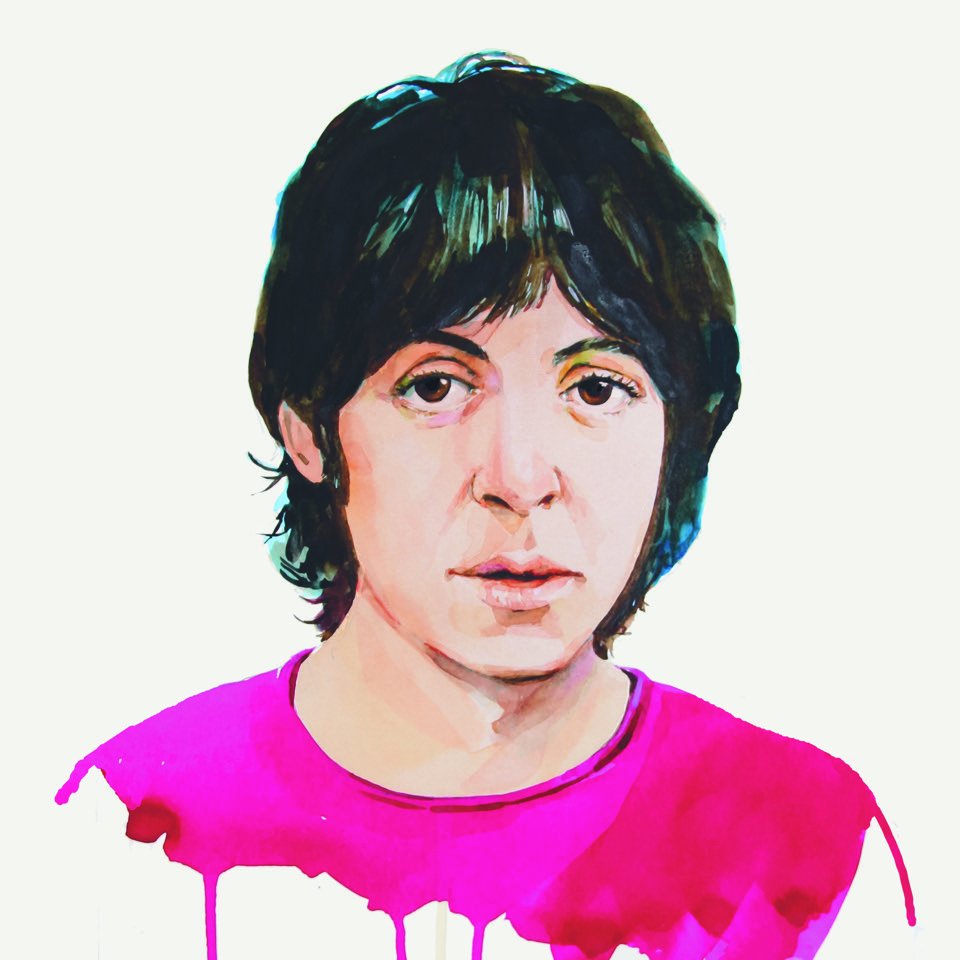
I’d done some work for the Beastie Boys, an animation for their [To the 5 Boroughs] tour (2004/05). They were signed to Capitol Records. The lady I was dealing with there rang me one Friday afternoon, and said, ‘Paul McCartney is coming in on Monday and we’re going to do a “Greatest Love Hits” – for the first time, a compilation of his Beatles and post-Beatles work.’ They were very specific: ‘We want him doe-eyed and lovely, from ’67, ’68…’ I was like, ‘Can do.’ So I worked over that weekend, so confused at how this had happened. Anyway, I did it, and the next week they got back to me: ‘Oh he’s just come in, and no Love album for him, he’s getting divorced.’ So that was the end of it. They said, ‘Oh he says it’s really great, he really likes it!’ They tried to buy the artwork. That was the closest brush with my obsession.
JUSTIN LEWIS:

I knew you as a brilliant artist even at school, but what sort of sleeve art was inspiring you back then?

MICHAEL GILLETTE:

Well, anything to do with the Beatles!, so, Klaus Voorman, Peter Blake and then Richard Hamilton – there’s three. My mum would buy me bargain bin books from WHSmiths in Swansea. One of the first was a Rick Griffin monograph. He was one of the San Francisco psychedelic hippy poster artists – all imagery inspired by music. Another was by the artist David Oxtoby, Oxtoby’s Rockers. He was a contemporary of David Hockney, from Bradford. He did incredible paintings of rock stars. I was twelve and had chicken pox when I got it – after two weeks off school itchily looking at this book, this massive door had opened in my mind. I thought, ‘Oh, this is also possible’ [laughs].

When I eventually visited San Francisco for the first time in 1997, the posters of the ‘60s had acted as sirens. I ended up living just a couple of streets away from where Griffin made most of his famous work in the late sixties. I used to pass his old house every day. He was long gone by then. He died in a motorbike accident in the 1990s, he’d been doing covers for The Cult just previously. He became a born-again Christian in 1969 and moved down to Southern California and became a massive influence in that world. An amazing character.

—–

JUSTIN LEWIS:

I’m going to quote from your excellent collection of artwork, Drawn in Stereo. ‘Art wasn’t my first career choice. I wanted to be a pop star.’ Now, I knew you were a good guitarist, that’s what I remember, but I hadn’t quite realised you had that in mind, so I was quite surprised to read that.

MICHAEL GILLETTE:

Yeah, I wasn’t that good at music. When we moved to Somerset, I did my art foundation year in Taunton. The West Country had a good music scene. PJ Harvey came out of that time and place. In Taunton, bands were everywhere… When I got to Kingston Art School, no-one was interested in forming groups. Disappointing. The thing about getting into colleges that are ‘good’ is people are focused on the job at hand! I wasn’t. I was in a band for the first year… but I just knew: Nope – you don’t got it.

JUSTIN LEWIS:

The thing about being in a band – maybe even if you’re a solo artist – is there’s a career arc you’re expected to follow, and it’s all about compromise. Whereas if you’re an artist, you can surprise yourself. You’ve got the freedom to be inventive. And it seems to me, given what you’ve gone on to do, you’ve just kept changing. You’ve never stuck to one thing for too long.

MICHAEL GILLETTE:

I was reared on that Beatles or Bowie [arc] to keep changing and evolving. The visual side of music is such a rich seam to mine – you can tap into two completely disparate things like, say, two-tone and psychedelia and evolve something fresh. But yeah, you’re right. It’s a control thing, and you don’t have that in a band. I didn’t much enjoy being on stage. I got very nervous, I’d play real fast.

JUSTIN LEWIS:

Were you trying to write songs, by the way?

MICHAEL GILLETTE:

A bit, with bands, but I didn’t have that gift on my own. I thought I would join a successful band at art school. Instead, I graduated off a cliff. At the end of Kingston, in ’92, some student friends knew Richard – the Aphex Twin and we all moved to Islington together. I didn’t know his music at the time, but holy WOW!

JUSTIN LEWIS:

The first time I heard him, that first album [Selected Ambient Works 85–92, 1992]: ‘What the hell is that?’ I was listening to quite a lot of electronic music at the time, but that felt like a real departure from everything.

MICHAEL GILLETTE:

I knew he was groundbreaking – anyone with half a tin ear could tell that. I think the groups I was involved with, during Britpop, were fantastic fun, but there was already so much of the guitar pop canon established. Richard was off the maps making his own worlds.

JUSTIN LEWIS:

Yes, I love Blur, but… a lot of it was good pastiche, but pastiche nonetheless.

MICHAEL GILLETTE:

I can understand pastiche, I personally don’t re-invent the wheel, I just put new rims on.

Oasis… I never saw them as Beatles-like, more Slade in Cagoules.

JUSTIN LEWIS:

But they weren’t going to reinvent themselves with every record like the Beatles did. We’ll come back to Aphex Twin in a second, but I just wanted to ask you about something else that happened in summer ‘92 when you’d just graduated from Kingston. You stuff an envelope of your stuff through the letterbox of Saint Etienne’s house in north London. I know that you’d really enjoyed Foxbase Alpha, their first album, but what made you think of choosing them to approach?

MICHAEL GILLETTE:

When did that album come out?

JUSTIN LEWIS:

October ’91. I remember I bought it the day it came out.

MICHAEL GILLETTE:

Okay, I must have too. In late 1991, I was in Russia on a month-long student exchange, I had it on tape, and listened to it there. That album’s very atmospheric and kaleidoscopic – it fit Moscow. Back in London, I listened to it driving around, it fit there too. ‘Nothing Can Stop Us’, what a fantastic song. Bob Stanley told me they paid £1,000 to clear the Dusty Springfield sample. Money very well spent.

Meanwhile, I fell out of Kingston. I wasn’t ready to leave college, I’d been expecting to do an MA – at the Royal College of Art, but they passed. In that last month of Kingston, I realised I’d better start approaching people. It was almost a desperate thing. I knew Saint Etienne were working on another album. But there was some magic involved, definitely – Foxbase Alpha, finding their home address on the back of the ‘Join Our Club’ single, picking them to stalk … They understood my fandom.

JUSTIN LEWIS:

Yeah, that first album, in the booklet, you’ve got all these photographs of icons, so Micky Dolenz is there, Billy Fury, Marianne Faithfull… Eight or nine of them.

MICHAEL GILLETTE:

It’s another mimetic gateway. The glamour of formica caffs that’s open to all. It wasn’t like the eighties, where you needed a zillion dollars to go into the studio and make some shit, atmosphere-free record; all boxy drums and Next suits with padded shoulders. Instead, it was the longings of the fan, lost treasures and pop theories. That record has a dreamy hiraeth.

I stuffed that envelope through the letterbox, went back to Surbiton for the last couple of weeks college. Next, I went up to Heavenly, their record company, rang the bell. Martin Kelly, their manager, opened the door and said, ‘Oh, they told me about you. Come on up!’ I thought, ‘My god, it’s this easy?! This is great! Is this how it’s going to work?’ And of course it doesn’t often work like that. Magic was afoot. You have to knock though.

JUSTIN LEWIS:

They’ve always been very interested in the contemporary, but shot through with something of the past at the time.

MICHAEL GILLETTE:

Yeah. Reinterpreting the past, excavating and curating. Bob Stanley was like meeting an older cousin who knew everything about pop. So anyway, that’s what happened, and they paid me £2,000 which was a lot of money straight out of college. I didn’t see money like that again for a long time.

JUSTIN LEWIS:

And then you started to do bits for Select magazine, right? Which was a sort of indie-dance version of Q magazine, for those who may not remember.

MICHAEL GILLETTE:

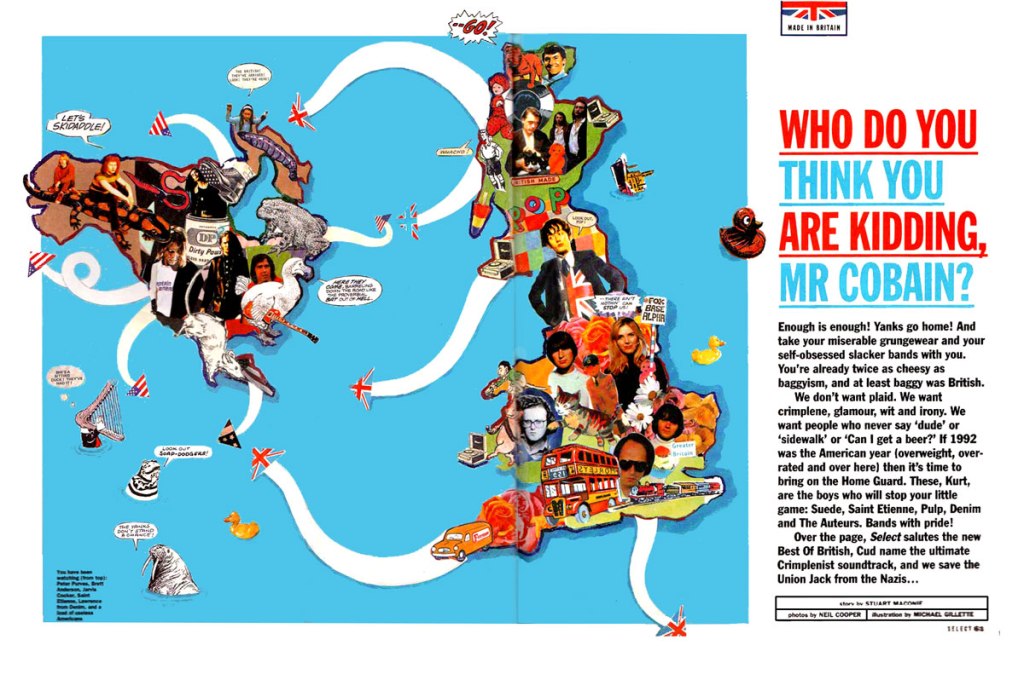
My flatmate Stu’s brother [Andrew Harrison] was the editor of Select. Andrew had a ‘no nepotism’ rule, he couldn’t be seen giving jobs for the boys. But when he found out I’d worked for Saint Etienne, he was like, ‘You must be bona fide.’ So that’s how I got the job doing the illustration for the Stuart Maconie article about Britpop [Select, April 1993 issue].
JUSTIN LEWIS:

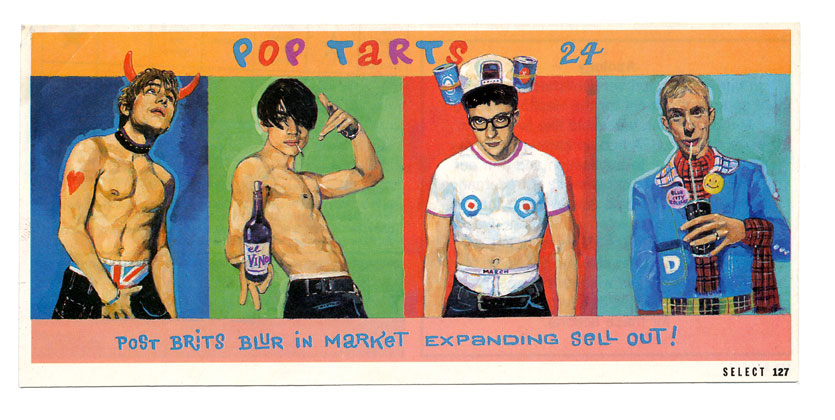
And then you did this regular feature called Pop Tarts, every month, and it’s reminded me how much you made me laugh in schooldays. Because you found room for humour and irreverence as well in many of these pieces.

MICHAEL GILLETTE:

Definitely. When I left college, I was a headless chicken, didn’t know what to do, and was thinking, ‘I’m only going to make serious work, try and do stuff for Faber & Faber’. Then I thought: ‘That’s not who I am – humour is really important.’  That’s yet another lesson from the Beatles – they could reach the highest rung of an artform and still be silly.  I can’t bear serious pretension – when the scene gets pretentious, I get really uncomfortable. I did fifty Pop Tarts. By ’96 I couldn’t take it anymore, but it was a good calling card for a while.

JUSTIN LEWIS:

That might be the longest-running thing you’ve ever done, then.

MICHAEL GILLETTE:

It probably is, yeah.
JUSTIN LEWIS:

And then you’re doing newspaper commissions, you’re in a lot of the broadsheets in the late nineties, doing accompanying illustrations for things. I found a thing in the Telegraph archive of all places, a culinary feature.

MICHAEL GILLETTE:

I did The Observer for a year, too. I did their back page column called ‘Americana’. Louis Theroux wrote many of the articles. I came back to London this last summer, went to Bar Italia, and there’s a drawing I did – maybe for the Telegraph – framed on the back wall! It was about Italian clothes culture, and I had decided to include Bar Italia. Not a work of genius, but when I saw it, I was thrilled [laughs]. I couldn’t think of a better place to hang!

JUSTIN LEWIS:

How do you feel in general now, seeing work you did thirty years ago or longer?

MICHAEL GILLETTE:

I’m just glad to be alive, and to have been able to make a creative living. Sometimes I have barely any recall of pieces – the Bar Italia picture for example. I’ve made so much stuff, it’s a rodeo schedule. I chose pop media – magazines, books, records, videos – rather than gallery art where ten people might see it. I wanted to be seen. It’s a really proletarian art form. Masses of art for the masses.

JUSTIN LEWIS:

Your stuff did get everywhere, and I saw a lot of it, although somehow I didn’t make the connection that it actually was you for some time. I should explain here that your surname has grown an extra ‘e’ at the end since we were at school.

MICHAEL GILLETTE:

Either Select added that to my name or maybe Saint Etienne.

JUSTIN LEWIS:

Was it in error?

MICHAEL GILLETTE:

It was, yeah. But I wasn’t going to argue with that. I just let it go. Everyone was dropping Es in the nineties. I picked one up.

JUSTIN LEWIS:

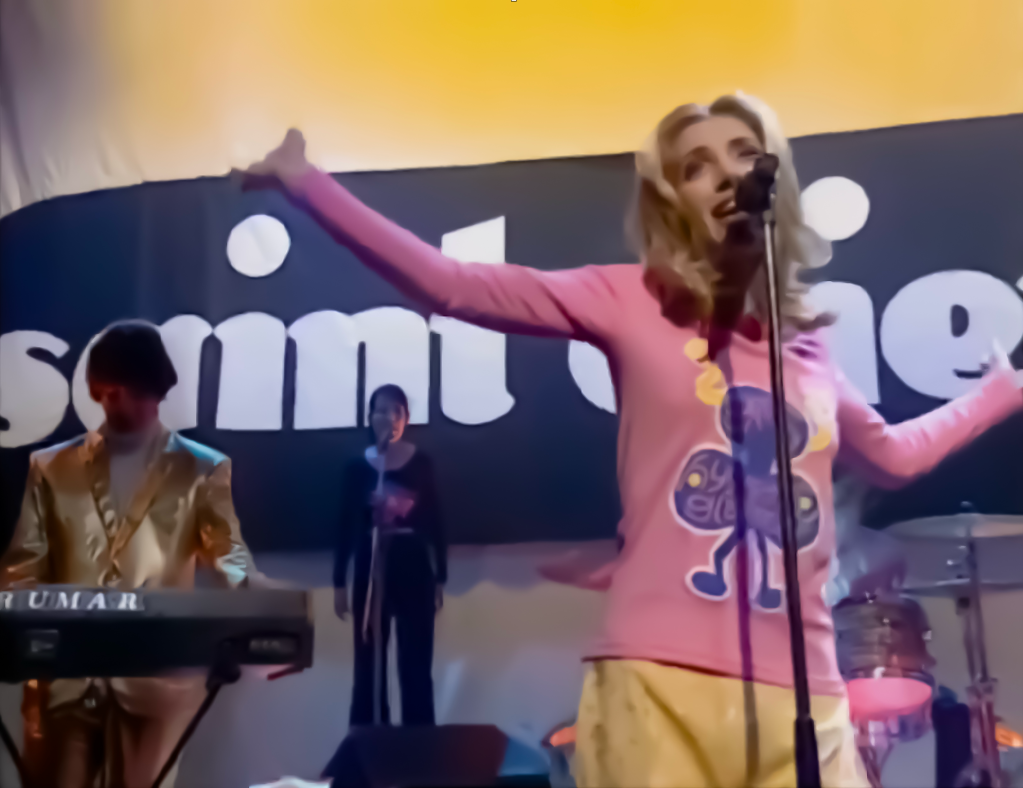
So what did you do for Saint Etienne’s So Tough album? You certainly came up with the logo, right? And you designed the cover?

MICHAEL GILLETTE:

I initially did a painting of the 1970s photo of Sarah, which her father took. They went with his photo for the cover, which was the right decision. I did paintings of Bob and Pete for the inner sleeve. I wasn’t match fit yet. I hadn’t advanced much at college. I comped together some logos and they went with one set in a font called Bunny Ears.

JUSTIN LEWIS:

And that was the logo they used when they first went on Top of the Pops, for ‘You’re in a Bad Way’.

MICHAEL GILLETTE:

I was so excited: ‘My logo is up there.’ A little bit of me is on TOTP.
JUSTIN LEWIS:

So, with Aphex Twin, you were living in the same house around this time, 1992–95, three years or so. Was that a creative environment, a chaotic one, or both?

MICHAEL GILLETTE:

Both, definitely. We lived in two different locations. In the first one, he and his girlfriend lived above us. So my introduction to him was through the floorboards, really. He was right above my bedroom, it would be very quiet for long periods of time, when he was listening through headphones making stuff, and then it would be uproariously loud and sometimes terrifying, sometimes beautiful.

Then we moved to Stoke Newington and he had a tiny studio in the midst of the flat, so there was no separation. There were a lot of people coming and going, hangers on, and basic early twenties bad behaviour from young creative types. We all wore each other out because we were so much in each other’s pockets. But everybody was interesting and funny. And for all that people think of Richard, he was not a pretentious human being.

JUSTIN LEWIS:

I always think there’s quite a lot of humour in what he does anyway.

MICHAEL GILLETTE:

Yeah, often puerile!

JUSTIN LEWIS:

How did his remix for Saint Etienne’s ‘Who Do You Think You Are?’ come about? Is it true you were a sort of messenger with that?

MICHAEL GILLETTE:

I asked him, yeah. I hadn’t known him for long – and I wouldn’t say I had the capability to sway him in any way, but he was open to doing stuff at that time. I think he did a good job.

JUSTIN LEWIS:

I find it quite funny he did it, given the choice of song. Because I can imagine him being offered ‘Avenue’ to remix, for instance, but ‘Who Do You Think You Are’ (nothing to do with the Spice Girls by the way, this was earlier!) was a cover version of a song recorded by the Opportunity Knocks-winning comedy showband Candlewick Green in 1974, and the Saint Etienne remake had the potential to be a huge hit. And it’s not a remix you’d expect from a commercial single at all. But then Saint Etienne were great at being leftfield pop stars.

MICHAEL GILLETTE:

I’m sure they were elated with that remix. I don’t think they were looking for a Fatboy Slim banging track.

JUSTIN LEWIS:

And you did some video work for Elastica too.

MICHAEL GILLETTE:

I did two animations for their videos, which was very stressful, and some sleeve work for them too.

JUSTIN LEWIS:

The ‘Connection’ single.

MICHAEL GILLETTE:

I did a painting for that, so I saw them from lift off to stratosphere. Justine [Frischmann] moved to Northern California in the noughties. We wound up living in the same neighbourhood – she helped us out to move there after we left San Francisco, so that was an enduring connection from that time.

JUSTIN LEWIS:

In 1997-ish, you finally got to visit San Francisco because, as I understand it, you had a show on at the Groucho Club in London and lots of wealthy people bought lots of your work, and so you could afford to go. Is that true?

MICHAEL GILLETTE:

Yes, that is exactly what happened. I had a show at the Groucho the same week that Labour were elected – a high watermark and possible end of Britpop – and I sold 14 out of 20 pictures.

JUSTIN LEWIS:

And Jarvis Cocker bought one?

MICHAEL GILLETTE:

Well, you know Ant Genn? He played with Elastica, he’d been in Pulp [and now writes scores for film and TV, including Peaky Blinders]. He bought three, one of which was for Jarvis, but Jarvis ended up paying for all three. I don’t know why. Who else bought one? Graham Linehan, who was then working at Select, Damon Hirst’s manager…’90s Soho.

JUSTIN LEWIS:

Do you ever miss Britain? You’ve been living in America a long time now.

MICHAEL GILLETTE:

Yeah, twenty-four years. Pound for pound, Britain punches harder than anywhere else. Music, comedy, history… I do love it. I feel a bit claustrophobic there now. I wish I’d spent more time visiting antiquity. I guess you always want what you haven’t got, right? Here, I want something pre-Victorian. I want to get my hands on something ancient!

—–

LAST: THE LEMON TWIGS: ‘Ghost Run Free’ [2023, from Everything Harmony album, Captured Tracks Records]

JUSTIN LEWIS:

Lemon Twigs have come up before on this series, and rightly so [FLA 24, Alison Eales]. What was it about ‘Ghost Run Free’ in particular?

MICHAEL GILLETTE:

Well, it’s like the offspring of The La’s and Big Star, isn’t it? I’d adopt that kid and bring them up as my own. Just instant ear candy, pressing all my buttons. I’ve played that song a lot – I like the rest of the album, but something about that song absolutely chimes. I was lucky to see them play here in St Louis – people tend to skip over the Midwest. I decided to wear a hat and stand at the back, not to spoil the kids’ fun. But the audience were all older than me! It was almost like a vampiric ritual… the band’s so young, what must it be like for them, looking out at the Night of the Living Gen Xers?

JUSTIN LEWIS:

It’s a breath of fresh air, this album, and while there’s lots of stuff I like at the moment, you don’t tend to get things that are big on chords, harmonies or melodies charting particularly highly. It’s unusually tuneful – the last time they got picked on this, I was referencing early seventies Beach Boys and Todd Rundgren, but now I can also hear Crosby Stills Nash and Young in it, even Roy Wood’s Wizzard.

MICHAEL GILLETTE:

They can all play, the band’s been together a while. They look like they were made in a pop culture laboratory. Live, they’re all swapping instruments. And then you’ve got the two D’Addario brothers, like the Everlys, Kinks or the Bee Gees. I’m going to quote Noel Gallagher here – ‘brothers singing is an instrument you can’t buy in a shop’. Like ABBA, where harmony and melody is absolutely everything. There’s always a chorus with multiple voices, so you feel like you’re included in the song. That’s one of Brian Eno’s pop observations/recipes.

Most songs I really love have got harmonies. Apart from The Smiths – I don’t know why they never had that.

JUSTIN LEWIS:

That’s a good point. I suppose with them, the harmonies are in the guitars.

MICHAEL GILLETTE:

Yeah, but Johnny Marr can sing – he’s got a good voice. Why did they never sing together? I suppose Morrissey won’t share his crisps.

—–

ANYTHING: JOHN O’CONOR: Nocturnes of John Field [1990, Telarc/Concord Records]

Extract: ‘Nocturne #1 in E flat Major’

MICHAEL GILLETTE:

I came to a point where pop music was just frazzling me. To quote that ‘Alfred Prufrock’ poem by TS Eliot: ‘I’ve measured my life out in coffee spoons’, whereas I’ve measured my life out in poppy tunes. There just came a time, especially working and reading, for [something else] and hearing these Nocturnes…

JUSTIN LEWIS:

What sort of age were you?

MICHAEL GILLETTE:

Oh, late forties. I’d always listened and worked to lots of soundtrack stuff, John Barry, Lalo Schifrin… But here, just the solo piano is so peaceful. Going from a world where I know everything about a musician, to this, where I didn’t know anything. I just listened without any baggage – a blank slate.

JUSTIN LEWIS:

Can you remember how you came across it, then?

MICHAEL GILLETTE:

I really don’t know. Maybe through YouTube’s algorithms… do you know anything about John Field? [Born in Dublin, 1782, lived till 1837] He had a riotous life. He was basically a rock star. His life would make a great film, Barry Lyndon-esque. Eventually I looked him up, but for years I knew nothing but the music.

JUSTIN LEWIS:

I knew the name, but it transpires he invented the nocturne form. Chopin was a fan. So he’s an innovator.

MICHAEL GILLETTE:

Yeah, I’m no connoisseur. I’ve listened to Chopin’s Nocturnes, I don’t enjoy them as much. Satie’s are good too, but Field’s are like an instant warm bath, reliably calming.

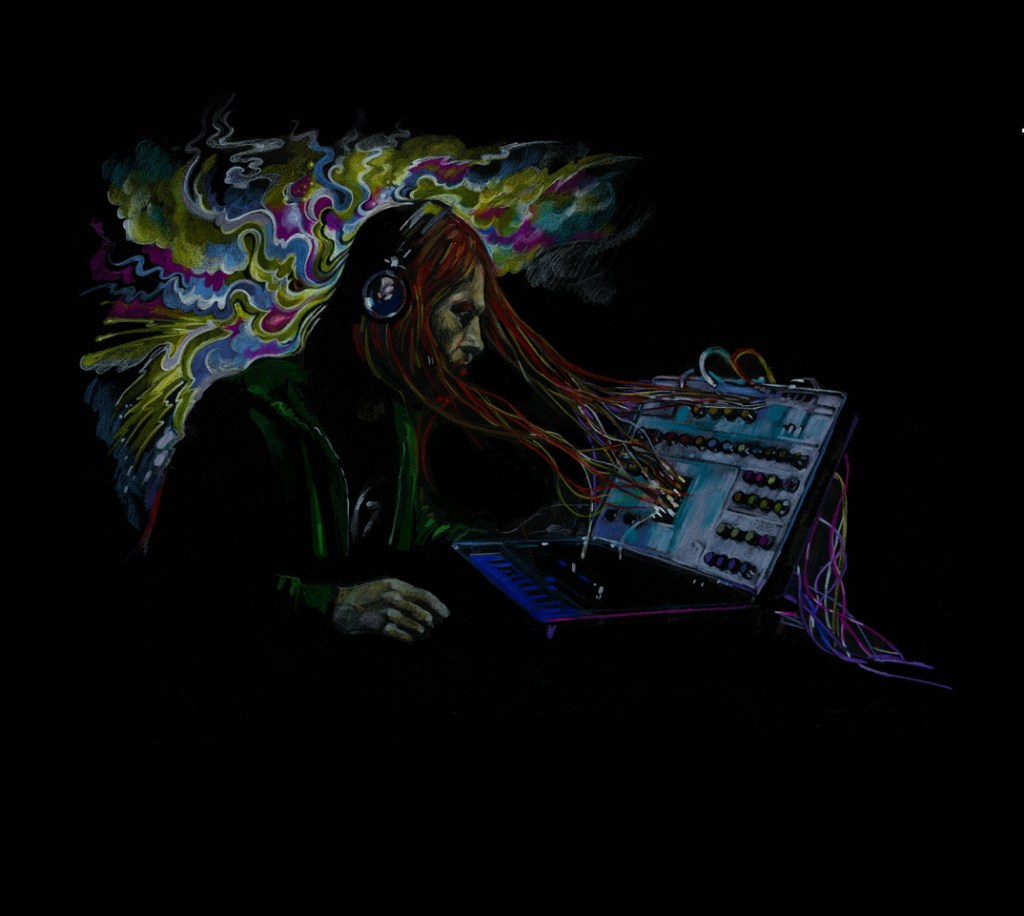
I’ve been thinking about the Aphex Twin this last couple of weeks because one of my students at college was drawing his logo over and over.

‘Oh, the Aphex Twin,’ I said.

‘Do you know that guy?’

‘Actually, yeah, I do know that guy.’

Then yesterday, my screen printer was wearing a homemade Aphex Twin T-shirt, with a picture of Richard in the Stoke Newington house studio. I’ve found folks want to keep the mystique of him intact. We are so overloaded with information. I think the mystery allows for purer engagement.
I feel like that about classical music. I won’t reach the point where I need to know what the third horn player had for his tea and how that affected anything. You know what I mean?

JUSTIN LEWIS:

When we were at school, the running joke about pop trivia knowing no bounds would be ‘What colour socks was Paul McCartney wearing when they recorded “Get Back”’?, and now the Get Back film exists, you can bloody well find out! It’s ridiculous really. I suppose thirty, forty years of reading the pop music press has created this frame of mind, and you can’t do that with everything. One of the nice things about new music now is I often come to things and I don’t know anything about them, who they are, nothing beyond the bare bones. It’s like being eight again.

MICHAEL GILLETTE:

It is. What I see with my children is they’re not interested in context, it’s all delivered scrolling on a phone. Recently, my daughter learnt to play ‘Love Grows Where My Rosemary Goes’ on the violin, and I asked:

‘How do you know that song?’ 

‘Instagram… How do you know it?’

‘It’s from the late 1960s.’

‘Oh I thought it was new.’

It’s trending audio… stuck behind reels. Folks use trending audio, and the algorithm boosts the post. It’s kinda greasy. My daughter was humming ‘Golden Brown’’, same thing – it’s used on medieval themed reels.

We were groomed [laughs] to be obsessed with pop minutiae. Now, it’s just another bit of content in the feed. They do introduce me to some new music though, Olivia Rodrigo I enjoy.

JUSTIN LEWIS:

Well, we were in the analogue age where knowledge was difficult to come by, so you’d collect fragments of information until you had far too much of it all. [Laughs] That’s what happened.

MICHAEL GILLETTE:

YES! – the scarcity back in the day. So maybe what I’m trying to do with jazz and classical music is to go back to pre-knowledge. I love Lou Donaldson, I love his music, but I wouldn’t know him from… Donald Duck. I know he’s Mr Shing-a-Ling. But I don’t really have any interest beyond listening and enjoying.

JUSTIN LEWIS:

And it makes it more random, you can make your own connections with it. For a long time, we got used to other people shaping music history, and now I guess you can create your own experience.

MICHAEL GILLETTE:

Totally. That’s the big difference. When you used to bring Smash Hits in to school, and we’d pore over it at lunchtime, Mark Ellen was the editor at the time. That Britpop illustration I mentioned earlier… Mark Ellen [by 1993, the Managing Editor of Select] was who I handed it over to. Did the obsession bring that to pass? I suppose what you give your attention to grows.

—- 

JUSTIN LEWIS:

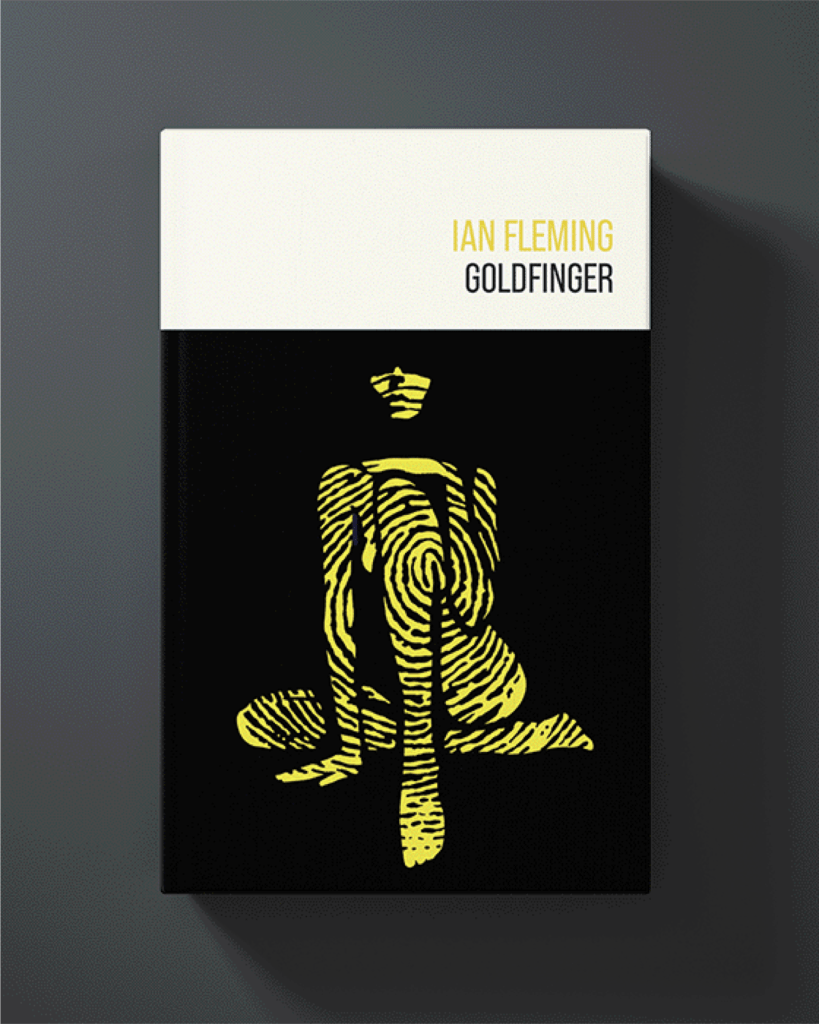
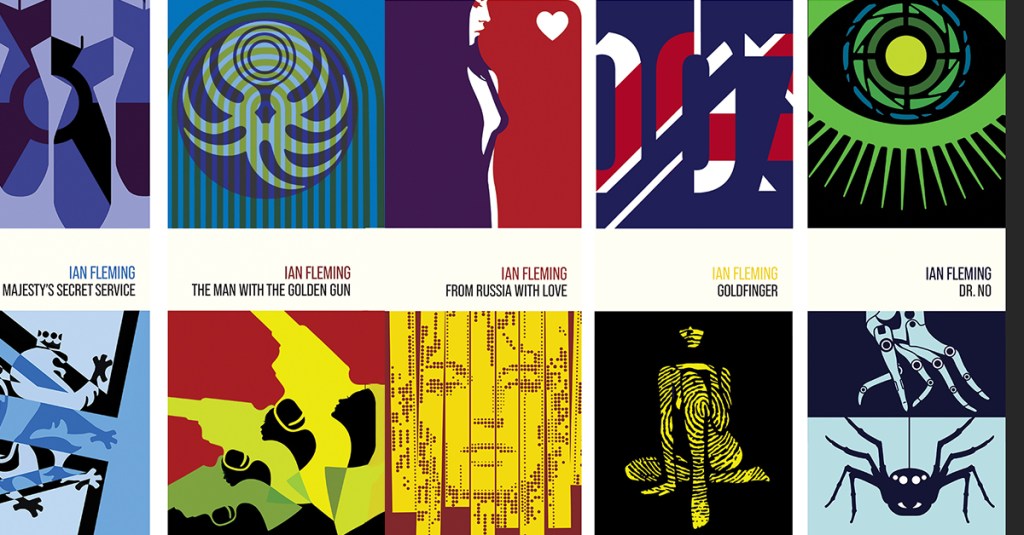
You’ve designed [in 2008 and again in 2024] two very differently styled series of covers for Ian Fleming’s collection of James Bond books. Did you read the Bond books as a kid, or did you connect with the films first?

MICHAEL GILLETTE:

My dad had the books, Pan paperbacks from the sixties – great covers. They were stashed away in my bedroom in a little attic space. I read them when I was probably 12, 13… but the films… apart from occasional Bank Holidays, I don’t really remember them being on much. Do you?

JUSTIN LEWIS:

I don’t think they were on TV much before the eighties.

[Note: The first Bond film to be shown on British TV was Dr No, on ITV, on Tuesday 28 October 1975. In January 1980, the UK TV premiere of Live and Let Die attracted 23 million viewers on ITV, still unbeaten for a single showing of a film on British TV.]
JUSTIN LEWIS:

The main thing I remember with Bond was going with my dad and my brother to see a double bill at the Swansea Odeon on the Kingsway [don’t look for it, it’s not there anymore], this would have been Summer ’78. It was Live and Let Die and The Man With the Golden Gun, a double-bill. Two hours long, each of them, that’s a long afternoon. Especially when you’re eight years old. It’s actually a long time since I’ve seen a new Bond film. But I was also wondering to what extent the music of Bond films inspired those designs of yours. Were you thinking a lot about John Barry scores?

MICHAEL GILLETTE:

I do absolutely adore his music, yeah. Because I’m involved in the Bondiverse, I understand people are as passionate for 007 as we are for bands. I understand the draw of Bond. My job as a designer is to translate visually as a composer would do musically. The most enduring Bond thing for me is Barry’s scores, so sophisticated and timeless.

JUSTIN LEWIS:

They really hold up, as do the themes which generally hold up better than the films. Not many duds, surprisingly.

MICHAEL GILLETTE:

With John Barry, it’s the whole score… Things like Petulia from 1967, that’s a great soundtrack, or The Knack, and The Ipcress File. I listen to those more. I’m not an obsessive in the Bond world. And that possibly helps because you can get lost in detail. It helps to take a wider view.

JUSTIN LEWIS:

I was just thinking: have you ever tried to pastiche the Beatles’ album sleeves?

MICHAEL GILLETTE:

The only thing I remember doing, and it’s in Drawn in Stereo, is Oasis as the Yellow Submarine characters for Q.

JUSTIN LEWIS:

Of course, that’s right.

MICHAEL GILLETTE:

But otherwise, for years, I felt like I didn’t have enough skills to represent what they meant to me.

JUSTIN LEWIS:

You were too close to it!

MICHAEL GILLETTE:

But record sleeves remain the same and book covers keep changing. It’s interesting why that is.

JUSTIN LEWIS:

Why does that happen, I wonder? Even modern books do that – often the paperback edition six months later looks nothing like the hardback.

MICHAEL GILLETTE:

Music and visual culture are so locked together, I can’t disassociate them. I can’t imagine 2-Tone without that Walt Jabsco image. With a book, you don’t just stare at the cover for hours while you’re reading it. But a record… think of that bus journey between HMV in Swansea and home, where all you’ve got to look at is the sleeve.

Doing the Bond covers both times… immediately the reaction from some fans was that I’d performed an act of heresy. Changing record sleeves would cause a riot, unless you are Taylor Swift, but like many things about her, she defies logic and gravity.

JUSTIN LEWIS:

What’s your working routine like now? Do you sit at the desk every day, working on something, even if you’re just sketching?

MICHAEL GILLETTE:

Things have changed since COVID. My career has been mostly that of a rodeo illustrator: showing up every day, seven days a week, moving between clients, which went on for a quarter of a century plus. I don’t quite do that anymore. Now, I teach and do more selective commissions, because the world’s changed and I’ve changed. You know what it’s like with deadlines, right? For four years I worked for the New Yorker pretty regularly. I’d be about to clock off on Friday afternoon, and they’d e-mail and that’s the weekend done. For many years of my life, I leant in very hard.

JUSTIN LEWIS:

Are there things that surprise you about the young generation of new artists – in a good way, I mean?

MICHAEL GILLETTE:

I feel that we are fed a story that this generation is ‘hopeless and weak’. It’s been the same call since biblical times. By the end of teaching a class, or seeing my kids create, I have hope for us as a species. I believe in magic. I believe there’s an indomitable spirit of creativity that everyone’s got. We’re born with it, and we’re here to represent it the best way we can. I think that’s why people get unhappy when they don’t have outlets for their creative energy.

JUSTIN LEWIS:

It worries me in this country that young people are now supposed to only foster the talents that are going to get them a job or are going to get them a way of making money for other people rather than what they might actually be good at. And that’s really kicked in, in recent years. Obviously, education and passing exams is important, but what about the imagination?

MICHAEL GILLETTE:

Well, when you saddle people with debt in college, that puts an entirely different slant on it. The two grand from Saint Etienne paid off my student debt. I worked all the way through college to keep it low, but that’s the difference – I could afford a London life, albeit a tight one. Two thousand pounds at a time when my rent in Islington was £55 a week. That kind of maths wouldn’t work now with London housing. The pay for a similar gig in 2025 would be more or less the same, and cover about five weeks’ rent.

I’ve had a career, but it wasn’t encouraged, it was unlikely even then. Most folks who studied illustration didn’t become illustrators. Not saying that being an illustrator is the high bar of anything. We’ve saddled students with middle-aged debt and the anxieties that go with it. It’s unfair. As a teacher, I try to help as much as I can. My teachers were often art school bullies who’d give you a good kicking. Maybe that was the point; maybe if you survived that, you were strong enough for the outside world! But I try to do the opposite, I hope to encourage.

JUSTIN LEWIS:

What sort of age are your students?

MICHAEL GILLETTE:

19, 20, 21. They’re super-young, but the same impulses are inherent. There’s that beauty of openness and that’s why avoid telling them ‘it’s like this’ and ‘you have to do that’. You make it up [for yourself]. I made it up by knocking on Saint Etienne’s door. 

JUSTIN LEWIS:

You find a way.

MICHAEL GILLETTE:

You find a way, be creative. Where one person will walk into a room and see nothing but walls, another will find an open door. That’s why I believe in magic – it’s very mysterious how it all works. We’ve known that from all the music stuff we’ve read, the connections and the odd chances of luck.

JUSTIN LEWIS:

Nobody really knows where ideas come from.

MICHAEL GILLETTE:

Hundred per cent, yeah. Writer’s block, artist’s block… who’s doing the blocking? It’s not the universe, it’s the writer and the artist. You can shut it down really easily. [With creativity] it was never encouraged, but now it’s probably worse, it’s harder to freelance. But where there’s a will… I needed a period of time to be able to make mistakes, be slack, be lost and not worry about finances. Talent will out, but it needs support.

JUSTIN LEWIS:

Yes, particularly the process of trying out things and making mistakes. Unless you have particularly wealthy parents now, it’s difficult to do that. And especially when you’re young, you have the energy – you can stay up till three in the morning doing creative things.

MICHAEL GILLETTE:

You get an era where you can batter yourself almost to death and continue working and somewhat thriving. I’ve lived in two of the most expensive cities in the world – London and San Francisco – and managed to survive making artwork. It’s a bloody miracle. For younger people, maybe they’ll think in a different way, and it’s not about London or San Francisco, because those are overrun with investment bankers and tech workers… St Louis, where I’m living now, is different, it’s a post-industrial city, there are opportunities to live creatively.

In London, the generation before us had studios in Covent Garden. Our generation… my studio was in Hoxton Square. Now… Pushing out people who are regular human beings, let alone artists from a metropolis like London – that’s tragic. It’s everyone’s loss. But the fundamental soul of creativity that I see in young people is exactly the same. It’s like a timeless river. That spirit always makes me feel hopeful.

————-

All images in this piece (apart from my usual FLA header and cassette inlay) are (c) Michael Gillette. Thanks so much to him for allowing FLA to include them.

Much more on Michael Gillette at his website: https://michaelgilletteart.com

You can order the book directly from his website, here: https://michaelgilletteart.com/products/drawn-in-stereo-book

You can also order art prints for Michael’s James Bond book cover designs (pictured here): https://michaelgilletteart.com/collections/prints
You can follow Michael on Instagram at https://www.instagram.com/michaelgilletteart/

——

FLA Playlist 35

Michael Gillette
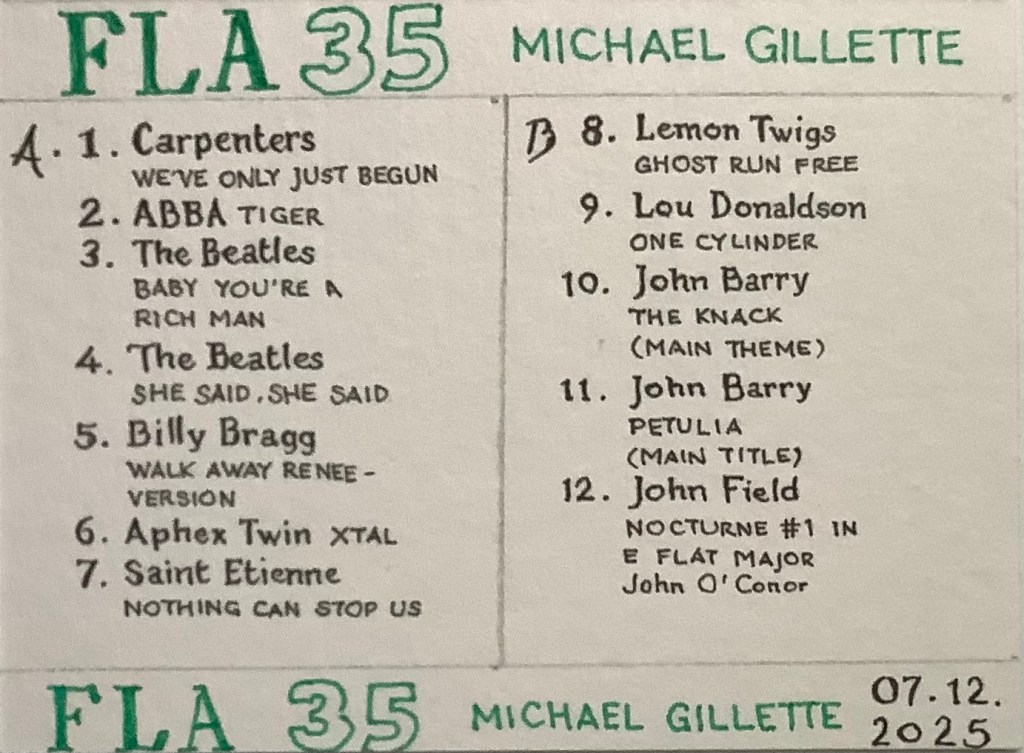
(For the time being, this site and project uses Spotify for the conversation playlists, but obviously I disapprove that Spotify doesn’t pay artists and composers properly, and other streaming platforms are available, as are sites to buy downloads and buy recordings. For consistency, you can also listen to the selections via YouTube (where available), and links are provided in each case, below.)

Thanks to Tune My Music, you can also transfer this playlist to the platform or site of your choice by using this link: https://www.tunemymusic.com/share/5yuhEgpQ6o

Track 1:

CARPENTERS: ‘We’ve Only Just Begun’:

https://www.youtube.com/watch?v=xeBoRF5tgDo&list=RDxeBoRF5tgDo&start_radio=1

Track 2:

ABBA: ‘Tiger’:

https://www.youtube.com/watch?v=htziQt0pCAQ&list=RDhtziQt0pCAQ&start_radio=1

Track 3:

THE BEATLES: ‘Baby You’re a Rich Man’:

https://www.youtube.com/watch?v=i5m-sgtwFck&list=RDi5m-sgtwFck&start_radio=1

Track 4:

THE BEATLES: ‘She Said, She Said’:

https://www.youtube.com/watch?v=NZOBWYHgZjw&list=RDNZOBWYHgZjw&start_radio=1

Track 5:

BILLY BRAGG: ‘Walk Away Renee (Version)’:

https://www.youtube.com/watch?v=iHrFkSeLukA&list=RDiHrFkSeLukA&start_radio=1

Track 6:

APHEX TWIN: ‘Xtal’:

https://www.youtube.com/watch?v=2tOutF8B3f8&list=RD2tOutF8B3f8&start_radio=1

Track 7:

SAINT ETIENNE: ‘Nothing Can Stop Us’:

https://www.youtube.com/watch?v=RAZUwvYqhpg&list=RDRAZUwvYqhpg&start_radio=1

Track 8:

LEMON TWIGS: ‘Ghost Run Free’:

https://www.youtube.com/watch?v=ewKdcUl3J7c&list=RDewKdcUl3J7c&start_radio=1

Track 9:

LOU DONALDSON: ‘One Cylinder’:

https://www.youtube.com/watch?v=F8RCGr8FEt0&list=RDF8RCGr8FEt0&start_radio=1

Track 10:

JOHN BARRY: ‘The Knack (Main Theme)’:

https://www.youtube.com/watch?v=k3utY_mJjK8&list=RDk3utY_mJjK8&start_radio=1

Track 11:

JOHN BARRY: ‘Petulia (Main Title)’:

https://www.youtube.com/watch?v=qhKQ1UT-MjE&list=RDqhKQ1UT-MjE&start_radio=1

Track 12:

JOHN FIELD: ‘Nocturne #1 in E Flat Major’

John O’Conor:

https://www.youtube.com/watch?v=2YJXgmLXTew&list=RD2YJXgmLXTew&start_radio=1
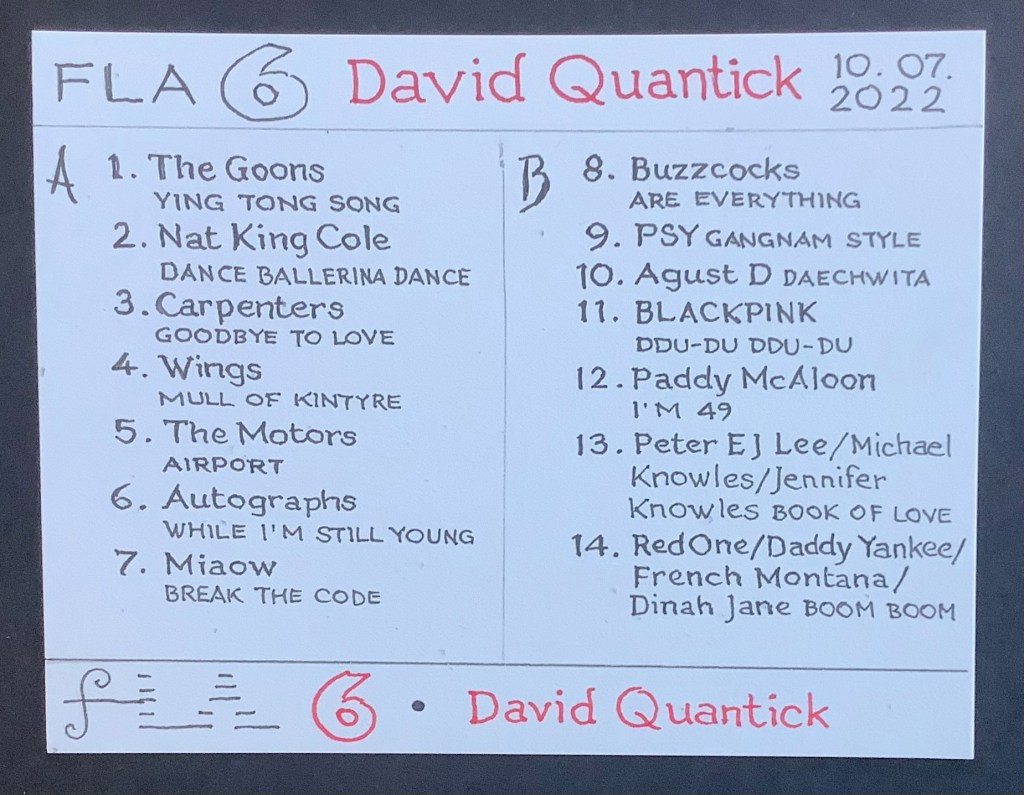
FLA 6: David Quantick (10/07/2022)

The Emmy-award winning David Quantick began writing for a living in the early 1980s, shortly after studying law at the University of London, and has barely stopped since. For thirteen years, he was at the New Musical Express, where he originated a torrent of reviews, articles and thinkpieces. There, his association with the late Steven Wells on such anarchic, hilarious columns as ‘Ride the Lizard!’ led to feedback from a young BBC radio producer called Armando Iannucci. Over thirty years after the astonishing On the Hour for Radio 4, David has continued to be a part of Armando’s writing team on such internationally acclaimed television projects as The Thick of It, Veep and most recently Avenue 5.

Frankly, David has written so much, there isn’t room to list it all: sketches for Spitting Image and The Fast Show, the first-ever internet sitcom (2000’s The Junkies, written with Jane Bussmann), Chris Morris’s Brass Eye and Blue Jam, and ten years of Harry Hill’s TV Burp, amongst many, many other things.


In recent years, David has turned to novel writing – his seventh novel, Ricky’s Hand, is out now – as well as writing the screenplay for the 2021 romcom feature film Book of Love, starring Sam Claflin and Verónica Echequi.


I have been a fan of David’s work since the 80s, and have since got to know him a little bit too, so was delighted when he agreed to join me on First Last Anything to discuss his love of music. And so, one morning in May 2022, he told me about his formative years in Plymouth and Exmouth, the appeal of K-pop, and how to review a new pop record. We hope you enjoy it.


DAVID QUANTICK

In the 60s, at first we didn’t have a record player, and then at some point, we got a Dansette from our neighbours Pam and Tony. For me, it was quite an influential thing because the records that came with it were some novelty singles: ‘Itsy Bitsy Teeny Weeny Yellow Polka Dot Bikini’, ‘Seven Little Girls Kissing and Hugging with Fred’, and there were some Val Doonican albums with novelty songs on like ‘Slattery’s Mounted Foot’ and ‘Paddy McGinty’s Goat’. But there were also two Goon Show albums, Best of the Goons, volumes one and two, my first exposure to recorded music.


Meanwhile, my dad used to love opera. We didn’t have any in the house, but he used to go a lot to the opera, and used to say it was rubbish if it was in English. If you could understand the words, it was no good. And he also used to go to musicals. He worked in London just after World War II, so he saw an amazing amount of original British productions of things like South Pacific and Oklahoma!


But what really takes me right back to my childhood is Nat King Cole. We had an album called The Nat King Cole Story, and it had links narrated by, I think, Brian Matthew. I still love Nat King Cole’s voice.


Later on, my parents were in the Readers Digest book and record club, so we had lots of Readers Digest box sets – country music, pop music, bit of classical. They liked Howard Keel, the light opera singer – and they liked The Carpenters, although my parents hated the fuzz guitar solo on ‘Goodbye to Love’ – I think they just thought it was a bit much.


JUSTIN LEWIS

That solo’s like something invading from a different world.


DAVID QUANTICK

It does work for me, but it is a bit like having Jimi Hendrix on the Nat King Cole record.


JUSTIN LEWIS

‘Yesterday Once More’ by The Carpenters is, I think, the first pop song I remember being a current, new record. Round about 1973. It’s weird to have, as one’s first-hand memory of pop music, a song that’s about nostalgia.


DAVID QUANTICK

The first like that I remember is ‘Hello Dolly!’ by Louis Armstrong, followed by ‘A Hard Day’s Night’, and that would have been on the BBC Light Programme. I would have been very little. 1964. Yeah, and I also remember my first TV musical memory – because we never watched Top of the Pops – was seeing John and Yoko getting off an aeroplane on the news [1969], wearing white suits like characters in The Champions.


JUSTIN LEWIS

What do you remember about school music lessons?


DAVID QUANTICK

There was ‘banging things at primary school’. The BBC used to do these schools radio programmes called Time and Tune – there’d be an accompanying magazine and you’d play along with xylophones. The one I remember was basically making space sounds.


JUSTIN LEWIS

Time and Tune ran for years. We had that at infants school. A different story project every term. This sounds like it might have been ‘Journey into Space’ (first broadcast, spring 1965, repeated spring 1968).


DAVID QUANTICK

For years, with the Carpenters, I was convinced that the song we practised in the Time and Tune lessons was ‘Calling Occupants of Interplanetary Craft’ (1977), but obviously, as I would realise later on in life, that would have been impossible.


JUSTIN LEWIS

And did you learn any musical instruments?


DAVID QUANTICK

When I was briefly at public school, I had piano lessons and the teacher asked if I was left-handed. I had oboe lessons and I got the cleaning feather stuck in that thing. I bought an acoustic guitar from the Burlington catalogue, the less famous version of the Freemans catalogue. And I think it was the obligatory Kay acoustic, because Kay made all the guitars that poor people had, and I couldn’t tune it. So I gave that up. That was my musical education as a child.


 —-

FIRST: WINGS: ‘Mull of Kintyre’ (1977, single, Parlophone)

JUSTIN LEWIS

So, the first single you ever bought. I think at the time the best-selling single there had ever been in Britain. Two million sales.


DAVID QUANTICK

Yeah, it outsold ‘She Loves You’ which made Macca very happy and Lennon less so. There was a great lie that I told for many years. When people asked me my first single, I used to tell them it was ‘Airport’ by the Motors, which was the second single I bought.


I had a school friend called Ewan, and whenever I talk about The Beatles, he still likes to say how embarrassing it was that I was a Beatles fan at school in the sixth form. This was just after punk, it was 1978, the Sid Vicious era of the Sex Pistols, Sham 69…  Now, we have this world of Beatles obsession and Beatles podcasts and remixes and all that. But back then… it wasn’t that the Beatles were loathed, but they were considered ‘boring’. They were summed up by ‘the Red and the Blue albums’, no-one had any of the other albums, and ELO had come along and stolen their crown and shat on it… Liking the Beatles, as I did, was just so naff. Ralph Wiggum would have liked The Beatles in 1978. And owning ‘Mull of Kintyre’ was even worse, I think.


JUSTIN LEWIS

When I was first obsessed with pop music in the early 80s, Lennon had just died, so there was still a lot of ‘John’s the best Beatle’, but my other big obsession was TV comedy, and it soon became clear that Paul McCartney had become the whipping boy in comedy for everything that was square in pop music. I think that only really started to move on when he collaborated with Elvis Costello at the end of the decade [on Costello’s Spike and McCartney’s Flowers in the Dirt]. Costello did this interview where he just went, ‘Why’s everyone so rude about McCartney? He’s written more great songs than almost anyone else.’ I’m paraphrasing, but that kind of thing.


DAVID QUANTICK

Flowers in the Dirt was interesting, not just for having Costello, but it marked the beginning of McCartney just going, Fuck it, I’m not gonna do records that sound like everybody else. Then there’s the production shift. Every so often now, he’ll do a record with Nigel Godrich or Mark Ronson, but he’s basically saying, ‘I’ll just do what I want.’


JUSTIN LEWIS

I wondered if Anthology (1995–96) was what really cemented The Beatles, because they’ve never really gone away since then. In the 70s, when I was a child, I don’t really remember hearing The Beatles on the radio. They might well have been played, but I just don’t remember it.


DAVID QUANTICK

It’s like if you went to a disco, as they were called then, a student disco, or a 60s night, you’d never hear The Beatles, even though some of their records are real stompers, like ‘Got to Get You Into My Life’ or ‘Get Back’… But you couldn’t play a Beatles record because it stands out too much, it’s like entering a lion in a cat show. It just doesn’t work in that context, even though in a real sixties disco, you would have followed the Kinks’ ‘You Really Got Me’ with ‘Day Tripper’ or whatever. I would love to see, actually, a transcript of a real 1966 DJ’s setlist. If there ever was such a thing.


JUSTIN LEWIS

And you rarely, if ever, get the Beatles on multi-artist compilation albums.


DAVID QUANTICK

No, absolutely, and that’s why [Starsound’s] ‘Stars on 45’ (1981) was such a hit because you could go to a disco and dance to The Beatles. I mean, the legals were probably quite powerful on Beatles stuff on compilations. Like it’s weird when you watch a film and there’s a Beatles song in it. ‘How the hell did they clear that?’


JUSTIN LEWIS

Just going back to ‘Mull of Kintyre’. You’d have been sixteen when it came out, and that does seem – if you don’t mind my saying, given what a massive fan of pop music you are – quite a late start for a first single. I mean, presumably, you were borrowing stuff from friends, or taping stuff off the radio – was there a record library?


DAVID QUANTICK

No, I didn’t have any of that. I liked comedy. As I say, it was rare for me to watch Top of the Pops, though I remember Alice Cooper’s ‘School’s Out’ because obviously I was at school. Queen’s ‘Killer Queen’ seemed a bit like a Gilbert and Sullivan or a Noël Coward song. But I would enjoy the Wurzels, the comedy records. I didn’t get rock. I literally didn’t. I preferred classical music. And I had some albums: Dark Side of the Moon which sounded amazing, and I had a Mike Oldfield box set which I loved…


I had changed schools a couple of times, felt a bit isolated, didn’t have a lot of friends, stayed in a lot. But then in the sixth form a couple of other kids came from different schools, and I became friends with them. They were popular kids and they liked punk and they liked John Peel. So I kind of skipped the entire history of rock music. I was hearing The Clash for the first time at the same time as I was hearing Motown for the first time.


JUSTIN LEWIS

So when people talk about punk as ‘year zero’, you actually experienced it like that, because in a sense, you had no reference points. Or if you did, they were all from different areas of culture.


DAVID QUANTICK

Yeah. It was easy to get into punk and I started to understand riffs and why ‘dang-dang-dang’ was good, but I also like categories, and it was easy to spot what was punk. Olivia Newton-John wasn’t punk. The Dickies were. You felt a bit cool because you didn’t like disco – though obviously now I love disco. These were my new friends, and I liked what they my new friends liked.


And you could go to Lawes Radio which was a local music shop in Exmouth, selling radios and electronic equipment, but they subscribed to the indie chart so they would have Crass singles in the window display. And they were really nice people, but they knew they couldn’t compete with [WH]Smiths. They had a ‘30p Box’ that seemed to be crammed with early XTC singles.


JUSTIN LEWIS

One of the aims of this series is to emphasise how record collections, especially early on, are almost accidents, because they’re based on how much money you have at that moment. What have the shops even got in stock? You might go to the shop expecting to buy Record X and they haven’t got it, but they have got record Y which is a bit cheaper. And also they’ve got that thing in the 10p bin which looks interesting. You’re buying a lot of things on a whim, you’re not curating it – that terrible word.


DAVID QUANTICK

It’s probably a bit more random. I would buy things that I’d heard, and I’d be embarrassed later. I had a single by a band called The Autographs called ‘While I’m Still Young’ (1978), which is great. It was a Mickie Most-concocted punk band, and it came on – I think – yellow vinyl.


JUSTIN LEWIS

I’m not familiar with this one! The mention of Mickie Most suggests it was on RAK Records.


DAVID QUANTICK

I think it was RAK, yeah. 30p. And I’d heard it on Roundtable, on Radio 1, and I loved it because I didn’t know any better. Of course I got rid of it when I realised… no-one ever told me to get rid of it, but I did. Now I look it up online and it’s not revered but it’s well-respected glam punk… It’s great. ‘While I’m Still Young’ – sung by some men who weren’t still young.


JUSTIN LEWIS

Knowing you a little bit, and hearing you on various podcasts and interviews talking about your early forays into writing, it occurs to me that you got into music journalism in the 80s, not directly because of music, but because it provided you with an outlet to write what you wanted. Because a lot of your background was liking comedy and novelists. And when you went to, particularly, the NME, in those days, you could write about authors, or cult films, or anything really. Didn’t you review the singles in the NME once as a Flann O’Brien parody?


DAVID QUANTICK

No, I wrote the gossip column as The Brother from Cruiskeen Lawn. It’s easy to parody. It’s basically: ‘This morning such and such happened’ and the other bloke who’s Flann O’Brien is going, ‘Is that a fact?’ So it’s a really good structure. I think we got one letter accusing the anonymous gossip column writer of racism. Because of course, there was no context, I didn’t explain this.


But it was great because you had to fill a weekly paper, all this space. The Thrills! section was meant to be interviews with up-and-coming bands, but there weren’t enough of those, so me and Stuart Maconie and Andrew Collins would fill it with comedy.


JUSTIN LEWIS

Somebody circulated on Twitter recently that Rock Family Trees parody the three of you worked on. An epic, incredible piece of work.


DAVID QUANTICK

They let us do anything then. And Stuart and Andrew were seconds away from being on Naked City on Channel 4 as columnists [co-hosted by the teenage Caitlin Moran], and I was a writer on that. But I hadn’t really fitted in at the NME in the 1980s, I hadn’t really liked the music. Then there was a sort of golden age when Alan Lewis and Danny Kelly were editing it [1987–92] – and I became friends with Andrew and Stuart. It was this wonderful thing when the NME was funny. You could write parodies, fake interviews. Working with Steven Wells [aka Swells] as well – we had two pages a week to write anything, which ended up with us working for Armando Iannucci.


JUSTIN LEWIS

Yes, apparently the piece he spotted was about classical music and how all stringed instruments are different-sized guitars. Like the cello is in fact a massive guitar.


DAVID QUANTICK

I’m always convinced that got us the job writing for On the Hour. Maybe because Armando didn’t like rock! Just to trot out my favourite cliché: the NME was ‘Cambridge for losers’. There’s a reason why me and Steven were one of the few writing teams in comedy who didn’t have an Oxbridge or public school education. And that’s because of Armando, you know – the back door route.


JUSTIN LEWIS

I saw you write the phrase ‘Nostalgia isn’t reviewing’ recently. As a reviewer, do you think your first impression of a record should be the one you stick with, regardless of whether you change your mind later?


DAVID QUANTICK

In real life, if you buy a record, and you play it, you love it because it’s by your favourite band, but you don’t really like it yet, because it’s a load of new music to take in. But you keep playing it, and generally the more you play it, the more you love it. You might even go back and play a record you hated but, because you’ve heard it every day, you love it.


But in terms of writing a review for a new record, you’ve only got your first impression. Your job is to try and imagine what you will think of it in the future, having heard it once. You’re livetweeting, to use a modern phrase, playing a record for the first time. What it sounds like compared to other things. Where does it fit in? And if you revisit an old review from a weekly music paper, there should be references in it that you won’t understand now. Like HERE COME THE HORSES or something. Because there should be references to where it fits that week ‘in June 89’. What I loathe, by the way, about Wikipedia, is they say things about old records like ‘allmusic.com gave it three stars’. Who cares? I want to know what Melody Maker said at the time.


JUSTIN LEWIS

When I was about 18, in the late 80s, I probably spent more on music magazines than on records. Lots of the reviews was stuff you wouldn’t hear about, unless you happened to hear Radio 1 at the right moment, so you had to rely on a critic to convey what it might be like. That review had to work on the page as a piece of writing.


DAVID QUANTICK

I would have little rules when reviewing. I would always try and describe the music, but also name some of the songs, and maybe some lyrics, to give people something to hold on to. And I’d make comparisons, so say, the Wonder Stuff’s ‘Size of a Cow’: ‘It sounds like crusties doing Madness.’


JUSTIN LEWIS

Which were useful, especially with records that Radio 1 might not play.


DAVID QUANTICK

With most of the NME bands, you could hear it on John Peel or the Evening Session. But when I started at the NME [1983], I got to interview the bands who nobody else wanted. Eddie and Sunshine, for instance, who were great. Or a bloke who’d been in Pilot. Records nobody else wanted to review. These were records you wouldn’t hear on John Peel. I reviewed Nikki Sudden records, because I’d liked Swell Maps, and they’re now re-evaluated as classic indie, but he wouldn’t get an interview in the NME because he was ‘five years ago’ and John Peel wouldn’t play it. Because he was like pre-Primal Scream. He was trying to make 60s rock music in an indie studio.


JUSTIN LEWIS

For me, as a young person, there was also Saturday morning TV, or stuff in the afternoons. Which you don’t get anymore. And you could get quite unlikely bands in there because the music bookers have to fill the space, and so you could get quite leftfield music on kids’ TV. I once saw Pere Ubu acting as the musical interlude on Roland Rat – The Series [BBC1, 25/07/1988].


DAVID QUANTICK

I remember seeing Buzzcocks on a Saturday morning show, doing ‘Are Everything’.


JUSTIN LEWIS

I think that might have been Fun Factory [Granada, 1980].


DAVID QUANTICK

I also remember going with my friends Miaow, Cath Carroll’s band, to Alton Towers where I think they were filming Hold Tight! [ITV’s quiz and music show for children filmed at a theme park. This was the last episode, TX 23/09/1987.] It was a really weird day because I met Graham Stark from Peter Sellers’ stuff, who was sitting in a car (‘Are you Graham Stark?’ ‘Yes I am’) and Miaow were on, and Thomas Lear was on who’d been on Mute Records in the early 80s. It was more NME than the NME.


—-

LAST: PSY: ‘Gangnam Style’ (2012, single, YG)

JUSTIN LEWIS

I don’t notice lots of people my age championing K-pop, but you very much do.


DAVID QUANTICK

Like millions of people who aren’t sixteen, the obvious entry point with K-pop for me, about ten years ago, was ‘Gangnam Style’ by PSY. I love a novelty record, which stands out and isn’t like anything else. And then I discovered that I really liked K-pop, because bands like Girls’ Generation of Wonder Girls had taken the Girls Aloud template: largely five-piece female bands with really good dancefloor singles, and really great choruses.


Then I was writing a book set in the world of K-pop, which gave me excuses to immerse myself in Korean culture: movies, books, history, North and South. I also became obsessed with North Korean music – which is something we won’t go into now, but one of my proud moments was watching that Michael Palin series about North Korea. He was in a cafeteria there, and I recognised the song that was on in the background. It was ‘Let’s Work’ by the Moranbong Band. That made my day.


Then my wife Jenna really got into K-pop, we watch K-dramas together, and she’s a massive BTS fan, an expert in fact. I’m less a fan of BTS as a group, but their solo stuff… they were a rap crew but in various rap teams and their solo mixtapes are astonishing. They’re downloadable for free. If you just put ‘BTS solo mixtapes’ in Google, you can get the one by Agust D which is actually Suga from BTS. There’s a brilliant song called ‘Daechwita’ which I can’t pronounce.


This is quite common now, but about four years ago, I went into HMV in Maidstone, and I was shocked to see a separate K-pop section in there. All these big boxes, costing £30, containing a CD, often just an EP and photos and notebooks and stuff. My wife tells me that BTS get in trouble with the charts for that because including promotional material makes your album non-eligible for chart status. The sales of CDs are not counted. Also, BTS have released their new hits compilation with four unreleased demos on CD, which is doing the fans’ nuts in because they haven’t got CD players – because they’re kids.


But because of these K-pop boxes, they don’t integrate into the rest of the shop, and it makes K-pop look separate in the way that The Beatles were.


JUSTIN LEWIS

What’s your perception of how British media treats K-pop?


DAVID QUANTICK

I’ve seen two approaches. The NME one, which is the current way of treating everything in the same breathless news way. And there’s the way the posh broadsheets treat it, which is like the sniffy way they used to treat pop. I’ve seen reviews of BLACKPINK and I start screaming at the computer. They don’t mention that none of the tracks from the last EP are on the album. They don’t mention the multiracial mixed line-up of the band. All they do is write, ‘I don’t really like this kind of music, but it reminds me a bit of something I do remember from the 90s’. It’s like reviewing The Osmonds. The sneer is back.


But what really gets on my nerves is that television still makes these documentaries where a light entertainment presenter goes to Seoul and has some weird food and says a few words of Korean and then goes to a karaoke bar… It just drives me absolutely spare. We’re still doing the funny foreigner approach?!


I like K-pop, not just for me to keep up with new music, but also because I find, due to my age and the circles I move in, that you’re always being dragged down by the hands of the dead. It’s so much easier for me to fill my iTunes with old stuff. I just bought a Bryan Ferry live album in 2020 in which he perfectly recreates some songs from fifty years ago. I just bought some Luxuria because I hadn’t heard much Howard Devoto stuff. I’m constantly buying old music that’s nice to have on the computer, but really I would like the percentage to be reversed: to buy 5 per cent old music, and 95 per cent new music.


But when you listen to the average pop single now, if you take off the vocals, it sounds like something John Peel would have played in 1983. Cutting things up, raps, post-post-post-sampling, post-post-Pop Will Eat Itself. Pop music now is NUTS. What I’ve been recently doing is driving around with Radio 1 on, and the records stop sounding the same when you hear them all together in a bunch.


JUSTIN LEWIS

Radio 1’s great at the moment, I think.


DAVID QUANTICK

The DJs are generally quite funny and, at worst, unobtrusive. An afternoon with Radio 1 is quite interesting these days. Yeah, there’s a lot of generic stuff, but even so.


JUSTIN LEWIS

My two favourite radio stations now are Radio 1 and Radio 3 and although they’re entirely different in presentation, I like that both stations are playing about 80 per cent stuff I don’t already know. Radio 2 drives me up the wall a bit. They have a habit of turning records you used to love into wallpaper.


DAVID QUANTICK

If you turned on Radio 2, now, any time, what’s playing? What’s the record? I’ll tell you mine.


JUSTIN LEWIS

It feels like it should be ‘We Built This City’.


DAVID QUANTICK

See for me, it’s ‘You Keep It All In’ by The Beautiful South. I’ve got no evidence for this.


JUSTIN LEWIS

In the early 90s, when Radio 2 was still quite MOR, it felt like any time it came out of a news bulletin, they’d start the next hour with ‘Going Loco Down in Acapulco’ by the Four Tops. [Laughter]

 —

ANYTHING: PADDY MCALOON: ‘I’m 49’ (2003, from I Trawl the Megahertz, Liberty Records, reissued under Prefab Sprout name, 2019, Sony Music)

JUSTIN LEWIS

Was this Paddy McAloon solo record a big surprise to you, given how different it was from usual Prefab Sprout records?


DAVID QUANTICK

It wasn’t a big surprise because I’d got used to the idea of artists doing something completely different and there were loads of reasons for Paddy doing it, to do with his health.


JUSTIN LEWIS

Now reissued under the Prefab Sprout name.


DAVID QUANTICK

That repetition of ‘I’m 49, divorced’. The way Paddy had slowed the voice down to make it sound more melancholic. It was like a Gavin Bryars record.


JUSTIN LEWIS

It really is reminiscent of ‘Jesus’ Blood Never Failed Me’.


DAVID QUANTICK

With Prefab Sprout, I hadn’t really been a fan. I liked some odd songs by them, ‘Cruel’, stuff on Swoon, the first album. But it sounded a bit old school – corporate and irritating at the same time. Like I loathe Steely Dan and that kind of jazzy pop. But then I heard ‘I’m 49’ and it was brilliant. Makes me like Prefab Sprout a bit more.


JUSTIN LEWIS

At one point on ‘I’m 49’, in this mass of sampled voices from radio phone-ins, there’s a sample of someone going ‘What’s wrong?’ Which I thought sounded not unlike your voice, strangely enough. Turns out it was apparently Jimmy Young [then of Radio 2, doing the Jeremy Vine phone-in slot]. And it also makes me think of Chris Morris’s Blue Jam series on Radio 1, which of course you wrote on, and I don’t know if Paddy had heard that. That mixture of comforting music and disturbing voices.


DAVID QUANTICK

It reminds me of Different Trains by Steve Reich as well. The voices cutting in like a countermelody. But with I Trawl the Megahertz as a whole, I’m a bit like the person who went to see David Bowie in 1970, just so they could hear ‘Space Oddity’. I play ‘I’m 49’, but I don’t really play the rest of the record.


It’s so out of character, for Paddy McAloon to do something that’s not song based, because he’s such a song obsessive. It’s obviously to do with the way he felt at that point. Middle-aged pop stars either ignoring it like Mick Jagger, or to start eating yourself like Bowie referencing himself on The Buddha of Suburbia. Or McCartney making Britpop with the Flaming Pie album. But what Paddy McAloon does here is express the way I felt about being middle-aged. Ironically now, because that was 20 years ago. But now it’s a really brilliant, really effective piece of music. The whole record, you only need that slowed down sample of a man saying, ‘I’m 49, divorced.’


JUSTIN LEWIS

There’s a new film you’ve written, Book of Love, and the composers have actually soundtracked your film with original songs. They didn’t just choose stuff from a back catalogue of hits. What was it like having your screenplay as a sort of jumping off point for their work?


DAVID QUANTICK

It was really nice to have a soundtrack. I had no consultation at all with the composers, because once they started making this film which was in Mexico and I couldn’t go, I was kind of outside the process. When I was writing the screenplay, I had different music in mind, a lot of reggaeton. But I love the soundtrack we’ve got. It’s an odd mix, but it works quite well because you know, it’s British and Mexican, and romantic and comedy as well. Romcoms are weird because you know it’s a comedy but it’s also a ‘rom’ so you have to have romantic scenes.


I do sometimes listen to music when I’m writing. With my novel, All My Colors, which was meant to be a Stephen King pastiche set in the 80s, I just listened to the Stranger Things soundtrack and that just led me to John Carpenter. When I wrote another novel, Night Train, that was fun because I listened to train songs, and none of the songs have got anything to do with each other except that they’re all about trains and quite a lot of them go dig-dig-dig-dig-dig.


JUSTIN LEWIS

Obviously you’ve also been a song lyricist – Spitting Image as far back as the 80s, and more recently 15 Minute Musical (for Radio 4) and other things too. What’s your approach to writing musical lyrical parody?


DAVID QUANTICK

I don’t know what my approach is. Brevity. It’s restrictions, really. With 15 Minute Musical, there was one, which sounds insane now… about Julian Assange being in the Embassy and it was set to a pastiche of Joseph and the Amazing Technicolor Dreamcoat.


When I wrote lyrics for Spitting Image songs, I wrote a song parodying U2, ‘I Still Don’t Know What I’m On About’ [1987], Bono talking in meaningless phrases. I wrote that solely for the one line, ‘You can change the world, but you can’t change the world.’


And I’m really pleased I wrote a rejected Pet Shop Boys parody for Spitting Image. When I told Neil Tennant the lyric, he claimed to be entertained. ‘Let’s run away together if we’re willing/Those eclairs are never a shilling.’


JUSTIN LEWIS

Very good.


DAVID QUANTICK

As they’ve written at least two songs in which Neil Tennant tells somebody else that they should run away together.


JUSTIN LEWIS

‘Two Divided by Zero’ and…


DAVID QUANTICK

‘One More Chance’.


JUSTIN LEWIS

I’m presuming with the songs, like the sketches, you weren’t on the writing team, you just sent stuff in as a freelancer.


DAVID QUANTICK

Yeah, I remember being invited up to the studio by the producer, Geoffrey Perkins, who kindly paid the train fare, and I went to see the U2 item being filmed. So I met the Bono puppet – and I was quite impressed, because they’d only just made it. They hadn’t done many groups because once you’ve made an Edge puppet, what the fuck do you do with it?


And that connection with Geoffrey led me to a weird period when I was a music suggester for Saturday Live and Friday Night Live, the Ben Elton vehicles. Geoffrey and the other producer, Geoff Posner, said, ‘You’re a music journalist. We don’t really know what bands to get.’ It was great, because their idea of a new band was not mine, and not the NME’s, so I would suggest people like The Pogues and Simply Red. I think I got a credit and fifty quid, something like that.


JUSTIN LEWIS

You’ve got a family now, obviously. Do your kids introduce you to music you’ve not heard before yet?


DAVID QUANTICK

They like The Beatles and they’re starting to like BTS. They really like The Wombles. That’s probably me pushing a bit because I know Mike Batt and I wanted to show off that I know Mike Batt.


But one of the things I loved about writing on TV Burp was that Harry Hill had older children, and was pretty up on the pop scene, and he would drop a lot of references to contemporary hits into his work, and it was nice because it wasn’t just indie. Working in comedy in the 90s for me, because I was a music journalist, all the stand-ups would make me mixtapes. And it was horrible because they just made me NME-type tapes. Don’t ever talk to a stand-up about their music collection, because it’s all fucking Pavement.

 ——

David Quantick’s novel Ricky’s Hand was published in August 2022 by Titan Books.

Book of Love can currently be streamed at NOW TV Cinema and Amazon Prime. It triumphed at the Imaagen Awards 2022, winning Best Primetime Movie.

The second series of Avenue 5 began airing on Sky in the UK in autumn 2022.

David has now written three series of BBC Radio 4’s Whatever Happened to Baby Jane Austen? starring Dawn French and Jennifer Saunders. In both 2023 and 2024, it won the British Comedy Guide’s Award for Best Radio Sitcom.

In late 2024, he began co-hosting The Old Fools, a very funny podcast series with fellow comedy writer Ian Martin and special guests every week. You can listen to it at Apple here, or wherever you listen to podcasts: https://podcasts.apple.com/gb/podcast/the-old-fools/id1774465485  

For tons more on David’s life, career and news, as well as regular new short stories, his website is at davidquantick.com

You can follow him on Bluesky at @quantick.bsky.social

—-

FLA Playlist 6

David Quantick

(For the time being, this site and project uses Spotify for the conversation playlists, but obviously I disapprove that Spotify doesn’t pay artists and composers properly, and other streaming platforms are available, as are sites to buy downloads and buy recordings. For consistency, you can also listen to the selections via YouTube (where available), and links are provided in each case, below.)

Track 1: THE GOONS: ‘Ying Tong Song’: https://www.youtube.com/watch?v=33-fVsL5Kdc

Track 2: NAT ‘KING’ COLE: ‘Dance Ballerina Dance’: https://www.youtube.com/watch?v=Rlsy4te7jY4

Track 3: CARPENTERS: ‘Goodbye to Love’: https://www.youtube.com/watch?v=YarvI9eCa8Q

Track 4: WINGS: ‘Mull of Kintyre’: https://www.youtube.com/watch?v=Plhtk_XJqhM

Track 5: THE MOTORS: ‘Airport’: https://www.youtube.com/watch?v=aS7dnNVidjA

Track 6: THE AUTOGRAPHS: ‘While I’m Still Young’: https://www.youtube.com/watch?v=o5xBh8ELOfY

Track 7: MIAOW: ‘Break the Code’: https://www.youtube.com/watch?v=9gzX2kNa7O4

Track 8: BUZZCOCKS: ‘Are Everything’: https://www.youtube.com/watch?v=fNX59sdaPcw

Track 9: PSY: ‘Gangnam Style’: https://www.youtube.com/watch?v=cGc_NfiTxng

Track 10: AGUST D: ‘Daechwita’: https://www.youtube.com/watch?v=8TWQg4z9Ic8

Track 11: BLACKPINK: ‘DDU-DU DDU-DU’: https://www.youtube.com/watch?v=IHNzOHi8sJs

Track 12: PADDY McALOON [now credited to Prefab Sprout]: ‘I’m 49’: https://www.youtube.com/watch?v=cenwtYd7HFo

Track 13: PETER EJ LEE, MICHAEL KNOWLES, JENNIFER KNOWLES: ‘Book of Love’: https://www.youtube.com/watch?v=QCg3PQuTNzw&list=PLyW-9UYLk9O2fSb_HYzGfl45t771DSTvD

Track 14: RED ONE, DADDY YANKEE, FRENCH MONTANA AND DINAH JANE: ‘Boom Boom’: https://www.youtube.com/watch?v=2a4gHAiXo7E


FLA 2: Suzy Norman (05/06/2022)

Painting, photography, acting, poetry, novel writing and singing – Suzy Norman does the lot. We first encountered each other online nearly 15 years ago when both of us had other blogs (don’t look for them, they’re not there anymore), and whenever we meet or talk, we regularly find ourselves discussing music, writing and general creativity.

In April and May 2022, we had a couple of conversations, encompassing not just her First/Last/Anything selections, but also the sound of silence in the big city, the physicality of music, and getting into trouble in GCSE music class. Suzy has an excellent singing voice, and often cannot help bursting into a song at the mention of its title. Maybe this should have been a podcast after all.

——

 SUZY NORMAN

I’m interested in how what you’re into develops. At any age. When I was younger, before the age of twelve – I was really into anyone female: Clare Grogan, Toyah, I loved Hazel O’Connor… And then I really, really liked boys, so… Duran Duran, Adam Ant, the handsome ones.. And then, I was just going all over the place, really. Tina Turner and Taylor Dayne, I really loved Cher – ‘Gypsies, Tramps and Thieves’…


JUSTIN LEWIS

The belters.


SUZY NORMAN

Yeah. I liked a lot of joyful stuff. But in tandem, I loved REM and even started listening to things like Mudhoney. Mudhoney and Taylor Dayne!


JUSTIN LEWIS

If you like leftfield stuff but you like chart stuff as well, you can never get bored. I’ve never understood why people take musical tribalism into adulthood… And I didn’t even really understand it at school. The peer pressure thing – never quite got it.


SUZY NORMAN

My older brother’s always had quite a forceful personality, so he’s always influenced me more than my sister – but did he influence me, or is it just that I had to listen to a lot of his stuff? The Jam. Or Madness. The ‘boys’ stuff. Which I still don’t particularly like, to this day – but you just heard it a lot, didn’t you?


JUSTIN LEWIS

I’ve come round to The Jam a bit more, I can separate it now, but the people who liked The Jam at school were the ones telling you they were always better than the pop music you were listening to.


SUZY NORMAN

Ye-e-es. I loved the Police, though.


JUSTIN LEWIS

I quite liked The Jam, but I liked lots of other groups too. And people were the same with The Smiths for a bit, weren’t they? ‘This is the only group that matters.’ One aim of this series is to remove the remnants of shame of music.

FIRST: RACEY: ‘Some Girls’ (RAK Records, Single, 1979)

JUSTIN LEWIS

In terms of age, your first record purchase is going to be hard to beat for future guests. Short of them being a baby! You were, what… four?


SUZY NORMAN

This is the weirdest thing. I have corroborated this with my mum and dad, that I couldn’t have been four, and yet I remember buying it, but then I think, do I misremember buying it? But I did buy it. That’s how early I was into music. At that age, you’re not influenced by anyone – it’s just the cheesy stuff that you like. Like Racey.


JUSTIN LEWIS

So you went out and bought that yourself? Can you remember where you got it from?


SUZY NORMAN

Woolworths, Chepstow High Street. My dad took me. I had money left over from Christmas, I suppose.


JUSTIN LEWIS

Have you heard it recently?


SUZY NORMAN

Yes, I listened to it again last week. It’s alright! [Starts singing chorus] I mean it sounds dead old-fashioned, like the fifties.


JUSTIN LEWIS

Do you know who covered ‘Some Girls’ a couple of years later? Barry Manilow.


SUZY NORMAN

Good old Bazza.


JUSTIN LEWIS

Sounds like the same backing track!


SUZY NORMAN

I was also three years old when ‘Mull of Kintyre’ came out, ‘77. And I adored it. My auntie bought it for me, actually, as a little single – I literally wore a hole in it. I remember getting the record, and being excited because it was my first record. My mum says that I was just obsessed with it. I used to be in love with Paul McCartney, when I was about seven, I had delusions I was going to marry him.


JUSTIN LEWIS

This is the reason I’ve gone with first last anything rather than favourite record. The trouble with favourite record is it pressurises people to think what sums them up. But if you say, What’s your first record, people could fib about it, but on this, I’m not judging anyone’s choices, because it makes for a more interesting chat.


SUZY NORMAN

I’ve always liked a lot of old shit! [Laughs]


JUSTIN LEWIS

So have I. I think there’s a lot of truth in that Noel Coward quote, ‘the potency of cheap music’. The things that make memories flood back to you are often quite disposable. ‘Give It Up’ by KC and the Sunshine Band, there’s almost nothing to it, about twenty words in the whole song. But that’s the sound of a holiday I had when I was about thirteen. When you look back on days gone by, sometimes what you remember are records you hated at the time. That mindset of, I like this record, or, I hate this record, gets less simple as you get older.


SUZY NORMAN

I think holidays are important to the memory because they’re so visceral. The first time we went abroad, we went camping in the south of France in 1982. And that was when ‘Come on Eileen’ was around – so that song, for my entire family, represents France. Also, ‘Tainted Love’. And the Minipops, which was a single on the jukebox on the campsite.

LAST: KATE BUSH: Aerial (EMI Records, CD, 2005, remastered 2018)

Extract: ‘Aerial’

SUZY NORMAN

I just think she’s a genius! And the older I get, the more I think there’s no-one else like her, and there never will be. I love the fact she does kooky stuff. But I wasn’t really into her until I got married, I think Phil, my husband, probably got me into her. We had the Hounds of Love album, with ‘Cloudbusting’ on it, and I think we’ve got another earlier album – Lionheart. I really liked those two, and then it was announced that she had a new album out.


JUSTIN LEWIS

It was her first new one for twelve years. The structure of Aerial is quite similar to Hounds of Love – the 24-hour cycle. I thought of you, when I was preparing for this, because in terms of subject matter and vocabulary, Kate Bush takes all these little bits of inspiration from literature and art and history and music itself. On Aerial alone, there’s references to songs like ‘Little Brown Jug’, ‘Autumn Leaves’ – there’s even a bit of the title track where the laughter echoes ‘The Laughing Policeman’.


SUZY NORMAN

I love that laughter and I love the birdsong. And being a visual person, I love the videos, they date brilliantly. They’re fascinating to watch – she’s really interested in dance and choreography.


JUSTIN LEWIS

I get the impression she never wanted to be famous, she just wanted to get to a point where she had a studio to make new music. ‘I don’t have to tour, I can just put out a record whenever I’m ready to, and make sure it’s as good as I can possibly make it.’


SUZY NORMAN

I think, on a personal level, she’s enigmatic, and I like that. I’m really intrigued by people who keep themselves to themselves – like Julie Christie does. I just love people where you don’t know what they do. Do they even do anything?


JUSTIN LEWIS

Supposedly the first disc of Aerial – we should say it’s a double album – is a collection of unrelated songs, but I’m not quite so sure. A lot of it is about family – there’s a song about her son, one about the passing of her mother – but then there’s a song all about the decimal placings of pi. Can you just sing numbers? Can you sing the phone book? And ‘Mrs Bartolozzi’ – a song literally about doing the laundry. Making art out of something apparently mundane.


SUZY NORMAN

Can you imagine trying to write a song about our mostly banal days? I can’t. I was listening to Aerial a lot when I was recovering from an operation – and I couldn’t really get out of bed, I was almost paralysed – but I was thinking of movement: acrobats and people dancing and twirling. And I just couldn’t wait to put my leggings on and stretch because I do dance around quite a lot at home, and it’s an important part of my yoga practice as well – I just wanted to stretch, and that album sounds like stretching.


JUSTIN LEWIS

You don’t often hear Kate Bush’s music discussed that much in relation to the physicality of the music. But there’s a lot of rhythm in what she does, always.


SUZY NORMAN

I love her song ‘The Dreaming’, the one with the dijeridu on it. I wanted to call my second novel The Ground is Full of Holes ‘The Dreaming’. I was set on that for a couple of years, in fact. So I must have been thinking about her when I was writing that, in a way. But I decided not to do that because it wasn’t original enough. But that was the working title of it for about four years.


My first novel, Duff, was initially called ‘The Edge of Rain’, and it was shortlisted for quite a major prize, the Dundee International Book Prize. Which was very encouraging to me. But I went back over it a year later, and I changed a lot of it, made it a lot more light-hearted. The essence was the same, but it turned into a little bit of a romcom, a slightly episodic novel where a man is trying to get his wife back, and to do so, he suggests a road trip from Wales up to Scotland. So that’s the premise.


The Ground is Full of Holes is also about a marriage breaking down, but it has a mature theme, I feel it goes deeper. I find first-person writing much easier, much freer – which is how I wrote Duff – but I wanted to challenge myself so this one was third person, omnipresent, or third person close [ie concentrating on one character, but written in third person].


JUSTIN LEWIS

As we’re talking about music and sound, how do you approach those elements – and maybe even silence – in your writing?


SUZY NORMAN

I feel that my books are quite silent anyway. But I do put certain sound under a microscope. For example, there’s a scene in The Ground is Full of Holes when one of the key characters, who’s an anaesthetist, is sat in an adjoining room to the operating theatre and he’s listening to the sounds going on in there. I find that kind of thing really interesting, and I wanted to try and make that come alive on paper because it’s a nice contrast to his isolation. The cut and thrust of his responsibilities next door, which he’s actually ignoring at that point.


There’s some semi-autobiographical and musical references in that book, too. I chose The Sundays, ‘Here’s Where the Story Ends’, because it was very evocative of me being a teenager, and I was seeing this guy – and that was the song I remember playing on his radio in his room.


My books are very quiet, but I feel that’s intentionally so – because I live in quite a quiet world myself. I live in Central London, but I do my damnedest to make my life as simple and quiet as I possibly can.


JUSTIN LEWIS

What struck me, reading The Ground is Full of Holes, was the feeling of quiet in the big city. With a city like London, you think of bustle and traffic, and a lot of this felt like nocturnal silence.


SUZY NORMAN

I think that’s the kind of London I would like to live in. This is what I experienced in lockdown, a beautiful experience, you know. I wonder what it would be like for me to live somewhere quiet. I think I might find that very strange. I think I would rather create my own quiet in a noisy environment rather than the other way round.


JUSTIN LEWIS

It’s nice to be able to make that choice.


SUZY NORMAN

Yes. I feel I have control over how busy I want to be. If I want to step out of my flat into a busy street, then I can. I worry about that option not being available at all, and the feel of the city is very energising. And to take that away might feel a little glum – I’ve never done it as an adult, I’ve never lived outside of a city as an adult. So I feel that a lot of what I create is my own fantasy of silence.


JUSTIN LEWIS

The way that we use music now in the twenty-first century: if we want noise we can find it, but we don’t have to have it. That control of whether it’s on or off. Whereas, years and years ago, where music wasn’t a constant soundtrack – in fact, it was even quite hard to find sometimes. Sure, there was Radio 1 but that was all there was! And the idea of music or noise you wanted on tap. And now, it’s tempting to think, There’s too much noise – but you can choose now.


SUZY NORMAN

You can turn it off.


JUSTIN LEWIS

Just to go full circle with titles: you mentioned you originally titled the novel ‘The Dreaming’, linking back to Kate Bush. But where is the actual title The Ground is Full of Holes from?


SUZY NORMAN

It’s an Edna O’Brien quote. I say ‘quote’ – it’s in a novel of hers. Because Irish literature is my thing.


JUSTIN LEWIS

Would your passion for Irish literature extend to Irish music?


SUZY NORMAN

Very much so, yeah. I’m not an expert on it at all. But I listen to it rather a lot.


JUSTIN LEWIS

Irish rock, Irish folk?


SUZY NORMAN

Oh, definitely not rock, although I love Van Morrison. Yeah, folky stuff. I don’t admit to it, because it’s a bit naff (Laughs) but I love it. The Dubliners, The Chieftains. It’s all fiddle-dee-dee.


JUSTIN LEWIS

And you’ve been to Ireland a number of times?


SUZY NORMAN

Probably more than anywhere else.


JUSTIN LEWIS

Have you sat in pubs while this music was being performed live?


SUZY NORMAN

Yes, I have. In Dingle, and in Galway as well. I love the sound of the music. I love the drums. It’s a romantic thing. It’s an Ireland that doesn’t exist anymore, only exists in pubs. Even though I would never have experienced this Ireland even when it did exist, even if it existed ever. But that’s the power of music, isn’t it? You can imagine an Ireland that’s something else, I suppose. Rather than the reality. The history is another thing I’ve had to educate myself about, partly because we’re not taught about it in schools. It’s the whole picture. They’re highly intelligent, creative people. They have a lovely vocabulary, that we perhaps don’t have over here sometimes. And that might stem back to going to church… The Irish people I’ve met have quite a forcefulness to them, a confidence about the language they use, the diction they use, which is interesting to me.

ANYTHING: JESSYE NORMAN: Henry Purcell – Dido and Aeneas: ‘Dido’s Lament (When I Am Laid in Earth)’ (Philips, CD, 1986)

JUSTIN LEWIS

It sounds like this was the moment for you when you properly connected with classical music.


SUZY NORMAN

I can’t believe how old it is, basically! [It was composed in the 1680s.] But it has this slightly modern tint to it – Sinead O’Connor could record it. And I guess the lyrics are very clear and very raw. And I just thought, What a wonderful thing to have at your funeral. I just love it. Salome Haller’s version, I heard first of all, and I’ve heard many versions since – but Jessye Norman’s is best, for me. She’s incredible. I heard her before I saw her, and I was actually surprised to discover that she was Black. I had no idea.


JUSTIN LEWIS

She’s been quite a role model for many performers since, especially in the States.


SUZY NORMAN

I’d assumed it was mostly a white woman’s game.


JUSTIN LEWIS

I think it’s changed quite a bit, especially recently. Why classical music is still here at all is due to people looking forward. One reason it stalled in the public consciousness was that, unlike popular music, which had this linear progression, the popular perception of classical music was: you get to the twentieth century, and… then what? Whereas it’s living and breathing. But you would have to be listening to a fair bit of Radio 3 and attending concerts to know how much is there. If you said to a lot of people, Name ten composers, they might name one or two after 1900. But generally, they’re going to go, Bach, Beethoven, Mozart etc…


SUZY NORMAN

When I was writing every day, I listened to a lot of Radio 3. I discovered how much I loved opera! But my introduction to classical music is very often through TV drama as well. There’s this brilliant piece of music from The Crown – it’s when Princess Margaret gets married. ‘Dies irae’ by Zbigniew Preisner. That blew me away too. Again, it’s very slow, and very sad. Debbie Wiseman’s Wolf Hall soundtrack… is beautiful, and I listen to that quite regularly. So not so much radio now, but a hell of a lot of TV drama. I’ll hear something, look it up, find out more about that composer or whatever. That tends to be how I do it.


JUSTIN LEWIS

But that constant Radio 3 listening was from when you were writing pretty much every day.


SUZY NORMAN

Yeah.


JUSTIN LEWIS

And I think when you are doing anything like that, you’ve got a routine in place, you’ve got your writing head on. Radio 3 has this element of surprise about it, but not one that’s going to put you off your stride, when you’re working.


SUZY NORMAN

It’s lovely, it’s like going into a library, and you don’t know what you’re going to get, but something will be on display in the main entrance… that’s what the radio is. You don’t really get that with Spotify because you have to select what you want to listen to. Unless you listen to a playlist, but in general I wouldn’t trust anyone else’s playlists! (Laughs)


JUSTIN LEWIS

Just on that point of how much you like melancholy music… has that always been the way?


SUZY NORMAN

It depends on the mood I’m in. The last ten years, I’ve probably listened to more upbeat music, quite a lot of pop music, things like Justin Bieber. But before then, it was sad stuff… sad Bob Dylan and Neil Young. Maybe I was a bit sadder then. But now, maybe life’s a bit more to be celebrated, though that said, I am listening to more sad music once again – but because I find it very relaxing and beautiful, for no other reason than that.


JUSTIN LEWIS

Recently, I went to see a piano duet recital in Cardiff. They played Schubert’s Fantasie in F, devastating piece it was, almost the last thing he wrote, might have been the last thing he wrote actually. It’s got this finale of doom to it, but as with a lot of sad music, it is life affirming – ‘I am overjoyed to be here listening to this now’.


SUZY NORMAN

It’s: We’re all mortal. And we’re here to reflect on the sadness of life. To be a complete human being – it’s not all fun fun fun.


JUSTIN LEWIS

I wonder if that’s why classical music – particularly in the past – slightly failed with a lot of younger people because as you get older, you realise that a lot of this music is about being an adult. Which is not to say pop music can’t be about that.


SUZY NORMAN

You have to have experienced loss, you have to have experienced disappointment. Nick Cave – he’s had a lot of tragedy the past ten years. But it’s still great music. I wouldn’t say it’s better for it. But it’s good enough.


JUSTIN LEWIS

Yes, it’s what you can do with the material that life has given you. And if you’re a real artist, it’s about trying to reflect that as honestly and as imaginatively as possible.


 —–


SUZY NORMAN

I grew up in south Wales, but for a while, I went to school in Princes Risborough [in Buckinghamshire] which is not far from London. So there were lots of wonderful experiences which I didn’t have in my Welsh school. Things like playing clarinet in the orchestra in the House of Lords, and seeing theatre in London… It wasn’t a great school but they did have a lot of extra-curricular stuff like that. And I really made the most of it, I think.


When I moved back to Wales, I dropped the clarinet… but I did choose GCSE Music – for only one year because I dropped out. It’s a shame that happened because I loved it, we studied The Beatles’ Help! as a form, we learned how to conduct a song, that’s when we learned about middle-eights, intros, all that. And I am a singer, so I was a confident singer.


JUSTIN LEWIS

Did you sing solo?


SUZY NORMAN

I did. I remember singing ‘That Ole Devil Called Love’ with the teacher on piano and me singing.


JUSTIN LEWIS

I’ve heard you sing that informally. But did you ever try songwriting?


SUZY NORMAN

I did actually write some songs in my mid-twenties. I’ve always been creative in that sense. I’d just got back from Australia, where I’d spent a year, and I was staying with my parents while I was saving up enough money to not live with them anymore. So I had a lot of quiet evenings when I just did that. I wrote about four, on guitar, and recorded them on a tape player. But god knows where they’ve gone. I didn’t notate them.


But here’s why I dropped GCSE Music after a year. We had a homework task, which was to compose a song, and even though I could play about ten chords on the guitar – which as we know is enough to write millions of songs – could I be bothered? No, I couldn’t. So I took this filler track from a Rick Astley album – one where I thought, ‘Well, no-one’s going to give me an A+ for this.’ It was called ‘The Love Has Gone’. I thought it would go under the radar. I went in and I sang it acapella, and the music teacher took me into a side room. And she said, ‘Suzy I’ve got to tell you – I’m really impressed with this, in fact I think it’s the best one in the class.’ And then she pressed ‘play’ on her tape player… and it was Rick Astley.


JUSTIN LEWIS

That is brutal.


SUZY NORMAN

It’s malicious! (Laughs) It’s a really sadistic way of doing it. I was mortified. So I never finished the course. My parents never noticed. I don’t think they even knew I’d been doing Music GCSE! So I didn’t have to explain myself.


JUSTIN LEWIS

Parents weren’t involved with their kids that much in those days, were they. They didn’t know what we were doing. Can I put that Rick Astley song on your First Last Anything playlist?


SUZY NORMAN

Definitely! It’s the story of my life in a playlist…


—–


Suzy Norman’s two novels, Duff and The Ground is Full of Holes, are published by Patrician Press. You can find them both here: Suzy Norman books and biography | Waterstones

You can follow Suzy on Twitter at @suzynorman.


—–

FLA Playlist 2

Suzy Norman

(For the time being, this site and project uses Spotify for the conversation playlists, but obviously I disapprove that Spotify doesn’t pay artists and composers properly, and other streaming platforms are available, as are sites to buy downloads and buy recordings. For consistency, you can also listen to the selections via YouTube (where available), and links are provided in each case, below.)

Track 1: TAYLOR DAYNE: Tell It to My Heart: https://www.youtube.com/watch?v=Ud6sU3AclT4

Track 2: CHER: Gypsies Tramps and Thieves: https://www.youtube.com/watch?v=uuA_gCMiw0E

Track 3: RACEY: Some Girls: https://www.youtube.com/watch?v=JY3pkagVP64 


Track 4: KATE BUSH: Mrs Bartolozzi: https://www.youtube.com/watch?v=tRiJ1xrZQ80

Track 5: KATE BUSH: Aerial: https://www.youtube.com/watch?v=vCw796Qz4M0

Track 6: THE SUNDAYS: Here’s Where The Story Ends: https://www.youtube.com/watch?v=slNYveNnQTg

Track 7: THE CHIEFTAINS & SINEAD O’CONNOR: The Foggy Dew: https://www.youtube.com/watch?v=jrrO4I-E8oY

Track 8: HENRY PURCELL: Dido and Aeneas, Z 626: Act 3: ‘Thy hand, Belinda… When I Am Laid in Earth’

Jessye Norman, English Chamber Orchestra, Raymond Leppard: https://www.youtube.com/watch?v=jOIAi2XwuWo

Track 9: ZBIGNIEW PREISNER: Dies irae: https://www.youtube.com/watch?v=2ADFroKeDlw


Track 10: DEBBIE WISEMAN: Monstrous Servant: https://www.youtube.com/watch?v=QHhzribmXoc


Track 11: RICK ASTLEY: The Love Has Gone: https://www.youtube.com/watch?v=V8AvyCpCVJI