
(c) Matthew Johnson
Fenella Humphreys is one of the most acclaimed, technically dazzling and imaginative violinists in Britain. In 2018, she won the BBC Music Magazine Instrumental Award, and her performing and recording career has seen her playing a wide range of concertos, chamber music and solo work. She has collaborated with numerous other artists including the pianists Martin Roscoe, Peter Donohoe and Nicola Eimer, singers Sir John Tomlinson and Sir Willard White, the oboist Nicholas Daniel, and the conductor (and previous FLA guest) Lev Parikian.
She is committed not just to keeping the music alive of such established composers as JS Bach, Vaughan-Williams, Tchaikovsky, Sibelius and Paganini, but of championing new works – the many composers whose works she has premiered in her career include Sally Beamish, Sir Peter Maxwell Davies, Adrian Sutton and Cheryl Frances-Hoad. A typical concert of hers, and indeed a typical CD running order, will pinball between the past and the contemporary, to terrific effect, and her recordings regularly receive five-star reviews in the classical music press.
Fenella’s working schedule is almost as jaw-dropping as her playing, and so I consider myself very fortunate that she took time out to talk to me on First Last Anything about her music career. As well as discussing her choices, we talked about her working life as a contemporary musician, about the pros and cons of perfectionism, about how to practise music, about how the memory of music can survive ‘in one’s fingers’ – and about how lockdown changed her perception of concert audiences for the better.
I learned such a lot about music performance and interpretation in this conversation, and I hope you find it as interesting and enlightening as I did.
—
FENELLA HUMPHREYS
My dad was a painter, an artist, he worked from home, and he listened to Radio 3 unless the cricket was on, in which case it was Test Match Special. For him, anything that wasn’t classical music was not music! He hated pop music, he hated anything else. He loved Mozart, he loved loads of later composers, but [for him] the best music was Bach – after Bach it went slightly downhill! But he had an enormous record collection, and he wanted me to listen seriously to classical music.
He was always giving me music to listen to. The first recording that really made an impression was the Britten Violin Concerto. I remember sitting in the car on the way to borrow a new violin from a trust, and listening to it, mind blown. It remains one of my favourite works to perform. He also used to take me to the Festival Hall, so that’s always a special place to be. Just that walk across the bridge from the Embankment to the South Bank, with him holding my hand, just the two of us. If life is being difficult, I will go and stand on that bridge – because there’s a sense of comfort standing there, with those memories.
But really from the beginning, he would sit me down at home, to play me something, and every week it was something different. Very occasionally, it was Shakespeare plays – but mostly it was music. And he was very much choosing the piece of music. For years, he wouldn’t let me listen to Beethoven’s Violin Concerto because he thought the music was so perfect, and he didn’t think I had the attention span or that I would understand it. He thought that I shouldn’t be allowed to destroy it for myself by listening to it when I wasn’t yet ready for it. It became almost a block for me – it was too perfect to go near. But when I learnt it, I thought, ‘It’s wonderful music – no question about that, but no more perfect than a lot of other pieces of music, it’s just a bit longer.’
JUSTIN LEWIS
Did it feel like, ‘Right, you’re ready for this piece, now you’re ready for that piece’?
FENELLA HUMPHREYS
There was a bit of that. But with Beethoven, for my dad, that one work was on such a massive pedestal that he was scared to let me break it.
JUSTIN LEWIS
I got a bit stuck with perfectionism, especially when I was young, and especially with playing music. That I could never be quite good enough.
FENELLA HUMPHREYS
Perfectionism makes me think about Mozart. When I was growing up, everybody would say how perfect he and his music was, all so beautiful and crystalline… and so I grew up thinking you couldn’t put a foot wrong with Mozart, and so I never played Mozart well. Then I had some coaching with [the conductor] Colin Davis, who had the absolute opposite attitude: Mozart was a human being. The characters in his operas have huge variety, and if you’re so trained on never being wrong and always being perfect, you can’t explore those characters. But also reading Mozart’s letters, you discover he was not this saintly, godly person… [Laughs] …quite the opposite. So, without that humanity, you’re never going to play it to the best of your ability, and certainly not to the best of the music’s ability. That was an amazing lesson to me, and it changed everything for me overnight when that happened.
JUSTIN LEWIS
How old would you have been when you had that epiphany, roughly?
FENELLA HUMPHREYS
Probably about eighteen or nineteen. It was brilliant to suddenly think, Oh, you’ve had it wrong all these years. Now you can go and enjoy playing Mozart! [Laughs]
JUSTIN LEWIS
Your latest CD recording, Caprices, was, I believe partly inspired by overcoming another block. That a violin teacher when you were younger told you that you ‘couldn’t’ play Paganini. Do you know why he said that?
FENELLA HUMPHREYS
He was kind of old school. Once, four of us from school went on this amazing concert tour abroad, and we were discussing what repertoire we were taking. And when I said, ‘I really want to play this piece’, he said, ‘No, because people I know are going to hear you, and basically they’ll judge me on the way you play.’ That really knocked me – I spent the whole tour worrying that I was going to give my teacher a bad reputation, just by playing the violin. Which I find both shocking, that any teacher would say that to a student, but also funny, to be teaching with that attitude. So, with Paganini, I’d already been playing that with a previous teacher, but he didn’t think I was good enough. And then later, I did one Paganini caprice with him – and it was like pulling teeth. So, rather than just sucking it up and going away and practising, I stopped doing it. But I was perfectly good enough to be doing it – when I look at the other repertoire I was doing at the time. It wasn’t any different – it just didn’t have Paganini’s name attached to it.
JUSTIN LEWIS
As I’m somebody who doesn’t play violin, can you explain what it is about Paganini that is so difficult, or at least is seen as so difficult?
FENELLA HUMPHREYS
He built such a name for himself, and became world famous by being such an extraordinary virtuoso, and having this amazing stage presence, like a rock star. It wasn’t that nobody did technically difficult stuff prior to him – because they did – but maybe not quite in the same way for a while. The thing is, it’s a very specific show-off technique, and his caprices really are the pinnacle of that sort of virtuoso work. There are great virtuoso works from people like Pablo de Sarasate (1844–1908), later on, but there’s certainly not anyone from Paganini’s era who’s remained in our knowledge of that history. Paganini’s still a household name, and none of the violinists who followed him were. So there’s that massive spotlight shone on him, for very good reasons.
When you think about works like Tchaikovsky’s Violin Concerto [composed 1878], which comes a bit later, which was seen as unplayable by the person it was written for, Leopold Auer, I don’t think it’s probably all that less difficult than Paganini. But with Tchaikovsky, you come to it thinking about the music, whereas certainly growing up, with Paganini, you think it’s all about the technique. So there was that block for me, that it was all about the virtuosity, not the music.
JUSTIN LEWIS
A more contemporary musician and composer you’ve recorded for Caprices is the American Mark O’Connor. How did you come across him?
FENELLA HUMPHREYS
That was recent. I knew of him as a bluegrass violinist. My producer Matthew Bennett had been concerned that an album of caprices would be all fast and loud and virtuosic, and I knew I had to be more and more searching in my attitude to the programming. I spent a lot of time on Google, and found the O’Connor Caprices. I was so excited, and I realised you could download the music from his website. I played some friends the beginning of each track to choose one, because I couldn’t decide, and I could only have one on the album. But they’re all really good. He’s an amazing musician.
JUSTIN LEWIS
I first saw him, funnily enough, on a TV series in the 80s called Down Home. It was Aly Bain, the Scottish fiddler, doing a travelogue documentary series…
FENELLA HUMPHREYS
Oh!
JUSTIN LEWIS
…You’d love it. Don’t know if it’s online now.
FENELLA HUMPHREYS
Someone will have uploaded it.
JUSTIN LEWIS
I hope so. A compilation CD came out as well [The Legendary Down Home Recordings, Lismor Recordings, 1990]. It was him visiting Nova Scotia, the Appalachians, Nashville, Louisiana and finding and playing with all the fiddlers who lived in these places. And that’s how I first saw Mark O’Connor.
Aly Bain and Mark O’Connor, from Down Home (Pelicula Films for Channel 4, first broadcast Mar/Apr 1986)
FENELLA HUMPHREYS
I discovered people like Aly Bain at music college, when I met Seonaid Aitken, whose work also appears on Caprices. She introduced me to Scottish fiddle music – we’d sit in corridors and she’d teach me tunes. I would love to take a year’s sabbatical, and go and learn how to play fiddle music properly from different people. But it’s never gonna happen – it’s a language to them, and I’m always going to be ‘a classically trained violinist who’s trying to play fiddle music’. So I guess I try and find a mid-ground, almost the way I approach Bach. With both Bach and Scottish fiddle music, I know how the people who know what they’re doing play it. I know I have a specific technique that’s very hard to walk away from. And I don’t want to play it in the way that my contemporary classical training tells me I should play.
JUSTIN LEWIS
Do you think the nature of classical music, whatever the instrument, is the interpretative nature of it? That it’s still notes on a page, and folk is generally taught aurally?
FENELLA HUMPHREYS
It’s like, if someone’s been classically trained, in ballet, and they try and do another dance form, there’s almost this stiffness, and trying to break out of that would be extremely difficult. Similarly, if you’ve been classically trained as a violinist, you’ve been perfecting this technique for years, and suddenly somebody’s saying, ‘Yeah but forget all that, because that doesn’t work here’, and so it’s finding new ways. But for instance, playing the really fast triplets in some folk fiddle reels – if I try and do that with my classical bow technique, I can’t do it. I have to find a new way of holding my bow, holding my arm. It’s something way more relaxed, that isn’t focused on projection. Letting go of trying too hard, actually.
JUSTIN LEWIS
And it’s a risk. You’ve spent all this time, this is your career, this is what you’ve wanted.
FENELLA HUMPHREYS
But then Seonaid is an incredible classical violinist, and also an incredible folk fiddler. And I met this incredible Finnish violinist, Pekka Kuusisto, on a music festival course when I was still in college. In Finland, they have both traditions and he’s as comfortable in either. He did this amazing performance at the Proms where he played some Finnish folk music and got the audience singing along.
Pekka Kuusisto: Encore – My Darling is Beautiful (BBC Proms, 5 August 2016)
JUSTIN LEWIS
In 2022, as well as Caprices, you’ve also released an album with the pianist Joseph Tong, of violin and piano music by Sibelius. I adored that album. You mentioned to me that you came across those when you were a student.
FENELLA HUMPHREYS
This is Pekka again! [Giggles] At that same festival, he said to me, ‘Didn’t you know that Sibelius wrote all of this music for violin and piano?’ I knew the [violin] concerto, the Sonatina, and the Humoresques, but nothing else. So I looked up all this other music, very expensive, but I ended up slowly piecing together all these collections and sets of music, and programming and performing them. And everybody was loving the music, but nobody ever performs it, although the ‘Romance’ (Opus 78) is often given to students. Maybe it’s expensive to buy the parts. But because nobody plays it, you don’t hear it, therefore you don’t know that it’s there. That was the case for me. So when Joe asked me to record it all, I was definitely going to say yes to that! Until Opus 81, Sibelius wrote them as bread-and-butter music, salon pieces for his publisher, so he could earn a living. Once he’d got his stipend, he didn’t have to worry about feeding himself, he was always going to be looked after, so everything after that, he wrote because he wanted to. They get really odd, but in a really wonderful way.
—-
FIRST: R.E.M.: Out of Time (1991, Warner Bros.)
Extract: ‘Shiny Happy People’
JUSTIN LEWIS
Going back a bit, let’s talk about your first purchase.
FENELLA HUMPHREYS
As I say, my dad wouldn’t listen to anything non-classical.
JUSTIN LEWIS
This was a rebellion for you.
FENELLA HUMPHREYS
Absolutely. I think I was in upper fifth at school, and we had a common room where Capital Radio was always on. But already, before that, in the art room, our art teacher had a record collection, and would let us put music on to listen to. He had loads of 60s and 70s stuff. That was my introduction to Police and Sting… and loads of non-classical music, while at home, I would play generally-loud-and-annoying pop and rock in my bedroom. I felt like a mega-rebel for buying an REM album, from HMV. I think someone in my class at school had played it to me. And I just wanted to keep listening to it, which meant having my own copy.
JUSTIN LEWIS
Did you listen to much pop subsequently?
FENELLA HUMPHREYS
On youth orchestra tours, I was introduced to Beatles albums on the coach. I know Beatles 1 very well. [Laughs] And then I went to study in Germany, where I was listening to German radio a lot, but I was mostly buying things like Rachmaninoff playing Rachmaninoff, and the great pianists of the first half of the twentieth century. Ancient music!
I went through a period of not being very happy, and the more unhappy I was, the less I listened to music. Although little things shone through. I played in a tango festival, and the double bass player copied me some CDs, one of which was John Coltrane’s Ballads. I listened to that relentlessly, and I still go back to that album whenever I just need a hug.
Then about six years ago, my whole life kind of changed, and as I was coming out of this darkness, I was really beginning to listen to other music I didn’t know. When I started seeing my boyfriend, one of the first things he did – because he couldn’t believe I didn’t know loads of music – was he did a Spotify playlist for me of all his favourite tracks. It introduced me to so many bands, so many musicians, got me going out, buying albums, and listening to this whole wealth of music that I just didn’t know about. It just makes life so much more colourful.
JUSTIN LEWIS
It sounds like what’s happened to you with pop, discovering more, has happened to me with classical. I knew bits, but not lots. And sometimes, you’re just looking or listening in a different direction anyway. It’s not like you can be immersed in everything.
FENELLA HUMPHREYS
When you’re doing music for a living, you can get to the point where, if you’ve been focused on playing music all day, you don’t want to listen to any more, even another sort of music… Quite often, I want to veg, and if I’m listening to classical music, then I’m concentrating.
JUSTIN LEWIS
Is it possible for you to listen to classical music and not have an analytical head on?
FENELLA HUMPHREYS
I have to be in the right frame of mind, listening to musicians I really trust so I can sit back from that analytical mindset. When it’s people I don’t trust, that’s more difficult, and I start thinking, ‘Why did you do that?’ I hate that attitude, though – if we all came and did the same carbon-copy performance, it’d be no good for anybody. At the same time, when something then becomes nonsensical because of musical decisions or because they’ve ignored something in the score, the performance isn’t going to make sense. But I love concerts, where I can just sit. Especially with new music you don’t know, or with supporting composer/performer friends. You’re sitting there waiting, to listen in a generous way. You’re not going to sit there, picking them apart!
LAST: ELLA FITZGERALD: Best Of (Decca)
Extract: ‘It’s Only a Paper Moon’ (1945 recording, with the Delta Rhythm Boys)
ENELLA HUMPHREYS
I’ve taken to trawling the charity shops for LPs, mostly for jazz albums. The last I got was Best of Ella Fitzgerald. When I was young, when my dad wasn’t looking, we’d get my mum’s little box of records out: Tom Lehrer, Ella Fitzgerald and Louis Armstrong. I loved them all, but all the jazz standards were amazing, and Ella and Louis doing songs from Porgy & Bess were so great. When I was twelve or so I started learning some Jascha Heifetz arrangements of the Porgy & Bess songs on violin, and then I could listen to their recording as much as I wanted! But I was in love with the quality of Ella’s voice – it was like nothing else. I did have some of these on CD later, but it wasn’t the same. So now when I see them in vinyl, I grab them.
—-
JUSTIN LEWIS
On your Patreon, you share clips of some of your practice sessions. I don’t know if this is how you see it, but it feels like a demystification of practice. Because I think of people such as yourself, and think, ‘You’re amazing’, but obviously when you’re in practice mode, it’s still always, in a sense, work in progress. I’ve started practising the flute again recently, after a very long break away from it, and it’s been very inspiring, from watching your practice videos, to realise that it’s about slow improvement from wherever you currently are. You’ve been a big inspiration!
FENELLA HUMPHREYS
Oh, thank you. It doesn’t matter who you are, what level you’re at, it’s all about the practising – and little and often. Obviously, for me, it’s dependent on what my day brings – not every day can be, like, seven hours of practice – but for kids learning or adults coming back to music, five minutes of good, solid work a day is way better than one hour, one day a week. However good that hour is. Because with five or ten minutes, you’re training your brain, your fingers, your ears, in a really concentrated way. With practice, as long as it’s done in a focused, thinking, ears-open sort of way, you’re always improving. Even if it doesn’t feel like it in the minute, and you feel like you’re going one step forward, two steps back… If you don’t do that, then nobody – whether you’re a beginner or Itzhak Perlman – can get away without doing the work.
JUSTIN LEWIS
Your Twitter bio reads ‘mostly chained to a hot violin’ – is it about keeping the instrument warm?
FENELLA HUMPHREYS
There is a saying in the music world: You don’t practise one day, you can hear it. You don’t practise two days, the critics can hear it. You don’t practise three days, the audience can hear it. There’s a real truth in that. If I don’t play today, and I go and do a concert tomorrow without having practised, I’ll really know about it.
JUSTIN LEWIS
Even if nobody else does?
FENELLA HUMPHREYS
I don’t think anyone else would. But I’d know about it. If I go in with the approach of ‘Don’t be hard on yourself, if you mess anything up’, then you probably won’t mess anything up. But if I know I haven’t practised, the flexibility in my fingers doesn’t quite feel the same, or the way the strings feel under the fingers, or the way the bow feels in my hand. I’m sure a lot of it’s psychological. Because how, when you’re doing it constantly, could two days of not touching the instrument have that effect, and I’m sure it can’t. But we’re so used to the idea of ‘you can’t go on stage if you haven’t put the hours in’…
JUSTIN LEWIS
Especially when everything is so demanding, technically.
FENELLA HUMPHREYS
Yeah. And everything is on this tiny knife-edge. The increments, for something to be right or wrong, on the violin, especially the higher up [the fingerboard] you get, and with so much double-stopping as well, running around like crazy, lots of massive shifts… There’s such a tiny difference between something being right and wrong. So you have to give yourself the best chance of it being right.
JUSTIN LEWIS
When I interviewed the conductor Lev Parikian in episode 1 of this series, who’s worked with you a lot, he mentioned a phrase you use when discussing repertoire or programming a concert: ‘Let me see if it’s in the fingers.’
FENELLA HUMPHREYS
Yes.
JUSTIN LEWIS
Now, that ties in with what you were just saying, about the link between the brain and the hands. You’ve got the mental memory of the repertoire, in your head, much of it you’ve probably carried around for many years, but also there’s the memory that’s in your fingers.
FENELLA HUMPHREYS
Yes. When you talk to people who know anything about science, or psychology, quite often they’ll tell me that everything I say is complete nonsense, but I know how it feels! For example, yesterday, I had to play this very virtuosic piece by Sarasate called ‘Navarra’, which is for two violins and either piano or orchestra. I’d been asked at quite short notice to do this – and I thought, I’ll make it work, because it was at Buckingham Palace! I’d not performed inside there before – I had been to the galleries but that’s all. I decided I’d do it, and I remembered the piece being really tricky, but I could vaguely remember it by ear. So I got them to send the music to me, because my music’s in storage at the moment.
JUSTIN LEWIS
It hadn’t seemed like a priority piece?
FENELLA HUMPHREYS
No, there was no sense that I would ever have played it again. They sent me the music, I started reading through it, and I thought, ‘It’s like I played this last week.’ But I hadn’t since I was 13, maybe 14. Yet somehow, my fingers remember it so well. And I would never have played it very well as a kid, I don’t think, because I wasn’t good enough at that age. I find that just utterly random – that your brain has internalised something so well, from when you were a child…
Whereas I recently went back to a Bach concerto that I studied very seriously with my first proper teacher. My old copy was so full of markings I could barely read the music, so I got a new copy. I was practising it, thinking, ‘Why am I shifting like this? This is very strange.’ I checked my old copy, and clearly written in the music is my teacher telling me exactly how to do that shift. So even the mechanics of something like that can be retained by your muscle memory. Some people say muscle memory doesn’t exist, but it HAS to, because otherwise I wouldn’t have been doing that. Unless my subconscious is telling me.
JUSTIN LEWIS
I’m not a scientist either! Sometimes you retain unexpected versions of memory. With the flute practice I mentioned earlier, I’d kept all the sheet music from my teens. So I went back, opened the box. I’ve not had a lesson since 1990! When I was twenty. I’m being kind to myself at the moment: ‘Let’s get the Grade V pieces right first.’ And I was really surprised by how much I remembered, how much came flooding back very quickly. But all the way along, the past thirty years, my fingers have often been playing, without the instrument being there. That fingers stuff has still been there, subconsciously. Do you do that?
FENELLA HUMPHREYS
All the time. Subconsciously, but also purposefully. Weirdly, if I’m struggling to get off to sleep, I find if I just sit and play something on my arm, I quite often find that lulls me. Which is the opposite of what it should be doing, of course. [Laughs]
JUSTIN LEWIS
But it’s a kind of release or reassurance, I guess?
FENELLA HUMPHREYS
You can just lull yourself into a piece, and concentrate on it because you’re playing it, but gradually, quietly, it goes into your subconscious mind. Sometimes I’ll do it with something I’m actually playing, but often I’ll do it with Bach’s Chaconne, because even though the overall structure is huge and changeable, because there’s this repeated eight-bar ground bass line underpinning it all the way through, there’s something quite lulling about concentrating on that.
JUSTIN LEWIS
So how quickly did you or people around you start to think, ‘You know what? You’re musical’?
FENELLA HUMPHREYS
Musically, when I was teeny-tiny. We didn’t have a piano, but my dad was really into Early Music, and he’d made a kit spinet, like an early form of a keyboard instrument. And if I was teething, and grouchy, the only thing which would placate me was playing notes on the keyboard. A little bit later, somebody gave me one of these plinkety-plonk boxes, like a one-octave piano keyboard on the front. My mum says that nobody could figure out how to play a tune on it, but I’d just sit there for hours playing tunes that sounded like tunes.
And with the violin, my brother was learning, and I probably had tantrums about not being allowed to play the violin. So eventually they let me have lessons as well. [My first teacher was] a bit of a disaster, but when I went to the next teacher, who was a wonderful violinist, I think I was learning really quickly, and was obviously extremely keen, and loved it. When I was asked what I was going to be when I grew up, I’d always say, ‘I’m going to be a violinist, a pianist, a singer and a ballet dancer.’ Because I’d started dancing way before playing a musical instrument. I did ballet shows from when I was two. That was what I really wanted to do – but I wasn’t good enough!
JUSTIN LEWIS
Has dancing helped you with violin playing, just in terms of movement and physicality?
FENELLA HUMPHREYS
Definitely with posture, and stage presence, so I was used to presenting myself on stage. When I was little, in ballet class, they would bang on about how the first foot you put on stage is the beginning of your performance. If you slope on stage, like you’re sorry to be there, immediately that’s giving a certain impression of your playing to the audience. But also, anything that gives you knowledge of your muscles, knowledge of how to use your limbs, has to help.
—-
ANYTHING: JOSEF HASSID: Teenage Genius (2017 compilation, Digital Grammophon)
Extract: ‘Hebrew Melody’
JUSTIN LEWIS
Growing up, were there particular musicians you regarded as role models?
FENELLA HUMPHREYS
I tended to be interested in people who moved me with their playing. So when I was little, as far as the violinists went: Fritz Kreisler (1875–1962), and also this guy called Josef Hassid (1923–50). He totally changed my life.
JUSTIN LEWIS
I was just reading up about Josef Hassid yesterday. A Polish-born violinist in England who was diagnosed with schizophrenia when he was just seventeen.
FENELLA HUMPHREYS
What an extraordinary talent, and what an extraordinary waste. If he’d been born just fifty years later, when people had a bit more understanding about the brain, that the answer wasn’t always to cut bits out of it. You just think of what we lost.
JUSTIN LEWIS
I checked newspaper archives but couldn’t find obits. The Wikipedia page alone is a horrifying read. But the recordings I just sampled were remarkable.
FENELLA HUMPHREYS
There are just eight little pieces. That’s all we have left of him. But at least with those recordings, we can hear just how extraordinary that playing was – that vibrato, that sound. The whole musicality is just unforgettable.
JUSTIN LEWIS
Some of these recordings from so long ago can really cut to you. From the dawn of recorded sound. Obviously by the standards of later recording techniques, it sounds primitive but…
FENELLA HUMPHREYS
My dad had a lot of these recordings, not just Hassid, but much earlier ones. Unfortunately, a lot of the recordings from the early 1900s, people like Joseph Joachim, were of people at the end of their careers. You look at the writing of the time, people who knew Joachim, saying, ‘This is not how he sounded when he was playing with Brahms’, when they were working on the concerto together [in the late 1870s]. His hands were older, to some extent had seized up, so you can’t presume that’s how vibrato sounded then. That’s how an old man was playing vibrato. And we all know that, as we get older, and our hands seize up a bit, you physically can’t do it. The recordings are an amazing thing to have, but we can’t take them as what it was really like, or as a guide.
JUSTIN LEWIS
It’s the closest we’ve got.
FENELLA HUMPHREYS
Yeah. I also loved the French violinist Ginette Neveu (1919–49) and I’m sure a little bit of that was ‘one woman in a sea of men’. For me growing up, there was no question that women shouldn’t be violinists, because there were so many contemporary women violinists with amazing careers… But I tended to listen to violinists from the first half of the twentieth century, and they were all men, except for Ginette Neveu.
JUSTIN LEWIS
And she died very young, didn’t she, in a plane crash?
FENELLA HUMPHREYS
Yes, with her brother, and I think there was a boxer on the plane as well. And then you get these people saying, ‘Oh yes and her violin was in the crash as well’ – well, if you’d lost the violin and kept the violinist, I’d be happy with that!
—
JUSTIN LEWIS
I first discovered you and your work during lockdown in 2020, when you were doing concerts from your home. I can’t imagine the impact that lockdown had on someone like yourself, whose livelihood is performance. Presumably the idea to do home concerts online came from: Necessity is the mother of invention?
FENELLA HUMPHREYS
Yes. Most musicians I know do some teaching, some session work, they had other things they could still earn money from, during lockdown. And I didn’t. All I had was performing – so when that stopped, I had no earning capability. When it was becoming abundantly clear that lockdown wasn’t only going to be a couple of weeks, I was panicked. So my boyfriend persuaded me into doing a livestream. He said, ‘Look, loads of people support you, loads of people suddenly don’t have their live music fix. If it’s awful, you don’t have to do it again. Try it.’ I didn’t want to put it all behind a paywall because I wanted to be accessible not just to people like my mum, but also people who were in the same dire financial situations as me. I wanted those videos to be available to everyone. So I put them on YouTube.
With the first video, the sound was decent because we had a good mic plugged in, but the video quality’s appalling. But we carried on doing them, learning the tech, because people were so supportive, and it meant that I could still pay the rent, and eat! The basics – because I had no money and nothing to fall back on.
So it was borne out of necessity. But I also wanted to make sure new music was represented in these home concerts, especially as it was unaccompanied violin music. Introducing people to composers they might not know, and younger composers. And people started sending me scores, and writing music for me. Normally in real life, pre-covid, you’d have to put your concert programme together a year, 18 months ahead. But suddenly, someone could send you a score on Tuesday, and you could play it on Wednesday in the home concert.
Having said that, I found those concerts incredibly nerve-wracking. A live performance, but no audience there. This constant fear of ‘Maybe nobody’s even listening’ – am I going through all this for nothing?! If you’re used to playing live in the In Tune studio (on Radio 3), where there’s a couple of producers and a presenter, but no audience as such, at least you’ve got used to that mentality. But in your own living room, there’s no acoustic, the microphone’s really quite close, and there isn’t a proper engineer dealing with the sound. So soundwise, it took a while to learn how to play well, but also… is anyone listening?
JUSTIN LEWIS
You’re communicating into the ether, and you don’t know if anything will come back! That must be very disconcerting.
FENELLA HUMPHREYS
It is. Doing those livestreams, I suddenly realised I had never stood back and thought about the role of an audience in my playing, in real time. Especially as I’d subconsciously always seen the audience as judging me. I’d had a very uncomfortable relationship with an audience, pre-covid. But when I started doing these livestreams, which I hated doing, all these people were, yes, sending money so I was able to eat, but also sending me beautiful messages. I realised all these people really cared about what I was doing, and that they genuinely wanted to hear me playing that music.
I had been very nervous doing those livestreams, and a part of me was worried that when I did start performing live again, I’d bring that discomfort to the stage with me. I remember the first concert after lockdown, at the Chiltern Arts Festival. I think it had been seven months since I’d had a live audience. I walked out onstage and I heard the applause and I felt this utter joy in my stomach – that there were real people to share the music with.
I realised then that my whole attitude towards the audience had completely changed. I didn’t go out there expecting to be judged, I just went out to enjoy performing. And I’ve been so much happier since – everything to do with my performance is now so much healthier. I mean, it’s stupid that it took that long to realise that, in a way, but I suppose when things have been inbuilt when you’re a child, and people are constantly judging you, it’s very difficult if you don’t realise that that’s how you’re feeling about it.
JUSTIN LEWIS
As an audience member, I’ve only so far been to a few concerts this year, but I’ve felt – and you know this! – that most people who come, the vast majority, are there to have a good time. We’re not there with our notebooks. We love it.
FENELLA HUMPHREYS
I know. But five years ago, I’d have said that was what an audience member was there to do. Unwittingly, I’d carried this burden, of being judged, or being afraid of making a mistake. Because that’s what it was like at school! And I realise that I’d had that inside me the whole time. I had no idea – until it all changed! It’s that imposter syndrome that we all have. I knew I had it, but I assumed nobody else does. And then you realise everybody does.
Also, during the last few years pre-covid, I’d been learning how to do my own thing at concerts with unaccompanied performances. I wasn’t relying on anyone else. It was just me, and I learned how to have my relationship with an audience, and with different audiences in different ways. And I enjoyed not just playing the music, but also talking to audiences – it’s fun, actually. As long as they react! [Laughter]
JUSTIN LEWIS
So you introduce the repertoire, what you’re going to play?
FENELLA HUMPHREYS
Yes, doing a solo concert, I always talk to the audience. Unless I’ve specifically been asked not to. Because what I’m playing can be challenging, but actually giving them things to hold on to.
If somebody’s giving you a way into it, you’re more likely to listen to it with open ears. I want to make sure there’s variety there – that people will come for something, but they’ll also hear something else. I still have imposter syndrome – ‘What are they going to think?’ – but as soon as I start performing, and I’ve developed that relationship with the audience, I’m usually fine.
JUSTIN LEWIS
Are you preparing for the fact it might go wrong, even though the chances of that are tiny?
FENELLA HUMPHREYS
I suppose there is a bit of ‘You’re only as good as your last concert’. People might hate it. Suddenly, in the middle of everything, you might get an audience who can’t stand you. And part of it’s pure perfectionism. As a violinist, you grow up knowing that everything has to be perfect. ‘If it’s not perfect, it’s not good enough.’
JUSTIN LEWIS
Do you think you’ve become such a spectacular, thoughtful musician because of that sense of perfectionism, or despite that?
FENELLA HUMPHREYS
Definitely despite it. But you have to have perfectionism. For a start, you have to have that personality type who has that focus and drive and is willing to repeat something three billion times, to make sure it’s always going to be right in the context of a concert.
The real problem with perfectionism is when it creates blocks. With my first proper violin teacher – yes, it was about perfectionism, but it was also about building me as a human being, and as a musician, as a violinist. And that’s not damaging, because it makes you focus in practice. But if you get a teacher who says it’s a disaster if it’s not perfect – that can take a long time to get over. It did in my case.
JUSTIN LEWIS
Do you think audiences have changed – in the sense of being more receptive?
FENELLA HUMPHREYS
I love that I get to talk to my audience. I kind of miss that when I play a concerto, you can’t really go, ‘Hey, high-five!’ [Laughter] Although with something like Tchaikovsky’s concerto, I will often know at the end of the first movement if they like me, because quite often they’ll clap. But with a lot of concertos, I only really know for sure that they’re enjoying it right at the end of the performance.
Whereas when I am talking to the audience, I know immediately. Usually my first piece in a solo programme will be quite short – it gives people a way to get their focus started, rather than with something hugely long. If you’ve just walked off the street, after a long busy day, it helps to have something short and sweet at the start. So in most programmes I do, within the first five or ten minutes, I’ve already got that validation from my audience!
[So yes, the relationship between performers and audiences has changed.] Nobody would have expected Heifetz to talk to an audience. Can you imagine, in the first half of the twentieth century, if you’d had Twitter, and if you’d had all these Q&As after concerts?

(c) Matthew Johnson
Fenella’s Caprices album, released in March 2022, is available from Rubicon Classics. It went on to win the BBC Music Magazine Premiere Award in 2023. In spring 2024, another equally rich collection of unaccompanied violin works, Prism, was also released by Rubicon.
Her album of Sibelius: Works for Violin and Piano, with the pianist Joseph Tong, was released in January 2022, through Resonus Classics.
In June 2023, Fenella performed the world premiere of Adrian Sutton’s Violin Concerto at London’s Southbank Centre with the Royal Philharmonic Orchestra, as part of a celebration of Adrian’s career so far, called Seize the Day. Adrian wrote the concerto especially for Fenella, and she has since recorded it with the BBC Philharmonic Orchestra and conductor Michael Seal. In April 2025, the recording won the BBC Music Magazine 2025 Premiere Award.
Among Fenella’s upcoming events during the summer of 2025, look out in particular for the premiere of Mark Boden’s violin concerto, Chasing Sunlight. She will be performing this with Sinfonia Cymru in Cardiff (twice on 5 June – as part of World Environment Day), in Bradford (6 June) and at the Southbank Centre, London on Sunday 6 July. See her website for information and links to these live events, festival engagements and latest news: Fenella Humphreys : Violinist. Do go and see her play – she truly is amazing.
During autumn 2025, Fenella will be Artist in Residence at the Wigmore Hall, London.
Fenella is represented by Cambridge Creative Management: www.cambridgecreativemanagement.co.uk/fenellahumphreys-ccm
You can follow Fenella on Twitter at @fhvln.
FLA Playlist 5
Fenella Humphreys
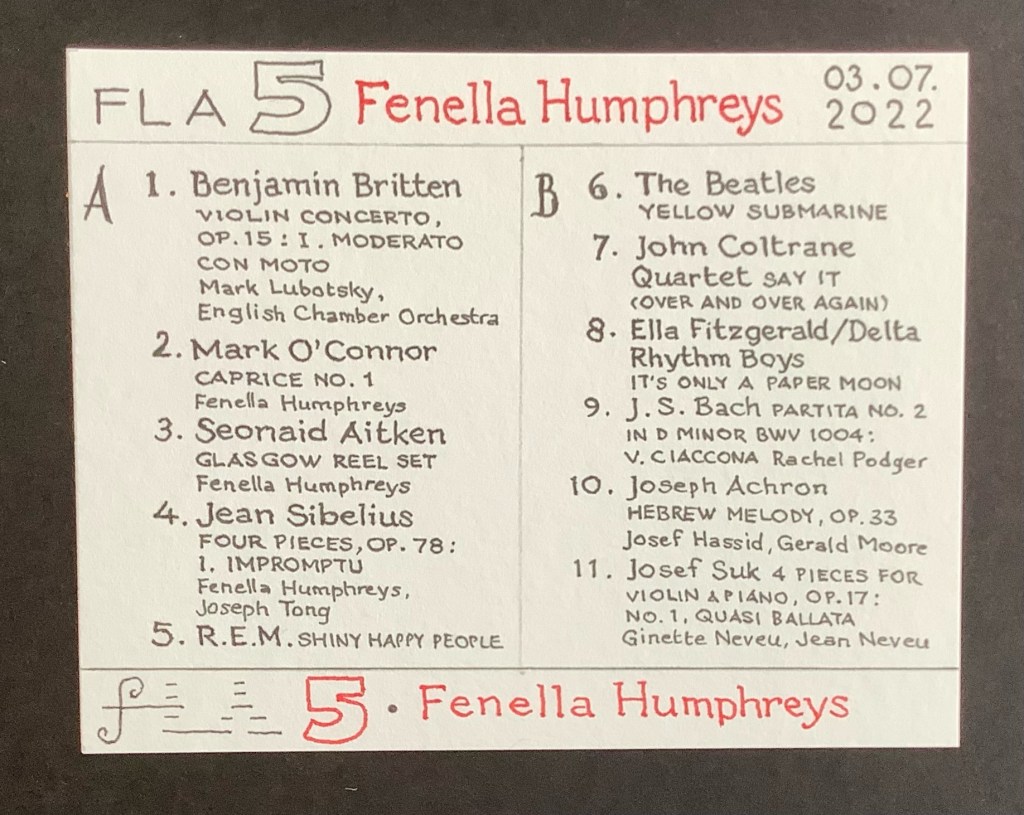
(For the time being, this site and project uses Spotify for the conversation playlists, but obviously I disapprove that Spotify doesn’t pay artists and composers properly, and other streaming platforms are available, as are sites to buy downloads and buy recordings. For consistency, you can also listen to the selections via YouTube (where available), and links are provided in each case, below.)
Track 1: BENJAMIN BRITTEN: Violin Concerto Op. 15: 1. Moderato con moto
Mark Lubotsky, English Chamber Orchestra: https://www.youtube.com/watch?v=sgJV0M_7l6o
[NB Fenella also recommends the recording by Anthony Marwood, released by Hyperion. This was not on Spotify at the time of our conversation in May 2022, but it is now. You can also hear it on YouTube: https://www.youtube.com/watch?v=d1SIbRJY8Io]
Track 2: MARK O’CONNOR: Caprice No. 1
Fenella Humphreys: https://www.youtube.com/watch?v=Wc5neCQPQ9U
Track 3: SEONAID AITKEN: Glasgow Reel Set
Fenella Humphreys: https://www.youtube.com/watch?v=sKOeNX4HyNQ
Track 4: JEAN SIBELIUS: Four Pieces, Op. 78: I. Impromptu
Fenella Humphreys, Joseph Tong: https://www.youtube.com/watch?v=tbmGvl5ho2s
Track 5: R.E.M.: ‘Shiny Happy People’: https://www.youtube.com/watch?v=JpOQoLZQUPc
Track 6: THE BEATLES: ‘Yellow Submarine’: https://www.youtube.com/watch?v=ZhxJAxa77sE
Track 7: JOHN COLTRANE QUARTET: ‘Say It (Over and Over Again)’: https://www.youtube.com/watch?v=oRh0hxV1_SU
Track 8: ELLA FITZGERALD & THE DELTA RHYTHM BOYS: ‘It’s Only a Paper Moon’: https://www.youtube.com/watch?v=rnx8bohIqkA
Track 9: J.S. BACH: Partita No. 2 in D Minor, BWV 1004: V. Ciaccona
Rachel Podger: https://www.youtube.com/watch?v=6XnXQOZd0ZI
Track 10: JOSEPH ACHRON: Hebrew Melody, Op. 33
Josef Hassid, Gerald Moore: https://www.youtube.com/watch?v=DmfCjgI50Fo
Track 11: JOSEF SUK: 4 Pieces for Violin and Piano, Op. 17: No. 1, Quasi Ballata
Ginette Neveu, Jean Neveu: https://www.youtube.com/watch?v=GbagMgNvr1E

 FIRST LAST ANYTHING