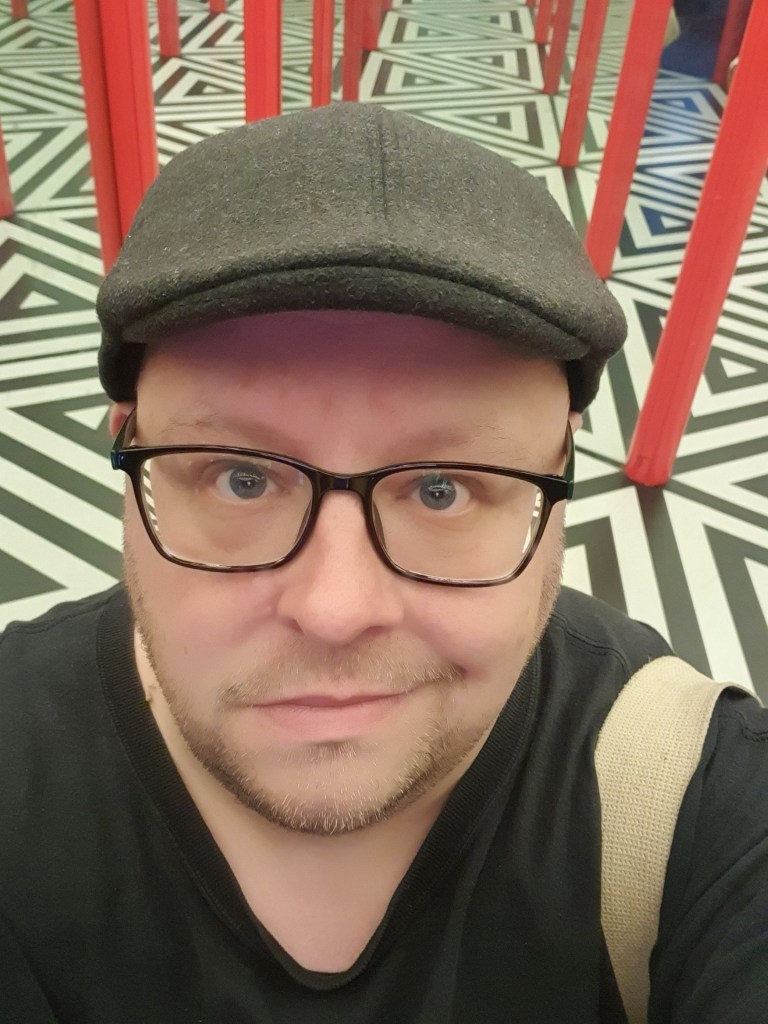
I began as a fan of Ben Baker’s work, before I became a friend. I’m still a fan – should clarify that. For nearly twenty years now, I’ve been listening to and enjoying his various podcasts, which later expanded into more and more podcasts, books and radio shows. He currently presents on one of the best internet radio stations I know, Noisebox Radio, where his shows include the soon-to-return hour-long music show Middle-Aged Teenage Angst. He also co-hosts the podcast, ALFsplaining, a compelling episode-by-episode deep dive into the US 1980s sitcom ALF [which stands for Alien Life Form], a podcast returning for its third series this autumn. Plus he’s always working on projects. He’ll have hatched two or three just while you’ve been reading this paragraph.
The conversation that follows took place on Zoom one afternoon in early July 2025. As well as Ben’s reminiscences about his first, last and wildcard purchases and acquisitions, you can find out how the music of the mid-1990s (both in the charts and on the fringes) coalesced and became a teenage obsession for him. You will also discover why silliness in music holds a special place in his heart, and how an internet radio station aims to attract and hold its listenership. Plus! What is the first ever track in the history of FLA to be chosen by two separate guests?
I’ve just realised: FLA is ALF backwards. Coincidence? Probably.
—–
BEN BAKER:
The earliest memory of music I can remember is not so much listening to it as visual. My dad had this little red box of records and he had it for years and years – to the point where it was more and more taped up with brown parcel tape around the side. So as a kid, I was always digging through them, which I don’t think my dad appreciated. Because as a kid, I don’t think you’re quite delicate with that sort of thing. But I was fascinated with certain artwork. Bad Manners singles always had cartoons on them, or ‘Oxygene’ by Jean-Michel Jarre with the ‘skull in the earth’ thing which used to freak me out.
So I’ve got lots of visual memories in my very early years, but also my dad has several younger brothers, and they were obsessed with Madness. So my grandma’s house – my dad had moved out – had three sons there, always life going on, and ‘Our House’ reminds me of that. Genuinely, there was always something going on that was usually quite loud – and it does make me a little bit melancholy, that record. With certain Madness records, you don’t pick up on that different level till you’re older, even though they were young men themselves when they did a lot of this stuff. I have an actual Uncle Sam – confusing because obviously there is a Madness song called that.
JUSTIN LEWIS:
With both Bad Manners and Madness, it was very visual. ‘Special Brew’ by Bad Manners was maybe the fifth or sixth single I ever bought.
BEN BAKER:
They were kind of like 2-Tone without the sort of political stuff of say, the Specials. They were cartoons.
JUSTIN LEWIS:
It’s interesting that Bad Manners became massive when the Specials cut down on relentless touring and would only gig at weekends. So they moved away from ska, and Bad Manners filled that role of being gregarious. And well, there are about forty-two people in the group as well.
BEN BAKER:
This is the thing. You look back at Top of the Pops footage and with Buster Bloodvessel, you wonder, ‘How old is he?’ You look back and he’s like 21, 22. He’s not old at all, but he doesn’t look youthful, he looks like a 48-year-old brickie.
Later, in ’92, when Madness came back, my dad bought Divine Madness, the compilation. I hammered that, used to walk around listening to that all the time, for maybe a year. I remember saying to my dad at one point, ‘When did Madness go serious?’ – and he went, ‘They didn’t go serious, what are you on about?’ Because I’d got this impression listening to that compilation, in chronological order. If you go from ‘The Prince’ [1979] to ‘Waiting for the Ghost Train’ [1986], that is a huge leap in terms of themes and styles and emotional stuff. Coming back to ‘Our House’ and stuff like that, there’s a lot of melancholy… also ‘Yesterday’s Men’, ‘One Better Day’.
JUSTIN LEWIS:
It’s there as early as ‘Grey Day’, really.
BEN BAKER:
Yeah, yeah. Which is an extraordinary thing to be a top ten single.
JUSTIN LEWIS:
And ‘Embarrassment’ which I bought and had no idea it was about racism. But there’s often a very light touch to these songs – there’s that music hall tradition running through what they were doing as well.
BEN BAKER:
I think that’s why Madness are ace, because there are levels to them. There’s always something deeper there if you want it, and if you don’t, they’re still great pop songs.
—–
JUSTIN LEWIS:
Obviously, I know you a fair bit anyway, but just from listening to your shows on Noisebox Radio, and your various podcasts, and reading your books over the years, it’s clear that you’ve absorbed all this information and enthusiasm. But where does that drive come from? Before there was any internet, were you just watching and listening to as much as possible?
BEN BAKER:
Oh yeah, I used to love stuff like Boxpops [BBC2, 1988–91], the follow-on from Windmill [BBC2, 1985–87], which showed archive TV clips and old pop stuff. I would soak up anything that had old stuff in it, and I was very lucky that I grew up during a time when there was still a lot of old stuff on TV.
JUSTIN LEWIS:
Do you think TV’s the main thing, that all the other enthusiasms have come from that, like music?
BEN BAKER:
We got Sky quite early on, 1990. Someone literally came round and said, ‘Here, do you want to buy a second-hand dish and a receiver box?’ And my dad went, ‘Yeah, alright then’ because you didn’t need a subscription except for the films back then. There wasn’t a lot of kids’ stuff on there, so I’d find myself watching MTV a lot, just because the loud noises and flashing colours just drew me in, even though I wasn’t fully into music at that point. Music came from TV for me, definitely – which is ironic because I’m a radio person more than anything now.
—-
FIRST (1) – PARTNERS IN KRYME: ‘Turtle Power’ (SBK, single, 1990)
JUSTIN LEWIS:
So, the first record you were given, and the first record you bought, are very different matters. The first record you were given is the first record that has ever come up twice in this series. Which has really made me realise this must have been massive at the time. You know like how Desert Island Discs always seemed to have ‘The Lark Ascending’ on every few weeks? It now seems that every week, First Last Anything will have to have ‘Turtle Power’ by Partners in Kryme. [Laughter]
BEN BAKER:
‘Turtle Power’ is not from the Teenage Mutant Ninja Turtles cartoon, famously renamed Teenage Mutant Hero Turtles in the UK in case kids became this vast swathe of ninjas suddenly coming over the fields of schools everywhere. The BBFC under James Ferman were very nervous about ninja stuff, apparently. So obviously there was editing with it on television, big cartoon comics… but ‘Turtle Power’ is from the first Teenage Mutant Ninja Turtles film. You’ll remember that when I was ten, when you were ten, films didn’t come out the same time in America and the UK, you’d get six months delay here. I don’t know why, whether we were just reusing prints? But there was always six months. One of my favourite pieces of trivia of all-time is that Ghostbusters and Gremlins came out on the same day in America [8 June 1984]. And then… six months later [7 December 1984], they both came out the same day in London.
JUSTIN LEWIS:
Wow. So, in Britain, Ghostbusters was a Christmas film, right?
BEN BAKER:
Yeah, and Gremlins was because it is a Christmas film. But it came out in the summer in America.
JUSTIN LEWIS:
Suddenly this reminds me why the Ray Parker Jr ‘Ghostbusters’ theme went back up the charts round about Christmas ’84, having already been in the top 10 months before.
BEN BAKER:
But with the Turtles… Not only was I a big fan because I was nine years old and obviously susceptible to hype like any nine-year-old… but also it was something that felt just out of reach. ‘I want to see this film, but it’s so far away…’ You see this thing: ‘I want Turtles. Bring me the Turtles.’
Then, a couple of months before it came out in the cinema, a friend of my dad’s went, ‘Got that new Turtles film on a pirated tape.’ ‘Oh my God.’ So we all went round to his house that night to watch it. And remember, the size of screens in homes, even big screens, it would have been 18 inches maybe. It snowed a lot in that film… based on the air tracking. But the point was, I was watching it, and before most of my mates as well. So I’ve always got this fond memory of it.
JUSTIN LEWIS
I realised that ‘Turtle Power’ was doing what Tim Burton’s Batman had done [1989]: you take something quite cuddly from telly, and you remake it as a darker thing for the cinema.
BEN BAKER:
But also, in both of those cases, both came from comics that were darker anyway to begin with. So a lot of it was going back to basics.
I haven’t thought about ‘Turtle Power’ in a long while, but I’ve always liked that it’s a proper rap song. It’s not DJ Jazzy Jeff and the Fresh Prince. Because I loved De La Soul, DAISY Age, all that. Rap and hip hop was the first sort of music I really loved because it was so colourful and there were these big characters – MC Hammer who was obviously ridiculous, the Fat Boys, Heavy D and the Boyz. I think that was what I was drawn to initially. So Partners in Kryme was very much that. And ‘Do the Bartman’ – the second record I was given – was another one tied to hype. Again, because we had Sky early, I had actually seen and loved The Simpsons.
The radio was always there, though. When I was younger, my parents had some businesses – for example, they had a transport café – and so, the radio was always on in there. Always Radio 1, until about ’93 when my dad was in his early thirties, so he wasn’t super-old, but he felt Radio 1, 1FM as it became known, was not for him. So, my parents and me diverged at that point.
JUSTIN LEWIS:
Yes, Radio 1 became a ‘young person’s station’ at that point, reputedly 15 to 24-year-olds. So did your parents opt for commercial radio instead?
BEN BAKER:
Yes, they went to Virgin 1215 [which launched 30 April 1993] as a lot of people did at that time. Radio 2 wasn’t there with open arms for people coming away from Radio 1.
JUSTIN LEWIS:
A few years later [from 1996], Radio 2 started to become almost like Q magazine on the radio, but in 1993 it was still pretty MOR. Even though there were individual presenters I liked – Wogan, Martin Kelner, people like that.
But I’ve realised – there’s ten years between us, I’m ten years older – that your ‘generation’ had experienced a much more casually visual dimension to music than mine had. When I was a kid, rather than a teenager, there was some Saturday morning telly, there was Top of the Pops, but Old Grey Whistle Test was on after you went to bed, there was no Channel 4, and you might see a music act on a variety show but there weren’t many programmes – let alone whole channels like MTV.
BEN BAKER:
You look back at old ITV pop shows, like Get it Together and it’s like from a different universe: a man and an owl puppet singing along to ‘Gertcha’ or what have you.
JUSTIN LEWIS:
Have you ever seen the clip from Get It Together of Roy North the presenter singing ‘Swords of a Thousand Men’ by Tenpole Tudor? [Laughter] I think it’s the last series, 1981.
BEN BAKER:
It wasn’t automatically the best acts showing up.
JUSTIN LEWIS:
Although famously Bowie first turned up to do Starman not on Top of the Pops but on Lift Off with Ayshea Brough, a kids show in the afternoons. And the reason it’s generally forgotten is that the clip doesn’t exist in the archive.
BEN BAKER:
It’s like ‘We’ll do pop music, but our way of doing it, the safe, comfortable way that won’t upset you’, because this is still when telly was for the whole family.
JUSTIN LEWIS:
So the first record you bought – as opposed to the first record you were given – was 1995. So in those four or five years, what was going on? Were you still just listening and watching everything?
BEN BAKER:
My dad used to buy the NOW compilation tapes, and I used to just play them and play them and play them, in that kind of way where you don’t know that Side C is actually all dance stuff and Side D is old-school rock. NOW 19 was the first one I properly got into [spring 1991], and that’s got Hale & Pace’s ‘The Stonk’ on it, another early single of mine, and stuff like ‘G.L.A.D’ by Kim Appleby. I just remember it being a good fun mix of stuff. So I’d listen to those a lot, watch Top of the Pops, MTV Europe.
—–
FIRST (2): PULP: ‘Common People’ (Island, single, 1995)
JUSTIN LEWIS:
We were saying earlier about how Radio 1 went much younger in 1993, and then a year or two later, they changed all the producers as well, which is when it became a big youth station, probably the reason it’s still here now.
BEN BAKER:
Yes, and summer 1995 is the summer of me properly becoming a music fan. Literally having the radio on from the moment I got up, to the time I went to bed, and buying singles every single week from then on.
When Oasis announced this new tour [for summer 2025], there was such a scramble for people to say how much they didn’t like them to begin with – and that’s fair enough if you didn’t, there’s a lot to dislike about them – but for me, fourteen years old and with stuff like Definitely Maybe… it was an explosion. I’d not heard this sort of energy and excitement.
I don’t think you get it with [the second LP What’s the Story?] Morning Glory, that’s quite a safe, produced record, but if you go back and listen to Definitely Maybe… I mean, I’ve always said, if you listen to ‘Listen Up’ by Oasis, the B-side [to ‘Cigarettes and Alcohol’] and you don’t feel like ‘Bloody hell, this is something bigger’… You know, it’s a daft throwback, very T Rex-y, as a lot of their early stuff was a lot of big changing chords and stuff like that. It just felt different and exciting. And adding all the other acts who were labelled Britpop… it was a really good starter kit for someone like me who wanted to explore this more alternative side of music.
JUSTIN LEWIS:
Absolutely, and to have Radio 1 pushing that, and all sorts of other things too. You know, when I was fifteen, a decade earlier in the mid-80s, it couldn’t do it in the same way because it had to cater to everyone. It wasn’t entirely Radio 1’s fault – the BBC weren’t going to provide another pop station, and at that point Radio 2 which had co-existed as a popular station playing MOR but also finding room for Culture Club and Eurythmics, decided to go more MOR, and a result Radio 1 had to carry all pop music, 30 years’ worth at the time, a hell of a hard job. So, to have Radio 1 concentrating on the utterly contemporary in 1995; I just thought, thank God this has finally happened.
BEN BAKER:
It was a quiet revolution. I remember we finished school for the summer on the Friday, and on the Saturday, my uncle Sam – mentioned earlier – got married. It was a full wedding… I had to wear a monkey suit… and at the disco, the guy kept playing a lot of new records: ‘I’m a Believer’ by EMF and Reeves & Mortimer, ‘Alright’ by Supergrass was out at that point, Shaggy’s ‘In the Summertime’… and ‘Common People’.
JUSTIN LEWIS:
Quite unusual to have current records at a wedding reception disco.
BEN BAKER:
Well, they’re quite young. I suspect my uncle would have been thirty, late twenties? And he loved Oasis, so he probably said to the DJ, ‘Play a lot of indie stuff’. But I remember thinking, ‘I love this.’ That was the Saturday. On the Monday, Mum said, ‘Go to Boots, get the photos developed, if there’s any money left you can keep it.’ I had three quid left, so I went to Our Price and bought ‘Common People’ because it had been living in my head. On cassingle because I didn’t have a CD player at that point.
JUSTIN LEWIS:
What was on that? ‘Common People’ and ‘Underwear’? And was it the long version of ‘Common People’?
BEN BAKER:
It was the short version. Which is weird, because you don’t hear that now – nor do you hear the single version of ‘Disco 2000’ very often either, the Alan Tarney version.
JUSTIN LEWIS:
With the little talk over.
BEN BAKER:
But the time between ‘Common People’ and ‘Disco 2000’ that Christmas… that period in 1995 was the most exciting for me. The beauty of it is that, as much as I’d have loved all this stuff to be number one – Sleeper, Echobelly, The Wannadies, all these bands I was slowly getting into – it was better they weren’t, because it meant they were still mine. You know, ‘Common People’ got to number two, kept off by Robson and Jerome, wasn’t it?
JUSTIN LEWIS:
That’s right: ‘Unchained Melody’. [‘Common People’ spent two weeks at number two – in its second week, it outsold Michael and Janet Jackson’s ‘Scream’, the first new Jackson song in over three years.]
BEN BAKER:
It kind of fed into that underdog aspect, didn’t it? Probably in hindsight, it did a lot for them, and I think that’s why people have more instant love for Pulp, for example, than Oasis or Blur.
JUSTIN LEWIS:
Because Oasis and Blur had the number one singles.
BEN BAKER:
It feels like Pulp were always bronze, third place in that table. And it’s shifted a little bit in recent years, I think. But at one point Oasis were so far ahead in terms of success that no-one was ever going to catch them. And it’s the best thing really, actually – because music had to go somewhere else.
JUSTIN LEWIS:
And Pulp had to wait so long for success. Blur had some fairly early on, and then they wobbled a bit. Oasis became massive fairly quickly.
BEN BAKER:
Oasis never had a song not going top 40.
JUSTIN LEWIS:
‘Supersonic’ did go in at its highest position [#31, April 1994] and fell away quite quickly, but obviously everything kept going back in the charts later.
With Pulp, I know they’re South Yorkshire, and you’re West Yorkshire, but is the Yorkshireness of bands like them important to you? Obviously Terrorvision, who I know you love, are West Yorkshire.
BEN BAKER:
Pulp, not relevant in that way, I only discovered that later. Terrorvision are very local to me. I was born in the same hospital as Tony [Wright] from Terrorvision. Though there was like 13 years between us.
JUSTIN LEWIS:
Terrorvision had an excellent run of singles in the 1990s, and I don’t know where they get played now. Would 6Music play them, I wonder?
BEN BAKER:
I didn’t realise that this thing I was living through was going to be rewritten. There’s a ‘Britpop story’ now, which is ‘Oasis versus Blur’. Pulp was the third band, you know – and then the Spice Girls came along, which was a different thing.
But Terrorvision existed before Britpop. If anything, they’re part of Britrock, alongside people like Skunk Anansie and Feeder, but it never really caught on as a catch-all scene. And they’re part of the Britpop scene as well, with the Ocean Colour Scenes and Kula Shakers and Casts, but they stand out there like a sore thumb. Terrorvision did so many different kinds of songs – they were generally seen as ‘power-pop’ but they did ballads and proper heavy stuff and dancier stuff. Which is partly why they were never really pigeonholed. And if you can’t pigeonhole something now, it just disappears. So on radio, if a station like Absolute 90s played ‘Perseverance’ or ‘Oblivion’, I’d be very surprised, even though they were both big hits. ‘Perseverance’ was #5 in the UK. ‘Tequila’ got to #2. ‘Bad Actress’, #10. They had big hits for a short period of time, they were definitely a big deal.
JUSTIN LEWIS:
It’s quite refreshing when you get rock in the mix. You forget how big it got in the 90s sometimes. But rock, heavy rock certainly, has never quite been integrated with the rest of pop. And maybe the rock fraternity like that, it means it belongs to them.
BEN BAKER:
I had a big love for a few bands like Deftones, still like them a lot too. But I think Britpop killed off a type of indie music. The kind that would fit on Beechwood Music compilations [eg the much-loved Indie Top 20 compilations released between 1987 and 1997]. Bands that got to number 47, but still had a career because there was money in the record industry to keep things going.
JUSTIN LEWIS:
You’re probably familiar with that David Cavanagh book on the history of the Creation record label [My Magpie Eyes are Hungry for the Prize], and that point in 1993-ish when Sony buys a 49% share in the label, so they can still argue that they still are more indie than not-indie. But you can’t really be an indie label after that, anymore. Before that, if you were in the main charts, it was a bonus. But suddenly after Oasis, if you’re not in the main charts, it’s disastrous. But not everything can be Oasis.
BEN BAKER:
And people do forget a lot of the acts that Creation signed in the wake of Oasis – Heavy Stereo and stuff like that. I mean, one of my favourite bands of all time are Super Furry Animals who don’t feel like a Creation band at all.
JUSTIN LEWIS:
And if they do, they feel like earlier Creation because they were doing what they wanted to.
BEN BAKER:
But also having hit singles. Not massive hit singles – they never had a top ten hit, for example, but they had an #11 (‘Northern Lites’), a #13 (‘Golden Retriever’) and a #14 (‘Juxtaposed with U’). And they had a Welsh language album get to #11 [Mwng in 2000] – an extraordinary achievement to get that into the charts. I love that band, but again, because they weren’t top tier, they could keep doing what they wanted.
—–
LAST: PULP: More (Island, album, 2025)
Extract: ‘Got to Have Love’
JUSTIN LEWIS:
Their first LP for nearly 25 years. Has your perception of Pulp changed, do you think? Is it too early to say yet where it belongs in the Pulp canon?
BEN BAKER:
See, for me, when I found out Pulp were doing a new record, I was just excited. I was like, ‘I don’t care what it’s like.’ I adore His ‘n’ Hers, but I also adore This is Hardcore – and I like Different Class a lot, though I’ve never had quite the same love for that as the other two. So I was like, ‘Oh, whatever, it might be awful.’ With the first song, ‘Spike Island’, lots of people had opinions about the video because they went full AI, and they were sort of making a statement. I think the record of ‘Spike Island’ is much better, it took a listen or two. But the second song, ‘Got to Have Love’ – it was just bang! Straight away, classic. For me, it felt like their scrappier, early 90s stuff like ‘Countdown’, ‘My Legendary Girlfriend’, when they were working out how to make pop records, but it was still a bit weird.
It does feel like a continuation from the last album, We Love Life (2001) in a lot of ways. Like you’ve got songs like ‘Grown Ups’, like a sequel to ‘I Spy’, this six-minute song, and it’s all about not knowing what you’re doing in bed in the early days of a relationship, that kind of stuff. But it’s Pulp NOW, it’s not Pulp then. It’s Pulp in their sixties with lots of lyrics which are ‘ohh, we got old’.
JUSTIN LEWIS:
Well, of course, Pulp, very unfashionably, did a song about being old in 1997. ‘Help the Aged.’
BEN BAKER:
Absolutely.
JUSTIN LEWIS:
When Cocker would have been, 33, 34, I mean he’s only seven years older than I am. I think the fact that he in particular had to wait so long for their breakthrough success, it’s probably made him quite circumspect. People aren’t meant to suddenly become famous pop stars in their thirties. It didn’t even happen much then.
BEN BAKER:
The very early records haven’t aged well. I like their first album, It (1983), quite good, it’s not what we know as Pulp now, but it’s quite jangly pop, I’m very fond of it. I think that’s the key thing – I don’t need them to sound like any one era because they’ve had several.
JUSTIN LEWIS:
I’ve got used to the idea that sometimes bands I really love are gonna make records that I don’t like as much, and that’s absolutely fine. I’d rather they tried different things rather than stick to a formula.
—-
ANYTHING: FRANK SIDEBOTTOM: Frank Sidebottom Salutes the Magic of Freddie Mercury and Queen and Also Kylie Minogue (You Know… Her Off ‘Neighbours’) (In Tape, EP, 1988)
Extract (1): ‘I Should Be So Lucky’
Extract (2): ‘Love Poem for Kylie’
BEN BAKER:
When I first got into Frank Sidebottom, and then the Freshies, and discovering more about Chris Sievey, it was bit by bit because the information wasn’t all out there. My ‘anything’ choice for this is a cassette made for me in late 1996 by someone whose name I have sadly forgotten, I genuinely can’t remember. But Mum and Dad had a pub, I was in the pub with them, and someone said to me, ‘You’ve never heard Frank Sidebottom? I’ll do you a tape.’ Two days later, he came back with the tape and he didn’t say what any of it was. I later discovered it was [a compilation of] the Timperley EP in full (1987), his Medium Play mini-album (1990), and his brilliantly named Frank Sidebottom Salutes the Magic of Freddie Mercury and Queen and Also Kylie Minogue (You Know… Her Off ‘Neighbours’) EP (1988).
And I was transfixed, I was just in love – because I remembered Frank from Saturday morning kids’ TV stuff [notably CITV shows No 73, Motormouth, What’s Up Doc?], and he was always a bit freaky with the big papier mache head. It was its own world, in its own universe, and that’s what I continue to love about Frank. Long after Sievey’s gone [he died in 2010], he left us this world. I think Frank was meant to be in his mid-thirties, living at home with his mum, and she can’t find out he’s a pop star or she’ll go mad. And if you took this character the wrong way, it could be creepy. It could be a bit unsettling. But it wasn’t, it was just a big kid and people either loved that kind of enthusiasm or they completely didn’t. I do not think there is anybody in this world who doesn’t mind Frank Sidebottom. I think you love him, or you just don’t get him, and that’s Chris Sievey’s brain, I think.
There are so many things that have come out in stuff like Being Frank, the Chris Sievey story film, which I was a Kickstarter backer on and to the point where I actually backed £200 for it, and got a box of his old belongings from his brother. It was just stuff from his house, and his old records. There was like a Steve Austin wrestling figure in there, a rubber dinosaur, some 3D glasses, some old fanzines. It’s so crazy, it’s like his brain. There’s some Beatles stuff in there, some robot stuff, obviously a bunch of Frank stuff as well. It’s a fascinating slice of his brain.
JUSTIN LEWIS:
Sounds like he was like us. Spending his formative years building up this collection of stuff.
BEN BAKER:
Yes and no. Every report suggests he was a very impulsive man. Famously, he bought a ZX-81 home computer [made by Sinclair in the early 80s], which he programmed stuff on. A friend of ours, Rhys Jones has been doing a lot of research into this – Chris did this single called ‘Camouflage’ [1983], and on the B-side there are several programs for the ZX-81. But he only bought the computer because he’d been sent out to pay a bill, and he’d seen this in the shop, and bought that instead. Which is a great story, but I imagine living with that would have been absolutely horrendous.
JUSTIN LEWIS:
The world of Frank is so prolific, and I’m thinking it must have taken real commitment, and I suspect some bloodymindedness, to keep that going for that long. And the moment in 1985-ish where he must have decided, ‘I know! I’ll put a big papier mache head on, and cover “You Spin Me Round” by Dead or Alive and some other songs on a single.’ But that decision coincides with some completely different material he was recording – which eventually got released under the title Big Record. Now he would have been doing those two things at the same time, and the material for Big Record is completely sincere.
BEN BAKER:
Yes, he wrote proper pop songs as well, but no-one was ever really interested in that side of him. He was a huge Beatles obsessive, and that bleeds into Frank as well. Like Chris and his brother went to London when they were teenagers, and tried to get signed by Apple, and would make homemade tapes. I really envy that level of self-belief.
We don’t know, and never will, now, sadly, but every time you see footage of Chris Sievey, he’s like, ‘Of course, this is gonna be massive. I’m going to be a pop star. I’m back in computer games. Oh, now I’m Frank Sidebottom.’ You know – you get these impulsive acts but born out of ‘I can do this’.
JUSTIN LEWIS:
You never know what will catch on, though. Given we were just talking about Pulp, if you’d heard the first Pulp album in the mid-80s, hard to imagine that a decade later they’d be huge pop stars. I doubt even Pulp could have pictured it in quite that way.
But of course, one of the strangest moments in Frank Sidebottom’s career is when he’s part of the bill for the Bros Wembley Stadium concert in 1989 [along with Debbie Gibson, Inner City and the Beatmasters featuring Betty Boo].
BEN BAKER:
All they said to him was, ‘You can do anything you want to – just don’t do any Bros songs.’ And so he did a Bros medley [as Frank] and was booed offstage. He had the opportunity to play, but he couldn’t not do that. It’s so self-destructive.
JUSTIN LEWIS:
The first time I’d have ever heard him was when they played the ‘Frank’s Firm Favourites’ medley on Roundtable, the record review show, on Radio 1 [in Aug 1985]. The panel was Alannah Currie from the Thompson Twins, I think Richard Skinner was hosting. Can’t remember who else was on the panel now. But my memory is, they left the faders up while the record was playing, and the panel was just in hysterics. ‘What the hell is this?’, you know.
BEN BAKER:
This is the thing. Frank starts off as the Freshies’ biggest fan, that’s how it starts, he needs to be their biggest fan. And then you get these medleys of then-current songs, and that never really changed that much throughout the career. Songs that always end, ‘You know it is, it really is – thank you.’ Or a variation on that.
‘Frank’s Firm Favourites’ came out initially as a demo, and then he got signed to EMI for a couple of singles, and was allowed to restart their Regal Zonophone sub-label to put them out. And the medley form was huge at that time, but it’s not ‘Stars on 45’ although it’s also not the Portsmouth Sinfonia either. It’s somewhere between the two. He knows what he’s doing – it’s that Les Dawson thing, you’ve got to know how to play the right notes before you can play the wrong ones. And I think the joy of Frank Sidebottom is this bluster, this sheer enthusiasm, like John Shuttleworth. John doesn’t know he’s naff – John still thinks he’s writing songs that Bono wants to cover.
With ‘Frank’s Firm Favourites’, it would either have been number one or a flop, I don’t think there was a middle ground.
JUSTIN LEWIS:
It got to 97.
BEN BAKER:
So he gets three singles on Regal Zonophone, and his second one is ‘Oh Blimey It’s Christmas’ [#87 at Christmas 1985]. Which I love. We play that a lot on Noisebox Radio at Christmas time. It’s such a daft British thing because it is about a British Christmas, it’s about parties and getting drunk and cheap Christmas trees.
JUSTIN LEWIS:
There are various offshoots from this particular question, but I know you have a fascination with let’s say ‘novel’ music, unusual or funny. There are people out there who have a suspicion of ‘comedy songs’ but you’ve always liked them, right?
BEN BAKER:
Yeah. Part of doing radio as I do is getting a reaction to a record. Sometimes I’m playing an amazing record, just sublime, beautifully played, gorgeous harmonies. But sometimes, I’m just playing something ridiculous. And it’s not like I’m sat there like Mike Smash with his car horn. But I do have a love of the daft, or the less serious.
JUSTIN LEWIS:
I can see a line from Sidebottom to the humour of what you do. [Agreement] Obviously the influences are coming from all sorts of other places as well. But what made you start to think in terms of doing things like internet radio or writing? What happened there?
BEN BAKER:
I always loved comedy, and sketch shows in particular. The obvious influence on me, you can hear it a mile off, is Mark Radcliffe, particularly that ‘graveyard shift’ show on Radio 1, 10 till midnight, 1993–97. I only caught him towards the end of that run, but that had a big impact on me, not just because it was funny – and when you think of Mark and Lard now, you think of the afternoon show and the catchphrases and it’s much sillier – but the ‘graveyard’ show was a mixture of the silliness and the passion. He was so passionate about the records: ‘You should hear this.’ And so I think he definitely fed into my musical and comedy interests. Though I should also mention the first person I remember listening to a lot on Radio 1 in that way was Mark Tonderai [a regular night-time presenter in 1993–95], who went on to do a lot of comedy stuff [as a performer and producer]. I mean, he’s gone on to do much bigger things, obviously – he’s a director now [The Five, Doctor Who, many other things], but he did this period of Radio 1 when he was on late and I used to love that sort of thing.
In the back of my head, I always wanted to do that sort of thing on the radio, but I didn’t have the confidence necessarily to go through hospital radio, like you did. So I had to wait for a time where I could make my own thing. And the first-ever thing I did was… It was streaming, but my mate found this thing that you could broadcast off your computer. So we’d make a programme like an album, with tracks and songs in between. That was fine, it wasn’t particularly exciting, but I took the bits I liked from that, made a half-hour edit, and put it on my webspace for people to download. This was early 2002, before podcasts.
I’m not particularly proud of a lot of that early stuff – it’s a guy in his early twenties working out what makes him laugh. That’s perfectly obvious.
JUSTIN LEWIS:
We’ve all got to start somewhere.
BEN BAKER:
Certainly, in the 2000s, I got into doing a bit of internet radio. Someone once called one of my programmes the ‘Keighley Everett Show’ – I’m from Keighley in West Yorkshire – and that’s the biggest compliment I’ve ever had. It’s completely nonsense – I was too young to enjoy Kenny on the radio but he had this marvellous skill and, again, passion. Because he loves the records as well. It fuels everything and I think that’s me.
Now I’m on Noisebox Radio, I’m a founder member of this radio station, we’ve just hit our third anniversary. I’m head of programming, and my friend Steve Binnie is head of music. There’s not a lot of us, but we’re trying to do a radio station that we always wanted to do. And I like mixing the stuff up, so recording loads of trails and stings, all very nonsensical stuff that’s there to make me laugh.
JUSTIN LEWIS:
Do you think that there’s an element missing from a lot of music radio now? There seems to be an absence of humour or irreverence. But Noisebox doesn’t do that, it’s often very funny.
BEN BAKER:
I think there are people who are funny on the radio, but radio hasn’t got these slots anymore to accommodate them. Radio 2 has gone very personality based, so they can have a bit more of a waffle. Whether that’s pre-prepared or not, I really don’t know. But with Noisebox, the tagline I threw out for it is ‘It’s pop music for adults, but not necessarily grown-ups.’ Because I think there is a generation of people who are grown up, who still listen to music, still love music. But they also like silly, they want fun. They don’t want Q magazine-style or Jools Holland-style broadcasting.
JUSTIN LEWIS:
It can get too earnest. With some people, it’s like they had to find a religion and their religion is music.
BEN BAKER:
See, we talked about music growing up. There wasn’t a lot of it, but what there was, was presented as entertainment – and now it’s completely the opposite way. When you watch something like Later with Jools Holland, you’re meant to politely clap. It’s all a bit po-faced.
JUSTIN LEWIS:
Yes – and one of the strengths of internet and community radio is that freedom to try things, and have surprise elements. Of course, sometimes that can topple over into indulgence. How do you make sure that what Noisebox does avoids that risk?
BEN BAKER:
I am very conscious of that, both as a listener and as a presenter. I felt frozen out by 6Music when they made big changes, like when they put Mary Anne Hobbs on daytime. And I love Mary Anne, brilliant late-night broadcaster – Breezeblock on Radio 1 was absolutely fantastic – but they tried to replicate that in daytime, and it didn’t work at all, and I still think they’re chasing a listener who’s not there.
JUSTIN LEWIS:
Sometimes with 6Music during the day, I wonder if some of the listenership has got very easy working environments because I can’t really listen to it while I’m trying to do my job. Evenings and weekends – fine. But the daytime…
BEN BAKER:
I’m confident with the programming of Noisebox that we have playlist hours, a live hour – instant festival and all that stuff – so we mix it up, but I’m also very aware that people want a mixture. At the moment, I do an indie show called Middle-Aged Teenage Angst. The whole idea with that is: I’m an adult, but I’m still very much that teenager, still into noisy old records. I could do more hours, but I just like doing an hour. And this year, I’ve ended up doing a different theme each week, so it helps me narrow down selections – but it also means I’m not clashing with the shows that play alternative music on Noisebox. So I want 30% stuff you definitely know, 30% you might have forgotten, and the rest is wildcard, depending on the theme. But genuinely I’m conscious to avoid going down the path of, say, playing five songs back to back that someone doesn’t know. Or that there’s no recognition factor. Sometimes I might put a cover version in there, which they might not know, but they can find it interesting and have an opinion.
JUSTIN LEWIS:
You’re connecting with the listener.
BEN BAKER:
I think that’s really important. When anyone comes to do a show on Noisebox, I always say to them: ‘Look, the music’s obviously important, but without any passion and personality…’ The talking is why it’s a show, not a Spotify playlist, and that’s why I’ve no interest in generic hits radio. We’ll play a different song – there are other ELO songs besides ‘Mr Blue Sky’.
So it’s important that people do have that indulgence – you’ve got a slot, but if your personality is not in that show, it’s not really a show I think we should have on.
But also, it’s still a radio station, so it’s a bit of everything. There’s a show on after mine, Off the Chart [Tuesdays, 9–11pm], a popular 80s chart show, with two lovely guys. Absolutely fantastic. So I try and do a show which is complementary to anyone who might be listening to that… Towards the end of my show, I include recognisable stuff for those tuning in early for Off the Chart, because I want people to go, ‘Oh, that’s interesting. Maybe I’ll check this show out next week.’ Again, I think it’s finding that balance.
—
BEN BAKER:
I have different approaches to live and pre-recorded. Wth pre-recorded shows, I make sure I get all the art together, so I can be posting on Bluesky while we’re on. It is a balancing act. If I’m live, I can’t do that, so instead I’ll make a folder of maybe fifty songs, and I’ll only play twenty, but that gives me enough range to think about without it being a thousand songs or every single record on my computer.
JUSTIN LEWIS:
So you can have an instinct.
BEN BAKER:
Yeah. With pre-records, I used to wing them a lot more, but I’ve just found it more satisfying to plan. With Middle-Aged Teenage Angst – as I mentioned, I’ll have a theme each episode now: for instance, ‘Acts That Only Did One Album’, for whatever reason, or ‘Albums from 1995’ because it’s thirty years on. So it’s trying to find that right balance between songs you know, songs you don’t, or maybe a cover or two.
JUSTIN LEWIS:
But I think having an hour concentrates that. I know you’re a great believer in making something that’s packaged, whether it’s radio shows, or podcasts, and you will tighten up and cut stuff out.
BEN BAKER:
There are multiple strands of thinking when it comes to that. Some people love a five-hour podcast, some people don’t. Personally, I think it comes back to my days listening to radio comedy. They were half an hour, 45 minutes or an hour. It’s like there was a structure to them. And I still think in that kind of way, there is a beauty in that. I have a bit of a script now, I don’t write every single word out, but it means if I write it, I can go back and put some more jokes in there or do a silly thing there. And that makes it a lot quicker when I’m recording it.
I do this podcast with my friend John Matthews [aka @ricardoautobahn on social media] called ALFSplaining. We are online friends who decided to look back, episode by episode, at this American sitcom, ALF (1986–90), which turned out to be a lot better than we remembered it. We certainly didn’t go into it with irony or sneering intent. We intended to love it, and we have, and thankfully we’ve managed to interview lots of great people – Paul Gannon, Ruth Husko, Tim Worthington, Nina Buckley – but also we’ve managed to get a few people who actually worked on ALF, including ALF.
JUSTIN LEWIS:
Yes. It’s insane you’ve managed to get Paul Fusco, the voice and the creator of the puppet, but also people like Mike Reiss and Al Jean, who were writers on the show, and who went on to be showrunners on The Simpsons. Indeed, Al Jean still is.
BEN BAKER:
That’s entirely John’s work, because he’s one of them pop stars off of the charts [as member of Cuban Boys, Spray, Rikki & Daz, Pound Shop Boys]. He’s got more confidence now, so he just went to Mike Reiss and asked him, Hey, do you fancy talking about ALF? And he was like, ‘Oh, yeah, I never talk about all that. Brilliant.’ Again, it comes back to this structure, this putting things together. Having a certain timeframe in mind. There was so much more I could have asked Mike Reiss and Al Jean for hours and hours – they worked on Sledge Hammer!, It’s Garry Shandling’s Show, they created The Critic. But that’s not what ALFsplaining’s about.
—
JUSTIN LEWIS:
Is Noisebox actually looking for presenters at the moment or for contributors, and if so, what sort of thing might you be looking for?
BEN BAKER:
If you’ve got an idea, that’s what we want. We’ve had demos with people saying, ‘This is me, I’m someone, playing some music.’ It’s like, ‘Cool, but what’s your idea?’ We particularly like specialist shows, so if you have a speciality – not indie, that’s been taken – go away, make a demo for us, obviously include some music but don’t, for instance, play the full version of ‘This Corrosion’ and do a small link at the start and end, because we want to get an idea of you. That’s what we need.
JUSTIN LEWIS:
To give people an idea, some of the things you do… You have a show about international pop music, It’s a Small World. Louis Barfe’s Barfe Night, a Sunday night jazz show.
BEN BAKER:
There’s also Brand New Beats, playing spanking up-to-date music, FFS Live – which is a request show – or The Bitter Sound Experience, which is our new goth show. Amongst many others.
JUSTIN LEWIS:
Rhys Jones does a show about Welsh language pop…
BEN BAKER:
Which he’s actually expanded to Celtic music now, it’s called Celtic Connection. With all these shows, the people involved were saying, ‘This is something I know about.’ And I’m like, ‘That’s a show.’ It is that simple – I don’t hear that idea anywhere else. And even if I did hear that idea anywhere else, it’s not being presented by you.
——-
If you’re interested in suggesting ideas and possible shows to Noisebox Radio’s schedule, do contact them at hello@noiseboxradio.com.
Noisebox Radio is on every day – livestream it from here. Give it a go!: https://noiseboxradio.com
You can check out the Noisebox schedule here: https://noiseboxradio.com/schedule/
For all things Ben Baker and his various and varied output as writer, creator, podcaster and broadcaster, take a look here: https://linktr.ee/BenBakerBooks.
Upcoming is a new zine called MATAZINE, based on themes from the last series of Middle-Aged Teenage Angst. A new series of the show is likely to air in September 2025.
A third series of ALFSplaining, with Ben and his co-host John Matthews, will be back in October 2025.
On Bluesky, you can follow Ben at @benbaker.bsky.social, Noisebox Radio at @noiseboxradio.com and ALFsplaining at @alfsplaining.bsky.social
—–
FLA 27 PLAYLIST:
Ben Baker
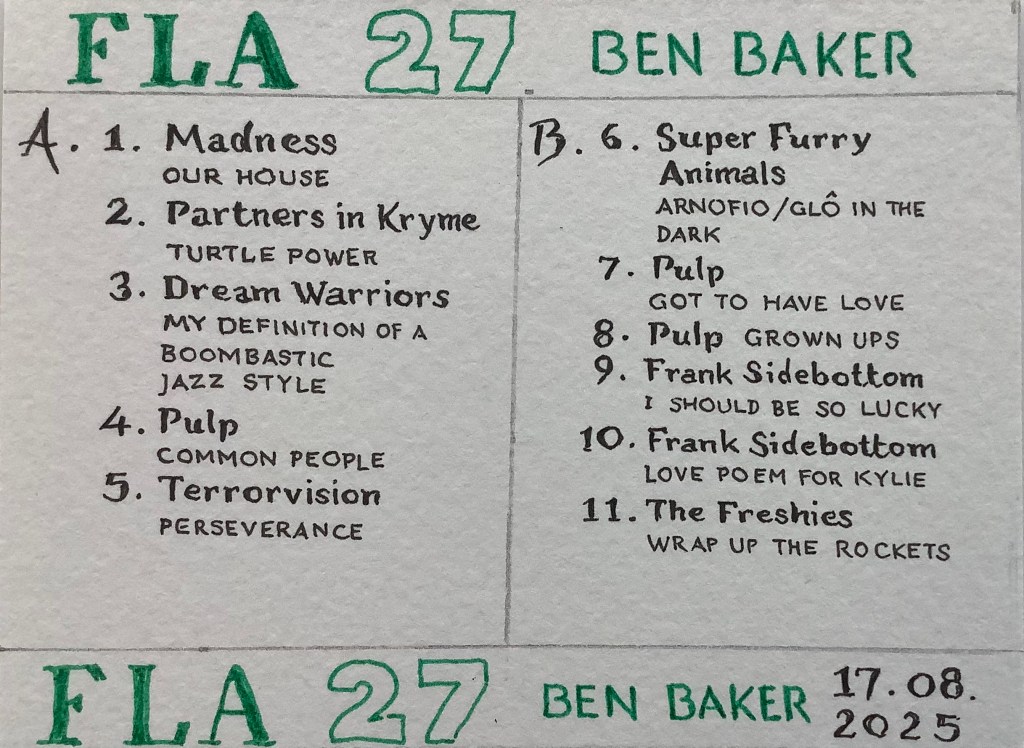
(For the time being, this site and project uses Spotify for the conversation playlists, but obviously I disapprove that Spotify doesn’t pay artists and composers properly, and other streaming platforms are available, as are sites to buy downloads and buy recordings. For consistency, you can also listen to the selections via YouTube (where available), and links are provided in each case, below.)
Thanks to Tune My Music, you can also transfer this playlist to the platform or site of your choice by using this link: https://www.tunemymusic.com/share/RCJQPCkOri
Track 1:
MADNESS: ‘Our House’:
https://www.youtube.com/watch?v=KwIe_sjKeAY&list=RDKwIe_sjKeAY&start_radio=1
Track 2:
PARTNERS IN KRYME: ‘Turtle Power’:
https://www.youtube.com/watch?v=uxHWm_bGScY&list=RDuxHWm_bGScY&start_radio=1
Track 3:
DREAM WARRIORS: ‘My Definition Of A Boombastic Jazz Style’:
https://www.youtube.com/watch?v=jIF_jdrj5L0&list=RDjIF_jdrj5L0&start_radio=1
Track 4:
PULP: ‘Common People’:
https://www.youtube.com/watch?v=acKCgLseDC8&list=RDacKCgLseDC8&start_radio=1
Track 5:
TERRORVISION: ‘Perseverance’:
https://www.youtube.com/watch?v=bECD7ardHhA&list=RDbECD7ardHhA&start_radio=1
Track 6:
SUPER FURRY ANIMALS: ‘Arnofio / Glô In The Dark’:
https://www.youtube.com/watch?v=bTHw9pv00RA&list=RDbTHw9pv00RA&start_radio=1
Track 7:
PULP: ‘Got to Have Love’:
https://www.youtube.com/watch?v=-r30F2FI_nk&list=RD-r30F2FI_nk&start_radio=1
Track 8:
PULP: ‘Grown Ups’:
https://www.youtube.com/watch?v=WjIKF6Z_uXk&list=RDWjIKF6Z_uXk&start_radio=1
Track 9:
FRANK SIDEBOTTOM: ‘I Should Be So Lucky’:
https://www.youtube.com/watch?v=26GA-LnyYnU&list=RD26GA-LnyYnU&start_radio=1
Track 10:
FRANK SIDEBOTTOM: ‘Love Poem For Kylie’:
https://www.youtube.com/watch?v=DHasLuCJjus&list=RDDHasLuCJjus&start_radio=1
Track 11:
THE FRESHIES: ‘Wrap Up the Rockets’:
https://www.youtube.com/watch?v=tDl1osbZbZ4&list=RDtDl1osbZbZ4&start_radio=1


 FIRST LAST ANYTHING