
FLA 24: Alison Eales (06/08/2023)

Alison Eales pic (c) Euan Robertson

Alison Eales is a musician, songwriter and arranger, whose splendid solo debut album, Mox Nox, is a captivating blend of folk, electronic music and found sounds of the city, namely the city of Glasgow where she has lived since the turn of the century. Released in Spring 2023, Mox Nox is already one of my records of the year.


Born in the south-east of England, Alison was raised in Berkshire, and then in Somerset. After university in Glasgow, she became the keyboard player and accordionist with Butcher Boy, who have made three studio albums to date, and released an anthology, You Had a Kind Face, in 2022. In addition, she has worked as a collaborator and arranger, has written a PhD on the Glasgow International Jazz Festival, and is currently working on a history of jazz in Scotland.


It was an absolute pleasure to talk to Alison on Zoom one evening at the start of August 2023, to hear about some of her working methods in composition and arrangement, her participation in choral music, and of course, some of the records which have inspired her, past and present. We hope you enjoy our conversation as much as we did.


—-


ALISON EALES

Until I was eight, we lived in Maidenhead, in Berkshire. I think my earliest memories of music in the house were the Carpenters, listening to ‘Goodbye to Love’ when I was really tiny, and my Nana was very into The Sound of Music – whenever we visited her, it was on – but my mum and dad were kind of folk singers who used to play guitar and sing. There was also quite a bit of stuff like Gordon Lightfoot and Tom Paxton. So lots of guitar-based, acoustic music at home.


But also, I’ve got a bit of a thing about old TV continuity, particularly idents. So there’s music from TV startups and jingles and things like that lodged in my head early on.


JUSTIN LEWIS

I often think of TV music from the past as being associated with waiting for things. When I first heard Air, who I love, it made me think of interludes and ‘Well, we’ll be back with children’s programmes later, but now here’s some music and Pages from Ceefax’. I seem to remember in the early days of the Internet, there was something called the Test Card Circle.

ALISON EALES

I was a member of that for a little while. They were based out of Edinburgh, I think. I’ve still got a load of the magazines somewhere. The main purpose of the Test Card Circle was to share trade test tapes of the start-up music and things like that. So there’s quite a lot of that library music that I really like now, and I think that goes back to when I was little.


There are composers and arrangers from that genre I love, like Brian Bennett, Alan Hawkshaw – and Keith Mansfield, who wrote the Granada TV start-up music [‘New Granada Theme’, 1979]. Granada didn’t have a jingle to accompany their logo, but he wrote that start-up music. And he wrote the Grandstand theme and the Wimbledon theme and ‘Funky Fanfare’, all that great library music. In the last few years, I’ve got very interested in the KPM Music Library.

JUSTIN LEWIS

Lots of it on streaming services now.

London Weekend Television: ‘River’ ident, 1970-78

JUSTIN LEWIS

Some genius uploaded a sequence of all the jingles considered for Thames Television before its launch in 1968 – and you can hear the variations which were considered. Really strange to hear the one they chose in amongst it, and you can hear they chose right.

Thames test idents, 1968 (the one at 1’20” is ‘the one’)

JUSTIN LEWIS

And there’s yet another one (1969–70), composed I believe by David ‘Jeans On/Channel 4’ Dundas, where they used this orange, white and black combination logo, which funnily enough made me think of your current album cover!

ALISON EALES

Maybe I stole it! Oh my god. [Laughter]

ALISON EALES

And there’s something so evocative about it. When I was very, very young, I remember thinking, ‘What does music mean?’ What does that sound mean when the LWT jingle comes into play on a Friday night: It’s the weekend! You know? They’re like time signals – ‘this little jingle tells you where you are in the week’ – so yeah, I love all that.


The LWT jingle was written by a guy called Harry Rabinowitz (1916–2016), who also did things like the soundtrack to Chariots of Fire. The jingle is, I think, meant to evoke the sound of Bow Bells – that little glockenspiel and then big fanfare.

ALISON EALES

Before they hit on the ‘river’ ident for LWT, they did one which was a Radiophonic Workshop-type jingle, and it’s crazy how you can think, ‘I can’t associate that with London Weekend. That’s not how it goes!’

London Weekend ident and jingle, 1968-69

JUSTIN LEWIS

But these colour schemes are very powerful, particularly when you’re young. And these associated bursts of music. Do you know of John Baker – I’m sure you do. [AE: Yes!] He did not only this Radiophonic Workshop arrangement of a Welsh folk song called ‘Tros y gareg’ for BBC Wales which was essentially ‘Programmes begin shortly’, but also the Harlech/HTV logo jingle.

ALISON EALES

Straight away, that HTV music – one of my favourites – is Robin of Sherwood to me. John Baker was on my mind when I made ‘Fifty-Five North’ because there’s a little ‘ding’ sound in it, that I sampled from the turnstiles on the Glasgow Subway. It reminded me of a piece of John Baker’s called ‘New Worlds’ which I saw the Radiophonic Workshop play about 10 or 15 years ago in Camden, and the very end of it got used as the jingle for Newsround. But there’s also all that melody made by John Baker striking bottles. So I’m absolutely delighted to have a little nod to John Baker in my own song, ‘Fifty-Five North’.

JUSTIN LEWIS

And we’ll come back to ‘Fifty-Five North’. There’s something quite haunting about a lot of that material.


ALISON EALES

I try not to wallow in nostalgia too much, but sometimes it can be a really sweet kind of melancholy.

FIRST: CULTURE CLUB: Colour by Numbers (Virgin Records, 1983)

Extract: ‘It’s a Miracle’

ALISON EALES

I was bought this by my mum and dad – I would have been three or four – because supposedly I just loved ‘Karma Chameleon’, would dance away to it whenever it was on Top of the Pops. But listening back to that album now, the song that strikes me as really underrated is ‘It’s a Miracle’.


JUSTIN LEWIS

Which is my favourite Culture Club single, I think. I used to presume ‘Karma Chameleon’ would be the one Culture Club would be remembered for, but it seems to have swung back to ‘Do You Really Want to Hurt Me’ of late. But this whole album is a great pop LP.


ALISON EALES

And I think the other thing that gets underrated about Culture Club is Helen Terry’s voice. On ‘It’s a Miracle’, she’s the driving force, what I love about that sort of 80s stuff, like Sarah Jane Morris with the Communards. These really soulful female singers coming through these bands. But Helen Terry gets relegated from Culture Club a little bit.


JUSTIN LEWIS

Yes, it’s never quite clear if she was a member of the group or not. Because she’s on lots of the records.


ALISON EALES

Her voice is such a big one. She’s like the Merry Clayton of Culture Club.


JUSTIN LEWIS

And it also makes me think of Alison Moyet’s records with Yazoo, that amazing combination, that tension between Vince Clarke’s electronics and her very bluesy voice over the top.


ALISON EALES

Yeah. Upstairs at Eric’s by Yazoo was also a key record in our house when I was growing up. It’s a very British response to disco – Vince Clarke came out of that post-punk landscape, a reaction to punk, the key elements of disco. Electronics and drum machines and a soulful female vocal.


JUSTIN LEWIS

And then selling that back to America. ‘Situation’ by Yazoo was a huge club record in America and all the DJs who would invent house music were listening to that and early Depeche Mode as well. And of course Vince Clarke was composing all the TV themes in the early 80s. All the pop shows.


—-


JUSTIN LEWIS

So how did you begin learning music yourself? Were you having lessons at school?


ALISON EALES

My mum and dad sent me for piano lessons when I was really quite young. But I think young children probably learn better by having fun with music. I’ve never really seen fully eye-to-eye with the piano. I never studied or practised very hard. I can read music, but I always preferred to learn things by ear. Later I had oboe lessons, which I hated even more, but I always enjoyed singing, so I used to sing in children’s choirs. You learn a lot in a choir, not just about music theory, but about musicality and musicianship and being able to interact with other musicians. I really valued that.


And because my mum and dad had both played guitar, there was always a couple of guitars lying around, and I did the typical teenage thing of picking up a guitar and playing Cranberries songs or whatever. This weekend just gone, I was in a charity shop and picked up a copy of Melanie’s first album, Born to Be (1968). I started listening to her in my mid-teens, just around that time I was picking up a guitar. There’s a particular song called ‘Close To It All’, and oddly enough I was in the studio a couple of weeks ago, playing it to my collaborator Paul Savage as a reference point, for something I wanted to sound like.


JUSTIN LEWIS

It’s funny, because when I hear the Mox Nox album, that you’ve released this year, I can hear folkier influences in there, but there’s electronics there too, and I guess I had assumed you were a bit of a keyboard whiz because there are keyboards all over that record.


ALISON EALES

I know my way around keyboards and around sounds, how to build sounds with a synthesiser. I’ve learned that from being in Butcher Boy because quite often John Hunt, who writes the songs, will have a particular sound in mind, usually a ‘movie sound’ – like ‘I want this to sound like John Carpenter’. The kind of music I play, in indie-pop circles, is not particularly challenging on any one instrument – which is good because I’m not particularly good at one instrument – but I think the skills needed are much more about what would work as a particular sound, or what would work in the arrangement.


I’d always thought of myself more as a songwriter, and in fact, the feedback I’ve had for Mox Nox has been, ‘You’re really good as an arranger.’ I’ll never be good enough to be a session musician, but I enjoy the process of thinking, ‘It’d be really nice to have this kind of synth sound,’ and then creating it from scratch.


JUSTIN LEWIS

How did the arranging begin, then? Because you were doing some in Butcher Boy, is that right?


ALISON EALES

That tends to be a group effort. John brings songs to the band, and we’ll all work on our own parts, and make suggestions to each other’s parts as well. But I’ve done vocal arrangements. There’s been a few things with multiple singers, and we did an EP (Bad Things Happen When It’s Quiet) with choral parts on it five or six years ago. It made sense for me to arrange those. I’ve done a little bit of string arrangement, but not that much as we’ve got two wonderful string players who are much, much better at that. And a couple of brass arrangements, although one of those ended up as a synth thing, actually. I just like getting stuck in, really.


JUSTIN LEWIS

How did you come to join Butcher Boy in the first place?


ALISON EALES

It was 2005. I used to go to a club night called National Pop League, a monthly indie-pop disco in Glasgow, that John used to run. It was at an old social club, and one night I got chatting to Garry Hoggan, who played bass in the band. And when he visited my flat, just off Byres Road, what caught his attention was that I had an accordion, because I think John had always wanted an accordion in Butcher Boy.


JUSTIN LEWIS

What had drawn you to the accordion, what was the appeal?


ALISON EALES

I think it goes back to being in my teens, getting into quite folksy stuff, and I remember saying to my parents, absent-mindedly, that I might like to play the accordion. So they got me one for my eighteenth birthday. I’ve never upgraded it – it’s nothing special but it sounds great.


JUSTIN LEWIS

As I understand it, they’re not easy to play.


ALISON EALES

Mine is a piano accordion. On one side, you’ve got a straightforward keyboard, and on the other, you’ve got buttons which play different chords and bass notes. Once you’ve worked out the pattern of the buttons, and learned how to control the flow of air, it’s quite intuitive.


JUSTIN LEWIS

I don’t think enough is made of arrangement in music. Because it’s not just about what you put in, it’s what you leave out too. And I’m interested in how someone like yourself makes those kinds of decisions. Were there particular arrangers who have inspired you?

ALISON EALES

Well, Angela Morley is the big one for me, a complete hero. Going back to the TV ident thing, she arranged the ATV ‘Zoom’ ident (1969-81) composed by Jack Parnell, ‘bing bing bing’.

When I hear a record I love, and I check the arranger’s name, I’m amazed by the number of times it’s her. Scott 4 by Scott Walker, one of my absolute favourite records. The soundtrack to Watership Down, which I don’t think she composed, but it’s such a beautiful arrangement. And going back to Keith Mansfield, he did the arrangements for some of my favourite pop songs – ‘No Stranger Am I’ by Dusty Springfield, with its staggering deployment of oboe, and ‘Peaceful’ by Georgie Fame.

JUSTIN LEWIS

The third track on your Mox Nox album, ‘The Broken Song’. I’ve read something you said about this one. ‘It was left deliberately unfinished to create room for experimentation in the studio.’


ALISON EALES

Yes.


JUSTIN LEWIS

So can you talk me through why that track in particular, and how you completed it for the record.


ALISON EALES

When I started writing that song, there were a couple of things happening in my life. One was that I’d fallen in love for the first time. The other was that I had started suffering with anxiety, which has characterised my whole adult life. And, you know, you can insert your own punchline here, about those two things being the same thing. I always thought that song was about my feelings towards this other person. I was happy with the song’s verses, but I could never settle on a chorus for it – I kept redrafting lyrics and in the end, before I went into the studio, I decided to just delete the choruses and see what was left.


I looked at the lyrics that were left, and they were all about anxiety. Not being able to concentrate, not being able to remember things. So I wrote some additional lyrics about the experience of what’s called derealisation, where you feel like you’re outside your body and disconnected from your senses. I wanted the song to sound queasy and uncomfortable, like two songs crashing together, and that’s why the verses and choruses sound so different.


JUSTIN LEWIS

Hence the title. ‘The Broken Song’.


ALISON EALES

Yes!


JUSTIN LEWIS

The first thing you did on your own, as far as I can tell, was an EP or single about ten years ago, ‘Land and Sea’. What did you learn from that, and how did that experience get you to the solo album, Mox Nox?


ALISON EALES

I like the Just Joans cover that I did, but I’m not so keen on the other two songs.


My main learning from that was about the limitations of home recording. At the time I was living in this big and echoey flat, but we had a little cupboard, a sort of walk-in wardrobe. So I sat on the floor inside that. Then I realised that I didn’t have a pop shield for the microphone, but I thought I could put a tote bag between me and the microphone. And I don’t know why it occurred to me to do this, but I put the tote bag over my head – I thought that was the best way to support this bit of fabric. An ingenious solution. So there I was, roasting hot, sitting on the floor of this cupboard singing these vocals with a bag over my head.


I got to the end and I thought: ‘I could have put this bag over the microphone.’ [Laughter]


JUSTIN LEWIS

With the recent Mox Nox, you’d just started making it, and then the first lockdown of 2020 happened, yes?


ALISON EALES

Yeah, I think I had two weeks in the studio, finished up on the Friday, took away all the rough mixes and backups of the files. And then the Monday was the first UK-wide lockdown. So it was quite fraught. And then trying to have those decisions about who’s coming into the studio. In the end, it was mostly just me and Paul Savage in the studio in the early days so it wasn’t too risky. We had a little recording bubble. I came away from the first recording session feeling a bit downhearted. I couldn’t imagine how it would all come together. But then around September 2020, I got Pete Harvey’s beautiful string arrangement for ‘Ever Forward’, and that fired me up again.


JUSTIN LEWIS

On one of the other tracks, ‘Goodbye’, I’ve read that you wanted a choir for that, but lockdown put paid to that, and so there’s something called a ‘robot choir’ instead.


ALISON EALES

Yeah. I wanted some of my colleagues from the Glasgow Madrigirls choir, of which I’m a long-term member, to come in and sing with me. Actually, they would have been on a few other tracks: ‘A Natural History of California’, ‘Mox Nox’, and ‘Through Hoops’, which has got little stacked harmonies at the end. But we couldn’t do it. It wouldn’t have been responsible to have half a dozen people in close proximity, breathing on each other.


So for the wee choir bit in ‘Goodbye’, I used a technique we use in the choir and which our director Katy calls ‘waffle’, which is when we are given a set of notes and we all sing around them in our own time. It makes a really lovely effect, so I did that. Tuning wise, it was awful, because I couldn’t hear anything by the end of it. So I said to Paul, ‘Why don’t we just pitch-correct this to within an inch of its life so that it sounds really artificial?’, so it sounds like a robot choir.


JUSTIN LEWIS

I love the album, and it’s really interesting to discover that it was made under lockdown, because I hadn’t clocked that at all. It sounds like a really open record.


ALISON EALES

I’m really glad you’ve said that, because my real fear was of making a record, doing it all myself and it ending up sounding suffocated. You need other people’s ideas and other people’s breathing space to avoid it sounding airless. I was particularly upset not to get the Madrigirls on it, and yeah, at times, it felt like it was just me and Paul in the studio in the middle of nowhere.

—-

LAST: LEMON TWIGS: Everything Harmony (Captured Tracks, 2023)

Extract: ‘Any Time of Day’

JUSTIN LEWIS

Lemon Twigs, now this was new to me. And the title tells you everything. Those harmonies which are so infectious must be heaven to you.


ALISON EALES

Yeah, I’m a complete sucker for anything with vocal harmonies, having sung in choirs all my life, but also thinking of all those acts I grew up with – ABBA, The Beach Boys, Carpenters… that’s a key selling point of all those acts. And like the Beach Boys and Carpenters, you know, they’re siblings.


JUSTIN LEWIS

They’re frighteningly young too, Lemon Twigs. I was a bit shocked.


ALISON EALES

They’re frighteningly young, and there’s only two of them and you’re like, ‘How are the two of you making all this noise?’ But they also have that wonderful thing of siblings singing together, like obviously the Beach Boys, their voices just blending together. Garry Hoggan, my co-writer, sent me a link to ‘Any Time of Day’, the first song of theirs that I had heard. But the Beach Boys wasn’t the first comparison I made – I thought, Steely Dan.


JUSTIN LEWIS

Todd Rundgren came to mind for me, and it came as no surprise that they’re massive fans.


ALISON EALES

I think the Guardian review of it said, ‘They’re trapped in a time loop and they keep going from, like, 1967 to 1976.’ That’s exactly it. But yeah. ‘Any Time of Day’ is a stand-out track for me, and ‘I Don’t Belong to Me’, and the title track. It’s really sophisticated stuff, and just gorgeous. I love it.


—–


JUSTIN LEWIS

Just one more question about found sounds. You bought a Pocket Operator?


ALISON EALES

Yeah, it’s amazing. It looks like a little calculator or game, made by a company called Teenage Engineering.


JUSTIN LEWIS

How much was it?


ALISON EALES

The one I bought was about £80.


JUSTIN LEWIS

That’s pretty reasonable, really.


ALISON EALES

Especially as a lot of their stuff is outrageously expensive. So you can record sound with this. And I tell you what got me thinking about it. I was on the Glasgow Subway one day, and I realised that one of the escalators was making a rhythmic noise that I’d have liked for ‘Fifty-Five North’. It was maybe not quite swingy enough for the track, in the end, but I had the idea to try and record something on the Subway. You can record up to 30 seconds of sound, and then you’ve got a little set of sixteen buttons, and you can capture this little fragment of sound, and pitch it up or down a bit. And I got the result I wanted in the end, because of the Glasgow Subway, for ‘Fifty-Five North’.


JUSTIN LEWIS

So the main beat is a sample of the train doors closing?


ALISON EALES

Yeah. There’s a drum machine as well, which I wasn’t sure about leaving in, but it does give a bit of weight to the sound.


JUSTIN LEWIS

It made me think of the source material for ‘Bad Guy’ by Billie Eilish.


ALISON EALES

Oh yeah, the [pedestrian] crossing in Sydney.


JUSTIN LEWIS

It also made me think of Art of Noise, because they had one of the first samplers in the early 80s, and you could only record one or two seconds of sound which is why their records had these big stabs of sound.


ALISON EALES

Well, Trevor Horn’s a complete hero of mine, and I love Art of Noise as well. Was it the Fairlight CMI they had? Kind of a digital version of the Mellotron, absolutely fascinating instrument.


JUSTIN LEWIS

Didn’t Trevor Horn have one of the first in Britain? I think Kate Bush had one as well – ‘Sat in Your Lap’ has that all over it.

ALISON EALES

And Peter Gabriel too. There’s a South Bank Show documentary (LWT/ITV, 31 October 1982) of him making one of his albums [Peter Gabriel 4: Security], and he sits and demonstrates, using the Fairlight. Amazing. The other great bit of footage of a Fairlight being used is Herbie Hancock on Sesame Street (c. 1983). With a very young Tatyana Ali. She says her name into it, and he samples it. It’s very sweet.

—-


JUSTIN LEWIS

Let me ask you a little more about the Glasgow Madrigirls then, and the repertoire you do. How did you become involved in that?


ALISON EALES

I’d wanted to sing in a choir as an adult for a few years, because I’d enjoyed it so much as a child, but I’d never found one I wanted to join. But then about 20 years ago, a couple of years after the Madrigirls started, I joined. I had seen adverts up around the Glasgow University campus, looking for people to join this female choir. I dithered about it, but I was doing finals, so I decided against. But Katy Cooper, one of the two directors of the choir, was my flatmate, and she suggested that I audition. I wasn’t singing publicly at all at that point, although I had a sort of pipe dream of doing something solo. But this was before Butcher Boy, I wasn’t working in music and didn’t really know how to get started.


It was really nice to join Madrigirls. Originally, as the name suggests, the repertoire was mostly mediaeval and renaissance music – part songs and plainsong – but now it’s a mix of sacred and secular music from all over the world. I’m not religious at all, but we tend to do an Advent concert in December, a lovely festive shebang, and then in the summer, we go into folkier stuff, which is also part of Katy’s musical background, so there are arrangements of traditional folk songs. And we’ve commissioned some pieces over the years that have been really lovely as well.


JUSTIN LEWIS

How many are in the group now?


ALISON EALES

When I joined, it was sixteen of us. We would usually sing four-part harmonies. It’s about forty now.


JUSTIN LEWIS

A few years ago, you wrote a PhD about the history of the Glasgow International Jazz Festival, an annual event that began in the late 1980s, a full decade before you moved to the city. What was it about that event that made you want to research it? Were you a fan of jazz?


ALISON EALES

In 2010, [some years after graduating in English] I suddenly found myself wanting to do something academic that I could be proud of. I got a scholarship, and I was very lucky to go back to Glasgow University to do a Masters in Popular Music Studies, studying the history and theory of popular music. It was one of the best years of my life, really stimulating. I got to meet lots of great people, and the guy who ran the course, Martin Cloonan, was friends with Jill Rodger, the director of the Glasgow Jazz Festival. She had an archive of 30 years of artist contracts and publicity and all sorts of stuff. Martin saw the opportunity to get some funding for someone to do a PhD, and he secured funding, and then I was interviewed and got the position. But to me, the appeal was that I didn’t know anything about jazz, and so this was a great opportunity to immerse myself in it.


JUSTIN LEWIS

So can you give an example of a breakout thing you heard where you thought, ‘Oh, I’m so glad I’m researching this’.


ALISON EALES

It’s funny. Having said earlier on that, as a musician, I didn’t get on with the piano terribly well, I love it as a listener. I struggle a little bit with things that are brass or sax heavy, I really prefer piano jazz, but the exception to that, and the person I saw at the Jazz Festival who blew me away was Evan Parker, who I saw at the Recital Room at Glasgow City Hall. I don’t think he was even on stage. Maybe he was standing on the floor, so it was like he was in this small room on a level with you. He was playing soprano sax, just circular breathing and fully improvising, for five or six minutes, this constant sound, and I think it fundamentally changed how I think about what music can do, and how melody works. It was just so inspiring. And he was interviewed as well, and his politics are obviously very left, so I felt he was a good guy!


It was mad, actually. I got to meet people like Pharoah Sanders. I did artist liaison for Ginger Baker – twice!


JUSTIN LEWIS

Wow, you went back.


ALISON EALES

Let’s just say there were highs and lows. But I came away from it afterwards feeling very depressed, because I think the story [of Glasgow International Jazz Festival] is a story of declining commitment of city authorities to culture as a driver for tourism. The aim was to position Glasgow as a European Capital of Culture, and other European Capitals of Culture (whether they had that official title or not) all had jazz festivals. At the beginning, the people who ran it were given a blank cheque, and as time went on… I have a metaphor for it. It’s like you’ve done up your house, you’ve made it all beautiful, you have a big housewarming party, you’ve put up lots of decorations, and then afterwards, you take those decorations down with slightly less care than how you put them up. And invariably there’ll be one tiny bit of tinsel sellotaped into a corner of a room, and people might absent-mindedly notice that when they come to visit.


I think the Glasgow Jazz Festival is this little remnant of a time when there was a real commitment to culture as a driver of tourism. That was the tourism sales pitch for Glasgow from the early 80s onwards. Now it’s shopping. In the early days of the Jazz Festival, it was popular enough that you could get retailers to piggyback on it and sponsor it. By the time I was going to the Jazz Festival for research, I’d see a jazz-funk trio playing in the St Enoch Centre to completely indifferent passers-by and I’d just think, that sums it up.


I’m writing a history of jazz in Scotland at the moment. I don’t think Britain is receptive to jazz, full stop, the way they are in mainland Europe. But those of us who grew up in Britain in the 60s, 70s, 80s were absolutely surrounded by it growing up because of that TV library music, and all those arrangers we mentioned earlier. Keith Mansfield, Alan Hawkshaw, John Barry, some of our greatest TV and film composers… jazz was their background! It’s funny how there’s this resistance to jazz in the UK, and yet… the theme to Coronation Street, for heaven’s sake. Some of the music we hear the most is based in jazz.  


JUSTIN LEWIS

Yes, jazz was massive in Britain once, in a mainstream way. There’s no real radio station that puts it front and centre anymore. And yet, once upon a time, in Britain, there were these three big musical areas: rock’n’roll, jazz, classical. (Four, actually. I forgot about folk.)  And each had their devotees with markedly different opinions about the rival genres.


ALISON EALES

Yeah, you had the BBC Light Programme, especially in the 1950s, which would later split into Radio 2 and Radio 1. It’s interesting looking at the Light Programme and see where jazz and folk fitted in. It reminds me of that Stewart Lee routine where he talks about ‘jazz folk sex’. Jazz and folk being lumped together is really interesting.


It fascinates me, for all sorts of reasons. I could talk about this for hours, about early jazz festivals in Britain, programming folk singers, particularly Scottish folk singers. Early jazz was considered an African-American folk music, so there was some audience crossover.


JUSTIN LEWIS

And there’s something immensely spontaneous about both jazz and folk.


ALISON EALES

And the trad jazz stuff is fascinating as well. I mean, there’s divisions within divisions… people arguing about the value of different genres and subgenres. But that trad jazz boom of the late 1950s, early 1960s… the narrative is that beat music comes in and almost wipes trad jazz off the map. But I think what actually happened was that for trad jazz fans, that was their youth music. And they grew up, and stopped going out, while the next generation came along, with the Beatles and the Stones, who obviously made a lasting impact. But then you get this trad jazz revival in the late 70s, early 80s, you get people like George Melly back on the telly. It’s the nostalgia thing – the group of people who twenty years prior had been out dancing in the dance halls to trad jazz. Suddenly their kids are grown up and they have some spare cash and they can go out and dance again. It does seem to be a twenty-year cycle. You see it now with Britpop. 

ANYTHING (1): JOANNA NEWSOM: Ys (Drag City Records, 2006)

Extract: ‘Emily’

[NB Joanna Newsom’s work is not available on Spotify and some other streaming services, else it would be on the FLA playlist at the end.]

JUSTIN LEWIS

You suggested two ‘Anything’ choices. When you mentioned this, I was just thinking about your work in arrangements, and the impact this must have made on you. I was reading up about how they made it, and apparently Joanna Newsom made the bare bones of the record first, voice and harp, and then Van Dyke Parks came in as arranger to build around the existing recording because of how the time signatures and phrasing worked.


ALISON EALES

Yes, I think at quite an early stage, she went to his house and literally played the album running order for him, and I think that was what got him on board to agree to do it. So she recorded the vocals and harp with Steve Albini. And then there are these points, on ‘Emily’ for instance, when it sounds like her and the orchestra are almost not in the same room, it’s hard to describe.


JUSTIN LEWIS

That artifice creates an interesting tension, because it is a recording. You can do anything. 


ALISON EALES

There are enough decisions to make when you’re making a record, without tying yourself in knots about things like artifice and authenticity. There’s no point. It’s a rabbit hole you’d never come out of, so yeah. One reason I like working with Paul Savage is I can get really perfectionist about nothing, and I allowed myself that on Mox Nox, but I’ve just been working in the studio with Paul on this follow-up EP, and I took a different tack. I was like: ‘If something is good enough, it’s good enough.’ And Paul hates perfectionism, he likes things to be a bit rough around the edges, so it’s really nice to work with him, and so the next EP [hopefully out early 2024] is really minimalist.


ANYTHING (2): MASAYOSHI TAKANAKA: Can I Sing? (1983, USM Japan/Universal)

Extract: ‘Jumpingtakeoff’

JUSTIN LEWIS

Apparently he used to be a member of the Sadistic Mika Band, who supported Roxy Music on a UK tour in the mid-70s.


ALISON EALES

I didn’t know that. That’s amazing!


JUSTIN LEWIS

So what’s the story with this one?


ALISON EALES

One of my best friends in Glasgow is a guy called Colin Edwards. We’re both passionate about comedy and jazz – they’re our shared points of contact. And we found out we had lots of mutual friends.


JUSTIN LEWIS

Comedy and jazz – very similar art forms when you think about it.


ALISON EALES

Very. I read a great piece in The Quietus, where the author [Jennifer Lucy Allan, The Quietus, 27 Feb 2023] was writing about how Mulligan and O’Hare got her into improvised music. It was a really lovely love letter to Reeves and Mortimer, because seeing that kind of absurdist improvisation at a young age had got her into the kind of artists who were doing that for real. Stuff like Phil Minton! You can’t listen to that and not think, ‘There’s a comedy vein here.’


Comedy is a passion of mine. I’m always on the fence about ‘funny music’ in comedy, I find it can be very cringey, but I really love comedians who know what’s funny about music. I really love that. That is what I really appreciate.


Colin stumbled upon Takanaka on one of his YouTube binges. Initially, he was like, ‘This is really cheesy’ – again, it’s like library music, kind of highly polished and very slick. But then he got really taken in by how phenomenal this guy is. So Colin recommended him to me and it turns out that my co-writer Garry is a fan too. He’s an absolute legend in Japan – It’s become a dream to go there and see him live.


JUSTIN LEWIS

He seems to be very productive. This was his twelfth solo album, 1983, and he’d only been solo for eight years.


ALISON EALES

I don’t know if you’ve seen any live videos of him, but I strongly suggest you look up a couple of things. There’s a 2014 live version of this track, ‘Jumpingtakeoff’. He’s playing a guitar that’s carved out of a surfboard. Halfway through, all these balloons start raining down on stage, and he’s batting them away with this surfboard guitar. It’s just the most joyous thing. It should be available on the NHS. It’s the kind of music that, if you listen to it first thing in the morning, you feel like you can achieve anything.

JUSTIN LEWIS

It’s funny how Japan is like such a massive market for pop music, and only occasionally has something broken out and reached the UK.


ALISON EALES

Yes, I mean, obviously Yellow Magic Orchestra, and I love Sakamoto.


JUSTIN LEWIS

Pizzicato Five, too.


ALISON EALES

Yes, and Cibo Matto have broken out. Another album I got obsessed with a couple of years ago is Adult Baby by Kazu, who was in Blonde Redhead, who’s Japanese-American.


I think Garry started listening to Takanaka because of YouTube recommendations from Yellow Magic Orchestra. So maybe the algorithm is giving Takanaka a bit of a renaissance.


The other album of his that I just fell in love with is called Seychelles (1976), and there’s a version of that that’s all on ukulele, which sounds mad but it’s really beautiful. The last track on Ukulele Seychelles is a live encore. You can hear him interacting with the audience, and you can hear the love for him. He’ll play a little bit or sing a little bit, and there’ll be some laughter and some applause. He’s such a warm presence as well as a shit-hot guitarist. He has another surfboard guitar that shoots lasers out of the end of it, and an acoustic that’s got a model railway on it! [Laughter]


But I love that Can I Sing? album. ‘Santiago Bay Rendezous’ is really uplifting, and ‘Tokyo… Singin’ in the City’. The vocoder and stuff. It has all the hallmarks of slick library music, but it’s so playful and full of joy. I just think it’s wonderful.


—-


Mox Nox, released by Fika Recordings, is out now on vinyl and digital download.

Alison has since released one solo EP, Four for a Boy (in March 2024), and two digital tracks, Five for Silver (in March 2024) and Blue Dream (in December 2024). A remix EP, Through Hoops, was also issued in December 2024.

 You Had a Kind Face, an anthology of Butcher Boy highlights, is available from Needle Mythology Records.

You can follow Alison on Bluesky at @alisoneales.bsky.social.

She also has a website: https://alisoneales.com

FLA PLAYLIST 24

Alison Eales
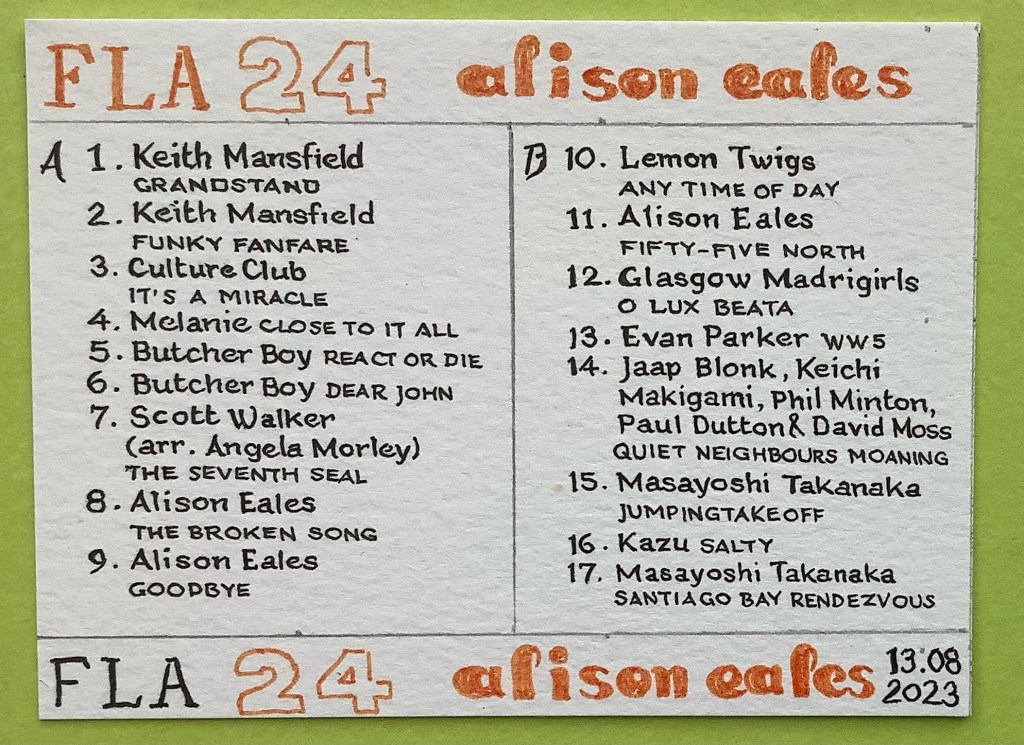
(For the time being, this site and project uses Spotify for the conversation playlists, but obviously I disapprove that Spotify doesn’t pay artists and composers properly, and other streaming platforms are available, as are sites to buy downloads and buy recordings. For consistency, you can also listen to the selections via YouTube (where available), and links are provided in each case, below.)

Track 1: KEITH MANSFIELD: ‘Grandstand’: https://www.youtube.com/watch?v=C60ZtQaPfxQ

Track 2: KEITH MANSFIELD: ‘Funky Fanfare’: https://www.youtube.com/watch?v=tUFwQjOpqJM

Track 3: CULTURE CLUB: ‘It’s a Miracle’: https://www.youtube.com/watch?v=YewVugPHon4

Track 4: MELANIE: ‘Close to It All’: https://www.youtube.com/watch?v=Kd5rb2-WRp0

Track 5: BUTCHER BOY: ‘React or Die’: https://www.youtube.com/watch?v=7rigVP6FSMs

Track 6: BUTCHER BOY: ‘Dear John’: https://www.youtube.com/watch?v=yCQZcjWmWX8

Track 7: SCOTT WALKER (arr. ANGELA MORLEY): ‘The Seventh Seal’: https://www.youtube.com/watch?v=J6XPXC-AKZ0

Track 8: ALISON EALES: ‘The Broken Song’: https://www.youtube.com/watch?v=6xo7WeIpcU0

Track 9: ALISON EALES: ‘Goodbye’: https://www.youtube.com/watch?v=IkofNhoWfBA

Track 10: LEMON TWIGS: ‘Any Time of Day’: https://www.youtube.com/watch?v=hmX2wsnzEGE

Track 11: ALISON EALES: ‘Fifty-Five North’: https://www.youtube.com/watch?v=Jjcf32H4V50

Track 12: GLASGOW MADRIGALS: ‘O Lux Beata’: https://www.youtube.com/watch?v=0Ub4IFK068M

Track 13: EVAN PARKER: ‘WW5’: https://www.youtube.com/watch?v=MtyG73Ujwzw

Track 14: PHIL MINTON: ‘Quiet Neighbours Moaning’: https://www.youtube.com/watch?v=rtK_fXQbMck

Track 15: MASAYOSHI TAKANAKA: ‘Jumpingtakeoff’: https://www.youtube.com/watch?v=n6MNJc88jnM

Track 16: KAZU: ‘Salty’: https://www.youtube.com/watch?v=RtnkfcyQGps

Track 17: MASAYOSHI TAKANAKA: ‘Santiago Bay Rendezvous’: https://www.youtube.com/watch?v=IahB2YJ_yl8

FLA 12: Ian Greaves (28/08/2022)

Fifteen years ago, the writer and editor Ian Greaves and myself were going mad. We were spending most spare minutes of our lives researching and eventually writing a 700-page book about the long-running BBC Radio 4 topical sketch series, Week Ending. We know. The BBC Written Archives Centre at Caversham, Berkshire, became a semi-regular workstation for our frankly ludicrous project.


Prime Minister You Wanted to See Me? – A History of Week Ending took us a whole year to complete. Two things, I believe, kept us going. One was the knowledge that we were undertaking a subject that genuinely interested us – how do you find new and exciting creative talent in radio comedy? The other was the amusement that we were obsessively cataloguing and analysing every single episode (1132 of them) of a programme that we never actually liked that much. The writer and critic David Quantick (FLA 6) was kind enough to give it (we think) a glowing review for it in The Word magazine in early 2009, ending his piece with the phrase, ‘makes the Domesday Book look like Baby Spice’s autobiography.’ There’s one for our headstones.


I first met Ian Greaves, online and then in person, in 2000. He was and is much younger than I am, and was already frighteningly well-informed on broadcasting in particular. He appeared to have seen far more television than even I had. We would work together regularly over the next decade or so, on articles, doomed book pitches and ultimately Prime Minister, You Wanted to See Me? We often take the piss out of ourselves for writing that book, but we remain immensely proud of it.


Together we also worked as consultants on Lucian Randall’s acclaimed Chris Morris biography, Disgusting Bliss (2010), and separately we contributed chapters for No Known Cure (2013), an assembly of new, exclusive essays on all things Morris.


Subsequently, Ian has contributed to many Radio 4 documentaries and series, and to BFI Screenonline. Plus he has compiled and edited some magisterial anthologies. The Art of Invective (2015, with David Rolinson and John Williams) presents highlights and curios from the playwright Dennis Potter’s extensive archive of non-fiction, while One Thing and Another (2017) is an incredible collection of Jonathan Miller’s writing on everything from humour to opera to surgery to theatre. ‘This stunning collection is a must,’ was US talk show legend Dick Cavett’s reaction. Dick Cavett!  


One subject Ian and I have always chatted about sporadically, although we’ve rarely written collaboratively on the subject, is music, and so I knew I wanted Ian as a guest on First Last Anything. Partly because I’ve often wondered how he became so immersed in what can be some of the noisiest and most uncompromising music around. But also because he is forever tremendous company and makes me laugh a lot.


In August 2022, one Sunday, we spent about 90 minutes exploring Ian’s itinerary from novelty childhood records, through pop epics, towards what you might call The Music of Sound. Enjoy!


——

IAN GREAVES

My persistent memory of the first record I had was ‘The Birdie Song’ [by The Tweets]. I’ve got a cousin, Mark, who’s a few years older than me and my elder sister, and I know him very well these days, but back in the Eighties he was this sort of distant figure who would ask for a Tom Waits album at Christmas from the family. He’s remained good on music ever since, but I’m sure he delivered ‘The Birdie Song’ to me. Maybe he didn’t want it in the house!


I’d listen to the charts with my sister. Keith Harris and Orville, ‘Orville’s Song’, that was a record we very much approved of. I’ve never really had any snobbery about novelty records, and I’ve always quite liked comedy records.


JUSTIN LEWIS

You’ve got to start somewhere, as a listener. Hardly anyone at the age of four is going to be at the 100 Club watching The Clash or whoever.


IAN GREAVES

And my parents had records. A great bone of contention in my dad’s life was that his dad got rid of all his Beatles albums as a sort of punishment – and he was a fan throughout, although I think he went off them a bit when the drugs kicked in.


But if my dad is reading this, the Beatles album in our house was Rock & Roll Music, the original double LP from 1976. And I’ve got that copy right here! [holds aloft] A weird collision of stuff. But I’ve always had sympathy with Alan in I’m Alan Partridge where he says his favourite Beatles album is ‘The Best of the Beatles’. I always say, ‘Oh I don’t own any Beatles records’ in a slightly posturing way, as if to suggest that the scenic route is more enjoyable. But it’s really because I nicked this off my dad. I think I only heard Abbey Road two years ago. They’re fine. [Laughs] I hear they’re good.


JUSTIN LEWIS

They’ll go a long way.


IAN GREAVES

So my dad had The Beatles and Ray Charles, I adore Ray Charles, my first connection with jazz really. I was slanted to the poppier end of my parents’ collection early on: ABBA, Queen, Motown compilations, there was a great 60s rock and pop CD collection… wish I could remember the name of that. Later, as a student, I was hoovering up mood albums. People like Al Caiola, who I still really love. But it transpired that my mother actually had things like George Shearing albums, Dave Brubeck. I imagine I was put off by the covers when I was younger but later I would put them on to minidisc and take them back to university with me.


JUSTIN LEWIS

Did anything happen with musical instruments and tuition?


IAN GREAVES

I probably lasted two piano lessons. Back then, if it was something I was really interested, I’d be really good at it. Anything so-so tended not to get that treatment.


JUSTIN LEWIS

What sort of age are we talking there?


IAN GREAVES

About 12.


JUSTIN LEWIS

An age where it could go either way: obsession or apathy.


IAN GREAVES

And because I was 12 in 1990, we’ve neatly arrived at the year of my first record.

——

FIRST: FRANKIE GOES TO HOLLYWOOD: Welcome to the Pleasuredome (ZTT Records, 1984, released on CD, 1985)

Extract: ‘Two Tribes (Annihilation)’

[NB: During the early years of Trevor Horn’s Zang Tumb Tuum label, especially 1983–85, numerous versions of its releases appeared in the shops, with different mixes, sleeves and contents. Frankie Goes to Hollywood’s singles and first album was no exception – the CD version of Welcome to the Pleasuredome, which came out nearly a year after the LP and cassette versions had a noticeably different running order, including this first 12” version of ‘Two Tribes’ rather than the three-minute single. More recent CD reissues of Welcome to the Pleasuredome have reverted to the running order of the original LP, and so this 12” version (subtitled ‘Annihilation’) can only currently be found on compilations.]


JUSTIN LEWIS

It’s interesting that you bought a copy of Welcome to the Pleasuredome on compact disc in 1990. Holly Johnson had been a fairly big solo artist a year earlier… but why this, and why then?


IAN GREAVES

My memory is that my dad had definitely subscribed me to the local record library. You had to be registered by an adult for some reason, so whether they were stocking Derek & Clive albums, I don’t know. But that’s how I discovered The Goons, borrowing things like Tales of Old Dartmoor, those 70s issues with loads missing off them. And I definitely heard Holly’s Blast by borrowing that, too.


But the reason for ‘Two Tribes’ is very specific. On 1 January 1990, Radio 1, they broadcast The Top 80 of the 80s, the best-selling singles of the decade, all in a six-hour block, hosted by Alan Freeman and Mark Goodier. I taped the whole thing and it was a good way of consuming pop music cheaply. A real mixed bag. Like, ‘Coward of the County’ by Kenny Rogers was number 78.


JUSTIN LEWIS

One of the darkest number ones ever.


IAN GREAVES

And very near the top was the ‘Annihilation’ mix of ‘Two Tribes’… Nine minutes. I listened yesterday to what I think is the standard version of ‘Two Tribes’, and it sounded a little ordinary. But when I listen to the ‘Annihilation’ 12-inch mix, there is no other version as far as I’m concerned.


JUSTIN LEWIS

Just before it came out as a single, in 1984, Frankie said something like, ‘Radio 1 will play it to death’, as if to over-compensate for the banning of ‘Relax’ a few months earlier. And they did. In one week alone, in July 1984, ‘Two Tribes’ was played by Radio 1 twenty-five times.


IAN GREAVES

I bought the CD of Pleasuredome with a voucher for my twelfth birthday, so this is March 1990. I dragged my dad down Woolworths, to help me use this voucher. Which I assumed entitled me to the CD automatically, but it actually entitled me to something like one-tenth of the price. My dad was slightly annoyed by this point, but we’d got this far, so he just bought it for me anyway.


I don’t know what happened to that original CD, but for recent reissues they’ve changed the running order: just the single version.


JUSTIN LEWIS

Yes, now it just duplicates the running order of the original LP and tape. But the first time I heard that ‘Annihilation’ mix of ‘Two Tribes’ was on Peter Powell’s show on Radio 1 because he used to count down the new Top 40 on a Tuesday teatime, and when he got to number one, he played this much longer version instead. Quite often, it was common with 12” versions back then to hold back the main song for as long as you possibly could – and it’s five and a half minutes before the main vocal arrives.


IAN GREAVES

I wasn’t used to remixes, and it’s actually a terrific way of discovering the art.


JUSTIN LEWIS

As a teenager I was obsessed with how things worked, how they fitted together, and the 12” mix is like laying bare the components of the song. The bassline is there, uninterrupted, there’s that guitar riff exposed, which is buried when you hear the song on the radio. And some of this was merely a way of extending the track for the sake of it, to fill the space, but it’s like an inventory of sound.


IAN GREAVES

Like an Airfix kit. It’s perfect for that age, really. Also, it was tapping into all the things that would interest me in music. It’s such a clatter of a record, so busy, so much happening that you can’t really take it all in at once. It’s got samples in it but they’re not samples.


JUSTIN LEWIS

Yes, it’s Patrick Allen re-reading or reading slightly different versions of his own commentary from the Protect and Survive government information films.


IAN GREAVES

Panorama had covered them earlier [If the Bomb Drops, 10/03/1980], they were public knowledge, and so there was nothing to stop Patrick Allen revoicing them, but it has the effect of being a sample, so it’s also commenting on something that was emerging in music at that time.


JUSTIN LEWIS

And having Chris Barrie from Spitting Image and A Prince Among Men doing his Reagan impression, but using that impression to read out extracts of statements from Castro and Hitler.


IAN GREAVES

And getting it on to Radio 1 without any citation. You either know or you don’t. I may have done more homework for this than I needed to, but I listened to the whole album again, and it is not a good album. And there’s also this 3-CD Frankie collection called Essential, which came out this year, but it’s already in the bargain bins. So many mixes. It’s got all but the last two tracks from [the second album] Liverpool which by any measure does not reflect the meaning of the word ‘essential’.


JUSTIN LEWIS

No.


IAN GREAVES

Also, I never want to hear ‘Warriors of the Wasteland’ ever again. But Welcome to the Pleasuredome’s four singles are all great, even if the title track tends to get forgotten.


JUSTIN LEWIS

Way too many covers on it.


IAN GREAVES

‘Born to Run’ is like: Can we expose ourselves to the fact that we do not have Clarence Clemons, because boy does it show.


JUSTIN LEWIS

One of ZTT’s big ideas in the early days was to have a cover version on the B-side of every single, an experiment which lasted until ‘The Power of Love’, when Frankie reportedly flat-out refused to cover The Velvet Underground’s ‘Heroin’.


IAN GREAVES

The first Frankie session for Peel, end of ‘82, is a sort of primitive funk-punk. And the early version of ‘Two Tribes’ – everything about the arrangement is all there. I wish I could hear more of that side of them because the song structures are really interesting.


JUSTIN LEWIS

The big question with ‘Relax’ was ‘how much did Frankie play on it?’ and I’ve seen Trevor Horn quoted as saying that because ‘Relax’ ‘needed to be a hit’ – because the label was getting started – it needed to have this epic production sound, and I suspect the real ‘Frankie group sound’ would not have been as big a hit.


IAN GREAVES

No, they’d have been a cult band like 23 Skidoo or something. I don’t know what my dad thought he was doing, really, letting me have this album! All the sleeve art – I’d forgotten the ‘bang’ symbolism is sperm. I wonder if that made it easier for me later to get into bands like Psychic TV and Throbbing Gristle and Coil…  who used sexual energy – and often gay sexual energy – as a central theme.


But the other thing about Frankie Goes to Hollywood, and what you said about quotations – they’re putting in references for you to work out. A more obvious version of that would be the Manics who are like a reading list with guitars. Take The Holy Bible, the only album of theirs that I really really love. Probably my first awareness of Pinter is on that album, and Sylvia Plath – and I was the right age for all of that stuff too. [“I spat out Plath and Pinter”¸ ‘Faster’]


And musical threads. If you discover The Fall, as I did when I was sixteen, then you will discover Beefheart, the Monks, Can, the Groundhogs (god help you if you get Groundhogs albums), Henry Cow…  They covered Henry Cow… How many people have covered Henry Cow?


JUSTIN LEWIS

I think I first knowingly heard The Fall in about ’84, doing ‘C.R.E.E.P.’. You were telling me that this festive John Peel Session from December 1994 was the moment you fell for them.


IAN GREAVES

I tuned in because Elastica had a session, that was pretty good, they were doing Christmassy stuff. And it was the first Festive Fifty I heard.


JUSTIN LEWIS

Which was the sort of listeners’ poll Peel held every Christmas.


IAN GREAVES

Where I first heard ‘Dirty Epic’ by Underworld, which was obviously thrilling. But above all, in that show I heard The Fall, with Brix Smith who I love, returning to the band and being fantastic. (I was there the night after she walked out again. My first Fall gig, and they didn’t even make it to the stage.) But no-one can truly be prepared for their Peel Session version of ‘Hark the Herald Angels Sing’ because, outside of Brix, it’s not often you hear a female voice on a Fall record. Which is Lucy Rimmer.


I put that Fall session on a tape for John, my mate, who I’ve known since ’89, and we’d swap records all the time. He became as much of a Fall fan as I did, and I do not judge him for this, but the next day he thrust the tape back in my hands and said, ‘That was shit.’ [Laughter] This horror that anyone considered that to be music. But eventually he realised that The Fall is as much a sort of organised chaos at its best as [Beefheart’s] Magic Band ever were.


JUSTIN LEWIS

Together, you will remember, we interviewed Stewart Lee live on the radio, on Resonance, nearly 20 years ago. And he said something like, ‘The first time you hear The Fall, you think, “Oh my God, what’s that? It’s awful”, and then a few weeks later you hear the same record again, and you think, “Oh my god, what’s that? It’s brilliant.”’ It’s like getting used to a cold bath.


IAN GREAVES

I did like The Fall immediately, but I thought it was absurd. I stuck with this rule for years, and it’s always true: if a Fall album doesn’t make you laugh, then it’s not a good Fall album, and sadly that began to happen in the 2000s. I think there’s still great stuff in that period, and I saw loads of gigs, but it does kind of drift for me.


JUSTIN LEWIS

So the humour is the key to it?


IAN GREAVES

Yeah, because Mark E. Smith’s a contrarian, isn’t he? So you either get into that or you don’t. But his phrasing is funny. His choice of words is funny. The noises he makes are funny. For my dissertation at university, I did ‘Lyricists from Manchester’ so I interviewed John Cooper Clarke, Howard Devoto, Vini Reilly – and eventually Mark. That was an experience. I tried to get answers from him about a couple of songs and he just refused. He could be a bit of a self-caricature at times in interviews, but it was a game for him because he wanted you to work a bit.

 —-

LAST: DEREK BAILEY: Domestic Jungle DAT (2022, Scatter)

Extract: ‘DAT Edit 5’

JUSTIN LEWIS

I had a number of thoughts on this.


IAN GREAVES

Can you tell me what you made of it?


JUSTIN LEWIS

I listened to bits and pieces. The ones I especially enjoyed was the Guitar, Drums ‘n’ Bass album he made (1996). I was just fascinated by the idea of this guy who would have been – what? – in his sixties by this point…


IAN GREAVES

He had a bus pass by the time of recording, yeah. 


JUSTIN LEWIS

…And improvising guitar over pirate radio stations in London playing drum and bass. Is that about right?


IAN GREAVES

Essentially. That album was done in a studio, and he’s playing against tapes done by someone in Birmingham to get around the whole kind of white label copyright grey area. With the release I’ve picked, Domestic Jungle DAT, no-one seems to care about that! [Laughter] And also, Shazam helps these days so we know what things are. I’m not sure if Guitar, Drums ‘n’ Bass is the first Derek record I bought, but it’s one of the earliest. It’s still got the receipt in it. It’s on John Zorn’s label Avant. I bought it in Virgin in Leeds, so I’d just started university. 4 October 1997, one minute past four. £17.99. And still to this day, if I see a first pressing of a Derek Bailey album in a shop, I just buy it. Regardless of the price, almost. I just want everything by him.


JUSTIN LEWIS

When we were setting up this conversation, you used the word ‘elemental’, so it obviously really made a fundamental impression on you.


IAN GREAVES

It cuts to the heart of my non-musicality, while also being very interested in music. You know when Blur came to John Peel’s house and he said the reason he hadn’t played their records before that was ‘dangerous amounts of melody’. [Laughter] I’m not against melody, that would be a ridiculous position, but my default is kind of noise, I suppose, and sound.


Derek Bailey, early in his career, used to work in the orchestra pit playing for Morecambe & Wise. But when I first heard him, he was playing with a very noisy Japanese group called Ruins on Radio 3’s Mixing It, recorded at the Purcell Rooms [03/04/1997, transmitted 14/04/1997]. There was this exoticism, and implied seriousness, and also people were being allowed to do this. [Laughs] And I’d listened to metal, I’d loved Iron Maiden as a kid and all that sort of thing, so that was fine, but in the middle of this maelstrom, there was this man outdoing them. And then I found out: Oh, it’s this old guy from Yorkshire. I instantly know when it’s him playing.


I am aware that people hear improvised music, and think, ‘It’s just a load of noise, they’re just making it up.’ But that line ‘between thought and expression’, as Lou Reed said – it’s such a short line with Bailey. There’s loads happening, and instantly. He joked somewhere that he’d spent almost 50 years of his life tuning up in public. [Laughs] Which is what it may sound like to people. Here he’s listening to those pirate stations, playing jungle, and remember this is a 65-year-old man in his living room in Hackney. There’s no artifice here. Later on, he referred to jungle as ‘fast as fuck and really shifting’.


There’s two things there. The ‘fast’ – that’s the speed his brain still works at. But the ‘shifting’ – he loves to perform with other people, not to trip them up or argue with them. A lot of improvisation is quite conversational, but often with Derek, he’s trying to drag everyone out of habit. There were very few musicians he would continue to play with over many, many years.


JUSTIN LEWIS

So was the frustration that collaborators would lapse into their default way of playing, and he would get impatient or bored?


IAN GREAVES

Totally, totally. He was going off to Japan in the 70s, finding guitarists, and other new people to play with. Evan Parker, the saxophonist, would do that as well. They ran a label together, were touring together. Bailey’s discography is enormous. There’s lots of good solo records, but I think his best stuff is with percussionists, and probably his best records are with Han Bennink, his most enduring collaborator, because Han would play anything. Ostensibly, he’s a drummer, but whatever happens to be in his vicinity gets played as well, so when I started to hear those records, it freed up all my notions of what music was. And it wasn’t jazz either. I think there’s this kind of interchangeability when people say ‘improvisation’ and ‘free jazz’, and they’re not necessarily the same thing. We need Philip Clark [FLA 4] here to explain that properly!


JUSTIN LEWIS

I’ve found a few really great quotes about Bailey, or from him. He wrote a book, you will know, around 1980 called Improvisation.


IAN GREAVES

A brilliant book. Based on the radio series [Tuesday afternoons, Radio 3, Feb/Mar 1974].


JUSTIN LEWIS

Aha! Like Hitchhikers Guide.


IAN GREAVES

Exactly like that.


JUSTIN LEWIS

This is from The Guardian review of the book, and it says of him, ‘He’s not interested in the competitive spirit, which drives so many jazzmen now.’ So it’s not ‘Right now I’m in the spotlight, it’s my turn’, fine as that can be, but he appears to have no interest in that. It’s all about ‘the conversation’, rather than a soliloquy.


IAN GREAVES

Yeah, and it’s important to say ‘conversation’ rather than ‘argument’. Sometimes if it’s loud, it’s assumed it’s hostile. But it’s often not.


JUSTIN LEWIS

This quote is from the LA Times, in the 1980s, which describes him as ‘pursuing sounds and textures, rather than melody and rhythm’. Melody and rhythm are prioritised in music, but the sounds, the textures, are also key, whether or not they’re connected with the melodies or the rhythms. I mean, some of the most famous pop songs ever written have all sorts of splurges of noise in them, but we don’t necessarily think about those things.


Phil Oakey once said that when they first got synthesisers in the Human League, the equipment didn’t come fully programmed or even constructed so they had to work out how to get a sound out of them.


IAN GREAVES

You know Robert Rental and Thomas Leer made this album The Bridge (1979), which got reissued by The Grey Area earlier this year. That came originally from Industrial Records: Throbbing Gristle, I think just for a laugh, gave them some money and equipment and sent them off to the studio for a week. And they literally had no idea how to get the thing to make noise. They ended up making a fairly good album at the end of it.


I should just say, by the way, because there may be pockets of Derek Bailey Twitter, who will be appalled. Guitar, Drums ‘n’ Bass is a divisive record among the fanbase because it’s not the purest stuff. And we’ve waited until 2022 to get the real thing – Domestic Jungle – which are tapes that he’d either send out to friends or make for himself of him playing along to jungle stations.


The point is: I’ve chosen a Derek Bailey record with a tune on it. And that’s unusual – he didn’t do much in the way of tunes. Gavin Bryars managed to get him to play one every now and again. But that was about it. Derek’s on ‘Jesus’ Blood Never Failed Me Yet’.


But Domestic Jungle is not just a 65-year-old keeping up with jungle. On that track I’ve picked out, ‘Edit 5’, he’s saying, in a broad Yorkshire accent, ‘Come on, lad, faster!’ [Laughter] He’s infuriated, because this kid is keeping him back. When Derek speaks on his records, and sometimes it’s him just chatting to the audience or plugging his record label, you get such a powerful sense of his personality. And he has an often comic way of playing guitar against his speech as well.


JUSTIN LEWIS

You kindly sent me a copy of the interview he did with The Wire in 1998, for the feature ‘Invisible Jukebox’, where the guests get played records with no context, or identification, and have to react… He gets asked about what it would be like to hear his own work in a lift, I think [Laughter], and he says: ‘Imagine you’ve got to pass a bit of time. It would be nice to play this in a railway station. It’s just something to listen to instead of being reminded of something.’


Now that made me think about how we react to art of all kinds. Do we react to art as ‘something new’, or as ‘this is like that other thing we know’. So much of my approach to hearing new music centres around ‘what are my reference points’, because I have so much past music in my head all the time. It’s very hard to get past that. Do you have that, or have you been able to free yourself?


IAN GREAVES

No, I haven’t freed myself from that and I think it happens retrospectively as well. I have this awful habit of listening to older music at the moment just because I’m buying so much older stuff. It sort of worries me that I’m not listening to enough new stuff. I listened to something this morning and I just thought, ‘Oh this is just that, that and that’, a combination of three things, and when I was 18, I thought that album was the bee’s knees. Which is unfair, because, you know, Bowie was a magpie. That’s pop and it’s how it goes. You could listen to, say, LCD Soundsystem’s Sound of Silver, which I think is a terrific album – and you could say, grumpily, ‘Oh, that’s just Bowie’s Lodger, and that bit’s Liquid Liquid’, but it’s a DJ trying to turn the music he plays into an original piece of music. It’s turntablism through the prism of a band. And you can ruin this kind of stuff for yourself if you overthink it.


People just have influences, and it comes through and it’s inevitable. And yeah, one thing that is increasingly obvious as I get older – and you’ll know this – is that my reference points mean nothing to anyone half my age.


JUSTIN LEWIS

Yes, this has been happening to me for some time now!


IAN GREAVES

The alarm bell was when I realised I was writing books about things that appealed to mostly people who’d be dead… So… that was a problem. I thought, I might need to just wind this back about 30 years.


JUSTIN LEWIS

And that’s going to get even weirder for the people behind us, believe me.


IAN GREAVES

It’s a common culture thing as well, isn’t it? You can’t help but key into all the stuff that you and lots of other people your age have enjoyed over the years: songs, films, catchphrases… And popular art feeds other popular arts. I don’t think this has really addressed your original question! But I still react to the past all the time, and it’s fine. I don’t get upset about it.


JUSTIN LEWIS

I find it harder to work out what I think on one listen now. Which reminds me of a direct Derek Bailey quote where he said he hated records. Once you’ve done it, what’s the point of listening to it?


IAN GREAVES

One thing missing from that Wire piece, because he hadn’t quite started doing it then, was that at the turn of this century, he was just making too much music. He would mail out CDRs to friends of him playing and talking, instead of letters, and then he started to do print-on-demand CDRs of concerts and whatever else. And I think he’d be mortified – he died in 2005 – that those CDRs still work!


JUSTIN LEWIS

That they’re supposed to have obsolescence.


IAN GREAVES

Yeah, and he probably quite contentedly used poorer resources for them as well. I just think that’s funny. But yeah, these CDRs go for a fortune, and you buy them, thinking, ‘…Is this gonna play?’ [Laughs] But then, maybe in this case, a CDR that skips and jars is fitting.


JUSTIN LEWIS

He’d probably love that.


IAN GREAVES

Yeah. I love it when people say what dead people would love! [Laughter]


—-


JUSTIN LEWIS

So roughly when did you start to explore this very different direction of music?


IAN GREAVES

I was at college. It was 1996/97. And I got a job in a record shop. A couple of years earlier, when I was getting into other bits of Radio 1, going to second hand shops… I went to a record fair, and they had a collection for sale of the first 90 issues of Q magazine [covering autumn 1986 to early 1994]. So I bought them, and honestly, I think I read them all within six months, and then – like a firecracker – I was off.


JUSTIN LEWIS

You had your map.


IAN GREAVES

I had my map, and I’m pretty sure the reason I got a record shop gig was because I now had a working knowledge of a lot of different music. I don’t think I’ve listened to George Thorogood and the Destroyers since Live Aid, but I could wing that conversation, you know?


JUSTIN LEWIS

Record shops before computers: it required a lot of knowledge from us underpaid staff.


IAN GREAVES

A copy of Music Master [big doorstop of a catalogue], that was it.


JUSTIN LEWIS

And your own memory.


IAN GREAVES

And your opinions.


JUSTIN LEWIS

And between you all, you could work out most things.


IAN GREAVES

Our folk section was very strong, Blues and prog, all that sort of thing in our back catalogue, but I was there as the young guy who knew about the ‘young stuff’. I’d get all the college kids chatting to me. One of them brought in a comic strip of me once – it was of me getting annoyed about them not knowing enough about industrial music. [Laughter] They did it in such a way that they probably thought, ‘This will wind him up.’ I actually loved it. Still got it somewhere. I was like Douglas Hurd buying a cartoon of himself.


I worked in that record shop when Be Here Now came out, and I took the day off, because I couldn’t stand the idea of serving people who’d be buying it. I went to Newcastle for the day, to my favourite record store, Surface Noise – and we just listened to Ivor Cutler and Beat Happening and whatever else. So my idea of a ‘day off’ was to go to another record shop! That’s fairly dysfunctional.


Meanwhile, I was reading The Wire magazine, listening to Mixing It. And both the Derek Bailey and the next record are sort of cheats, as my ‘Last’ and ‘Anything’ came to me – as artists – at about the same time. I like your premise for this series: what’s changed your listening, or what’s changed the way you listened. Which I think is what Tim Gane of Stereolab said about Nurse With Wound.

——

(Link to Scatter page at Bandcamp.)

https://scatterarchive.bandcamp.com/track/dat-edit-5?from=twittercard

—–

ANYTHING: STEREOLAB/NURSE WITH WOUND: Crumb Duck (1993, single, Clawfist) 

Extract: ‘Animal or Vegetable (A Wonderful Wooden Reason…)’

JUSTIN LEWIS

Now, as I understand it, you are – certainly were – a big Stereolab fan anyway. But then you’ve become perhaps a bigger Nurse With Wound fan.


IAN GREAVES

Oh god, yeah.


JUSTIN LEWIS

And we should probably give a content warning here about some of their music and certainly some of the artwork, particularly if someone is hunting down sleeve designs.


IAN GREAVES

Yeah, don’t do what I did, in the 90s, before the Internet. I asked my parents one Christmas for two Nurse With Wound albums, in amongst all the other presents and the Terry’s Chocolate Orange.


JUSTIN LEWIS

No!


IAN GREAVES

Innocently! One was A Missing Sense (1986) which has quite an odd cover, but it looks like a painting I guess so it was just about acceptable. But the other was The 150 Murderous Passions (1981), which was a collaboration with Whitehouse, and I can’t fully describe the cover. I think you’re just going to have to find it for yourself in the comfort of your own home, and definitely not on a work laptop. And that Christmas Day, I don’t think we even had a conversation about it. I think we just moved on very quickly.


JUSTIN LEWIS

Did they wrap it?


IAN GREAVES

Well, they must have done! Honestly, you’re unwrapping it, you’re thinking, ‘This isn’t very Christmassy…’ But ‘Animal or Vegetable’ is another record I’ve chosen for potential conversation purposes. This is not the best Nurse With Wound record, or the best Stereolab record, and it isn’t my favourite record of all time. But I think it does connect to a lot of things.


My first Stereolab record was Refried Ectoplasm (1995), which was a collection of seven-inch tracks and rarities, and the rarities had all had handmade sleeves or been in very limited runs and were consequently very hard to get hold of. In the middle of this compilation there are two songs. One is ‘Exploding Head Movie’, a kind of remix of part of ‘Jenny Ondioline’, which had been on the album Transient Random-Noise Bursts with Announcements (1993). What a title. And the B-side is ‘Animal or Vegetable (A Wonderful Wooden Reason…)’, the bit in brackets being a quotation from Faust’s ‘It’s a Rainy Day Sunshine Girl’.


I don’t think I’d heard of Nurse With Wound. I heard this, this 13-minute thing, and then Steve Stapleton (who essentially is Nurse With Wound) was on the cover of The Wire pretty soon after [Issue 160, June 1997], my first issue of The Wire. I was still somehow absorbing everything and hunting down everything that was being mentioned, and he sounded like an incurable record collector who was more than twice my age, so I thought, ‘Well, he’s probably alright.’ Then I was down on the Darlington town market record stall one Saturday and they happened to have this Nurse With Wound collection called Crumb Duck which also featured these two tracks from the Stereolab collaboration. So it was like this divorce, basically, with the same tracks on two separate artist collections!


Again, some Nurse With Wound fans will be very disappointed that I’ve chosen Crumb Duck because it’s got rhythm, and when Steve Stapleton had started to use rhythm, around 1992, lots of the fans thought, ‘I’m not having this’ because it had been very noisy or very weird or very cut-up music for a long time. I mean, my favourite NWW record is The Sylvie and Babs Hi-Fi Companion (1985), which is 40 minutes of just relentless cut-up – and very funny with it. It’s my ultimate record because – even though I’ve probably heard it 100 times and know it really well now – a lot of the appeal of this kind of music is that it’s so overwhelming, and it’s often so tuneless [Laughs] that you can never feel like you’ve drawn the map of it in your brain. You can’t recall it exactly, and so it always has this ability to surprise you.


JUSTIN LEWIS

It sounds like a puzzle you can’t solve, perhaps?


IAN GREAVES

A very big jigsaw, but it’s taking you ages, and every time you get up in the morning, some poltergeist’s taken all the pieces apart again and you have to put it back together. [Laughter]


JUSTIN LEWIS

You’re like Sisyphus pushing that rock up the hill every day.


IAN GREAVES

That is me getting through a Merzbow box set, that’s right.


JUSTIN LEWIS

We met in the early 2000s because of our interest in comedy, and broadcasting, and so on, and it struck me how much of 90s comedy on the fringes – late night radio and TV in particular – traded in the surprising, even the unsettling. Was that part of the appeal with this kind of music?


IAN GREAVES

It all goes back to the Goon Show records. I think you’re onto something, mainly that I have never been of the view that all avant-garde music is serious. I like it when it’s got a glint in the eye or a sense of humour, and you’ll have heard in ‘Animal or Vegetable’ those two minutes of complete madness, which are just obviously meant to be funny and astonishing. It’s not that boring Paul Merton whimsy, it’s rooted in dada. It’s got a kind of intellectual edge. It scalped me. Changed me forever.


We’ll get back to your question [Laughter], but it drives me mad when people are at concerts for this kind of stuff at places like Café Oto, where it’s a full house, and I’ve heard things that I think are hilarious yet no-one else there is laughing. Jandek – how do you describe Jandek? Every album sounds like a suicide note, but he was doing a show at Oto once where he had this kind of John Shuttleworth big keyboard, and he was playing it the way Leonard Cohen does it on I’m Your Man [the album]. There was something in his phrasing, and I just said to my mate, ‘This is clearly supposed to be funny.’ But for everyone else it was ‘We’re watching Jandek, we’re not supposed to laugh.’ No! We’re supposed to be having fun.


JUSTIN LEWIS

Music is often sold to us as relaxing, reassuring, familiar, benign – all well and good. But it tends to be written off if it’s funny, perhaps because people don’t quite know what to do with humour and music, or with the disruptive in general. It might not be for everybody, but nobody questions cinema’s role in reflecting the unsettling aspects of life.


IAN GREAVES

Loads of film music nowadays is like Nurse With Wound or industrial, quite strange or directly avant-garde music. We went to see Nope last night and that’s terrific. Mica Levi, the stuff she does, Cristobal Tapia de Veer who scored Utopia – the Channel 4 series. For a long time, we went through a period in film and television where soundtracks were ostensibly classical music. But way before that, when I was growing up, it was radiophonics… Anyone from about… 1958 onwards was subjected to that in the mainstream of the BBC. You ask the KLF and the Orb and that generation, and that’s what they were all listening to. That’s the music that corrupted them. It was the Doctor Who and the Sea Devils music – Malcolm Clarke.


David Stubbs, who wrote that book Fear of Music asked ‘Why do people get on with Rothko but they’re scared of Stockhausen?’ I think in truth people accept this stuff osmotically, but they don’t necessarily know it. What about cartoon music in the 50s and 60s! Pierre Henri would fit in on those, you know.


—-


IAN GREAVES

I don’t think I’ve told you, or anyone, this before. I was nearly blinded by a seven-inch single when I was twelve or thirteen. We were in the school assembly hall. There was a teacher at the other side of the hall. There were six or seven of us just arseing around in that pointless destructive way that children do. And there was a box of scratched seven-inch singles, which I think had been used for country dancing lessons. So already a relic of a thing to be doing. Screamadelica was out; we were doing country dancing.


There was a lad who shall not be named and also, I can’t remember his name. They’d already been snapping the edges off the records, and some of them still had airborne potential. And he just started throwing them, not in a deliberate [targeted] way like a bully would. But he just span it towards me, and it was probably one of the snapped-off bits on the edge that caught me, as near as you could have got just under the eyebrow… It cut me, not that badly, but the teacher was horrified, realised they hadn’t been paying attention. I never told my parents, I don’t think. They would have just gone spare.


I wish I could tell you what the record was. [Laughter] Does that count as my first single?


—-

Ian’s latest book is an utter treat: Penda’s Fen: Scene by Scene, about the 1974 Play for Today written by David Rudkin and directed by Alan Clarke, published on 23 June 2025 by Ten Acre Films publishing. You can order it here: https://tenacrefilms.bigcartel.com/product/pendas-fen-scene-by-scene

Prime Minister, You Wanted to See Me?: A History of Week Ending is published by Kaleidoscope.


Dennis Potter: The Art of Invective: Selected Non-Fiction 1953–94 (edited by Ian with David Rolinson and John Williams) is published by Bloomsbury.


Jonathan Miller: One Thing and Another: Selected Writings 1954–2016 is published by Bloomsbury.


You can follow Ian on Twitter at @GreavesIan. He is also to be found on Bluesky at @greavesian.bsky.social, and on Instagram as @greavesian78.

FLA PLAYLIST 12

Ian Greaves

(For the time being, this site and project uses Spotify for the conversation playlists, but obviously I disapprove that Spotify doesn’t pay artists and composers properly, and other streaming platforms are available, as are sites to buy downloads and buy recordings. For consistency, you can also listen to the selections via YouTube (where available), and links are provided in each case, below.)

(NB: Derek Bailey’s ‘Edit 5’ from the Domestic Jungle album is not currently on Spotify, but should that change in the future, it will be incorporated into this playlist. Meantime, you can access it on YouTube here: https://www.youtube.com/watch?v=xdRxUvrWUPQ&t=531s)

Track 1: THE TWEETS: ‘Birdie Song’: https://www.youtube.com/watch?v=eNcUPje_0hk

Track 2: THE BEATLES: ‘Drive My Car’: https://www.youtube.com/watch?v=alNJiR6R5aU

Track 3: GEORGE SHEARING: ‘One Note Samba (Samba De Una Nota So)’: https://www.youtube.com/watch?v=qi4rcF0Vkw4

Track 4: FRANKIE GOES TO HOLLYWOOD: ‘Two Tribes (Annihilation)’: https://www.youtube.com/watch?v=XHFPuH5iEww

(Currently not available on Spotify.)

Track 5: COIL: ‘The Anal Staircase’: https://www.youtube.com/watch?v=YH9zK8tvK6s

Track 6: MANIC STREET PREACHERS: ‘Faster’: https://www.youtube.com/watch?v=rl2Jv4dzFqg

Track 7: UNDERWORLD: ‘Dirty Epic’: https://www.youtube.com/watch?v=phWYWpu5KUQ

Track 8: THE FALL: ‘Glam-Racket/Star’ (Peel Session, TX 17/12/1994): https://www.youtube.com/watch?v=5FHpf_7SIug

Track 9: THE FALL: ‘Hark the Herald Angels Sing’ (Peel Session, TX 17/12/1994): https://www.youtube.com/watch?v=hGMpTuHSEL4

Track 10: DEREK BAILEY: ‘N/Jz/Bm (Re-Mix)’: https://www.youtube.com/watch?v=ah0MQm1Qe4w

Track 11: THE HUMAN LEAGUE: ‘Morale…/You’ve Lost That Lovin’ Feeling’’: https://www.youtube.com/watch?v=tSbLpd-SSvI

Track 12: LCD SOUNDSYSTEM: ‘Get Innocuous!’: https://www.youtube.com/watch?v=0GpLkFv-CKU

Track 13: STEREOLAB/NURSE WITH WOUND: ‘Animal or Vegetable (A Wonderful Wooden Reason…)’: https://www.youtube.com/watch?v=h56tXx8JHMI

Track 14: MALCOLM CLARKE: ‘Doctor Who: The Sea Devils’: https://www.youtube.com/watch?v=NwhTqTiOkG8

(Currently not available on Spotify.)