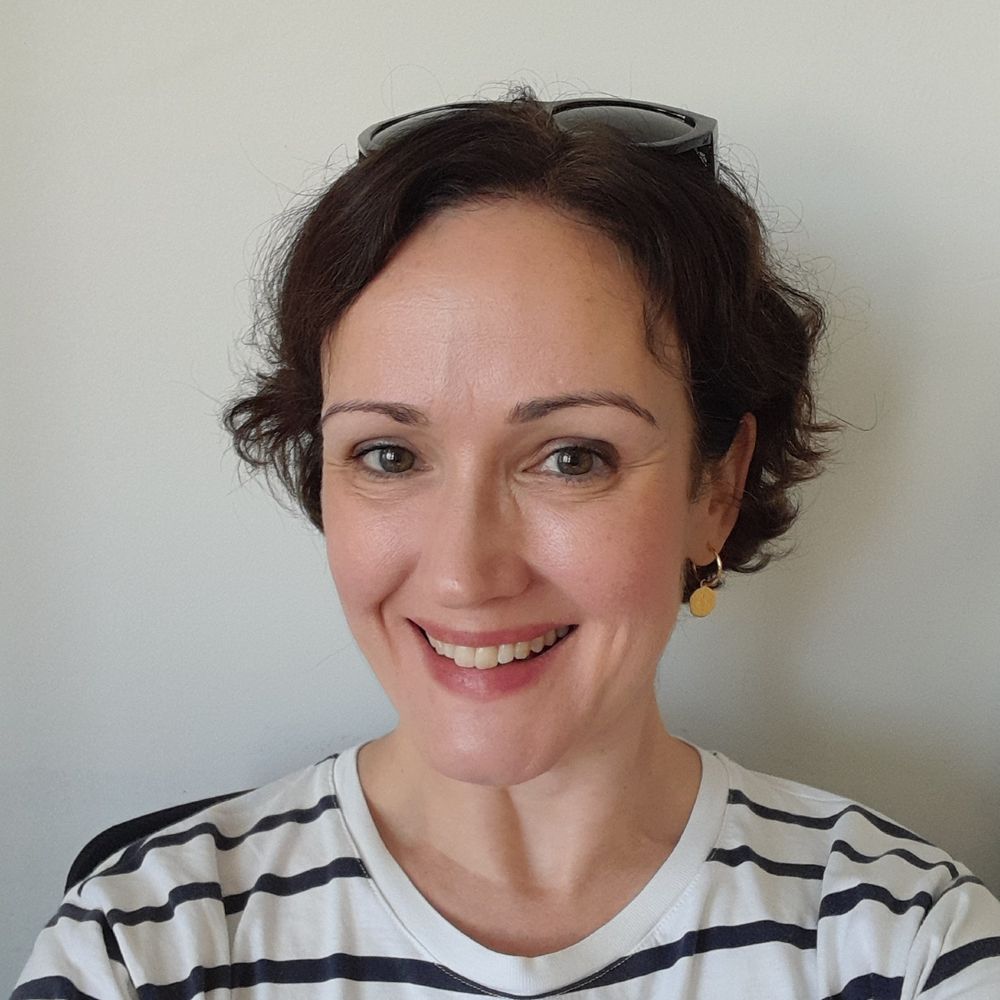
FLA 32: Joanna Wyld (09/11/2025)

Of all the guests I’ve had on First Last Anything so far, Kent-born Joanna Wyld might have worn the most musical hats. Writer, musician, composer, librettist, teacher and administrator, she’s played in orchestras, concert bands and pop groups, she has a passion for everything from bellringing to soul music, and has been a prolific writer of articles, liner notes and concert programme notes for many years. Her writing is always so perceptive, thoughtful, colourful, nuanced and (underrated quality, this) informative.

In conversation, Joanna is no different. What follows, the highlights from a couple of hours on Zoom one afternoon in October 2025, could easily have run twice as long. I love it when a conversation with a guest introduces me to many new pieces, and this is certainly one of those occasions. We both hope you enjoy reading it, and sampling Joanna’s wide-ranging listening choices – not only her First, Last and wildcard selections, but all her other suggestions too.

—-

JUSTIN LEWIS:

So to begin with, what music do you first remember hearing in your home? Because I know you have a very eclectic taste – was that always there?

JOANNA WYLD:

Yes, I think ‘eclectic’ is a really good reflection of my home growing up. I didn’t grow up in what you would describe as a musical household. Everyone loved music, but my parents weren’t classically trained – my dad can’t read music but loves it, my mum can read music, and plays the piano and the organ.

We were never told that a particular genre was better than others. We had a good eclectic range of records that we enjoyed playing. I think the first record I learned to put on the record player independently was The Beatles’ ‘I Want to Hold Your Hand’. And there were quite a few Beatles singles, but also my brothers and I would use music to capture our imaginations a bit. Because we’d hear ‘Oxygene’ by Jean-Michel Jarre when we’d go to the London Planetarium, it would be on if you were waiting to go in. So [at home] we’d use those kinds of experiences – we’d use a reel-to-reel tape recorder, and – I mean, we were very little, it was very silly – we’d write a type of sci-fi script with ‘Oxygene’ playing in the background as our soundtrack.
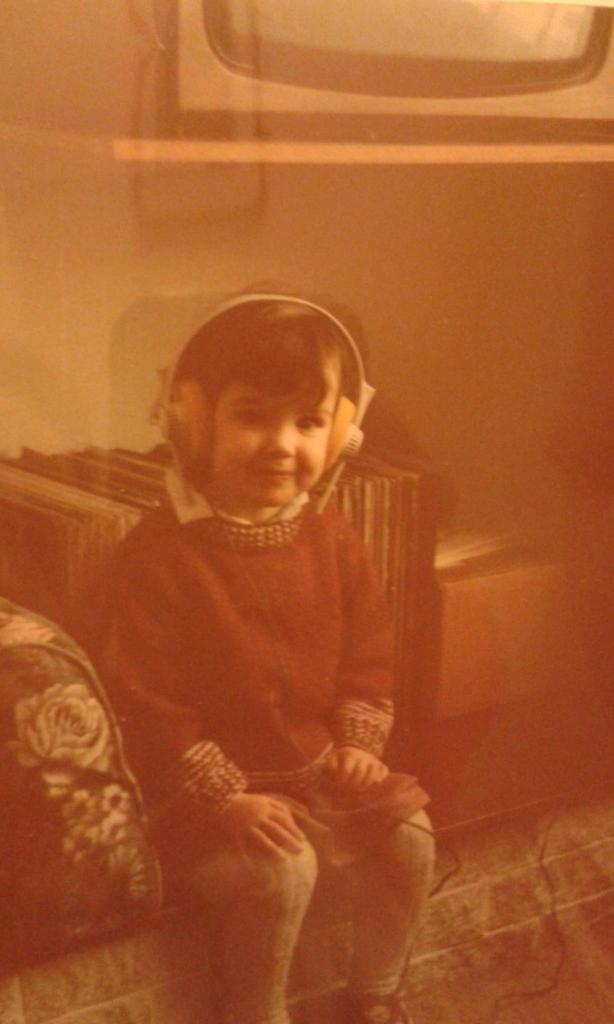
My relationship with sound was affected by certain things growing up. My grandad and my dad were – and my dad still is – bellringers, which I think is a hugely underrated discipline. We rightly praise the Aurora Orchestra playing things by heart – I went to see them do The Rite of Spring by heart [at Saffron Hall in 2023] and it was absolutely mindblowing, they deserve all the credit for that – but bellringers do that every weekend, three hours or more of memorised mathematical permutations while handling these unwieldly bells. If we’re going to be patriotic about something, I feel like that’s something to be proud about, because it’s unusual and it’s such a skill.  

With bellringing, there are these interesting patterns, but also these slight irregularities because it’s not mechanised – there are people doing this, and there are also these spatial qualities of sound that you get when you hear it resonating in a ringing chamber. With the tunings, you get these harmonics, these overtones, and sometimes they seem to vibrate or clash.

JUSTIN LEWIS:

There’s that way that bells can sound slightly off-key, which you sometimes get with distance and echo. Do you have perfect pitch, then?

JOANNA WYLD:

No, and actually, I suspect my relationship with tuning is a little bit strange because I grew up with this sense of music being a little more fluid, not necessarily fitting within these strict parameters we’re used to thinking about in terms of pitch. And I suspect that then influenced my love for composition and contemporary and 20th century music later, made me open to it, because I’d grown up with this variety of sounds, without that sense of hierarchy about it.

JUSTIN LEWIS:

And did you do some bellringing yourself?

JOANNA WYLD:

I did learn for a short while, but then I had an experience where a rope hit me – it is quite dangerous. My dad was there, and he grabbed it and it was fine… but I was a bit put off by that. Also, I don’t think I’ve got the mathematical brain to do all the actual methods, but I love the sound of it. It could almost be rebranded as mindfulness. If you listen, it’s got enough patterns to keep your brain interested – but it’s also quite mesmerising. I think, I hope, there is a new generation of people coming through who can do it. It’s in the category of things like dry-stone walling… almost like folk traditions. These things deserve to be continued in the least jingoistic way, just because they are interesting and skilful.

I have a CD called Church Bells of England, which is an incredibly sexy thing to own, and it has all these examples of ringing in various places. None of them are perfect in terms of the ringing or the sound quality, but they give a sense of what’s hypnotic about it. The example from St Giles, Cripplegate launches straight into these complex patterns, it’s so absorbing. And then you have composers who’ve drawn on this, from William Byrd’s emulation of change-ringing in keyboard music, to Jonathan Harvey’s wonderful Mortuous Plango, Vivos Voco, which samples the tenor bell at Winchester Cathedral. I heard it played during a London Sinfonietta concert and you felt like you were surrounded by the recording of the bell, it was a visceral experience.

——

JOANNA WYLD:

Classical music came in when we were in the car, we’d put cassettes on, and I did discover then that I really loved this music. This would have been from the age of about eight onwards… that’s when I started to play the flute.

JUSTIN LEWIS:

The exact age I started too, actually. Why did you pick the flute, then?

JOANNA WYLD:

Well, it was slightly by default, because in my primary school, which was very tiny, you could learn the piano, the violin or the flute. There were three teachers who came in, and I had more of a yearning to learn the clarinet, but it wasn’t really possible. It just wasn’t very practical – this is before we got our piano. My older brother had been learning to play the violin, so I kind of ended up on the flute because that was what was available. I mean, it took ages to get a note out of it, but it wasn’t a burning ambition to learn that particular instrument.

JUSTIN LEWIS:

Yeah, I think I wanted to play the violin, but I have a feeling my parents couldn’t have coped with the idea there’d be at least three years of scraping. I seem to remember we were watching something on TV, there was someone playing the violin absolutely brilliantly, and I recall saying something like, ‘Oh I’d love to be able to do that’, and it all went very quiet in the room. So maybe that was a clue. I think with the flute, I think I liked it as a colour in an ensemble, rather than as a solo instrument. I did enjoy playing but I found solo playing quite stressful – and also I felt a bit alienated in my teens because I did want to be in bands, but I had no idea how you went about that. I learned the saxophone for a while, and that got me into bands a bit. But I told this story on a podcast recently – when I got into university, I did a music degree for a year, but obviously in the college orchestra you could only really have three flautists in there. You couldn’t really have fifteen.

JOANNA WYLD:

Yes, if you’ve got too many flutes, what do you do? I was really lucky because I grew up near the Bromley Youth Music Trust, a music hub that offers affordable music ensembles, so I grew up in a concert band system, and that’s how they deal with instruments where there are too many for a standard orchestra. That was quite a discipline in terms of ensemble playing. And so I ended up in this concert band where we’d tour and do competitions and it was quite high level, but it was a brilliant exercise in eclectic music, because in concerts you’d have stuff written for it specifically, often quite contemporary and imaginative. And then you’ve got arrangements of pop, film and classical – so a lovely kind of cross section. Music for concert band and brass band is another genre that’s oddly underrated I think. I love the ‘Overture’ from Björk’s Selma Songs (don’t watch Dancer in the Dark, it’s traumatising, but listen to the soundtrack), it’s a lovely example of rich brass writing. And the song that pairs with it, ‘New World’, is gorgeous, very powerful.

And then in the sixth form, I got into the BYMT symphony orchestra having sort of worked my way through. That was a huge experience, and I was just so lucky, because we were playing quite high-level repertoire: Britten’s ‘Four Sea Interludes’, and Bernstein’s ‘On the Waterfront’, and Dvořák symphonies, Sibelius symphonies… We played Mahler, you know! I became immersed in all this. And our teachers were phenomenal because they expected these really high standards of us, and we were living up to them. This was a lot of state-school educated people, and we were so lucky to have this affordable opportunity to make music like that. Then at university, I was exposed to more 20th century and contemporary and started to play things like the Berio ‘Sequenza’ and Messiaen’s ‘Le merle noir’, stuff which uses more kind of percussive and unusual sounds on the flute.

JUSTIN LEWIS:

Tell me about Richard Strauss, who you mentioned to me was a particularly important composer you heard at a formative age.

JOANNA WYLD:

It’s his ‘Four Last Songs’ [composed in 1948] in particular. I think, for GCSE or A level music, I had heard his ‘Morgen!’ [‘Tomorrow!’]. Back in the day, CDs were quite expensive and I wasn’t buying them lots. My birthday or Christmas was coming up and so I asked my parents for Strauss’s ‘Morgen!’. They couldn’t find that on record in our local record shop so they gave me this instead – a happy accident.

I love all of the music on that record for different reasons – you’ve also got ‘Death and Transfiguration’, [a tone poem written in 1888–89] when Strauss was quite a young man, and which in many ways is not really about death but is more life-affirming, though it’s dramatic. Whereas with the ‘Four Last Songs’ everything’s stripped back, because he did tend towards bombast and vulgarity at times, and these were written when he was really facing death. They’re just four of the most beautiful things ever written. The third one in particular [‘When Falling Asleep’] just has this incredible climactic moment and wonderful violin solo. And in the final song [‘At Sunset’], you get this pair of piccolos which are the birds representing the two souls of him and his wife, off into the ether – it’s just so beautiful.

JUSTIN LEWIS:

And ‘At Sunset’ quotes a little motif from ‘Death and Transfiguration’, doesn’t it, at one point?

JOANNA WYLD:

Yes, and there’s a horn solo at the end of [the second song] ‘September’ – his father was a very celebrated horn player. And through him, he’d been to hear lots of premieres of Wagner operas because his father was playing in them, and his father tried to discourage his interest in Wagner! [laughs] Anyway, so you feel as though that horn solo might have been just a nice little valedictory kind of farewell to that memory of his father as well.

JUSTIN LEWIS:

I know you particularly love this specific recording of the ‘Four Last Songs’, with Gundula Janowitz singing and Herbert von Karajan conducting [first released in 1974], but I take it you know who else was a fan of it as well?

JOANNA WYLD:

David Bowie [which inspired him to write four songs for his Heathen album]. Yes, I love this fact. I’m kind of thrilled that it’s that specific recording, with Janowitz – because people are divided as to which is the best. Strauss is one of those people, like Mahler, where I have different recordings of their works because I do think people can bring something different in. But yeah, I just love the fact that Bowie loved the same recording as I do!

JUSTIN LEWIS:

Bowie’s influences just seem to come from so many places. We’re back to eclectic again, as with you.

JOANNA WYLD:

I think I’m discerning about quality, but there isn’t a hierarchy of genres. Obviously, classical is my speciality, and I’m passionate about it, but it’s all there to be enjoyed, we’re complex human beings, and Bowie obviously recognised that. I understand why people specialise, but I love to embrace variety.

——

FIRST: QUEEN: ‘Bohemian Rhapsody’/ These Are the Days of Our Lives’ (EMI Records, cassette single, 1991)

JUSTIN LEWIS:

‘Bohemian Rhapsody’ was first released in 1975 when I was five, and I vividly remember the video on Top of the Pops. It’s hard to remember what the world was like before this record, because it is one of the first that’s seared into my mind.

JOANNA WYLD:

And this reissue was the first record that I can remember wanting to buy. I was eleven. I heard it on the radio. It was just unlike anything else I’d ever heard. But it’s got that context of originally coming out in the mid-seventies when there was the mainstream three-minute pop song and at the same time there was prog: people yodelling or a synth solo, sometimes quite self-indulgent. But here you’ve got something that’s both: it’s mainstream adjacent and also proggy – it’s an extended idea and a concept. I just thought it was really fun, kind of dramatic and extraordinary. And that appealed.

It wasn’t that long afterwards that Wayne’s World (1992) cemented it as well. But for me it also represents a couple of things I generally find interesting about music. One: it’s the victim of its own success – as you said, you can’t imagine it not being there. Even those who don’t like it, couldn’t imagine it not being there. That’s an extraordinary achievement. And that can lead to it becoming ubiquitous and taken for granted, almost an irritant.

A parallel for me would be Holst’s Planets suite. I fell into the same trap with that – I’d just heard it so many times. And then at university, I finally got to play in it. And I realised: this is so well written, so well orchestrated, and this would have been incredibly original at the time. And it has been emulated a lot since, but I hadn’t given it enough credit for what it was, when it was written.

The other aspect of ‘Bohemian Rhapsody’ I find interesting: it’s so of the person who wrote it. Some composers have that instantly recognisable fingerprint. Holst is one, Messiaen, Stravinsky, Copland, more recently Louis Cole and Genevieve Artadi, both separately and together as Knower, – and I think Freddie Mercury is another, in this song. It’s him, just going, ‘I’m not going to worry about what anyone else thinks, I’m not going to draw on lots of other influences, this is what I want to write.’ I admire anyone who can do that.

JUSTIN LEWIS:

There are aspects of it that remain mysterious, like nobody has ever quite nailed what it is really about. Brilliantly, someone has put up clips of Kenny Everett actually playing ‘Bohemian Rhapsody’ for the first time, on his weekend lunchtime show on Capital Radio in 1975 – have you heard this?

JOANNA WYLD:

No, but he championed it, didn’t he? I haven’t done a deep dive, I have to admit.

JUSTIN LEWIS:

I only found it the other day. Seems he had been playing extracts from it, and then he plays the whole thing.

Kenny Everett, Capital Radio, c. October 1975

We had this song in our house because it’s on their album A Night at the Opera, which has this ambitious mix of quite whimsical, almost music-hall songs, and then out-and-out rock tracks. I still think it’s probably their best record. I like to hear it as part of the album. As you just said with The Planets, it’s good to go back and play it in context.

But even with Kenny Everett’s support, it’s still really weird they put this out as the single, in a way. And obviously, you bought this re-release after Freddie Mercury had just died [24 November 1991]. How aware were you of that event?

JOANNA WYLD:

I think this was the first experience I had of a celebrity death having an impact, and of feeling incredibly sad. The AA side, ‘These Are the Days of Our Lives’, is just incredibly poignant. I can’t watch the video where he sort of says ‘I love you’ at the end. It’s just so, so heartbreaking. I think for a lot of people, it really brought home the reality of the HIV and AIDS pandemic. That this wonderful larger-than-life figure, famous and well-off and all the rest of it, had been hit by it. I don’t remember the extent to which I understood everything at that point in my life, but it definitely stayed with me. It felt like such a horrible shock and a horrible loss. 

JUSTIN LEWIS:

Until I was doing the research for this, I’d forgotten it was a charity single, for the Terrence Higgins Trust. Since when it’s been in so many other things – Wayne’s World as you mentioned, but just this summer, in September, at the Last Night of the Proms.

JOANNA WYLD:

The Prom was a lot of fun. I know it divided opinion a little bit, but it’s nice to celebrate people while they’re alive. I think Brian May and Roger Taylor deserve that moment. While I’m not the biggest Queen fan, and I don’t listen to the music loads, they do all seem fundamentally decent, and those remaining members have really championed Freddie’s memory and always mention him. There’s something quite loving there.

——

JUSTIN LEWIS:

I wanted to talk to you about writing liner notes for CD releases and programme notes for concerts, because that’s something you’ve been doing for many years. How did you first get into this sort of work?

JOANNA WYLD:

The first clue lies back in my childhood. We’d play classical music in the car, and one cassette we had was Saint-Saëns’ Carnival of the Animals suite [composed 1886, but only published posthumously in 1922], featuring lots of quite kid-friendly stuff. And when I went to secondary school, my first music assignment was to write the description of a piece of music. I remember spending ages on this, being so enthused by it. I went home, read the sleevenotes of Carnival of the Animals, got my little dictionary of music, did a bit of research and wrote it up. It was like a prototype for what I’d do later. It was just a Year 7 essay, I was about eleven, it wasn’t hugely in-depth, but it’s interesting that’s stuck with me as a memory – an early enjoyment of writing about music showed up.

But how I got into it professionally… I was working at a record company, originally called ASV, which also had some peripheral labels: Gaudeamus was an early music label, Black Box was a contemporary music label, everything on White Line was sort of middle of the road, like light music, and then Living Era was the nostalgia label. This was my first job after university, and I was the editorial assistant.

For Living Era, we used to get these liner notes written on a typewriter by these lovely old gents who were jazz experts, some of them virtually contemporary with the songs they were writing about! They were delightful to work with, but one day we were missing a liner note, and my boss said, ‘This person just forgot to file this copy and we really need it now. Can you cobble something together?’ And this was in the days before there was a huge amount on the Internet about these things. I think I used early Wikipedia. But because I’d edited and proofread so many of these notes already, I knew the style. So I was able to emulate that slightly chatty nostalgic style, as well as getting the information in. I knocked this out quite quickly and my boss was quite impressed, which was nice, and then asked me to do more and more bits of writing.

And then ASV got bought out by Sanctuary Records, which had all these associated metal artists – so you’d go into the canteen and Bruce Dickinson of Iron Maiden would be there, and they’d have Kerrang! TV on. We had a meeting interrupted because Robert Plant was in reception. It was very glamorous, quite fun – I loved it, and I got to meet some really interesting people.

But all this meant that later, still in the heyday of CD production, particularly in classical music, I was hired to do a lot of freelance writing. There was a lot of repackaging – essentially getting older recordings and repackaging them as ‘The Best of Poulenc’ or whoever it was – and new labels were being set up. So I was asked to churn out quite a lot of essays for them, and quite quickly built up a body of work. The hardest commission was when my daughter was only a couple of months old, when I was asked to do 17 liner notes in two and a half weeks, so I was a machine for that period. It was something like one essay a day. And obviously I was looking after a small child!

Then I started to get emails from various people – the BBC, Royal Liverpool Philharmonic, and others: ‘We’ve noticed your writing, we like it, would you like to send me some examples.’ And it’s slowly built from there.

I would say I’m a generalist. I’m not someone who’s done a PhD in a specific area, I always treat myself as someone who’s not really an expert, but I will do the research when I’m writing a programme note, as thoroughly as possible, as is relevant for that programme note, but I’m always kind of standing on the shoulders of people who’ve done that in-depth research. But equally, I’m trying to bring my perspective, and the way I hear it and write about it, hopefully I can bring some joy to people’s listening experience. 

JUSTIN LEWIS:

And you got to write about new commissions as well, is that right?

JOANNA WYLD:

One that was really nice – it was a premiere performance – was Mark-Anthony Turnage’s ‘Owl Songs’ as a tribute to Oliver Knussen (1952–2018). It was a real privilege to write about that because I’d met Oliver Knussen a couple of times, an absolute gem of a man and composer. His music is just these crystalline jewels of orchestral beauty, and I’d recommend something like ‘Flourish with Fireworks’ (1988) to anyone who thinks contemporary music’s a bit alienating. So he mentored Mark-Anthony Turnage who I’ve also since interviewed, and Olly was known affectionately as Big Owl – particularly Mark referred to him in that affectionate way. So the Owl Songs are these wonderful tributes.

JUSTIN LEWIS:

Are you adhering to house style with these things, or do they tend to leave you alone?

JOANNA WYLD:

There’s very little editorial interference, actually, which is lovely. And I’ve built up trust with a number of commissioners, which is great. What has changed in the style of writing for these sorts of things is it used to be much more academic, much closer to my university essays. The expectation would be that your audience would be aficionados – but it was a lot drier. Actually it’s much more fun now, because the emphasis is on something more inviting and accessible that could be read by anyone, and if you do something more technical, you just explain it in passing. You try and make it as enjoyable as possible to read and that has been fun because I can bring out my own personality a bit more, and feel freer to illuminate what’s exciting about the music.

I feel very strongly that we tend to present classical music as very polite, elegant and smooth, and it can be all of those things, but it can also be… terrifying, for example. Like with Stravinsky’s Rite of Spring, I get palpitations – it’s visceral, it’s filthy. Or Richard Strauss, which can be, to be blunt, very sexual – and I think people almost need permission to hear it in that way because they think classical is ‘all very nice’, and actually… he was a bit of a perv, you know? And if that sort of thing’s there, it’s pointless to not draw people towards that way of listening or bringing out the enjoyment of it.

JUSTIN LEWIS:

Why do you think then that happened to classical music, that the politeness of it became paramount? Is it because of how it was taught, or presented?

JOANNA WYLD:

Every possible experience you have had is all there in classical music somewhere. These are very complex people writing it, and often that’s what I enjoy exploring – their personality, their quirks, their flaws, and the rest of it.

I mean, this is a huge topic – people have done PhDs on this – but in terms of how we receive it… the Victorians have a fair bit to answer for. You know, the idea of the Opera House: people had previously been there as an everyday experience, and then it became this hierarchy of ‘who sits where’, and then obviously with different genres, you have this shift – music that was contemporary becoming historical, and then becoming classical, so it’s no longer immediate. Whereas pop music is obviously reflecting people now. So with anything historical, you can end up with this sheen of respectability and this sense of it being a museum piece, something that you have to treat with reverence.

It’s really complicated but yes, definitely the way it’s taught, even the way it’s marketed… the way even people who love classical music sometimes talk about it… it can be quite reverential, and there are bits of it that are of course sublime. But there’s plenty else in there, and it’s almost just encouraging people to go and hear it.

JUSTIN LEWIS:

So how do you strike a balance between musicology and biography when you’re writing these?

JOANNA WYLD:

There used to be more of an emphasis on musicology – perhaps the structure of a piece of music could go into a bit of detail – whereas now I tend to start with biography and history and set the scene. I try and give a bit of historical context and wherever possible bring out the interesting details about that composer that are relevant to that piece. And if possible, quotes – direct quotes are really interesting. If I can find them, if they’re reliable, just from letters or whatever, because that just tells you so much about them.

We were told at university: You mustn’t let the biography of a composer influence the way the music is interpreted too heavily. I think that’s fair, particularly from an academic perspective – that you are not there to try and tell a story through every single score. And if you’re trying to look at it on its own terms, musically, you do need to separate the two, but for a concert-going or a CD-listening experience, it brings the music to life, stops it being a museum piece. Because you realise these human beings were just as complicated as we are, and often just funny, or grumpy or whatever. Then I might go into some musical detail, and if I’ve got space, try and do a bit of a listening guide, try and draw out some highlights, some things to listen out for.

Occasionally I’ll do a deep dive, find something that isn’t widely known, or almost gives people permission to think of those composers in a slightly different way. For example, JS Bach’s ‘Musical Offering’ (1747). With Bach, he’s so revered we tend to deify him, and talk about him in reverential tones. But the story behind that piece is so fascinating. I did a lot of research from a non-classical perspective, like reading a bit of Gödel, Escher, Bach [by the US scientist Douglas Hofstadter, published 1979], and stuff about mathematical patterns. But with that piece, you also had family dynamics going on – his son [CPE Bach] was working for Frederick [the Great, King Frederick II of Prussia] who commissioned this piece, but they laid down the gauntlet in the most provocative way by saying, ‘Oh, improvise a fugue in six parts’ and no-one had ever really done that. He managed a three-part improvisation and then went away – and it was as though he had a fit of pique, producing this ridiculously vast response to this challenge, creating something out of this deliberately difficult and angular theme. And none of this that I included was new, but it was quite nice to bring out those aspects. Especially with someone like Bach who obviously had great faith and appears to be very holy… that composition came from a bit of anger and irritation.

JUSTIN LEWIS:

Yes, bringing composers to life as human beings without overemphasising to the detriment of the work. I’m sure it’s changed in school-teaching now, back stories are brought up more. I had good music teachers at school, but I don’t ever remember being taught about these composers’ lives, which now feels really weird. Or even the wider history of the time.

JOANNA WYLD:

It’s like Beethoven was a young carer, effectively. His dad descended into alcoholism after his mother’s death, so he was caring for his siblings, which prevented him from staying in Vienna to study with Mozart, which he really wanted to do. Information like that is really humanising, especially as Beethoven was perhaps the first in the 19th century to be regarded as ‘in touch with the divine’, and really cast that long shadow.

I would probably say I’m not a musicologist like, say, Leah Broad [FLA 28], but I’d call myself a music historian. The history of it is fascinating, and it helps people to get closer to the music because they realise these were normal people who might have been incredibly gifted but also worked really hard. Again, Bach was one of those people, who said, Anyone who works as hard as me can do the same thing. Which is not entirely true, but nor was he sitting there on a cloud, you know, being a genius.

JUSTIN LEWIS:

I mentioned this in the Leah Broad chat, about hearing Radio 3 say in passing about how Felix Mendelssohn essentially revived JS Bach’s music around 1830 – it had hardly been played for about eighty years after Bach’s death.

JOANNA WYLD:

It had really gone out of fashion, it’s sort of staggering. Although Mozart and Beethoven had studied Bach, and actually the sort of contrapuntal depth they learnt from him is one thing that elevates their music above the more lightweight stuff of the time. So his influence was still there at key moments, although in terms of performance it wasn’t until Mendelssohn revived it.

——

JUSTIN LEWIS:

Something else I discovered from your website: you’ve been a librettist. Can you tell me about your work with Robert Hugill?

JOANNA WYLD:

That was a wonderful opportunity. A friend put us in touch. It was called ‘The Gardeners’. Robert had read this article about a family of gardeners in the Middle East, tending war graves, and it was intergenerational. So he had this idea, it was his conception, of how the generations relate to each other, and the old man of the three generations could hear the dead. So there was that metaphysical aspect to it, and so we had a chorus of the dead, and the youngest is quite a rebellious character. All of this was fictionalised – this isn’t based on the article – and it was a chamber opera, so it’s not huge scale, but it unfolded as a sort of family drama. Ultimately, the old man dies, whereupon the youngest man inherits his ability to hear the dead. Meantime, you’ve got the women of the family trying to keep the peace. So it’s a family drama with a metaphysical aspect. We performed it a couple of times, which was amazing, firstly at the Conway Hall and then at the Garden Museum with a wonderful cast.

JUSTIN LEWIS:

Is it about trying to find words that sound good as well as have meaning? When you’re writing something like that, does it become clear what doesn’t belong? Do you have a working method for something like that?

JOANNA WYLD:

I definitely think it helps that my Masters was in Composition. And I’ve set a lot of words myself. So I know the kind of thing I would set, and it’s not always the choice you might expect. It has to be something where the words lend themselves to musical treatment. Which often means there’s a rhythmic lilt to them – you’re thinking of the words rhythmically, but also making sure they don’t obstruct the music. So if it’s really overly polysyllabic and flowery, that’s going to get in the way, and it becomes about the words, not the music. But there’s also how the words sit next to each other – I remember reading a wonderful letter from Ted Hughes to Sylvia Plath about the choice of two words in one of her poems. It was two quite punchy words next to each other, and I think he suggested weighting them differently but also talking about them as if they were physical objects. I relate to that. So when I’m writing something like that, and I’m not saying it’s on that level, I try and think in terms of the weight of the words, and how they’ll then sit in someone’s mouth.

JUSTIN LEWIS:

Because just as there’s a musicality in music itself, there’s a musicality in words too, so you’ve got to match the two up. Do you still write music yourself, as well?

JOANNA WYLD:

I’ve written a couple of songs with bands I’ve been in, I enjoyed that. I had a really lovely teacher at university, Robert Saxton, but you really have to pursue it, you have to be so obsessed with it, and I also realised I’m probably better at writing about music than writing music.

JUSTIN LEWIS:

What sort of music were you writing for the bands you’ve been in?

JOANNA WYLD:

One song started out as a sort of Hot Chip parody really, almost like a joke – and then I added some influences from LCD Soundsystem; it’s quite a fun track, which we once played at a wedding, and a conga formed, which was one of the biggest compliments.

JUSTIN LEWIS:

That’s brilliant.

JOANNA WYLD:

And then I’ve written a sort of cathartic song called ‘Prufrock’, where I drew on TS Eliot’s ‘Love Song of J. Alfred Prufrock’.

JUSTIN LEWIS:

So you were singing these?

JOANNA WYLD:

Yeah. Another one was called ‘The Air’ which was my attempt at layering stuff together in a sort of Brian Wilson fashion.

JUSTIN LEWIS:

And what were your bands called? Were you gigging?

JOANNA WYLD:

One was called Fake Teak, and we recorded ‘Prufrock’. It’s my brother’s band, named after the equipment that our dad had when we were growing up. That’s now evolved into something called Music Research Unit, which is a similar line-up, but more fluid and with new songs. We had our first rehearsal just yesterday! Then I’m in another band called Dawn of the Squid, and I don’t write for them, and they’re hard to describe, but they’re kind of… indie-folk, and there’s comedy in there.

JUSTIN LEWIS:

Is this out there to hear?

JOANNA WYLD:

There’s a new Dawn of the Squid album, which I didn’t play on, I can’t take any credit, but that’s out. There’s quite a bit of Fake Teak on Spotify. I play synthesisers and flute in these groups, and to go back to what we were discussing earlier – about sounds not being strictly in tune – what I find lovely about some synthesisers is they feel much closer to acoustic instruments; they can go out of tune, and you can make unpleasant as well as pleasant noises on them. I play this instrument sometimes called an ARP Odyssey [analogue synthesiser introduced in 1972] and it can go out of tune on stage, it’s a real rarity, and it’s been used in loads of pop like Ultravox. But I have had gigs where it’s gone a bit out of tune, and in a weird way I kind of enjoyed that more than digital instruments where it’s got presets and everything’s tidy, because it feels much closer to my experience of other instruments.

—–

LAST: THE UNTHANKS: Diversions, Vol. 4: The Songs and Poems of Molly Drake (2017, RabbleRouser Music)

Extract: ‘What Can a Song Do to You?’

JOANNA WYLD:

I’m not a folk expert, I’m getting into it more, but like a lot of people, I came to this because I heard Unthanks do the ‘Magpie’ song on Detectorists. Then I went to a concert, locally, on the strength of that, and that’s where they performed some of these Molly Drake songs. I loved the whole concert – one of my prevailing memories of it is my crying my contact lens out during one of the Molly Drake songs, and just having to sit there with it in my palm, kind of half-blind.

JUSTIN LEWIS:

These songs are amazing to hear because we know so much, or at least we think we do, about Nick Drake’s life, but obviously the Molly Drake archive hasn’t been pored over by scholars too much. I think most of these songs are from the Fifties, and the Unthanks have covered them, apparently, because they wanted to make better quality recordings. And the Molly Drake versions are out there too. But there’s something about these songs that are both public creativity – as in the Drake family being aware of these songs – and private creativity too as it wasn’t out in the public domain for years. And you keep having to remind yourself that these songs were written before Nick Drake got into music himself, not afterwards. 

JOANNA WYLD:

Yes, so many women composers are talked of in relation to their male relative, but you’re right that she was doing this first. It clearly influenced Nick Drake, and the almost painful shyness is a clear link, so it illuminates his music, which I also love, but I think on its own terms Molly’s music is phenomenal and yet, incredible that she was so shy that I think her husband bought her a reel-to-reel and set her up in a room on her own with it. He recognised her talent so there was this idea of ‘Let’s get this down for posterity’, but there was no concept in her mind that anyone would ever hear it, which seems really alien to us now, but there’s a real beauty to that.

JUSTIN LEWIS:

I think there can be a pressure when you’re writing something that you know is going to be for public consumption in some way. But I found a great Rachel Unthank quote:

‘Her work shares her son’s dark introspection, but in Molly we get a clearer sense of how those who understand depths of despair can do so only by understanding happiness and joy too. Through Molly’s work, we see the soulful, enigmatic lonesomeness as a person who is also a member of a loving and fun-loving family.’

I think that’s really important because Nick Drake – and his work – tends to be defined by what happened to him, and not all of him and his work is like that. I mean, the Molly song that feels like it could have been written in response to his early death – ‘Do You Ever Remember?’ – was written much earlier.

JOANNA WYLD:

You mentioned family, but obviously on the Unthanks recording, you’ve also got Gabrielle Drake reciting the poetry. I went to the Nick Drake Prom, with the Unthanks performing with Gabrielle Drake, which was phenomenally moving – and brave of her as well, I thought. And it’s a rich combination to listen to – you’ve got the sugared almond sound of the Unthanks’ voices, and the woodier timbre of her delivery. The whole thing really cuts to your heart, similar to Nick Drake, but it’s even less crowded in metaphor, it cuts to the heart with a deceptive simplicity. The first track, ‘What Can a Song Do to You?’, has one of those melodies that feels like it’s always existed, and then this tremendous bit of poetry. I really admire people who can pick and use very few words to convey something. I was lucky enough to interview Michael Morpurgo many years ago, and he blew my mind in terms of how to write. He used to say, ‘We don’t need to teach kids lots of florid words, but to be direct.’ That lyrical and nuanced but straightforward vocabulary can be more powerful and it’s something I aspire to, [but] I don’t always find it easy.

JUSTIN LEWIS:

I feel the same way. As an editor and sometime writer, I find that writing a simple sentence is actually quite hard.

JOANNA WYLD:

The poem I was going to mention at the end of ‘What Can a Song Do to You?’: ‘Does it remind you of a time when you were sad? (So in other words, why? Why is this person crying?) Does it remind you of the time when you were sad? Ah, no. But it reminds me of a time when I could be. It reminds me of a time when I could be…

And I sort of think that’s… mindblowing.

JUSTIN LEWIS:

That particular song has been going around my head for the last few days. Going back to what you were saying with Detectorists making you aware of Unthanks, film and TV does seem to be a major way for people to connect with people now. I sometimes look at the streaming stats for tracks at random, wonder how that’s become the biggest thing, and it’s nearly always some film or TV programme I wasn’t aware of.

JOANNA WYLD:

I guess it’s a route in. I recognise this with classical music as well – I’m lucky enough to have grown up with enough that I’ve absorbed bits and learned about it, done my degrees in it. If I hadn’t done that, that might be my way in as well. And as I don’t have that background with folk song – I like the genre in a broad sense, but I wouldn’t know where to start looking. There’s too much out there, and there are playlists but they can be a bit too rambling.

——

ANYTHING: THE CARDINALL’S MUSICK / ANDREW CARWOOD / DAVID SKINNER: Cornysh, Turges, Prentes: Latin Church Music (1997, Gaudeamus/ASV Records)

Extract: William Cornysh: ‘Salve Regina’

JOANNA WYLD:

This ties a few things together. This is the William Cornysh recording of ‘Salve Regina’, which is my favourite work on that album, but it’s on the Gaudeamus label which I mentioned earlier. I worked with some of the people on that label, but I also know about this repertoire because I was lucky enough at university to study early music with David Skinner, who’s one of the two founders of The Cardinall’s Musick [the other being Andrew Carwood]. They’ve since gone in different directions and David now conducts [a consort] called Alamire. So this is going back a bit, but it was through that university experience that I got to hear this. It’s funny – we were talking about church music earlier but this is English Catholic music of the Tudor era and it’s sad to me that the Catholic Church in this country doesn’t have that kind of choral tradition because we’ve got these riches but for some reason it’s not performed in that church context very often, but nor is it often sung in the concert hall either. Slightly later you get Thomas Tallis and William Byrd, in the Elizbaethan era, that gets mentioned a bit more. But for some reason the Eton Choir Book doesn’t get as much attention and I think it deserves it, so I thought it might be quite fun to bring that in. Because particularly with the Cornysh ‘Salve Regina’, it’s incredible.

JUSTIN LEWIS:

In fact, I’ve got a quote from David Skinner here, from the 1990s: Henry VIII had destroyed most of the musical manuscripts and he says ‘there are literally only two of the choir books I worked from when originally there would have been hundreds.’

JOANNA WYLD:

Yes, Lambeth is the other one, I think?

JUSTIN LEWIS:

He mentions the Eton Choir Book, and the other was Caius?

JOANNA WYLD:

I will have to check my facts because the history of this area is so complex!

JUSTIN LEWIS:

I’m glad you said that! I merely skimmed this, and it felt quite complicated!

JOANNA WYLD:

Really complicated, and I’m sure some of the complexities of how it was written have gone out of the window for me… I learned them a long time ago. I do, very geekily, have a facsimile copy of the Eton Choir Book. I occasionally try and follow along, and it’s quite tricky to follow because instead of it being arranged in score, you’ve got the four parts written separately.

But when I heard the ‘Salve Regina’ at university, it stuck out for me. It’s incredibly beautiful, it takes a bit of time to get into the language and it’s interesting to me that a lot of people who love early music and love contemporary music overlap because early music predates a lot of ‘the rules’ that dominate so much of Western music. With this piece, it’s like you’re walking through a cathedral, meandering, just wandering, but then you get these cadences or these chords, very vivid moments, that feel like light coming through stained glass. And it’s quite a long piece, but right at the end, it just builds and builds up to that high note, which then drops down, and then you have these glorious last two chords. At that point, it’s almost like you’re at the rose window… Even if you’re not religious, music does reflect every facet of who we are, and spirituality is one facet of who we are as human beings. So it’s powerful even if we don’t specifically believe in something. It’s a sense of time travel. It takes you out of yourself and takes you back, but it also kind of elevates as well.

———–

JOANNA WYLD:

At school, I don’t recall learning much pop at all. It wasn’t that I wasn’t exposed to it, but in terms of my actual education, the emphasis was on the history of Western music, classical and symphonic music and so on. My daughter did have to analyse pop – I remember Fleetwood Mac’s ‘The Chain’ being one example. I’ve been a primary school teacher, and I do remember teaching some Stevie Wonder because any excuse, I absolutely love Stevie Wonder, but it was Black History Month and so I brought in his songs about social history, and they all knew ‘Happy Birthday’ but we could talk about how that brought in Martin Luther King Day, which was a lovely way of giving the pupils a sense of the impact music can have.

JUSTIN LEWIS:

Interesting that they knew the song, it’s not one of his you hear that often now.

JOANNA WYLD:

They all knew the chorus, when I sang that bit, they knew that, but they didn’t know the verses or the lyrics so they just thought of it as generic. It’s not my favourite Stevie song – I’ve got so many – but it’s an example of how powerful music can be.

———

You can find out more about Joanna, and her work, at her website, Notes Upon Notes: https://www.notes-upon-notes.com

You can follow her on Bluesky at @joannawyld.bsky.social.

Also, find out more about Dawn of the Squid at their website: https://dawnofthesquid.co.uk

—–

FLA PLAYLIST 32

Joanna Wyld
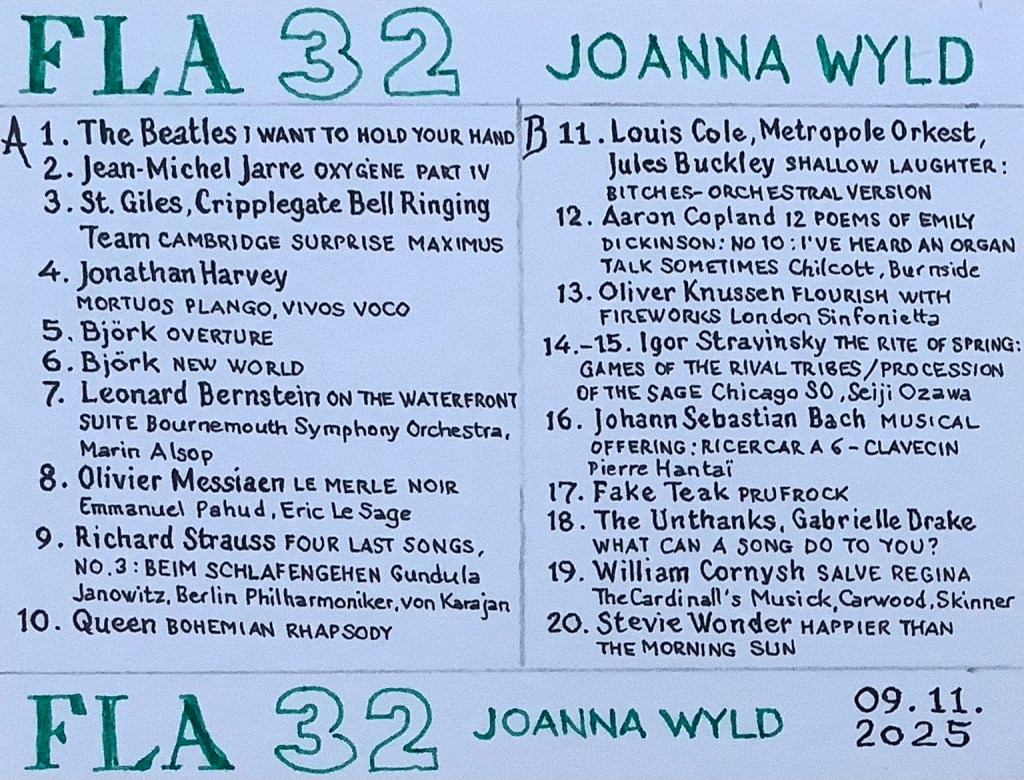
For the time being, this site and project uses Spotify for the conversation playlists, but obviously I disapprove that Spotify doesn’t pay artists and composers properly, and other streaming platforms are available, as are sites to buy downloads and buy recordings. For consistency, you can also listen to the selections via YouTube (where available), and links are provided in each case, below.)

Thanks to Tune My Music, you can also transfer this playlist to the platform or site of your choice by using this link: https://www.tunemymusic.com/share/QWjXV28T8E

Track 1:

THE BEATLES: ‘I Want to Hold Your Hand’:

https://www.youtube.com/watch?v=XT4pwRi2JmY&list=RDXT4pwRi2JmY&start_radio=1

Track 2:

JEAN-MICHEL JARRE: ‘Oxygène, Part IV’:

https://www.youtube.com/watch?v=_PycXs9LpEM&list=RD_PycXs9LpEM&start_radio=1

Track 3:

ST GILES, CRIPPLEGATE BELL RINGING TEAM: ‘Cambridge Surprise Maximus’: https://www.youtube.com/watch?v=o8rwhJHt9Ds&list=RDo8rwhJHt9Ds&start_radio=1

Track 4:

JONATHAN HARVEY: ‘Mortuos Plango, Vivos Voco’:

https://www.youtube.com/watch?v=0T-H-fVlHE0&list=RD0T-H-fVlHE0&start_radio=1

Track 5:

BJÖRK: ‘Overture’:

https://www.youtube.com/watch?v=6k4xT0qjUW4&list=RD6k4xT0qjUW4&start_radio=1

Track 6:

BJÖRK: ‘New World’:

https://www.youtube.com/watch?v=eNma-h_urvs&list=RDeNma-h_urvs&start_radio=1

Track 7:

LEONARD BERNSTEIN: ‘On the Waterfront Suite’

Bournemouth Symphony Orchestra, Marin Alsop:

https://www.youtube.com/watch?v=t4isx_tGYwM&list=RDt4isx_tGYwM&start_radio=1

Track 8:

OLIVIER MESSIAEN: ‘Le merle noir’:

Emmanuel Pahud, Eric Le Sage:

https://www.youtube.com/watch?v=hT8MQpg7oTo&list=RDhT8MQpg7oTo&start_radio=1

Track 9:

RICHARD STRAUSS: ‘4 Letzte Lieder [Four Last Songs], TrV 296: No. 3: Beim Schlafengehen’:

Gundula Janowitz, Berliner Philharmoniker, Herbert von Karajan:

https://www.youtube.com/watch?v=t5n0DqFlpMY&list=RDt5n0DqFlpMY&start_radio=1

Track 10:

QUEEN: ‘Bohemian Rhapsody’:

https://www.youtube.com/watch?v=xG16sdjLtc0&list=RDxG16sdjLtc0&start_radio=1

Track 11:

LOUIS COLE, METROPOLE ORKEST, JULES BUCKLEY: ‘Shallow Laughter: Bitches – orchestral version’: https://www.youtube.com/watch?v=bEmMAG4C1BE&list=RDbEmMAG4C1BE&start_radio=1

Track 12:

AARON COPLAND: ’12 Poems of Emily Dickinson: No. 10: I’ve Heard An Organ Talk Sometimes’:

Susan Chilcott, Iain Burnside:

https://www.youtube.com/watch?v=SvKLlCf2TWE&list=RDSvKLlCf2TWE&start_radio=1

Track 13:

OLIVER KNUSSEN: ‘Flourish with Fireworks, op. 22: Tempo giusto e vigoroso – Molto vivace’:

London Sinfonietta:

https://www.youtube.com/watch?v=wLkTfXPC-TU&list=RDwLkTfXPC-TU&start_radio=1

Track 14:

IGOR STRAVINSKY: ‘The Rite of Spring, Part 1: V. Games of the Rival Tribes’:

Seiji Ozawa, Chicago Symphony Orchestra:

https://www.youtube.com/watch?v=XiAr76Qs8WY&list=RDXiAr76Qs8WY&start_radio=1

Track 15:

IGOR STRAVINSKY: ‘The Rite of Spring, Part 1: VI. Procession of the Sage’:

Seiji Ozawa, Chicago Symphony Orchestra:

https://www.youtube.com/watch?v=nvBog5Tej2I&list=PL-XNw6p4EDBv7-H-z2Vo_c3sB3rvIxt7-&index=6

Track 16:

JOHANN SEBASTIAN BACH: ‘Musical Offering, BWV 1079: Ricercar a 6 – Clavecin’:

Pierre Hantaï:

https://www.youtube.com/watch?v=5K07rF5xOvQ 

Track 17:

FAKE TEAK: ‘Prufrock’:

https://www.youtube.com/watch?v=L5-1prkhHjU&list=RDL5-1prkhHjU&start_radio=1

Track 18:

THE UNTHANKS: ‘What Can A Song Do to You?’

[Poem read by Gabrielle Drake]:

https://www.youtube.com/watch?v=Jzqb_78LUkI&list=RDJzqb_78LUkI&start_radio=1

Track 19:

WILLIAM CORNYSH: ‘Salve Regina’:

The Cardinall’s Musick, Andrew Carwood, David Skinner:

https://www.youtube.com/watch?v=pQprxgtbk4E&list=RDpQprxgtbk4E&start_radio=1

Track 20:

STEVIE WONDER: ‘Happier Than the Morning Sun’:

https://www.youtube.com/watch?v=S4PcSOLtf-U&list=RDS4PcSOLtf-U&start_radio=1
FLA 28: Dr Leah Broad (24/08/2025)

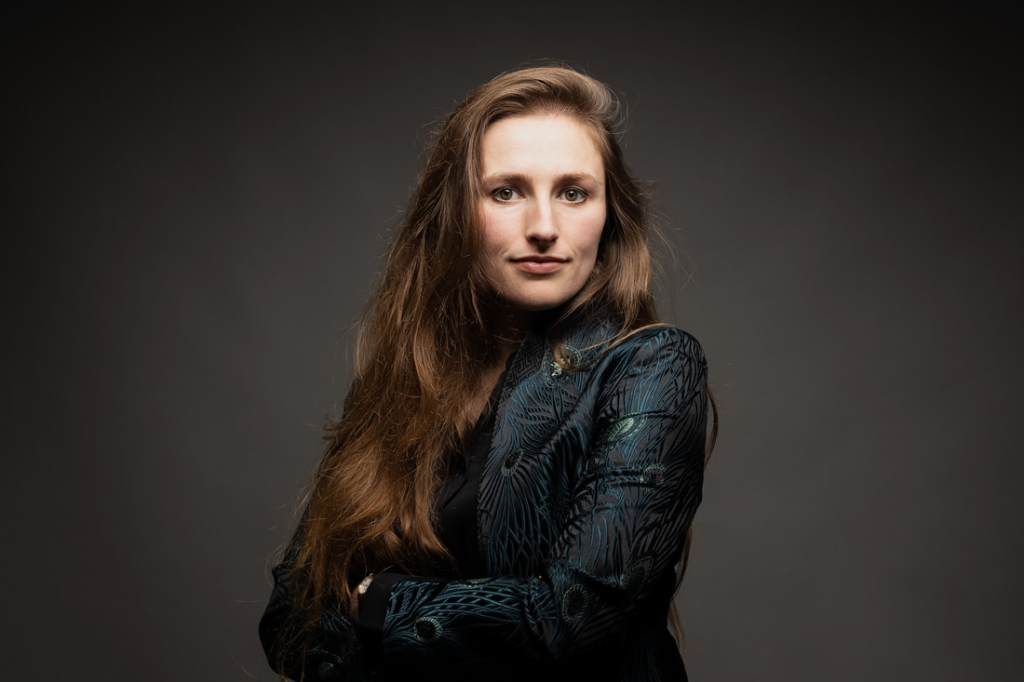
Picture (c) Monika Tomiczek

Since the day I started reading the author, broadcaster and musician Dr Leah Broad’s magnificent Quartet: How Four Women Challenged the Musical World in the early spring of 2023, I knew I wanted to talk to her for First Last Anything.

Quartet is an accessible, thoughtful biography of four of England’s foremost women composers. It has won several book awards (including a Presto Music Books of the Year Award in 2023, and the Royal Philharmonic Society Book Award in 2024), and has led to a series of concert events of talk and music called Lost Voices, in which the composers’ works were brought to life by Leah, the violinist Fenella Humphreys (who was the guest for FLA episode 5 in July 2022) and the pianist Nicky Eimer. 

With their overlapping lifespans covering a total of nearly 150 years, the four composers that Leah focused on for Quartet are Ethel Smyth (1858–1944), Rebecca Clarke (1886–1979), Dorothy Howell (1898–1982) and Doreen Carwithen (1922–2003). In our conversation, on Zoom one afternoon in August 2025, Leah explains why she chose these four women for the book, but we also talk about much besides – including the representation of women composers in educational syllabuses, at the 2025 BBC Proms, and for her forthcoming book project: women in music during World War II. Plus find out Leah’s first, last and wildcard music purchases. Leah was so generous with her knowledge, experience, expertise and time, and I found it all absolutely fascinating. I’m sure you will too.

——

JUSTIN LEWIS:

The first question is one I ask everybody. What music do you first remember being played in your home when you were growing up?

LEAH BROAD:

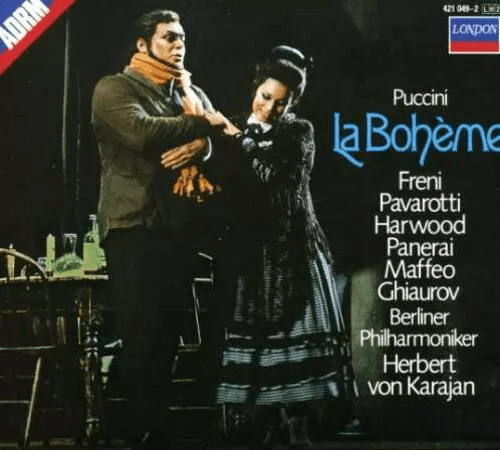
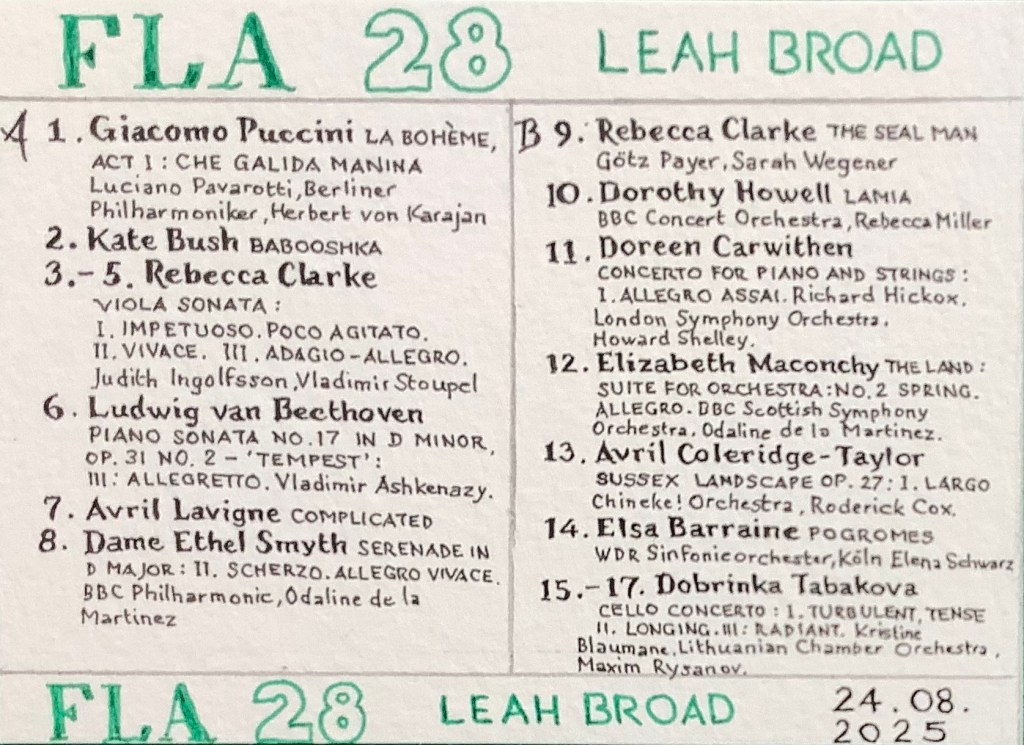
Oh, it was a highlights record. It was Highlights from [Puccini’s] La Boheme, on vinyl, with Pavarotti singing. I used to play this whenever there was a storm because I was really afraid of the storms, and so this was just really calming. My parents listened to mostly Kate Bush, Genesis, The The, and then they had some popular classics albums especially because my grandfather really loved classical music and so we got some of his vinyl as well.

So that’s what I remember, along with Kate Bush’s Lionheart, which my mum had. I guess when I grew up, there was nothing unusual about classical music. My family weren’t musicians. My dad had played drums before I was born, but nobody played an instrument while I was growing up. There was nothing classical musical background-wise there whatsoever, but it was just part of the music that I chose to listen to when I was little.

JUSTIN LEWIS:

It’s interesting that you have the pop and the classical in your life at the same time.

LEAH BROAD:

Yeah, my dad had once wanted to be a drummer, and so he had played professionally for a little while. So he was heavily into drumming before I was born. By the time I came along he was an estate agent for a while, and then he set up his own business, was small shop owner, but he still loved prog-rock. My mum was the biggest Kate Bush stan on the planet and for some reason I liked classical music – so I don’t know what happened there.

JUSTIN LEWIS:

Do you still keep up with pop as well as classical? Are you still into both?

LEAH BROAD:

Oh, do I!

JUSTIN LEWIS:

I presume it doesn’t feel like a big gap between the two.

LEAH BROAD:

To me, in terms of what I listen to, it just feels like I listen to music that I enjoy and I am quite happy seguing from like, Janelle Monáe to… Avril Coleridge-Taylor. Just what I happen to be listening to. In terms of cultures that surround this music, though, there are vast differences between the two. Classical music feels like it’s going through a period of change in terms of who both listeners and performers are. Very often you find out that for younger performers and younger listeners, there is no massive bridge between pop and classical. We all grew up like this, right? Pop, and classical, and everything else combined.

But particularly in the way that classical music is written about… the things that are written about female performers, by example, by classical music reviewers, are jaw-dropping compared to pop criticism. The type of language we see used about somebody like Yuja Wang [astonishing Chinese-born American piano virtuoso], for example. So much is written, derogatorily, about her short skirts and tight outfits. And I’m like, ‘Get your ass to a Taylor Swift concert and learn!’ It’s unacceptable.

JUSTIN LEWIS:

Are we talking about Norman Lebrecht here, by any chance?

LEAH BROAD:

It’s not just him. It is widespread, this sort of entrenched idea that classical music is special, and it shouldn’t be defiled by “slutty women”. It’s quite alienating. The idea that you’re disgracing yourself and the music if you wear a slightly short skirt, is just not something you’d see written by pop critics. There does feel like there’s a divide in the way the music is being thought about. Because narratives about reverence that come with classical music are just not present in pop.

JUSTIN LEWIS:

I’m about to have a new book published about a history of the 1980s in pop music [Into the Groove, out in October 2025] and one reason I wanted to do that is to try and reassess that decade in terms of the greater inclusivity we have now. And it’s really surprising quite how male it was. These were my formative years, so I didn’t really think about it too carefully at the time, but it’s as if the industry was, ‘We’ve got Kate Bush, we don’t need another’. Maybe Annie Lennox, both of whom absolutely brilliant, obviously. And funnily enough, the arrival of Madonna – I was just thinking then when you mentioned Yuja Wang – it became all about what she was wearing. After which there was this explosion of creative women pop stars.

LEAH BROAD:

Right. And it feels like classical music is almost having that moment now. Forty odd years later, right? We need our Madonna — maybe we’ve got her in the shape of Yuja Wang. And there are so many performers now who say, I’m going to wear whatever I want to wear. And also a more widespread understanding that women aren’t these alien creatures that are included only because you have to, because they’re singers. They’re an integral part of the fabric of classical music. But yeah, it feels like we’re having that realisation and it takes a long time for attitudes to change.

I really want to read your book, by the way, because this transition period just absolutely fascinates me. Talking about formative periods… I was born in 1991, and I was growing up with the Spice Girls. I remember them as pioneering feminists – and I look back now… I saw this interview with Victoria Beckham the other day. She was so painfully thin and had these issues around body image and eating and weight. And this interviewer asks, ‘Have you lost the weight you’re intending to? Have you lost the weight you wanted to?’ And she says, ‘Oh yes’, and then he gets out a pair of scales and goes, ‘Go on then – get on the scales and prove to me you’ve lost the weight.’ What?! We grew up with this! This was on TV, this was just the way that women and their bodies were treated. And here was one of the women I remember as being a powerful woman of the 90s being treated so disgracefully…

JUSTIN LEWIS:

I think the Spice Girls came along at a point when Britpop had been pretty male, there weren’t many women in Britpop, really. But the number of younger women I know who have all said, ‘Yes, I was a massive Spice Girls fan’ partly because visibility in itself was so important.

LEAH BROAD:

I was six or seven when the Spice Girls were coming out. We’d all sit in our little group listening to the new Spice Girls record, saying ‘Oh my god, they’re so good’, but it was really because they were the only people we saw in pop like that, and they were very unapologetic for who they were as well. I think that was really powerful for young women growing up. But now, there’s a flip side of realising that there were all these other narratives surrounding them that I don’t remember quite as well, but obviously will have been assimilating at the same time really problematic ideas about the way women are being treated and presented. We still have criticism talking about opera singers’ body weight and this kind of nonsense — in ten or fifteen years, we’ll look back on it and think, ‘That’s disgraceful.’

JUSTIN LEWIS:

When I was reading Quartet, even vaguely knowing that awful things had been written about women in music over the years, it was still quite astonishing to see them in print like that. But during the research for my book, I discovered two incredible things: the first solo female rapper to have an album of her own released was MC Lyte as late as 1988, and that the first ever female head of a major record company in Britain was Lisa Anderson at RCA and that was as late as 1989. So to look at the 80s through that prism, seeing how it was mostly men who were making those decisions about marketing. Even now, I can’t think of many women record producers who aren’t producing their own stuff. Are there many staff producers who are women? It’s very difficult to think of them.

LEAH BROAD:

There are statistics on this. The 2024 Misogyny in Music report  found that record production is still one of the most male-dominated areas of the industry, as are the more techie kind of jobs as well. It’s still a big problem.

JUSTIN LEWIS:

An album I was going to mention when you were talking about younger performers is Women by the violinist Esther Abrami – which came out this year.

LEAH BROAD:

I nearly mentioned her just then, yeah! Because she just did an Instagram post about comments she gets about wearing skirts that were too short.

JUSTIN LEWIS:

I did see that! That album is programmed in a refreshing way, it’s got a wide range of music, but it’s sequenced in such a way that it flows, there aren’t really gaps between the tracks, it has this pace to it, even though it has many different styles and moods.

LEAH BROAD:

A little like a concept album.

JUSTIN LEWIS:

Yes, and in fact it starts with ‘March of the Women’, composed by Ethel Smyth – who we’ll come to shortly – and it ends with a piece Abrami composed herself (‘Transmission’) and there’s an arrangement of ‘Flowers’, the Miley Cyrus song, and arrangements of work by film composers such as Anne Dudley and Rachel Portman, but also selections from women composers whose names were new to me [including Irene Delgado-Jiménez and Chiquinha Gonzaga].

This must be a very exciting period – perhaps frustrating at times – for you as a historian because there’s all this untapped material about women composers, that almost nobody knows about.

LEAH BROAD:

It’s incredibly exciting. Overwhelming sometimes, but incredibly exciting. There’s still a widespread lack of knowledge, and it’s surprising because there have been feminist musicologists around since the 60s, 70s, 80s, 90s… They did the groundwork, and I couldn’t do my work if they hadn’t been around preserving things, especially by 20th century composers who would otherwise have completely fallen off the radar. But prejudice — or ignorance — is still widespread. One question I get asked a lot is ‘Oh, but are there any good pieces by women?’ Or: ‘If they were good, wouldn’t I already know them?’ Or: ‘Oh my goodness, having read this book, I didn’t realise that women wrote music’. I think those thoughts are still there for so many reasons, but women are on the radar in a niche sub-section of classical music. But it can still feel quite surprising for some people that there are really good works by women.

Interestingly enough, I’ve experienced less surprise from literary readers that women write music, than from readers who think of themselves as classical music lovers. Classical music audiences can come with the belief, ‘Well I listen to a lot of classical music – therefore, if it was good, I’d have heard it already.’ Whereas literary audiences are more likely to say: ‘I don’t know much about classical music, but totally makes sense to me that women would have written music’. So it’s less surprising to them because they’re not coming with that backlog of knowledge.

Classical music readers are more likely to say: ‘What? What do you mean? There’s all this extra stuff I didn’t know about!’ So when you encounter new music by women I think you have to confront something, as a classical music listener, about prejudices in the industry, and admit the gaps in your own knowledge. That’s a really interesting difference in how readers have come to Quartet. They’ll often email me or come and talk to me after gigs. There’s a really marked different in terms of how surprised people are by women being composers.

JUSTIN LEWIS:

I started a music degree at university, in 1989, and I only did the first year – switched to English single honours after that – so it may be that I wasn’t fully paying attention, and I’m happy to acknowledge that could be a possibility! But I do not remember at any point in that year, and the same during A level, same in school orchestras, learning instruments… at no point ever in that period do I remember anyone mentioning a woman composer. And contrasting that with reading English at university – funny, given you just mentioned the literary world – where we were studying Jeanette Winterson or Alice Walker or Caryl Churchill, and it was quite a political course in many ways, obviously because we were doing a lot of contemporary study as well as the traditional canon.

But anyway. Nobody ever seemed to mention female composers then, and I was wondering if you, someone a lot younger than I am, did it occur to you that there didn’t seem to be any? Did that hit you quite early on?

LEAH BROAD:

No, no. I trained as a pianist, and I think the only piece by a woman I remember playing was by Pamela Wedgwood on the Grade V syllabus, a sort of jazz piece. The question: ‘Where are all the other women?’ didn’t really register. Because I did the Beethoven sonatas, I played Ravel, I was really into Debussy, these were the people I studied and you never saw women’s names on the lists of repertoire for all the big competitions. So I absorbed this narrative that the good composers were just men, and that’s just how it was.

At university, [studying music], there was an optional course on women composers. And I don’t want to say this, but it’s true: I did not take it because the general view was ‘Well the music on it isn’t very good but you have to know this stuff because it’s historically interesting about how women were treated.’ And I didn’t want people treating me differently because of my gender, I wanted to be taken seriously here. I think, as a teenage woman, I was very used to being sexualised all the time, growing up. I did not want my university experience to be marked by that, so I was not gonna take this course. I wanted to do the “serious” music that people respected. One of my dear, dear friends, a wonderful feminist, said, ‘Leah, you get on that course’, and we had a huge argument over it. I was like, ‘No, I do not want to be seen as a woman first and a thinker second – absolutely not. This is not for me.’

And then I was listening to BBC Radio 3 on my phone so I couldn’t see details about what was playing, and this piece of music came on, and I had to stop and find out who the hell wrote it. It was Rebecca Clarke, her Viola Sonata – and after that, I started looking up pretty much everything I could find by her. And it was really good! It did not fit what I’d been told about “women writing rubbish music but we study them because it’s politically important”.’ I was midway through my undergraduate degree by then, this was 2011, 2012, and I decided to start independently reading all this feminist literature about women and listening to the music. And luckily it coincided with this boom in recordings of women, and particularly more broadcasts of women on Radio 3, where they were incorporating women as Composer of the Week. So I could go through and listen to those.

JUSTIN LEWIS:

Yeah, it’s not just International Women’s Day with Radio 3, they seem to be committed all year round.

LEAH BROAD:

Exactly. Radio 3 have been really stellar. Right through the year, they programme an awful lot of music by women, they’ve been fantastic.

I’ve stopped teaching at university now – I write full-time – but I taught at Oxford for about ten years, and very often, when students came into my tutorials, it was the first time they would have encountered music by women, because I incorporated women in my courses, including in subjects that weren’t gender focused – like analysis, for example. And that felt just so disappointing, that you could still study music for so long and not have encountered women as composers. It’s especially disappointing for those women students who wanted to compose. Comparing when I started teaching, though, and when I ended, the students were so politically engaged that by the end of those ten years, they’d be coming to me and saying, ‘I want this on the syllabus’ and ‘Why aren’t you teaching THIS?’ So I have so much faith for the future. They know what’s what.

JUSTIN LEWIS:

So you were teaching undergraduates in this period?

LEAH BROAD:

Yes.

JUSTIN LEWIS:

I have a theory, which may not hold water, but I’ll say it anyway. Just after I did O level music, in the late 80s, they introduced the GCSE syllabus at school, and one of the new features of the GCSE syllabus was composition, which had never been part of the O level course at all. Do you think that the GCSE syllabus has enabled more young composers to emerge, simply because they’re encouraged to compose at an earlier stage?

LEAH BROAD:

Oh man. This is such a difficult topic because of all the defunding of music in schools. At the point where I left university teaching, the undergraduate entrance criteria were being changed so you didn’t have to have A level music, because so few state schools offered A level music that it would have been deeply exclusionary. So this is a problem that universities are having to deal with. A lot of people who would want to study music haven’t had the opportunity to study it at school – and so you can have these incredibly talented performers who somehow managed to learn music because they’ve had independent teaching, but would be excluded from university applications because their schools don’t offer A level music. And so in a sense, it’s immaterial what goes on to the GCSE syllabus if your school doesn’t have the resources to teach it.

JUSTIN LEWIS:

So that’s changed since, when, 2010? Was it better before that?

LEAH BROAD:

Well, music was not quite such a fringe subject as it’s now becoming in the UK. It’s deeply concerning.

JUSTIN LEWIS:

That’s just astonishing. I mean, clearly, I’ve not been paying the right kind of attention to that. But then I don’t have children, I don’t have that direct connection to education. When I was a teenager in the 80s, I was at a comprehensive in Swansea, quite a good one, we had a school orchestra, pretty good music department, so that was an option. But the idea you wouldn’t have those subjects anymore… education should fire the imagination a bit.

LEAH BROAD:

For classical music in particular, it takes money and time and resources to learn an instrument. Funding in schools is just so important, and being able to explore music, maybe try learning an instrument… that’s how most people get into loving music, through records, and trying out an instrument.

It’s really depressing, honestly… but in principle, having composition as part of the GCSE syllabus, as part of the A level syllabus is really important, and I’m really glad that the A level syllabus is changing as well to make sure there are musical examples by women. There was a campaign several years ago, by a student, her name was Jessy McCabe. She got women included on the A level syllabus, and it’s been increasing since then.

[In December 2015, McCabe’s campaign led to Pearson (who offer the Edexcel qualifications) altering its A level music specification to introduce five new set works by female composers: Clara Schumann, Rachel Portman, Kate Bush, Anoushka Shankar and Kaija Saariaho. McCabe’s campaign began when she noted that Edexcel’s list of 63 composers on its syllabus had not included a single woman.]

——

FIRST (1): VLADIMIR ASHKENAZY: Ludwig Van Beethoven – Favourite Piano Sonatas (Decca Records, double CD compilation, 1997)

Extract: Beethoven Piano Sonata No 17 in D Minor (‘Tempest’) – III. Allegretto

FIRST (2): AVRIL LAVIGNE: Let Go (Arista Records, album, 2002)

Extract: ‘Complicated’

JUSTIN LEWIS:

I didn’t think to ask you which Beethoven Piano Sonatas collection by Ashkenazy it was. There’s a box set which is about 9 hours long. But there’s also a selection.

LEAH BROAD:

It was a Decca double CD, all the big hit sonatas. So the Moonlight, the Appassionata, the Tempest, the Pathétique, the Pastoral, Waldstein and Les Adieux.

JUSTIN LEWIS:

And meanwhile you’ve got Avril Lavigne. Were both these albums around the same time? 2001, 2002?

LEAH BROAD:

Yeah, it must have been. I was about eleven. I had an Avril Lavigne phase, and I was going around with my arm-warmers and all my great big eye make up on, being like Avril Lavigne… and then turning up and playing the [Beethoven] Waldstein [Sonata No 21]! [Laughs] But that was me! I wanted to be a punk on weekdays and a classical musician on the weekends. And I didn’t really see any problem there, or discrepancy between those two. So yes – I was a piano-playing teenage goth.

JUSTIN LEWIS:

So what was it about Avril then?

LEAH BROAD:

The music first of all, I was so there for ‘Sk8er Boi’, I really loved that. And I wasn’t a girly girl, I was a bit of a tomboy – and so when she came out with this very grungy look, I was like, ‘That’s me with the baggy trousers and this great big black cardigan like on the front cover of the album.’ And I think she also had this slightly overwrought teenage angst that, frankly, I felt I could also explore in some of Beethoven’s piano sonatas!

JUSTIN LEWIS:

How interesting! These two sides inspiring the same sorts of reactions from you.

LEAH BROAD:

I just didn’t see any sort of barrier between the two, and so I was listening to both at the same time.

JUSTIN LEWIS:

Were you studying pop at school as part of the music course at all? Did you have to study a pop album?

LEAH BROAD:

I mean, it was pop music, but I think we did The Beatles and Jimi Hendrix. It wasn’t the stuff I was listening to. It was sort of like “worthy” pop that had been deemed appropriate for inclusion and ‘wouldn’t corrupt our youth now’ kind of vibe.

JUSTIN LEWIS:

Which Hendrix album was it?

LEAH BROAD:

I think it was just one song, ‘Little Wing’.  Maybe this was just one song that my teacher liked. I don’t know whether it was actually on the syllabus. And then there was Sergeant Pepper – we did more songs from that, but… god, you’re testing my memory now! Syllabuses take so long to catch up, right? I mean, what would I have been listening to? Christina Aguilera’s Stripped (2002) – but I don’t see ‘Dirrty’ anywhere on the GCSE syllabus!

JUSTIN LEWIS:

That might be a while away, I think!

LEAH BROAD:

There is still a kind of divide between music you study in school and music you listen to… and this is why I really like university. Very often tutors will be teaching on their passion projects, so they’re teaching about the stuff they listen to and enjoy. So a lot of my colleagues teach about Billie Eilish or drag, so stuff that’s much more contemporary.

JUSTIN LEWIS:

Music has this thing of going in and out of fashion. We’ll talk about this more in relation to Quartet but one thing that blew my mind – something I’m sure you’ve known for years – was a couple of years ago, when Petroc Trelawny was still on Radio 3 Breakfast, he happened to say one morning about how JS Bach’s music had barely been played after his death [in 1750]… until Felix Mendelssohn revived it in about 1830.

LEAH BROAD:

Yes, Bach’s a bit of a 19th century phenomenon.

JUSTIN LEWIS:

And that’s when I realised that almost nothing can escape the risk of going out of fashion. It’s a bit different these days because of recordings, but… I think you mentioned in Quartet about how Beethoven and Schubert were perpetually popular, but it was unusual for composers to have that kind of afterlife.

LEAH BROAD:

But with caveats, right? Because there were Beethoven pieces that were very popular, but also there was the Beethoven that was thought of as densely intellectual. And if you were going to programme that, you needed to break it up with some sort of musical filler and some nice songs – because otherwise the audience are going to get bored and scared and not turn up.

So, yes, Beethoven has always been popular but it depends which bits, and which audience as well. And that’s why he was so important at the start of the 19th century. He was this very intellectual composer who wrote music that sounded a bit like noise at first — so he was patronised by the tastemakers who wanted to show how clever they were by patronising this composer who wrote densely intellectual music that very few people could understand. So yes, he was very popular within certain circles, but it’s music that you aspire to, rather than music that you just GET – unless it’s ‘Fur Elise’ or the first movement of the Moonlight, pieces that take on a separate life outside of these smaller classical music audiences.

JUSTIN LEWIS:

I was interested, re-reading Quartet, to realise that after you’d suggested the Beethoven Sonatas to discuss, to read that the sonatas were also an obsession for the teenage Ethel Smyth. And I saw another parallel, again maybe unwitting, about how Rebecca Clarke would present pre-concert lectures about what she would play, and how you’ve been doing something similar with the Lost Voices live events you’ve been doing.

LEAH BROAD:

I probably have brought out things like that a little bit, because in the experience of writing up the book, I would often be reading these composers’ materials, reading what was important to them, and for the first time be able to relate to them. I read about Dorothy Howell and Doreen Carwithen and their going to the Royal Academy of Music to study, writing about their pre-concert nerves… and I’d remember my own nerves going up there for my audition… and I felt terrified too.

I think I never really felt as though it was important to me, or even mattered to me, that composers’ experiences felt even a little bit relatable to me. I liked the oddness of the people I wrote my PhD about – Sibelius, Ture Rangström and Wilhelm Stenhammar. When I read about Sibelius’s life, I was fascinated by it intellectually. But with some of the women in Quartet, there was an emotional connection that I hadn’t experienced previously. And I wonder what we’re missing by reducing our histories so hugely. Maybe there are other experiences that other people want to relate to as well, and those books need to be written.

JUSTIN LEWIS:

In fact, didn’t you win the Anthony Burgess Prize for a Sibelius essay? In The Observer newspaper maybe a decade ago.

LEAH BROAD:

Yes, I wrote a piece about his theatre music. I like the stuff that other people think is inconsequential! My PhD – here’s a niche subject for you – was about Nordic incidental music. And that was great fun because it opened up this different lens of thinking about Nordic composers. In a lot of the classical music literature, they were written about as peripheral Nordic northerners, defined in relation to this central, Germanic canon. But I felt: ‘OK, but what if we stand in the Scandinavian countries and look out?’ And then you find that they were really quite happy… yes, there was this anxiety about their relationship to Germany and France… but especially in the theatre, there was this abundance of creativity and experimentation. Nordic theatre was world-leading in this period, 1880 to 1930, the playwrights Ibsen and Strindberg were at the front of the theatrical avant-garde, and that’s who these composers were writing music for. Really redefining what theatrical music can do, and can be – and I loved it. And so when you start taking Sibelius’s music really seriously, it opens up new ways of thinking about his symphonies and his other music. And that led to this piece for the Anthony Burgess Prize. Which was very nice, doing that. That was great.

JUSTIN LEWIS:

How did your writing, then, start to move from academia towards articles and eventually books?

LEAH BROAD:

In my last year of undergraduate, I set up a review site called the Oxford Culture Review because I wanted a space for academics who were world leaders in their subjects to give their take on culture. So it was a place for long-form reviews by people who knew a lot about particular topics. Very often, when you get invited to review something, you’ve got 200 words, and you can give a brief impression, but you can’t mention ‘the producer has put so much work into this symbolism in the third act’ or whatever. And sometimes you need a longer form for constructive criticism. If something doesn’t work in a production, sometimes that’s the most useful criticism to get. Anyway, I set that up, and out of that, I was writing very regular cultural criticism. God knows why I decided to do that during my Masters and also my PhD. But, you know, I like to be busy!

And then I hit the end of my PhD, I had to decide what I wanted to do career wise. Making my work accessible and publicly relevant has been really, really important to me. I was always involved in access and outreach projects – from year one, as an undergraduate, I did all the open days and talks for schools, that was all so important to me. So when I was thinking about tanking years of my life into writing a book, I thought: ‘Do I want to write an academic monograph that costs several hundred pounds to buy that very few people are going to read and find it interesting?’ Maybe my mum won’t even find it interesting but she’ll read it dutifully!

JUSTIN LEWIS:

And so, with Quartet, did that start as the story of one composer which then became the stories of four composers?

LEAH BROAD:

While I’d been doing my PhD, I was accepted on to the BBC Radio 3 New Generation Thinkers programme and so my career was already moving in a more public direction. So, doing this broadcasting, I wondered, ‘What is the actual story that I think is important to tell and that a public readership might go for?’ I spoke to an agent, we talked through this list of book ideas, and I thought, I’d love to write one about women composers — but surely there’s no public readership for this, which publisher is going to take a punt on this? And he said, ‘No, Leah, that’s the book.’

We talked about what shape it should take, and we agreed that a group biography was right for various reasons – which I talk about in the introduction. Ethel Smyth would have been the person I would have done on her own because she’s definitely the best known, but she’s so unusual.

JUSTIN LEWIS:

I know it’s not all about the stories, but there are good stories about her. If this was a rock star’s biography, you’d be intrigued.

LEAH BROAD:

I really hope she gets a big public biography. She deserves it, desperately needs it. But I really wanted to show that music by women is more than Ethel Smyth because a lot of people have heard her name and said [Dismissively], ‘Don’t like her music. Women can’t write music.’ So I really wanted it to be more than her.

JUSTIN LEWIS:

We should probably explain all these four composers in turn, and your reasons for choosing them. Because their overlapping lifetimes cover a period from the 1850s to the 21st century. Would you like to introduce them, one by one?

LEAH BROAD:

Okay. Ethel Smyth is my first composer. She was an utterly extraordinary woman. She was a composer of six operas at a time when it was thought not just improbable, but biologically impossible for women to write great music. She had all of those operas staged in her lifetime. She was also a militant suffragette. She was imprisoned in Holloway for her militant suffrage action. She was lovers or friends with pretty much anybody interesting in the early 20th century, including Emmeline Pankhurst… Virginia Woolf, not lovers with her, but wanted to be. She really was a pioneering figure.

JUSTIN LEWIS:

Oscar Wilde’s brother [William] has a walk-on part in her story.

LEAH BROAD:

Oh yes, she was briefly engaged to Oscar Wilde’s brother! And then got bored of him, so turned him down! [Laughs]. What a hero! There are so many times now, if I’m feeling uncertain of myself, I think, ‘What would Ethel do?’ And then I don’t do that because I’d probably get banned! But I will do a more muted version, slightly more confident than how I’d instinctively be.

Rebecca Clarke is my second composer, also a viola player, and she is probably most famous for her Viola Sonata that she wrote in 1919. She was acknowledged as one of the pioneering modernist composers in Britain in the 1920s, and had a stellar career as both composer and performer.

My third composer is Dorothy Howell, a composer and pianist. She is definitely the quietest woman in Quartet. She was a Catholic composer, a lot of her choral music was written for the Catholic Church, although she was predominantly an orchestral composer. Her big pieces include Lamia – also from 1919 – an orchestral tone poem based on a poem by Keats which was a whirlwind success at the Proms where it was premiered. Her other big works include a Piano Concerto, which also premiered at the Proms with herself at the piano, a ballet called Koong Shee, and The Rock, a big orchestral work. And also some symphonic dances called Three Divertissements.

Doreen Carwithen, my final composer, the youngest of the four, was mainly a film composer, and also a very good pianist, but she didn’t have the same public career as Dorothy Howell. But I mean… I adore her music.

And the reason for these four… I don’t think you can accurately write a history of British music in the 19th or 20th century without including Ethel Smyth. It’s been done before, and I think it’s very wrong. And it’s led to the perception – Benjamin Britten promoted this narrative himself – that British opera before Britten was Purcell. No, actually! Ethel Smyth was a DBE, the first woman to be made DBE for composition. You know – she had three honorary doctorates in music. She was a celebrity, and her operas were really important to the story of British opera in the early 20th century.

So Ethel Smyth was always going to be in Quartet. She, Rebecca Clarke and Dorothy Howell made a very natural trio because in their lifetime they were thought of as the three leading women composers in Britain. They all pleasingly had very different personalities and were good at different things and so they lend themselves well to being the first three composers in Quartet. For the fourth composer, I kind of wanted to stretch into the 21st century… and it could have been so many people actually because there were so many women composing. It was almost Elizabeth Maconchy, but I really wanted somebody whose music was stylistically similar to that of the other three women. It already felt like an enormous book, and if I’d started writing about the stylistic change of modernism in the 20th century, it would be too massive.

JUSTIN LEWIS:

That felt like a different book?

LEAH BROAD:

That felt like a different book. And one day I hope to write about Elizabeth Maconchy, Grace Williams, Elisabeth Lutyens – and Ruth Gipps staunchly holding up her flag: ‘No modernism here!’ But I ended up choosing Doreen Carwithen because she was a film composer, still something that’s considered a bit unusual for women to do today. I wanted to show that actually there’s a precedent, that there’s this woman who was very successful in the 40s and 50s as a film composer.

JUSTIN LEWIS:

To the extent of composing the music for the Pathé documentary on Queen Elizabeth II’s Coronation in 1953.

LEAH BROAD:

Yes! And dubiously credited! She comes up as the ‘conductor [Adrian Boult]’s assistant’. So not quite completely uncredited, but she did write original music for that, she arranged all the pieces you hear on that soundtrack, and she had to do it extraordinarily quickly.

JUSTIN LEWIS:

Yes, didn’t it have to be in the cinema the following day, the following morning?

LEAH BROAD:

Yeah, because there was a kind of a competition between two production companies to see who could get their movie out first, because whoever did was going to make bank, basically. And so it was worth a lot of money to them to have a good composer who was quick. And she was the woman they trusted. And they were right – that film went out first. So she was really going places and.it seemed like an important story to tell as well because she did something that the other three women did not do. She married someone and wrote herself out of the narrative by promoting her husband [the composer William Alwyn], and I wanted a woman who represented that kind of story because it’s such a familiar trope.

JUSTIN LEWIS:

It’s interesting that Carwithen is the most recent of the four composers – if you’d known nothing about any of them, you might presume the earliest of the four composers would suffer that fate. In fact, it’s worked the opposite way – Smyth, the most apparently ferociously independent – is probably the best-known. The ones who have come since have fallen away from the limelight, often out of whatever was in fashion at time, or even conscious erasure.

Even with Smyth, after she died, her music wasn’t really performed very much anymore, and she was castigated for ‘not making it all about the music’. But to some extent as a pioneer, you have to put that personality forward.

LEAH BROAD:

Maybe this is going to sound off-tangent, but it’s not, I promise! I watched Oppenheimer, this huge behemoth of a biopic that really is about ideas and intellectualism. And I just thought it would be so nice to see a movie like that about a historical woman – but also it would probably be a bit of a lie. Because women having to fight against gender prejudice is such a definitive aspect of historical women’s experience that it would be very difficult to make that kind of film in parallel without it tackling gender dynamics. So it’s so frustrating for women like Smyth who desperately wanted it to just be about the music, but who found that she couldn’t, because people forced her to say, ‘Yes, okay, I’m a woman, let’s talk about that and then we can talk about the music’ – because she was always approached as a woman first and an artist second. She was so desperate to be taken seriously that she wanted to hide the fact that she was a woman at all. Her first works were out under the name ‘EM Smyth’ rather than ‘Ethel Smyth’. Because as soon as people realised she was a woman, that became the foregrounded thing. I don’t think she wanted to be exceptional as a woman; she wanted to be exceptional as a composer AND as a woman. It was impossible to be anything other than exceptional as a woman, and I think that’s why, when she kept hitting up against this, she was, ‘Alright then, I’ll meet you where you are forcing me. Yes, I’m a woman – what you going to do about it?’ Whereas other women, I think, just gave up and crumbled under that kind of relentless exceptionalism.

But definitely in her early life, she had no interest in being viewed as a woman at all. Given the constraints of her time, I think if she could have chosen her gender and just allowed herself to be viewed primarily for the quality of her music, she would have absolutely, without hesitation, dispensed with any gender.

JUSTIN LEWIS:

Yes – when her work first gets performed in public in England, at Crystal Palace in about 1890, there she is as ‘EM Smyth’ in the programme, but the crowd are euphoric, and they go even more nuts when she appears, to take her applause, and they see she’s a woman. That’s something to note, too – how often you mention premieres of these composers’ new works, and the public often really take to them, really like them.

LEAH BROAD:

Well, yeah – and I think this still persists as a kind of double conversation. As an example, take the Lost Voices tour [featuring music covered in Quartet] which I’ve been doing with Fenella Humphreys [violin] and Nicky Eimer [piano]. Audiences who have come to that have been so blown away by the music. What’s been particularly lovely is people often come up afterwards and say they like Dorothy Howell the most, but they’ve never had the opportunity to hear it before then.

JUSTIN LEWIS:

Would it be true to say that she’s the least recorded of the four of them?

LEAH BROAD:

Absolutely, for sure. And that’s changing. Rebecca Miller has been doing incredible work to promote Howell’s orchestral music, and has just brought out the premiere recording of her orchestral works [in 2024]. So little of Howell’s music was published during her lifetime, so it wasn’t recorded and then wasn’t broadcast. But Howell has this really accessible but quite restrained style that a lot of people really want to hear – at least people who’ve been speaking to me after the concerts.

JUSTIN LEWIS:

We should say that she tried to destroy a lot of her music while she was alive, and it was only the quick thinking of the people around her that saved all this. That must have been challenging to go through that archive.

LEAH BROAD:

Yeah, it was challenging both emotionally and physically – with a lot of it, her niece and nephew have done their best to preserve it as best they can. But it’s material that needs a professional archive, and archive conditions to be preserved because some of it’s on trace paper, on very old manuscript paper, and it will disintegrate if it’s not taken care of properly. So that’s an ongoing conversation. Also, it’s just so sad knowing that she suffered quite badly from depression at the end of her life, and a lot of that was to do with her music being completely ignored. There are fewer things sadder for composers than to know your music is going to die with you. And so, she thought, I’d better destroy it. Merryn, her niece, was telling me how she saw Dorothy ripping up her pages, and saying, ‘Come on, Dorothy, don’t be silly, nobody wants this.’ It’s just heartbreakingly sad, that prejudice around gender basically led to this.

JUSTIN LEWIS:

Quartet was published about two and a half years ago, March 2023. What are the most important developments you’ve noticed since its publication, and in terms of these four composers, are there particular recordings you can recommend to people?

LEAH BROAD:

Absolutely. The world premiere recording of Ethel Smyth’s second opera Der Wald with the BBC Symphony Orchestra and BBC Singers, and John Andrews conducting – that’s a big one. I’m so glad that has come out. Then: Rebecca Miller’s recording of Dorothy Howell’s Orchestral Works – that’s a big, important one. And the pianist Samantha Ege has just recorded Doreen Carwithen’s Piano Concerto – there are many more performances of the Carwithen, the piano concerto has really taken off. Pianists seem to love that. And when you look at the number of performances of Doreen Carwithen’s music in the last few years – really shooting up. Programmers, performers and audiences are all really embracing her, which is so encouraging to see.

JUSTIN LEWIS:

And Quartet seems to have crossed over to a readership who might not normally have read a book about classical music.

LEAH BROAD:

I hope so. It’s always hard talking about your own work! I’ve had some really lovely feedback from readers, and I know for sure it has reached people who didn’t know anything about classical music before coming to it. It’s lovely that people can come to classical music through this music by women. One person said to me: ‘Oh I discovered Beethoven through this!’ I wanted these women to be remembered and I wanted their music to be heard. It’s so important to get that music out there so people can make up their own minds about whether they like it or not.

JUSTIN LEWIS:

Are you able to say what your next book is about?

LEAH BROAD:

For sure. It’s about women in music in World War II. My composer of choice, and there’s only one in this next book, is Avril Coleridge-Taylor. And so there’s a world premiere recording of her Piano Concerto and Orchestral Works coming out in November. Again, John Andrews conducting, with the BBC Philharmonic, Samantha Ege on piano – my dream team.

JUSTIN LEWIS:

Avril Coleridge-Taylor, when I put her name into the streaming service search engine, almost nothing came up, I think I’m right in saying.

LEAH BROAD:

Yes, there’s one recording of ‘Sussex Landscape’ by the Chineke! Orchestra, and then there’s a transcription of two of her songs for cello and piano. Here endeth the lesson. Yeah, it’s a really tiny discography, and that was why it was so important to get this recording done. John and I have been working on a series of recordings of world premiere recordings of women’s compositions, and this is building off the one we did of Grace Williams’ Orchestral Works with the BBC Philharmonic [released in 2024]. So this Avril Coleridge-Taylor collection is coming out to coincide with the book – and I’ve got some other recording projects in the works as well to really get her publicly available, and a lot of that is going to involve publication because none of her orchestral works are published.

JUSTIN LEWIS:

That must feel so extraordinarily rewarding for you, that you are able to revive these people’s works, that might otherwise just never be covered.

——

LAST: WDR SINFONIEORCHESTER/ELENA SCHWARZ: Elsa Barraine: Symphonies 1 and 2 (CPO, album, 2025)

Extract: ‘Pogromes’

LEAH BROAD:

Because I’m writing about women in World War II at the moment. We’re so used to thinking about men as political thinkers and political writers and wartime composers who obviously responded to the war in their compositions. It would be odd if all these women living through World War II were not responding creatively in any way. Elsa Barraine was fascinating, she was one of the few French composers who really opposed the Occupation, and refused to perform under those conditions. She was arrested by the Vichy police and later she had to go into hiding – she was of Jewish descent.

Just an utterly fascinating and extraordinarily brave woman who wrote really interesting music – that, as you observed, has lapsed out of popularity. So I was utterly delighted to see this come out because I’d gone to look at her scores in Paris, I thought, Oh my God – this woman needs an outing.’ And here it is. Hurray!

JUSTIN LEWIS:

Obviously, Elsa Barraine has been performed at the Proms this year, 2025. and one of the things I’m putting at the end of this conversation is a playlist compilation of available works by women composers for this year’s Proms. Obviously not everything’s on there, although a surprising amount is.

LEAH BROAD:

Well, it’s not a surprise – for the reason that when programmers come to programme a piece, the first questions they ask are: ‘What’s the instrumentation?’, ‘Where’s the score?’ and ‘Where’s the recording?’ So they can hear whether it fits with the rest of a programme – and this is one of the biggest barriers with programming unusual works. If you have to say, ‘Well, actually, there’s no recording, the score’s in an archive, and I can tell you the instrumentation but you’ll need to run it to be able to work out the full timing and actually, the score’s in a bit of a mess’… that’s a huge lot of work when you could just google Beethoven’s Fifth, with the bonus that the performers already know Beethoven 5 because they’ve played it a hundred times before.

When Glyndebourne did Ethel Smyth’s The Wreckers [in 2022], they made their own edition. When [conductor] Odaline de la Martinez did The Wreckers at the Proms in 1994, she made her own edition. So that’s a huge barrier, because it’s a lot of work when multiple editions of Beethoven’s Fifth Symphony just come up for free on IMSLP [the International Music Score Library Project]. So it’s actually not a coincidence that performed works at the Proms have been recorded – it’s an important point. Recording this work is crucial to getting it performed because nobody programmes music they don’t know.

JUSTIN LEWIS:

Looking at what’s on at the Proms in summer 2025, and I’m asking this from very much an outsider’s perspective, but it still feels unusual to have music by women as the headlining work at a Prom. Obviously, there are women with their own Prom – Anoushka Shankar and St Vincent spring to mind this year – but it’s still relatively unusual in the classical world, would you agree?

LEAH BROAD:

Absolutely. I was so pleased when they did The Wreckers in 2022. I was like, Thank god. The Proms is a huge festival, they have more latitude than a lot of music festivals to take some risks with programming. But having said that they are trying to fulfil a lot of different competing wants, and I think headlining unusual or unfamiliar works to an audience is perceived as a bit of a risk financially, for a venue of that size. There’s still the practicality of bums on seats, which can be tricky because sometimes the weirdest things impact on whether an audience turns up – sometimes it’ll be too hot, or there’s a tube strike, completely unrelated to the music in question.

This is why I come back to recording and broadcasting as the fundamental base block for getting this music performed more broadly, because then people can go, ‘Oh I heard that on Classic FM, I liked it.’ And so then programmers are less scared that when they put on Doreen Carwithen’s Suffolk Suite, nobody’s going to turn up because they have no idea who Doreen Carwithen is. This is why I always look through the Proms programme and look for the women they are there – but the title will say, for instance, ‘Mahler’.

JUSTIN LEWIS:

Yes. You have to go to each event’s webpage and click on it to see the full programme, not just the headlining work. A good example of that was the other night, when they had Dvořák’s New World Symphony televised on BBC Four and that was how it was billed, but the first half of the concert also had three less-heard works: Adolphus Hailstok’s An American Port of Call, Jennifer Higdon’s blue cathedral, and Arturo Márquez’s Concierto de otoño for trumpet.

LEAH BROAD:

It was the same when I did the radio interval for the Prom [31 July 2025] with Elsa Barraine [Symphony No 2], Aaron Copland [Clarinet Concerto], Artie Shaw [Clarinet Concerto] and Rachmaninov’s Symphonic Dances. And Rachmaninov and Copland were the headlines. And it’s because everyone goes, ‘Oh! Rachmaninov’s Symphonic Dances! Yes, I’ll buy tickets for that’ – but then they can hear Elsa Barraine as well. What I love about the Proms programming is that I trust their promoters to know what they’re doing in terms of getting people there. But also they’re doing a great job of matching up works, and of not token-womaning in the programme (where you’d turn up to a concert, and there’s an aesthetically coherent programme – and then a piece by a woman that sounds completely different, it doesn’t bear any relation to the rest of the programme). That Prom I just mentioned was all World War II [era] music, or from roughly around that period. So it made sense as a programme.

Credit where it’s due, I think the Proms are doing a pretty good job of integrating women throughout the season, both contemporary and historical. They’ve done quite a lot recently – they’ve done some Ruth Gipps, they’ve done Avril Coleridge-Taylor – ‘A Sussex Landscape’, with the Ulster Orchestra in 2024… Yes, there’s still stuff to work on. When you look at the duration of pieces by women…

JUSTIN LEWIS:

Yes, that occurred to me. There’s a lot of ‘oh, there’s a work by a woman but it’s four minutes’.

LEAH BROAD:

Yes, concert openers, right? Exactly. But I think this stuff is a process, and fair enough, people need to go at a pace that is sustainable for them, financially, and take audiences with them. I think there’s a lot of fear about programming music by women because people are worried that audiences aren’t going to turn up. So I do want to give credit to venues and festivals that are pushing ahead and are putting this music on programmes. Overall they’re doing a really good job.

JUSTIN LEWIS:

It does feel, fingers crossed, this is not going to be treated like a fad. This is going to continue to evolve.

LEAH BROAD:

I hope so. See what happens in America, because a lot of funding comes from America. And if American private philanthropy starts being entirely redirected to US audiences and venues – because the public funding’s being stripped away – then the UK infrastructure gets impacted as well. Let’s see…

JUSTIN LEWIS:

Maybe I’m being a bit optimistic!

LEAH BROAD:

Put it this way, we aren’t going to lose all the stuff that has been done in the last few years, so if nothing else, there’s a lot more material available now for programming than there was 30 years ago.

JUSTIN LEWIS:

The Internet I’ve also found so helpful with gathering together so much information and material about some of these forgotten figures. Just in terms of realising how many women composers there have been in history. There are, it turns out, thousands and thousands.

LEAH BROAD:

But a lot of this is building on work that was done in the 70s and 80s by women like Sophie Fuller who did the Pandora Guide to Women Composers [published 1994], and she went round, she did this archival work, and she has interviewed the women, and she has bloody well gone and done the groundwork. Then there were these big volumes by these big pioneering musicologists of the 70s and 80s, Jane Bowers and Judith Tick, Women Making Music [first published 1986]. It’s because of them that a lot of these women’s names have persisted and so because of that work, we can now start to go and do way more archival work. Which is still really important. Digitisation is great — like the British Newspaper Archive, for example – what a bloody godsend to have all this digitised material! But I really want to stress that not everything is digitised. Sometimes there’s a perception that if it’s online, that’s all there is, that everything’s been uploaded and digitised now. But especially writing about World War II, this is super not-the-case. There is still so much to be said for going to an archive and looking at the material and getting down and dirty with the historical manuscripts, and with the material from the time. Because so much digitisation is really selective – you’ll sometimes find one random newspaper hasn’t been included for digitisation, for copyright or legal reasons or something odd.

One of the women I’m writing about [at the moment] was a Nazi musician. She was rehabilitated, almost, immediately after the war, and it’s now very clear that she was very important during the Nazi regime. Some of the press around her has been digitised – some of it really has not, and it’s incredibly revealing! So it’s still really important to do the archival stuff.

——

ANYTHING: DOBRINKA TABAKOVA: String Paths (ECM, 2013)

Extract: Cello Concerto (Kristine Blaumane, Lithuanian Chamber Orchestra, Maxim Rysanov):

I. Turbulent, Tense

II. Longing

III. Radiant

LEAH BROAD:

How did I even find this? I think I interviewed a conductor who’d been performing Dobrinka’s music, and she mentioned that her music was one of the things she’d most enjoy conducting. So I went and looked her up – and there is nothing she’s written I haven’t absolutely loved. I defy anybody to listen to the Cello Concerto on this disc and not just have their heart stop.

JUSTIN LEWIS:

I am going to buy this one. You actually said to me when we were discussing choices on email, when I asked about the ‘Anything’ category: ‘I think this one has to be String Paths.’ It was that emphatic!

LEAH BROAD:

Yes, I evangelise about this to anyone whenever I get the opportunity. My goodness, that particular album has got me through some pretty miserable times and it means a great deal to me. So whenever I’m asked to pick a piece that means a lot to me, it’s probably going to be that Cello Concerto. It’s just one of these pieces of music that has absolutely everything in it.

JUSTIN LEWIS:

I noticed that she’s used a lot of the musicians on these recordings she had been studying with at college in London [Royal Academy, Guildhall, King’s]… and I was thinking, How exciting that must be – to have composers and musicians collaborating in that way.

LEAH BROAD:

Collaboration is such a fruitful way of writing music for a lot of composers, right? It’s absolutely fundamental to what they do. Everything she writes is so emotionally driven and intellectually fruitful. And she has a way of kind of speaking to the audience – it just works for me.

JUSTIN LEWIS:

I’m so glad you introduced me to this because I did not know about her at all. This is one of the reasons I do these conversations – there’s always a new name in the choices I didn’t know before.

LEAH BROAD:

Brilliant! Another convert!

——

Leah Broad’s Quartet: How Four Women Changed the Musical World is published by Faber Books. Her forthcoming book on women in music during World War II will be published in early 2027, and you can read an extract from the book here: https://www.whiting.org/content/leah-broad#/.

You can read plenty more about Leah and her work at her website: https://www.leahbroad.com/

I also must recommend Leah’s Substack site, Songs of Sunrise, with a plethora of her essays, articles and material. Check it out here: https://leahbroad.substack.com/

You can follow Leah on social media: on Bluesky at @leahbroad.bsky.social‬, and on Instagram at instagram.com/leahbroad.

——

FLA 28 PLAYLIST

Leah Broad

(For the time being, this site and project uses Spotify for the conversation playlists, but obviously I disapprove that Spotify doesn’t pay artists and composers properly, and other streaming platforms are available, as are sites to buy downloads and buy recordings. For consistency, you can also listen to the selections via YouTube (where available), and links are provided in each case, below.)

Thanks to Tune My Music, you can also transfer this playlist to the platform or site of your choice by using this link: https://www.tunemymusic.com/share/hXx1vojBXq

Track 1:

GIACOMO PUCCINI: La Bohème: Act I: ‘Che Galida manina’

Luciano Pavarotti, Berliner Philharmoniker, Herbert von Karajan: https://www.youtube.com/watch?v=0DXtDcP4ESw&list=RD0DXtDcP4ESw&start_radio=1

Track 2:

KATE BUSH: Babooshka: https://www.youtube.com/watch?v=3NMhpI2-pLU&list=RD3NMhpI2-pLU&start_radio=1

Tracks 3–5:

REBECCA CLARKE: Viola Sonata

Judith Ingolfsson, Vladimir Stoupel.

  1. Impetuoso. Poco agitato: https://www.youtube.com/watch?v=pBKO8nwi1gQ&list=RDpBKO8nwi1gQ&start_radio=1
  2. Vivace: https://www.youtube.com/watch?v=xyHi9jGZWBI&list=RDxyHi9jGZWBI&start_radio=1
  3. Adagio – Allegro: https://www.youtube.com/watch?v=fDGkUELIW0k&list=RDfDGkUELIW0k&start_radio=1

Track 6:

LUDWIG VAN BEETHOVEN: Piano Sonata No. 17 in D Minor, Op. 31 No. 2 – ‘Tempest’:

Vladimir Ashkenazy:

III. Allegretto: https://www.youtube.com/watch?v=TQBBOZ8a0yg&list=RDTQBBOZ8a0yg&start_radio=1

Track 7:

AVRIL LAVIGNE: ‘Complicated’: https://www.youtube.com/watch?v=pjrBPHjCiuI&list=RDpjrBPHjCiuI&start_radio=1

Track 8:

DAME ETHEL SMYTH: Serenade in D Major: II. Scherzo. Allegro vivace:

BBC Philharmonic, Odaline de la Martinez: https://www.youtube.com/watch?v=Ka2bpiucgq4&list=RDKa2bpiucgq4&start_radio=1

Track 9:

REBECCA CLARKE: The Seal Man:

Götz Payer, Sarah Wegener: https://www.youtube.com/watch?v=hvztghVqQBU&list=RDhvztghVqQBU&start_radio=1

Track 10:

DOROTHY HOWELL: Lamia:

BBC Concert Orchestra, Rebecca Miller: https://www.youtube.com/watch?v=HySxRaxwlRU&list=RDHySxRaxwlRU&start_radio=1

Track 11:

DOREEN CARWITHEN: Concerto for Piano and Strings: I. Allegro assai:

Richard Hickox, London Symphony Orchestra, Howard Shelley: https://www.youtube.com/watch?v=mqbgm8KTVwg&list=RDmqbgm8KTVwg&start_radio=1

Track 12:

ELIZABETH MACONCHY: The Land: Suite for Orchestra: No. 2 Spring. Allegro:

BBC Scottish Symphony Orchestra, Odaline de la Martinez: https://www.youtube.com/watch?v=HIoKkaKIHO4&list=RDHIoKkaKIHO4&start_radio=1

Track 13:        

AVRIL COLERIDGE-TAYLOR: A Sussex Landscape, Op. 27: I. Largo:

Chineke! Orchestra, Roderick Cox: https://www.youtube.com/watch?v=JbT5NCaVgm0&list=RDJbT5NCaVgm0&start_radio=1

Track 14:

ELSA BARRAINE: Pogromes:

WDR Sinfonieorchester Köln, Elena Schwarz: https://www.youtube.com/watch?v=cazapIbpynQ&list=RDcazapIbpynQ&start_radio=1

Tracks 15–17:

DOBRINKA TABAKOVA: Cello Concerto:

Kristine Blaumane, Lithuanian Chamber Orchestra, Maxim Rysanov:

  1. Turbulent, Tense: https://www.youtube.com/watch?v=utujACA3xa4&list=RDutujACA3xa4&start_radio=1
  2. Longing: https://www.youtube.com/watch?v=Rv0EvERYsQI&list=RDRv0EvERYsQI&start_radio=1
  3. Radiant: https://www.youtube.com/watch?v=7vPQmm7eeQI&list=RD7vPQmm7eeQI&start_radio=1

APPENDIX: WOMEN COMPOSERS AT THE BBC PROMS, 2025 PLAYLIST

As I mentioned in the above conversation with Leah, I decided to compile a playlist of works from women composers which are being performed at the 2025 BBC Proms, where I could find recordings (not available in all cases, but should this change, I will add new recordings to the linked playlist, and to the list below).

(For the time being, this site and project uses Spotify for the conversation playlists, but obviously I disapprove that Spotify doesn’t pay artists and composers properly, and other streaming platforms are available, as are sites to buy downloads and buy recordings. For consistency, you can also listen to the selections via YouTube (where available), and links are provided in each case, below.)

Thanks to Tune My Music, you can also transfer this playlist to the platform or site of your choice by using this link: https://www.tunemymusic.com/share/DNyCxrxx6p

Track 1: CHARLOTTE SOHY (1887–1955): Danse mystique:

Orchestre National de Lyon, Nikolaj Szeps-Znaider: https://www.youtube.com/watch?v=nIFAVyEJtWo&list=RDnIFAVyEJtWo&start_radio=1

Tracks 2–4: GRAŻYNA BACEWICZ (1909–69): Concerto for String Orchestra:

Primuz Chamber Orchestra, Lukasz Blaszczyk

  1. Allegro: https://www.youtube.com/watch?v=hvYOwIEPrLI&list=RDhvYOwIEPrLI&start_radio=1
  2. Andante: https://www.youtube.com/watch?v=iITnM1ItrRk&list=RDiITnM1ItrRk&start_radio=1
  3. Vivo: https://www.youtube.com/watch?v=9KXDYTaDkAM&list=RD9KXDYTaDkAM&start_radio=1

Tracks 5–7: ELSA BARRAINE (1910–99): Symphony No. 2 “Voïna”:

WDR Sinfonieorchester Köln, Elena Schwarz:

  1. Allegro vivace: https://www.youtube.com/watch?v=OgFQgA2vzJc&list=RDOgFQgA2vzJc&start_radio=1
  2. Marche funèbre: https://www.youtube.com/watch?v=sx29-aPeGQU&list=RDsx29-aPeGQU&start_radio=1
  3. Finale: https://www.youtube.com/watch?v=LealxkhMDhU&list=RDLealxkhMDhU&start_radio=1

Track 8: GALINA GRIGORJEVA (b. 1962): Svjatki: V. Spring is Coming:

Else Torp, Estonian Philharmonic Chamber Choir, Paul Hillier: https://www.youtube.com/watch?v=2nEdpUzFMMw&list=RD2nEdpUzFMMw&start_radio=1

Track 9: AMY BEACH (1867–1944): Bal masque, Op 22:

Moravian Philharmonic Orchestra, Hector Valdivia: https://www.youtube.com/watch?v=LWds9q2md3o&list=RDLWds9q2md3o&start_radio=1

Track 10: GRACE WILLIAMS (1906–77): Elegy:

Royal Philharmonic Orchestra, Owain Arwel Hughes: https://www.youtube.com/watch?v=sWWjoX0KGqQ&list=RDsWWjoX0KGqQ&start_radio=1

Track 11: JENNIFER HIGDON (b. 1962): blue cathedral:

Atlanta Symphony Orchestra, Robert Spano: https://www.youtube.com/watch?v=dyOVPwYZR8w&list=RDdyOVPwYZR8w&start_radio=1

Track 12: MARIA HULD MARKAN SIGFÚSDÓTTIR (b. 1980): Oceans:

Iceland Symphony Orchestra, Daniel Bjarnason: https://www.youtube.com/watch?v=p_LJtQ2FMqo&list=RDp_LJtQ2FMqo&start_radio=1

Track 13: ANNA CLYNE (b. 1980): Restless Oceans:

Kanako Abe, Orchestre Pasdeloup: https://www.youtube.com/watch?v=TAwFdBo4yNk&list=RDTAwFdBo4yNk&start_radio=1

Track 14: CAROLINE SHAW (b. 1982): The Observatory:

BBC Symphony Orchestra, Dalia Stasevska: https://www.youtube.com/watch?v=zqMK-eeO9nQ&list=RDzqMK-eeO9nQ&start_radio=1

Track 15: ANOUSHKA SHANKAR (b. 1981): Stolen Moments: https://www.youtube.com/watch?v=3Kcdme8DLTs&list=RD3Kcdme8DLTs&start_radio=1

Track 16: ETHEL SMYTH (1858–1944): Komm, süsser Tod:

SANSARA, Tom Herring: https://www.youtube.com/watch?v=-DtTONu4KGo&list=RD-DtTONu4KGo&start_radio=1

Track 17: ALMA MAHLER (1879–1964): Licht in der Nacht:

Iris Vermillion, Royal Concertgebouw Orchestra, Riccardo Chailly: https://www.youtube.com/watch?v=QO2CgGsKuRM&list=RDQO2CgGsKuRM&start_radio=1

Track 18: AUGUSTA HOLMÈS (1847–1903): Andromede:

Staatsphilharmonie Rheinland-Pfalz, Samuel Friedmann: https://www.youtube.com/watch?v=e6TS_-wBc5M&list=RDe6TS_-wBc5M&start_radio=1

Track 19: MARGARET SUTHERLAND (1897–1984): Haunted Hills:

Melbourne Symphony Orchestra, Patrick Thomas: https://www.youtube.com/watch?v=gLhPqzXS68o&list=RDgLhPqzXS68o&start_radio=1

Track 20: HANNAH KENDALL (b. 1984): Weroon Weroon:

Pekka Kuusisto: [work currently not on YouTube]

Track 21: CAROLINE SHAW (b. 1982): Plan & Elevation: V. The Beech Tree:

Mari Samuelsen, Scoring Berlin: https://www.youtube.com/watch?v=hdO6rxBQomE&list=RDhdO6rxBQomE&start_radio=1

Track 22: RUTH GIPPS (1921–99): Death on the Pale Horse, Op. 25:

BBC Philharmonic, Rumon Gamba: https://www.youtube.com/watch?v=6x1ChTFr_Ck&list=RD6x1ChTFr_Ck&start_radio=1

Track 23: LILI BOULANGER (1893–1918): D’un matin de printemps:

BBC Philharmonic, Yan Pascal Tortelier: https://www.youtube.com/watch?v=5jW3mLOQ0Xc&list=RD5jW3mLOQ0Xc&start_radio=1

FLA 6: David Quantick (10/07/2022)

The Emmy-award winning David Quantick began writing for a living in the early 1980s, shortly after studying law at the University of London, and has barely stopped since. For thirteen years, he was at the New Musical Express, where he originated a torrent of reviews, articles and thinkpieces. There, his association with the late Steven Wells on such anarchic, hilarious columns as ‘Ride the Lizard!’ led to feedback from a young BBC radio producer called Armando Iannucci. Over thirty years after the astonishing On the Hour for Radio 4, David has continued to be a part of Armando’s writing team on such internationally acclaimed television projects as The Thick of It, Veep and most recently Avenue 5.

Frankly, David has written so much, there isn’t room to list it all: sketches for Spitting Image and The Fast Show, the first-ever internet sitcom (2000’s The Junkies, written with Jane Bussmann), Chris Morris’s Brass Eye and Blue Jam, and ten years of Harry Hill’s TV Burp, amongst many, many other things.


In recent years, David has turned to novel writing – his seventh novel, Ricky’s Hand, is out now – as well as writing the screenplay for the 2021 romcom feature film Book of Love, starring Sam Claflin and Verónica Echequi.


I have been a fan of David’s work since the 80s, and have since got to know him a little bit too, so was delighted when he agreed to join me on First Last Anything to discuss his love of music. And so, one morning in May 2022, he told me about his formative years in Plymouth and Exmouth, the appeal of K-pop, and how to review a new pop record. We hope you enjoy it.


DAVID QUANTICK

In the 60s, at first we didn’t have a record player, and then at some point, we got a Dansette from our neighbours Pam and Tony. For me, it was quite an influential thing because the records that came with it were some novelty singles: ‘Itsy Bitsy Teeny Weeny Yellow Polka Dot Bikini’, ‘Seven Little Girls Kissing and Hugging with Fred’, and there were some Val Doonican albums with novelty songs on like ‘Slattery’s Mounted Foot’ and ‘Paddy McGinty’s Goat’. But there were also two Goon Show albums, Best of the Goons, volumes one and two, my first exposure to recorded music.


Meanwhile, my dad used to love opera. We didn’t have any in the house, but he used to go a lot to the opera, and used to say it was rubbish if it was in English. If you could understand the words, it was no good. And he also used to go to musicals. He worked in London just after World War II, so he saw an amazing amount of original British productions of things like South Pacific and Oklahoma!


But what really takes me right back to my childhood is Nat King Cole. We had an album called The Nat King Cole Story, and it had links narrated by, I think, Brian Matthew. I still love Nat King Cole’s voice.


Later on, my parents were in the Readers Digest book and record club, so we had lots of Readers Digest box sets – country music, pop music, bit of classical. They liked Howard Keel, the light opera singer – and they liked The Carpenters, although my parents hated the fuzz guitar solo on ‘Goodbye to Love’ – I think they just thought it was a bit much.


JUSTIN LEWIS

That solo’s like something invading from a different world.


DAVID QUANTICK

It does work for me, but it is a bit like having Jimi Hendrix on the Nat King Cole record.


JUSTIN LEWIS

‘Yesterday Once More’ by The Carpenters is, I think, the first pop song I remember being a current, new record. Round about 1973. It’s weird to have, as one’s first-hand memory of pop music, a song that’s about nostalgia.


DAVID QUANTICK

The first like that I remember is ‘Hello Dolly!’ by Louis Armstrong, followed by ‘A Hard Day’s Night’, and that would have been on the BBC Light Programme. I would have been very little. 1964. Yeah, and I also remember my first TV musical memory – because we never watched Top of the Pops – was seeing John and Yoko getting off an aeroplane on the news [1969], wearing white suits like characters in The Champions.


JUSTIN LEWIS

What do you remember about school music lessons?


DAVID QUANTICK

There was ‘banging things at primary school’. The BBC used to do these schools radio programmes called Time and Tune – there’d be an accompanying magazine and you’d play along with xylophones. The one I remember was basically making space sounds.


JUSTIN LEWIS

Time and Tune ran for years. We had that at infants school. A different story project every term. This sounds like it might have been ‘Journey into Space’ (first broadcast, spring 1965, repeated spring 1968).


DAVID QUANTICK

For years, with the Carpenters, I was convinced that the song we practised in the Time and Tune lessons was ‘Calling Occupants of Interplanetary Craft’ (1977), but obviously, as I would realise later on in life, that would have been impossible.


JUSTIN LEWIS

And did you learn any musical instruments?


DAVID QUANTICK

When I was briefly at public school, I had piano lessons and the teacher asked if I was left-handed. I had oboe lessons and I got the cleaning feather stuck in that thing. I bought an acoustic guitar from the Burlington catalogue, the less famous version of the Freemans catalogue. And I think it was the obligatory Kay acoustic, because Kay made all the guitars that poor people had, and I couldn’t tune it. So I gave that up. That was my musical education as a child.


 —-

FIRST: WINGS: ‘Mull of Kintyre’ (1977, single, Parlophone)

JUSTIN LEWIS

So, the first single you ever bought. I think at the time the best-selling single there had ever been in Britain. Two million sales.


DAVID QUANTICK

Yeah, it outsold ‘She Loves You’ which made Macca very happy and Lennon less so. There was a great lie that I told for many years. When people asked me my first single, I used to tell them it was ‘Airport’ by the Motors, which was the second single I bought.


I had a school friend called Ewan, and whenever I talk about The Beatles, he still likes to say how embarrassing it was that I was a Beatles fan at school in the sixth form. This was just after punk, it was 1978, the Sid Vicious era of the Sex Pistols, Sham 69…  Now, we have this world of Beatles obsession and Beatles podcasts and remixes and all that. But back then… it wasn’t that the Beatles were loathed, but they were considered ‘boring’. They were summed up by ‘the Red and the Blue albums’, no-one had any of the other albums, and ELO had come along and stolen their crown and shat on it… Liking the Beatles, as I did, was just so naff. Ralph Wiggum would have liked The Beatles in 1978. And owning ‘Mull of Kintyre’ was even worse, I think.


JUSTIN LEWIS

When I was first obsessed with pop music in the early 80s, Lennon had just died, so there was still a lot of ‘John’s the best Beatle’, but my other big obsession was TV comedy, and it soon became clear that Paul McCartney had become the whipping boy in comedy for everything that was square in pop music. I think that only really started to move on when he collaborated with Elvis Costello at the end of the decade [on Costello’s Spike and McCartney’s Flowers in the Dirt]. Costello did this interview where he just went, ‘Why’s everyone so rude about McCartney? He’s written more great songs than almost anyone else.’ I’m paraphrasing, but that kind of thing.


DAVID QUANTICK

Flowers in the Dirt was interesting, not just for having Costello, but it marked the beginning of McCartney just going, Fuck it, I’m not gonna do records that sound like everybody else. Then there’s the production shift. Every so often now, he’ll do a record with Nigel Godrich or Mark Ronson, but he’s basically saying, ‘I’ll just do what I want.’


JUSTIN LEWIS

I wondered if Anthology (1995–96) was what really cemented The Beatles, because they’ve never really gone away since then. In the 70s, when I was a child, I don’t really remember hearing The Beatles on the radio. They might well have been played, but I just don’t remember it.


DAVID QUANTICK

It’s like if you went to a disco, as they were called then, a student disco, or a 60s night, you’d never hear The Beatles, even though some of their records are real stompers, like ‘Got to Get You Into My Life’ or ‘Get Back’… But you couldn’t play a Beatles record because it stands out too much, it’s like entering a lion in a cat show. It just doesn’t work in that context, even though in a real sixties disco, you would have followed the Kinks’ ‘You Really Got Me’ with ‘Day Tripper’ or whatever. I would love to see, actually, a transcript of a real 1966 DJ’s setlist. If there ever was such a thing.


JUSTIN LEWIS

And you rarely, if ever, get the Beatles on multi-artist compilation albums.


DAVID QUANTICK

No, absolutely, and that’s why [Starsound’s] ‘Stars on 45’ (1981) was such a hit because you could go to a disco and dance to The Beatles. I mean, the legals were probably quite powerful on Beatles stuff on compilations. Like it’s weird when you watch a film and there’s a Beatles song in it. ‘How the hell did they clear that?’


JUSTIN LEWIS

Just going back to ‘Mull of Kintyre’. You’d have been sixteen when it came out, and that does seem – if you don’t mind my saying, given what a massive fan of pop music you are – quite a late start for a first single. I mean, presumably, you were borrowing stuff from friends, or taping stuff off the radio – was there a record library?


DAVID QUANTICK

No, I didn’t have any of that. I liked comedy. As I say, it was rare for me to watch Top of the Pops, though I remember Alice Cooper’s ‘School’s Out’ because obviously I was at school. Queen’s ‘Killer Queen’ seemed a bit like a Gilbert and Sullivan or a Noël Coward song. But I would enjoy the Wurzels, the comedy records. I didn’t get rock. I literally didn’t. I preferred classical music. And I had some albums: Dark Side of the Moon which sounded amazing, and I had a Mike Oldfield box set which I loved…


I had changed schools a couple of times, felt a bit isolated, didn’t have a lot of friends, stayed in a lot. But then in the sixth form a couple of other kids came from different schools, and I became friends with them. They were popular kids and they liked punk and they liked John Peel. So I kind of skipped the entire history of rock music. I was hearing The Clash for the first time at the same time as I was hearing Motown for the first time.


JUSTIN LEWIS

So when people talk about punk as ‘year zero’, you actually experienced it like that, because in a sense, you had no reference points. Or if you did, they were all from different areas of culture.


DAVID QUANTICK

Yeah. It was easy to get into punk and I started to understand riffs and why ‘dang-dang-dang’ was good, but I also like categories, and it was easy to spot what was punk. Olivia Newton-John wasn’t punk. The Dickies were. You felt a bit cool because you didn’t like disco – though obviously now I love disco. These were my new friends, and I liked what they my new friends liked.


And you could go to Lawes Radio which was a local music shop in Exmouth, selling radios and electronic equipment, but they subscribed to the indie chart so they would have Crass singles in the window display. And they were really nice people, but they knew they couldn’t compete with [WH]Smiths. They had a ‘30p Box’ that seemed to be crammed with early XTC singles.


JUSTIN LEWIS

One of the aims of this series is to emphasise how record collections, especially early on, are almost accidents, because they’re based on how much money you have at that moment. What have the shops even got in stock? You might go to the shop expecting to buy Record X and they haven’t got it, but they have got record Y which is a bit cheaper. And also they’ve got that thing in the 10p bin which looks interesting. You’re buying a lot of things on a whim, you’re not curating it – that terrible word.


DAVID QUANTICK

It’s probably a bit more random. I would buy things that I’d heard, and I’d be embarrassed later. I had a single by a band called The Autographs called ‘While I’m Still Young’ (1978), which is great. It was a Mickie Most-concocted punk band, and it came on – I think – yellow vinyl.


JUSTIN LEWIS

I’m not familiar with this one! The mention of Mickie Most suggests it was on RAK Records.


DAVID QUANTICK

I think it was RAK, yeah. 30p. And I’d heard it on Roundtable, on Radio 1, and I loved it because I didn’t know any better. Of course I got rid of it when I realised… no-one ever told me to get rid of it, but I did. Now I look it up online and it’s not revered but it’s well-respected glam punk… It’s great. ‘While I’m Still Young’ – sung by some men who weren’t still young.


JUSTIN LEWIS

Knowing you a little bit, and hearing you on various podcasts and interviews talking about your early forays into writing, it occurs to me that you got into music journalism in the 80s, not directly because of music, but because it provided you with an outlet to write what you wanted. Because a lot of your background was liking comedy and novelists. And when you went to, particularly, the NME, in those days, you could write about authors, or cult films, or anything really. Didn’t you review the singles in the NME once as a Flann O’Brien parody?


DAVID QUANTICK

No, I wrote the gossip column as The Brother from Cruiskeen Lawn. It’s easy to parody. It’s basically: ‘This morning such and such happened’ and the other bloke who’s Flann O’Brien is going, ‘Is that a fact?’ So it’s a really good structure. I think we got one letter accusing the anonymous gossip column writer of racism. Because of course, there was no context, I didn’t explain this.


But it was great because you had to fill a weekly paper, all this space. The Thrills! section was meant to be interviews with up-and-coming bands, but there weren’t enough of those, so me and Stuart Maconie and Andrew Collins would fill it with comedy.


JUSTIN LEWIS

Somebody circulated on Twitter recently that Rock Family Trees parody the three of you worked on. An epic, incredible piece of work.


DAVID QUANTICK

They let us do anything then. And Stuart and Andrew were seconds away from being on Naked City on Channel 4 as columnists [co-hosted by the teenage Caitlin Moran], and I was a writer on that. But I hadn’t really fitted in at the NME in the 1980s, I hadn’t really liked the music. Then there was a sort of golden age when Alan Lewis and Danny Kelly were editing it [1987–92] – and I became friends with Andrew and Stuart. It was this wonderful thing when the NME was funny. You could write parodies, fake interviews. Working with Steven Wells [aka Swells] as well – we had two pages a week to write anything, which ended up with us working for Armando Iannucci.


JUSTIN LEWIS

Yes, apparently the piece he spotted was about classical music and how all stringed instruments are different-sized guitars. Like the cello is in fact a massive guitar.


DAVID QUANTICK

I’m always convinced that got us the job writing for On the Hour. Maybe because Armando didn’t like rock! Just to trot out my favourite cliché: the NME was ‘Cambridge for losers’. There’s a reason why me and Steven were one of the few writing teams in comedy who didn’t have an Oxbridge or public school education. And that’s because of Armando, you know – the back door route.


JUSTIN LEWIS

I saw you write the phrase ‘Nostalgia isn’t reviewing’ recently. As a reviewer, do you think your first impression of a record should be the one you stick with, regardless of whether you change your mind later?


DAVID QUANTICK

In real life, if you buy a record, and you play it, you love it because it’s by your favourite band, but you don’t really like it yet, because it’s a load of new music to take in. But you keep playing it, and generally the more you play it, the more you love it. You might even go back and play a record you hated but, because you’ve heard it every day, you love it.


But in terms of writing a review for a new record, you’ve only got your first impression. Your job is to try and imagine what you will think of it in the future, having heard it once. You’re livetweeting, to use a modern phrase, playing a record for the first time. What it sounds like compared to other things. Where does it fit in? And if you revisit an old review from a weekly music paper, there should be references in it that you won’t understand now. Like HERE COME THE HORSES or something. Because there should be references to where it fits that week ‘in June 89’. What I loathe, by the way, about Wikipedia, is they say things about old records like ‘allmusic.com gave it three stars’. Who cares? I want to know what Melody Maker said at the time.


JUSTIN LEWIS

When I was about 18, in the late 80s, I probably spent more on music magazines than on records. Lots of the reviews was stuff you wouldn’t hear about, unless you happened to hear Radio 1 at the right moment, so you had to rely on a critic to convey what it might be like. That review had to work on the page as a piece of writing.


DAVID QUANTICK

I would have little rules when reviewing. I would always try and describe the music, but also name some of the songs, and maybe some lyrics, to give people something to hold on to. And I’d make comparisons, so say, the Wonder Stuff’s ‘Size of a Cow’: ‘It sounds like crusties doing Madness.’


JUSTIN LEWIS

Which were useful, especially with records that Radio 1 might not play.


DAVID QUANTICK

With most of the NME bands, you could hear it on John Peel or the Evening Session. But when I started at the NME [1983], I got to interview the bands who nobody else wanted. Eddie and Sunshine, for instance, who were great. Or a bloke who’d been in Pilot. Records nobody else wanted to review. These were records you wouldn’t hear on John Peel. I reviewed Nikki Sudden records, because I’d liked Swell Maps, and they’re now re-evaluated as classic indie, but he wouldn’t get an interview in the NME because he was ‘five years ago’ and John Peel wouldn’t play it. Because he was like pre-Primal Scream. He was trying to make 60s rock music in an indie studio.


JUSTIN LEWIS

For me, as a young person, there was also Saturday morning TV, or stuff in the afternoons. Which you don’t get anymore. And you could get quite unlikely bands in there because the music bookers have to fill the space, and so you could get quite leftfield music on kids’ TV. I once saw Pere Ubu acting as the musical interlude on Roland Rat – The Series [BBC1, 25/07/1988].


DAVID QUANTICK

I remember seeing Buzzcocks on a Saturday morning show, doing ‘Are Everything’.


JUSTIN LEWIS

I think that might have been Fun Factory [Granada, 1980].


DAVID QUANTICK

I also remember going with my friends Miaow, Cath Carroll’s band, to Alton Towers where I think they were filming Hold Tight! [ITV’s quiz and music show for children filmed at a theme park. This was the last episode, TX 23/09/1987.] It was a really weird day because I met Graham Stark from Peter Sellers’ stuff, who was sitting in a car (‘Are you Graham Stark?’ ‘Yes I am’) and Miaow were on, and Thomas Lear was on who’d been on Mute Records in the early 80s. It was more NME than the NME.


—-

LAST: PSY: ‘Gangnam Style’ (2012, single, YG)

JUSTIN LEWIS

I don’t notice lots of people my age championing K-pop, but you very much do.


DAVID QUANTICK

Like millions of people who aren’t sixteen, the obvious entry point with K-pop for me, about ten years ago, was ‘Gangnam Style’ by PSY. I love a novelty record, which stands out and isn’t like anything else. And then I discovered that I really liked K-pop, because bands like Girls’ Generation of Wonder Girls had taken the Girls Aloud template: largely five-piece female bands with really good dancefloor singles, and really great choruses.


Then I was writing a book set in the world of K-pop, which gave me excuses to immerse myself in Korean culture: movies, books, history, North and South. I also became obsessed with North Korean music – which is something we won’t go into now, but one of my proud moments was watching that Michael Palin series about North Korea. He was in a cafeteria there, and I recognised the song that was on in the background. It was ‘Let’s Work’ by the Moranbong Band. That made my day.


Then my wife Jenna really got into K-pop, we watch K-dramas together, and she’s a massive BTS fan, an expert in fact. I’m less a fan of BTS as a group, but their solo stuff… they were a rap crew but in various rap teams and their solo mixtapes are astonishing. They’re downloadable for free. If you just put ‘BTS solo mixtapes’ in Google, you can get the one by Agust D which is actually Suga from BTS. There’s a brilliant song called ‘Daechwita’ which I can’t pronounce.


This is quite common now, but about four years ago, I went into HMV in Maidstone, and I was shocked to see a separate K-pop section in there. All these big boxes, costing £30, containing a CD, often just an EP and photos and notebooks and stuff. My wife tells me that BTS get in trouble with the charts for that because including promotional material makes your album non-eligible for chart status. The sales of CDs are not counted. Also, BTS have released their new hits compilation with four unreleased demos on CD, which is doing the fans’ nuts in because they haven’t got CD players – because they’re kids.


But because of these K-pop boxes, they don’t integrate into the rest of the shop, and it makes K-pop look separate in the way that The Beatles were.


JUSTIN LEWIS

What’s your perception of how British media treats K-pop?


DAVID QUANTICK

I’ve seen two approaches. The NME one, which is the current way of treating everything in the same breathless news way. And there’s the way the posh broadsheets treat it, which is like the sniffy way they used to treat pop. I’ve seen reviews of BLACKPINK and I start screaming at the computer. They don’t mention that none of the tracks from the last EP are on the album. They don’t mention the multiracial mixed line-up of the band. All they do is write, ‘I don’t really like this kind of music, but it reminds me a bit of something I do remember from the 90s’. It’s like reviewing The Osmonds. The sneer is back.


But what really gets on my nerves is that television still makes these documentaries where a light entertainment presenter goes to Seoul and has some weird food and says a few words of Korean and then goes to a karaoke bar… It just drives me absolutely spare. We’re still doing the funny foreigner approach?!


I like K-pop, not just for me to keep up with new music, but also because I find, due to my age and the circles I move in, that you’re always being dragged down by the hands of the dead. It’s so much easier for me to fill my iTunes with old stuff. I just bought a Bryan Ferry live album in 2020 in which he perfectly recreates some songs from fifty years ago. I just bought some Luxuria because I hadn’t heard much Howard Devoto stuff. I’m constantly buying old music that’s nice to have on the computer, but really I would like the percentage to be reversed: to buy 5 per cent old music, and 95 per cent new music.


But when you listen to the average pop single now, if you take off the vocals, it sounds like something John Peel would have played in 1983. Cutting things up, raps, post-post-post-sampling, post-post-Pop Will Eat Itself. Pop music now is NUTS. What I’ve been recently doing is driving around with Radio 1 on, and the records stop sounding the same when you hear them all together in a bunch.


JUSTIN LEWIS

Radio 1’s great at the moment, I think.


DAVID QUANTICK

The DJs are generally quite funny and, at worst, unobtrusive. An afternoon with Radio 1 is quite interesting these days. Yeah, there’s a lot of generic stuff, but even so.


JUSTIN LEWIS

My two favourite radio stations now are Radio 1 and Radio 3 and although they’re entirely different in presentation, I like that both stations are playing about 80 per cent stuff I don’t already know. Radio 2 drives me up the wall a bit. They have a habit of turning records you used to love into wallpaper.


DAVID QUANTICK

If you turned on Radio 2, now, any time, what’s playing? What’s the record? I’ll tell you mine.


JUSTIN LEWIS

It feels like it should be ‘We Built This City’.


DAVID QUANTICK

See for me, it’s ‘You Keep It All In’ by The Beautiful South. I’ve got no evidence for this.


JUSTIN LEWIS

In the early 90s, when Radio 2 was still quite MOR, it felt like any time it came out of a news bulletin, they’d start the next hour with ‘Going Loco Down in Acapulco’ by the Four Tops. [Laughter]

 —

ANYTHING: PADDY MCALOON: ‘I’m 49’ (2003, from I Trawl the Megahertz, Liberty Records, reissued under Prefab Sprout name, 2019, Sony Music)

JUSTIN LEWIS

Was this Paddy McAloon solo record a big surprise to you, given how different it was from usual Prefab Sprout records?


DAVID QUANTICK

It wasn’t a big surprise because I’d got used to the idea of artists doing something completely different and there were loads of reasons for Paddy doing it, to do with his health.


JUSTIN LEWIS

Now reissued under the Prefab Sprout name.


DAVID QUANTICK

That repetition of ‘I’m 49, divorced’. The way Paddy had slowed the voice down to make it sound more melancholic. It was like a Gavin Bryars record.


JUSTIN LEWIS

It really is reminiscent of ‘Jesus’ Blood Never Failed Me’.


DAVID QUANTICK

With Prefab Sprout, I hadn’t really been a fan. I liked some odd songs by them, ‘Cruel’, stuff on Swoon, the first album. But it sounded a bit old school – corporate and irritating at the same time. Like I loathe Steely Dan and that kind of jazzy pop. But then I heard ‘I’m 49’ and it was brilliant. Makes me like Prefab Sprout a bit more.


JUSTIN LEWIS

At one point on ‘I’m 49’, in this mass of sampled voices from radio phone-ins, there’s a sample of someone going ‘What’s wrong?’ Which I thought sounded not unlike your voice, strangely enough. Turns out it was apparently Jimmy Young [then of Radio 2, doing the Jeremy Vine phone-in slot]. And it also makes me think of Chris Morris’s Blue Jam series on Radio 1, which of course you wrote on, and I don’t know if Paddy had heard that. That mixture of comforting music and disturbing voices.


DAVID QUANTICK

It reminds me of Different Trains by Steve Reich as well. The voices cutting in like a countermelody. But with I Trawl the Megahertz as a whole, I’m a bit like the person who went to see David Bowie in 1970, just so they could hear ‘Space Oddity’. I play ‘I’m 49’, but I don’t really play the rest of the record.


It’s so out of character, for Paddy McAloon to do something that’s not song based, because he’s such a song obsessive. It’s obviously to do with the way he felt at that point. Middle-aged pop stars either ignoring it like Mick Jagger, or to start eating yourself like Bowie referencing himself on The Buddha of Suburbia. Or McCartney making Britpop with the Flaming Pie album. But what Paddy McAloon does here is express the way I felt about being middle-aged. Ironically now, because that was 20 years ago. But now it’s a really brilliant, really effective piece of music. The whole record, you only need that slowed down sample of a man saying, ‘I’m 49, divorced.’


JUSTIN LEWIS

There’s a new film you’ve written, Book of Love, and the composers have actually soundtracked your film with original songs. They didn’t just choose stuff from a back catalogue of hits. What was it like having your screenplay as a sort of jumping off point for their work?


DAVID QUANTICK

It was really nice to have a soundtrack. I had no consultation at all with the composers, because once they started making this film which was in Mexico and I couldn’t go, I was kind of outside the process. When I was writing the screenplay, I had different music in mind, a lot of reggaeton. But I love the soundtrack we’ve got. It’s an odd mix, but it works quite well because you know, it’s British and Mexican, and romantic and comedy as well. Romcoms are weird because you know it’s a comedy but it’s also a ‘rom’ so you have to have romantic scenes.


I do sometimes listen to music when I’m writing. With my novel, All My Colors, which was meant to be a Stephen King pastiche set in the 80s, I just listened to the Stranger Things soundtrack and that just led me to John Carpenter. When I wrote another novel, Night Train, that was fun because I listened to train songs, and none of the songs have got anything to do with each other except that they’re all about trains and quite a lot of them go dig-dig-dig-dig-dig.


JUSTIN LEWIS

Obviously you’ve also been a song lyricist – Spitting Image as far back as the 80s, and more recently 15 Minute Musical (for Radio 4) and other things too. What’s your approach to writing musical lyrical parody?


DAVID QUANTICK

I don’t know what my approach is. Brevity. It’s restrictions, really. With 15 Minute Musical, there was one, which sounds insane now… about Julian Assange being in the Embassy and it was set to a pastiche of Joseph and the Amazing Technicolor Dreamcoat.


When I wrote lyrics for Spitting Image songs, I wrote a song parodying U2, ‘I Still Don’t Know What I’m On About’ [1987], Bono talking in meaningless phrases. I wrote that solely for the one line, ‘You can change the world, but you can’t change the world.’


And I’m really pleased I wrote a rejected Pet Shop Boys parody for Spitting Image. When I told Neil Tennant the lyric, he claimed to be entertained. ‘Let’s run away together if we’re willing/Those eclairs are never a shilling.’


JUSTIN LEWIS

Very good.


DAVID QUANTICK

As they’ve written at least two songs in which Neil Tennant tells somebody else that they should run away together.


JUSTIN LEWIS

‘Two Divided by Zero’ and…


DAVID QUANTICK

‘One More Chance’.


JUSTIN LEWIS

I’m presuming with the songs, like the sketches, you weren’t on the writing team, you just sent stuff in as a freelancer.


DAVID QUANTICK

Yeah, I remember being invited up to the studio by the producer, Geoffrey Perkins, who kindly paid the train fare, and I went to see the U2 item being filmed. So I met the Bono puppet – and I was quite impressed, because they’d only just made it. They hadn’t done many groups because once you’ve made an Edge puppet, what the fuck do you do with it?


And that connection with Geoffrey led me to a weird period when I was a music suggester for Saturday Live and Friday Night Live, the Ben Elton vehicles. Geoffrey and the other producer, Geoff Posner, said, ‘You’re a music journalist. We don’t really know what bands to get.’ It was great, because their idea of a new band was not mine, and not the NME’s, so I would suggest people like The Pogues and Simply Red. I think I got a credit and fifty quid, something like that.


JUSTIN LEWIS

You’ve got a family now, obviously. Do your kids introduce you to music you’ve not heard before yet?


DAVID QUANTICK

They like The Beatles and they’re starting to like BTS. They really like The Wombles. That’s probably me pushing a bit because I know Mike Batt and I wanted to show off that I know Mike Batt.


But one of the things I loved about writing on TV Burp was that Harry Hill had older children, and was pretty up on the pop scene, and he would drop a lot of references to contemporary hits into his work, and it was nice because it wasn’t just indie. Working in comedy in the 90s for me, because I was a music journalist, all the stand-ups would make me mixtapes. And it was horrible because they just made me NME-type tapes. Don’t ever talk to a stand-up about their music collection, because it’s all fucking Pavement.

 ——

David Quantick’s novel Ricky’s Hand was published in August 2022 by Titan Books.

Book of Love can currently be streamed at NOW TV Cinema and Amazon Prime. It triumphed at the Imaagen Awards 2022, winning Best Primetime Movie.

The second series of Avenue 5 began airing on Sky in the UK in autumn 2022.

David has now written three series of BBC Radio 4’s Whatever Happened to Baby Jane Austen? starring Dawn French and Jennifer Saunders. In both 2023 and 2024, it won the British Comedy Guide’s Award for Best Radio Sitcom.

In late 2024, he began co-hosting The Old Fools, a very funny podcast series with fellow comedy writer Ian Martin and special guests every week. You can listen to it at Apple here, or wherever you listen to podcasts: https://podcasts.apple.com/gb/podcast/the-old-fools/id1774465485  

For tons more on David’s life, career and news, as well as regular new short stories, his website is at davidquantick.com

You can follow him on Bluesky at @quantick.bsky.social

—-

FLA Playlist 6

David Quantick

(For the time being, this site and project uses Spotify for the conversation playlists, but obviously I disapprove that Spotify doesn’t pay artists and composers properly, and other streaming platforms are available, as are sites to buy downloads and buy recordings. For consistency, you can also listen to the selections via YouTube (where available), and links are provided in each case, below.)

Track 1: THE GOONS: ‘Ying Tong Song’: https://www.youtube.com/watch?v=33-fVsL5Kdc

Track 2: NAT ‘KING’ COLE: ‘Dance Ballerina Dance’: https://www.youtube.com/watch?v=Rlsy4te7jY4

Track 3: CARPENTERS: ‘Goodbye to Love’: https://www.youtube.com/watch?v=YarvI9eCa8Q

Track 4: WINGS: ‘Mull of Kintyre’: https://www.youtube.com/watch?v=Plhtk_XJqhM

Track 5: THE MOTORS: ‘Airport’: https://www.youtube.com/watch?v=aS7dnNVidjA

Track 6: THE AUTOGRAPHS: ‘While I’m Still Young’: https://www.youtube.com/watch?v=o5xBh8ELOfY

Track 7: MIAOW: ‘Break the Code’: https://www.youtube.com/watch?v=9gzX2kNa7O4

Track 8: BUZZCOCKS: ‘Are Everything’: https://www.youtube.com/watch?v=fNX59sdaPcw

Track 9: PSY: ‘Gangnam Style’: https://www.youtube.com/watch?v=cGc_NfiTxng

Track 10: AGUST D: ‘Daechwita’: https://www.youtube.com/watch?v=8TWQg4z9Ic8

Track 11: BLACKPINK: ‘DDU-DU DDU-DU’: https://www.youtube.com/watch?v=IHNzOHi8sJs

Track 12: PADDY McALOON [now credited to Prefab Sprout]: ‘I’m 49’: https://www.youtube.com/watch?v=cenwtYd7HFo

Track 13: PETER EJ LEE, MICHAEL KNOWLES, JENNIFER KNOWLES: ‘Book of Love’: https://www.youtube.com/watch?v=QCg3PQuTNzw&list=PLyW-9UYLk9O2fSb_HYzGfl45t771DSTvD

Track 14: RED ONE, DADDY YANKEE, FRENCH MONTANA AND DINAH JANE: ‘Boom Boom’: https://www.youtube.com/watch?v=2a4gHAiXo7E