
FLA 19: Moray Hunter (25/06/2023)

It’s forty years since Moray Hunter’s career as a writer for television and radio got underway, with his writing collaborator John Docherty (later known as Jack Docherty*). The pair were already part of the Edinburgh sketch troupe The Bodgers, along with Pete Baikie and Gordon Kennedy, who all graduated to their own Radio 4 series in 1985.


With the addition of two more writer-performers, Morwenna Banks and John Sparkes, the sextet formed a company to make television’s Absolutely (Channel 4, 1989–93), establishing a cast of memorable, quotable and occasionally grotesque characters: Little Girl, Don and George, Frank Hovis, Stoneybridge Town Council, The Nice Family, Denzil and Gwynedd, and Moray’s own star turn, the pedantic but cheerful Calum Gilhooley.


As Absolutely Productions diversified into numerous spin-off projects and nurturing talents including Armstrong & Miller and Dom Joly’s Trigger Happy TV, Moray continued writing with John/Jack Docherty on mr don and mr george, The Creatives and The Cup. The Absolutely team minus Docherty reformed in 2013 for three more radio series, while Moray has devised and scripted four series of Alone for Radio 4, starring Angus Deayton.


I’ve been a fan of Moray’s work for, well, 40 years, so was delighted he agreed to participate in First Last Anything, one morning in June 2023. I hope you enjoy our chat.


[*In 1988, John Docherty became Jack Docherty for professional performing purposes due to Equity union rules (there was already a performer called John Docherty), but Moray calls him John throughout our conversation. Fellow Absolutely collaborator John Sparkes will be referred to by his full name to avoid any confusion.]


—-


MORAY HUNTER

My dad sang in the church choir and did light opera, amateur opera with a company called Southern Light Opera Company in southern Edinburgh. He was good, he was usually the comedy foil. They’d do a show once a year in the King’s Theatre, and it was always sold out because it was filled with family and friends.


I’ve not really followed any interest in musicals or light opera, but I did love those shows at the time, usually great romantic stories: The Desert Song, and then My Fair Lady and The Merry Widow. So those records were in the house, and maybe something like ‘100 Best Classical Tunes’? Unlike those Top of the Pops compilations you used to get back then, these were played by proper people. [Laughter]


—-

FIRST: BENNY HILL: ‘Ernie (The Fastest Milkman in the West)’ (Columbia Records, single, 1971)

JUSTIN LEWIS

The Christmas number one of 1971, and your first single.


MORAY HUNTER

Okay. I was feeling slightly awkward about this one…


JUSTIN LEWIS

I watched him as a kid a lot because he did TV parodies and I loved anything like that. He was clever on that front in the 50s and 60s with television techniques and playing all the parts in the sketches. 


MORAY HUNTER

Yeah, although there was always that end-of-the-pier thing going on, and the scantily-clad women got harder to defend. But ‘Ernie’ did make me laugh.


JUSTIN LEWIS

Strange to think now that ‘Ernie’ was much played by Junior Choice.


MORAY HUNTER

Ignoring the double entendres. Was Junior Choice hosted by Ed Stewpot Stewart? One week, he read out this request from Edinburgh, a message from a guy in Pilton for another chap in Drylaw nearby. These two gangland areas basically, with young boys running around in gangs. And the message was: ‘I’d like you to play “This Town Ain’t Big Enough for Both of Us” by Sparks.’ A threat on the airwaves – and Stewpot was like, ‘What a lovely message.’ [Laughter]


JUSTIN LEWIS

‘Ernie’ is kind of a Western pastiche, isn’t it? Certainly in its accompanying promo.


MORAY HUNTER

Yeah, that was kind of ahead of its time as well, the video.


JUSTIN LEWIS

Novelty records back then all seemed to be story songs and someone dies at the end. They all seemed to do that. Well… okay, ‘Lily the Pink’ by the Scaffold did it as well. That makes two. [Laughter]


[I thought of other examples afterwards. ‘Paddy McGinty’s Goat’. ‘The Old Lady Who Swallowed A Fly.’ ‘Hole in the Ground’ by Bernard Cribbins.]


—-


MORAY HUNTER

We got an Alba stereo in 1971 – it was like a Dansette, but a bit bigger than that with one separate speaker. Our parents got us The Best of Andy Williams and The Best of the Seekers. But we had some money put aside and we could go out and get our own records.


I had Bridge Over Troubled Water. I bought the lyrics book for that which had the chords – like ‘El Condor Pasa’, which I wasn’t particularly a fan of, but it was quite an easy play for a guy learning guitar. ‘The Only Living Boy in New York’ is probably my favourite track on that. The harmonies, just beautiful. That great story about that song when Art Garfunkel went off to film Catch 22, and Paul Simon was a bit pissed off: ‘What am I doing? I’m here on my own. And why aren’t you here?’


JUSTIN LEWIS

The cracks in the relationship, I guess.


MORAY HUNTER

They didn’t last that much longer.


JUSTIN LEWIS

Obviously they did the odd gig after that. But before the album was even released, they knew they were done.


—-


MORAY HUNTER

I love singer-songwriters, and the acoustic guitar. That’s been the basis of everything for me musically, really, and James Taylor, with Mud Slide Slim and the Blue Horizon, was one of the first for me.


JUSTIN LEWIS

He’s interesting, because he’d signed to the Beatles’ Apple label initially, and then became the biggest singer-songwriter of the time. Has everyone covered ‘You’ve Got a Friend’ now?


MORAY HUNTER

Not even his song, of course! It’s Carole King! It’s his ex, his first ex-wife, so…


JUSTIN LEWIS

Yeah, who plays on the record.


MORAY HUNTER

And then recorded it on Tapestry. But I don’t think she released it as a single.


JUSTIN LEWIS

Another early purchase: Piledriver by Status Quo, from 1972. I don’t think I had ever actually heard a Quo album from start to finish, apart from greatest hits sets. This one fully establishes them with the 12-bar boogie era, after their first couple of years in psychedelia. Apparently they heard ‘Roadhouse Blues’ by The Doors somewhere in Germany, and they thought, ‘Oh – we could do something like that’, and that was the basis for the Quo sound. And they cover ‘Roadhouse Blues’ on this record.


MORAY HUNTER

I remember going to see them. My first gig had been a Strawbs gig (21 March 1973), at Usher Hall in Edinburgh, and they’d just brought out that awful single…


JUSTIN LEWIS

‘Part of the Union’?


MORAY HUNTER

Yeah, but the previous album, Grave New World (1972) had been great. So I went to see them, but the next night (22 March 1973), a lot of mates went to see Status Quo at the Caley Picture House, and that sounded like much more fun: ‘Okay, I’ll get my denims out.’ Quo was always a good night. You’d go and see them playing at the Apollo in Renfield Street in Glasgow, and catch the last train home – and the balcony would famously go up and down when folks were jumping up and down. Quite worrying, if you’re underneath it. Or on top of it.


JUSTIN LEWIS

I wish I’d heard them properly at that time, because by the 80s when I was 14, 15… they were brilliant at Live Aid, of course… but they were almost showbiz rock by then. And I once shared a house at university with someone who had a Quo greatest hits which had this terrible medley single on it [‘The Anniversary Waltz Parts I & II’, 1990], which seemed to be their attempt to cover every song ever written.


MORAY HUNTER

Their nadir, really. But I went to see them a few years after that – John Doc and Pete are also fans – and they’d obviously worked out they should be playing the earlier stuff again.


JUSTIN LEWIS

Next, Bowie’s Ziggy Stardust – was it seeing ‘Starman’ on Lift Off or Top of the Pops?


MORAY HUNTER

I was living a sheltered life in Edinburgh, so never mind the make up and when he’s draping himself around Mick Ronson – I was simply amazed by a blue guitar. So I got into Ziggy Stardust, then Aladdin Sane… I remember a pal of mine, Al, always very up-to-date musically, and him playing me ‘Time’ – ‘Time falls wanking to the floor’… and then I went back and listened to Hunky Dory, which came out before those two. Someone asked on Twitter the other week, ‘run of best three Bowie albums’, and I think those would be mine.


—-


JUSTIN LEWIS

How did you begin writing comedy, then?


MORAY HUNTER

Growing up in Edinburgh, there were lots of single sex schools and my parents went to a church called Greenbank Church. I wasn’t terribly religious, but there was a youth fellowship there, which was a place to meet girls, really. It was called the Junior Quest when you were about 15 or 16 and then you went on to Senior Quest, but both versions joined forces for an annual show at the Churchill Theatre, the highlight of the Quest year. And we’d write our own material. I think the first-ever sketch I’d written was this Robin Hood item, with lots of gags probably from a joke book, and I cast myself as Robin Hood, but I was told afterwards I’d been mouthing everyone’s lines, because I’d written it. So that was a habit I had to break. And by Senior Quest, I was directing that show a couple of times, writing lots of it.


JUSTIN LEWIS

The four members of the Bodgers – you, Pete Baikie, Gordon Kennedy and John Docherty – were all at the same school, right? In different years, admittedly.


MORAY HUNTER

We were, we were. Pete and I were in the same class aged five, although we weren’t mates then, but this Quest thing brought us together, because we got him to take over the folk group, and he mentored me through it, because he’s obviously an accomplished musician. I could get by on guitar.


Then I wrote lots of our sixth form revue at school, and after university, I was working as an apprentice lawyer, and watching Not the Nine O’Clock News, looking at the writers’ list and thinking, ‘Who’s this Richard Curtis who’s writing every week, and Colin Bostock-Smith? I’d like to be on that list one day’, and I really started getting the bug. I also realised [the legal profession] was not for me.


JUSTIN LEWIS

Didn’t John Docherty also study law, or start studying it at least?


MORAY HUNTER

He was at Aberdeen University, and like me, he knew that this just wasn’t for him. I think he wrote on his last exam paper the words ‘Parting is such sweet, sweet sorrow’.


JUSTIN LEWIS

Just as you were noting who wrote Not the Nine O’Clock News, I was also interested in who wrote things. So seeing you and John in the end credits of various shows – Radio Active, In One Ear, Spitting Image – meant that I tuned in specially for In Other Words… the Bodgers (BBC Radio 4, 1985), your first series. And quite a few sketches would turn up from that when you began doing Absolutely in 1989. ‘This is radical television… We’re behind the set… Beat this! I’m still in the dressing room!’


MORAY HUNTER

We first did that sketch in the theatre, in the Pleasance in Edinburgh. It worked well, but the best bit was we found that John, if we gave him enough time, could rush upstairs, get into the roof, and there was this well, this trapdoor where he could stick his head out and surprise the audience, having been on stage a minute before.


JUSTIN LEWIS

Apparently, Angus Deayton gave you and John your break as writers for radio and TV.


MORAY HUNTER

Angus had seen us in Edinburgh in 1982, although it was John Gorman who contacted us. He’d been in the Scaffold, but had been working with Chris Tarrant on Tiswas, OTT and now this new late-night show called Saturday Stayback (Central/ITV, 1983). Angus had contacted Stayback about us because he was going to script edit the series. We sold a lot of our best sketches to Stayback and it wasn’t quite our cup of tea, but it paid very well.


JUSTIN LEWIS

A strange show. A sort of variety sketch show with live music, but set in a real Midlands pub with what appears to be real customers.


MORAY HUNTER

But it led to us working with Angus on Radio Active [for three series, 1983–85]. So all this was his doing. God bless him.


JUSTIN LEWIS

It’s back to ‘who wrote things’, isn’t it? I’d watch Alas Smith and Jones, see twenty writers’ names flash by and then the long game was trying to work out who had written what. Like discovering you and John had written the ‘Hi-Fi Sales Conference’ sketch, a favourite of mine: ‘What do all the buttons do?’ [Alas Smith and Jones Series 3, Episode 1: 18 September 1986]:

MORAY HUNTER

That’s probably the best thing we ever wrote for them. When Mel and Griff did the sketch, it was a studio night, we were in the audience, it got a decent reception, and they announced, ‘The two guys that wrote this are actually here’ and they made us stand – though we were a bit shy – and we got a round of applause. Which was a nice touch.


LAST: WILLIAM THE CONQUEROR: Maverick Thinker (Chrysalis Records, 2021)

Extract: ‘Maverick Thinker’

MORAY HUNTER

A gang of us go up north every September, for a few days carousing and maybe some golf, some fishing, some drinking. I was going up with one of the guys, Doug, in his car, with his music on, and I had my Shazam out. That’s how I discovered William the Conqueror, a trio with Ruarri Joseph from Edinburgh originally but now living in Cornwall, plus Naomi Holmes (bass) and Harry Harding (drums). They’re indie rock, with a slight Americana feel to it. Ruarri had made three solo albums – more acoustic – but now it’s more electric guitar.


Ruarri’s lyrics are quite imperceptible at times, very poetic and a great read, but  it’s more a mood thing with him. He’s got a great voice – half-sings, half-speaks. In fact, one of his songs, ‘Maverick Thinker’, starts with him saying about how he spoke to his mum: ‘I phoned my mum and she says you don’t sing like you used to.’ I’m sure that’s autobiographical because he’s just telling a story or talking, but then gradually singing it. It just works.


Doug also put me on to Peter Bruntnell, also a bit Americana, although I don’t know where he’s from…  


JUSTIN LEWIS

New Zealand apparently. But he’s been settled over here quite some time.


MORAY HUNTER

I recently saw him in the Voodoo Rooms in Edinburgh, in a room with about fifty people packed in. Absolutely brilliant, and there was a three-piece group, with this local guy, Iain Sloan, on steel guitar, and a bass player called Peter Noone, but not the Herman’s Hermits guy.


Another mate of mine put me onto Colin Hay. There’s a fascinating Netflix documentary about him: Waiting for My Real Life (2015). He emigrated with his family to Australia. He started Men At Work. Huge success. Things fell apart. He’s on his uppers, he ends up moving to LA, and the documentary joins him as he’s gigging again. He’s just one man with a guitar turning up at a venue with maybe a hundred people, and he’s got three or four well-known hits from Men at Work, and his new stuff. He’s very witty. I saw him recently at the Fruit Market in Glasgow, a really special night. And that song, ‘Waiting for My Real Life to Begin’… I’ve always felt like that myself.


JUSTIN LEWIS

That’s a good philosophy – your attitude is still active: ‘Okay, what’s next?’


MORAY HUNTER

Yeah, things could be better. He was rags to riches, and he’s not rich again, but he’s a really contented man. You can tell that he’s just so comfortable in himself, and happy with what he’s doing.


JUSTIN LEWIS

It’s about having creative control. It bothers me when people accuse young people of wanting to be famous – I think the majority of them want some kind of success in doing something interesting.


MORAY HUNTER

That’s what Colin Hay looks like. A man in control when he turns up. He knows that’s all he needs and that’s it. He’s stripped his life down to that.


JUSTIN LEWIS

And in the same vein, perhaps: Rab Noakes. Now, I know you must have seen him live quite a lot, you’ve been a big fan for many years, and I remember seeing your tweet when he died, only last year.


MORAY HUNTER

My older brother who was at Dundee University, was into him. He went to one of his gigs at the University Union, ‘71 or ‘72, and he grabbed a few friends to come along, none of whom knew who Rab was. And there was a raffle for his new album [Rab Noakes, 1972].


JUSTIN LEWIS

The one with ‘Drunk Again’ on it.


MORAY HUNTER

Yeah. My brother won the raffle, and probably deserved to because he brought a few folk along. It was a signed album, but he got Rab to sign it again. There was a little dog in the photo and he signed it ‘Pony’ for the dog. I think it must have been the dog’s name. Anyway. Three years later, I’m at Dundee University, Rab Noakes is playing the Union again, and I grab a few people to There’s a raffle for the new album [Never Too Late, 1975], and I win it. I go backstage and try and explain to him how amazing it is because my brother had won another raffle three years earlier…


Luckily, later on, I got to know Rab a bit. Doing The Bodgers in Edinburgh in 1984, we took over the Calton Studios, and we had a few slots to sell – and Rab came and did a few late-night slots, and he came and saw us and was very nice. And [in the late 1980s] when he became a radio producer [at BBC Radio Scotland], I ended up doing some shows for him, like our St Andrew’s Day show.


I have another memory of Rab. In the 90s, I was working in Glasgow for a few weeks, and on my day off, I couldn’t find his latest album – Standing Up (1994) – in any of the shops. As I came out of HMV in Argyle Street, standing in front of me was Rab. He said, ‘What are you doing here?’ And I said, ‘I’m looking for your new album and I can’t find it anywhere.’ So, being Rab, he asked me for my address, and two days later, it came through my letterbox.


JUSTIN LEWIS

That’s lovely.


MORAY HUNTER

They say never meet your heroes, but that does not apply in this case.


JUSTIN LEWIS

That career path of becoming a radio producer made me think of Pete Atkin who’d been in that duo with Clive James, writing and performing songs, and then he became an entertainment producer at BBC Radio in London. In fact, when Rab became a producer at Radio Scotland, there was a youth programme on the station called Bite the Wax. With a young guy called Armando Iannucci and another guy called Eddie Mair.


MORAY HUNTER

In fact, Rab became Robert Noakes for a period because he felt he wanted to separate the singer-songwriter Rab from Robert. It never took, the Robert thing! A great man.


JUSTIN LEWIS

I found a Melody Maker gig review from 1970, in London. It mentions that the audience, who had probably never seen Rab before, had a rapport with him and the songs, and were already able to join in on choruses. Clearly there’s a real warmth in the performances from the get-go.


MORAY HUNTER

Very self-effacing and I think that endears him to people. He wasn’t a showman, but very egalitarian – just as likely to come in lugging an amp as anyone else. Folk pick up on that. And there are catchy tunes, which help.


JUSTIN LEWIS

And what about the Jackson Browne choice. ‘Late for the Sky’? Which is in Taxi Driver, of course. When Bickle’s watching the TV.


MORAY HUNTER

This one is because of my mate Jem, who I was pals with at university, who had good taste in music. This would have been my second year, 1976. I still adore Late for the Sky. That was my introduction. I realise there’s quite a lot of maudlin stuff in my choices, do you think?


JUSTIN LEWIS

You don’t strike me as that kind of person!


MORAY HUNTER

I was looking at the list, and I think I am ‘glass half full’, but I vary. I have a darker side.


JUSTIN LEWIS

Is that the comedy writing, though?


MORAY HUNTER

A bit of that, yeah. The sad clown thing.


JUSTIN LEWIS

And then there’s Decemberists. I was very lucky to see them live some years ago, at the Brixton Academy.


MORAY HUNTER

Oh, did you?


JUSTIN LEWIS

I didn’t know much of their stuff, I was stunned to discover they’d made about five albums.


MORAY HUNTER

I only really know this album. ‘June Hymn’ so beautifully evokes summer… there’s the line about summer coming to Springville Hill, which is near where they are in Portland, in Oregon. It just makes me think of those endless summers when you’re a kid and you think, ‘I’m never going back to school, this is life now.’ I love the harmonies and Colin Meloy’s got such a great voice.


—-


JUSTIN LEWIS

How did you and John Docherty become mainstays in the Spitting Image writers’ room?


MORAY HUNTER

We had applied for the annual writers’ contract at BBC Radio, encouraged to do so by Angus Deayton, him again, and we got the gig. We started in April 1984. We were hanging around the Radio Light Entertainment corridor, writing for various shows. At the meeting with [head of Radio LE] Martin Fisher, he said, ‘If you get offered BBC telly, we’d understand – but what we don’t want, is if you wrote for The Other Side, [meaning ITV and Channel 4].’ We went, ‘No problem’, never thinking that only six weeks later, we’d be hired for what was the second series of Spitting Image. Rob Grant and Doug Naylor had taken over script editing the show, and if memory serves, our radio producer Alan Nixon (who had worked with them on Son of Cliché) had talked us up to them. And then ‘Spit” offered us about the same amount of money for the series that we were getting for the whole year of writing for radio. It was a big, big show. We felt we had no option but to go for it.


JUSTIN LEWIS

I remember going to school the Monday morning after the first ever episode [February 1984], and everyone was a bit ‘Hmm, not sure’ – but by the second run that summer, it was absolutely unmissable.


MORAY HUNTER

We loved it when Chris Barrie got hold of how to do the voice of the sports commentator and presenter David Coleman.


JUSTIN LEWIS

Yes, the Question of Sport host then.


MORAY HUNTER

We didn’t really do much politics, John and I, we were kind of ‘the silly department’. We had this idea about Coleman getting confused and commentating on the opening title graphics for Sportsnight by mistake. At the time, the titles for Sportsnight had a clip of the Boat Race, with Oxford and Cambridge sinking, and the previous clip was Everton winning the League. They cut to the Boat Race and ‘Coleman’ is going, ‘Oh my god, and Everton are sinking.’


JUSTIN LEWIS

I love that ‘Coleman’ item where he’s doing the athletics commentary, and the bell sounds for the last lap, and he just goes absolutely bananas: ‘I’ve gone too soon, there’s a whole lap to go. Disaster for Coleman!’ And he ends up exploding.


MORAY HUNTER

That was a favourite trick on the show. Like the death at the end of the comedy song, having the puppet explode was our equivalent.


JUSTIN LEWIS

‘Coleman’ is immediately hilarious on Spitting Image. What Chris Barrie gets right is that detail from time to time that he had the faintest remnant of a north country accent.


MORAY HUNTER

I never knew he was from the north.


JUSTIN LEWIS

He was born in Cheshire [Alderley Edge, it transpires]. It was still the days when BBC presenters had their regional accents smoothed out.
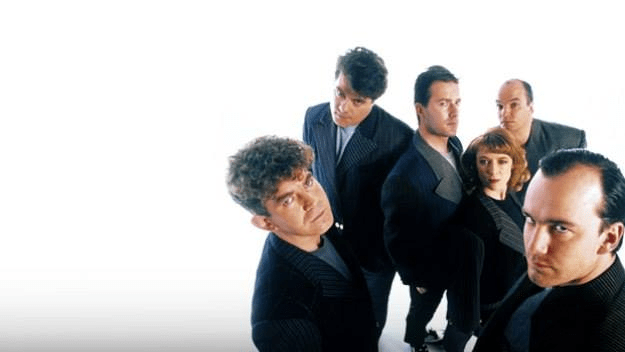
 

Absolutely, 1989 (l-r): Moray Hunter, Gordon Kennedy, John Sparkes, Morwenna Banks, Pete Baikie, Jack Docherty

JUSTIN LEWIS

What was the thinking behind setting up an independent production company to make Absolutely? You just wanted to do it yourselves?


MORAY HUNTER

Basically, that. And Alan Nixon at BBC Radio Light Entertainment really pushed us to do that. After including us in a few Pick of the Fringe radio shows, Alan had asked us to do the Bodgers radio series [In Other Words… The Bodgers, 1985], after which there were some complaints that we all sounded the same, and they didn’t know how many Scottish guys were in it. So for a second series, we got some extra voices, our pals Morwenna Banks and John Sparkes, so it became Bodgers, Banks and Sparkes (BBC Radio 4, 1986). So then, there was a woman from Cornwall, a Welsh guy and there’s still ‘is it four or five Scottish guys’?  


When we tried to sell Absolutely, for television, STV were briefly keen on the idea. But when Channel 4 expressed interest, Alan Nixon said, ‘You know, we could do it.’ Absolutely was a funny company at the start because the six of us set it up with Alan, and two other producers, Jamie Rix and David Tyler. But clearly to begin with, the company was mainly going to be about the Absolutely show. So Alan became the sole producer until some of us started producing shows ourselves further down the line. But yes, it was really to get control. Once we got a couple of production fees, we could get an office, and see what else we could do. It was a good model.


JUSTIN LEWIS

And obviously Don and George, which was you and John Docherty, had some TV exposure before Absolutely. Friday Night Live (Channel 4, 1988), of course, but also on a variety show in Scotland a year earlier called The Terry Neason Show


MORAY HUNTER

Oh god, that’s right. We first did Don and George as a couple of tweed-suited peak-capped buffers.


JUSTIN LEWIS

As much older characters?


MORAY HUNTER

For some New Year Hogmanay shows. We did one with Craig Ferguson and Peter Capaldi, we’re all just starting out really, and the next year with [Alan Cumming and Forbes Masson’s] Victor and Barry characters. They’d written a song for the four of us, and I had about a day to desperately learn these lyrics. If you catch the clip of it, I lose it for about a whole verse – much to John D’s amusement later on – which reminds me, oddly enough, of what my dad used to do on stage with Southern Light Opera.


JUSTIN LEWIS

I’ve heard you and Gordon, and John all mention that you were trying to avoid certain types of comedy with Absolutely – so no TV parodies or celebrities or overt politics. Some armchair psychology here, but is that partly because you’d just done four years on Spitting Image? And also, almost nobody’s doing character comedy in ’88. Harry Enfield is, Barry Humphries, and a few others. But almost everyone else is doing sitcom, stand-up or impressions.


MORAY HUNTER

A lot of political comedy stand-up, yeah. We weren’t very political, we didn’t want to be. I think ‘no parody’ was John Docherty’s suggestion initially. I hadn’t thought about the Spitting Image thing – it could have been that. But doing characters helped place it in the real world, somehow, even though we were doing some surreal stuff in that real world. It was a good rule, although it was very annoying at times, if you had a good parody sketch and you couldn’t do it.


JUSTIN LEWIS

All this is to Absolutely’s advantage – it remains remarkably fresh all these years later.


MORAY HUNTER

It’s contemporary but not topical.


JUSTIN LEWIS

Because the trouble with leaning on personalities and impressions is that, 30 years on, nobody knows who most of them are. Interesting from a social and historical perspective, perhaps, but not always in terms of the comedy.


MORAY HUNTER

Though we did cheat once, with that U2/Simple Minds spoof video. I think it was a Pete and John D thing. [Absolutely, Series 2 Episode 8, final item]


JUSTIN LEWIS

I always saw that as a composite parody. There were so many bands making videos like that at the time! On the subject of Absolutely music, was Pete writing all the song lyrics himself?


MORAY HUNTER

Sometimes we’d write with him, they’d toss the lyrics around, but he did a lot of them himself – in the Absolutely Radio Show more recently, just about all of them. He’s a brilliant songwriter.


JUSTIN LEWIS

It strikes me that a lot of the humour in Absolutely is not coming from television, but from other places: absurdist cinema or theatre, or even literature.


MORAY HUNTER

Yeah. Pete’s always tried to do something a bit unexpected, it’s just in his nature – John D too, probably. John Sparkes had trained as an actor and had done a lot of physical comedy, so he wanted to bring that to bear. But we had a lot of time to fill in the early series, a longer slot than half-an-hour, so we’d have these epic 10-minute sketches… like a battle outside a pub with the Salvation Army… But by series four, which was six half-hours, we were doing three-minute sketches. In a way, I preferred the longer stuff because we were really letting go.


After series four (1993), Channel 4 wanted another series, and we had an idea of having a town where all our characters lived, but we never had quite the nerve to do it. And a wee while later, the League of Gentlemen did that and absolutely bloody nailed it! For years I thought we had made a mistake by not doing another series, but we had been running on empty a bit by series four, and I was certainly writing less material by that series.

JUSTIN LEWIS

How did the writing sessions work? I picture a situation rather like Monty Python where the six of you would read stuff out to the group.


MORAY HUNTER

At the start of a new series, we’d go away for a couple of days, an excuse to get in a room together with lovely food and nice drink. We’d put a whiteboard up and discuss things. In the early days, John and I were actually still writing together, mostly physically in a room. Later we’d write separately and bring things in. But also John D would work on stuff with Morwenna, as would I.


A lot of stuff we’d read out would be quite messy, though you could see the kernel of an idea and where it was going. John Sparkes’ stuff, though, was really tight, handwritten scripts – it was finished, basically. Those Denzil and Gwynedd sketches – they are absolutely packed, two and a half minutes. And that room of theirs being slightly askew is a good metaphor for Absolutely. Everything is leaning a slightly different way.


I’m about the words, really, I wasn’t so much into the surreal although John D and I did take Don and George in a very surreal direction in Absolutely and then in their own series [mr don and mr george, Channel 4, 1993]. I like ‘real’ stuff, but obviously there’s a big chunk of me that’s happy doing big and silly.


JUSTIN LEWIS

Was there meant to be a second series of mr don and mr george? You were certainly writing it, I believe.


MORAY HUNTER

We had big plans for it, and they commissioned a couple of scripts because they weren’t sure. and the story we got was it was nixed because [then Channel 4 boss] Michael Grade’s son didn’t get into it. Whether that’s true or not, I don’t know. It was a shame. It’s one of my regrets that we didn’t get to do more of that. The success of Father Ted shows that going surreal can work.


JUSTIN LEWIS

I always thought Don and George had the potential to cross over to a much younger audience. I could imagine kids liking that show.


MORAY HUNTER

That’s a very good point. We were going out at [half-ten on a Wednesday] with that first series and that turned into a hard slot. You could do edgier, racier stuff there, and we were not doing that! It should have been out at 7 or half-seven.


JUSTIN LEWIS

When you revived Absolutely for Radio 4 in 2013, John D wasn’t involved. I know he was doing Scot Squad, a semi-improvised sitcom for BBC1 in Scotland, very successful. I’m presuming you hadn’t fallen out…


MORAY HUNTER

No, we hadn’t fallen out. He didn’t really fancy doing Absolutely again. I think he just felt it was ‘going backwards’. It could withstand one member not being involved, although in a way John was almost the unofficial leader of the group – he wrote loads of material and was also good at developing other people’s ideas. Initially I wasn’t sure, but I thought maybe we could survive without him. It’s not the same without him, but I still think it stood up as a show. When Python lost Cleese [for Monty Python’s Flying Circus series four], they could still do a decent Python show.


JUSTIN LEWIS

Interesting parallel because Cleese was often described as the unofficial leader of Python.


MORAY HUNTER

‘The tall one with the silly legs.’ It was funny to do Absolutely without John D but, apart from anything, it was a good social thing, getting the gang back together. It was still slightly nerve-wracking to read out stuff to the group, but it’s not a bad process.


JUSTIN LEWIS

Returning to some of those characters, were you wondering where they were in their lives? Had they aged in your minds?


MORAY HUNTER

Definitely. All this technology had been happening in the meantime, so much for the likes of Calum to get to grips with – or not get to grips with. So it was joyous to revisit those characters, and find there’s still life in them, talking about the issues of the day and contemporary life.


JUSTIN LEWIS

Is it true that you’ve written a pilot for the Calum character?


MORAY HUNTER

I wrote a sitcom script for him. I should have done it years ago. There’s a lot more depth to that character, I think, than was initially suggested. I’ve just written about four and a half thousand words of what would be a Calum book, which I’m quite keen to try and get someone interested in. Partly to bring him up to date, but also include some favourite sketches from over the years. That could also be quite a nice audiobook.


JUSTIN LEWIS

A Calum autobiography! I’ve always found him endearingly cheerful.


MORAY HUNTER

Yeah, he’s positive, actually.


JUSTIN LEWIS

He’s not a stock ‘nerd’ character. Just as Frank Hovis’s redeeming feature is he’s incredibly apologetic about his predicaments, and Morwenna refuses to do Little Girl as ‘cute’. They’re not clichés.  


MORAY HUNTER

Calum has changed, though. John D invented him for our Edinburgh show in 1987 (The Couch), and he said, ‘You’ve got to play this guy’, and I said, ‘Fair enough’ – one of the biggest gifts I ever got. At that stage he was just an annoying friend of John’s – funny in itself.


But over the years, because Calum’s pedantic and annoying, he can point out when other people are being boring and annoying. Like the coffee shop sketch in the radio series where they say, ‘Do you want anything else with that?’, which they always do, even though you haven’t asked for anything. And so he says, ‘Okay, well, what else have you got? Can you list everything…?’ He’s more on our side of it now. Sometimes he’s making a good point.


JUSTIN LEWIS

When we were talking about Benny Hill earlier, it reminded me that he was Tony Benn’s favourite comedian, while Elvis Costello was a big fan of the Peter Tinniswood sitcom I Didn’t Know You Cared. Nicola Benedetti, the violinist, would – according to one interview – watch Seinfeld on a loop. Does Absolutely have any surprising celebrity fans that you know of?


MORAY HUNTER

See, I would put Seinfeld on a loop too. In fact, I have done. Recently, I was doing a scene with Miranda Richardson in Good Omens 2, which is coming up this summer. Don’t make a cup of tea or you’ll miss me, but I’m in there. She was great, really charming, and I couldn’t believe I was working with Queenie from Blackadder II – and so much else of course – but yeah, it turned out she was a fan of Absolutely, so that was nice!


JUSTIN LEWIS

Is that it for Absolutely, then? I know there’s no more radio series, but could there ever be a tour?


MORAY HUNTER

We’ve always failed to get a tour sorted. There’s too many naysayers! I don’t think John D would come back for a start. We thought about it during the original run on TV, and again a few years ago, in the midst of the radio show. But there was always one person going, ‘I’m not in the mood, I don’t want to do it’. That is a regret. We should have done it when we’d just done the TV series.  

—–

ANYTHING – RADIOHEAD: OK Computer (Parlophone, 1997)

[Extract: ‘Let Down’]

MORAY HUNTER

OK Computer by Radiohead was a real game-changer for me. Beautiful melodies… but quite rocky as well. It’s just a masterwork, particularly ‘Let Down’, which I love. And then I worked backwards with them: The Bends and then Pablo Honey. As with the Bowie albums, three albums in a row. But then, for me, I’m not sophisticated enough, musically, with Kid A and Hail to the Thief, when they started getting experimental.


JUSTIN LEWIS

I did respect Radiohead for choosing to do something different at a time when they didn’t have to. That takes real nerve.  


MORAY HUNTER

Although I just wish they’d done something else differently from what they did. [Laughter] But it’s like Bowie, always coming back, reinventing himself.


JUSTIN LEWIS

Yeah, see, I think my three Bowie albums in a row would be Station to Station, Low, Heroes. A little bit later.


MORAY HUNTER

Another song from recent times: I was watching Guilt, Neil Forsyth’s series. Not only can he write, he’s also got great taste in music. There’s a song in it called ‘My Backwards Walk’ by Frightened Rabbit, which has a sad story behind it, because the lead singer, Scott Hutchison…


JUSTIN LEWIS

He died, is that right?


MORAY HUNTER

Yeah, a troubled guy. You can hear it in his lyrics, and in his voice. But he was also hugely talented. ‘My Backwards Walk’ is about a break-up and he wishes he could do a backwards walk, go back and sort things out.


JUSTIN LEWIS

I’ll have to look that up.


MORAY HUNTER

It’s a beautiful song. What else did I have on my list? ‘I’ll Take You There’ by the Staple Singers. I’m a Hearts fan and when they won the Scottish Cup Final for the first time in my lifetime, in 1998, I set the video to record the game on BBC, in case we won, and went to the game. And during the little video montage afterwards, they played that song. So I fell in love with that, and of course now it evokes a very good day.


JUSTIN LEWIS

Do you still have a deep connection with the Edinburgh music scene?


MORAY HUNTER

I’ve been listening to Adam Holmes, a singer-songwriter. ‘Edinburgh’, from his most recent album, Hope Park, is a love song to the city. As I’m living back up north now [near Berwick], I’m spending more time there, and appreciating it more and more. And there’s Blue Rose Code, which is Ross Wilson, Edinburgh-born but now based in London. He writes some achingly beautiful songs and feeds my need for melancholy. ‘Denouement’ was the first I discovered, again on that journey to the Highlands. The travel was every bit as good as the arrival in this case.


What else have I been listening to lately? I’ve always loved The Cure, a great mix of some poppy songs, and also some ark, brooding melodies – like ‘Lullaby’. ‘So Here We Are’ by Bloc Party, who I don’t know much about, but this is a mesmerising blend of rock and electronica. Similarly addictive is ‘Changes’, not a Bowie cover, by Antonio Williams featuring Kerry McCoy.


I play in a fun band, The Strawmen, with some pals, most of us fairly new to our instruments – I’m learning bass. Our first song was ‘Strawman’ by Lou Reed, hence our name. Our leader, the proper muso in the group is a guy called Marcus Paine, who, apart from his missionary work with us keen amateurs, also heads up a band called Roark – and he’s just released an album, Pelforth Poolside Dusk. So my last song is my current favourite off that: ‘Gone, But Not Forgotten’. He’s a man who knows how to write a hooky chorus and I really enjoy his voice.


—-


JUSTIN LEWIS

One final Absolutely question. If all six of you were in a pub, as I believe you often were when making the show…


MORAY HUNTER

Still are sometimes!


JUSTIN LEWIS

…what would each of you put on the jukebox? Were you all aware of each other’s musical taste?


MORAY HUNTER

Pete Baikie would put on something by The Beatles. No question about that.

John Docherty would put on Talking Heads. Gordon Kennedy… Gordie’s quite a good singer, he was in a band with Pete called There’s An Awful Lot of Coffee in Brazil, who then changed their name to the Hairstyles. They were a half-serious, half-comedy band. So Gordon might play something by Free or Bad Company. Morwenna, she might play Belle and Sebastian, she’s a big fan. John Sparkes, I have no idea. Basically the Welsh national anthem, although he’s not sporty either, so…


JUSTIN LEWIS

He could hum ‘Greensleeves’.


MORAY HUNTER

Actually, yes. It would be something off the wall with John Sparkes. What was the one he used to do, as Frank Hovis, with a beer glass, spilling the beer everywhere? ‘Tears’ by Ken Dodd. But his version, it has to be ‘Tears’ by John Sparkes.

—–

The Absolutely Radio Show, featuring all three runs of the BBC Radio 4 series plus extra material, is out now, published by BBC Audio.


The television incarnation of Absolutely is available to stream via the Channel 4 website, and is also still available on DVD on the Absolutely Everything set (which contains many many extras).


mr. don & mr. george, TV series is also available to stream via the Channel 4 website.


Many episodes (currently series 3 and 4)  of Moray’s Radio 4 sitcom, Alone – starring Angus Deayton, Abigail Cruttenden, Pierce Quigley, Kate Isitt and Bennett Arron – can be heard on BBC Sounds. All 25 episodes (including the pilot episode) are also available to buy via BBC Audiobook.

You can follow Moray on Bluesky at @morayh.bsky.social.

 —-

FLA 19 PLAYLIST

Moray Hunter


(For the time being, this site and project uses Spotify for the conversation playlists, but obviously I disapprove that Spotify doesn’t pay artists and composers properly, and other streaming platforms are available, as are sites to buy downloads and buy recordings. For consistency, you can also listen to the selections via YouTube (where available), and links are provided in each case, below.)

Track 1: KATHRYN GRAYSON AND TONY MARTIN: ‘One Alone’ [from The Desert Song]: https://www.youtube.com/watch?v=F7kDbG1WKuA

Track 2: KITTY CARLISLE: ‘Vilia’ [from The Merry Widow, original 1934 recording]: https://www.youtube.com/watch?v=MWoK2scz7m8

Track 3: BENNY HILL: ‘Ernie (The Fastest Milkman in the West)’: https://www.youtube.com/watch?v=8e1xvyTdBZI

Track 4: SIMON AND GARFUNKEL: ‘The Only Living Boy in New York’: https://www.youtube.com/watch?v=5biEjyXNa2o

Track 5: JAMES TAYLOR: ‘You Can Close Your Eyes’: https://www.youtube.com/watch?v=t4XGEQmT3eM

Track 6: STATUS QUO: ‘Don’t Waste My Time’: https://www.youtube.com/watch?v=CwQHDZYX3ao

Track 7: DAVID BOWIE: ‘Five Years’: https://www.youtube.com/watch?v=2ObjtVdsV3I

Track 8: WILLIAM THE CONQUEROR: ‘Maverick Thinker’: https://www.youtube.com/watch?v=QcwxdSeeJ6U

Track 9: PETER BRUNTNELL: ‘Handful of Stars’: https://www.youtube.com/watch?v=PpORe23Jcrw

Track 10: COLIN HAY: ‘Waiting for My Real Life to Begin’: https://www.youtube.com/watch?v=Ko5isS9JQKM

Track 11: RAB NOAKES: ‘Just Away’: https://www.youtube.com/watch?v=E-nq2ItlY20

Track 12: JACKSON BROWNE: ‘Late for the Sky’: https://www.youtube.com/watch?v=n3SJz9jujEA

Track 13: DECEMBERISTS: ‘June Hymn’: https://www.youtube.com/watch?v=EnP5hRYp6uI

Track 14: RADIOHEAD: ‘Let Down’: https://www.youtube.com/watch?v=-Z_NvVMUcG8

Track 15: FRIGHTENED RABBIT: ‘My Backwards Walk’: https://www.youtube.com/watch?v=yKH-YEhzuvA

Track 16: STAPLE SINGERS: ‘I’ll Take You There’: https://www.youtube.com/watch?v=IhHBr7nMMio

Track 17: BLUE ROSE CODE: ‘Denouement’: https://www.youtube.com/watch?v=96CaPpkLVAU

Track 18: ADAM HOLMES: ‘Edinburgh’: https://www.youtube.com/watch?v=0kSm-9tQIjM

Track 19: THE CURE: ‘Lullaby’: https://www.youtube.com/watch?v=oGyqB3yC87k

Track 20: BLOC PARTY: ‘So Here We Are’: https://www.youtube.com/watch?v=dzZQJZdcCU4

Track 21: ANTONIO WILLIAMS FEATURING KERRY MCCOY: ‘Changes’: https://www.youtube.com/watch?v=ip6P1do1__c

Track 22: ROARK: ‘Gone But Not Forgotten’: https://www.youtube.com/watch?v=SurUs9Zx0C4
FLA 12: Ian Greaves (28/08/2022)

Fifteen years ago, the writer and editor Ian Greaves and myself were going mad. We were spending most spare minutes of our lives researching and eventually writing a 700-page book about the long-running BBC Radio 4 topical sketch series, Week Ending. We know. The BBC Written Archives Centre at Caversham, Berkshire, became a semi-regular workstation for our frankly ludicrous project.


Prime Minister You Wanted to See Me? – A History of Week Ending took us a whole year to complete. Two things, I believe, kept us going. One was the knowledge that we were undertaking a subject that genuinely interested us – how do you find new and exciting creative talent in radio comedy? The other was the amusement that we were obsessively cataloguing and analysing every single episode (1132 of them) of a programme that we never actually liked that much. The writer and critic David Quantick (FLA 6) was kind enough to give it (we think) a glowing review for it in The Word magazine in early 2009, ending his piece with the phrase, ‘makes the Domesday Book look like Baby Spice’s autobiography.’ There’s one for our headstones.


I first met Ian Greaves, online and then in person, in 2000. He was and is much younger than I am, and was already frighteningly well-informed on broadcasting in particular. He appeared to have seen far more television than even I had. We would work together regularly over the next decade or so, on articles, doomed book pitches and ultimately Prime Minister, You Wanted to See Me? We often take the piss out of ourselves for writing that book, but we remain immensely proud of it.


Together we also worked as consultants on Lucian Randall’s acclaimed Chris Morris biography, Disgusting Bliss (2010), and separately we contributed chapters for No Known Cure (2013), an assembly of new, exclusive essays on all things Morris.


Subsequently, Ian has contributed to many Radio 4 documentaries and series, and to BFI Screenonline. Plus he has compiled and edited some magisterial anthologies. The Art of Invective (2015, with David Rolinson and John Williams) presents highlights and curios from the playwright Dennis Potter’s extensive archive of non-fiction, while One Thing and Another (2017) is an incredible collection of Jonathan Miller’s writing on everything from humour to opera to surgery to theatre. ‘This stunning collection is a must,’ was US talk show legend Dick Cavett’s reaction. Dick Cavett!  


One subject Ian and I have always chatted about sporadically, although we’ve rarely written collaboratively on the subject, is music, and so I knew I wanted Ian as a guest on First Last Anything. Partly because I’ve often wondered how he became so immersed in what can be some of the noisiest and most uncompromising music around. But also because he is forever tremendous company and makes me laugh a lot.


In August 2022, one Sunday, we spent about 90 minutes exploring Ian’s itinerary from novelty childhood records, through pop epics, towards what you might call The Music of Sound. Enjoy!


——

IAN GREAVES

My persistent memory of the first record I had was ‘The Birdie Song’ [by The Tweets]. I’ve got a cousin, Mark, who’s a few years older than me and my elder sister, and I know him very well these days, but back in the Eighties he was this sort of distant figure who would ask for a Tom Waits album at Christmas from the family. He’s remained good on music ever since, but I’m sure he delivered ‘The Birdie Song’ to me. Maybe he didn’t want it in the house!


I’d listen to the charts with my sister. Keith Harris and Orville, ‘Orville’s Song’, that was a record we very much approved of. I’ve never really had any snobbery about novelty records, and I’ve always quite liked comedy records.


JUSTIN LEWIS

You’ve got to start somewhere, as a listener. Hardly anyone at the age of four is going to be at the 100 Club watching The Clash or whoever.


IAN GREAVES

And my parents had records. A great bone of contention in my dad’s life was that his dad got rid of all his Beatles albums as a sort of punishment – and he was a fan throughout, although I think he went off them a bit when the drugs kicked in.


But if my dad is reading this, the Beatles album in our house was Rock & Roll Music, the original double LP from 1976. And I’ve got that copy right here! [holds aloft] A weird collision of stuff. But I’ve always had sympathy with Alan in I’m Alan Partridge where he says his favourite Beatles album is ‘The Best of the Beatles’. I always say, ‘Oh I don’t own any Beatles records’ in a slightly posturing way, as if to suggest that the scenic route is more enjoyable. But it’s really because I nicked this off my dad. I think I only heard Abbey Road two years ago. They’re fine. [Laughs] I hear they’re good.


JUSTIN LEWIS

They’ll go a long way.


IAN GREAVES

So my dad had The Beatles and Ray Charles, I adore Ray Charles, my first connection with jazz really. I was slanted to the poppier end of my parents’ collection early on: ABBA, Queen, Motown compilations, there was a great 60s rock and pop CD collection… wish I could remember the name of that. Later, as a student, I was hoovering up mood albums. People like Al Caiola, who I still really love. But it transpired that my mother actually had things like George Shearing albums, Dave Brubeck. I imagine I was put off by the covers when I was younger but later I would put them on to minidisc and take them back to university with me.


JUSTIN LEWIS

Did anything happen with musical instruments and tuition?


IAN GREAVES

I probably lasted two piano lessons. Back then, if it was something I was really interested, I’d be really good at it. Anything so-so tended not to get that treatment.


JUSTIN LEWIS

What sort of age are we talking there?


IAN GREAVES

About 12.


JUSTIN LEWIS

An age where it could go either way: obsession or apathy.


IAN GREAVES

And because I was 12 in 1990, we’ve neatly arrived at the year of my first record.

——

FIRST: FRANKIE GOES TO HOLLYWOOD: Welcome to the Pleasuredome (ZTT Records, 1984, released on CD, 1985)

Extract: ‘Two Tribes (Annihilation)’

[NB: During the early years of Trevor Horn’s Zang Tumb Tuum label, especially 1983–85, numerous versions of its releases appeared in the shops, with different mixes, sleeves and contents. Frankie Goes to Hollywood’s singles and first album was no exception – the CD version of Welcome to the Pleasuredome, which came out nearly a year after the LP and cassette versions had a noticeably different running order, including this first 12” version of ‘Two Tribes’ rather than the three-minute single. More recent CD reissues of Welcome to the Pleasuredome have reverted to the running order of the original LP, and so this 12” version (subtitled ‘Annihilation’) can only currently be found on compilations.]


JUSTIN LEWIS

It’s interesting that you bought a copy of Welcome to the Pleasuredome on compact disc in 1990. Holly Johnson had been a fairly big solo artist a year earlier… but why this, and why then?


IAN GREAVES

My memory is that my dad had definitely subscribed me to the local record library. You had to be registered by an adult for some reason, so whether they were stocking Derek & Clive albums, I don’t know. But that’s how I discovered The Goons, borrowing things like Tales of Old Dartmoor, those 70s issues with loads missing off them. And I definitely heard Holly’s Blast by borrowing that, too.


But the reason for ‘Two Tribes’ is very specific. On 1 January 1990, Radio 1, they broadcast The Top 80 of the 80s, the best-selling singles of the decade, all in a six-hour block, hosted by Alan Freeman and Mark Goodier. I taped the whole thing and it was a good way of consuming pop music cheaply. A real mixed bag. Like, ‘Coward of the County’ by Kenny Rogers was number 78.


JUSTIN LEWIS

One of the darkest number ones ever.


IAN GREAVES

And very near the top was the ‘Annihilation’ mix of ‘Two Tribes’… Nine minutes. I listened yesterday to what I think is the standard version of ‘Two Tribes’, and it sounded a little ordinary. But when I listen to the ‘Annihilation’ 12-inch mix, there is no other version as far as I’m concerned.


JUSTIN LEWIS

Just before it came out as a single, in 1984, Frankie said something like, ‘Radio 1 will play it to death’, as if to over-compensate for the banning of ‘Relax’ a few months earlier. And they did. In one week alone, in July 1984, ‘Two Tribes’ was played by Radio 1 twenty-five times.


IAN GREAVES

I bought the CD of Pleasuredome with a voucher for my twelfth birthday, so this is March 1990. I dragged my dad down Woolworths, to help me use this voucher. Which I assumed entitled me to the CD automatically, but it actually entitled me to something like one-tenth of the price. My dad was slightly annoyed by this point, but we’d got this far, so he just bought it for me anyway.


I don’t know what happened to that original CD, but for recent reissues they’ve changed the running order: just the single version.


JUSTIN LEWIS

Yes, now it just duplicates the running order of the original LP and tape. But the first time I heard that ‘Annihilation’ mix of ‘Two Tribes’ was on Peter Powell’s show on Radio 1 because he used to count down the new Top 40 on a Tuesday teatime, and when he got to number one, he played this much longer version instead. Quite often, it was common with 12” versions back then to hold back the main song for as long as you possibly could – and it’s five and a half minutes before the main vocal arrives.


IAN GREAVES

I wasn’t used to remixes, and it’s actually a terrific way of discovering the art.


JUSTIN LEWIS

As a teenager I was obsessed with how things worked, how they fitted together, and the 12” mix is like laying bare the components of the song. The bassline is there, uninterrupted, there’s that guitar riff exposed, which is buried when you hear the song on the radio. And some of this was merely a way of extending the track for the sake of it, to fill the space, but it’s like an inventory of sound.


IAN GREAVES

Like an Airfix kit. It’s perfect for that age, really. Also, it was tapping into all the things that would interest me in music. It’s such a clatter of a record, so busy, so much happening that you can’t really take it all in at once. It’s got samples in it but they’re not samples.


JUSTIN LEWIS

Yes, it’s Patrick Allen re-reading or reading slightly different versions of his own commentary from the Protect and Survive government information films.


IAN GREAVES

Panorama had covered them earlier [If the Bomb Drops, 10/03/1980], they were public knowledge, and so there was nothing to stop Patrick Allen revoicing them, but it has the effect of being a sample, so it’s also commenting on something that was emerging in music at that time.


JUSTIN LEWIS

And having Chris Barrie from Spitting Image and A Prince Among Men doing his Reagan impression, but using that impression to read out extracts of statements from Castro and Hitler.


IAN GREAVES

And getting it on to Radio 1 without any citation. You either know or you don’t. I may have done more homework for this than I needed to, but I listened to the whole album again, and it is not a good album. And there’s also this 3-CD Frankie collection called Essential, which came out this year, but it’s already in the bargain bins. So many mixes. It’s got all but the last two tracks from [the second album] Liverpool which by any measure does not reflect the meaning of the word ‘essential’.


JUSTIN LEWIS

No.


IAN GREAVES

Also, I never want to hear ‘Warriors of the Wasteland’ ever again. But Welcome to the Pleasuredome’s four singles are all great, even if the title track tends to get forgotten.


JUSTIN LEWIS

Way too many covers on it.


IAN GREAVES

‘Born to Run’ is like: Can we expose ourselves to the fact that we do not have Clarence Clemons, because boy does it show.


JUSTIN LEWIS

One of ZTT’s big ideas in the early days was to have a cover version on the B-side of every single, an experiment which lasted until ‘The Power of Love’, when Frankie reportedly flat-out refused to cover The Velvet Underground’s ‘Heroin’.


IAN GREAVES

The first Frankie session for Peel, end of ‘82, is a sort of primitive funk-punk. And the early version of ‘Two Tribes’ – everything about the arrangement is all there. I wish I could hear more of that side of them because the song structures are really interesting.


JUSTIN LEWIS

The big question with ‘Relax’ was ‘how much did Frankie play on it?’ and I’ve seen Trevor Horn quoted as saying that because ‘Relax’ ‘needed to be a hit’ – because the label was getting started – it needed to have this epic production sound, and I suspect the real ‘Frankie group sound’ would not have been as big a hit.


IAN GREAVES

No, they’d have been a cult band like 23 Skidoo or something. I don’t know what my dad thought he was doing, really, letting me have this album! All the sleeve art – I’d forgotten the ‘bang’ symbolism is sperm. I wonder if that made it easier for me later to get into bands like Psychic TV and Throbbing Gristle and Coil…  who used sexual energy – and often gay sexual energy – as a central theme.


But the other thing about Frankie Goes to Hollywood, and what you said about quotations – they’re putting in references for you to work out. A more obvious version of that would be the Manics who are like a reading list with guitars. Take The Holy Bible, the only album of theirs that I really really love. Probably my first awareness of Pinter is on that album, and Sylvia Plath – and I was the right age for all of that stuff too. [“I spat out Plath and Pinter”¸ ‘Faster’]


And musical threads. If you discover The Fall, as I did when I was sixteen, then you will discover Beefheart, the Monks, Can, the Groundhogs (god help you if you get Groundhogs albums), Henry Cow…  They covered Henry Cow… How many people have covered Henry Cow?


JUSTIN LEWIS

I think I first knowingly heard The Fall in about ’84, doing ‘C.R.E.E.P.’. You were telling me that this festive John Peel Session from December 1994 was the moment you fell for them.


IAN GREAVES

I tuned in because Elastica had a session, that was pretty good, they were doing Christmassy stuff. And it was the first Festive Fifty I heard.


JUSTIN LEWIS

Which was the sort of listeners’ poll Peel held every Christmas.


IAN GREAVES

Where I first heard ‘Dirty Epic’ by Underworld, which was obviously thrilling. But above all, in that show I heard The Fall, with Brix Smith who I love, returning to the band and being fantastic. (I was there the night after she walked out again. My first Fall gig, and they didn’t even make it to the stage.) But no-one can truly be prepared for their Peel Session version of ‘Hark the Herald Angels Sing’ because, outside of Brix, it’s not often you hear a female voice on a Fall record. Which is Lucy Rimmer.


I put that Fall session on a tape for John, my mate, who I’ve known since ’89, and we’d swap records all the time. He became as much of a Fall fan as I did, and I do not judge him for this, but the next day he thrust the tape back in my hands and said, ‘That was shit.’ [Laughter] This horror that anyone considered that to be music. But eventually he realised that The Fall is as much a sort of organised chaos at its best as [Beefheart’s] Magic Band ever were.


JUSTIN LEWIS

Together, you will remember, we interviewed Stewart Lee live on the radio, on Resonance, nearly 20 years ago. And he said something like, ‘The first time you hear The Fall, you think, “Oh my God, what’s that? It’s awful”, and then a few weeks later you hear the same record again, and you think, “Oh my god, what’s that? It’s brilliant.”’ It’s like getting used to a cold bath.


IAN GREAVES

I did like The Fall immediately, but I thought it was absurd. I stuck with this rule for years, and it’s always true: if a Fall album doesn’t make you laugh, then it’s not a good Fall album, and sadly that began to happen in the 2000s. I think there’s still great stuff in that period, and I saw loads of gigs, but it does kind of drift for me.


JUSTIN LEWIS

So the humour is the key to it?


IAN GREAVES

Yeah, because Mark E. Smith’s a contrarian, isn’t he? So you either get into that or you don’t. But his phrasing is funny. His choice of words is funny. The noises he makes are funny. For my dissertation at university, I did ‘Lyricists from Manchester’ so I interviewed John Cooper Clarke, Howard Devoto, Vini Reilly – and eventually Mark. That was an experience. I tried to get answers from him about a couple of songs and he just refused. He could be a bit of a self-caricature at times in interviews, but it was a game for him because he wanted you to work a bit.

 —-

LAST: DEREK BAILEY: Domestic Jungle DAT (2022, Scatter)

Extract: ‘DAT Edit 5’

JUSTIN LEWIS

I had a number of thoughts on this.


IAN GREAVES

Can you tell me what you made of it?


JUSTIN LEWIS

I listened to bits and pieces. The ones I especially enjoyed was the Guitar, Drums ‘n’ Bass album he made (1996). I was just fascinated by the idea of this guy who would have been – what? – in his sixties by this point…


IAN GREAVES

He had a bus pass by the time of recording, yeah. 


JUSTIN LEWIS

…And improvising guitar over pirate radio stations in London playing drum and bass. Is that about right?


IAN GREAVES

Essentially. That album was done in a studio, and he’s playing against tapes done by someone in Birmingham to get around the whole kind of white label copyright grey area. With the release I’ve picked, Domestic Jungle DAT, no-one seems to care about that! [Laughter] And also, Shazam helps these days so we know what things are. I’m not sure if Guitar, Drums ‘n’ Bass is the first Derek record I bought, but it’s one of the earliest. It’s still got the receipt in it. It’s on John Zorn’s label Avant. I bought it in Virgin in Leeds, so I’d just started university. 4 October 1997, one minute past four. £17.99. And still to this day, if I see a first pressing of a Derek Bailey album in a shop, I just buy it. Regardless of the price, almost. I just want everything by him.


JUSTIN LEWIS

When we were setting up this conversation, you used the word ‘elemental’, so it obviously really made a fundamental impression on you.


IAN GREAVES

It cuts to the heart of my non-musicality, while also being very interested in music. You know when Blur came to John Peel’s house and he said the reason he hadn’t played their records before that was ‘dangerous amounts of melody’. [Laughter] I’m not against melody, that would be a ridiculous position, but my default is kind of noise, I suppose, and sound.


Derek Bailey, early in his career, used to work in the orchestra pit playing for Morecambe & Wise. But when I first heard him, he was playing with a very noisy Japanese group called Ruins on Radio 3’s Mixing It, recorded at the Purcell Rooms [03/04/1997, transmitted 14/04/1997]. There was this exoticism, and implied seriousness, and also people were being allowed to do this. [Laughs] And I’d listened to metal, I’d loved Iron Maiden as a kid and all that sort of thing, so that was fine, but in the middle of this maelstrom, there was this man outdoing them. And then I found out: Oh, it’s this old guy from Yorkshire. I instantly know when it’s him playing.


I am aware that people hear improvised music, and think, ‘It’s just a load of noise, they’re just making it up.’ But that line ‘between thought and expression’, as Lou Reed said – it’s such a short line with Bailey. There’s loads happening, and instantly. He joked somewhere that he’d spent almost 50 years of his life tuning up in public. [Laughs] Which is what it may sound like to people. Here he’s listening to those pirate stations, playing jungle, and remember this is a 65-year-old man in his living room in Hackney. There’s no artifice here. Later on, he referred to jungle as ‘fast as fuck and really shifting’.


There’s two things there. The ‘fast’ – that’s the speed his brain still works at. But the ‘shifting’ – he loves to perform with other people, not to trip them up or argue with them. A lot of improvisation is quite conversational, but often with Derek, he’s trying to drag everyone out of habit. There were very few musicians he would continue to play with over many, many years.


JUSTIN LEWIS

So was the frustration that collaborators would lapse into their default way of playing, and he would get impatient or bored?


IAN GREAVES

Totally, totally. He was going off to Japan in the 70s, finding guitarists, and other new people to play with. Evan Parker, the saxophonist, would do that as well. They ran a label together, were touring together. Bailey’s discography is enormous. There’s lots of good solo records, but I think his best stuff is with percussionists, and probably his best records are with Han Bennink, his most enduring collaborator, because Han would play anything. Ostensibly, he’s a drummer, but whatever happens to be in his vicinity gets played as well, so when I started to hear those records, it freed up all my notions of what music was. And it wasn’t jazz either. I think there’s this kind of interchangeability when people say ‘improvisation’ and ‘free jazz’, and they’re not necessarily the same thing. We need Philip Clark [FLA 4] here to explain that properly!


JUSTIN LEWIS

I’ve found a few really great quotes about Bailey, or from him. He wrote a book, you will know, around 1980 called Improvisation.


IAN GREAVES

A brilliant book. Based on the radio series [Tuesday afternoons, Radio 3, Feb/Mar 1974].


JUSTIN LEWIS

Aha! Like Hitchhikers Guide.


IAN GREAVES

Exactly like that.


JUSTIN LEWIS

This is from The Guardian review of the book, and it says of him, ‘He’s not interested in the competitive spirit, which drives so many jazzmen now.’ So it’s not ‘Right now I’m in the spotlight, it’s my turn’, fine as that can be, but he appears to have no interest in that. It’s all about ‘the conversation’, rather than a soliloquy.


IAN GREAVES

Yeah, and it’s important to say ‘conversation’ rather than ‘argument’. Sometimes if it’s loud, it’s assumed it’s hostile. But it’s often not.


JUSTIN LEWIS

This quote is from the LA Times, in the 1980s, which describes him as ‘pursuing sounds and textures, rather than melody and rhythm’. Melody and rhythm are prioritised in music, but the sounds, the textures, are also key, whether or not they’re connected with the melodies or the rhythms. I mean, some of the most famous pop songs ever written have all sorts of splurges of noise in them, but we don’t necessarily think about those things.


Phil Oakey once said that when they first got synthesisers in the Human League, the equipment didn’t come fully programmed or even constructed so they had to work out how to get a sound out of them.


IAN GREAVES

You know Robert Rental and Thomas Leer made this album The Bridge (1979), which got reissued by The Grey Area earlier this year. That came originally from Industrial Records: Throbbing Gristle, I think just for a laugh, gave them some money and equipment and sent them off to the studio for a week. And they literally had no idea how to get the thing to make noise. They ended up making a fairly good album at the end of it.


I should just say, by the way, because there may be pockets of Derek Bailey Twitter, who will be appalled. Guitar, Drums ‘n’ Bass is a divisive record among the fanbase because it’s not the purest stuff. And we’ve waited until 2022 to get the real thing – Domestic Jungle – which are tapes that he’d either send out to friends or make for himself of him playing along to jungle stations.


The point is: I’ve chosen a Derek Bailey record with a tune on it. And that’s unusual – he didn’t do much in the way of tunes. Gavin Bryars managed to get him to play one every now and again. But that was about it. Derek’s on ‘Jesus’ Blood Never Failed Me Yet’.


But Domestic Jungle is not just a 65-year-old keeping up with jungle. On that track I’ve picked out, ‘Edit 5’, he’s saying, in a broad Yorkshire accent, ‘Come on, lad, faster!’ [Laughter] He’s infuriated, because this kid is keeping him back. When Derek speaks on his records, and sometimes it’s him just chatting to the audience or plugging his record label, you get such a powerful sense of his personality. And he has an often comic way of playing guitar against his speech as well.


JUSTIN LEWIS

You kindly sent me a copy of the interview he did with The Wire in 1998, for the feature ‘Invisible Jukebox’, where the guests get played records with no context, or identification, and have to react… He gets asked about what it would be like to hear his own work in a lift, I think [Laughter], and he says: ‘Imagine you’ve got to pass a bit of time. It would be nice to play this in a railway station. It’s just something to listen to instead of being reminded of something.’


Now that made me think about how we react to art of all kinds. Do we react to art as ‘something new’, or as ‘this is like that other thing we know’. So much of my approach to hearing new music centres around ‘what are my reference points’, because I have so much past music in my head all the time. It’s very hard to get past that. Do you have that, or have you been able to free yourself?


IAN GREAVES

No, I haven’t freed myself from that and I think it happens retrospectively as well. I have this awful habit of listening to older music at the moment just because I’m buying so much older stuff. It sort of worries me that I’m not listening to enough new stuff. I listened to something this morning and I just thought, ‘Oh this is just that, that and that’, a combination of three things, and when I was 18, I thought that album was the bee’s knees. Which is unfair, because, you know, Bowie was a magpie. That’s pop and it’s how it goes. You could listen to, say, LCD Soundsystem’s Sound of Silver, which I think is a terrific album – and you could say, grumpily, ‘Oh, that’s just Bowie’s Lodger, and that bit’s Liquid Liquid’, but it’s a DJ trying to turn the music he plays into an original piece of music. It’s turntablism through the prism of a band. And you can ruin this kind of stuff for yourself if you overthink it.


People just have influences, and it comes through and it’s inevitable. And yeah, one thing that is increasingly obvious as I get older – and you’ll know this – is that my reference points mean nothing to anyone half my age.


JUSTIN LEWIS

Yes, this has been happening to me for some time now!


IAN GREAVES

The alarm bell was when I realised I was writing books about things that appealed to mostly people who’d be dead… So… that was a problem. I thought, I might need to just wind this back about 30 years.


JUSTIN LEWIS

And that’s going to get even weirder for the people behind us, believe me.


IAN GREAVES

It’s a common culture thing as well, isn’t it? You can’t help but key into all the stuff that you and lots of other people your age have enjoyed over the years: songs, films, catchphrases… And popular art feeds other popular arts. I don’t think this has really addressed your original question! But I still react to the past all the time, and it’s fine. I don’t get upset about it.


JUSTIN LEWIS

I find it harder to work out what I think on one listen now. Which reminds me of a direct Derek Bailey quote where he said he hated records. Once you’ve done it, what’s the point of listening to it?


IAN GREAVES

One thing missing from that Wire piece, because he hadn’t quite started doing it then, was that at the turn of this century, he was just making too much music. He would mail out CDRs to friends of him playing and talking, instead of letters, and then he started to do print-on-demand CDRs of concerts and whatever else. And I think he’d be mortified – he died in 2005 – that those CDRs still work!


JUSTIN LEWIS

That they’re supposed to have obsolescence.


IAN GREAVES

Yeah, and he probably quite contentedly used poorer resources for them as well. I just think that’s funny. But yeah, these CDRs go for a fortune, and you buy them, thinking, ‘…Is this gonna play?’ [Laughs] But then, maybe in this case, a CDR that skips and jars is fitting.


JUSTIN LEWIS

He’d probably love that.


IAN GREAVES

Yeah. I love it when people say what dead people would love! [Laughter]


—-


JUSTIN LEWIS

So roughly when did you start to explore this very different direction of music?


IAN GREAVES

I was at college. It was 1996/97. And I got a job in a record shop. A couple of years earlier, when I was getting into other bits of Radio 1, going to second hand shops… I went to a record fair, and they had a collection for sale of the first 90 issues of Q magazine [covering autumn 1986 to early 1994]. So I bought them, and honestly, I think I read them all within six months, and then – like a firecracker – I was off.


JUSTIN LEWIS

You had your map.


IAN GREAVES

I had my map, and I’m pretty sure the reason I got a record shop gig was because I now had a working knowledge of a lot of different music. I don’t think I’ve listened to George Thorogood and the Destroyers since Live Aid, but I could wing that conversation, you know?


JUSTIN LEWIS

Record shops before computers: it required a lot of knowledge from us underpaid staff.


IAN GREAVES

A copy of Music Master [big doorstop of a catalogue], that was it.


JUSTIN LEWIS

And your own memory.


IAN GREAVES

And your opinions.


JUSTIN LEWIS

And between you all, you could work out most things.


IAN GREAVES

Our folk section was very strong, Blues and prog, all that sort of thing in our back catalogue, but I was there as the young guy who knew about the ‘young stuff’. I’d get all the college kids chatting to me. One of them brought in a comic strip of me once – it was of me getting annoyed about them not knowing enough about industrial music. [Laughter] They did it in such a way that they probably thought, ‘This will wind him up.’ I actually loved it. Still got it somewhere. I was like Douglas Hurd buying a cartoon of himself.


I worked in that record shop when Be Here Now came out, and I took the day off, because I couldn’t stand the idea of serving people who’d be buying it. I went to Newcastle for the day, to my favourite record store, Surface Noise – and we just listened to Ivor Cutler and Beat Happening and whatever else. So my idea of a ‘day off’ was to go to another record shop! That’s fairly dysfunctional.


Meanwhile, I was reading The Wire magazine, listening to Mixing It. And both the Derek Bailey and the next record are sort of cheats, as my ‘Last’ and ‘Anything’ came to me – as artists – at about the same time. I like your premise for this series: what’s changed your listening, or what’s changed the way you listened. Which I think is what Tim Gane of Stereolab said about Nurse With Wound.

——

(Link to Scatter page at Bandcamp.)

https://scatterarchive.bandcamp.com/track/dat-edit-5?from=twittercard

—–

ANYTHING: STEREOLAB/NURSE WITH WOUND: Crumb Duck (1993, single, Clawfist) 

Extract: ‘Animal or Vegetable (A Wonderful Wooden Reason…)’

JUSTIN LEWIS

Now, as I understand it, you are – certainly were – a big Stereolab fan anyway. But then you’ve become perhaps a bigger Nurse With Wound fan.


IAN GREAVES

Oh god, yeah.


JUSTIN LEWIS

And we should probably give a content warning here about some of their music and certainly some of the artwork, particularly if someone is hunting down sleeve designs.


IAN GREAVES

Yeah, don’t do what I did, in the 90s, before the Internet. I asked my parents one Christmas for two Nurse With Wound albums, in amongst all the other presents and the Terry’s Chocolate Orange.


JUSTIN LEWIS

No!


IAN GREAVES

Innocently! One was A Missing Sense (1986) which has quite an odd cover, but it looks like a painting I guess so it was just about acceptable. But the other was The 150 Murderous Passions (1981), which was a collaboration with Whitehouse, and I can’t fully describe the cover. I think you’re just going to have to find it for yourself in the comfort of your own home, and definitely not on a work laptop. And that Christmas Day, I don’t think we even had a conversation about it. I think we just moved on very quickly.


JUSTIN LEWIS

Did they wrap it?


IAN GREAVES

Well, they must have done! Honestly, you’re unwrapping it, you’re thinking, ‘This isn’t very Christmassy…’ But ‘Animal or Vegetable’ is another record I’ve chosen for potential conversation purposes. This is not the best Nurse With Wound record, or the best Stereolab record, and it isn’t my favourite record of all time. But I think it does connect to a lot of things.


My first Stereolab record was Refried Ectoplasm (1995), which was a collection of seven-inch tracks and rarities, and the rarities had all had handmade sleeves or been in very limited runs and were consequently very hard to get hold of. In the middle of this compilation there are two songs. One is ‘Exploding Head Movie’, a kind of remix of part of ‘Jenny Ondioline’, which had been on the album Transient Random-Noise Bursts with Announcements (1993). What a title. And the B-side is ‘Animal or Vegetable (A Wonderful Wooden Reason…)’, the bit in brackets being a quotation from Faust’s ‘It’s a Rainy Day Sunshine Girl’.


I don’t think I’d heard of Nurse With Wound. I heard this, this 13-minute thing, and then Steve Stapleton (who essentially is Nurse With Wound) was on the cover of The Wire pretty soon after [Issue 160, June 1997], my first issue of The Wire. I was still somehow absorbing everything and hunting down everything that was being mentioned, and he sounded like an incurable record collector who was more than twice my age, so I thought, ‘Well, he’s probably alright.’ Then I was down on the Darlington town market record stall one Saturday and they happened to have this Nurse With Wound collection called Crumb Duck which also featured these two tracks from the Stereolab collaboration. So it was like this divorce, basically, with the same tracks on two separate artist collections!


Again, some Nurse With Wound fans will be very disappointed that I’ve chosen Crumb Duck because it’s got rhythm, and when Steve Stapleton had started to use rhythm, around 1992, lots of the fans thought, ‘I’m not having this’ because it had been very noisy or very weird or very cut-up music for a long time. I mean, my favourite NWW record is The Sylvie and Babs Hi-Fi Companion (1985), which is 40 minutes of just relentless cut-up – and very funny with it. It’s my ultimate record because – even though I’ve probably heard it 100 times and know it really well now – a lot of the appeal of this kind of music is that it’s so overwhelming, and it’s often so tuneless [Laughs] that you can never feel like you’ve drawn the map of it in your brain. You can’t recall it exactly, and so it always has this ability to surprise you.


JUSTIN LEWIS

It sounds like a puzzle you can’t solve, perhaps?


IAN GREAVES

A very big jigsaw, but it’s taking you ages, and every time you get up in the morning, some poltergeist’s taken all the pieces apart again and you have to put it back together. [Laughter]


JUSTIN LEWIS

You’re like Sisyphus pushing that rock up the hill every day.


IAN GREAVES

That is me getting through a Merzbow box set, that’s right.


JUSTIN LEWIS

We met in the early 2000s because of our interest in comedy, and broadcasting, and so on, and it struck me how much of 90s comedy on the fringes – late night radio and TV in particular – traded in the surprising, even the unsettling. Was that part of the appeal with this kind of music?


IAN GREAVES

It all goes back to the Goon Show records. I think you’re onto something, mainly that I have never been of the view that all avant-garde music is serious. I like it when it’s got a glint in the eye or a sense of humour, and you’ll have heard in ‘Animal or Vegetable’ those two minutes of complete madness, which are just obviously meant to be funny and astonishing. It’s not that boring Paul Merton whimsy, it’s rooted in dada. It’s got a kind of intellectual edge. It scalped me. Changed me forever.


We’ll get back to your question [Laughter], but it drives me mad when people are at concerts for this kind of stuff at places like Café Oto, where it’s a full house, and I’ve heard things that I think are hilarious yet no-one else there is laughing. Jandek – how do you describe Jandek? Every album sounds like a suicide note, but he was doing a show at Oto once where he had this kind of John Shuttleworth big keyboard, and he was playing it the way Leonard Cohen does it on I’m Your Man [the album]. There was something in his phrasing, and I just said to my mate, ‘This is clearly supposed to be funny.’ But for everyone else it was ‘We’re watching Jandek, we’re not supposed to laugh.’ No! We’re supposed to be having fun.


JUSTIN LEWIS

Music is often sold to us as relaxing, reassuring, familiar, benign – all well and good. But it tends to be written off if it’s funny, perhaps because people don’t quite know what to do with humour and music, or with the disruptive in general. It might not be for everybody, but nobody questions cinema’s role in reflecting the unsettling aspects of life.


IAN GREAVES

Loads of film music nowadays is like Nurse With Wound or industrial, quite strange or directly avant-garde music. We went to see Nope last night and that’s terrific. Mica Levi, the stuff she does, Cristobal Tapia de Veer who scored Utopia – the Channel 4 series. For a long time, we went through a period in film and television where soundtracks were ostensibly classical music. But way before that, when I was growing up, it was radiophonics… Anyone from about… 1958 onwards was subjected to that in the mainstream of the BBC. You ask the KLF and the Orb and that generation, and that’s what they were all listening to. That’s the music that corrupted them. It was the Doctor Who and the Sea Devils music – Malcolm Clarke.


David Stubbs, who wrote that book Fear of Music asked ‘Why do people get on with Rothko but they’re scared of Stockhausen?’ I think in truth people accept this stuff osmotically, but they don’t necessarily know it. What about cartoon music in the 50s and 60s! Pierre Henri would fit in on those, you know.


—-


IAN GREAVES

I don’t think I’ve told you, or anyone, this before. I was nearly blinded by a seven-inch single when I was twelve or thirteen. We were in the school assembly hall. There was a teacher at the other side of the hall. There were six or seven of us just arseing around in that pointless destructive way that children do. And there was a box of scratched seven-inch singles, which I think had been used for country dancing lessons. So already a relic of a thing to be doing. Screamadelica was out; we were doing country dancing.


There was a lad who shall not be named and also, I can’t remember his name. They’d already been snapping the edges off the records, and some of them still had airborne potential. And he just started throwing them, not in a deliberate [targeted] way like a bully would. But he just span it towards me, and it was probably one of the snapped-off bits on the edge that caught me, as near as you could have got just under the eyebrow… It cut me, not that badly, but the teacher was horrified, realised they hadn’t been paying attention. I never told my parents, I don’t think. They would have just gone spare.


I wish I could tell you what the record was. [Laughter] Does that count as my first single?


—-

Ian’s latest book is an utter treat: Penda’s Fen: Scene by Scene, about the 1974 Play for Today written by David Rudkin and directed by Alan Clarke, published on 23 June 2025 by Ten Acre Films publishing. You can order it here: https://tenacrefilms.bigcartel.com/product/pendas-fen-scene-by-scene

Prime Minister, You Wanted to See Me?: A History of Week Ending is published by Kaleidoscope.


Dennis Potter: The Art of Invective: Selected Non-Fiction 1953–94 (edited by Ian with David Rolinson and John Williams) is published by Bloomsbury.


Jonathan Miller: One Thing and Another: Selected Writings 1954–2016 is published by Bloomsbury.


You can follow Ian on Twitter at @GreavesIan. He is also to be found on Bluesky at @greavesian.bsky.social, and on Instagram as @greavesian78.

FLA PLAYLIST 12

Ian Greaves

(For the time being, this site and project uses Spotify for the conversation playlists, but obviously I disapprove that Spotify doesn’t pay artists and composers properly, and other streaming platforms are available, as are sites to buy downloads and buy recordings. For consistency, you can also listen to the selections via YouTube (where available), and links are provided in each case, below.)

(NB: Derek Bailey’s ‘Edit 5’ from the Domestic Jungle album is not currently on Spotify, but should that change in the future, it will be incorporated into this playlist. Meantime, you can access it on YouTube here: https://www.youtube.com/watch?v=xdRxUvrWUPQ&t=531s)

Track 1: THE TWEETS: ‘Birdie Song’: https://www.youtube.com/watch?v=eNcUPje_0hk

Track 2: THE BEATLES: ‘Drive My Car’: https://www.youtube.com/watch?v=alNJiR6R5aU

Track 3: GEORGE SHEARING: ‘One Note Samba (Samba De Una Nota So)’: https://www.youtube.com/watch?v=qi4rcF0Vkw4

Track 4: FRANKIE GOES TO HOLLYWOOD: ‘Two Tribes (Annihilation)’: https://www.youtube.com/watch?v=XHFPuH5iEww

(Currently not available on Spotify.)

Track 5: COIL: ‘The Anal Staircase’: https://www.youtube.com/watch?v=YH9zK8tvK6s

Track 6: MANIC STREET PREACHERS: ‘Faster’: https://www.youtube.com/watch?v=rl2Jv4dzFqg

Track 7: UNDERWORLD: ‘Dirty Epic’: https://www.youtube.com/watch?v=phWYWpu5KUQ

Track 8: THE FALL: ‘Glam-Racket/Star’ (Peel Session, TX 17/12/1994): https://www.youtube.com/watch?v=5FHpf_7SIug

Track 9: THE FALL: ‘Hark the Herald Angels Sing’ (Peel Session, TX 17/12/1994): https://www.youtube.com/watch?v=hGMpTuHSEL4

Track 10: DEREK BAILEY: ‘N/Jz/Bm (Re-Mix)’: https://www.youtube.com/watch?v=ah0MQm1Qe4w

Track 11: THE HUMAN LEAGUE: ‘Morale…/You’ve Lost That Lovin’ Feeling’’: https://www.youtube.com/watch?v=tSbLpd-SSvI

Track 12: LCD SOUNDSYSTEM: ‘Get Innocuous!’: https://www.youtube.com/watch?v=0GpLkFv-CKU

Track 13: STEREOLAB/NURSE WITH WOUND: ‘Animal or Vegetable (A Wonderful Wooden Reason…)’: https://www.youtube.com/watch?v=h56tXx8JHMI

Track 14: MALCOLM CLARKE: ‘Doctor Who: The Sea Devils’: https://www.youtube.com/watch?v=NwhTqTiOkG8

(Currently not available on Spotify.)