ENJOY THE MOMENT: OXIDE GHOSTS

24879974_10154830109296086_3117380731159129930_oMichael Cumming is one of British television’s foremost comedy directors. Over the past twenty years, the Cumbrian has worked with Mark Thomas, Lenny Henry, Rory Bremner, Matt Lucas and David Walliams, Matt Berry, and Stewart Lee. But his career in comedy began in the spring of 1995. Chris Morris’s Brass Eye, which took eighteen months to complete, drew on Cumming’s versatility on a wide range of programmes, from documentary inserts to corporate videos, from children’s magazine shows to Channel 4’s post-pub yoof sneeze, The Word. His wide range of experience gave Morris’s project – somewhere between experimental media satire, sketch show and hidden camera – an authenticity. As with The Day Today, Morris’s previous series with Armando Iannucci, Brass Eye didn’t look like a comedy show.

As I wrote on this blog earlier this year, 20 years after it finally made it to air, Brass Eye had a difficult gestation. With the fragmentation of multi-channel broadcasting and the Internet, it seems unlikely that a single comedy series will have that kind of impact again, especially as television is more cautious with humour now. But fortunately, there is now a chance to sample Oxide Ghosts, an hour-long compilation of mostly previously unseen material from the six-part series, selected and completed by Cumming, but with Morris’s approval.

The only catch? You have to go out and see it, at a cinema or arts centre, where Cumming appears in person, to introduce his film, and then to take questions afterwards. Recording the event is strictly prohibited, and the film is extremely unlikely to be commercially available or downloadable. This is a deliberate decision; some of the footage is legally sensitive, but in any case, both Cumming and Morris felt that there was something alluring about a once-only viewing. After all, though many of us (myself included) made sure we had videotaped the original series off the telly, it felt much too outlandish and extreme to ever be reshown, let alone be released on video and DVD. (Even though it eventually was, and it eventually was.) Because Brass Eye was about impact – at the time it felt like a once-only experience.

And so, Oxide Ghosts, even for people who thought they knew every frame and line of the series (already way too much to absorb and process in one viewing) is not so much a completion of Brass Eye as an added bonus, something we thought we would never see. Included in Cumming’s film are extended versions of familiar material, what you might call “deleted scenes”, and two or three clearly outrageous moments presumably never intended to be broadcast (designed to distract Channel 4 and the ITC from the stuff the programme makers actually wanted to be included in final edits). There are even some outtakes and bloopers involving Morris and other cast members; there’s one particularly memorable moment when one of the tensest scenes in the entire series dissolves into joyous catharsis in the studio. It’s still unlikely to be on It’ll Be Alright on the Night, though.

As someone you might call a ‘comedy historian’, I might once have found this kind of event frustrating. Obsessed with archiving every moment became almost too easy with the Internet, but there was something fantastically liberating about knowing that the showing of Oxide Ghosts I saw last night in Cardiff is likely to be the only time I’ll ever see it. Even then, like the series on first viewing, there was too much material to process (you couldn’t even hear every line, such was the density of footage). But that’s okay. Just to see it at all felt like a massive privilege. Hopefully, if you have not been able to see it, Cumming may tour it again one day.  But for me, one showing is actually enough. And that is not a criticism. To quote the poster outside the event, I chose to ‘enjoy the moment’.

Oxide Ghosts is being shown in Newcastle and Blackpool on 17 and 18 December. Further details at Michael Cumming’s website, which is here.
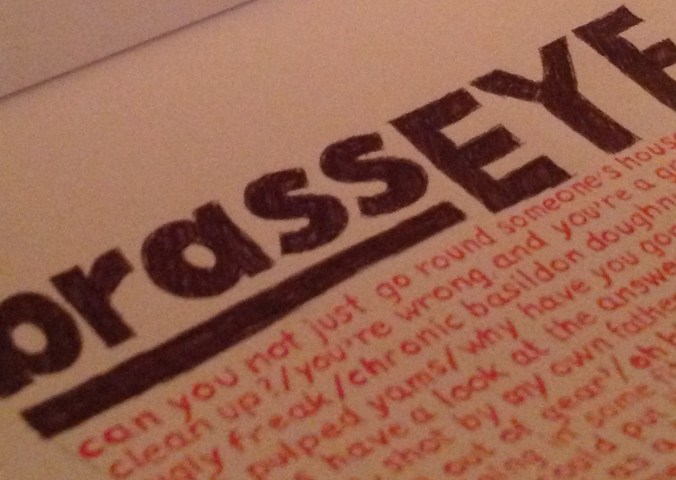


FAKE NEWS: BRASS EYE 20 YEARS ON

file_0005I was once roped into attending a trivia quiz night in London which hinged on the life and work of the comedy writer, producer and performer Chris Morris. None of its several rounds acknowledged his esteemed radio work, but at one point we were played a clip from his 1997 TV series Brass Eye. The item parodied the studio discussion format in which a contributor (played by actor Mark Heap) had been booked to talk about living with the AIDS virus. He revealed that he had caught the virus from his boyfriend, rather than through a blood transfusion. ‘So you’ve got Bad AIDS, not Good AIDS,’ accused Morris, in character somewhere between Paxman and Kilroy-Silk. Chaos was seen to erupt in the studio.

When the clip ended, the round began. We were shown images of ten public figures, and asked whether they had died of Good AIDS or Bad AIDS. As we started, sighing, to identify the likes of Freddie Mercury and Arthur Ashe, gloomy that their extraordinary lives had been reduced to this cruddy indignity, one of my teammates leaned over and whispered to me, ‘Haven’t they missed the entire point of the sketch?’

The sketch was, of course, really sending up the tabloid perception that some people deserve their punishment according to lifestyle. But maybe, I dunno, maybe the quiz organisers just thought it’d be funny to do a round about people who’d died of AIDS. I know the argument that, once someone’s work becomes public it no longer belongs to them, but it was surprising to discover that Morris fans had misunderstood something so profoundly. Warren Mitchell, who played the character of the bigoted east Londoner Alf Garnett on television for many years, used to say that he had grown used to people approaching him in the street and congratulating him for ‘having a go at the foreigners’. He reputedly used to retort, ‘No, I’m having a go at people like you.’ Oh, fandom.

All art needs context, and although not strictly topical, Brass Eye needs some background. Before, during and even after its first transmission, it caused unprecedented trouble for a TV comedy show, especially one that was only watched by around 1.5 million people. It was billed as ‘comedy with a strong taste’, and as ‘a satirical look at television current affairs’. Each half-hour episode addressed a broad subject that provoked emotive responses: animal rights, drugs, science, sex, crime and ‘moral decline’. After being scheduled for premiere in November 1996, it was postponed by Channel 4’s Chief Executive, Michael Grade, concerned that MPs and celebrities had been hoodwinked into contributing to the programme.

The series made great use of creating its own fake news footage and campaigns, and then showing the material to obviously uninformed politicians, journalists and celebrities. A lot of the footage was supposedly uncovered abroad: cattle being fired out of cannons in Libya; the dangerous drug of ‘cake’ in Prague making it to British shores; heavy electricity in Sri Lanka which hit victims like ‘a ton of invisible lead soup’; a two-foot bollock being kept alive in a Siberian hospital; the miraculous vision in Ireland of a statue of Mary driving a car through a field; a US senator who couldn’t stop masturbating at press conferences…  It lampooned that quintessentially British way of thinking: we’re normal; the rest of the world’s crazy.

After the series belatedly began airing in January 1997, Grade ordered that a segment about a West End musical on the murderer Peter Sutcliffe – itself commenting on the celebrity of criminals – should be snipped from the final episode. When broadcast on 5 March, dutifully minus the contentious item, it included a defiant flash-frame: ‘Grade is a Cunt.’ The c-word; the c-word about your channel controller; and a flash-frame, in itself illegal on television. Cue further controversy when the stunt was revealed.

In the aftermath, Morris returned to radio, to create Blue Jam. For years, radio had been his natural home; a decade earlier, he had begun creating satirical stunts for local radio, influenced by the likes of Kenny Everett, Victor Lewis-Smith and Viv Stanshall. In 1990, he was talent-spotted by radio producer Armando Iannucci, and the pair created On the Hour for Radio 4, later to reach BBC2 as The Day Today. Brass Eye was then only Morris’s second full television project, but its style already seemed a natural conclusion of his work, a full stop.

Repeats or commercial releases of Brass Eye then seemed unlikely, but it won awards, several of its production team went on to senior positions in TV entertainment, and it was a big influence on TV comedy. Not necessarily in a good way: if Mark Thomas and Rory Bremner continued to pursue incisive political satire, elsewhere hasty, ill-conceived hidden camera shows sprang up, frequently concerned with humiliating the public. It was into this environment that Brass Eye was finally repeated, with cut material reinstated, in summer 2001, along with a new seventh episode: satirising tabloid attitudes surrounding paedophilia. It had laudable intentions, but I was a bit disappointed by its comedy elements. Regardless, many weren’t, it helped make more people aware of the original series, and the tabloids got upset all over again.

Morris’s work could be cruel, but his prime target was ultimately media attitudes – and he and his co-writers were both imaginative and obsessed with attention to detail. His targets were wide and courageous: tabloid media of course (who attacked the series) and public figures, but also gangsters and drug dealers. In contrast, those who followed him tended towards simply humiliating the participants, and more desperate to push the envelope than tell any good jokes. It was often a cold, mean-spirited time for comedy in the early 21st century, and I’m struck by how that strain of material has thankfully mostly disappeared from TV now, but migrated to the Internet, an environment Brass Eye anticipated. (Greetings, Mr Pie – now please quit shouting and write some gags.)

Twenty years on, and perhaps the only thing that dates Brass Eye are the public figures who were stung; most are now forgotten, deceased or, in one notable case, disgraced and in prison. Rewatching the programmes again, they remain contemporary, relevant and surprisingly funnier than ever, though in the face of relentless, unfunny ‘fake news’ – too big a subject to be incidental about here – maybe its humour simply acts as sharp relief. Above all, as fans and quiz night organisers should be aware, little of it should be taken purely at face value.

——–

With thanks to Kate for videotaping the original run for me, while I was moving house and while my VCR was in storage.

Brass Eye was last televised in 2008 by More4, but it’s on DVD for peanuts and on YouTube for even fewer peanuts. For much, much more information on the series, there are two books: Disgusting Bliss: The Brass Eye of Chris Morris by Lucian Randall (in which I acted as a text consultant and researcher), and No Known Cure: The Comedy of Chris Morris, an anthology of new essays edited by James Leggott and Jamie Sexton, in which I contributed an essay about Morris’s work as a DJ and musician.