 Andrew O’Hagan’s new book, The Secret Life, consists of three essays. The first of them, ‘Ghosting’, is itself about the process of writing, and his experience of trying to ghostwrite Julian Assange’s autobiography for Canongate Books, only to find that Assange cannot or will not commit to writing or exposing his real thoughts and feelings, who long ago gave up any professional and objective integrity for self-absorption and a studied cult of personality. Leaving aside everything else about Assange (and there is a lot of everything else about Assange), I keep picturing him as a man who spends a lot of his time staring in the mirror, stroking his hair while fantasising about being interviewed. ‘That was the big secret with him,’ writes O’Hagan at one point, ‘He wanted to cover up everything about himself except his fame.’
On Monday, I went to see Andrew O’Hagan speak about this new book at the London Review of Books Bookshop. Just minutes before the talk began, I learned of the death of a man who – while very famous in his day – never seemed to want to hog the limelight for its own sake. Brian Cant, truly I would say, was a hero to millions of us children who watched television between the 1960s and 1980s. On long-running programmes like Play School and Play Away, Brian – it would feel wrongly impersonal to refer to him by surname – felt like your television dad. With an eternal twinkle in his eye, he was the warmest, most generous and reassuring of TV entertainers.
There were some people on television in those days – we all know who – whom we felt we had to tolerate, mostly down to lack of other options. You never imagined Brian could be one of these bumptious, drunk-with-fame screen obstacles. Nor did he ever seem trapped by children’s television. In later years, when fleetingly interviewed, he expressed only gratitude and love. But it feels a shame that his full story remains mostly untold.
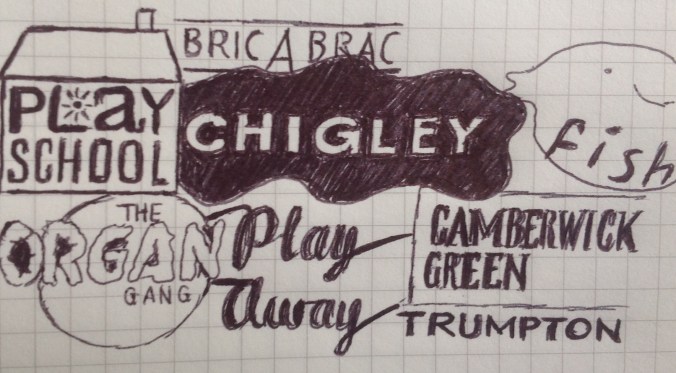
As I mentioned in last week’s blogpost, very little children’s TV was on offer in the 1960s and 1970s, and what there was existed in isolation. Often it was a single programme, a lifeline, a tiny island in an ocean of closedowns, interludes and testcards. Brian was often an inhabitant on these islands: Play School in the mid-morning on BBC2; Play Away the only children’s programme on Saturday afternoon while other channels broadcast hours of sport; lunchtime broadcasts for pre-schoolers, entertainment lasting just fifteen extremely precious minutes. In those latter lunchtime slots, Brian’s voice accompanied the action of Gordon Murray’s trilogy of stop-frame animated series, all set in the fictional county of Trumptonshire: Camberwick Green (1966), Trumpton itself (1967) and finally Chigley (1969). It was disappointing to hear on Radio 4’s Last Word this week that Brian was reportedly only paid a flat fee for his original voiceovers, and did not receive any royalties for their many repeats.
Brian began to fade from children’s TV in the mid-1980s – his last remaining link, Bric-A-Brac (1980–82), in which he played a shop owner who only stocked items beginning with the same initial letter, was repeated until 1987. Thereafter my encounters with Brian became sparser but each one was a delight, nonetheless. I reacted with surprise to his cameo in the final episode of the Esmonde & Larbey sitcom Ever Decreasing Circles (1989), having almost forgotten he was primarily an actor. (As well as a lot of theatre, his many TV acting credits also included Doctor Who, Dixon of Dock Green and Z Cars.)
I never really saw Dappledown Farm, Brian’s subsequent breakfast TV series for young children, but his self-parodic narrations of ‘The Organ Gang’ on Stewart Lee and Richard Herring’s This Morning With Richard Not Judy in 1998 were hilarious. ‘The Organ Gang’ was a consciously cheap cartoon about a cast of disembodied innards with faces (Barry Bladder, Beryl Brain, Lily Liver) – imagine a cross between Mr Benn, The Munch Bunch and indeed Camberwick Green. I enjoyed the way Brian gamely pretended to express apathy and even annoyance with the formulaic, threadbare scripts: in the last episode, he couldn’t even be bothered to sing the theme tune properly. I hope he enjoyed doing them, because his infectious sense of fun was still very much in evidence.
And then a few months later, early 1999, I heard the track ‘Fish’ by the artist and DJ called Mr Scruff on Chris Morris’s late-night Radio 1 series Blue Jam. It sampled Brian’s voice from two different sources, both records I had been given when very young. One came from the Camberwick Green story album, just straight transfers of Brian’s narration and Freddie Phillips’ music from the TV series, and it was specifically from a story where Windy Miller went fishing. The other, which took me a little longer to identify, familiar as it was, came from a 1972 compilation album of Play School stories, an item called ‘All the Fish in the Sea’, written by Janet Lynch-Watson, and told by Brian and co-presenter Carole Ward:
CW: ‘Why should it be that the fish in the sea are all unable to sing?
BC: ‘Just listen to me, young fellow/What need is there for fish to sing, when I can roar and bellow?
These were my first records, my first awareness (apart from books) of on-demand entertainment, to be played again and again, whenever I liked. Until I was doing research for this piece, I had not listened to the Play School record in many years. The last time I had played it was in 1980, when I was ten, and really much too old to be listening to it – but by then I had started buying pop singles and even albums for myself, and I played it knowing full well that I was about to bid farewell to something.
I last heard Brian Cant on Radio 4’s The Reunion in 2010, reminiscing about Play School itself. Most of his memories seemed to be less about him than his happy experiences with fellow presenters and encounters with the public who loved him. It just enhanced all the affection for this gentle, dignified, generous but fun-loving chap. It would be nice to think that a proper BBC tribute is being planned; I suspect generations of viewers would welcome it.
Brian Cant died on 19 June 2017, aged eighty-three. It would be fantastic if I could link to a
Brian Cant at the BBC DVD here. Make it happen, someone.
Andrew O’Hagan’s The Secret Life is published by Faber & Faber.
 FIRST LAST ANYTHING