FLA 21: Sangeeta Ambegaokar (16/07/2023)

When I was first thinking about First Last Anything, I knew I wanted to include a range of guests, including those who were learning and performing music at amateur level. And so I thought of my friend Sangeeta Ambegaokar, a medic based in Birmingham whose spare time outside her day job is these days dominated by music. She has weekly saxophone lessons and plays in an amateur orchestra for mixed ability players, called The Rusty Players Orchestra. She also sings in four different choirs in the city – and is a member of a bell choir.


Sangeeta kindly and helpfully shared her experiences of all these groups with me when we spoke on Zoom in the early spring of 2023 – since when she has achieved distinctions in her Grade 3 and 5 theory examinations. We both hope this conversation may inspire you, whether at beginner, intermediate or lapsed level, to seek out amateur or community groups in your area.


Sangeeta and I also talk about her formative years in the UK and the United Arab Emirates, about the Absolute 80s Sunday night show Forgotten 80s – which is how we met, as fellow listeners! – and of course discuss her first, recent and wildcard record choices. But as usual, I started with one question: what music was being played at home before she started buying records?


—-


SANGEETA AMBEGAOKAR

I was born in Newport, in South Wales. I don’t remember us having music in the house much, although the radio and Top of the Pops always featured highly, but early on, I can remember at bedtime – I don’t know if you’d call it a lullaby – my dad singing ‘All My Loving’ by The Beatles. We had the ‘Red’ and the ‘Blue’ albums.


I was three when ‘Save Your Kisses for Me’ by Brotherhood of Man came out, and at the end it goes, ‘Even though you’re only three’. You’re very egocentric about age then – you think everything would be about you, so I was of course convinced that it was written about me as a three-year-old.


ABBA was a big thing. I can remember being absolutely terrified of ‘Tiger’ [from Arrival]. ‘I am behind you, I always find you, I am the tiger.’ And Showaddywaddy as well, ‘Under the Moon of Love’, that kind of sticks.


I also remember going to a childminder, who had a record player, and things like ‘I Love You Because’ by Jim Reeves, and a copy of ‘The Laughing Policeman’ which had a scratch on it at a really inopportune time, on the last word – the last laugh in fact, on and on and on, so even more terrifying, and it’s quite terrifying anyway.


JUSTIN LEWIS

It really is. The guy who did that record, Charles Penrose, had a career of making all these records about laughing. Even though ‘The Laughing Policeman’ was 50 years old in the 1970s, they were still playing it on Junior Choice on Radio 1. I suspect that it was people writing in and requesting it for their grandchildren. Because I never met a child who liked it.


SANGEETA AMBEGAOKAR

When I was five, so from 1978 to 1991, we moved to the Middle East. And although from 1983 I went to boarding school back in the UK, for those first four years I’ve got this real gap in popular culture. In the UAE, we got quite a weird selection of things available to watch and to listen to. But the two ‘local bangers’ that everyone who lived in the UAE in the late 70s and 80s will recall are ‘Life in the Emirates’ and ‘Back in Dubai’.

‘Life in the Emirates’, The Establishment (1979)

‘Back in Dubai’, The Establishment & Sal Davies (1984)

By about 1982, around the time we got a video player, we used to go to the local video rental place. Somebody had recorded all the episodes of Top of the Pops in the UK and they’d send them over, so you’d get like a month’s worth of Top of the Pops to watch, four episodes, and then a great month when there were five episodes. It must have been summer ’82 – ‘Happy Talk’ by Captain Sensible was number one.


JUSTIN LEWIS

Were these official BBC tapes?


SANGEETA AMBEGAOKAR

I don’t think there was anything official about anything that went on over there! [Laughter]


JUSTIN LEWIS

Ah, I just wondered if it was a BBC World Service thing.


SANGEETA AMBEGAOKAR

I used to listen to the charts on the World Service, but it was really hard to hear. Before that, there used to be a programme on Dubai Television called Pop in Germany, which was all in German, and occasionally you’d see a band you’d recognise, like Boney M… which would figure, given it was from Germany. And we had a radio station that played music from all over. But with Top of the Pops, I vividly remember seeing one of these tapes of the 1000th episode, with Spandau Ballet’s ‘True’ at number one (original broadcast BBC1, 5 May 1983).


JUSTIN LEWIS

Oh yes, when they’d celebrate the programme, and say, ‘Let’s now look back at the old days, the five clips from the sixties we haven’t burnt.’ Cue ‘Pictures of Matchstick Men’ by Status Quo.


SANGEETA AMBEGAOKAR

And with these tapes of Top of the Pops, something similar happened again later with Live Aid (13 July 1985), though as you can probably imagine, this stretched to about five different video cassettes, and came in Part 1, Part 2, and so on. So we did manage to watch the whole of Live Aid in the UAE, but not actually in the correct order!


JUSTIN LEWIS

I saw you tweet a picture of one of your 80s compilation tapes yesterday. One of the tracks was by ‘TMTCH’ – presumably The Men They Couldn’t Hang?


SANGEETA AMBEGAOKAR

I seemed to have a cassette of them playing live so I must have taped it with one of those double cassette recorders. The song’s called ‘A Night to Remember’. I don’t want to upset any Men They Couldn’t Hang fans but in my view, the live version is much better. The album version sounds quite clunky.


JUSTIN LEWIS

The reason we know each other is because of something called Forgotten 80s, a radio show on Absolute 80s on Sunday nights, hosted and compiled by Matthew Rudd, with a considerable listener input, and quite a social media community has sprouted up around that over the years. With that show, have you found yourself joining dots you couldn’t join during the 80s? How did you discover that show?


SANGEETA AMBEGAOKAR

My other half was a fan of Forgotten 80s. At that time they used to repeat it on a Thursday, he’d be doing the ironing, and listening to it, and saying, ‘This is a great show, loads of forgotten tunes from the 80s’. I had imagined – nothing against The Fall – but that it would be that kind of obscure stuff which I wasn’t really into. And then one week, I heard them play ‘The Last Film’ by Kissing the Pink. And I thought, ‘God, I haven’t heard this on the radio for years.’ So I thought this show might actually be quite good. That must have been eight, nine years ago. Not quite since the beginning!


In 1983, I came to boarding school in the UK, in Monmouth, so from then, I’d see Top of the Pops when it went out, and there was Radio 1 so I was an avid listener. Mike Read was on the breakfast show at the time, and the signal to go to school was this feature he did called ‘First Love’.


JUSTIN LEWIS

Yes, with Scott Walker and the Walker Brothers’ record, ‘First Love Never Dies’, as the jingle!


SANGEETA AMBEGAOKAR

I’d latch on to any kind of music then. On TV, Fame. In those days, if you missed an episode, and we didn’t have a video recorder at school, then that was it. So I remember buying the cassette of the Kids from Fame album, really liking ‘It’s Gonna Be a Long Night’, and being really gutted I’d missed the episode that song was played in. But at the start of lockdown, I got the whole series on DVD, and started watching them.


JUSTIN LEWIS

So was Fame shown on television in the UAE?


SANGEETA AMBEGAOKAR

Yeah, on Dubai Television, which used to start at five o’clock with the reading from the Holy Quran.


JUSTIN LEWIS

Fame was massive in Britain because it was on straight after Top of the Pops, wasn’t it? In fact it did much better than in America, where I think it might otherwise have been cancelled because the ratings weren’t great there. And there were all these Kids from Fame albums. Were there two or three, a live one?


SANGEETA AMBEGAOKAR

I think I might have four of them!

—-

FIRST: FUN BOY THREE: ‘Tunnel of Love’ (Chrysalis, single, 1983)

JUSTIN LEWIS

So your first purchase was this, which comes from this same period.


SANGEETA AMBEGAOKAR

I’m renowned for liking this song so much. People now tweet me to tell me when it’s on.

I first saw them do it on Top of the Pops. I was mesmerised by the whole thing – the song, and also all the musicians they had playing with them, who were all women. So that really drew me to them. The cello player [the great Caroline Lavelle]! I don’t think I’d ever seen a cello on Top of the Pops before. I remember us being out at the shopping centre in Dubai, God knows how much it cost, because it was real, not pirate. My sister bought Orange Juice’s ‘Rip It Up’. So we each bought a single. And then my sister had a pirate cassette of Fun Boy Three’s first album, which I got a copy of as well, and then I got Waiting, their second album.


But the charts in general were a big thing. Remember when Simon Mayo on the Radio 1 breakfast show used to do Highest New Entry, Highest Climber and Number One at about 7.45? My life was run by bells when I was at boarding school. At twenty to eight, there was a bell: ‘Make sure you get over to breakfast, 7.45.’ And you couldn’t have music on during breakfast, but by then you could get these ear-pod-type headphones, and I’d have my Walkman in my pocket with a radio on it. I’d have the wire going down my sleeves and into my hand, so I’d tell everyone on the breakfast table what Mayo was announcing.


JUSTIN LEWIS

It’s hard to explain that era to anyone young now. There wasn’t music everywhere then. Radio 1 wasn’t even 24 hours a day. I remember at secondary school, taking a tiny little radio in on a Tuesday lunchtime, and Gary Davies would announce the brand-new chart. I don’t know what this says about me, but people from school still remember this about me! This stuff felt important then. But meanwhile, what was your involvement in music at school during this time?


SANGEETA AMBEGAOKAR

[I did various things at school.] At primary school, when I was five or six, I started playing the piano, my sister had lessons. So I looked at her piano book, it was John Thompson’s Teaching Little Fingers to Play. I think everyone had those back in the day. I started going through it, and teaching myself how to play the piano – probably not very well. And then mum and dad decided they should probably pay for lessons for me as well. Then, at secondary school, I started learning the violin because of ‘Come On Eileen’. But I quickly realised I was awful at the violin and it was never going to happen.


JUSTIN LEWIS

It’s a hard instrument. Professional violinists say this!


SANGEETA AMBEGAOKAR

I don’t think I have the patience either, because I think I’ve got quite a good ear for music, so I could hear it wasn’t in tune, and it was all about moving my fingers. I got really fed up with that. But I carried on with the piano, I was in the choir at school. And I’d played the recorder in primary school as everybody did. I was probably one of the better players at school, so a couple of us got to play a duet in a concert.


So I always had an aptitude for music, I guess, but then after that, year 10/11, it was all ‘you ought to be in the school opera and school performances’. It all looked a bit much, so I didn’t do any music at all after that.


JUSTIN LEWIS

There’s a lot of extracurricular activity, isn’t there, and it requires a lot of commitment. Not unlike being in sports teams. You have to give up evenings, and after school – if you’re going to take this seriously, I suppose.


SANGEETA AMBEGAOKAR

I had a brief foray into playing percussion in the orchestra in sixth form. They needed percussionists, and there were four of us. It was hilarious because I think a couple of us were okay, we had a decent sense of rhythm, but one of my friends, they put on cymbals, and she never quite came in on time. I stuck to tambourine and castanets – those were my specialities.

—-

LAST: DEPECHE MODE: Black Celebration: The 12” Singles (Venusnote/Sony Music, vinyl box set, 2022)

Extract: ‘Stripped (Highland Mix)’

JUSTIN LEWIS

We should perhaps explain that this isn’t the album of Black Celebration. This is a lavish repackaged box set that assembles all the 12” singles released from that album in 1986: ‘Stripped’, ‘A Question of Lust’ and ‘A Question of Time’, some of them released in multiple formats with extra mixes, B-sides and live tracks. They really seemed keen to give the fanbase value for money, and it’s beautifully packaged too.


SANGEETA AMBEGAOKAR

I’ve got this real affinity to the Black Celebration era of Depeche Mode. When we were in the USA in summer 2022, we were staying in Los Angeles, and nearby there was this big record shop called Amoeba Records. On our last day, we went in, and just as when I used to go into record shops, went straight to the Depeche Mode section. There were a few box sets of the different albums’ respective singles, but Black Celebration was the one. I was wondering: ‘Should I get this, because it’s expensive. And do I really need it?’


JUSTIN LEWIS

How much was it? Because it’s, what, five 12” singles? £100?


SANGEETA AMBEGAOKAR

It was less than £100, but it didn’t take a lot to talk me into it. It was an unexpected impulse buy. Depeche Mode was my first ever concert as well, at Newport Centre [The opening date of the Music for the Masses tour’s UK leg, 9 January 1988.] ‘Behind the Wheel’ had just come out, they started off with that.


JUSTIN LEWIS

So you saw them on the same tour at Newport that ended up in California, where they recorded the 101 live album, because it was the 101st and final date of the tour [18 June 1988]. Which of course led to a live album and a film, and you see this stadium of people all singing the ‘Everything Counts’ chorus at the end. And they become huge in America. But how did you first get into them?


SANGEETA AMBEGAOKAR

The first song I remember was ‘Get the Balance Right!’ on Top of the Pops, ’83, but just before I started boarding school the same year, if you bought a pair of Start Rite shoes, you got a free single from the top ten, and so I got ‘Everything Counts’ by Depeche Mode. I kept up with their singles – I remember Lenny Henry reviewing ‘Love in Itself’ in Smash Hits.

JUSTIN LEWIS

It was his Single of the Fortnight, I think.


SANGEETA AMBEGAOKAR

Yeah, and he was bowled over by it sounding like it had some proper instruments on it, rather than just synths. So he went, ‘Guys, are you okay?’ The other thing about ‘Love in Itself’ – I’m the sort of person who, if somebody says a word, I break into a song with the word in it. When I was a student, there was a bloke – it usually was a bloke – saying something like ‘You can’t come out with a song with the word “insurmountable” in it.’ And I went, ‘Well, actually…’


I got Some Great Reward (1984), then the Singles 81–85 compilation (1985), and then in Year 9, we had to do a project at school on music. I originally started doing my project on the Thompson Twins, but then I lost the book I was using, so I decided to do it on Depeche Mode, and nobody else seemed to like them, which I suppose drew me towards them even more. When I was writing their biography for the project, on how they came to be, I asked other people to write comments about them, and they’d either put, ‘They’re really boring and depressing’, or ‘I think their music is fab, but I don’t think much of their image.’


Their next album was Black Celebration, which I played over and over. Another girl who started at the school about then, was really into them as well, so we bonded over them.


JUSTIN LEWIS

You mentioned just now that you have teenagers. Do you keep up with new stuff through them?


SANGEETA AMBEGAOKAR

They’re 18 and 14. Yes, it’s a bit of a standing joke as to which songs that me and my other half have heard of that they’re listening to. Watching the Brit Awards with your teenagers is always quite amusing. Even my 18-year-old said, ‘You complain that all the songs sound the same’ – in fact she complained herself that all new music sounds the same! Which is quite interesting because our generation remembers our parents used to say that as well.


JUSTIN LEWIS

We’ve established that you had these forays into music at school. But then, years later, you are in an orchestra playing the saxophone. Tell me about how that came about.


SANGEETA AMBEGAOKAR

I’ve always been drawn to the saxophone, I guess. Especially with Spandau Ballet, the Steve Norman sax bits, and then ‘Your Latest Trick’ by Dire Straits. So it was always in my head. And then, one day, in around 2000, I bought a saxophone from a second-hand music shop near where we lived in Birmingham. I had one lesson at the time, and worked out that the fingering was the same as the descant recorder.


JUSTIN LEWIS

Yes, tuned to E flat rather than C, but otherwise similar. I learned alto saxophone when I was a teenager. And the flute, which I already played, was similar fingering, although again in C.


SANGEETA AMBEGAOKAR

Yeah. After that one lesson, work and life took over for a time. But we have this [organisation] called Birmingham Music Services, which goes into schools and does music lessons and has loads of ensembles, which are all free to join, they have them for all standards from beginners up to Grade VIII symphony orchestra. So if you play an instrument you can join any of the ensembles.


When they started doing lessons in the evenings at our local school and they opened it up to adults, I thought, This is my opportunity. I can actually have saxophone lessons now. At first they were full, but a couple of weeks before term started, I got a phone call: ‘We’ve got a space, someone’s dropped out.’ This was 2019, so a few months before lockdown, whereupon they switched over to Teams. And because of the singing, and having a good ear, and reading music, my teacher said after a few months, ‘It would be really good if you could join some sort of ensemble, you’ll progress much more if you’re playing with people.’ There was a real gap for adults in ensembles, as the Birmingham Music Service ensembles are only for school age children. If you feel you’re really, really good, obviously there are orchestras, but if you’re a learner or beginner, there’s a real gap.


After that, a friend sent me a link to an orchestra they found on Facebook, called the Rusty Players Orchestra, which was an offshoot of the People’s Orchestra, a charity based in West Bromwich. As you know, in orchestras, saxophones aren’t a central instrument, but as they were a saxophone-welcoming orchestra… So it’s for people who used to play when they were younger and would like to go back to playing or for people who are kind of beginner or intermediate and want to play in an orchestra.


I went along to rehearsal, in January or February 2020, and there was quite a motley crew of us. They’d welcome any instrument at all, they’d find music for you. So we had concertinas that were playing the violin part, for instance. It’s a proper range of ages too – our youngest player is from year 10 (so he must be 14 or 15) and our oldest player has just turned 80! Some started learning recently, but quite a lot were a good standard at school and are coming back to play.


JUSTIN LEWIS

Do they have similar projects elsewhere in Britain?


SANGEETA AMBEGAOKAR

They do, in places. There are two branches in South Wales actually: in Barry and Carmarthen.


JUSTIN LEWIS

Not in Swansea, unfortunately?


SANGEETA AMBEGAOKAR

Not at the moment, by the look of it, no.


JUSTIN LEWIS

I’ve been thinking about this a lot recently. I went back to the flute last year, after a long time away from it, and I thought, What on earth do I do with this now? Because I don’t yet feel good enough again to go and audition for a proper orchestra. And of course, with an instrument like the flute, they only have two or three in an orchestra anyway. But it sounds like there’s no formal audition process for the Rusty Players Orchestra.


SANGEETA AMBEGAOKAR

No, you just turn up. The first week I went, I probably played about three notes! I was too scared to play any more than that. I remember we were playing ‘Moon River’, me and a clarinet player. Both of us quite new, she was newer than me, but I was still anxious. We were both supposed to come in at a particular point, but neither of us did, we were too scared!


But now, our conductor is a student at the Birmingham Conservatoire and it’s a bit more relaxed. You come along, you have a go, it doesn’t matter if you can or can’t play, but the following week, you’re likely to be able to play more notes – and then you just keep going. So there’s really no pressure at all.


JUSTIN LEWIS

What are your plans in the near future with the saxophone?


SANGEETA AMBEGAOKAR

I’m lining myself up to do the Grade 6 exam.


JUSTIN LEWIS

Wow, you really are coming on in leaps and bounds. So what sort of things are you learning in your lessons? What’s your repertoire in those?


SANGEETA AMBEGAOKAR

A mixture, really. One of my pieces is Scott Joplin. I often just turn up with things, but one thing I really want to be able to play is the sax solo from ‘Will You’, the Hazel O’Connor song. It’s really really hard.


JUSTIN LEWIS

It’s a long solo too. Two minutes or so!


SANGEETA AMBEGAOKAR

And with Grade 6, you’re first starting to learn those top notes anyway. So that’s a bit of a work I progress. And in the orchestra, we’re playing a lot of film stuff: Hamilton, Chicago, Blues Brothers. It’s quite a nice range.


—-


SANGEETA AMBEGAOKAR

As well as the Rusty Players Orchestra, I’m in four choirs and a bell choir. The biggest choir is called So Vocal, and it’s the community choir of the City of Birmingham Symphony Orchestra, which is 150, up to 200 singers in that. And we’d sing with the CBSO every Christmas in the Christmas Concerts which is amazing. We started off being the free performance before the concert, and then we graduated to singing in the concert. Clearly, they thought, ‘Actually, they’re not too bad!’ We ended up going on tour to Poland.


I’ve made some really good friends through that. About two years ago, me and a friend went to an experience day with the London Community Gospel Choir. You have a day of learning songs, and in the evening, you join one of their rehearsals. A few of us go to this summer school as well, which is called Sing for Pleasure. It’s a three-day course, you learn some songs, and then there’s a concert at the end. You don’t have to think at all for three days, it’s like a holiday from life! One year, our group was taken by Themba Mvula, who runs a gospel choir in Lichfield, and he’s just out of this world. When you sing, you’re encouraged to go a little bit off-piste if you want to, make your own stuff up, sing as you feel. And though I’m not somebody who really does that, actually you find yourself coming out with stuff.


JUSTIN LEWIS

Is it like improv?


SANGEETA AMBEGAOKAR

Sort of. It’s like pretending you’re a bit of a diva. It’s quite a lot of fun, actually. You have that moment, and everyone else – who are all like-minded – has a bit of a go.


JUSTIN LEWIS

The first time I actually met you in person, it was at a Forgotten 80s event, and there was a karaoke bit, and you seemed well into that. Have you always been?


SANGEETA AMBEGAOKAR

I don’t do karaoke, generally. If there is karaoke, I could be persuaded to join in. But I would never say, Let’s go and do karaoke.


JUSTIN LEWIS

Does that mean, then, that you like having rehearsal and preparation time? The learning process.


SANGEETA AMBEGAOKAR

Not specifically. I think it’s just, you might have had a day at work where your brain is full of stuff. It’s just doing something totally different from that – singing and making music with people. You’re using a different part of the brain, so all the things you were doing earlier are forgotten.


The choir I’ve been in the longest is a Ladies Choir called Bournville Vocal Ease which is based close to where I live. When my daughter started at the local school, one of the parents was talking about a choir there, and I thought, God, I’d love to join a choir. Within the school is a carillon, and they’ve got a set of handbells they lend the school. In Year 6, all the children learn how to play the handbells, and so when our Ladies Choir conductor decided to form a bell choir, I joined that. I’ve been in that about six years or so. We play with bell plates.


JUSTIN LEWIS

I was watching the YouTube clip where your group does ‘Singing in the Rain’. That would require a particular kind of co-ordination, even if you’ve only got two bells to play.

SANGEETA AMBEGAOKAR

Well, not necessarily only two! Sometimes you’ll have five bells, and you have to swap and pick up the right one and they change key often. And then sometimes the person next to you can’t play that bell because they’ve got too many notes, too many bells already, so someone else has to step in and play their bell temporarily! It can be quite complicated – and you have a proper musical score as well, so you go through and highlight your bells. What’s really amazing, though: there’s a couple of people in the bell choir that actually can’t read music, but they’re playing from a score and they’re actually just learning what their notes look like and highlighting them and learning how to count.

ANYTHING: RICHARD SMALLWOOD: ‘Total Praise’ (composed 1996)

London Community Gospel Choir, ‘Total Praise’

SANGEETA AMBEGAOKAR

In one of the choirs I’m in, the So Vocal choir, we sing a real mixture of stuff, and our conductor introduced us to this piece by Richard Smallwood, ‘Total Praise’. I think this was our first real foray into gospel singing, although we’re not a gospel choir and I’m not religious at all. But singing gospel music, something about it takes you somewhere else, so when we all sang it together, it was a powerful experience. We sang it in a few concerts, and then a choir member passed away, and at the next rehearsal after we heard the news, we all decided we wanted to sing it as a tribute to him. It’s something that feels like it draws us all together, wherever we are. All the arrangements that I’ve heard of it blow you away.


Some of the choirs I’m in are relatively straightforward, but I’m also in this a capella choir, Cantoras. Really challenging, and I had to audition on Zoom. We sing in Latin and German, even Norwegian, all sorts.


JUSTIN LEWIS

I found a clip on YouTube, which I enjoyed watching.

‘Sing My Child’, composed by Sarah Quartel, performed by Cantoras Upper Voices Chamber Choir

SANGEETA AMBEGAOKAR

I went to a taster day. You could go along and sing, and then if you wanted to audition, then you could. And I realised: I know I can sing, I can read music. A lot of the people in Cantoras are musicians or singers who do it for a living or teach music, so it’s a different sort of group. In some of the choirs, I’m one of the stronger musicians, whereas in Cantoras, I’m one of the weaker ones. But that lifts you, it stretches you, and I guess doing the other choirs has given me the confidence to do something new and exciting and challenging that I wouldn’t have done before.


Interestingly, I’m a different voice part in each choir: Soprano 1, Soprano 2, Alto 1 and Alto 2. Just because, for various reasons, the first choir I went to, I was a soprano because they didn’t have enough of them. Second choir, they said, ‘Soprano or alto?’ and I said, ‘I don’t mind’, and they were, ‘Well, we need more sopranos.’ With the third choir, they had too many sopranos, and I fancied a change, so I was an alto.


JUSTIN LEWIS

Where would you say you belong most naturally in terms of vocal range?


SANGEETA AMBEGAOKAR

I’m probably not quite a Soprano 1. I’m a fairly comfortable Soprano 2, but I can sing low as well. With the choir I auditioned for, where I’m an Alto 2, she did a range test, and I could hit the Alto 2 notes.


With the Cantoras group, we went to see an a capella group recently called Papagena – an all-female vocal quintet. They’re well worth looking up, and quite an inspiration because one thing we try and do is sing songs by female composers or arrangers, and we’ve sung a song that they’ve done as well, called ‘When the Earth Stands Still’. I don’t know if that’s on the YouTube channel. It’s nice to do things for fun, but also to stretch yourself. You might be at an age where you think your best days are behind you, but perhaps that isn’t the case! 


—-


You can follow Sangeeta on Bluesky at @mango24.bsky.social. She is also on Threads at @mango___24.

 For more on The Rusty Players, visit The People’s Orchestra website, where you can also find information on The People’s Show Choir. They have branches around the country. https://thepeoplesorchestra.com/the-rusty-players-orchestra/

If you’d like to know more about Sing For Pleasure, who organised the singing summer school Sangeeta mentioned, see here: https://singforpleasure.org.uk/. The charity focuses on the enjoyment of singing, trains choral leaders, publishes some excellent songbooks, and runs events for singers. 

This is an excellent resource for details of amateur orchestras across the UK: https://amateurorchestras.org.uk

The radio show we mentioned, Forgotten 80s, hosted by Matthew Rudd, is broadcast on Absolute Radio’s Absolute 80s station every Sunday night between 9 and 11pm. You can listen to episodes here.

 —-

FLA 21 PLAYLIST

Sangeeta Ambegaokar

(For the time being, this site and project uses Spotify for the conversation playlists, but obviously I disapprove that Spotify doesn’t pay artists and composers properly, and other streaming platforms are available, as are sites to buy downloads and buy recordings. For consistency, you can also listen to the selections via YouTube (where available), and links are provided in each case, below.)

Track 1: THE BEATLES: ‘All My Loving’: https://www.youtube.com/watch?v=LdajVoRgx3w

Track 2: BROTHERHOOD OF MAN: ‘Save Your Kisses for Me’: https://www.youtube.com/watch?v=5yJUi6ke71I

Track 3: ABBA: ‘Tiger’: https://www.youtube.com/watch?v=htziQt0pCAQ

Track 4: THE MEN THEY COULDN’T HANG: ‘A Night to Remember’ [5 Go Mad on the Other Side Version]: https://www.youtube.com/watch?v=dtV1m_UjD-8

Track 5: KISSING THE PINK: ‘The Last Film’: https://www.youtube.com/watch?v=WuRdrAoroSw

Track 6: THE WALKER BROTHERS: ‘First Love Never Dies’: https://www.youtube.com/watch?v=KszX9WAas-0

Track 7: THE KIDS FROM FAME: ‘It’s Gonna Be a Long Night’: https://www.youtube.com/watch?v=tWLwcfw3C-s

Track 8: FUN BOY THREE: ‘Tunnel of Love’: https://www.youtube.com/watch?v=Qi7BXqmYxiw

Track 9: DEPECHE MODE: ‘Stripped’ (Highland Mix): https://www.youtube.com/watch?v=_Dx9ZvpUD8U

Track 10: DEPECHE MODE: ‘Behind the Wheel’: https://www.youtube.com/watch?v=VEAuMiKqP-4

Track 11: DEPECHE MODE: ‘Love in Itself’: https://www.youtube.com/watch?v=1pi_egc6qkY

Track 12: DIRE STRAITS: ‘Your Latest Trick’: https://www.youtube.com/watch?v=blPf0-WphFQ

Track 13: HAZEL O’CONNOR: ‘Will You?’: https://www.youtube.com/watch?v=PDa-uPzlzDg

Track 14: DONNIE McCLURKIN & RICHARD SMALLWOOD: ‘Total Praise’: https://www.youtube.com/watch?v=U8NIr9fqLBQ

Track 15: DON MacDONALD AND PAPAGENA: ‘When the Earth Stands Still’: https://www.youtube.com/watch?v=tJmbEecjjMA

FLA 6: David Quantick (10/07/2022)

The Emmy-award winning David Quantick began writing for a living in the early 1980s, shortly after studying law at the University of London, and has barely stopped since. For thirteen years, he was at the New Musical Express, where he originated a torrent of reviews, articles and thinkpieces. There, his association with the late Steven Wells on such anarchic, hilarious columns as ‘Ride the Lizard!’ led to feedback from a young BBC radio producer called Armando Iannucci. Over thirty years after the astonishing On the Hour for Radio 4, David has continued to be a part of Armando’s writing team on such internationally acclaimed television projects as The Thick of It, Veep and most recently Avenue 5.

Frankly, David has written so much, there isn’t room to list it all: sketches for Spitting Image and The Fast Show, the first-ever internet sitcom (2000’s The Junkies, written with Jane Bussmann), Chris Morris’s Brass Eye and Blue Jam, and ten years of Harry Hill’s TV Burp, amongst many, many other things.


In recent years, David has turned to novel writing – his seventh novel, Ricky’s Hand, is out now – as well as writing the screenplay for the 2021 romcom feature film Book of Love, starring Sam Claflin and Verónica Echequi.


I have been a fan of David’s work since the 80s, and have since got to know him a little bit too, so was delighted when he agreed to join me on First Last Anything to discuss his love of music. And so, one morning in May 2022, he told me about his formative years in Plymouth and Exmouth, the appeal of K-pop, and how to review a new pop record. We hope you enjoy it.


DAVID QUANTICK

In the 60s, at first we didn’t have a record player, and then at some point, we got a Dansette from our neighbours Pam and Tony. For me, it was quite an influential thing because the records that came with it were some novelty singles: ‘Itsy Bitsy Teeny Weeny Yellow Polka Dot Bikini’, ‘Seven Little Girls Kissing and Hugging with Fred’, and there were some Val Doonican albums with novelty songs on like ‘Slattery’s Mounted Foot’ and ‘Paddy McGinty’s Goat’. But there were also two Goon Show albums, Best of the Goons, volumes one and two, my first exposure to recorded music.


Meanwhile, my dad used to love opera. We didn’t have any in the house, but he used to go a lot to the opera, and used to say it was rubbish if it was in English. If you could understand the words, it was no good. And he also used to go to musicals. He worked in London just after World War II, so he saw an amazing amount of original British productions of things like South Pacific and Oklahoma!


But what really takes me right back to my childhood is Nat King Cole. We had an album called The Nat King Cole Story, and it had links narrated by, I think, Brian Matthew. I still love Nat King Cole’s voice.


Later on, my parents were in the Readers Digest book and record club, so we had lots of Readers Digest box sets – country music, pop music, bit of classical. They liked Howard Keel, the light opera singer – and they liked The Carpenters, although my parents hated the fuzz guitar solo on ‘Goodbye to Love’ – I think they just thought it was a bit much.


JUSTIN LEWIS

That solo’s like something invading from a different world.


DAVID QUANTICK

It does work for me, but it is a bit like having Jimi Hendrix on the Nat King Cole record.


JUSTIN LEWIS

‘Yesterday Once More’ by The Carpenters is, I think, the first pop song I remember being a current, new record. Round about 1973. It’s weird to have, as one’s first-hand memory of pop music, a song that’s about nostalgia.


DAVID QUANTICK

The first like that I remember is ‘Hello Dolly!’ by Louis Armstrong, followed by ‘A Hard Day’s Night’, and that would have been on the BBC Light Programme. I would have been very little. 1964. Yeah, and I also remember my first TV musical memory – because we never watched Top of the Pops – was seeing John and Yoko getting off an aeroplane on the news [1969], wearing white suits like characters in The Champions.


JUSTIN LEWIS

What do you remember about school music lessons?


DAVID QUANTICK

There was ‘banging things at primary school’. The BBC used to do these schools radio programmes called Time and Tune – there’d be an accompanying magazine and you’d play along with xylophones. The one I remember was basically making space sounds.


JUSTIN LEWIS

Time and Tune ran for years. We had that at infants school. A different story project every term. This sounds like it might have been ‘Journey into Space’ (first broadcast, spring 1965, repeated spring 1968).


DAVID QUANTICK

For years, with the Carpenters, I was convinced that the song we practised in the Time and Tune lessons was ‘Calling Occupants of Interplanetary Craft’ (1977), but obviously, as I would realise later on in life, that would have been impossible.


JUSTIN LEWIS

And did you learn any musical instruments?


DAVID QUANTICK

When I was briefly at public school, I had piano lessons and the teacher asked if I was left-handed. I had oboe lessons and I got the cleaning feather stuck in that thing. I bought an acoustic guitar from the Burlington catalogue, the less famous version of the Freemans catalogue. And I think it was the obligatory Kay acoustic, because Kay made all the guitars that poor people had, and I couldn’t tune it. So I gave that up. That was my musical education as a child.


 —-

FIRST: WINGS: ‘Mull of Kintyre’ (1977, single, Parlophone)

JUSTIN LEWIS

So, the first single you ever bought. I think at the time the best-selling single there had ever been in Britain. Two million sales.


DAVID QUANTICK

Yeah, it outsold ‘She Loves You’ which made Macca very happy and Lennon less so. There was a great lie that I told for many years. When people asked me my first single, I used to tell them it was ‘Airport’ by the Motors, which was the second single I bought.


I had a school friend called Ewan, and whenever I talk about The Beatles, he still likes to say how embarrassing it was that I was a Beatles fan at school in the sixth form. This was just after punk, it was 1978, the Sid Vicious era of the Sex Pistols, Sham 69…  Now, we have this world of Beatles obsession and Beatles podcasts and remixes and all that. But back then… it wasn’t that the Beatles were loathed, but they were considered ‘boring’. They were summed up by ‘the Red and the Blue albums’, no-one had any of the other albums, and ELO had come along and stolen their crown and shat on it… Liking the Beatles, as I did, was just so naff. Ralph Wiggum would have liked The Beatles in 1978. And owning ‘Mull of Kintyre’ was even worse, I think.


JUSTIN LEWIS

When I was first obsessed with pop music in the early 80s, Lennon had just died, so there was still a lot of ‘John’s the best Beatle’, but my other big obsession was TV comedy, and it soon became clear that Paul McCartney had become the whipping boy in comedy for everything that was square in pop music. I think that only really started to move on when he collaborated with Elvis Costello at the end of the decade [on Costello’s Spike and McCartney’s Flowers in the Dirt]. Costello did this interview where he just went, ‘Why’s everyone so rude about McCartney? He’s written more great songs than almost anyone else.’ I’m paraphrasing, but that kind of thing.


DAVID QUANTICK

Flowers in the Dirt was interesting, not just for having Costello, but it marked the beginning of McCartney just going, Fuck it, I’m not gonna do records that sound like everybody else. Then there’s the production shift. Every so often now, he’ll do a record with Nigel Godrich or Mark Ronson, but he’s basically saying, ‘I’ll just do what I want.’


JUSTIN LEWIS

I wondered if Anthology (1995–96) was what really cemented The Beatles, because they’ve never really gone away since then. In the 70s, when I was a child, I don’t really remember hearing The Beatles on the radio. They might well have been played, but I just don’t remember it.


DAVID QUANTICK

It’s like if you went to a disco, as they were called then, a student disco, or a 60s night, you’d never hear The Beatles, even though some of their records are real stompers, like ‘Got to Get You Into My Life’ or ‘Get Back’… But you couldn’t play a Beatles record because it stands out too much, it’s like entering a lion in a cat show. It just doesn’t work in that context, even though in a real sixties disco, you would have followed the Kinks’ ‘You Really Got Me’ with ‘Day Tripper’ or whatever. I would love to see, actually, a transcript of a real 1966 DJ’s setlist. If there ever was such a thing.


JUSTIN LEWIS

And you rarely, if ever, get the Beatles on multi-artist compilation albums.


DAVID QUANTICK

No, absolutely, and that’s why [Starsound’s] ‘Stars on 45’ (1981) was such a hit because you could go to a disco and dance to The Beatles. I mean, the legals were probably quite powerful on Beatles stuff on compilations. Like it’s weird when you watch a film and there’s a Beatles song in it. ‘How the hell did they clear that?’


JUSTIN LEWIS

Just going back to ‘Mull of Kintyre’. You’d have been sixteen when it came out, and that does seem – if you don’t mind my saying, given what a massive fan of pop music you are – quite a late start for a first single. I mean, presumably, you were borrowing stuff from friends, or taping stuff off the radio – was there a record library?


DAVID QUANTICK

No, I didn’t have any of that. I liked comedy. As I say, it was rare for me to watch Top of the Pops, though I remember Alice Cooper’s ‘School’s Out’ because obviously I was at school. Queen’s ‘Killer Queen’ seemed a bit like a Gilbert and Sullivan or a Noël Coward song. But I would enjoy the Wurzels, the comedy records. I didn’t get rock. I literally didn’t. I preferred classical music. And I had some albums: Dark Side of the Moon which sounded amazing, and I had a Mike Oldfield box set which I loved…


I had changed schools a couple of times, felt a bit isolated, didn’t have a lot of friends, stayed in a lot. But then in the sixth form a couple of other kids came from different schools, and I became friends with them. They were popular kids and they liked punk and they liked John Peel. So I kind of skipped the entire history of rock music. I was hearing The Clash for the first time at the same time as I was hearing Motown for the first time.


JUSTIN LEWIS

So when people talk about punk as ‘year zero’, you actually experienced it like that, because in a sense, you had no reference points. Or if you did, they were all from different areas of culture.


DAVID QUANTICK

Yeah. It was easy to get into punk and I started to understand riffs and why ‘dang-dang-dang’ was good, but I also like categories, and it was easy to spot what was punk. Olivia Newton-John wasn’t punk. The Dickies were. You felt a bit cool because you didn’t like disco – though obviously now I love disco. These were my new friends, and I liked what they my new friends liked.


And you could go to Lawes Radio which was a local music shop in Exmouth, selling radios and electronic equipment, but they subscribed to the indie chart so they would have Crass singles in the window display. And they were really nice people, but they knew they couldn’t compete with [WH]Smiths. They had a ‘30p Box’ that seemed to be crammed with early XTC singles.


JUSTIN LEWIS

One of the aims of this series is to emphasise how record collections, especially early on, are almost accidents, because they’re based on how much money you have at that moment. What have the shops even got in stock? You might go to the shop expecting to buy Record X and they haven’t got it, but they have got record Y which is a bit cheaper. And also they’ve got that thing in the 10p bin which looks interesting. You’re buying a lot of things on a whim, you’re not curating it – that terrible word.


DAVID QUANTICK

It’s probably a bit more random. I would buy things that I’d heard, and I’d be embarrassed later. I had a single by a band called The Autographs called ‘While I’m Still Young’ (1978), which is great. It was a Mickie Most-concocted punk band, and it came on – I think – yellow vinyl.


JUSTIN LEWIS

I’m not familiar with this one! The mention of Mickie Most suggests it was on RAK Records.


DAVID QUANTICK

I think it was RAK, yeah. 30p. And I’d heard it on Roundtable, on Radio 1, and I loved it because I didn’t know any better. Of course I got rid of it when I realised… no-one ever told me to get rid of it, but I did. Now I look it up online and it’s not revered but it’s well-respected glam punk… It’s great. ‘While I’m Still Young’ – sung by some men who weren’t still young.


JUSTIN LEWIS

Knowing you a little bit, and hearing you on various podcasts and interviews talking about your early forays into writing, it occurs to me that you got into music journalism in the 80s, not directly because of music, but because it provided you with an outlet to write what you wanted. Because a lot of your background was liking comedy and novelists. And when you went to, particularly, the NME, in those days, you could write about authors, or cult films, or anything really. Didn’t you review the singles in the NME once as a Flann O’Brien parody?


DAVID QUANTICK

No, I wrote the gossip column as The Brother from Cruiskeen Lawn. It’s easy to parody. It’s basically: ‘This morning such and such happened’ and the other bloke who’s Flann O’Brien is going, ‘Is that a fact?’ So it’s a really good structure. I think we got one letter accusing the anonymous gossip column writer of racism. Because of course, there was no context, I didn’t explain this.


But it was great because you had to fill a weekly paper, all this space. The Thrills! section was meant to be interviews with up-and-coming bands, but there weren’t enough of those, so me and Stuart Maconie and Andrew Collins would fill it with comedy.


JUSTIN LEWIS

Somebody circulated on Twitter recently that Rock Family Trees parody the three of you worked on. An epic, incredible piece of work.


DAVID QUANTICK

They let us do anything then. And Stuart and Andrew were seconds away from being on Naked City on Channel 4 as columnists [co-hosted by the teenage Caitlin Moran], and I was a writer on that. But I hadn’t really fitted in at the NME in the 1980s, I hadn’t really liked the music. Then there was a sort of golden age when Alan Lewis and Danny Kelly were editing it [1987–92] – and I became friends with Andrew and Stuart. It was this wonderful thing when the NME was funny. You could write parodies, fake interviews. Working with Steven Wells [aka Swells] as well – we had two pages a week to write anything, which ended up with us working for Armando Iannucci.


JUSTIN LEWIS

Yes, apparently the piece he spotted was about classical music and how all stringed instruments are different-sized guitars. Like the cello is in fact a massive guitar.


DAVID QUANTICK

I’m always convinced that got us the job writing for On the Hour. Maybe because Armando didn’t like rock! Just to trot out my favourite cliché: the NME was ‘Cambridge for losers’. There’s a reason why me and Steven were one of the few writing teams in comedy who didn’t have an Oxbridge or public school education. And that’s because of Armando, you know – the back door route.


JUSTIN LEWIS

I saw you write the phrase ‘Nostalgia isn’t reviewing’ recently. As a reviewer, do you think your first impression of a record should be the one you stick with, regardless of whether you change your mind later?


DAVID QUANTICK

In real life, if you buy a record, and you play it, you love it because it’s by your favourite band, but you don’t really like it yet, because it’s a load of new music to take in. But you keep playing it, and generally the more you play it, the more you love it. You might even go back and play a record you hated but, because you’ve heard it every day, you love it.


But in terms of writing a review for a new record, you’ve only got your first impression. Your job is to try and imagine what you will think of it in the future, having heard it once. You’re livetweeting, to use a modern phrase, playing a record for the first time. What it sounds like compared to other things. Where does it fit in? And if you revisit an old review from a weekly music paper, there should be references in it that you won’t understand now. Like HERE COME THE HORSES or something. Because there should be references to where it fits that week ‘in June 89’. What I loathe, by the way, about Wikipedia, is they say things about old records like ‘allmusic.com gave it three stars’. Who cares? I want to know what Melody Maker said at the time.


JUSTIN LEWIS

When I was about 18, in the late 80s, I probably spent more on music magazines than on records. Lots of the reviews was stuff you wouldn’t hear about, unless you happened to hear Radio 1 at the right moment, so you had to rely on a critic to convey what it might be like. That review had to work on the page as a piece of writing.


DAVID QUANTICK

I would have little rules when reviewing. I would always try and describe the music, but also name some of the songs, and maybe some lyrics, to give people something to hold on to. And I’d make comparisons, so say, the Wonder Stuff’s ‘Size of a Cow’: ‘It sounds like crusties doing Madness.’


JUSTIN LEWIS

Which were useful, especially with records that Radio 1 might not play.


DAVID QUANTICK

With most of the NME bands, you could hear it on John Peel or the Evening Session. But when I started at the NME [1983], I got to interview the bands who nobody else wanted. Eddie and Sunshine, for instance, who were great. Or a bloke who’d been in Pilot. Records nobody else wanted to review. These were records you wouldn’t hear on John Peel. I reviewed Nikki Sudden records, because I’d liked Swell Maps, and they’re now re-evaluated as classic indie, but he wouldn’t get an interview in the NME because he was ‘five years ago’ and John Peel wouldn’t play it. Because he was like pre-Primal Scream. He was trying to make 60s rock music in an indie studio.


JUSTIN LEWIS

For me, as a young person, there was also Saturday morning TV, or stuff in the afternoons. Which you don’t get anymore. And you could get quite unlikely bands in there because the music bookers have to fill the space, and so you could get quite leftfield music on kids’ TV. I once saw Pere Ubu acting as the musical interlude on Roland Rat – The Series [BBC1, 25/07/1988].


DAVID QUANTICK

I remember seeing Buzzcocks on a Saturday morning show, doing ‘Are Everything’.


JUSTIN LEWIS

I think that might have been Fun Factory [Granada, 1980].


DAVID QUANTICK

I also remember going with my friends Miaow, Cath Carroll’s band, to Alton Towers where I think they were filming Hold Tight! [ITV’s quiz and music show for children filmed at a theme park. This was the last episode, TX 23/09/1987.] It was a really weird day because I met Graham Stark from Peter Sellers’ stuff, who was sitting in a car (‘Are you Graham Stark?’ ‘Yes I am’) and Miaow were on, and Thomas Lear was on who’d been on Mute Records in the early 80s. It was more NME than the NME.


—-

LAST: PSY: ‘Gangnam Style’ (2012, single, YG)

JUSTIN LEWIS

I don’t notice lots of people my age championing K-pop, but you very much do.


DAVID QUANTICK

Like millions of people who aren’t sixteen, the obvious entry point with K-pop for me, about ten years ago, was ‘Gangnam Style’ by PSY. I love a novelty record, which stands out and isn’t like anything else. And then I discovered that I really liked K-pop, because bands like Girls’ Generation of Wonder Girls had taken the Girls Aloud template: largely five-piece female bands with really good dancefloor singles, and really great choruses.


Then I was writing a book set in the world of K-pop, which gave me excuses to immerse myself in Korean culture: movies, books, history, North and South. I also became obsessed with North Korean music – which is something we won’t go into now, but one of my proud moments was watching that Michael Palin series about North Korea. He was in a cafeteria there, and I recognised the song that was on in the background. It was ‘Let’s Work’ by the Moranbong Band. That made my day.


Then my wife Jenna really got into K-pop, we watch K-dramas together, and she’s a massive BTS fan, an expert in fact. I’m less a fan of BTS as a group, but their solo stuff… they were a rap crew but in various rap teams and their solo mixtapes are astonishing. They’re downloadable for free. If you just put ‘BTS solo mixtapes’ in Google, you can get the one by Agust D which is actually Suga from BTS. There’s a brilliant song called ‘Daechwita’ which I can’t pronounce.


This is quite common now, but about four years ago, I went into HMV in Maidstone, and I was shocked to see a separate K-pop section in there. All these big boxes, costing £30, containing a CD, often just an EP and photos and notebooks and stuff. My wife tells me that BTS get in trouble with the charts for that because including promotional material makes your album non-eligible for chart status. The sales of CDs are not counted. Also, BTS have released their new hits compilation with four unreleased demos on CD, which is doing the fans’ nuts in because they haven’t got CD players – because they’re kids.


But because of these K-pop boxes, they don’t integrate into the rest of the shop, and it makes K-pop look separate in the way that The Beatles were.


JUSTIN LEWIS

What’s your perception of how British media treats K-pop?


DAVID QUANTICK

I’ve seen two approaches. The NME one, which is the current way of treating everything in the same breathless news way. And there’s the way the posh broadsheets treat it, which is like the sniffy way they used to treat pop. I’ve seen reviews of BLACKPINK and I start screaming at the computer. They don’t mention that none of the tracks from the last EP are on the album. They don’t mention the multiracial mixed line-up of the band. All they do is write, ‘I don’t really like this kind of music, but it reminds me a bit of something I do remember from the 90s’. It’s like reviewing The Osmonds. The sneer is back.


But what really gets on my nerves is that television still makes these documentaries where a light entertainment presenter goes to Seoul and has some weird food and says a few words of Korean and then goes to a karaoke bar… It just drives me absolutely spare. We’re still doing the funny foreigner approach?!


I like K-pop, not just for me to keep up with new music, but also because I find, due to my age and the circles I move in, that you’re always being dragged down by the hands of the dead. It’s so much easier for me to fill my iTunes with old stuff. I just bought a Bryan Ferry live album in 2020 in which he perfectly recreates some songs from fifty years ago. I just bought some Luxuria because I hadn’t heard much Howard Devoto stuff. I’m constantly buying old music that’s nice to have on the computer, but really I would like the percentage to be reversed: to buy 5 per cent old music, and 95 per cent new music.


But when you listen to the average pop single now, if you take off the vocals, it sounds like something John Peel would have played in 1983. Cutting things up, raps, post-post-post-sampling, post-post-Pop Will Eat Itself. Pop music now is NUTS. What I’ve been recently doing is driving around with Radio 1 on, and the records stop sounding the same when you hear them all together in a bunch.


JUSTIN LEWIS

Radio 1’s great at the moment, I think.


DAVID QUANTICK

The DJs are generally quite funny and, at worst, unobtrusive. An afternoon with Radio 1 is quite interesting these days. Yeah, there’s a lot of generic stuff, but even so.


JUSTIN LEWIS

My two favourite radio stations now are Radio 1 and Radio 3 and although they’re entirely different in presentation, I like that both stations are playing about 80 per cent stuff I don’t already know. Radio 2 drives me up the wall a bit. They have a habit of turning records you used to love into wallpaper.


DAVID QUANTICK

If you turned on Radio 2, now, any time, what’s playing? What’s the record? I’ll tell you mine.


JUSTIN LEWIS

It feels like it should be ‘We Built This City’.


DAVID QUANTICK

See for me, it’s ‘You Keep It All In’ by The Beautiful South. I’ve got no evidence for this.


JUSTIN LEWIS

In the early 90s, when Radio 2 was still quite MOR, it felt like any time it came out of a news bulletin, they’d start the next hour with ‘Going Loco Down in Acapulco’ by the Four Tops. [Laughter]

 —

ANYTHING: PADDY MCALOON: ‘I’m 49’ (2003, from I Trawl the Megahertz, Liberty Records, reissued under Prefab Sprout name, 2019, Sony Music)

JUSTIN LEWIS

Was this Paddy McAloon solo record a big surprise to you, given how different it was from usual Prefab Sprout records?


DAVID QUANTICK

It wasn’t a big surprise because I’d got used to the idea of artists doing something completely different and there were loads of reasons for Paddy doing it, to do with his health.


JUSTIN LEWIS

Now reissued under the Prefab Sprout name.


DAVID QUANTICK

That repetition of ‘I’m 49, divorced’. The way Paddy had slowed the voice down to make it sound more melancholic. It was like a Gavin Bryars record.


JUSTIN LEWIS

It really is reminiscent of ‘Jesus’ Blood Never Failed Me’.


DAVID QUANTICK

With Prefab Sprout, I hadn’t really been a fan. I liked some odd songs by them, ‘Cruel’, stuff on Swoon, the first album. But it sounded a bit old school – corporate and irritating at the same time. Like I loathe Steely Dan and that kind of jazzy pop. But then I heard ‘I’m 49’ and it was brilliant. Makes me like Prefab Sprout a bit more.


JUSTIN LEWIS

At one point on ‘I’m 49’, in this mass of sampled voices from radio phone-ins, there’s a sample of someone going ‘What’s wrong?’ Which I thought sounded not unlike your voice, strangely enough. Turns out it was apparently Jimmy Young [then of Radio 2, doing the Jeremy Vine phone-in slot]. And it also makes me think of Chris Morris’s Blue Jam series on Radio 1, which of course you wrote on, and I don’t know if Paddy had heard that. That mixture of comforting music and disturbing voices.


DAVID QUANTICK

It reminds me of Different Trains by Steve Reich as well. The voices cutting in like a countermelody. But with I Trawl the Megahertz as a whole, I’m a bit like the person who went to see David Bowie in 1970, just so they could hear ‘Space Oddity’. I play ‘I’m 49’, but I don’t really play the rest of the record.


It’s so out of character, for Paddy McAloon to do something that’s not song based, because he’s such a song obsessive. It’s obviously to do with the way he felt at that point. Middle-aged pop stars either ignoring it like Mick Jagger, or to start eating yourself like Bowie referencing himself on The Buddha of Suburbia. Or McCartney making Britpop with the Flaming Pie album. But what Paddy McAloon does here is express the way I felt about being middle-aged. Ironically now, because that was 20 years ago. But now it’s a really brilliant, really effective piece of music. The whole record, you only need that slowed down sample of a man saying, ‘I’m 49, divorced.’


JUSTIN LEWIS

There’s a new film you’ve written, Book of Love, and the composers have actually soundtracked your film with original songs. They didn’t just choose stuff from a back catalogue of hits. What was it like having your screenplay as a sort of jumping off point for their work?


DAVID QUANTICK

It was really nice to have a soundtrack. I had no consultation at all with the composers, because once they started making this film which was in Mexico and I couldn’t go, I was kind of outside the process. When I was writing the screenplay, I had different music in mind, a lot of reggaeton. But I love the soundtrack we’ve got. It’s an odd mix, but it works quite well because you know, it’s British and Mexican, and romantic and comedy as well. Romcoms are weird because you know it’s a comedy but it’s also a ‘rom’ so you have to have romantic scenes.


I do sometimes listen to music when I’m writing. With my novel, All My Colors, which was meant to be a Stephen King pastiche set in the 80s, I just listened to the Stranger Things soundtrack and that just led me to John Carpenter. When I wrote another novel, Night Train, that was fun because I listened to train songs, and none of the songs have got anything to do with each other except that they’re all about trains and quite a lot of them go dig-dig-dig-dig-dig.


JUSTIN LEWIS

Obviously you’ve also been a song lyricist – Spitting Image as far back as the 80s, and more recently 15 Minute Musical (for Radio 4) and other things too. What’s your approach to writing musical lyrical parody?


DAVID QUANTICK

I don’t know what my approach is. Brevity. It’s restrictions, really. With 15 Minute Musical, there was one, which sounds insane now… about Julian Assange being in the Embassy and it was set to a pastiche of Joseph and the Amazing Technicolor Dreamcoat.


When I wrote lyrics for Spitting Image songs, I wrote a song parodying U2, ‘I Still Don’t Know What I’m On About’ [1987], Bono talking in meaningless phrases. I wrote that solely for the one line, ‘You can change the world, but you can’t change the world.’


And I’m really pleased I wrote a rejected Pet Shop Boys parody for Spitting Image. When I told Neil Tennant the lyric, he claimed to be entertained. ‘Let’s run away together if we’re willing/Those eclairs are never a shilling.’


JUSTIN LEWIS

Very good.


DAVID QUANTICK

As they’ve written at least two songs in which Neil Tennant tells somebody else that they should run away together.


JUSTIN LEWIS

‘Two Divided by Zero’ and…


DAVID QUANTICK

‘One More Chance’.


JUSTIN LEWIS

I’m presuming with the songs, like the sketches, you weren’t on the writing team, you just sent stuff in as a freelancer.


DAVID QUANTICK

Yeah, I remember being invited up to the studio by the producer, Geoffrey Perkins, who kindly paid the train fare, and I went to see the U2 item being filmed. So I met the Bono puppet – and I was quite impressed, because they’d only just made it. They hadn’t done many groups because once you’ve made an Edge puppet, what the fuck do you do with it?


And that connection with Geoffrey led me to a weird period when I was a music suggester for Saturday Live and Friday Night Live, the Ben Elton vehicles. Geoffrey and the other producer, Geoff Posner, said, ‘You’re a music journalist. We don’t really know what bands to get.’ It was great, because their idea of a new band was not mine, and not the NME’s, so I would suggest people like The Pogues and Simply Red. I think I got a credit and fifty quid, something like that.


JUSTIN LEWIS

You’ve got a family now, obviously. Do your kids introduce you to music you’ve not heard before yet?


DAVID QUANTICK

They like The Beatles and they’re starting to like BTS. They really like The Wombles. That’s probably me pushing a bit because I know Mike Batt and I wanted to show off that I know Mike Batt.


But one of the things I loved about writing on TV Burp was that Harry Hill had older children, and was pretty up on the pop scene, and he would drop a lot of references to contemporary hits into his work, and it was nice because it wasn’t just indie. Working in comedy in the 90s for me, because I was a music journalist, all the stand-ups would make me mixtapes. And it was horrible because they just made me NME-type tapes. Don’t ever talk to a stand-up about their music collection, because it’s all fucking Pavement.

 ——

David Quantick’s novel Ricky’s Hand was published in August 2022 by Titan Books.

Book of Love can currently be streamed at NOW TV Cinema and Amazon Prime. It triumphed at the Imaagen Awards 2022, winning Best Primetime Movie.

The second series of Avenue 5 began airing on Sky in the UK in autumn 2022.

David has now written three series of BBC Radio 4’s Whatever Happened to Baby Jane Austen? starring Dawn French and Jennifer Saunders. In both 2023 and 2024, it won the British Comedy Guide’s Award for Best Radio Sitcom.

In late 2024, he began co-hosting The Old Fools, a very funny podcast series with fellow comedy writer Ian Martin and special guests every week. You can listen to it at Apple here, or wherever you listen to podcasts: https://podcasts.apple.com/gb/podcast/the-old-fools/id1774465485  

For tons more on David’s life, career and news, as well as regular new short stories, his website is at davidquantick.com

You can follow him on Bluesky at @quantick.bsky.social

—-

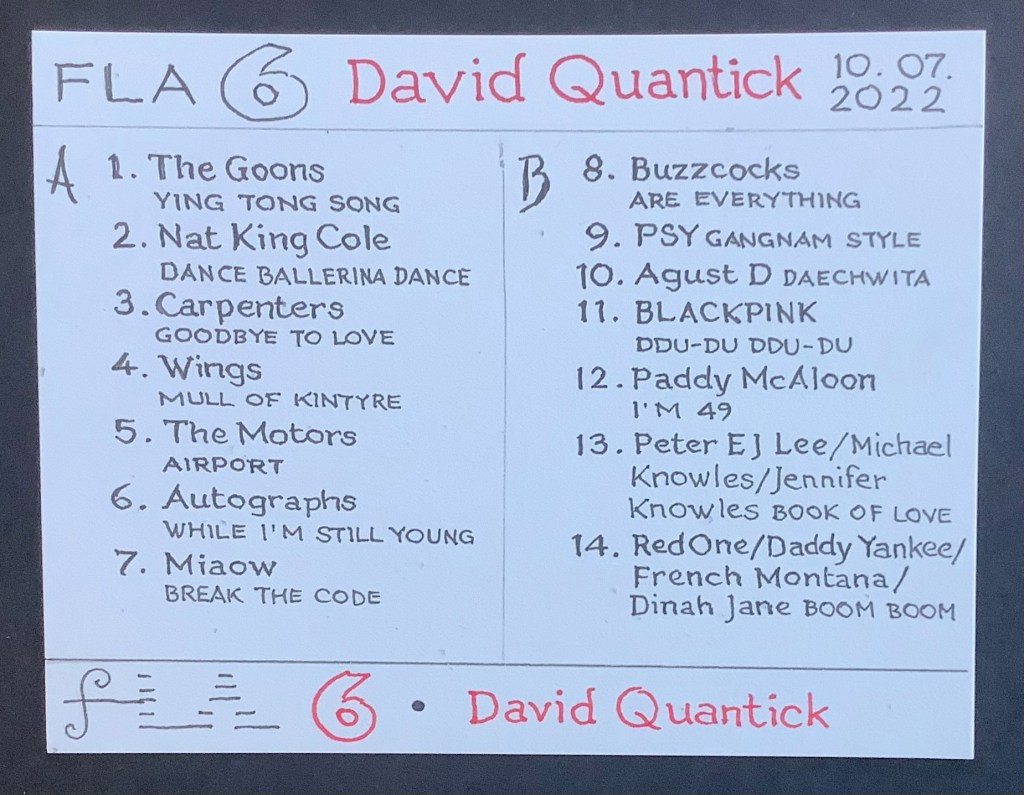
FLA Playlist 6

David Quantick

(For the time being, this site and project uses Spotify for the conversation playlists, but obviously I disapprove that Spotify doesn’t pay artists and composers properly, and other streaming platforms are available, as are sites to buy downloads and buy recordings. For consistency, you can also listen to the selections via YouTube (where available), and links are provided in each case, below.)

Track 1: THE GOONS: ‘Ying Tong Song’: https://www.youtube.com/watch?v=33-fVsL5Kdc

Track 2: NAT ‘KING’ COLE: ‘Dance Ballerina Dance’: https://www.youtube.com/watch?v=Rlsy4te7jY4

Track 3: CARPENTERS: ‘Goodbye to Love’: https://www.youtube.com/watch?v=YarvI9eCa8Q

Track 4: WINGS: ‘Mull of Kintyre’: https://www.youtube.com/watch?v=Plhtk_XJqhM

Track 5: THE MOTORS: ‘Airport’: https://www.youtube.com/watch?v=aS7dnNVidjA

Track 6: THE AUTOGRAPHS: ‘While I’m Still Young’: https://www.youtube.com/watch?v=o5xBh8ELOfY

Track 7: MIAOW: ‘Break the Code’: https://www.youtube.com/watch?v=9gzX2kNa7O4

Track 8: BUZZCOCKS: ‘Are Everything’: https://www.youtube.com/watch?v=fNX59sdaPcw

Track 9: PSY: ‘Gangnam Style’: https://www.youtube.com/watch?v=cGc_NfiTxng

Track 10: AGUST D: ‘Daechwita’: https://www.youtube.com/watch?v=8TWQg4z9Ic8

Track 11: BLACKPINK: ‘DDU-DU DDU-DU’: https://www.youtube.com/watch?v=IHNzOHi8sJs

Track 12: PADDY McALOON [now credited to Prefab Sprout]: ‘I’m 49’: https://www.youtube.com/watch?v=cenwtYd7HFo

Track 13: PETER EJ LEE, MICHAEL KNOWLES, JENNIFER KNOWLES: ‘Book of Love’: https://www.youtube.com/watch?v=QCg3PQuTNzw&list=PLyW-9UYLk9O2fSb_HYzGfl45t771DSTvD

Track 14: RED ONE, DADDY YANKEE, FRENCH MONTANA AND DINAH JANE: ‘Boom Boom’: https://www.youtube.com/watch?v=2a4gHAiXo7E