FLA 35: Michael Gillette (07/12/2025)

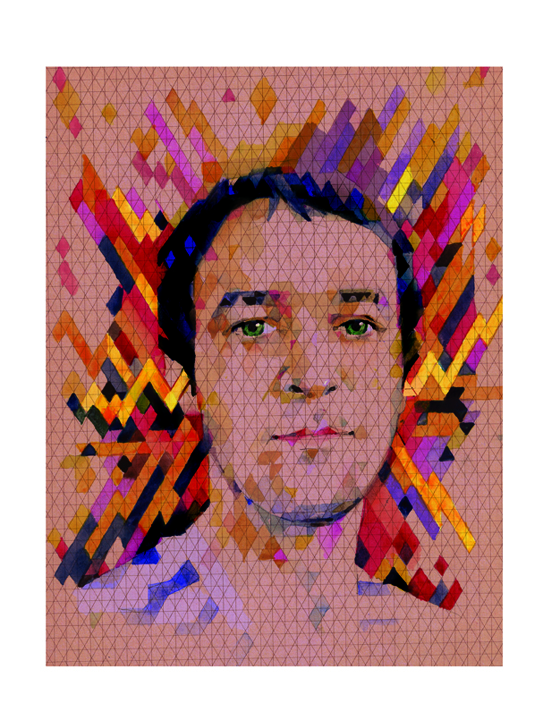
Michael Gillette is an artist, a true artist. Over the past thirty-five years or so, as a painter, illustrator, cartoonist, designer and creative mind, he has produced a boggling torrent of material – in range and volume – primarily inspired by pop music and pop culture. His clients over the years have included Saint Etienne, Elastica and the Beastie Boys, and his work has appeared in a wide range of newspapers and magazines ranging from Select and Q to The Observer and the New Yorker. If you’ve bought any or all of Ian Fleming’s James Bond novels since 2008, chances are Michael’s done the cover art. But it’s a challenge to summarise that kind of career in a single paragraph, so in the first instance, I urge you to check out his website, michaelgilletteart.com, and a book of some of his many highlights, Drawn in Stereo, published in 2015.

I always sensed Michael would flourish as an artist. The clues were there early on, when we were at junior school in Swansea. Just watching him draw anything was captivating. He was amusing and thoughtful. At the turn of the 1980s, just as the lure of pop history dragged me in, so he’d seen the BBC2 season of Beatles films, and connected profoundly with that pop history’s ultimate figureheads. From then on, for several years, we discussed pop a lot. I now realise this was one of the main reasons to go to school.

At sixteen, Michael moved to Somerset with his family, and then gravitated to Greater London, graduating from art school in the early 90s, and soon finding his skills, talents and wit in considerable demand. As an obsessive reader of the music press and broadsheet newspapers, I saw his work everywhere – and yet somehow still didn’t quite connect this with the talented friend I’d known early on. For reasons that will be explained in the conversation that follows.

The penny dropped when I found Michael’s website in the early 2000s. By then, he was living in San Francisco. We had a long catch-up chat on the phone, and have kept sporadically in touch ever since – and then finally, this year, we had a catch-up in person, in the pub. Which inspired me to ask him if he’d like to do First Last Anything. I was thrilled when he agreed, and so one day in November 2025, we spoke via Zoom: me in Swansea, Michael in St Louis, Missouri, where he now lives with his family. Coming up, amongst other things: what it’s like to house-share with Aphex Twin, the outcome of a commission for Paul McCartney (yes, Paul McCartney), and living and working as an artist and how to share that kind of experience as a teacher and educator.   

—-

JUSTIN LEWIS:

So, to begin at the beginning, what music do you remember early on in your home?

MICHAEL GILLETTE:

With mum and dad… Mum was listening to mostly classical music, Schubert’s The Trout, and Holst’s The Planets, I recall… and maybe a few pop albums. The Beatles ‘Red’ and ‘Blue’ albums, and the Greatest Hits of the Carpenters on repeat. Oh! And the The Beach Boys, 20 Golden Greats with an airbrushed painting of a surfer on the front. The musical equivalents of having a dictionary in the house.

Dad, I was not aware of his musical preferences. He saw Gene Vincent and Eddie Cochran play in Birmingham as a teen but in those days, you were only allowed to be a teenager for about fifteen minutes, right? He packed it away. He listened to Jimmy Young who would have been on Radio 2, or Radio 1…

JUSTIN LEWIS:

He was on Radio 1 in the mid-mornings when that started and then around 1973 moved to Radio 2.

MICHAEL GILLETTE:

So it would have been wall-to-wall Radio 2, that’s what I can remember.

JUSTIN LEWIS:

You’d have Terry Wogan on in the morning.

MICHAEL GILLETTE:

Oh yeah, for sure. And apart from that, it was just the homogeneity of the 1970s TV –  Top of the Pops for Goalposts.

JUSTIN LEWIS:

It keeps coming up in these conversations for those of us in that generation. And there wasn’t a lot else, really.

—–

FIRST: ABBA: Arrival (1976, Epic Records)

Extract: ‘Tiger’

JUSTIN LEWIS:

We had this album as well in the house, although I think my dad borrowed it off someone for a while. But we were playing it a lot. But I remember coming to your house at the time and you had this album, along with – if I remember correctly – the first Muppet Show album.

MICHAEL GILLETTE:

Yeah, that makes sense.

JUSTIN LEWIS:

Which we put on. So how did you come to Arrival, then?

MICHAEL GILLETTE:

I think I had it for my seventh birthday, so I must have asked for it. I just think it was in the culture: Look-In, posters on the wall etc.. I’m sure they were on Seaside Special and things like that. Unavoidable, right? Utterly fantastic. And immediately sticky [laughs].

JUSTIN LEWIS:

The people who are ten years older than us thought ABBA were ridiculous.

MICHAEL GILLETTE:

They must be deaf.

JUSTIN LEWIS:

Because, firstly, ‘it’s Europe’ and unless it was Kraftwerk, no pop from Europe was meant to be any good, apparently. And then punk rock happened in Britain, even though ABBA were already making brilliant singles, and the Sex Pistols liked ABBA, for instance. And subsequently, there was a critical revival with ABBA – I remember Elvis Costello saying of ‘Oliver’s Army’… I’m sure you know this…

MICHAEL GILLETTE:

You can hear it – the piano.

JUSTIN LEWIS:

He used to cover ‘Knowing Me Knowing You’, live.

—–

JUSTIN LEWIS:

Towards the end of junior school – so this is 1980, 1981 – I remember two or three massive Beatles fans in our year, and you were one of them, and I remember talking to you about it. So you had the ‘Red’ and the ‘Blue’ albums in your house, but what was the next step for you with Beatles fandom?

MICHAEL GILLETTE:

Aw – BBC, Christmas 1979 – they showed all the films. I remember the Shea Stadium one, and especially Magical Mystery Tour

JUSTIN LEWIS:

Which I don’t think had been on since the first showings [over Christmas 1967 – once on BBC1 which was still monochrome, and days later on BBC2 which had just begun broadcasting in colour].

MICHAEL GILLETTE:

I remember watching that in my grandparents’ house in my Cub Scout uniform [Friday 21 December 1979, BBC2, 6.10–7.00pm], and looking at it – because there’s a bit with a stripper in it which I was watching via a convex mirror because I thought ‘I can’t just turn around and watch this!’

That Christmas was the introduction, really.

JUSTIN LEWIS:

You having your Cub Scout uniform on suggests we must have been to some Cub event, because we were in the same pack. I’m trying to think what that might have been.

[The other showings of Beatles films that Christmas:

Sat 22/12/79, BBC2 1835–2000: Help!

Sun 23/12/79, BBC2, 1740–1830: The Beatles at Shea Stadium [first showing since 1966]

Mon 24/12/79, BBC2, 1740–1900: Yellow Submarine

Tue 25/12/79, BBC2, 1500–1625: A Hard Day’s Night

Wed 26/12/79, BBC2, 1750–1910: Let It Be]

MICHAEL GILLETTE:

They just made me never want to wear a uniform again. It sparked off something :‘What on Earth is this? How do people get to live like this?’ It was the whole package – to see the comedy and the style. I’ve always had these two things together – visual/musical – and seeing them [together] made a massive difference. No regular job plans after that.

JUSTIN LEWIS:

One of the themes of your career, really, is how you’ve channelled pop music into artwork, but with the Beatles, I feel as if you’ve particularly latched on to the fantasy and mythology over the reality of them. I’m not suggesting you haven’t studied the latter! But it’s about setting the imagination free, and Magical Mystery Tour certainly encourages that. As much as something like Get Back would show them making a record in real time, you get this other side to them which has them having adventures. Like they’re comic book characters.

MICHAEL GILLETTE:

Yeah. Perfect for children, as a gateway. It was the scarcity of it. Even though it was on at Christmas that year, after that, it was gone. Until John Lennon died.

Just before he died [December 1980], I remember you used to write the charts out every week, and I saw that John Lennon was in with ‘Starting Over’, [a brand-new single]. And I was like, ‘What do you mean, John Lennon’s got a new single out?’ When I heard it, I couldn’t equate it with The Beatles, it seemed like a dimmed bulb. So when he died, part of me felt, ‘Oh great, The Beatles are now everywhere!’ I was spending all my pocket money on everything I could get, all that merchandise that appeared!  It’s a terrible way to think about it really.

JUSTIN LEWIS:

But he’d also been away for five years, of course, prior to that single, which is a long time. And were you a John fan or a Paul fan?

MICHAEL GILLETTE:

I didn’t know who sang what until later. When I started buying their records, I would look for the albums with the least amount of music that I already knew, to get the best value out of it. The first one I bought was Revolver.

JUSTIN LEWIS:

Funnily enough, the critic David Quantick once pointed out [on the superlative Beatles podcast, Chris Shaw’s I Am the Eggpod] that Revolver (along with the ‘White Album’) is probably the least well represented album on ‘Red’ and ‘Blue’.

MICHAEL GILLETTE:

Yeah, that’s why I would have bought it. ‘She Said, She Said’ – that song really opened things up for me, it’s in my DNA. I don’t think Paul McCartney’s even on that song. 

JUSTIN LEWIS:

An enduring Beatles mystery, so many conflicting accounts and fragments of evidence.

MICHAEL GILLETTE:

I read a lot of philosophy and psychology. Partly it’s helped me understand and justify pop’s importance rather than its triviality. Pop’s taken up a lot of my bandwidth!

I learnt a lot from René Girard, who, as an anthropologist at Stanford in the eighties, coined theories around mimetic desire. We’re all porous to suggestions and mimic others. We desire what other people desire. We can also hate what other people desire. This causes tribalism and scapegoatism. Girard’s warnings are important because many Silicon Valley bros, including Peter Thiel, took his class. They saw his cautions as business models. Look at how that’s played out with social media… 

Anyhow, I thought, ‘oh, this is kind of what happened to me with the Beatles and pop music.’ The Sergeant Pepper cover – it’s a mimetic map of culture, religion, art, everything. Probably 90 per cent of my interests all connect back to the Beatles. Ultra mimetic.

We both grew up during the high watermark of youth cults [JL agrees]… music with distinct looks and styles…These are explained by mimetic theory too. We were kind of outside it in Wales – couldn’t get the right clothes [laughs], but it saturated those impressionable years for our generation, right?

JUSTIN LEWIS:

Yeah – you’d look at London or Manchester and you’d think, ‘How do you get to go there then, a city where it’s all happening?’ Because nice beaches that there are, amazing coastline, Swansea didn’t really have that kind of magic. Bands didn’t come very often, and it wasn’t easy to go and see people if you were under eighteen.

MICHAEL GILLETTE:

Billy Bragg I managed to see in Swansea, a miners benefit gig [7 April 1985 – Easter Sunday, in fact]. At the Penyrheol Leisure Centre. I saw The Alarm there too [16 November 1987].

JUSTIN LEWIS:

Just before we move on from The Beatles, though I’m sure we won’t move too far, can you tell the story about your Paul McCartney album sleeve commission? Because this is extraordinary.

MICHAEL GILLETTE:

I’d done some work for the Beastie Boys, an animation for their [To the 5 Boroughs] tour (2004/05). They were signed to Capitol Records. The lady I was dealing with there rang me one Friday afternoon, and said, ‘Paul McCartney is coming in on Monday and we’re going to do a “Greatest Love Hits” – for the first time, a compilation of his Beatles and post-Beatles work.’ They were very specific: ‘We want him doe-eyed and lovely, from ’67, ’68…’ I was like, ‘Can do.’ So I worked over that weekend, so confused at how this had happened. Anyway, I did it, and the next week they got back to me: ‘Oh he’s just come in, and no Love album for him, he’s getting divorced.’ So that was the end of it. They said, ‘Oh he says it’s really great, he really likes it!’ They tried to buy the artwork. That was the closest brush with my obsession.

JUSTIN LEWIS:

I knew you as a brilliant artist even at school, but what sort of sleeve art was inspiring you back then?

MICHAEL GILLETTE:

Well, anything to do with the Beatles!, so, Klaus Voorman, Peter Blake and then Richard Hamilton – there’s three. My mum would buy me bargain bin books from WHSmiths in Swansea. One of the first was a Rick Griffin monograph. He was one of the San Francisco psychedelic hippy poster artists – all imagery inspired by music. Another was by the artist David Oxtoby, Oxtoby’s Rockers. He was a contemporary of David Hockney, from Bradford. He did incredible paintings of rock stars. I was twelve and had chicken pox when I got it – after two weeks off school itchily looking at this book, this massive door had opened in my mind. I thought, ‘Oh, this is also possible’ [laughs].

When I eventually visited San Francisco for the first time in 1997, the posters of the ‘60s had acted as sirens. I ended up living just a couple of streets away from where Griffin made most of his famous work in the late sixties. I used to pass his old house every day. He was long gone by then. He died in a motorbike accident in the 1990s, he’d been doing covers for The Cult just previously. He became a born-again Christian in 1969 and moved down to Southern California and became a massive influence in that world. An amazing character.

—–

JUSTIN LEWIS:

I’m going to quote from your excellent collection of artwork, Drawn in Stereo. ‘Art wasn’t my first career choice. I wanted to be a pop star.’ Now, I knew you were a good guitarist, that’s what I remember, but I hadn’t quite realised you had that in mind, so I was quite surprised to read that.

MICHAEL GILLETTE:

Yeah, I wasn’t that good at music. When we moved to Somerset, I did my art foundation year in Taunton. The West Country had a good music scene. PJ Harvey came out of that time and place. In Taunton, bands were everywhere… When I got to Kingston Art School, no-one was interested in forming groups. Disappointing. The thing about getting into colleges that are ‘good’ is people are focused on the job at hand! I wasn’t. I was in a band for the first year… but I just knew: Nope – you don’t got it.

JUSTIN LEWIS:

The thing about being in a band – maybe even if you’re a solo artist – is there’s a career arc you’re expected to follow, and it’s all about compromise. Whereas if you’re an artist, you can surprise yourself. You’ve got the freedom to be inventive. And it seems to me, given what you’ve gone on to do, you’ve just kept changing. You’ve never stuck to one thing for too long.

MICHAEL GILLETTE:

I was reared on that Beatles or Bowie [arc] to keep changing and evolving. The visual side of music is such a rich seam to mine – you can tap into two completely disparate things like, say, two-tone and psychedelia and evolve something fresh. But yeah, you’re right. It’s a control thing, and you don’t have that in a band. I didn’t much enjoy being on stage. I got very nervous, I’d play real fast.

JUSTIN LEWIS:

Were you trying to write songs, by the way?

MICHAEL GILLETTE:

A bit, with bands, but I didn’t have that gift on my own. I thought I would join a successful band at art school. Instead, I graduated off a cliff. At the end of Kingston, in ’92, some student friends knew Richard – the Aphex Twin and we all moved to Islington together. I didn’t know his music at the time, but holy WOW!

JUSTIN LEWIS:

The first time I heard him, that first album [Selected Ambient Works 85–92, 1992]: ‘What the hell is that?’ I was listening to quite a lot of electronic music at the time, but that felt like a real departure from everything.

MICHAEL GILLETTE:

I knew he was groundbreaking – anyone with half a tin ear could tell that. I think the groups I was involved with, during Britpop, were fantastic fun, but there was already so much of the guitar pop canon established. Richard was off the maps making his own worlds.

JUSTIN LEWIS:

Yes, I love Blur, but… a lot of it was good pastiche, but pastiche nonetheless.

MICHAEL GILLETTE:

I can understand pastiche, I personally don’t re-invent the wheel, I just put new rims on.

Oasis… I never saw them as Beatles-like, more Slade in Cagoules.

JUSTIN LEWIS:

But they weren’t going to reinvent themselves with every record like the Beatles did. We’ll come back to Aphex Twin in a second, but I just wanted to ask you about something else that happened in summer ‘92 when you’d just graduated from Kingston. You stuff an envelope of your stuff through the letterbox of Saint Etienne’s house in north London. I know that you’d really enjoyed Foxbase Alpha, their first album, but what made you think of choosing them to approach?

MICHAEL GILLETTE:

When did that album come out?

JUSTIN LEWIS:

October ’91. I remember I bought it the day it came out.

MICHAEL GILLETTE:

Okay, I must have too. In late 1991, I was in Russia on a month-long student exchange, I had it on tape, and listened to it there. That album’s very atmospheric and kaleidoscopic – it fit Moscow. Back in London, I listened to it driving around, it fit there too. ‘Nothing Can Stop Us’, what a fantastic song. Bob Stanley told me they paid £1,000 to clear the Dusty Springfield sample. Money very well spent.

Meanwhile, I fell out of Kingston. I wasn’t ready to leave college, I’d been expecting to do an MA – at the Royal College of Art, but they passed. In that last month of Kingston, I realised I’d better start approaching people. It was almost a desperate thing. I knew Saint Etienne were working on another album. But there was some magic involved, definitely – Foxbase Alpha, finding their home address on the back of the ‘Join Our Club’ single, picking them to stalk … They understood my fandom.

JUSTIN LEWIS:

Yeah, that first album, in the booklet, you’ve got all these photographs of icons, so Micky Dolenz is there, Billy Fury, Marianne Faithfull… Eight or nine of them.

MICHAEL GILLETTE:

It’s another mimetic gateway. The glamour of formica caffs that’s open to all. It wasn’t like the eighties, where you needed a zillion dollars to go into the studio and make some shit, atmosphere-free record; all boxy drums and Next suits with padded shoulders. Instead, it was the longings of the fan, lost treasures and pop theories. That record has a dreamy hiraeth.

I stuffed that envelope through the letterbox, went back to Surbiton for the last couple of weeks college. Next, I went up to Heavenly, their record company, rang the bell. Martin Kelly, their manager, opened the door and said, ‘Oh, they told me about you. Come on up!’ I thought, ‘My god, it’s this easy?! This is great! Is this how it’s going to work?’ And of course it doesn’t often work like that. Magic was afoot. You have to knock though.

JUSTIN LEWIS:

They’ve always been very interested in the contemporary, but shot through with something of the past at the time.

MICHAEL GILLETTE:

Yeah. Reinterpreting the past, excavating and curating. Bob Stanley was like meeting an older cousin who knew everything about pop. So anyway, that’s what happened, and they paid me £2,000 which was a lot of money straight out of college. I didn’t see money like that again for a long time.

JUSTIN LEWIS:

And then you started to do bits for Select magazine, right? Which was a sort of indie-dance version of Q magazine, for those who may not remember.

MICHAEL GILLETTE:

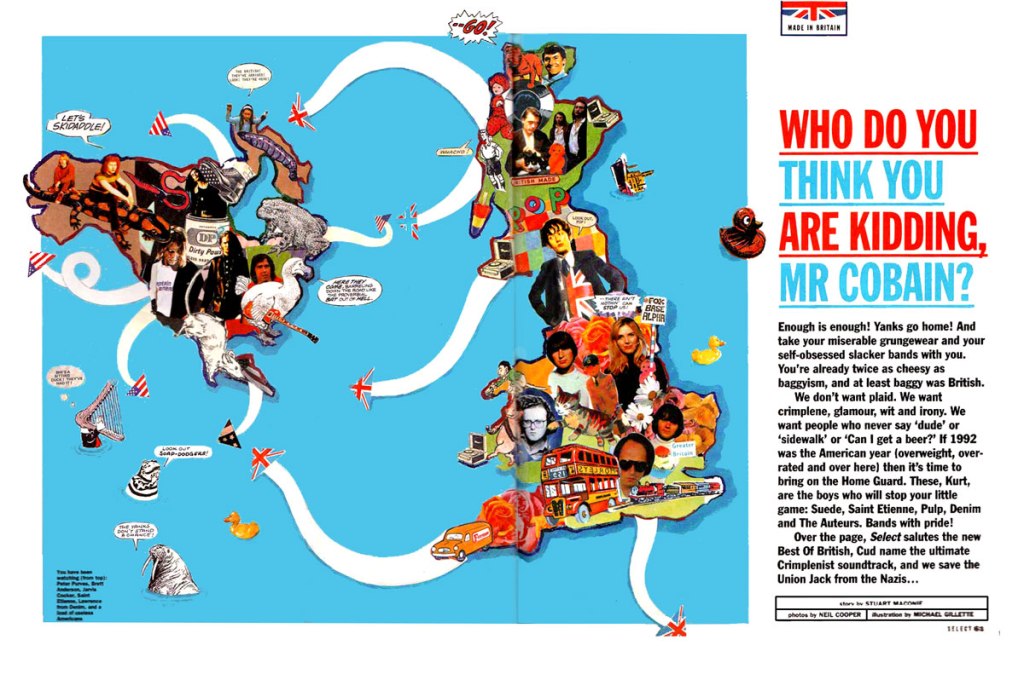
My flatmate Stu’s brother [Andrew Harrison] was the editor of Select. Andrew had a ‘no nepotism’ rule, he couldn’t be seen giving jobs for the boys. But when he found out I’d worked for Saint Etienne, he was like, ‘You must be bona fide.’ So that’s how I got the job doing the illustration for the Stuart Maconie article about Britpop [Select, April 1993 issue].
JUSTIN LEWIS:

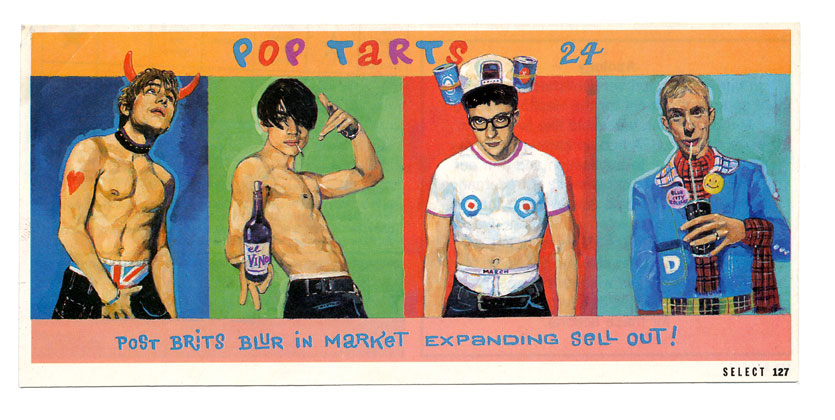
And then you did this regular feature called Pop Tarts, every month, and it’s reminded me how much you made me laugh in schooldays. Because you found room for humour and irreverence as well in many of these pieces.

MICHAEL GILLETTE:

Definitely. When I left college, I was a headless chicken, didn’t know what to do, and was thinking, ‘I’m only going to make serious work, try and do stuff for Faber & Faber’. Then I thought: ‘That’s not who I am – humour is really important.’  That’s yet another lesson from the Beatles – they could reach the highest rung of an artform and still be silly.  I can’t bear serious pretension – when the scene gets pretentious, I get really uncomfortable. I did fifty Pop Tarts. By ’96 I couldn’t take it anymore, but it was a good calling card for a while.

JUSTIN LEWIS:

That might be the longest-running thing you’ve ever done, then.

MICHAEL GILLETTE:

It probably is, yeah.
JUSTIN LEWIS:

And then you’re doing newspaper commissions, you’re in a lot of the broadsheets in the late nineties, doing accompanying illustrations for things. I found a thing in the Telegraph archive of all places, a culinary feature.

MICHAEL GILLETTE:

I did The Observer for a year, too. I did their back page column called ‘Americana’. Louis Theroux wrote many of the articles. I came back to London this last summer, went to Bar Italia, and there’s a drawing I did – maybe for the Telegraph – framed on the back wall! It was about Italian clothes culture, and I had decided to include Bar Italia. Not a work of genius, but when I saw it, I was thrilled [laughs]. I couldn’t think of a better place to hang!

JUSTIN LEWIS:

How do you feel in general now, seeing work you did thirty years ago or longer?

MICHAEL GILLETTE:

I’m just glad to be alive, and to have been able to make a creative living. Sometimes I have barely any recall of pieces – the Bar Italia picture for example. I’ve made so much stuff, it’s a rodeo schedule. I chose pop media – magazines, books, records, videos – rather than gallery art where ten people might see it. I wanted to be seen. It’s a really proletarian art form. Masses of art for the masses.

JUSTIN LEWIS:

Your stuff did get everywhere, and I saw a lot of it, although somehow I didn’t make the connection that it actually was you for some time. I should explain here that your surname has grown an extra ‘e’ at the end since we were at school.

MICHAEL GILLETTE:

Either Select added that to my name or maybe Saint Etienne.

JUSTIN LEWIS:

Was it in error?

MICHAEL GILLETTE:

It was, yeah. But I wasn’t going to argue with that. I just let it go. Everyone was dropping Es in the nineties. I picked one up.

JUSTIN LEWIS:

So what did you do for Saint Etienne’s So Tough album? You certainly came up with the logo, right? And you designed the cover?

MICHAEL GILLETTE:

I initially did a painting of the 1970s photo of Sarah, which her father took. They went with his photo for the cover, which was the right decision. I did paintings of Bob and Pete for the inner sleeve. I wasn’t match fit yet. I hadn’t advanced much at college. I comped together some logos and they went with one set in a font called Bunny Ears.

JUSTIN LEWIS:

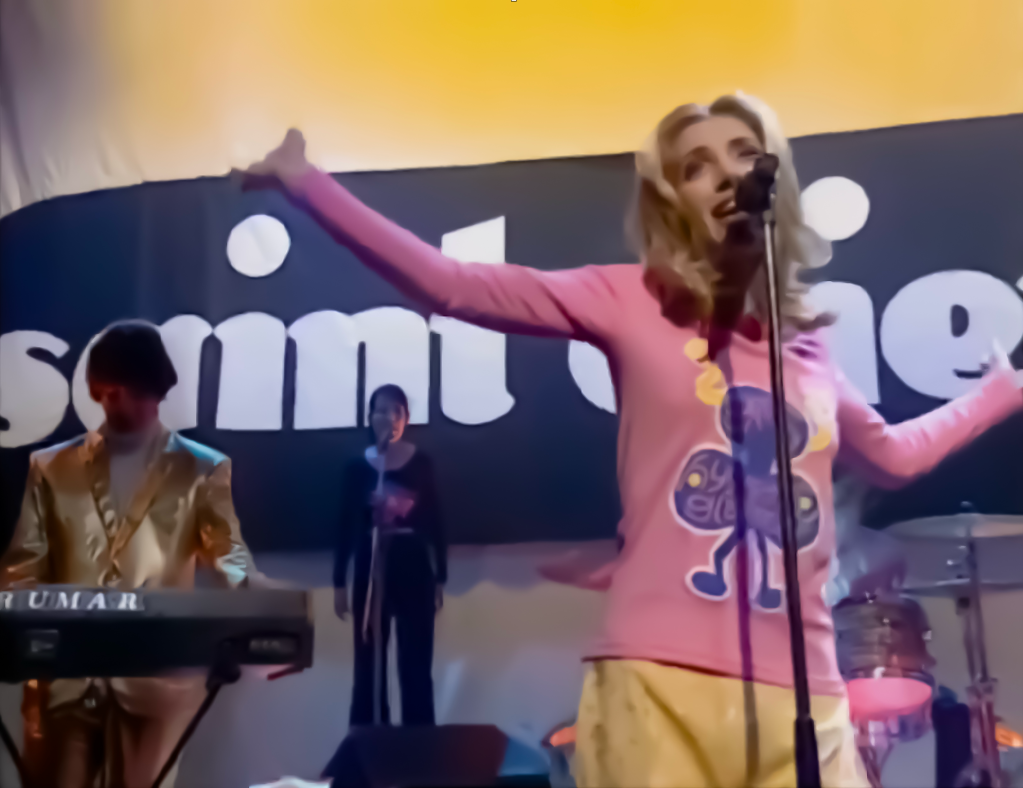
And that was the logo they used when they first went on Top of the Pops, for ‘You’re in a Bad Way’.

MICHAEL GILLETTE:

I was so excited: ‘My logo is up there.’ A little bit of me is on TOTP.
JUSTIN LEWIS:

So, with Aphex Twin, you were living in the same house around this time, 1992–95, three years or so. Was that a creative environment, a chaotic one, or both?

MICHAEL GILLETTE:

Both, definitely. We lived in two different locations. In the first one, he and his girlfriend lived above us. So my introduction to him was through the floorboards, really. He was right above my bedroom, it would be very quiet for long periods of time, when he was listening through headphones making stuff, and then it would be uproariously loud and sometimes terrifying, sometimes beautiful.

Then we moved to Stoke Newington and he had a tiny studio in the midst of the flat, so there was no separation. There were a lot of people coming and going, hangers on, and basic early twenties bad behaviour from young creative types. We all wore each other out because we were so much in each other’s pockets. But everybody was interesting and funny. And for all that people think of Richard, he was not a pretentious human being.

JUSTIN LEWIS:

I always think there’s quite a lot of humour in what he does anyway.

MICHAEL GILLETTE:

Yeah, often puerile!

JUSTIN LEWIS:

How did his remix for Saint Etienne’s ‘Who Do You Think You Are?’ come about? Is it true you were a sort of messenger with that?

MICHAEL GILLETTE:

I asked him, yeah. I hadn’t known him for long – and I wouldn’t say I had the capability to sway him in any way, but he was open to doing stuff at that time. I think he did a good job.

JUSTIN LEWIS:

I find it quite funny he did it, given the choice of song. Because I can imagine him being offered ‘Avenue’ to remix, for instance, but ‘Who Do You Think You Are’ (nothing to do with the Spice Girls by the way, this was earlier!) was a cover version of a song recorded by the Opportunity Knocks-winning comedy showband Candlewick Green in 1974, and the Saint Etienne remake had the potential to be a huge hit. And it’s not a remix you’d expect from a commercial single at all. But then Saint Etienne were great at being leftfield pop stars.

MICHAEL GILLETTE:

I’m sure they were elated with that remix. I don’t think they were looking for a Fatboy Slim banging track.

JUSTIN LEWIS:

And you did some video work for Elastica too.

MICHAEL GILLETTE:

I did two animations for their videos, which was very stressful, and some sleeve work for them too.

JUSTIN LEWIS:

The ‘Connection’ single.

MICHAEL GILLETTE:

I did a painting for that, so I saw them from lift off to stratosphere. Justine [Frischmann] moved to Northern California in the noughties. We wound up living in the same neighbourhood – she helped us out to move there after we left San Francisco, so that was an enduring connection from that time.

JUSTIN LEWIS:

In 1997-ish, you finally got to visit San Francisco because, as I understand it, you had a show on at the Groucho Club in London and lots of wealthy people bought lots of your work, and so you could afford to go. Is that true?

MICHAEL GILLETTE:

Yes, that is exactly what happened. I had a show at the Groucho the same week that Labour were elected – a high watermark and possible end of Britpop – and I sold 14 out of 20 pictures.

JUSTIN LEWIS:

And Jarvis Cocker bought one?

MICHAEL GILLETTE:

Well, you know Ant Genn? He played with Elastica, he’d been in Pulp [and now writes scores for film and TV, including Peaky Blinders]. He bought three, one of which was for Jarvis, but Jarvis ended up paying for all three. I don’t know why. Who else bought one? Graham Linehan, who was then working at Select, Damon Hirst’s manager…’90s Soho.

JUSTIN LEWIS:

Do you ever miss Britain? You’ve been living in America a long time now.

MICHAEL GILLETTE:

Yeah, twenty-four years. Pound for pound, Britain punches harder than anywhere else. Music, comedy, history… I do love it. I feel a bit claustrophobic there now. I wish I’d spent more time visiting antiquity. I guess you always want what you haven’t got, right? Here, I want something pre-Victorian. I want to get my hands on something ancient!

—–

LAST: THE LEMON TWIGS: ‘Ghost Run Free’ [2023, from Everything Harmony album, Captured Tracks Records]

JUSTIN LEWIS:

Lemon Twigs have come up before on this series, and rightly so [FLA 24, Alison Eales]. What was it about ‘Ghost Run Free’ in particular?

MICHAEL GILLETTE:

Well, it’s like the offspring of The La’s and Big Star, isn’t it? I’d adopt that kid and bring them up as my own. Just instant ear candy, pressing all my buttons. I’ve played that song a lot – I like the rest of the album, but something about that song absolutely chimes. I was lucky to see them play here in St Louis – people tend to skip over the Midwest. I decided to wear a hat and stand at the back, not to spoil the kids’ fun. But the audience were all older than me! It was almost like a vampiric ritual… the band’s so young, what must it be like for them, looking out at the Night of the Living Gen Xers?

JUSTIN LEWIS:

It’s a breath of fresh air, this album, and while there’s lots of stuff I like at the moment, you don’t tend to get things that are big on chords, harmonies or melodies charting particularly highly. It’s unusually tuneful – the last time they got picked on this, I was referencing early seventies Beach Boys and Todd Rundgren, but now I can also hear Crosby Stills Nash and Young in it, even Roy Wood’s Wizzard.

MICHAEL GILLETTE:

They can all play, the band’s been together a while. They look like they were made in a pop culture laboratory. Live, they’re all swapping instruments. And then you’ve got the two D’Addario brothers, like the Everlys, Kinks or the Bee Gees. I’m going to quote Noel Gallagher here – ‘brothers singing is an instrument you can’t buy in a shop’. Like ABBA, where harmony and melody is absolutely everything. There’s always a chorus with multiple voices, so you feel like you’re included in the song. That’s one of Brian Eno’s pop observations/recipes.

Most songs I really love have got harmonies. Apart from The Smiths – I don’t know why they never had that.

JUSTIN LEWIS:

That’s a good point. I suppose with them, the harmonies are in the guitars.

MICHAEL GILLETTE:

Yeah, but Johnny Marr can sing – he’s got a good voice. Why did they never sing together? I suppose Morrissey won’t share his crisps.

—–

ANYTHING: JOHN O’CONOR: Nocturnes of John Field [1990, Telarc/Concord Records]

Extract: ‘Nocturne #1 in E flat Major’

MICHAEL GILLETTE:

I came to a point where pop music was just frazzling me. To quote that ‘Alfred Prufrock’ poem by TS Eliot: ‘I’ve measured my life out in coffee spoons’, whereas I’ve measured my life out in poppy tunes. There just came a time, especially working and reading, for [something else] and hearing these Nocturnes…

JUSTIN LEWIS:

What sort of age were you?

MICHAEL GILLETTE:

Oh, late forties. I’d always listened and worked to lots of soundtrack stuff, John Barry, Lalo Schifrin… But here, just the solo piano is so peaceful. Going from a world where I know everything about a musician, to this, where I didn’t know anything. I just listened without any baggage – a blank slate.

JUSTIN LEWIS:

Can you remember how you came across it, then?

MICHAEL GILLETTE:

I really don’t know. Maybe through YouTube’s algorithms… do you know anything about John Field? [Born in Dublin, 1782, lived till 1837] He had a riotous life. He was basically a rock star. His life would make a great film, Barry Lyndon-esque. Eventually I looked him up, but for years I knew nothing but the music.

JUSTIN LEWIS:

I knew the name, but it transpires he invented the nocturne form. Chopin was a fan. So he’s an innovator.

MICHAEL GILLETTE:

Yeah, I’m no connoisseur. I’ve listened to Chopin’s Nocturnes, I don’t enjoy them as much. Satie’s are good too, but Field’s are like an instant warm bath, reliably calming.

I’ve been thinking about the Aphex Twin this last couple of weeks because one of my students at college was drawing his logo over and over.

‘Oh, the Aphex Twin,’ I said.

‘Do you know that guy?’

‘Actually, yeah, I do know that guy.’

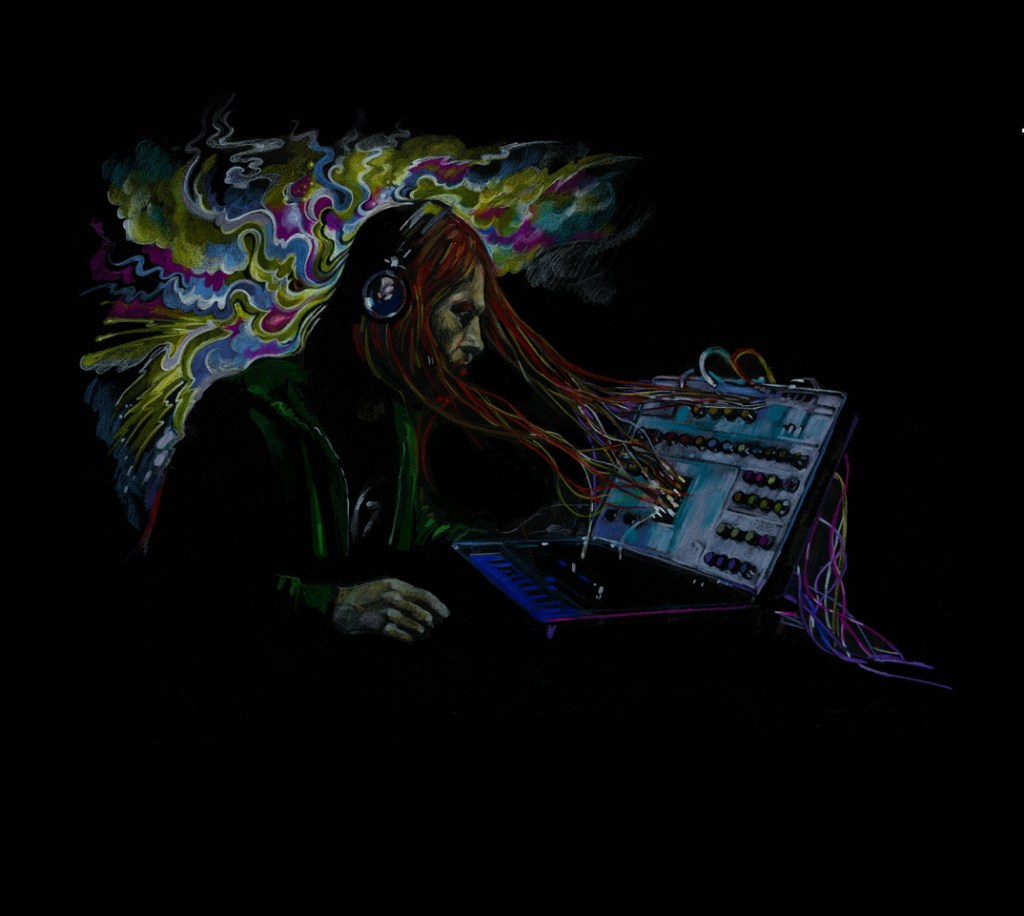
Then yesterday, my screen printer was wearing a homemade Aphex Twin T-shirt, with a picture of Richard in the Stoke Newington house studio. I’ve found folks want to keep the mystique of him intact. We are so overloaded with information. I think the mystery allows for purer engagement.
I feel like that about classical music. I won’t reach the point where I need to know what the third horn player had for his tea and how that affected anything. You know what I mean?

JUSTIN LEWIS:

When we were at school, the running joke about pop trivia knowing no bounds would be ‘What colour socks was Paul McCartney wearing when they recorded “Get Back”’?, and now the Get Back film exists, you can bloody well find out! It’s ridiculous really. I suppose thirty, forty years of reading the pop music press has created this frame of mind, and you can’t do that with everything. One of the nice things about new music now is I often come to things and I don’t know anything about them, who they are, nothing beyond the bare bones. It’s like being eight again.

MICHAEL GILLETTE:

It is. What I see with my children is they’re not interested in context, it’s all delivered scrolling on a phone. Recently, my daughter learnt to play ‘Love Grows Where My Rosemary Goes’ on the violin, and I asked:

‘How do you know that song?’ 

‘Instagram… How do you know it?’

‘It’s from the late 1960s.’

‘Oh I thought it was new.’

It’s trending audio… stuck behind reels. Folks use trending audio, and the algorithm boosts the post. It’s kinda greasy. My daughter was humming ‘Golden Brown’’, same thing – it’s used on medieval themed reels.

We were groomed [laughs] to be obsessed with pop minutiae. Now, it’s just another bit of content in the feed. They do introduce me to some new music though, Olivia Rodrigo I enjoy.

JUSTIN LEWIS:

Well, we were in the analogue age where knowledge was difficult to come by, so you’d collect fragments of information until you had far too much of it all. [Laughs] That’s what happened.

MICHAEL GILLETTE:

YES! – the scarcity back in the day. So maybe what I’m trying to do with jazz and classical music is to go back to pre-knowledge. I love Lou Donaldson, I love his music, but I wouldn’t know him from… Donald Duck. I know he’s Mr Shing-a-Ling. But I don’t really have any interest beyond listening and enjoying.

JUSTIN LEWIS:

And it makes it more random, you can make your own connections with it. For a long time, we got used to other people shaping music history, and now I guess you can create your own experience.

MICHAEL GILLETTE:

Totally. That’s the big difference. When you used to bring Smash Hits in to school, and we’d pore over it at lunchtime, Mark Ellen was the editor at the time. That Britpop illustration I mentioned earlier… Mark Ellen [by 1993, the Managing Editor of Select] was who I handed it over to. Did the obsession bring that to pass? I suppose what you give your attention to grows.

—- 

JUSTIN LEWIS:

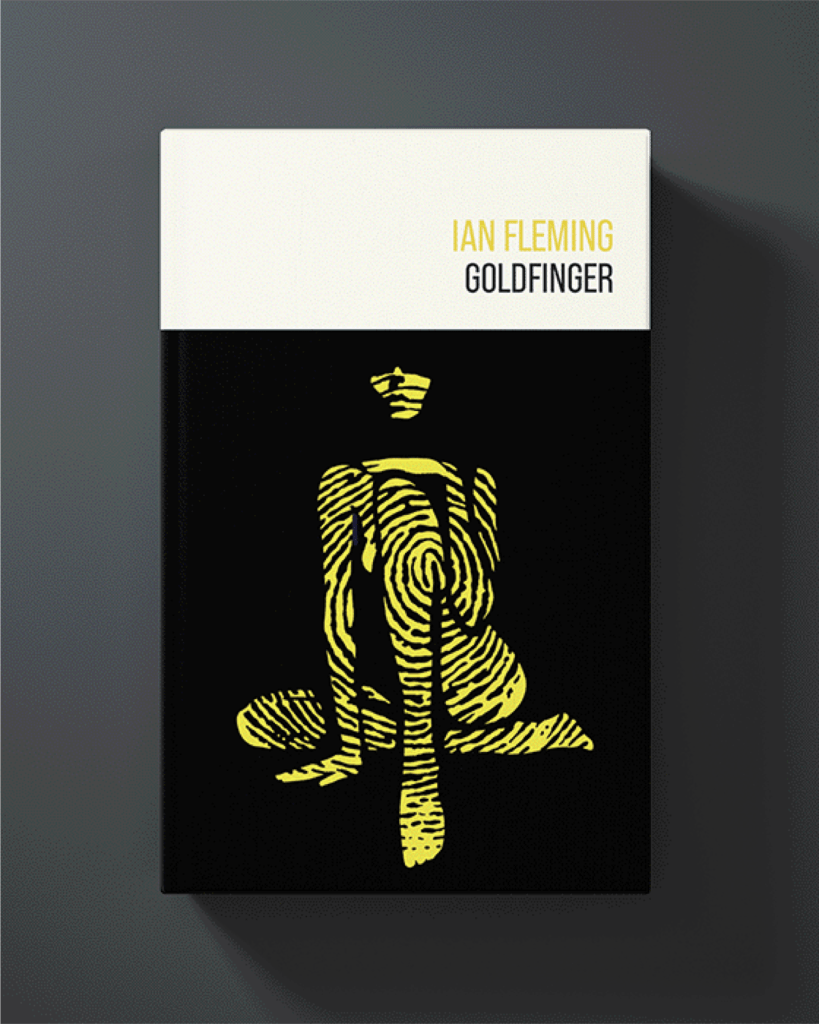
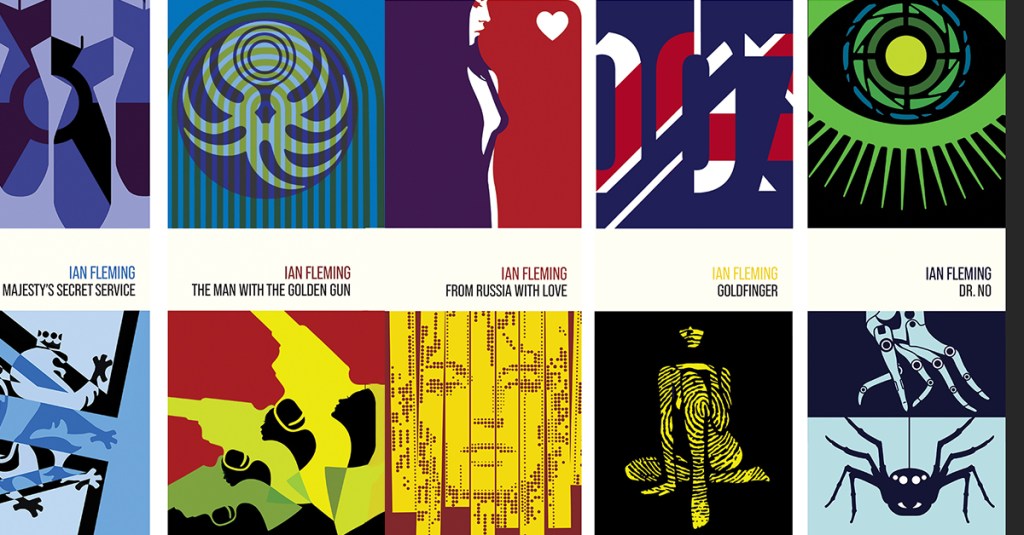
You’ve designed [in 2008 and again in 2024] two very differently styled series of covers for Ian Fleming’s collection of James Bond books. Did you read the Bond books as a kid, or did you connect with the films first?

MICHAEL GILLETTE:

My dad had the books, Pan paperbacks from the sixties – great covers. They were stashed away in my bedroom in a little attic space. I read them when I was probably 12, 13… but the films… apart from occasional Bank Holidays, I don’t really remember them being on much. Do you?

JUSTIN LEWIS:

I don’t think they were on TV much before the eighties.

[Note: The first Bond film to be shown on British TV was Dr No, on ITV, on Tuesday 28 October 1975. In January 1980, the UK TV premiere of Live and Let Die attracted 23 million viewers on ITV, still unbeaten for a single showing of a film on British TV.]
JUSTIN LEWIS:

The main thing I remember with Bond was going with my dad and my brother to see a double bill at the Swansea Odeon on the Kingsway [don’t look for it, it’s not there anymore], this would have been Summer ’78. It was Live and Let Die and The Man With the Golden Gun, a double-bill. Two hours long, each of them, that’s a long afternoon. Especially when you’re eight years old. It’s actually a long time since I’ve seen a new Bond film. But I was also wondering to what extent the music of Bond films inspired those designs of yours. Were you thinking a lot about John Barry scores?

MICHAEL GILLETTE:

I do absolutely adore his music, yeah. Because I’m involved in the Bondiverse, I understand people are as passionate for 007 as we are for bands. I understand the draw of Bond. My job as a designer is to translate visually as a composer would do musically. The most enduring Bond thing for me is Barry’s scores, so sophisticated and timeless.

JUSTIN LEWIS:

They really hold up, as do the themes which generally hold up better than the films. Not many duds, surprisingly.

MICHAEL GILLETTE:

With John Barry, it’s the whole score… Things like Petulia from 1967, that’s a great soundtrack, or The Knack, and The Ipcress File. I listen to those more. I’m not an obsessive in the Bond world. And that possibly helps because you can get lost in detail. It helps to take a wider view.

JUSTIN LEWIS:

I was just thinking: have you ever tried to pastiche the Beatles’ album sleeves?

MICHAEL GILLETTE:

The only thing I remember doing, and it’s in Drawn in Stereo, is Oasis as the Yellow Submarine characters for Q.

JUSTIN LEWIS:

Of course, that’s right.

MICHAEL GILLETTE:

But otherwise, for years, I felt like I didn’t have enough skills to represent what they meant to me.

JUSTIN LEWIS:

You were too close to it!

MICHAEL GILLETTE:

But record sleeves remain the same and book covers keep changing. It’s interesting why that is.

JUSTIN LEWIS:

Why does that happen, I wonder? Even modern books do that – often the paperback edition six months later looks nothing like the hardback.

MICHAEL GILLETTE:

Music and visual culture are so locked together, I can’t disassociate them. I can’t imagine 2-Tone without that Walt Jabsco image. With a book, you don’t just stare at the cover for hours while you’re reading it. But a record… think of that bus journey between HMV in Swansea and home, where all you’ve got to look at is the sleeve.

Doing the Bond covers both times… immediately the reaction from some fans was that I’d performed an act of heresy. Changing record sleeves would cause a riot, unless you are Taylor Swift, but like many things about her, she defies logic and gravity.

JUSTIN LEWIS:

What’s your working routine like now? Do you sit at the desk every day, working on something, even if you’re just sketching?

MICHAEL GILLETTE:

Things have changed since COVID. My career has been mostly that of a rodeo illustrator: showing up every day, seven days a week, moving between clients, which went on for a quarter of a century plus. I don’t quite do that anymore. Now, I teach and do more selective commissions, because the world’s changed and I’ve changed. You know what it’s like with deadlines, right? For four years I worked for the New Yorker pretty regularly. I’d be about to clock off on Friday afternoon, and they’d e-mail and that’s the weekend done. For many years of my life, I leant in very hard.

JUSTIN LEWIS:

Are there things that surprise you about the young generation of new artists – in a good way, I mean?

MICHAEL GILLETTE:

I feel that we are fed a story that this generation is ‘hopeless and weak’. It’s been the same call since biblical times. By the end of teaching a class, or seeing my kids create, I have hope for us as a species. I believe in magic. I believe there’s an indomitable spirit of creativity that everyone’s got. We’re born with it, and we’re here to represent it the best way we can. I think that’s why people get unhappy when they don’t have outlets for their creative energy.

JUSTIN LEWIS:

It worries me in this country that young people are now supposed to only foster the talents that are going to get them a job or are going to get them a way of making money for other people rather than what they might actually be good at. And that’s really kicked in, in recent years. Obviously, education and passing exams is important, but what about the imagination?

MICHAEL GILLETTE:

Well, when you saddle people with debt in college, that puts an entirely different slant on it. The two grand from Saint Etienne paid off my student debt. I worked all the way through college to keep it low, but that’s the difference – I could afford a London life, albeit a tight one. Two thousand pounds at a time when my rent in Islington was £55 a week. That kind of maths wouldn’t work now with London housing. The pay for a similar gig in 2025 would be more or less the same, and cover about five weeks’ rent.

I’ve had a career, but it wasn’t encouraged, it was unlikely even then. Most folks who studied illustration didn’t become illustrators. Not saying that being an illustrator is the high bar of anything. We’ve saddled students with middle-aged debt and the anxieties that go with it. It’s unfair. As a teacher, I try to help as much as I can. My teachers were often art school bullies who’d give you a good kicking. Maybe that was the point; maybe if you survived that, you were strong enough for the outside world! But I try to do the opposite, I hope to encourage.

JUSTIN LEWIS:

What sort of age are your students?

MICHAEL GILLETTE:

19, 20, 21. They’re super-young, but the same impulses are inherent. There’s that beauty of openness and that’s why avoid telling them ‘it’s like this’ and ‘you have to do that’. You make it up [for yourself]. I made it up by knocking on Saint Etienne’s door. 

JUSTIN LEWIS:

You find a way.

MICHAEL GILLETTE:

You find a way, be creative. Where one person will walk into a room and see nothing but walls, another will find an open door. That’s why I believe in magic – it’s very mysterious how it all works. We’ve known that from all the music stuff we’ve read, the connections and the odd chances of luck.

JUSTIN LEWIS:

Nobody really knows where ideas come from.

MICHAEL GILLETTE:

Hundred per cent, yeah. Writer’s block, artist’s block… who’s doing the blocking? It’s not the universe, it’s the writer and the artist. You can shut it down really easily. [With creativity] it was never encouraged, but now it’s probably worse, it’s harder to freelance. But where there’s a will… I needed a period of time to be able to make mistakes, be slack, be lost and not worry about finances. Talent will out, but it needs support.

JUSTIN LEWIS:

Yes, particularly the process of trying out things and making mistakes. Unless you have particularly wealthy parents now, it’s difficult to do that. And especially when you’re young, you have the energy – you can stay up till three in the morning doing creative things.

MICHAEL GILLETTE:

You get an era where you can batter yourself almost to death and continue working and somewhat thriving. I’ve lived in two of the most expensive cities in the world – London and San Francisco – and managed to survive making artwork. It’s a bloody miracle. For younger people, maybe they’ll think in a different way, and it’s not about London or San Francisco, because those are overrun with investment bankers and tech workers… St Louis, where I’m living now, is different, it’s a post-industrial city, there are opportunities to live creatively.

In London, the generation before us had studios in Covent Garden. Our generation… my studio was in Hoxton Square. Now… Pushing out people who are regular human beings, let alone artists from a metropolis like London – that’s tragic. It’s everyone’s loss. But the fundamental soul of creativity that I see in young people is exactly the same. It’s like a timeless river. That spirit always makes me feel hopeful.

————-

All images in this piece (apart from my usual FLA header and cassette inlay) are (c) Michael Gillette. Thanks so much to him for allowing FLA to include them.

Much more on Michael Gillette at his website: https://michaelgilletteart.com

You can order the book directly from his website, here: https://michaelgilletteart.com/products/drawn-in-stereo-book

You can also order art prints for Michael’s James Bond book cover designs (pictured here): https://michaelgilletteart.com/collections/prints
You can follow Michael on Instagram at https://www.instagram.com/michaelgilletteart/

——

FLA Playlist 35

Michael Gillette
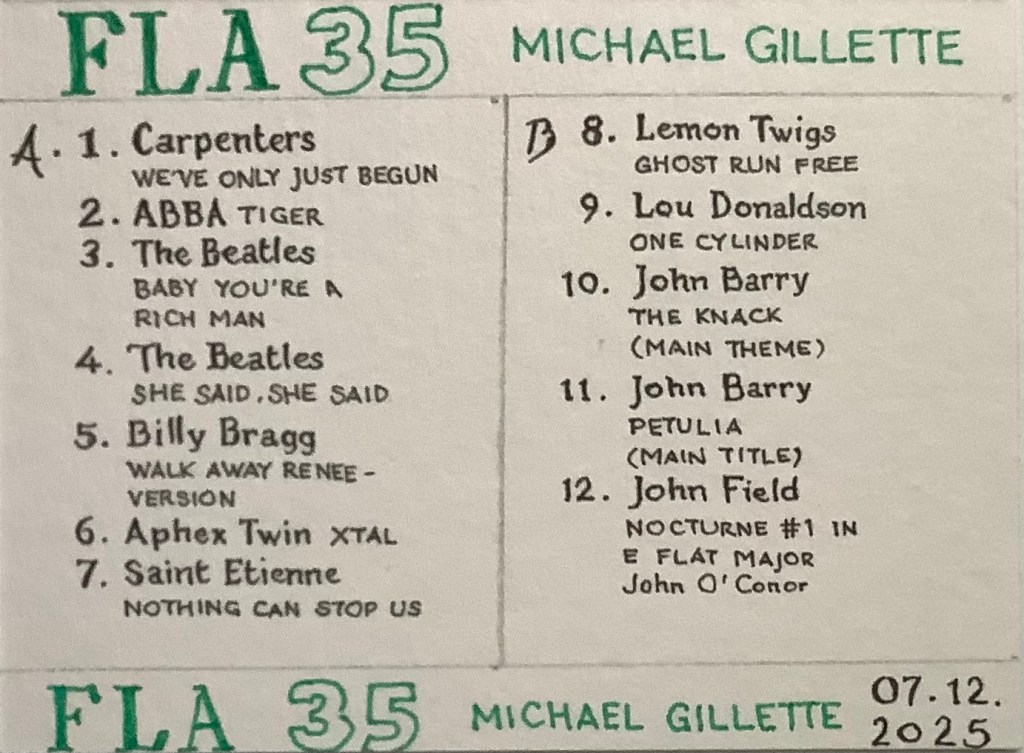
(For the time being, this site and project uses Spotify for the conversation playlists, but obviously I disapprove that Spotify doesn’t pay artists and composers properly, and other streaming platforms are available, as are sites to buy downloads and buy recordings. For consistency, you can also listen to the selections via YouTube (where available), and links are provided in each case, below.)

Thanks to Tune My Music, you can also transfer this playlist to the platform or site of your choice by using this link: https://www.tunemymusic.com/share/5yuhEgpQ6o

Track 1:

CARPENTERS: ‘We’ve Only Just Begun’:

https://www.youtube.com/watch?v=xeBoRF5tgDo&list=RDxeBoRF5tgDo&start_radio=1

Track 2:

ABBA: ‘Tiger’:

https://www.youtube.com/watch?v=htziQt0pCAQ&list=RDhtziQt0pCAQ&start_radio=1

Track 3:

THE BEATLES: ‘Baby You’re a Rich Man’:

https://www.youtube.com/watch?v=i5m-sgtwFck&list=RDi5m-sgtwFck&start_radio=1

Track 4:

THE BEATLES: ‘She Said, She Said’:

https://www.youtube.com/watch?v=NZOBWYHgZjw&list=RDNZOBWYHgZjw&start_radio=1

Track 5:

BILLY BRAGG: ‘Walk Away Renee (Version)’:

https://www.youtube.com/watch?v=iHrFkSeLukA&list=RDiHrFkSeLukA&start_radio=1

Track 6:

APHEX TWIN: ‘Xtal’:

https://www.youtube.com/watch?v=2tOutF8B3f8&list=RD2tOutF8B3f8&start_radio=1

Track 7:

SAINT ETIENNE: ‘Nothing Can Stop Us’:

https://www.youtube.com/watch?v=RAZUwvYqhpg&list=RDRAZUwvYqhpg&start_radio=1

Track 8:

LEMON TWIGS: ‘Ghost Run Free’:

https://www.youtube.com/watch?v=ewKdcUl3J7c&list=RDewKdcUl3J7c&start_radio=1

Track 9:

LOU DONALDSON: ‘One Cylinder’:

https://www.youtube.com/watch?v=F8RCGr8FEt0&list=RDF8RCGr8FEt0&start_radio=1

Track 10:

JOHN BARRY: ‘The Knack (Main Theme)’:

https://www.youtube.com/watch?v=k3utY_mJjK8&list=RDk3utY_mJjK8&start_radio=1

Track 11:

JOHN BARRY: ‘Petulia (Main Title)’:

https://www.youtube.com/watch?v=qhKQ1UT-MjE&list=RDqhKQ1UT-MjE&start_radio=1

Track 12:

JOHN FIELD: ‘Nocturne #1 in E Flat Major’

John O’Conor:

https://www.youtube.com/watch?v=2YJXgmLXTew&list=RD2YJXgmLXTew&start_radio=1
FLA 25: Matthew Rudd (03/08/2025)

Matthew Rudd pic (c) Jamie Stephenson

If you work Mondays to Fridays, Sunday nights don’t have a good reputation. They’re about winding down the weekend, and about preparing for another week of grindstone. Creeping into the late Sunday night routine in recent years, though, has been a reassuring but often adventurous radio show, tapping into a generation’s nostalgia for the 1980s. For two hours every week, from 9pm UK time, Forgotten 80s gathers together listeners’ requests for the underplayed and the undervalued from all kinds of pop music genres.

Forgotten 80s’ creator, presenter and producer is Matthew Rudd, who has worked in radio for 30 years, initially at stations in the North of England including Hallam FM in Sheffield, Viking FM in Hull, and Stockport’s Imagine FM.

But he has since reached a national audience via Q Radio and since 2013, Absolute 80s, the decade-specific offshoot of Absolute Radio, and it was my pleasure to invite him on to First Last Anything to launch this third series of conversations on music. Over two Zoom sessions in June 2025, we discussed how he puts Forgotten 80s together, how it all came about, and how it continues to link together a loyal band of listeners on a variety of social media platforms every Sunday.

Matthew also talked to me about how he first got into music, about a band who put his home city of Hull on the map, although Hull was already generally on maps obviously, and about some of the other acts who have floated his musical boat down the years. We hope you enjoy our conversation.   

—–

JUSTIN LEWIS:

Let’s start with the question I ask everyone. What music would have been playing in your house in your formative years?

MATTHEW RUDD:

I was raised in East Yorkshire and my parents are both from East Yorkshire. I love my parents dearly, but I’ve always felt they were brought up in a period where so much exciting stuff was going on and it completely passed them by. Either because they didn’t get access to it, but more likely because of the influence of their own parents; I think that they were told ‘this isn’t for you’ and therefore ‘stay away from it’.

My dad was born in 1940 and my mum in 1942, both still with us, and so both teenagers when Elvis Presley came along. The immediate reaction of their own parents was ‘this is not good’ – you know, like all parents are with new stars. But of course this was more than that – the advent of rock’n’roll, the beginning of what we would now call a modern world.

My dad’s only experience of music – I don’t know this for certain – was hearing a transistor radio while he was at work, as a motor mechanic, fixing a car. Most places where they’re providing a service and the customer has to stay for a while or the service involves the staff being in the same place for a long time, they’re going to have the radio on in the background, and I don’t think that was any different back in the 50s and 60s.

My mum, though, did notice stuff. Her parents were much more musically minded, they liked going dancing between the wars, when they first met and then, after the war when my mum and my auntie were little, they didn’t have a lot of money, but they treated themselves by going to a dance club. But also my granddad was always into Perry Como. And so, the very first record I remember in the house – I was preschool, so 76/77 – was a Perry Como LP. Couldn’t tell you what it was called, but it had ‘It’s Impossible’ on it.

JUSTIN LEWIS:

He had that revival, that second little run of hits in the 70s, didn’t he, that and ‘And I Love You So’.

MATTHEW RUDD:

Now my granddad died in 1991; he was nearly 80. We’re almost 35 years later and my mum who’s now in her 80s, still says, ‘Oh, my favourite was always Perry Como.’ And I’m like, ‘Yeah, but it was his music.’

Later, when I was a teenager, I found this 7-inch singles box stowed away somewhere. There was Elvis Presley’s ‘Rock-A-Hula Baby’, the double A-side with ‘Can’t Help Falling in Love’ (1961). Now, neither of my parents remembers buying it. So whose was it, where did it come from? And did they have anything to play it on? I’m convinced my granddad on my dad’s side, who died when I was ten, would not have had a record player. But there was also a copy of Louis Armstrong’s ‘What a Wonderful World’ (1968), and the other albums included a Leo Sayer album [Leo Sayer, 1978], with the Buddy Holly song ‘Raining in My Heart’ on it… and Arrival by ABBA (1976). And I remember my mum was particularly keen on one of that album’s tracks, ‘When I Kissed the Teacher’.

But, apart from that Perry Como LP, I’ve never known who owned these records. I’m guessing it’s my mother, though my dad is not a music ignoramus. He’s a good singer. And this is something that he will be known for, by every member of his family all his life – he knows the first line to every single song that’s ever been recorded – and no more.

So to answer your question about the music that I grew up with, I had to learn about it myself and I learned more from my elder brother – same age as you, born 1970, and a completely fervent and loyal rock fan – who went to a Motörhead gig at Hull City Hall at the age of 13.

He had a friend who was a year older, really into heavy rock. Motörhead were on tour. His mate got two tickets – and he wanted to go, obviously – but he’s 13 and it’s Motörhead, they’ve been massive with ‘Ace of Spades’ et al, and it’s Hull City Hall in the middle of the city centre, on a school night. And he was allowed to go on one condition: that my dad drove him there, parked outside the City Hall and stayed there for however long the gig was – two hours, whatever. And then, when the gig’s over, Dad expects his first-born son to be out of the door and straight back into the passenger seat immediately. And that’s exactly how it transpired.

That he was allowed to go to that, though, is amazing. My mum would have made the final decision, but it’s a tribute to my dad because he had a father who really did not rate anything about the modern world and didn’t actually rate his son very much. They had a very difficult, awkward relationship, which only got better when he left home and got married and produced grandchildren with his surname. That was important.

Meanwhile, my mum’s younger sister, my auntie, is a baby boomer, born in 1946. My granddad had been out to war. And like an awful lot of couples, as soon as my grandparents reunited, when the war was over, another child was soon on the way. So when The Beatles became really prominent, she was 16 years old.

In 1963 or ‘64, my auntie got tickets to go and see The Beatles, at the old ABC cinema on Ferensway. So she’s 17 or 18, but she’s living at home. And my grandma just said, ‘You’re not going’. And that was it. That was the end of the debate. Nowadays, there’d be bartering, bargaining, pleading, third party gets involved. But: no. My auntie’s always been quite generous about it – ‘Well, it’s just the way things were, so I didn’t go’ – but I can’t help but think she never forgave my grandma for that. Because the Beatles never came back to Hull.

——

FIRST (1): SHAKIN’ STEVENS: ‘This Ole House’ (Epic Records, single, 1981)

MATTHEW RUDD:

I was not quite eight years old, so clearly Shakin’ Stevens was going to appeal to me. I was the right age for purchasing this record, with the help of my parents. Every major city has a local record store of great repute, and ours in Hull was called Sydney Scarborough. The address was ‘under the City Hall, Hull’, and that was enough. And I think that’s where my mum had gone to buy it for me.

That was my first record that I had bought for me. And over the next year or two, Mum would continue to buy the odd record for me, from town.

——-

FIRST (2): HOWARD JONES: ‘What is Love?’ (WEA Records, single, 1983)

MATTHEW RUDD:

But the first record that I bought myself was Howard Jones, ‘What is Love?’, in January ’84-ish. It got to number two, his biggest hit. And 1984… I can’t put into words how important that year was for me.

JUSTIN LEWIS:

That sounds like my 1980. Pop music became everything.

MATTHEW RUDD:

Well, there is this phenomenal period between the summer of 1980 and the end of 1981 where so many artists who defined the whole decade had their first hits – it’s incredible. You’ve got UB40, Joy Division, OMD, The Cure, Spandau Ballet, Linx, Ultravox, Bad Manners, Adam and the Ants in the second half of 1980, and then look at 1981: The Teardrop Explodes, Toyah, Duran Duran, Visage, Kim Wilde, Altered Images, Level 42, Depeche Mode, ABC, Human League, Freeez, Echo and the Bunnymen, Japan, U2, Imagination, Haircut 100, Soft Cell, Fun Boy Three… it almost goes on forever. I was seven and eight years old, I only noticed bits and bats, and didn’t see any bigger picture, and just liked Shakin’ Stevens because I was a child. If I’d been 11 then I don’t know how I would have
kept up, but I’d have had a good go.

And by the beginning of 1984, I’d started to be quite obsessed with the Top 40. I’d listen to the new chart on Tuesday, six o’clock [Radio 1, Peter Powell]. And that obsession came from the first Now That’s What I Call Music album, which was incredibly heavily advertised at the end of ‘83. And on that album was Howard Jones with ‘New Song’, which I’d seen him do on Top of the Pops.

By the time I started secondary school in September ‘84, I began to become known for my pop obsession, and also get slightly teased for it – but in particular my Howard Jones obsession had gone through the roof. I got the Human’s Lib album on cassette for my birthday – my grandma, the one who wouldn’t let my auntie go to see The Beatles, still managed to get herself to HMV and buy that for me.

I interviewed Howard Jones, in 2013, not long after I joined Absolute 80s. I was such a fanboy. It’s a good interview, I’m pleased with it – but I sound like somebody who knows slightly too much about him! He’s a lovely man, which is one of the reasons I liked him – he wasn’t controversial, but for 1983, ’84, he still looked relevant. He was a bit older, of course – he was twenty-eight when he had his first hit. He was a classically trained musician who ditched his boring square piano, and got this massive synth stack. He ditched his normal hairdo from his prog rock days, and his music teaching days and spiked it and turned it orange. And he found this mime artist geezer, Jed, with a bald head and stuck some chains on his wrist and said, you know, ‘Act like a div in front of me and let’s see what happens’. What can I say? I was ten years old and looking for somebody to idolise, and there he was.

JUSTIN LEWIS:

And you have something in common with him. Because obviously you’ve worked on overnight radio shifts…

MATTHEW RUDD:

Yes. He used to go to Piccadilly Radio in Manchester and he wasn’t allowed to use his real name because of something to do with the Musicians’ Union or something like that.

JUSTIN LEWIS:

He was billed as John Howard.

MATTHEW RUDD:

Well, his real name is John Howard Jones. His real first name is John. He studied at the Royal Northern College of Music in Manchester… And he used to go into what was then called Piccadilly Radio – became Key 103 later – and do songs on the overnight show.

JUSTIN LEWIS:

Apparently a psychedelic version of ‘Lucy in the Sky with Diamonds’.

MATTHEW RUDD:

Well he was a big prog man.

JUSTIN LEWIS:

Tell me how you got into radio, then.

MATTHEW RUDD:

I had two obsessions as a child. One was music and one was football. I wasn’t a musician and I wasn’t a good enough footballer, [but I was] so determined that these things were going to rule my adult life as much as my childhood. So I decided to go into journalism, because in any case, I was also quite a news and current affairs junkie. I took A levels in both English subjects and then after sixth form I went to Darlington College of Technology and did the NCTJ pre-entry certificate in newspaper journalism.

Prior to that, in 1989, when I was sixteen, I joined Kingstown Hospital Radio in Hull, at the Kingston General Hospital, which isn’t there anymore, but which was the original hospital radio station in England, started by a guy called Ken Fulstow (1920–83), who came up with the idea of setting up a radio station within a hospital to play music and requests and give messages to patients. [In 1969, Fulstow helped to set up NAHBO (the National Association of Hospital Broadcasting Organisations) and became its vice-president.] I learned the craft there, eventually well enough to get onto Hallam FM in Sheffield [1996]. Meanwhile, after I did my newspaper journalism qualification, I was a newspaper journalist, living in Huddersfield, and I worked for a news agency doing news and sport. But I was also doing what they called RSLs, Restricted Service Licences, which were 28-day FM stations handed out by the Radio Authority to people who wanted to put on a station in a town where the Radio Authority were considering advertising a permanent licence. So you basically got this opportunity to run your own 28-day radio station, see if it works, see what the reaction was. And then when the licence was advertised, you could apply for it permanently.

JUSTIN LEWIS:

Isn’t that how the original XFM [now Radio X] got started?

MATTHEW RUDD:

Yeah, that’s right.

JUSTIN LEWIS:

So where did the format of Forgotten 80s, your Sunday night show, come from, then? Because it began – and this is how I first became aware of you – as something called Q the 80s.

MATTHEW RUDD:

At the turn of the 21st century, in commercial radio, most FM stations, certainly ones that were targeting the slightly older adult contemporary audience, 25-to-44 year olds, would always have an 80s show. Friday evening, kickstart the weekend, nonstop 80s for four hours. And it was: ‘Come On Eileen’, ‘Don’t You Want Me’, ‘Don’t Leave Me This Way’, ‘The Only Way is Up’, etcetera etcetera. Every week. Which was taking the piss out of the people with a liking and a memory of this era because they were just playing the stuff that got overplayed in the first place. I mean, most commercial radio to this day (outside the one I work for) still thinks that Depeche Mode only had one hit single in the 1980s.

JUSTIN LEWIS:

‘Just Can’t Get Enough’, presumably.

MATTHEW RUDD:

Yes. At the time, Q Radio was run by an old chum of mine from Hallam FM called James Walshe, who was also the programme director of Kerrang! Radio, and Q was in the same building. Some Kerrang! presenters used to host voicetracked shows on Q, their own little pet projects, because nobody was calculating who was listening so they could put on whatever they liked that fitted in with the idea of what a Q magazine reader was.

So I emailed James with a treatment for a three-hour eclectic 80s show, Q the 80s, listed about half a dozen 80s songs, and I promise you, I got an e-mail back within 45 seconds saying, ‘When can you start?’ There was no money in it. I never got paid for Q the 80s, and I did 138 shows [September 2010 – April 2013], Sunday nights 6 till 9. I was still working for a living as a full-time presenter on stations all around the north as a freelancer, but I had this chance now to put together my own 80s programme, showing my image of who I was as a listener and as an adolescent.

Because I had been obsessed with music in the 80s, listening to everything, but not necessarily liking everything. But with my radio sensibilities, I knew that what the presenter likes isn’t necessarily what the listener will like, and vice versa. I persuaded myself that you can put on what you don’t like because somebody out there will really appreciate it because they do like it.

In fact, the biggest influence on both Q the 80s and then Forgotten 80s was a brilliant local show called Good Times, Great Oldies, hosted by a guy called Tim Jibson, who passed away earlier this year. He did it on BBC Radio Humberside, then on Viking Radio when they launched in the mid-80s, and then with his wife producing, much later on KCFM, the station that he ran which launched in Hull in 2007 (and I was on the launch team of that). I have no idea how they actually picked the music from different eras, 50s through to 80s, maybe the odd 90s track… but there would be detailed research on the songs and that made all the difference, plus they were often choosing less obvious songs from quite well-known artists. I’ve always wanted to be somebody who wants to pass on the basic facts about a record, or something they didn’t already know about the song in question. I got that inspiration from this show, and it was a big precursor to what I’ve done since.

When we started Q the 80s, we had a tiny cult audience almost entirely on social media because, Q wasn’t using RAJAR, so it had no calculation of audience figures. It wasn’t on DAB, you could only listen to Q on Freeview and online, and this is before smart speakers and before apps – so it was only on Freeview and its own website.

JUSTIN LEWIS:

And this is when I started listening, quite soon after it began. It started to trend well on social media, especially Twitter – did that surprise you?

MATTHEW RUDD:

Yeah, massively. I mean it. It thrilled me to bits because it was the only type of radio I wanted to do at this stage. I was otherwise eking out a living covering other people’s programmes on standard commercial radio and just phoning it in, you know, show and go as they call it.

JUSTIN LEWIS:

Then, in 2013, the Q the 80s format was tweaked for Forgotten 80s, on Absolute 80s. Tell me how that came about. 

MATTHEW RUDD:

Q Radio was coming to a halt, but the format of Q the 80s was mine. My name was above the door as the producer, as well as the presenter – and I was desperate for that to continue. And Absolute said yes, you can continue that. I was giving up the industry at this point because I was retraining – and suddenly I’d been offered the biggest gig of my career.

Initially Forgotten 80s had no profile, it had to start somewhere – so I was quite cautious with music choices. When I joined in 2013, the station was only three and a half years old, and DAB was still fairly fledgling as a platform. We started to get more traffic when we put the show on a Mixcloud page after broadcast, and then eventually the app and smart speaker technology gave us more platforms to aid the show’s growth.

There’s only room for 24 tracks in a two-hour show, but I will get upwards of 150 requests a week, on e-mail alone, as well as all the stuff that comes in on social media during and after the show has been on. And then there’s all the stuff that comes in later, on the socials, with people who consume the show via Listen Again.

JUSTIN LEWIS:

For people who may not know the show, we should probably explain that it’s not just a standard 80s show, is it? Forgotten 80s, as its name suggests, treads a slightly different path.

MATTHEW RUDD:

It’s an 80s programme but it plays an awful lot that otherwise doesn’t get onto standard ‘80s radio. One or two selections scrape through on the Absolute 80s daytime schedule or during the rest of the weekend, but the vast majority of tracks don’t get on the station’s peak slots, and certainly not on other 80s stations, certainly not mainstream ones.

The opening night for Forgotten 80s was 26 May 2013, which was two days after my 40th birthday – the symmetry is wonderful. So every year, we do an anniversary show. This year, we’d done 12 years in May, we did songs that got to number 12 in the charts – a wide range of things… ‘Tower of Strength’ by The Mission; ‘Ever So Lonely’ by Monsoon; ‘Thinking of You’ by The Colour Field; ‘Easier Said Than Done’ by Shakatak.

But with Forgotten 80s I made sure I had features from day one. In fact, from the beginning of this year, I revived the one we started with, an hourly feature called ‘The Nobody’s Diary’, where we play singles from artists who charted between number 41 and number 100 but never actually made it to the Top 40, the route into the Radio 1 chart show and potentially Top of the Pops. ‘The Nobody’s Diary’ was the one feature I brought with me from Q the 80s.

JUSTIN LEWIS:

What are some of the other ones you’ve done? There have been several, haven’t there?

MATTHEW RUDD:

With ‘When Will I Be Famous?’, we’d play acts who became really big but whose initial singles flopped. ‘Dreaming of Me’ by Depeche Mode, for example, that sort of thing.

Then we did a couple of tie-ins with the retro chart shows that precedes us in the Absolute 80s schedules: Sarah Champion doing two 80s singles charts from 4 till 7, and Chris Martin doing the equivalent albums charts from those same two years from 7 till 9. So we’d find a couple of records that didn’t make those Top 40 singles charts or weren’t in the Top 20 album charts.

Another time, we did ‘Calling America’, selections from the Billboard Hot 100 from that week in two different years that never made the charts here – some of the stuff there never even got a UK release.

With ‘Flaunt the Imperfection’, people picked album tracks from two favourite albums of the 1980s. And finally last year, we did ‘Song for Whoever’ – cover versions released in the 1980s. Most of these features ran for two years at a time, though ‘Song for Whoever’ was just a year – and now we’ve gone back to ‘The Nobody’s Diary’.

JUSTIN LEWIS:

Do people suggest features to you from time to time?

MATTHEW RUDD:

They have done. ‘B-sides’ is one. I also get a lot of suggestions for ‘12-Inch Versions’.

JUSTIN LEWIS:

I remember suggesting that one myself, very early on! You explained why not, and I understood.

MATTHEW RUDD:

Because if you take a song that people already may not like very much, and then play the seven-minute version, which takes forever to start, you’re just going to piss people off. It’s too divisive.

JUSTIN LEWIS:

A surprising number of 12-inch versions are terrible, it must be said. Long for the sake of it, sometimes.

MATTHEW RUDD:

And we’ve had people suggesting a ‘novelty records feature’, which is a straight no. My first executive producer of Forgotten 80s, Martyn Lee, was incredibly supportive – he said: ‘As long as you’re not ridiculous.’ And by that, I think he meant: Don’t play any novelty records.

I get requests for novelty records all the time, but I’m not going to play them, partly because ultimately it’s my head on the block, but also because it’s counterproductive. The person who wants them: fine. But everyone else is going to go, ‘What’s he playing this shit for?’ And they’ll switch off. I can’t afford for that to happen. And I wouldn’t blame them for switching off, because I’d do the same. 

JUSTIN LEWIS:

What is a novelty record, then? How would you define that?

MATTHEW RUDD:

If it’s designed to make people laugh, or if it’s an obvious parody, or if the artist is very obviously not taking it seriously. I’ve played the odd one which people say is a novelty record – the one that always comes up which I’m now looking forward to seeing on your playlist at the end of this is ‘John Kettley (Is a Weatherman)’ by A Tribe of Toffs (1988). A teenage band having a go, mentioning lots of celebrities, and it’s all a bit playful. It’s not offensive, it’s funny but it’s not laugh out loud – just random celebrities and random rhyming.

But there’s a ‘mini campaign’ on Facebook for ‘Seven Tears’ by the Goombay Dance Band [#1, 1982]. [JL gasps] Yeah, exactly. Your reaction says it all. But generally, I’m not complaining. Long-time listeners know what I’m going to play and what I’m not and they get it completely.

——

LAST: BROTHERS OSBORNE: ‘Might as Well Be Me’ (from Brothers Osborne album, EMI Records Nashville, 2023)

JUSTIN LEWIS:

Not to be confused with the bluegrass act the Osborne Brothers, especially popular in the 60s and 70s, this is the Brothers Osborne, an entirely different act – and current, too.

MATTHEW RUDD:

I was listening to Planet Rock, and what I like about it as a radio station is that they take the word ‘rock’, and they look at every single subgenre with the word ‘rock’ in it – they’ll play hard rock, soft rock, prog rock, spandex rock, glam rock, Celtic rock, roots rock, a little bit of punk rock, and then they’ll play an awful lot of country rock. And that’s where these guys come in, because Planet Rock played this song, ‘Might as Well Be Me’. I thought it was great. I don’t know anything about them, it’s just two brothers, obviously American. Ultimately, with Planet Rock, if it’s got a guitar and a raucous vocal and a heartfelt lyric or whatever else, they think, ‘Our listeners are going to like it.’

JUSTIN LEWIS:

When we were setting this up, you acknowledged that you’re not listening to a lot of contemporary stuff, instead tending towards music that’s unfamiliar to you from different eras. And you mentioned that that started to kick in maybe about 15 years ago. It occurred to me that coincides with the creation of Q the 80s. So do you think that the 80s shows have necessitated you doing more listening research, or did you in any case find you were getting less satisfaction from new music – or both?

MATTHEW RUDD:

Well, certainly I was doing the research for the shows because it’s the professional thing to do. There are always going to be gaps in your knowledge and when somebody requests an unfamiliar song, you go off and look down the usual Spotify or YouTube rabbit holes and find a million other things at the same time…

But also, by 2013, by the time I came off daily commercial radio, it was my own choice. I lost a lucrative nightclub gig thanks to the premises closing which meant that my DJ work was no longer paying the bills on its own. I did love being on the radio, I loved prepping, the geeky side of it, working the desk, hitting the news on time, doing all the professional things. But the music – and a lot of jocks of this era will tell you this, depending on the station you’re on – was incidental. And repetitive. Your own taste never came into it – never does with formatted commercial radio, you play what you’re told, and you play it in that order…

JUSTIN LEWIS:

And with that frequency too.

MATTHEW RUDD:

Yes. And I was only forty, but I just felt too old for the majority of stuff. I didn’t mind most of it, but I can’t say I loved any of it. One genre that I’ve always found a struggle is R&B and that was dominating radio playlists. An awful lot of new music was R&B. Even the new music that wasn’t R&B was being pushed to one side. And there’s plenty of good R&B and I used to love playing it if I was doing a more modern club night – because I knew the audience would like it. There are records like ‘Yeah!’ by Usher, which I will always turn up if I hear it. But the majority of it was insipid, bland, boring – and I just didn’t like it. And unfortunately, it really dominated radio playlists at the turn of the century.

——

ANYTHING (1): THE HOUSEMARTINS: London 0 Hull 4 (Go! Discs album, 1986)

Extract: ‘Happy Hour’

MATTHEW RUDD:

I don’t know how much airplay they got before ‘Happy Hour’ – but that video became part of the psyche, and it became national as much as it became local. But I’d never seen them live – I was too young, and also, I always lived in the East Riding, so the city centre and the music venues were always at least a bus ride away. And I think my dad had, by now, gone beyond the stage of ferrying his lads into town to watch bands anymore. Plus, it was a different era for me, I was doing other things in the evening. I was a competitive swimmer and that dominated things.

JUSTIN LEWIS:

So how quickly did you get round to buying this album? It came out at the end of June 1986, just as ‘Happy Hour’ was in the top three. 

MATTHEW RUDD:

I’m pretty certain I saved my pocket money, and bought the cassette – cassettes were just handier and you could play them in the car. And I bought it in the summer holidays, so if it came out in June, I got it within a month or so. But I’d heard about the Housemartins not from the teenage music press that I read but from the local paper – they were in the Hull Daily Mail all the time, and were interviewed on BBC Radio Humberside. They were playing the Adelphi, still a very famous venue. Paul Heaton lived around the corner from it for years – even at his most famous in the Beautiful South, he was still living on Grafton Street and talking about the Grafton pub and the Adelphi Night, the Adelphi Music Club, still a brilliant going concern to this day.

JUSTIN LEWIS:

It’s very interesting to see, in that period, ’85–88, even at the height of their fame, they’re talking to the local press, the Hull Daily Mail, much more than the national press. When they decided to stop, Norman Cook did quite a long interview with the paper, and you get a completely different side of them to how they ended up being marketed in the national media, in which they were portrayed as first ‘wacky’ and then attacked for daring to have opinions on things. The ‘Happy Hour’ video, and it’s brilliant, does unfortunately and unwittingly pigeonhole them as The Wacky Housemartins. And of course, on this album – they’re not that at all.

MATTHEW RUDD:

No, they’re not. They’re ‘wacky’ because of that video, but that video is a massive pisstake of people in the City, making too much money and being obnoxious and being unpleasant to bar staff, especially female members of staff. London 0 Hull 4 is wonderful – nearly every song is brief but the lyrics hit you hard, and the musicality is fantastic. Only ‘Lean On Me’ goes on for any length of time, and that’s more an epic piano track.

JUSTIN LEWIS:

And ‘Flag Day’’s a very different arrangement on the album to how it was as the single, their first single which Norman wasn’t on. Ted Key, the original bassist, is on that. Norman joined after that.

MATTHEW RUDD:

‘Think for a Minute’ was like ‘Flag Day’ in that it was very different in arrangement when released as a single. I don’t remember hearing ‘Flag Day’ as a single – it didn’t chart, and therefore it fell by the wayside. ‘Sheep’, my first experience of them, nearly made the Top 40. But ‘Happy Hour’ was when I realised I liked them, and they remain a favourite band. And that album means so much to me because they’re ours.

Hull’s musical history – and there’s half a million people here – is not considered outstanding. That’s not to say there weren’t great people making music from here; they just never got the breaks or got the chance. Whatever, you know… life happened for them, presumably. We did have David Whitfield [light operatic tenor, was #1 for 10 weeks in 1954 with ‘Cara Mia’], whose granddaughter was in the year below me at school. Joe Longthorne, brilliant entertainer, was from Hull. Mick Ronson – now more revered in the city than I think he ever was when he was alive. There’s a stage in Queen’s Gardens named after him, a memorial in East Park and a mural on a wall in Cranbrook Avenue, in the middle of the student belt. 

JUSTIN LEWIS:

Do you claim Everything But the Girl as Hull, as obviously they were at university there?

MATTHEW RUDD:

Oh yeah, because they formed there. The Housemartins, similarly – Paul Heaton’s formative years were spent in Manchester, Peterborough and Sheffield – and then he moved to Hull where the Housemartins formed. But Everything But the Girl – who famously took their name from a local furniture shop in the city, a shop I used to walk past every week to get to the hospital radio station – are one of the three bands from Hull who Paul Heaton claimed were better than the Housemartins because they used to label themselves ‘the fourth best band in Hull’.

JUSTIN LEWIS:

Red Guitars were one of the other two, I think, and…?

MATTHEW RUDD:

The Gargoyles. I’m assuming Kingmaker hadn’t formed at that point. But also, the Housemartins called themselves Christian socialists. They had the little crucifixes shaved into their heads. How religious they really were, I don’t know. But they combined Christian values with left-wing politics. And whether you agreed with them or not, it was just completely infectious.

I can’t put into words just how much my class at school talked about that album over the rest of 1986. And at the end of the year, when ‘Caravan of Love’, which wasn’t on the album, got to number one… you could have asked the Lord Mayor of Hull to give everybody a day off work and he would probably have said yes. It was that important, Justin. I can’t emphasise it enough – their impact on the reputation of a city that still hasn’t got, hasn’t had for a long time, a good reputation, even though most people who say that Hull’s a shithole have never been there.

They’re still revered around here, the Housemartins. They’ll never get back together again – not properly anyway. I remember publicly saying I’d hope they would reconvene after Hull got awarded the City of Culture status for 2017, but it never happened, although Paul and Jacqui Abbott did a gig at Craven Park, home of one our rugby league teams, during that year. They were supposed to reform when the Adelphi had a big anniversary a couple of years ago and they nearly managed it. But Norman got delayed and had to pull out. Paul, Stan and Dave Hemingway were there. But then Norman did Glastonbury, didn’t he, last year, with Paul, playing ‘Happy Hour’. I’d have loved to have seen Stan and Dave there as well.

—–

ANYTHING (2): JESUS JONES: Doubt (Food Records, 1991)

Extract: ‘Trust Me’

MATTHEW RUDD:

The first time I knew about Jesus Jones was ‘Info-Freako’, great record, which just missed the Top 40 in ’89. And then ‘Real Real Real’ came out [spring 1990] and I just thought, What a brilliant song. It’s no more scientific than that! I bought this album, on CD, I had a CD player by then, early 91, while I was doing my A levels. I went to Sydney Scarborough again, and bought that and Mixed Up by The Cure on the same day. I had a part-time job in a pizza takeaway at this stage, so I had a little bit more money, bit more disposable income, and saved for a CD player and then started getting CDs.

Doubt is still a great album. It opens with this two-minute jam, ‘Trust Me’, which starts with this little sound of a door opening or something. And then in the background, a voice: ‘Trust me, I know what I’m doing.’ And then immediately this noise starts up. They actually put a warning on the album notes that some of the music could cause damage to speaker equipment! Some of the songs had been deliberately recorded slightly louder than the recommended level for recorded music played on stereo systems or hi-fis. And ‘Trust Me’ is so loud – it’s a noise but it’s a musical noise. Adrian Edmondson always said that the Sex Pistols were the best punk band because they made the best noise and I know what he means.

The second song is ‘Who? Where? Why?’, a much better version than the one that came out as a single. A guitar part that bangs you right between the ears. And that was a track that I could play at full volume on my hi-fi. I made a point of it, especially when I was a student in Darlington and had my own digs, I loved blasting that. And coming straight after ‘Trust Me’… it was a loud, relentless, unforgiving guitar song, but with a with a singer, with a melody, with an electronic element. I liked that Jesus Jones were a fusion band, electronic as well as guitar led, which attracted me more than bands like the Stone Roses, who I’ve never really had much time for. Although I also liked Inspiral Carpets because I love the organ motif on most of their records, and they had the best singer of the era in Tom Hingley.

Also, on Doubt, later on, you get ‘Right Here Right Now’, Mike Edwards’ effort at talking about the revolutions in Eastern Europe at the end of the 80s. The fall of Romania. The split of Czechoslovakia into two separate states. Lech Walesa had done his job in Poland, the fall of the Berlin Wall, and of course the breakup of the USSR in the early 90s.

JUSTIN LEWIS:

Which was not a particularly big hit here, but was massive in America [#2 on Billboard, in fact].

MATTHEW RUDD:

And at the end of the album there’s this song called ‘Blissed’, their kind of ambient track, with bleeps on it that sounds a bit like the pips on the radio.

JUSTIN LEWIS:

I was very interested to discover that while making this album they’d been listening to the KLF’s ambient album, Chill Out. That and Janet Jackson.

MATTHEW RUDD:

There’s not a lot of ambience on the album – ‘I’m Burning’ is one, ambient but still a sort of fusion track.

JUSTIN LEWIS:

But there are quite a few samples. And I think when they were doing remixes as well, they were really interested in all that, I think they got a lot of inspiration from Pop Will Eat Itself and people like that.

MATTHEW RUDD:

They were influenced by dance music, but they had guitars in their hands as well and as songwriters and as performers they could marry the two. In turn, Jesus Jones heavily influenced EMF, who were younger, a little bit less mature, more tabloid fodder.

JUSTIN LEWIS:

Also massive in America, briefly [‘Unbelievable’ was a US #1 single].

MATTHEW RUDD:

Yeah, at the same time – the two bands became sort of touring mates.

—-

JUSTIN LEWIS:

How do you put each Forgotten 80s together, then?

MATTHEW RUDD:

When it comes to picking the music, for the main body of the show, I have three rules.

The first rule – and it has to be my decision in the end – is that the record in question is underplayed. The show’s called Forgotten 80s, but if you’ve been listening for ten years or more, nothing’s forgotten anymore, because I’ve kind of played everything. So ‘underplayed’ is a better word now – a song from the 1980s that you think doesn’t get on the radio often enough, if at all. That’s the first rule, kind of the main rule.

The second rule: to guarantee that we don’t get too much repetition, so that the artists are spread around in the various genres and that the individual years are evened out, there’s always a thirty-show gap between each play of a song. Once I’ve played the song, I have to wait at least thirty shows – usually longer, depending on requests – before I’ll play it again.

And the third rule: no artist is repeated two weeks in a row. So I wouldn’t play, say, Ultravox two weeks running – although when it comes to solo careers of group members, I could play Midge Ure – or Visage for that matter.

But mainly, it’s about gut feeling: ‘Those two tracks will sound good together.’ It’s about mixing it up and representing as many people as possible who put requests in.

JUSTIN LEWIS:

And you really do mix genres up – not always to everyone’s satisfaction! There was a running joke that certain listeners would announce they were putting the bins out whenever a heavy metal record would start, but I quite enjoy that element, not least because it evokes what an 80s top 40 chart was like. Heavy metal was part of the mix.

MATTHEW RUDD:

Yeah, though I have a soft spot for those tracks because they bled through my bedroom walls throughout my childhood via my brother’s collection. People also do the bins joke with a lot of dance records from the end of the 80s. But I’ve got the nerve to play almost anything – as long as there are no obscenities – if it fits those three rules. I do like a mad segue, and they often get picked up by people on the socials – my most memorable one was putting The Fall next to Elaine Paige and Barbara Dickson, and then imagining the number of programme directors throughout my career who were obsessed with pigeonholing and compartmentalising music and presenters and audiences that would now be tearing their hair out! But nobody at Absolute has ever come to me after a show and told me not to do something again.

Generally, I’m not one who dislikes. Of 1980s bands, I’m known for not liking Simple Minds and New Order, but between them, they’ve been played on the show 124 times in over 600 shows. As we’re speaking, I’m putting show 627 together. So about a fifth of the shows have featured at least one of those two groups. Because people ask for them and I’m not quite so pompous to say, ‘Well, I don’t like that band, so I’m not going to play their record.’

JUSTIN LEWIS:

The request element of it is very important. Because, especially via social media… you’ve created a community through that show, there’s no question about it.

MATTHEW RUDD:

Well, we’ve had one Forgotten 80s wedding. I think at least two other couples have got together through the show, if not got married. But the weirdest thing, though, which I still can’t get my head around: every year, maybe twice a year, some listeners have a tweet-up or meet-up. They meet in a pub somewhere and do karaoke and quizzes – and these are all people who largely didn’t know each other. They’ve come together because they’ve met on social media through this tatty two-hour show that appears on their radios at the end of the weekend. It’s brilliant. It’s a huge, magnificent compliment – but it’s also a bit of a mindblower.

I count my blessings literally every week, because – something that isn’t always known and certainly isn’t common within the industry – not only do I present this show, I produce it as well. It’s the most privileged job in radio, as far as I’m concerned.

—–

You can hear Forgotten 80s with Matthew Rudd every Sunday on Absolute 80s between 9 and 11pm (UK time). You can stream Absolute 80s here: https://radioplayer.planetradio.co.uk/ab8, or tune in via your DAB radio.

Here’s how you can get involved in suggesting tracks for the show:

Via the Facebook page ‘Forgotten 80s – Requests.

Or email Matthew via Absolute Radio here: matthew.rudd@absoluteradio.co.uk

Before you do that, take a look at the Forgotten 80s blog, with details of every show’s set list since it began in 2013: https://forgotten80s.blogspot.com/.

And search ‘matthewjrudd’ on Spotify to find playlists of every Forgotten 80s feature, and most of the show’s special editions.

Check out the archive of Disco Dancing 80s, a show Matthew sold around commercial and community stations a few years back. The tracks chosen were selected from the Disco/Club charts in the music press during the 1980s. The shows (50 editions, arranged chronologically and all anniversary based) are available to listen to here: https://www.mixcloud.com/DD80s/

Matthew is also a columnist for Classic Pop magazine: https://www.classicpopmag.com/

Finally, please consider donating to Matthew’s favourite charity: Parkinson’s UK – https://www.parkinsons.org.uk

Follow Matthew on Bluesky at @matthewjrudd.bsky.social

——

FLA PLAYLIST 25:

Matthew Rudd

Spotify playlist link: https://open.spotify.com/playlist/5iv1pSVvbqiqpSuCPJ3yTu?si=e13576b945554b3d

(For the time being, this site and project uses Spotify for the conversation playlists, but obviously I disapprove that Spotify doesn’t pay artists and composers properly, and other streaming platforms are available, as are sites to buy downloads and buy recordings. For consistency, you can also listen to the selections via YouTube (where available), and links are provided in each case, below.)

Thanks to Tune My Music, you can also transfer this playlist to the platform or site of your choice by using this link: https://www.tunemymusic.com/share/KMEXs4aWEH

Track 1: PERRY COMO: ‘It’s Impossible’:

https://www.youtube.com/watch?v=X8yzk5wuNTk&list=RDX8yzk5wuNTk&start_radio=1

Track 2: ELVIS PRESLEY: ‘Rock-a-Hula Baby’:

https://www.youtube.com/watch?v=nMIdBzQcsy8&list=RDnMIdBzQcsy8&start_radio=1

Track 3: ABBA: ‘When I Kissed the Teacher’:

https://www.youtube.com/watch?v=8dW8XRt5-hY&list=RD8dW8XRt5-hY&start_radio=1

Track 4: MOTORHEAD: ‘Ace of Spades’:

https://www.youtube.com/watch?v=PMavhk16FJU&list=RDPMavhk16FJU&start_radio=1

Track 5: SHAKIN’ STEVENS: ‘This Ole House’:

https://www.youtube.com/watch?v=dRvcrWGUmR4&list=RDdRvcrWGUmR4&start_radio=1

Track 6: HOWARD JONES: ‘What Is Love?’:

https://www.youtube.com/watch?v=w34vnz_LEX4&list=RDw34vnz_LEX4&start_radio=1

Track 7: DEPECHE MODE: ‘Dreaming of Me’:

https://www.youtube.com/watch?v=DeRezaKB_os&list=RDDeRezaKB_os&start_radio=1

Track 8: A TRIBE OF TOFFS: ‘John Kettley (Is a Weatherman)’:

https://www.youtube.com/watch?v=XJRdsqMvBgE&list=RDXJRdsqMvBgE&start_radio=1

Track 9: BROTHERS OSBORNE: ‘Might As Well Be Me’:

https://www.youtube.com/watch?v=rCuNc3XfFVA&list=RDrCuNc3XfFVA&start_radio=1

Track 10: USHER featuring LIL JON, LUDACRIS: ‘Yeah!’:

https://www.youtube.com/watch?v=GxBSyx85Kp8&list=RDGxBSyx85Kp8&start_radio=1

Track 11: THE HOUSEMARTINS: ‘Happy Hour’:

https://www.youtube.com/watch?v=I9-_0RJYGl0&list=RDI9-_0RJYGl0&start_radio=1

Track 12: THE HOUSEMARTINS: ‘Caravan of Love’:

https://www.youtube.com/watch?v=ehfiQd7lcPY&list=RDehfiQd7lcPY&start_radio=1

Track 13: JESUS JONES: ‘Trust Me’:

https://www.youtube.com/watch?v=CK3C9XZcTbM&list=RDCK3C9XZcTbM&start_radio=1

Track 14: JESUS JONES: ‘Who? Where? Why?’ (Album Version):

https://www.youtube.com/watch?v=fidPRriWTrQ&list=RDfidPRriWTrQ&start_radio=1

FLA 21: Sangeeta Ambegaokar (16/07/2023)

When I was first thinking about First Last Anything, I knew I wanted to include a range of guests, including those who were learning and performing music at amateur level. And so I thought of my friend Sangeeta Ambegaokar, a medic based in Birmingham whose spare time outside her day job is these days dominated by music. She has weekly saxophone lessons and plays in an amateur orchestra for mixed ability players, called The Rusty Players Orchestra. She also sings in four different choirs in the city – and is a member of a bell choir.


Sangeeta kindly and helpfully shared her experiences of all these groups with me when we spoke on Zoom in the early spring of 2023 – since when she has achieved distinctions in her Grade 3 and 5 theory examinations. We both hope this conversation may inspire you, whether at beginner, intermediate or lapsed level, to seek out amateur or community groups in your area.


Sangeeta and I also talk about her formative years in the UK and the United Arab Emirates, about the Absolute 80s Sunday night show Forgotten 80s – which is how we met, as fellow listeners! – and of course discuss her first, recent and wildcard record choices. But as usual, I started with one question: what music was being played at home before she started buying records?


—-


SANGEETA AMBEGAOKAR

I was born in Newport, in South Wales. I don’t remember us having music in the house much, although the radio and Top of the Pops always featured highly, but early on, I can remember at bedtime – I don’t know if you’d call it a lullaby – my dad singing ‘All My Loving’ by The Beatles. We had the ‘Red’ and the ‘Blue’ albums.


I was three when ‘Save Your Kisses for Me’ by Brotherhood of Man came out, and at the end it goes, ‘Even though you’re only three’. You’re very egocentric about age then – you think everything would be about you, so I was of course convinced that it was written about me as a three-year-old.


ABBA was a big thing. I can remember being absolutely terrified of ‘Tiger’ [from Arrival]. ‘I am behind you, I always find you, I am the tiger.’ And Showaddywaddy as well, ‘Under the Moon of Love’, that kind of sticks.


I also remember going to a childminder, who had a record player, and things like ‘I Love You Because’ by Jim Reeves, and a copy of ‘The Laughing Policeman’ which had a scratch on it at a really inopportune time, on the last word – the last laugh in fact, on and on and on, so even more terrifying, and it’s quite terrifying anyway.


JUSTIN LEWIS

It really is. The guy who did that record, Charles Penrose, had a career of making all these records about laughing. Even though ‘The Laughing Policeman’ was 50 years old in the 1970s, they were still playing it on Junior Choice on Radio 1. I suspect that it was people writing in and requesting it for their grandchildren. Because I never met a child who liked it.


SANGEETA AMBEGAOKAR

When I was five, so from 1978 to 1991, we moved to the Middle East. And although from 1983 I went to boarding school back in the UK, for those first four years I’ve got this real gap in popular culture. In the UAE, we got quite a weird selection of things available to watch and to listen to. But the two ‘local bangers’ that everyone who lived in the UAE in the late 70s and 80s will recall are ‘Life in the Emirates’ and ‘Back in Dubai’.

‘Life in the Emirates’, The Establishment (1979)

‘Back in Dubai’, The Establishment & Sal Davies (1984)

By about 1982, around the time we got a video player, we used to go to the local video rental place. Somebody had recorded all the episodes of Top of the Pops in the UK and they’d send them over, so you’d get like a month’s worth of Top of the Pops to watch, four episodes, and then a great month when there were five episodes. It must have been summer ’82 – ‘Happy Talk’ by Captain Sensible was number one.


JUSTIN LEWIS

Were these official BBC tapes?


SANGEETA AMBEGAOKAR

I don’t think there was anything official about anything that went on over there! [Laughter]


JUSTIN LEWIS

Ah, I just wondered if it was a BBC World Service thing.


SANGEETA AMBEGAOKAR

I used to listen to the charts on the World Service, but it was really hard to hear. Before that, there used to be a programme on Dubai Television called Pop in Germany, which was all in German, and occasionally you’d see a band you’d recognise, like Boney M… which would figure, given it was from Germany. And we had a radio station that played music from all over. But with Top of the Pops, I vividly remember seeing one of these tapes of the 1000th episode, with Spandau Ballet’s ‘True’ at number one (original broadcast BBC1, 5 May 1983).


JUSTIN LEWIS

Oh yes, when they’d celebrate the programme, and say, ‘Let’s now look back at the old days, the five clips from the sixties we haven’t burnt.’ Cue ‘Pictures of Matchstick Men’ by Status Quo.


SANGEETA AMBEGAOKAR

And with these tapes of Top of the Pops, something similar happened again later with Live Aid (13 July 1985), though as you can probably imagine, this stretched to about five different video cassettes, and came in Part 1, Part 2, and so on. So we did manage to watch the whole of Live Aid in the UAE, but not actually in the correct order!


JUSTIN LEWIS

I saw you tweet a picture of one of your 80s compilation tapes yesterday. One of the tracks was by ‘TMTCH’ – presumably The Men They Couldn’t Hang?


SANGEETA AMBEGAOKAR

I seemed to have a cassette of them playing live so I must have taped it with one of those double cassette recorders. The song’s called ‘A Night to Remember’. I don’t want to upset any Men They Couldn’t Hang fans but in my view, the live version is much better. The album version sounds quite clunky.


JUSTIN LEWIS

The reason we know each other is because of something called Forgotten 80s, a radio show on Absolute 80s on Sunday nights, hosted and compiled by Matthew Rudd, with a considerable listener input, and quite a social media community has sprouted up around that over the years. With that show, have you found yourself joining dots you couldn’t join during the 80s? How did you discover that show?


SANGEETA AMBEGAOKAR

My other half was a fan of Forgotten 80s. At that time they used to repeat it on a Thursday, he’d be doing the ironing, and listening to it, and saying, ‘This is a great show, loads of forgotten tunes from the 80s’. I had imagined – nothing against The Fall – but that it would be that kind of obscure stuff which I wasn’t really into. And then one week, I heard them play ‘The Last Film’ by Kissing the Pink. And I thought, ‘God, I haven’t heard this on the radio for years.’ So I thought this show might actually be quite good. That must have been eight, nine years ago. Not quite since the beginning!


In 1983, I came to boarding school in the UK, in Monmouth, so from then, I’d see Top of the Pops when it went out, and there was Radio 1 so I was an avid listener. Mike Read was on the breakfast show at the time, and the signal to go to school was this feature he did called ‘First Love’.


JUSTIN LEWIS

Yes, with Scott Walker and the Walker Brothers’ record, ‘First Love Never Dies’, as the jingle!


SANGEETA AMBEGAOKAR

I’d latch on to any kind of music then. On TV, Fame. In those days, if you missed an episode, and we didn’t have a video recorder at school, then that was it. So I remember buying the cassette of the Kids from Fame album, really liking ‘It’s Gonna Be a Long Night’, and being really gutted I’d missed the episode that song was played in. But at the start of lockdown, I got the whole series on DVD, and started watching them.


JUSTIN LEWIS

So was Fame shown on television in the UAE?


SANGEETA AMBEGAOKAR

Yeah, on Dubai Television, which used to start at five o’clock with the reading from the Holy Quran.


JUSTIN LEWIS

Fame was massive in Britain because it was on straight after Top of the Pops, wasn’t it? In fact it did much better than in America, where I think it might otherwise have been cancelled because the ratings weren’t great there. And there were all these Kids from Fame albums. Were there two or three, a live one?


SANGEETA AMBEGAOKAR

I think I might have four of them!

—-

FIRST: FUN BOY THREE: ‘Tunnel of Love’ (Chrysalis, single, 1983)

JUSTIN LEWIS

So your first purchase was this, which comes from this same period.


SANGEETA AMBEGAOKAR

I’m renowned for liking this song so much. People now tweet me to tell me when it’s on.

I first saw them do it on Top of the Pops. I was mesmerised by the whole thing – the song, and also all the musicians they had playing with them, who were all women. So that really drew me to them. The cello player [the great Caroline Lavelle]! I don’t think I’d ever seen a cello on Top of the Pops before. I remember us being out at the shopping centre in Dubai, God knows how much it cost, because it was real, not pirate. My sister bought Orange Juice’s ‘Rip It Up’. So we each bought a single. And then my sister had a pirate cassette of Fun Boy Three’s first album, which I got a copy of as well, and then I got Waiting, their second album.


But the charts in general were a big thing. Remember when Simon Mayo on the Radio 1 breakfast show used to do Highest New Entry, Highest Climber and Number One at about 7.45? My life was run by bells when I was at boarding school. At twenty to eight, there was a bell: ‘Make sure you get over to breakfast, 7.45.’ And you couldn’t have music on during breakfast, but by then you could get these ear-pod-type headphones, and I’d have my Walkman in my pocket with a radio on it. I’d have the wire going down my sleeves and into my hand, so I’d tell everyone on the breakfast table what Mayo was announcing.


JUSTIN LEWIS

It’s hard to explain that era to anyone young now. There wasn’t music everywhere then. Radio 1 wasn’t even 24 hours a day. I remember at secondary school, taking a tiny little radio in on a Tuesday lunchtime, and Gary Davies would announce the brand-new chart. I don’t know what this says about me, but people from school still remember this about me! This stuff felt important then. But meanwhile, what was your involvement in music at school during this time?


SANGEETA AMBEGAOKAR

[I did various things at school.] At primary school, when I was five or six, I started playing the piano, my sister had lessons. So I looked at her piano book, it was John Thompson’s Teaching Little Fingers to Play. I think everyone had those back in the day. I started going through it, and teaching myself how to play the piano – probably not very well. And then mum and dad decided they should probably pay for lessons for me as well. Then, at secondary school, I started learning the violin because of ‘Come On Eileen’. But I quickly realised I was awful at the violin and it was never going to happen.


JUSTIN LEWIS

It’s a hard instrument. Professional violinists say this!


SANGEETA AMBEGAOKAR

I don’t think I have the patience either, because I think I’ve got quite a good ear for music, so I could hear it wasn’t in tune, and it was all about moving my fingers. I got really fed up with that. But I carried on with the piano, I was in the choir at school. And I’d played the recorder in primary school as everybody did. I was probably one of the better players at school, so a couple of us got to play a duet in a concert.


So I always had an aptitude for music, I guess, but then after that, year 10/11, it was all ‘you ought to be in the school opera and school performances’. It all looked a bit much, so I didn’t do any music at all after that.


JUSTIN LEWIS

There’s a lot of extracurricular activity, isn’t there, and it requires a lot of commitment. Not unlike being in sports teams. You have to give up evenings, and after school – if you’re going to take this seriously, I suppose.


SANGEETA AMBEGAOKAR

I had a brief foray into playing percussion in the orchestra in sixth form. They needed percussionists, and there were four of us. It was hilarious because I think a couple of us were okay, we had a decent sense of rhythm, but one of my friends, they put on cymbals, and she never quite came in on time. I stuck to tambourine and castanets – those were my specialities.

—-

LAST: DEPECHE MODE: Black Celebration: The 12” Singles (Venusnote/Sony Music, vinyl box set, 2022)

Extract: ‘Stripped (Highland Mix)’

JUSTIN LEWIS

We should perhaps explain that this isn’t the album of Black Celebration. This is a lavish repackaged box set that assembles all the 12” singles released from that album in 1986: ‘Stripped’, ‘A Question of Lust’ and ‘A Question of Time’, some of them released in multiple formats with extra mixes, B-sides and live tracks. They really seemed keen to give the fanbase value for money, and it’s beautifully packaged too.


SANGEETA AMBEGAOKAR

I’ve got this real affinity to the Black Celebration era of Depeche Mode. When we were in the USA in summer 2022, we were staying in Los Angeles, and nearby there was this big record shop called Amoeba Records. On our last day, we went in, and just as when I used to go into record shops, went straight to the Depeche Mode section. There were a few box sets of the different albums’ respective singles, but Black Celebration was the one. I was wondering: ‘Should I get this, because it’s expensive. And do I really need it?’


JUSTIN LEWIS

How much was it? Because it’s, what, five 12” singles? £100?


SANGEETA AMBEGAOKAR

It was less than £100, but it didn’t take a lot to talk me into it. It was an unexpected impulse buy. Depeche Mode was my first ever concert as well, at Newport Centre [The opening date of the Music for the Masses tour’s UK leg, 9 January 1988.] ‘Behind the Wheel’ had just come out, they started off with that.


JUSTIN LEWIS

So you saw them on the same tour at Newport that ended up in California, where they recorded the 101 live album, because it was the 101st and final date of the tour [18 June 1988]. Which of course led to a live album and a film, and you see this stadium of people all singing the ‘Everything Counts’ chorus at the end. And they become huge in America. But how did you first get into them?


SANGEETA AMBEGAOKAR

The first song I remember was ‘Get the Balance Right!’ on Top of the Pops, ’83, but just before I started boarding school the same year, if you bought a pair of Start Rite shoes, you got a free single from the top ten, and so I got ‘Everything Counts’ by Depeche Mode. I kept up with their singles – I remember Lenny Henry reviewing ‘Love in Itself’ in Smash Hits.

JUSTIN LEWIS

It was his Single of the Fortnight, I think.


SANGEETA AMBEGAOKAR

Yeah, and he was bowled over by it sounding like it had some proper instruments on it, rather than just synths. So he went, ‘Guys, are you okay?’ The other thing about ‘Love in Itself’ – I’m the sort of person who, if somebody says a word, I break into a song with the word in it. When I was a student, there was a bloke – it usually was a bloke – saying something like ‘You can’t come out with a song with the word “insurmountable” in it.’ And I went, ‘Well, actually…’


I got Some Great Reward (1984), then the Singles 81–85 compilation (1985), and then in Year 9, we had to do a project at school on music. I originally started doing my project on the Thompson Twins, but then I lost the book I was using, so I decided to do it on Depeche Mode, and nobody else seemed to like them, which I suppose drew me towards them even more. When I was writing their biography for the project, on how they came to be, I asked other people to write comments about them, and they’d either put, ‘They’re really boring and depressing’, or ‘I think their music is fab, but I don’t think much of their image.’


Their next album was Black Celebration, which I played over and over. Another girl who started at the school about then, was really into them as well, so we bonded over them.


JUSTIN LEWIS

You mentioned just now that you have teenagers. Do you keep up with new stuff through them?


SANGEETA AMBEGAOKAR

They’re 18 and 14. Yes, it’s a bit of a standing joke as to which songs that me and my other half have heard of that they’re listening to. Watching the Brit Awards with your teenagers is always quite amusing. Even my 18-year-old said, ‘You complain that all the songs sound the same’ – in fact she complained herself that all new music sounds the same! Which is quite interesting because our generation remembers our parents used to say that as well.


JUSTIN LEWIS

We’ve established that you had these forays into music at school. But then, years later, you are in an orchestra playing the saxophone. Tell me about how that came about.


SANGEETA AMBEGAOKAR

I’ve always been drawn to the saxophone, I guess. Especially with Spandau Ballet, the Steve Norman sax bits, and then ‘Your Latest Trick’ by Dire Straits. So it was always in my head. And then, one day, in around 2000, I bought a saxophone from a second-hand music shop near where we lived in Birmingham. I had one lesson at the time, and worked out that the fingering was the same as the descant recorder.


JUSTIN LEWIS

Yes, tuned to E flat rather than C, but otherwise similar. I learned alto saxophone when I was a teenager. And the flute, which I already played, was similar fingering, although again in C.


SANGEETA AMBEGAOKAR

Yeah. After that one lesson, work and life took over for a time. But we have this [organisation] called Birmingham Music Services, which goes into schools and does music lessons and has loads of ensembles, which are all free to join, they have them for all standards from beginners up to Grade VIII symphony orchestra. So if you play an instrument you can join any of the ensembles.


When they started doing lessons in the evenings at our local school and they opened it up to adults, I thought, This is my opportunity. I can actually have saxophone lessons now. At first they were full, but a couple of weeks before term started, I got a phone call: ‘We’ve got a space, someone’s dropped out.’ This was 2019, so a few months before lockdown, whereupon they switched over to Teams. And because of the singing, and having a good ear, and reading music, my teacher said after a few months, ‘It would be really good if you could join some sort of ensemble, you’ll progress much more if you’re playing with people.’ There was a real gap for adults in ensembles, as the Birmingham Music Service ensembles are only for school age children. If you feel you’re really, really good, obviously there are orchestras, but if you’re a learner or beginner, there’s a real gap.


After that, a friend sent me a link to an orchestra they found on Facebook, called the Rusty Players Orchestra, which was an offshoot of the People’s Orchestra, a charity based in West Bromwich. As you know, in orchestras, saxophones aren’t a central instrument, but as they were a saxophone-welcoming orchestra… So it’s for people who used to play when they were younger and would like to go back to playing or for people who are kind of beginner or intermediate and want to play in an orchestra.


I went along to rehearsal, in January or February 2020, and there was quite a motley crew of us. They’d welcome any instrument at all, they’d find music for you. So we had concertinas that were playing the violin part, for instance. It’s a proper range of ages too – our youngest player is from year 10 (so he must be 14 or 15) and our oldest player has just turned 80! Some started learning recently, but quite a lot were a good standard at school and are coming back to play.


JUSTIN LEWIS

Do they have similar projects elsewhere in Britain?


SANGEETA AMBEGAOKAR

They do, in places. There are two branches in South Wales actually: in Barry and Carmarthen.


JUSTIN LEWIS

Not in Swansea, unfortunately?


SANGEETA AMBEGAOKAR

Not at the moment, by the look of it, no.


JUSTIN LEWIS

I’ve been thinking about this a lot recently. I went back to the flute last year, after a long time away from it, and I thought, What on earth do I do with this now? Because I don’t yet feel good enough again to go and audition for a proper orchestra. And of course, with an instrument like the flute, they only have two or three in an orchestra anyway. But it sounds like there’s no formal audition process for the Rusty Players Orchestra.


SANGEETA AMBEGAOKAR

No, you just turn up. The first week I went, I probably played about three notes! I was too scared to play any more than that. I remember we were playing ‘Moon River’, me and a clarinet player. Both of us quite new, she was newer than me, but I was still anxious. We were both supposed to come in at a particular point, but neither of us did, we were too scared!


But now, our conductor is a student at the Birmingham Conservatoire and it’s a bit more relaxed. You come along, you have a go, it doesn’t matter if you can or can’t play, but the following week, you’re likely to be able to play more notes – and then you just keep going. So there’s really no pressure at all.


JUSTIN LEWIS

What are your plans in the near future with the saxophone?


SANGEETA AMBEGAOKAR

I’m lining myself up to do the Grade 6 exam.


JUSTIN LEWIS

Wow, you really are coming on in leaps and bounds. So what sort of things are you learning in your lessons? What’s your repertoire in those?


SANGEETA AMBEGAOKAR

A mixture, really. One of my pieces is Scott Joplin. I often just turn up with things, but one thing I really want to be able to play is the sax solo from ‘Will You’, the Hazel O’Connor song. It’s really really hard.


JUSTIN LEWIS

It’s a long solo too. Two minutes or so!


SANGEETA AMBEGAOKAR

And with Grade 6, you’re first starting to learn those top notes anyway. So that’s a bit of a work I progress. And in the orchestra, we’re playing a lot of film stuff: Hamilton, Chicago, Blues Brothers. It’s quite a nice range.


—-


SANGEETA AMBEGAOKAR

As well as the Rusty Players Orchestra, I’m in four choirs and a bell choir. The biggest choir is called So Vocal, and it’s the community choir of the City of Birmingham Symphony Orchestra, which is 150, up to 200 singers in that. And we’d sing with the CBSO every Christmas in the Christmas Concerts which is amazing. We started off being the free performance before the concert, and then we graduated to singing in the concert. Clearly, they thought, ‘Actually, they’re not too bad!’ We ended up going on tour to Poland.


I’ve made some really good friends through that. About two years ago, me and a friend went to an experience day with the London Community Gospel Choir. You have a day of learning songs, and in the evening, you join one of their rehearsals. A few of us go to this summer school as well, which is called Sing for Pleasure. It’s a three-day course, you learn some songs, and then there’s a concert at the end. You don’t have to think at all for three days, it’s like a holiday from life! One year, our group was taken by Themba Mvula, who runs a gospel choir in Lichfield, and he’s just out of this world. When you sing, you’re encouraged to go a little bit off-piste if you want to, make your own stuff up, sing as you feel. And though I’m not somebody who really does that, actually you find yourself coming out with stuff.


JUSTIN LEWIS

Is it like improv?


SANGEETA AMBEGAOKAR

Sort of. It’s like pretending you’re a bit of a diva. It’s quite a lot of fun, actually. You have that moment, and everyone else – who are all like-minded – has a bit of a go.


JUSTIN LEWIS

The first time I actually met you in person, it was at a Forgotten 80s event, and there was a karaoke bit, and you seemed well into that. Have you always been?


SANGEETA AMBEGAOKAR

I don’t do karaoke, generally. If there is karaoke, I could be persuaded to join in. But I would never say, Let’s go and do karaoke.


JUSTIN LEWIS

Does that mean, then, that you like having rehearsal and preparation time? The learning process.


SANGEETA AMBEGAOKAR

Not specifically. I think it’s just, you might have had a day at work where your brain is full of stuff. It’s just doing something totally different from that – singing and making music with people. You’re using a different part of the brain, so all the things you were doing earlier are forgotten.


The choir I’ve been in the longest is a Ladies Choir called Bournville Vocal Ease which is based close to where I live. When my daughter started at the local school, one of the parents was talking about a choir there, and I thought, God, I’d love to join a choir. Within the school is a carillon, and they’ve got a set of handbells they lend the school. In Year 6, all the children learn how to play the handbells, and so when our Ladies Choir conductor decided to form a bell choir, I joined that. I’ve been in that about six years or so. We play with bell plates.


JUSTIN LEWIS

I was watching the YouTube clip where your group does ‘Singing in the Rain’. That would require a particular kind of co-ordination, even if you’ve only got two bells to play.

SANGEETA AMBEGAOKAR

Well, not necessarily only two! Sometimes you’ll have five bells, and you have to swap and pick up the right one and they change key often. And then sometimes the person next to you can’t play that bell because they’ve got too many notes, too many bells already, so someone else has to step in and play their bell temporarily! It can be quite complicated – and you have a proper musical score as well, so you go through and highlight your bells. What’s really amazing, though: there’s a couple of people in the bell choir that actually can’t read music, but they’re playing from a score and they’re actually just learning what their notes look like and highlighting them and learning how to count.

ANYTHING: RICHARD SMALLWOOD: ‘Total Praise’ (composed 1996)

London Community Gospel Choir, ‘Total Praise’

SANGEETA AMBEGAOKAR

In one of the choirs I’m in, the So Vocal choir, we sing a real mixture of stuff, and our conductor introduced us to this piece by Richard Smallwood, ‘Total Praise’. I think this was our first real foray into gospel singing, although we’re not a gospel choir and I’m not religious at all. But singing gospel music, something about it takes you somewhere else, so when we all sang it together, it was a powerful experience. We sang it in a few concerts, and then a choir member passed away, and at the next rehearsal after we heard the news, we all decided we wanted to sing it as a tribute to him. It’s something that feels like it draws us all together, wherever we are. All the arrangements that I’ve heard of it blow you away.


Some of the choirs I’m in are relatively straightforward, but I’m also in this a capella choir, Cantoras. Really challenging, and I had to audition on Zoom. We sing in Latin and German, even Norwegian, all sorts.


JUSTIN LEWIS

I found a clip on YouTube, which I enjoyed watching.

‘Sing My Child’, composed by Sarah Quartel, performed by Cantoras Upper Voices Chamber Choir

SANGEETA AMBEGAOKAR

I went to a taster day. You could go along and sing, and then if you wanted to audition, then you could. And I realised: I know I can sing, I can read music. A lot of the people in Cantoras are musicians or singers who do it for a living or teach music, so it’s a different sort of group. In some of the choirs, I’m one of the stronger musicians, whereas in Cantoras, I’m one of the weaker ones. But that lifts you, it stretches you, and I guess doing the other choirs has given me the confidence to do something new and exciting and challenging that I wouldn’t have done before.


Interestingly, I’m a different voice part in each choir: Soprano 1, Soprano 2, Alto 1 and Alto 2. Just because, for various reasons, the first choir I went to, I was a soprano because they didn’t have enough of them. Second choir, they said, ‘Soprano or alto?’ and I said, ‘I don’t mind’, and they were, ‘Well, we need more sopranos.’ With the third choir, they had too many sopranos, and I fancied a change, so I was an alto.


JUSTIN LEWIS

Where would you say you belong most naturally in terms of vocal range?


SANGEETA AMBEGAOKAR

I’m probably not quite a Soprano 1. I’m a fairly comfortable Soprano 2, but I can sing low as well. With the choir I auditioned for, where I’m an Alto 2, she did a range test, and I could hit the Alto 2 notes.


With the Cantoras group, we went to see an a capella group recently called Papagena – an all-female vocal quintet. They’re well worth looking up, and quite an inspiration because one thing we try and do is sing songs by female composers or arrangers, and we’ve sung a song that they’ve done as well, called ‘When the Earth Stands Still’. I don’t know if that’s on the YouTube channel. It’s nice to do things for fun, but also to stretch yourself. You might be at an age where you think your best days are behind you, but perhaps that isn’t the case! 


—-


You can follow Sangeeta on Bluesky at @mango24.bsky.social. She is also on Threads at @mango___24.

 For more on The Rusty Players, visit The People’s Orchestra website, where you can also find information on The People’s Show Choir. They have branches around the country. https://thepeoplesorchestra.com/the-rusty-players-orchestra/

If you’d like to know more about Sing For Pleasure, who organised the singing summer school Sangeeta mentioned, see here: https://singforpleasure.org.uk/. The charity focuses on the enjoyment of singing, trains choral leaders, publishes some excellent songbooks, and runs events for singers. 

This is an excellent resource for details of amateur orchestras across the UK: https://amateurorchestras.org.uk

The radio show we mentioned, Forgotten 80s, hosted by Matthew Rudd, is broadcast on Absolute Radio’s Absolute 80s station every Sunday night between 9 and 11pm. You can listen to episodes here.

 —-

FLA 21 PLAYLIST

Sangeeta Ambegaokar

(For the time being, this site and project uses Spotify for the conversation playlists, but obviously I disapprove that Spotify doesn’t pay artists and composers properly, and other streaming platforms are available, as are sites to buy downloads and buy recordings. For consistency, you can also listen to the selections via YouTube (where available), and links are provided in each case, below.)

Track 1: THE BEATLES: ‘All My Loving’: https://www.youtube.com/watch?v=LdajVoRgx3w

Track 2: BROTHERHOOD OF MAN: ‘Save Your Kisses for Me’: https://www.youtube.com/watch?v=5yJUi6ke71I

Track 3: ABBA: ‘Tiger’: https://www.youtube.com/watch?v=htziQt0pCAQ

Track 4: THE MEN THEY COULDN’T HANG: ‘A Night to Remember’ [5 Go Mad on the Other Side Version]: https://www.youtube.com/watch?v=dtV1m_UjD-8

Track 5: KISSING THE PINK: ‘The Last Film’: https://www.youtube.com/watch?v=WuRdrAoroSw

Track 6: THE WALKER BROTHERS: ‘First Love Never Dies’: https://www.youtube.com/watch?v=KszX9WAas-0

Track 7: THE KIDS FROM FAME: ‘It’s Gonna Be a Long Night’: https://www.youtube.com/watch?v=tWLwcfw3C-s

Track 8: FUN BOY THREE: ‘Tunnel of Love’: https://www.youtube.com/watch?v=Qi7BXqmYxiw

Track 9: DEPECHE MODE: ‘Stripped’ (Highland Mix): https://www.youtube.com/watch?v=_Dx9ZvpUD8U

Track 10: DEPECHE MODE: ‘Behind the Wheel’: https://www.youtube.com/watch?v=VEAuMiKqP-4

Track 11: DEPECHE MODE: ‘Love in Itself’: https://www.youtube.com/watch?v=1pi_egc6qkY

Track 12: DIRE STRAITS: ‘Your Latest Trick’: https://www.youtube.com/watch?v=blPf0-WphFQ

Track 13: HAZEL O’CONNOR: ‘Will You?’: https://www.youtube.com/watch?v=PDa-uPzlzDg

Track 14: DONNIE McCLURKIN & RICHARD SMALLWOOD: ‘Total Praise’: https://www.youtube.com/watch?v=U8NIr9fqLBQ

Track 15: DON MacDONALD AND PAPAGENA: ‘When the Earth Stands Still’: https://www.youtube.com/watch?v=tJmbEecjjMA

FLA 13: Juliet Brando (04/09/2022)

Juliet Brando is an artist, illustrator, copywriter, scriptwriter, journalist and author, with credits on publications such as Bizarre, Maxim, Huffington Post, Forum magazine (for which she wrote a regular humorous agony column), NewsThump and the BBC Radio comedy show Newsjack.

We first encountered each other online in the early noughties on various comedy and TV forums, although unbeknown to me at the time, she was actually also working as a singer and songwriter, doing a fair amount of gig and session work. We talk about that in this conversation, which we recorded in late August 2022, along with Juliet’s own First Last and Anything memories, and chats about earworms, mashups, and the safe space of cheerful music. Sadly, because this is a textcast and not a podcast, there is no way of fully reflecting the background contributions of Juliet’s endearingly vocal parrot, Digby. But he does make one particular cameo in the text!

Juliet was, as ever, terrific and amusing company in this, and I would particularly recommend her playlist as one of my favourites in the series so far.

JULIET BRANDO

When I was very, very small, maybe a baby or toddler, apparently I used to dance to ‘Super Trouper’. My mum had been a massive ABBA fan, when she was younger, and a massive Beatles fan too. She had loads of Beatles memorabilia that would probably be worth millions these days. But when she was a teenager, she decided that she’d grown out of The Beatles. So she had a big Beatles bonfire and burned every last bit of it.


JUSTIN LEWIS

What?


JULIET BRANDO

I know. Yeah, she regrets it now. She decided she was too old for the Beatles. Very much a teenage girl thing.


JUSTIN LEWIS

This brings to mind the Disco Demolition Night in Chicago [12/07/1979] where there was this mass burning of disco records.


JULIET BRANDO

Oh really?


JUSTIN LEWIS

There was this big hatred rock fans had for disco in the US, particularly, and it was all egged on by some radio station


JULIET BRANDO

I’ve kind of inherited this slash and burn mentality. I’ve never burned any music, but things like old writing, old diaries, old drawings, things like that. I’ve not done this in years, but certainly in my teens and twenties. Every so often I’d have a big old ‘oh fuck it all’ moment and just burn everything I’ve written or drawn. I think it’s like a snake shedding its skin. When you’re doing anything creative like writing, every so often, you have this massive impostor syndrome moment where you go, ‘It’s all shit’. And then start again from scratch.


JUSTIN LEWIS

There’s a healthy element in that, sometimes, or can be. Although I think it’s not so much about destroying but wanting to forget it a little bit. That whole thing of, how do you compartmentalise things a bit? I’m quite bad at change, I’ve realised, because I see it all as a continuous thread, everything is connected to everything else.


JULIET BRANDO

I’ve got a younger sister, two years younger than me, and I can remember when I was probably about seven years old, we had a 60s night in the house, because my parents had a lot of 60s vinyl, especially French music. We dressed up in 60s clothes and makeup – or some kind of child approximation of it – and we were allowed to drink some wine and, yeah, listen to music my parents put on.


JUSTIN LEWIS

What sort of French music was it, can you remember?


JULIET BRANDO

Stuff like Richard Anthony, Françoise Hardy, Sylvie Vartan… Hugues Aufray, and Marie Laforêt. Although not Johnny Hallyday, they thought he was naff! But even before my parents got together, they both really loved French culture, especially in the 60s, and then when they got together in the mid-70s, found they had a lot of shared interests.


JUSTIN LEWIS

Radio 3 on Saturday morning, about 7.15, do a sequence called ‘Croissant Corner’, where listeners can request French music of all kinds, so they play three in a row. They’ve had Françoise Hardy, Charles Trenet, stuff like that. Very sad music, some of it, but really great.

—-

FIRST: TASMIN ARCHER: Great Expectations (EMI, 1992)

Extract: ‘In Your Care’

JUSTIN LEWIS

Now, I’m presuming it was ‘Sleeping Satellite’, its big number one single, that got you into this album.


JULIET BRANDO

It definitely was. I didn’t have my own money before that, so I’d have to rely on birthdays and Christmases to get music. But when Great Expectations came out, I had my own money, bit of pocket money, babysitting money…


JUSTIN LEWIS

It’s a good album as a whole, actually, isn’t it. What were your impressions of it at the time, then?


JULIET BRANDO

The song I used to play on repeat was ‘In Your Care’. Certainly as a teenager, having problems at school, and so on, that song really was one that I played over and over, in my own little world. A lot of her lyrics seemed to have a depth to them.


JUSTIN LEWIS

‘In Your Care’ was the follow-up single to ‘Sleeping Satellite’ – I’m not sure it got played very much on the radio, what with a chorus that started ‘son of a bitch, you broke my heart’. All the royalties for that single went to ChildLine.


JULIET BRANDO

I didn’t even realise it was a single! But it was the track on the album that really grabbed my brain.


—–


JULIET BRANDO

At middle school, we had very basic music lessons, but they didn’t really have a lot of equipment. So if people wanted to learn piano or violin or anything like that, they had to…


JUSTIN LEWIS

Go private, effectively?


JULIET BRANDO

Yes. But I always loved music, listening to it. By secondary school, a lot of my friends were into boy bands, very poppy stuff, which wasn’t really my thing. 


JUSTIN LEWIS

Bros, New Kids on the Block?


JULIET BRANDO

That kind of thing. I was a bit of an outcast at school anyway. I was the weird kid with an off-brand Walkman listening to Kate Bush, and early 80s Depeche Mode. But when Tori Amos first appeared on the music scene, I was obsessed.


JUSTIN LEWIS

Yes, that first album, Little Earthquakes, was a big album for me as well.


JULIET BRANDO

And then I had to buy everything she did, you know. I’d go to the back pages of Melody Maker and Record Collector and see if I could track down anybody who could get me bootlegs or live recordings on cassette tapes. I was about 13 or 14. I’d found this artist that I loved so much, whose lyrics I found so meaningful. And I just had to kind of follow that as far as I could go.


JUSTIN LEWIS

I take it you discovered her Chas and Dave covers? (She really did cover ‘London Girls’ and ‘That’s What I Like’ as B-sides in 1996.)


JULIET BRANDO

Oh, definitely. All the singles, all the B-sides. There was a guy, I think he was based in Wales somewhere, who used to somehow get loads and loads of bootlegs, live recordings. I’d send him a cheque through the post and he’d send me all these cassette tapes and packages.


JUSTIN LEWIS

Are you still buying Tori Amos records?


JULIET BRANDO

I am, but the latest one [Ocean to Ocean, 2021] has got so much grief and sadness in it, a lot of it is about the loss of her mother… it’s beautiful and so good, but a bit too raw for me.


—-


JUSTIN LEWIS

You were talking on Tim Worthington’s podcast Looks Unfamiliar about ‘Breathe’, the cover version you made of the Télépopmusik song. But it does sound remarkably close – a compliment by the way, because I really like that version as well.


JULIET BRANDO

Well, it took ages in the studio to try and get the tone of my voice to sound exactly the same as Angela McCluskey’s voice on the original. According to Last FM, I didn’t exist, so I put it up on my YouTube channel.


JUSTIN LEWIS

I’m so glad you did!


JULIET BRANDO

I worked with a lot of producers back then on various iterations. Most of them never saw the light of day at all, but ‘Breathe’ ended up being used on everything. It was a whole day in the studio, but I was never told where the song would end up. And I kept hearing it. Chill out compilations, even TV shows. It’s on Six Feet Under! I think it was cheaper to licence it out. I only got paid £150!


JUSTIN LEWIS

If only you’d held out for a percentage!


JULIET BRANDO

I had no bargaining power. I was young, I was skint!


JUSTIN LEWIS

But presumably you were pursuing this work for a while.


JULIET BRANDO

I just wanted to make my own music. I worked with some really good producers for my own stuff, even though I didn’t have a great voice, and I wasn’t massively musically talented. But basically I got picked up by a manager at a gig I was doing when I was a teenager and he said he’d manage me. So he set me up with some really good producers, but also to get to make demos with them for free. A lot of that involved doing things like testing vocals for songs for much bigger artists. Demos for all sorts of stuff… So yeah, ‘Breathe’ was one of the rare ones where I got paid at all!


JUSTIN LEWIS

Given you weren’t learning instruments, how did you get into songwriting, and how did it that process work when you were collaborating?


JULIET BRANDO

It was instinctive. Whenever I was working with musicians, I’d sing the vocal line, and I’d tap out the rhythm, and I had very basic, slightly clumsy keyboard skills. So I could figure out chords in my head, but it just took a while to make them into something other people could hear or understand. And often when I was working with producers, they’d have some sort of backing track already, or some semblance of one in mind. And I’d put lyrics over it. But mostly we’d jam until music came out.


JUSTIN LEWIS

So were you a solo artist or in a band, or was it a bit of both?


JULIET BRANDO

A little of both. I was in a band when I was about 18, and that’s when I got picked up by the manager who wanted to work with me as a solo artist. I had to have ‘the conversation’ with the other members of the band, two other guys, and they both had other stuff going on anyway.


JUSTIN LEWIS

And how would you describe what the music sounded like?


JULIET BRANDO

It was a bit like trip-hop, which I loved. Portishead, Tricky, Moloko, Morcheeba… Ruby…


JUSTIN LEWIS

Oh agreed on all those. Ruby were great. That was the woman out of Silverfish, wasn’t it? Lesley Rankine.


JULIET BRANDO

I’ve got all Ruby’s stuff, I love it so much and they’re still putting out music now and it’s brilliant. Their first album definitely was one of my really big influences. With my first band, I wanted to push our sound in that direction, but the other guys… one was driving towards house music, and the other towards guitar rock. So it ended up being a clash of all of those things, and we didn’t really have a direction as such.


When I was doing solo stuff, I was trying to push it towards dark trip-hop roots, you know?

But it was just before Evanescence and that sort of scene… Nine Inch Nails, nu-metal, away from that trip-hop style. So we ended up being more metally. I had a backing band by that point.


JUSTIN LEWIS

What were you called?


JULIET BRANDO

I was called Fae Magdalene. I’ve actually googled myself just to see if there was any trace of me. I did some big gigs in Germany, in Manchester, a lot around the south coast of England. Sometimes record company people would be in, but that was a nightmare. It was in the early noughties when all these Simon Cowell-type programmes had first become popular. There’d be these A&R people, standing at the back with their arms folded, looking angry and unimpressed, and then smug and dismissive. It was the worst possible audience and as somebody in my early twenties, I was not very emotionally resilient at the time. I was just trying to do something I loved, to make a living wage out of it, but I was just not strong enough for the music industry.


JUSTIN LEWIS

Very few people are, really, I think. And the experiences of the last couple of years where nobody could go and do gigs for a long time really did expose a lot of vulnerabilities, especially as very few people were making money out of recordings in the first place. I mean, I think streams have probably killed the pop band, at least in the British/American world. It’s all solo artists at the top end.


JULIET BRANDO

Yeah, it’s really strange how much the industry has changed – even without COVID – just in the space of a few years. But I remember in the early 2000s, on the motorway with my then manager, I was playing a recording of a live gig by PJ Harvey. And he just scoffed at it. ‘Well, she wouldn’t get signed now.’ She should always have been signed. Always. She’s a genius.


JUSTIN LEWIS

I think people just got a lot more cautious and conservative. The thing about all those things like Pop Idol and X Factor. They’re never really about music. They’re about television. [Agreement] I mean, some talented people have gone through that machine, but the trouble is, the whole thing is predicated on a guarantee that people will buy the music at the end of the series, and even that is prone to all sorts of variables. And you can’t guarantee that because, really, nobody can predict what will take off. The public can get behind some quite unusual things sometimes, which completely derails the idea that there’s some magic formula.


JULIET BRANDO

Yeah, and because those TV shows are so gladiatorial… that kind of influence, the way musicians and music were talked about behind the scenes… that all spilled over into where I was making music. There was so much pressure to be thin enough, and confident enough. It became all about the saleability of it, not about the music itself. And I just fell to pieces a bit when I was about 23. I thought, This really isn’t for me. This is not something I can keep doing. And I mean, I genuinely wasn’t talented enough, either musically or my singing voice. I loved writing music, but I think I would have been better placed to write it for other people.


JUSTIN LEWIS

Music isn’t always directly about pure musical talent. Which is not to do her down, but take Madonna. Not the greatest voice in the world, but it’s about the determination and concentration on image. All of which is obviously valid.


JULIET BRANDO

 My sister went through a brief Madonna phase. I bought a single on tape for her! ‘Crazy for You’ [the slightly remixed version, 1991].


And it’s like going back to the Beatles and bonfires. Madonna sheds her skin every now and then. She just reinvents herself, constantly keeps moving.


JUSTIN LEWIS

Working with whoever the up-and-coming producers are.


JULIET BRANDO

As well as keeping up with what’s going on in the queer scene and underground scene. I like it when people do this. I’m thinking maybe Taylor Swift will go down this route, but also people like Björk who got really big and poppy but then went down these weird musical corridors and made whole albums of throat singing.


JUSTIN LEWIS

I was just thinking of the Medulla album! I seem to remember she did a song from that (‘Oceania’) at the Athens Olympics (2004).


JULIET BRANDO

I love her weird stuff. Just a really unusual sort of experiment that goes to really unexpected places. And I’m not a big Taylor Swift fan, but I can see that she’s very talented and good at what she does. I like that she drops an album occasionally that’s totally not her usual style. I have a lot of respect for that.


JUSTIN LEWIS

I wonder if that’s what Billie Eilish is going to do as well.


JULIET BRANDO

Everything I’ve heard by her has been really good. I know little about her music or about her, but I know that if I got into it, I think I’d be a really big fan.


—-


JULIET BRANDO

Because I’ve been going through some tough times, there are a lot of songs that would make me cry, like that new Tori Amos album I mentioned earlier. My safe space is Cuban music, which I first got into via Kirsty MacColl.


JUSTIN LEWIS

Oh yes, ‘Mambo de la Luna’. What’s that album called?


JULIET BRANDO

Tropical Brainstorm (2000). I love everything she did. I got into her music fairly late, and through a series of coincidences which are gonna sound really, really odd. Her music was always around in the background, but I’d never really properly listened. And one day, years ago, near Christmas, I was sitting in a pub with my sister, and ‘Fairytale of New York’ [with the Pogues] came on the jukebox, it was just on autoplay as it was the afternoon, nobody else was in there. And suddenly, we just stopped talking. As soon as Kirsty’s voice kicked in, as if we were hearing her voice for the first time. It was kind of revelatory: ‘Fuck, she’s amazing.’

It was like a sort of weirdly religious experience. And then we got home and it was on the news that she’d died [18/12/2000].


And that was the start of a whole series of events and really, really weird coincidences that led me to buy everything she’d ever done. I ended up being friends with various friends of hers and family members of hers, and her sons… even down to one of her best friends ending up as my lodger last year. The world is a small and strange place, and somehow Kirsty is in the algorithm, and all the strange coincidences led me down a kind of rabbit hole.


JUSTIN LEWIS

She had lots of label trouble, especially in the 80s, she was on so many different record labels in the end [Polydor, Stiff, Virgin, ZTT, V2]. The first time there was a compilation of her stuff was Galore, which was a great compilation (Virgin, 1995). Unfortunately, you still tend to hear her cover versions (‘A New England’, ‘Days’) rather than the stuff she wrote herself.


JULIET BRANDO

She was an amazing writer. [Agreement] Lyrically, she inspired me more than anybody, certainly in my twenties. Her lyrics were so clever and funny, on the verge of being comedy songs, but with equal depth and heartbreak. People have compared her to Dorothy Parker and it’s a good comparison: funny, sharp, cutting lyrics.


JUSTIN LEWIS

I suspect she would have been an amazing tweeter. But the roots of her interest in Cuban music seem to stem from ‘My Affair’, from the Electric Landlady album (1991). Not a big hit, but it was a surprise, a very unlikely direction for her to go in.


JULIET BRANDO

I don’t use Spotify, and so for my car, I just put a load more songs on a USB stick every few months, so my car playlist has been growing and growing and growing. And it’s mostly Cuban music, or Afro-Cuban music, or upbeat, tropical Kirsty songs. And a record I recently got into was this:

LAST: VARIOUS ARTISTS: Putumayo Presents: Congo to Cuba (2002, Putumayo World Music)

Extract: ‘Canto a la Vueltabajera’ by Alfredo Valdes

JUSTIN LEWIS

It’s impossible to feel downhearted with this sort of music, isn’t it?


JULIET BRANDO

That’s exactly it. A deliberate shove to my own mental health, to try and listen only to music that will make me feel more upbeat and happy.


JUSTIN LEWIS

Cheerful music is seen as a little unfashionable, isn’t it? Pop music in general, there’s something uplifting about it. Anything that’s seen to cheer you up is not really viewed as great art. It’s like the eternal question: Why do so few comedy films win Oscars?


But you were telling me before we started that you don’t know what the lyrics are. And I think, more than a book or a film, once we hear a song, our own experience colours what that song is, and what it means. You can’t necessarily do that with a film, but you definitely can do it with a piece of music because the moment of that music completely and instantly associates itself with something in your life, whether it’s that holiday, that person you fell in love with… Sometimes it’s a bad experience. But even just hearing one line, one word of it, can take you right back.


JULIET BRANDO

It’s fascinating. When I was growing up, and certainly all the way through most of my 20s, I always felt that lyrics were the most important part of a song, the part that spoke to me the most. But I think it’s because I had quite severe clinical depression and anxiety – it’s sort of hearing me cackling in the background – but I could relate to it in such a way, it spoke to the heartbreak and anxiety I was feeling. I don’t know whether you’d call it a breakdown, but I went through a really bad time towards my late twenties. I found I couldn’t listen to music with lyrics at that point because it would just hit me too hard.


More recently, I’ve been going through something similar – different sorts of fears and bereavements. I could only listen to instrumentals for a while. I think there’s a sort of mass trauma with all of us at the moment. We’re going through some really strange times and I think my safe space is delightful, happy sunshiny music with lyrics in Spanish. Even though I know some Spanish, I almost don’t want to be able to understand fully what they’re saying. They all feel like summertime and fun and serotonin and dopamine. Good brain chemicals.


JUSTIN LEWIS

I almost was tempted to put some of the lyrics into Google Translate to see if I could work out what the songs were about. And then I thought, ‘Maybe Juliet would prefer not to know what they mean.’


JULIET BRANDO

I actually have done that with some of them. They seem to be about quite nice things anyway. But I love that I’ve slightly misheard them in some cases. You know Buena Vista Social Club? There’s a song called ‘Pueblo Nuevo’, a song about a ‘New Town’. But I slightly misread it, so when it came up on my car playlist, I thought it was about ‘New Paul’. Somebody called Paul! [Laughter]


JUSTIN LEWIS

It’s all about Pablo, almost!


JULIET BRANDO

I misread it as Pablo! [Laughter]


JUSTIN LEWIS

Congo to Cuba, as the title suggests, by the way, seems to reflect this passing of a musical baton back and forth between Latin America and Africa. As I understand it, it’s some Latin melodies got taken to Africa, that music then became Africanised, and then that version gravitated back to Latin America. So it’s like this ongoing conversation where the music kept getting embellished.


JULIET BRANDO

I love that about it because listening to so many of those tracks has got me into different African music that’s just amazing. Like there’s this Congolese band called Mbongwana Star. They have a song called ‘Malukayi’. I still haven’t been able to find a whole album by them, because it’s the only song by them that I’ve got.


JUSTIN LEWIS

I have established there is an album. It’s called From Kinshasa (released 2015, World Circuit Limited Records).


JULIET BRANDO

I found ‘Malukayi’ on YouTube, put it on in my car, and the bass on it is so strong that it makes the whole car rattle. I’m pretty sure I’ve blown my speakers now because that bass is just so odd.


JUSTIN LEWIS

It’s got that great electronic pulse underneath it.


JULIET BRANDO

Exactly.


JUSTIN LEWIS

It appears that some of the group is French, so they’ve mixed Congolese and European music.


JULIET BRANDO

I know very little about them, but that song… As soon as I heard it, it just hit me so hard. It made me want to dance. There’s something so powerful and fizzy about it, it reminds me of when you put an Alka-Seltzer in a glass. There’s something so delicious and energising about the sound.

 —–

ANYTHING: VAN McCOY: ‘The Shuffle’ (1976, single, H&L Records)

JULIET BRANDO

I remember this distinctly from very early childhood. I must have been very, very, very young at the time because it was a post-natal exercise class my mum went to, maybe after my sister was born. And this woman was instructing these mothers to do all these exercises. Like doing the bicycle legs… all these exercises to prop your belly and your pelvic floor back together. So I remember ‘The Shuffle’ as a song they were exercising to, as a tiny child. The notes in it, the way the chords move in it, it’s like audible serotonin. [At this point Juliet’s pet parrot, Digby – a sporadic contributor to quite a bit of our conversation – voiced what sounded like approval!] That’s Digby shouting!


JUSTIN LEWIS

He’s a big fan of Van McCoy! With ‘The Shuffle’ I have two massive associated Proustian rushes. One is a family holiday at Amroth Castle, Pembrokeshire, when I was seven, when the single was originally out. And the second Proustian rush I get is of the 1990s, when it was the theme tune, improbably, to Sport on 4 with Cliff Morgan on Saturday morning Radio 4. It used to be on after the Today programme, about nine o’clock, and before Loose Ends, I think.


But what amuses me about that is that, generally, with themes to sports programmes, the theme tunes, are punchy, urgent, epic, lots of brass. Whereas with this: what sport is it meant to be accompanying?


JULIET BRANDO

Could be dressage!


JUSTIN LEWIS

[Laughs] Unless the footage is meant to be all in slow motion. Or maybe for bowls coverage.


JUSTIN LEWIS

You mentioned you are prone to earworms, and I get them too, in a big way. Do you understand how all these fragments assemble in your head? Sometimes they turn into collisions, which fascinate me, and sometimes irritate me.


JULIET BRANDO

Often it’s a brain glitch for me. I actually have had to just mix and make some of these in real life, but often my earworms are two songs overlaid with each other. My brain is always trying to make mashups that don’t yet exist. I seem to do it subconsciously, but then I think the only way to kind of get this out of my head is to mix it in real life. One I made was the Grandmaster Flash vs. Peter Gabriel. Every time I heard ‘White Lines’ I would hear ‘Solsbury Hill’ and vice versa. I couldn’t understand why my brain was doing this, but every time I would hear one, I’d hear the other. Simultaneously in a mashup that doesn’t yet exist, so during one of the lockdowns I had to create this as a mashup. And it works. It really works.


JUSTIN LEWIS

That’s specifically impressive because they’re not even in the same time signature! ‘Solsbury Hill’ is in 7/4, I think?


JULIET BRANDO

I know! I had to make it because it was like some sort of mental glitch!

JUSTIN LEWIS

Sometimes with earworms, I find myself joining two songs together. Like Mariah Carey’s ‘All I Want for Christmas is You’, when she sings the title, I find myself adding ‘In the summertime…’ from ‘Sunny Afternoon’ by The Kinks. They’re not even in the same key, but I find myself singing it anyway.


JULIET BRANDO

Bruce Springsteen. Every time he sings ‘Baby we were born to run’, my head goes into the Blockbusters theme.


JUSTIN LEWIS

I can definitely hear that! On the EggPod Beatles podcast, it came up that someone had done a mashup of ‘Come Together’ and the Grange Hill theme. It works perfectly.

JUSTIN LEWIS

But it makes me think, as you’re talking about these examples, especially when you’re actually putting these mashups together, you’re a producer, essentially. It’s almost like how a producer works in the studio.


JULIET BRANDO

I stopped doing mainstream music industry stuff back in about 2003, I was burnt out, but I was a jazz singer for a while, did some gigs in Germany with a band. But then I started making stupid mashups and weird songs, sampling weird things, just not for any commercial gain.


JUSTIN LEWIS

It’s a creative exercise, isn’t it?


JULIET BRANDO

I’ve got a whole YouTube channel full of silliness. You know that period of Covid, early 2021, when everybody got into sea shanties? I realised how well some of the sea shanties fit with the backing tracks from Nineties 90s rap and hip hop. This is ‘Wellerman’s Paradise’:

Juliet’s website is at julietbrando.com

You can follow Juliet on Twitter at @sliderulesyou, and on Bluesky at @sliderulesyou.bsky.social.

—–

FLA Playlist 13

Juliet Brando

(For the time being, this site and project uses Spotify for the conversation playlists, but obviously I disapprove that Spotify doesn’t pay artists and composers properly, and other streaming platforms are available, as are sites to buy downloads and buy recordings. For consistency, you can also listen to the selections via YouTube (where available), and links are provided in each case, below.)

Track 1: ABBA: ‘Super Trouper’: https://www.youtube.com/watch?v=BshxCIjNEjY

Track 2: Françoise Hardy: ‘Il Voyage’: https://www.youtube.com/watch?v=3Iw8uCAbejw

Track 3: Tasmin Archer: ‘In Your Care’: https://www.youtube.com/watch?v=g5r8QlX_Eqo

Track 4: Depeche Mode: ‘Waiting for the Night’: https://www.youtube.com/watch?v=vyrpRzdvp5U

Track 5: Kate Bush: ‘Waking the Witch’: https://www.youtube.com/watch?v=ZlZmpe-svno

Track 6: Tori Amos: ‘Silent All These Years’: https://www.youtube.com/watch?v=HSYr0etDzRM

Track 7: Moloko: ‘Dominoid’: https://www.youtube.com/watch?v=5y8vmDxpTUI

Track 8: Ruby: ‘Paraffin’: https://www.youtube.com/watch?v=SifLUDfEGJ8

Track 9: PJ Harvey: ‘The Wind’: https://www.youtube.com/watch?v=GmOMuBYEejc

Track 10: Björk: ‘Oceania’: https://www.youtube.com/watch?v=thnTE2e341g

Track 11: Kirsty MacColl: ‘My Affair’: https://www.youtube.com/watch?v=zjRyZcePVoI

Track 12: Alfredo Valdes: ‘Canto a la Vueltabajera’: https://www.youtube.com/watch?v=_FY7cpDWVmo

Track 13: Balla Tounkara: ‘Le monde est fou’: https://www.youtube.com/watch?v=II0w1JAh-ns

Track 14: Buena Vista Social Club: ‘Pueblo Nuevo’: https://www.youtube.com/watch?v=OagCWe_oer8

Track 15: Mbongwana Star featuring Konono N°1: ‘Malukayi’: https://www.youtube.com/watch?v=OJCwfjl_sXc

Track 16: Van McCoy: ‘The Shuffle’: https://www.youtube.com/watch?v=RO5NZMwfTDg


FLA 1: Lev Parikian (29/05/2022)

(c) ADRIAN CLEVERLEY

It was such a privilege to have Lev Parikian as my first guest on this series of conversations. He is a birdwatcher, an author, a musician, and a conductor, as well as one of the finest, most dryly funny tweeters I know.

One morning, in April 2022, we talked about his musical background and career, and about his First/Last/Anything musical choices, which encompass: one of the best-loved pop groups; a formidable and imaginative soloist and collaborator; and a pioneering composer in the world of animation.

We also discussed some of his experiences as a conductor, but we began by talking about his father Manoug Parikian (1920–87), one of the most celebrated British classical musicians of his day.


LEV PARIKIAN

My dad was a violinist, so my early life was listening to him play the violin very, very well indeed.  One of my memories is of sitting cross-legged on the floor of his music room, just listening to him practise. So that obviously goes in at a kind of deep level. There were times when he was away and not around, but at other times, he would be rehearsing with other very fine musicians, so there was music being made to a greater or lesser degree quite often.

And we had a record player, you know, so 33s and 45s and 78s, on which there would be things like Colin Davis Conducts the Highlights of The Marriage of Figaro, or Beethoven 9 conducted by… Karl Böhm, I think it was. But interestingly my dad wasn’t a recording fetishist; he made recordings, though not as many as he might have done, and he recorded quite a lot for BBC Radio 3, a lot of which has been deleted over the years. But when those were broadcast on the radio, he’d record them on reel-to-reel tapes. So, from the parental side of things, it was very much a classical upbringing.

But I was a child, this was the early 70s, and my brother is four years older than me, so I’d get influences from him, and we’d listen to Radio 1 and the Top 40 on Sunday afternoons. Later, by around 1977/78, my brother was very into new wave and punk, and played bass in a band, and I was twelve, thirteen, and had been listening to things like Genesis’s The Lamb Lies Down on Broadway. So suddenly I’m listening to Siouxsie and the Banshees and The Clash and the Ramones, and listening to John Peel at night, thinking, Okay, this is good music. And then my brother suddenly did a complete right turn, and started listening to funk and soul – and that has really stuck with me, I remain a big fan.


JUSTIN LEWIS

Were there crossovers between your parents’ taste in music and yours? Did your dad ever poke his head round the door, and go, That’s rather good?


LEV PARIKIAN

He never did that. I do remember that on Thursday evenings, he would sit down with us to watch Top of the Pops. He didn’t really go for it. And then, in my teens, I was getting into jazz. We had had these eight-track cartridges for car journeys – one by Louis Armstrong, and one by Herb Alpert and His Tijuana Brass – so I got it into my head: ‘Oh! He likes jazz.’ But I started getting into more outré, difficult jazz, and when Carla Bley (certainly more ‘difficult’ than Louis Armstrong!) was on the telly late one night on BBC2, I assumed because Dad listened to Louis Armstrong, he’d be well into Carla Bley. But he said, ‘I don’t really like it.’

Dad’s musical tastes really were straight classical. Mozart was revered above all else. But he was also a great champion of contemporary British classical composers.


JUSTIN LEWIS

So did he commission people with new works?


LEV PARIKIAN

He did – there were some commissions that were written with him in mind as a soloist: Sandy Goehr, Elizabeth Maconchy – and Hugh Wood (1932–2021), who died recently. Dad recorded his violin concerto in the early 70s, and while Hugh was writing it, he basically came on holiday with us! He was a bit Douglas Adams with deadlines. ‘If we spend two weeks with him, then he will have to [finish it].’


JUSTIN LEWIS

You didn’t have to lock him in his room, did you?


LEV PARIKIAN

No, we didn’t have to have a bodyguard for him, like Adams did! But I remember, much later on, ten, fifteen years later, Hugh wrote something for my dad’s piano trio, and that literally came page by page. Hugh was a lovely man. When I started conducting, with the Brent Symphony, our local amateur orchestra, he used to come to my concerts. This was at the church on the St John’s Wood roundabout, which was his local church. And after the first half he would come into the vestry, where I was changing, knock on the door, and say, ‘Very good, very very good…. So far…’ [Laughter] Puppy-like enthusiasm, but: ‘I’ve got my eye on you’. He became a friend of mine after Dad died. As I grew up, we kept in touch.

FIRST: ABBA: ‘Waterloo’ (Epic Records, Single, 1974)

JUSTIN LEWIS

So, where do ABBA fit into all this, then? How did you get to buy ‘Waterloo’ as your first record?


LEV PARIKIAN

1974, I was nine years old, and I had pocket money, and they had probably just won Eurovision, and it was being played everywhere, and I wanted to have my own record. We had some things knocking about that my parents had bought. But that’s not the same, you know.


JUSTIN LEWIS

It’s a decision you’ve made.


LEV PARIKIAN

‘This is my record.’ That ABBA choice has stuck with me, those early records of theirs I think of as my favourites. They can really divide people – I know people who say, ‘Oh god, they’re so tedious’ or ‘I hate that big sound’, but I always found them incredibly life-affirming and uplifting. I had no idea how they made that sound, and how they constructed their songs – but something about it definitely stuck.


JUSTIN LEWIS

Yes, the arrangements. I’ve come to realise that one of my obsessions is with arrangements, and yet it’s the aspect that is often overlooked. People tend to discuss lyrics, or the tune…


LEV PARIKIAN

Sometimes harmonies, ‘that’s a beautiful chord progression’, or the hook or ‘the middle eight’s brilliant’. For an obvious example with ABBA: ‘Dancing Queen’. The decisions that they make at every stage of recording that song, of how they’re going to build the sound. It’s multi-tracked, all sorts of things are producing that big, bright, completely infectious sound, and it’s quite hard work to build something like that. It’s not just going into the studio and playing and recording it and that’s what comes out. Instead, it’s voicing this, and doubling that line, even quadrupling it.


JUSTIN LEWIS

You know what one of the inspirations for ‘Dancing Queen’ was? It was that George McCrae record, ‘Rock Your Baby’.


LEV PARIKIAN

There’s nothing original under the sun, is there?! And around the same time as ‘Waterloo’, there was Cozy Powell. ‘Dance With the Devil’. And I just loved the rhythm of it, the drums.


JUSTIN LEWIS

Well, you became a percussionist…


LEV PARIKIAN

This is all foreshadowing! I was eight, so it obviously started somewhere. Because I was playing the piano a little bit, in a desultory kind of way. I started with the violin when I was four or five and that was a dead loss. Listening to my dad doing it, and thinking, Well I’m never going to be able to do that.

But with percussion, in the first instance, I think I got a term’s worth of free lessons because they were starting it up. I went to the local prep school in Oxford, I’d been singing in the choir, and they’d started teaching percussion lessons. I thought, A term of free lessons – great, and I get to hit things.

During my teens, I was dabbling with a drum kit – not well, but enjoying it – and I was playing timpani and percussion in orchestras. And then there was a sort of moment of revelation – I was about to do A levels, had been doing no work at all, was predicted really bad results. And I was playing in a concert, playing the timps and thought, Oh – this is good. I like doing this. I was already 17, 18. So I wanted to get into music college, but realised how good you have to be, to get in. So there was a period of hiatus, in between leaving school and going on to the Royal Academy. Playing in a jazz band with friends in Oxford where I lived – but also trying to get into music college to do classical percussion.


JUSTIN LEWIS

Let’s talk about conducting. How did you make the leap from being a musician to being a conductor?


LEV PARIKIAN

I was studying at the Royal Academy of Music, and I wanted to be a freelance orchestral timpanist, percussionist, whatever. They’d also just started a jazz course there, and I was dabbling in that, and playing in the big band, but when you’re playing timpani and percussion, especially in the classical repertoire, you’ve got a lot of bars’ rest, a lot of time sitting around. So you could either be pissing around, which I did a lot, or just gazing into the distance. Or observing the orchestra and the conductor, and I don’t think I did it consciously, but I think I must have noticed the difference that conductors make.

We played Mahler’s First Symphony, and Colin Davis came to conduct it, and we’d been playing other stuff – not just with student conductors, but with the regular conductors of the Academy. And you just suddenly go: This sounds like a different orchestra. They’re the same people that were playing last Tuesday but suddenly it sounds like a better orchestra. How did that happen? Because it’s just one person at the front. So there was an interest there.

But also, I remember an earlier conversation with my mum, when I was going through my terrible teen years of doing nothing at all. I wanted to give up playing piano – I wasn’t getting anywhere, wasn’t doing any practice, and [my parents] were paying for my lessons and it was just kind of pointless. And my mum said, ‘Well if you’re not enjoying it, then obviously you shouldn’t be doing it, but it’s a shame because I think it’ll come in useful – because I think you’re going to be a conductor.’ And this is when I was fourteen.


JUSTIN LEWIS

That’s fascinating.


LEV PARIKIAN

Yes, it is, but I don’t know whether that implanted the seed in my head or whether she had the foresight… Whether she turned me into a conductor via a time machine, you know?


JUSTIN LEWIS

Have you ever analysed what you had that turned you into a conductor? Did people ever say, or have you worked out what you had?


LEV PARIKIAN

I don’t know. They might have seen that I was not dedicated enough to really master an instrument [laughs]. I was dedicated to playing percussion in orchestras, which is a slightly different thing. I think, also at that time the idea of being a solo percussionist – multipercussion and marimba and so on – was very fledgling and niche. But I just think they probably they spotted some sort of musical curiosity.

Being a drummer in a band meant being the driver of things, and I suppose that links to conducting. And in the same way that a really good drummer drives without being obtrusive, then a really good conductor will do a similar sort of role.

I also remember when I was about sixteen, I became fascinated by Stravinsky’s Rite of Spring, by the sound of it, the size of it. My dad had a shelf full of miniature scores, and he had a score of that. I couldn’t read scores at all and a lot of it’s really complex, but there’s one bit which is just kind of repeated chords, changing a few notes at a time, and I just played that over and over again at the piano, reading the different staves. So it was clear that I was interested in orchestras and that was the direction that it could go.


JUSTIN LEWIS

Studying music at A level was the first time I’d ever really seen full scores of things, which you’d follow as you listened. Prior to that, as a soloist or an orchestral player, you’d mostly only see your own part. Obviously you were listening to what else was going on and you’re watching the conductor or whatever, but you never really saw or heard what the conductor sees or hears, which is basically everything. As a conductor, you’re a director, but it’s like being a film director.


LEV PARIKIAN

Yes. And part of the job, if you’re equating it to directing a film or theatre, is to tell the whole story. There are different techniques at your disposal. On a pragmatic level, you’re the one that’s best placed to hear everything, because you’re standing in a position where the musicians are around you, and you don’t have an instrument underneath your ear. So you’re in the position that’s closest to what the audience is hearing. Often the job is just to make sure that the balance is right – it’s a producer’s job.


JUSTIN LEWIS

With the baton, it’s like you’ve got this series of faders.


LEV PARIKIAN

And of course the better the orchestra, the better their ability to do that for themselves and so the better your ability has to be. Obviously there’s spotting mistakes and correcting rhythms and encouraging certain facets of the music by what you say and what you do. But a lot of it is boringly pragmatic, in a sense! [Laughter] It seems kind of unromantic to say it – it’s so easy to think of the conductor as some sort of magician, with the tailcoat and a wand. What we do is so intangible, people might think, Oh it’s some sort of magic.

There is obviously an element of inspiration, personality on the music. But if you take away a conductor from most orchestras, even amateur ones that I mostly work with, you’ll see they can play pretty well without a conductor. Especially if the music is familiar, and it doesn’t have complex tempo changes, they can play pretty well at least 85, 90 per cent of the time, without a conductor. But then your job is to know: What is that 10 per cent? How can you add to it?  


JUSTIN LEWIS

With non-professional or amateur orchestras, by the way – do we say ‘amateur’?


LEV PARIKIAN

‘Non-professional’ can encompass students and youth orchestras and so on as well. ‘Amateur’ is fine – a good thing in my view because it comes from ‘to love’ in Latin. Although, also as an amateur cricketer myself, I understand the connotations of the word amateur!

LAST: FENELLA HUMPHREYS: Caprices (Rubicon CD, 2022)

(Extract: Niccolo Paganini: Caprice No. 24 in A Minor. Fenella Humphreys (violin))

JUSTIN LEWIS

This was one of my recent purchases too. It’s phenomenal, a collection of solo violin works, but I hadn’t realised it was crowdfunded.


LEV PARIKIAN

I was one of the crowdfunders. I have probably worked with Fenella more than any other soloist over the last ten years at least. So we’re friends, and we’ve always got on really well musically and socially – but I was thinking about what makes me want to keep working with her as an artist. She plays the violin brilliantly, that’s the first thing, but what makes her playing special is that blend of intellectual rigour and showpersonship – I don’t know if that’s really a word, and it’s clumsy, but you know what I mean – so she’s a performer.

There’s also that word ‘collegiate’, she’s a great collaborator. She gets the amateur orchestra ethos –she always plays with the musicians who happen to be in the room. She understands what we’re doing.

And Fenella is flexible and spontaneous, with strong musical ideas, and as a conductor and collaborator, I never worry, working with her, ‘Oh god, is this going to be okay? There are moments that in a spontaneous way can be quite exhilarating, but you just feel like you’re in safe hands and so you can just relax, and know that the musicians in the room play better as a result. And I think that’s quite a rare thing.


JUSTIN LEWIS

I first became aware of her when she was performing concerts from her home during lockdown. And then I discovered her recordings. I find it fascinating how some musicians just find a way to your heart. Because, obviously, there are loads of brilliant violinists but there are ones who you find really, really special, and you think, I really want to hear them play that concerto. And she’s one of them. (And that doesn’t mean the others aren’t good!) But I see the range and volume of repertoire she performs at concerts, and it’s completely different stuff at each one. Now, is that common? I don’t get the sense it is. 


LEV PARIKIAN

Well, she’s pretty driven!


JUSTIN LEWIS

She must have the most incredible memory for a start.


LEV PARIKIAN

And it’s not that she’s taking these things on, and going to give them half measure. And my treat – and this applies to any concerto accompaniment – is I get to stand right next to it. There’s something quite special about standing next to a really good musician when they’re playing. And for me obviously the violin is extremely important because a good violin sound has been in my head for 50 years from my dad, so even though I don’t play myself, you know it when you hear it. And she’s got it in spades.


JUSTIN LEWIS

So with the Caprices album itself, I mean. What stands out for you? Can we discuss the sequencing? There’s so much variety.


LEV PARIKIAN

What’s great to see is so many young, contemporary, and living composers in there. It’s slightly disconcerting to see birthdates from the 1990s.


JUSTIN LEWIS

Yes, that keeps the ego in check. But with a number of names on that, I think, I must check more of their work out. And some surprising choices too. And Paganini himself, who I think sometimes gets a rough ride, gets dismissed as fluff.


LEV PARIKIAN

‘It’s all flashy.’


JUSTIN LEWIS

But I certainly don’t think that’s true of the 24 Caprices. I first properly heard them when I was about eighteen – I borrowed a CD out of the library, I think it was Michael Rabin’s version. First you hear the fireworks, and then…


LEV PARIKIAN

There is depth there, yes, and they are incredibly difficult and technical. They could just be this monumental technical exercise: ‘I can play these sixths, I can play the thirds, I can play the octaves…’ But to actually make a coherent musical piece, I think that’s an art as well. And that’s true of all 24 of them.


JUSTIN LEWIS

Fenella’s performance is just fearless. Completely liberated. And as well as the inclusion of the 24th Caprice, probably Paganini’s most famous piece of music, you get a sequence of brand new variations of that theme, each one contributed by a contemporary composer or artist. All extraordinary in their different ways. Rounding off with a gypsy jazz interpretation composed by Seonaid Aitken. 


LEV PARIKIAN

Yes, the ordering on the disc is interesting. It’s great to see some people I know a little bit and have heard before and have followed their careers. It’s seeing her playing all this new music and just saying: this is great music and it all lives together. Like her Bach to the Future discs, this is innovative, interesting programming for a CD – it makes sense as an album. Listening through this with shuffle turned off is rewarding. It’s not just a case of: Here’s a nice one, and oh here’s another nice one.

ANYTHING: SCOTT BRADLEY: Tom and Jerry and Tex (Apple Music, digital download album, 2010)

Extract: ‘Tom and Jerry: Downbeat Bear’ (1956)

JUSTIN LEWIS

Obviously I’m familiar with the music of Tom and Jerry.


LEV PARIKIAN

If someone said, ‘Tom and Jerry music’, you can hear the shape of it, the feel of it, the character of it. In the 70s it felt like Tom and Jerry was on every afternoon. And the Christmas one, every year, and they were funny and brilliant, and fast and slapstick.


JUSTIN LEWIS

Did you know that before BBC1 started showing Tom and Jerry, April 1967, it had never been on television before, not in Britain anyway. Just cinema.


LEV PARIKIAN

Really? That’s fascinating. And because you watched the credits, you’d see Fred Quimby’s name, the producer, with that little flourish on the Y. And the name of Scott Bradley, who composed the music for all of them. 

I don’t know a lot about composing music for cartoons, but what was brilliant about it, even at the time, was how the music fitted and dictated the action on the screen. You’d get BANG and what sounded like a swanee whistle but was actually two clarinets going up on a glissando, in semitones – or playing ‘the Petrushka chord’, I now understand! I was watching one of them earlier, ‘Putting on the Dog’, and there’s just a tiny little thing on the trombone when it goes boooeerrroom, and it’s the glissando bar from Stravinsky’s Firebird.


JUSTIN LEWIS

That’s a defining cartoon, ‘Putting on the Dog’. Certainly musically.


LEV PARIKIAN

He uses twelve-tone techniques in that as well. So he does Schoenberg – ‘here’s a bit of Schoenberg, but you don’t know it’s Schoenberg’ – and he’s got the Petrushka chord, twelve-tone stuff, and a bit of the Firebird, as well as these popular songs in great zippy arrangements.


JUSTIN LEWIS

You can hear ‘Old McDonald’ in there, and I noticed there was one Tom and Jerry cartoon called ‘Downbeat Bear’ from 1956, which seems to have not only a section of The Blue Danube in it, but also – fleetingly – ‘Rock Around the Clock’, which had just come out.


LEV PARIKIAN

And it all happens in two seconds, and it’s gone. And it’s all completely associated with the action on the screen, so it’s not him showing off, he’s demonstrating how to portray that moment of slapstick on the screen in music, which is all played with breathtaking brilliance by a group of twenty musicians. I know people who played in the John Wilson Orchestra who did that compilation at the Proms [2013]. And they said, ‘You have no idea how hard this is. This is the hardest music I’ve ever played in my life.’

JUSTIN LEWIS

I was watching the clip – rows of string players playing for their lives.


LEV PARIKIAN

And you don’t even realise it, because you’re watching Tom and Jerry. If I ever need to be cheered up, then that Proms clip is seven or eight minutes of pure joy.


JUSTIN LEWIS

I love that this music is so light on the face of it, and playful, but played seriously and absolutely straight. Have you ever had to conduct anything like cartoon music?


LEV PARIKIAN

For years, I had this idea we should play Tom and Jerry music live to the cartoon. But as far as I could find out there was no way to get hold of the musical materials – if they even existed at all. So the idea never came to fruition. But luckily John Wilson was rather more committed to the idea than me!


JUSTIN LEWIS

The Proms performance is a compilation, isn’t it. Helpfully itemised on YouTube.


LEV PARIKIAN

I’d still love to do it, but you need players of the highest calibre.


—-


JUSTIN LEWIS

As a conductor, what do you think is the biggest misconception about the profession?


LEV PARIKIAN

A lot of people simply don’t understand what a conductor does, why they exist, and what is difficult about it. And I include in that, not just non-musicians but also musicians – and also, dare I say it, some conductors. [Laughter] With a violinist, it’s obvious what the job is – you play the violin. With a writer, you write books, or plays, or sketches or whatever. But with a conductor, it’s not entirely clear what they’re doing and what would happen if you took the conductor away.

Do you remember the programme Maestro (2008)?


JUSTIN LEWIS

In which celebrities learned to conduct an orchestra.


LEV PARIKIAN

Yes, David Soul, and Goldie… and Sue Perkins won it, and they had the BBC Concert Orchestra playing. I know a few people who play in that orchestra, and one of them told me: ‘Obviously they’re making it for telly so it’s a broken-up process, but the one thing they never did at any stage was to just take all the conductors away and allow us musicians to play by ourselves without a conductor.’ Just to show people that this is what an orchestra can do – so the job of the conductor, especially as the playing level gets higher, becomes more about the ears, and is about how to get a group of people to play better – by whatever means that takes.


JUSTIN LEWIS

Reality TV covering music generally can be a problem, because it’s never about music, it’s about television. A completely different thing.


LEV PARIKIAN

They had quite a big audience on BBC2, and it was an opportunity to slightly demystify what the job is, but it didn’t seem to me that they really did that. And I can’t remember how many conductors they had on the panel, but they had orchestral musicians on the panel, so the focus was on the relationships between the mentors and the pupils, and the journey of the pupils. But it kind of underestimated its audience – it never actually addressed what they were doing and why. It never explained, ‘This is why this gesture doesn’t work, and why this gesture does work’, you know?


—–


JUSTIN LEWIS

We touched on this earlier, but in the 70s, you had pop over there, jazz over there, classical over there. They were like islands that weren’t connected. And now – they’ve almost connected round the back somewhere.


LEV PARIKIAN

I think this is a good thing, and speaking as a bloke in my mid-fifties, I’ve noticed that younger musicians in general I think are much more into cross fertilising in what they’re exposed to, the things they play, the things they listen to. That’s definitely changed since I was young.

At the Royal Academy in the early 80s, when I was studying timpani and percussion in orchestras, I was also interested in jazz. I was listening to quite a lot of funk and I remember listening to Level 42 quite a bit – partly because of Mark King’s bass playing. Their drummer, Phil Gould studied percussion at Royal Academy of Music a few years before me, and apparently, what happened – he’d put together a kit from a suspended cymbal and a snare drum and other bits, and started playing around, and the reaction was, ‘We don’t do that here.’

Meanwhile, this jazz course had been started by Graham Collier, who had also been instrumental in starting the [big band/orchestra] Loose Tubes. So that was a fledgling thing that I was well into, and I know several musicians, friends of mine who were also there as classical players, but were also in big bands and small bands. And nowadays I think it’s just taken for granted that classical musicians will not just be interested in Mozart and Beethoven.


JUSTIN LEWIS

When I used to go to concerts, when younger, I used to find it quite a difficult experience in that I didn’t feel like I belonged there. To go now, you feel much more welcome. There isn’t that formalised restriction anymore. Sometimes, the musicians now will talk to you, introduce the music they’re going to play.


LEV PARIKIAN

For some players that can be quite a daunting thing. I do talk to audiences at concerts, sometimes very briefly, but fairly recently, I did a film music concert, with nine big pieces of film music, each one of them benefiting from an introduction. And for the last two minutes of any piece I’m conducting, my mind is already thinking: Okay. What am I going to say about the next piece? I didn’t want to do that nine times, so I thought of Neil Brand, because we were doing [Bernard Herrmann’s] Vertigo suite, which is his favourite thing – he’s done a whole thing on his YouTube channel about it. I thought, What this needs is Neil Brand telling us what the music is doing before we play it. It was brilliant – it just took the pressure off me, and he was focused on communicating the music.

But yes, musicians talking to audiences, even if we just say, ‘Uh, hello, thanks for coming. It’s lovely to see you all. I hope you enjoy this. It’s eight minutes long.’ [Laughter]


Lev Parikian’s book, Light Rains Sometimes Fall, was published in paperback in 2022. His other books include Music to Eat Cake By, Into the Tangled Bank, and Why Do Birds Suddenly Disappear?

Since our conversation, Lev’s superb and highly acclaimed book Taking Flight was published by Elliott and Thompson in May 2023, and was shortlisted for the Royal Society Science Book Prize.

He also writes a lot about birds, and his regular Six Things round-up at his Substack: levparikian.substack.com

Much more at levparikian.com, and you can find him on Bluesky as @levparikian.bsky.social.

———————

FLA Playlist 1

Lev Parikian

(For the time being, this site and project uses Spotify for the conversation playlists, but obviously I disapprove that Spotify doesn’t pay artists and composers properly, and other streaming platforms are available, as are sites to buy downloads and buy recordings. For consistency, you can also listen to the selections via YouTube (where available), and links are provided in each case, below.)

Track 1: WOLFGANG AMADEUS MOZART: Violin Concerto No. 1 in B-Flat Major, K.207: I. Allegro moderato

Manoug Parikian, Orchestra Colonne, Walter Goehr: https://www.youtube.com/watch?v=bgQHvH-cWMI

Track 2: HUGH WOOD: Violin Concerto No. 1, Op. 17: II

Manoug Parikian, Royal Liverpool Philharmonic Orchestra, David Atherton: https://www.youtube.com/watch?v=Kpmlo7D3uyY

Track 3: ABBA: Waterloo

https://www.youtube.com/watch?v=Sj_9CiNkkn4

Track 4: COZY POWELL: Dance with the Devil

https://www.youtube.com/watch?v=7IpfZnBvBF0

Tracks 5, 6, 7: IGOR STRAVINSKY: Le Sacre du Printemps (1947):

Introduction / Adoration of the Earth / The Augurs of Spring / Dances of the Young Girls / Ritual of Abduction

Pierre Boulez, Cleveland Orchestra

(Track 5): https://www.youtube.com/watch?v=3gfnF6gdNi8

(Track 6): https://www.youtube.com/watch?v=Pc1wX7MTRaI

(Track 7): https://www.youtube.com/watch?v=LvQ1aTlPqe8

Track 8: NICCOLO PAGANINI: Caprice No. 24 for Solo Violin

Fenella Humphreys: https://www.youtube.com/watch?v=6Vx-jsXx4h4

Track 9: SEONAID AITKEN: Paganini Caprice No. 24 for Solo Violin Variation: Gypsy Jazz:

Fenella Humphreys: https://www.youtube.com/watch?v=y11pZfeMdII

Track 10: SCOTT BRADLEY: Tom and Jerry: Downbeat Bear

https://www.youtube.com/watch?v=rRBU0nS9W4A&t=58s

Track 11: SCOTT BRADLEY: Tom and Jerry at MGM

Performed live by the John Wilson Orchestra, BBC Proms, 26 Aug 2013

https://www.youtube.com/watch?v=kYrUWfLlYI0

Track 12: BERNARD HERRMANN: Vertigo – Prelude and Rooftop

https://www.youtube.com/watch?v=RPSZuzW5IG0


Track 13: STUART HANCOCK: Violin Concerto: I. Andante maestoso – Andante semplice:

Jack Liebeck, BBC Concert Orchestra, Lev Parikian

https://www.youtube.com/watch?v=oireCP8yLrE