FLA 21: Sangeeta Ambegaokar (16/07/2023)

When I was first thinking about First Last Anything, I knew I wanted to include a range of guests, including those who were learning and performing music at amateur level. And so I thought of my friend Sangeeta Ambegaokar, a medic based in Birmingham whose spare time outside her day job is these days dominated by music. She has weekly saxophone lessons and plays in an amateur orchestra for mixed ability players, called The Rusty Players Orchestra. She also sings in four different choirs in the city – and is a member of a bell choir.


Sangeeta kindly and helpfully shared her experiences of all these groups with me when we spoke on Zoom in the early spring of 2023 – since when she has achieved distinctions in her Grade 3 and 5 theory examinations. We both hope this conversation may inspire you, whether at beginner, intermediate or lapsed level, to seek out amateur or community groups in your area.


Sangeeta and I also talk about her formative years in the UK and the United Arab Emirates, about the Absolute 80s Sunday night show Forgotten 80s – which is how we met, as fellow listeners! – and of course discuss her first, recent and wildcard record choices. But as usual, I started with one question: what music was being played at home before she started buying records?


—-


SANGEETA AMBEGAOKAR

I was born in Newport, in South Wales. I don’t remember us having music in the house much, although the radio and Top of the Pops always featured highly, but early on, I can remember at bedtime – I don’t know if you’d call it a lullaby – my dad singing ‘All My Loving’ by The Beatles. We had the ‘Red’ and the ‘Blue’ albums.


I was three when ‘Save Your Kisses for Me’ by Brotherhood of Man came out, and at the end it goes, ‘Even though you’re only three’. You’re very egocentric about age then – you think everything would be about you, so I was of course convinced that it was written about me as a three-year-old.


ABBA was a big thing. I can remember being absolutely terrified of ‘Tiger’ [from Arrival]. ‘I am behind you, I always find you, I am the tiger.’ And Showaddywaddy as well, ‘Under the Moon of Love’, that kind of sticks.


I also remember going to a childminder, who had a record player, and things like ‘I Love You Because’ by Jim Reeves, and a copy of ‘The Laughing Policeman’ which had a scratch on it at a really inopportune time, on the last word – the last laugh in fact, on and on and on, so even more terrifying, and it’s quite terrifying anyway.


JUSTIN LEWIS

It really is. The guy who did that record, Charles Penrose, had a career of making all these records about laughing. Even though ‘The Laughing Policeman’ was 50 years old in the 1970s, they were still playing it on Junior Choice on Radio 1. I suspect that it was people writing in and requesting it for their grandchildren. Because I never met a child who liked it.


SANGEETA AMBEGAOKAR

When I was five, so from 1978 to 1991, we moved to the Middle East. And although from 1983 I went to boarding school back in the UK, for those first four years I’ve got this real gap in popular culture. In the UAE, we got quite a weird selection of things available to watch and to listen to. But the two ‘local bangers’ that everyone who lived in the UAE in the late 70s and 80s will recall are ‘Life in the Emirates’ and ‘Back in Dubai’.

‘Life in the Emirates’, The Establishment (1979)

‘Back in Dubai’, The Establishment & Sal Davies (1984)

By about 1982, around the time we got a video player, we used to go to the local video rental place. Somebody had recorded all the episodes of Top of the Pops in the UK and they’d send them over, so you’d get like a month’s worth of Top of the Pops to watch, four episodes, and then a great month when there were five episodes. It must have been summer ’82 – ‘Happy Talk’ by Captain Sensible was number one.


JUSTIN LEWIS

Were these official BBC tapes?


SANGEETA AMBEGAOKAR

I don’t think there was anything official about anything that went on over there! [Laughter]


JUSTIN LEWIS

Ah, I just wondered if it was a BBC World Service thing.


SANGEETA AMBEGAOKAR

I used to listen to the charts on the World Service, but it was really hard to hear. Before that, there used to be a programme on Dubai Television called Pop in Germany, which was all in German, and occasionally you’d see a band you’d recognise, like Boney M… which would figure, given it was from Germany. And we had a radio station that played music from all over. But with Top of the Pops, I vividly remember seeing one of these tapes of the 1000th episode, with Spandau Ballet’s ‘True’ at number one (original broadcast BBC1, 5 May 1983).


JUSTIN LEWIS

Oh yes, when they’d celebrate the programme, and say, ‘Let’s now look back at the old days, the five clips from the sixties we haven’t burnt.’ Cue ‘Pictures of Matchstick Men’ by Status Quo.


SANGEETA AMBEGAOKAR

And with these tapes of Top of the Pops, something similar happened again later with Live Aid (13 July 1985), though as you can probably imagine, this stretched to about five different video cassettes, and came in Part 1, Part 2, and so on. So we did manage to watch the whole of Live Aid in the UAE, but not actually in the correct order!


JUSTIN LEWIS

I saw you tweet a picture of one of your 80s compilation tapes yesterday. One of the tracks was by ‘TMTCH’ – presumably The Men They Couldn’t Hang?


SANGEETA AMBEGAOKAR

I seemed to have a cassette of them playing live so I must have taped it with one of those double cassette recorders. The song’s called ‘A Night to Remember’. I don’t want to upset any Men They Couldn’t Hang fans but in my view, the live version is much better. The album version sounds quite clunky.


JUSTIN LEWIS

The reason we know each other is because of something called Forgotten 80s, a radio show on Absolute 80s on Sunday nights, hosted and compiled by Matthew Rudd, with a considerable listener input, and quite a social media community has sprouted up around that over the years. With that show, have you found yourself joining dots you couldn’t join during the 80s? How did you discover that show?


SANGEETA AMBEGAOKAR

My other half was a fan of Forgotten 80s. At that time they used to repeat it on a Thursday, he’d be doing the ironing, and listening to it, and saying, ‘This is a great show, loads of forgotten tunes from the 80s’. I had imagined – nothing against The Fall – but that it would be that kind of obscure stuff which I wasn’t really into. And then one week, I heard them play ‘The Last Film’ by Kissing the Pink. And I thought, ‘God, I haven’t heard this on the radio for years.’ So I thought this show might actually be quite good. That must have been eight, nine years ago. Not quite since the beginning!


In 1983, I came to boarding school in the UK, in Monmouth, so from then, I’d see Top of the Pops when it went out, and there was Radio 1 so I was an avid listener. Mike Read was on the breakfast show at the time, and the signal to go to school was this feature he did called ‘First Love’.


JUSTIN LEWIS

Yes, with Scott Walker and the Walker Brothers’ record, ‘First Love Never Dies’, as the jingle!


SANGEETA AMBEGAOKAR

I’d latch on to any kind of music then. On TV, Fame. In those days, if you missed an episode, and we didn’t have a video recorder at school, then that was it. So I remember buying the cassette of the Kids from Fame album, really liking ‘It’s Gonna Be a Long Night’, and being really gutted I’d missed the episode that song was played in. But at the start of lockdown, I got the whole series on DVD, and started watching them.


JUSTIN LEWIS

So was Fame shown on television in the UAE?


SANGEETA AMBEGAOKAR

Yeah, on Dubai Television, which used to start at five o’clock with the reading from the Holy Quran.


JUSTIN LEWIS

Fame was massive in Britain because it was on straight after Top of the Pops, wasn’t it? In fact it did much better than in America, where I think it might otherwise have been cancelled because the ratings weren’t great there. And there were all these Kids from Fame albums. Were there two or three, a live one?


SANGEETA AMBEGAOKAR

I think I might have four of them!

—-

FIRST: FUN BOY THREE: ‘Tunnel of Love’ (Chrysalis, single, 1983)

JUSTIN LEWIS

So your first purchase was this, which comes from this same period.


SANGEETA AMBEGAOKAR

I’m renowned for liking this song so much. People now tweet me to tell me when it’s on.

I first saw them do it on Top of the Pops. I was mesmerised by the whole thing – the song, and also all the musicians they had playing with them, who were all women. So that really drew me to them. The cello player [the great Caroline Lavelle]! I don’t think I’d ever seen a cello on Top of the Pops before. I remember us being out at the shopping centre in Dubai, God knows how much it cost, because it was real, not pirate. My sister bought Orange Juice’s ‘Rip It Up’. So we each bought a single. And then my sister had a pirate cassette of Fun Boy Three’s first album, which I got a copy of as well, and then I got Waiting, their second album.


But the charts in general were a big thing. Remember when Simon Mayo on the Radio 1 breakfast show used to do Highest New Entry, Highest Climber and Number One at about 7.45? My life was run by bells when I was at boarding school. At twenty to eight, there was a bell: ‘Make sure you get over to breakfast, 7.45.’ And you couldn’t have music on during breakfast, but by then you could get these ear-pod-type headphones, and I’d have my Walkman in my pocket with a radio on it. I’d have the wire going down my sleeves and into my hand, so I’d tell everyone on the breakfast table what Mayo was announcing.


JUSTIN LEWIS

It’s hard to explain that era to anyone young now. There wasn’t music everywhere then. Radio 1 wasn’t even 24 hours a day. I remember at secondary school, taking a tiny little radio in on a Tuesday lunchtime, and Gary Davies would announce the brand-new chart. I don’t know what this says about me, but people from school still remember this about me! This stuff felt important then. But meanwhile, what was your involvement in music at school during this time?


SANGEETA AMBEGAOKAR

[I did various things at school.] At primary school, when I was five or six, I started playing the piano, my sister had lessons. So I looked at her piano book, it was John Thompson’s Teaching Little Fingers to Play. I think everyone had those back in the day. I started going through it, and teaching myself how to play the piano – probably not very well. And then mum and dad decided they should probably pay for lessons for me as well. Then, at secondary school, I started learning the violin because of ‘Come On Eileen’. But I quickly realised I was awful at the violin and it was never going to happen.


JUSTIN LEWIS

It’s a hard instrument. Professional violinists say this!


SANGEETA AMBEGAOKAR

I don’t think I have the patience either, because I think I’ve got quite a good ear for music, so I could hear it wasn’t in tune, and it was all about moving my fingers. I got really fed up with that. But I carried on with the piano, I was in the choir at school. And I’d played the recorder in primary school as everybody did. I was probably one of the better players at school, so a couple of us got to play a duet in a concert.


So I always had an aptitude for music, I guess, but then after that, year 10/11, it was all ‘you ought to be in the school opera and school performances’. It all looked a bit much, so I didn’t do any music at all after that.


JUSTIN LEWIS

There’s a lot of extracurricular activity, isn’t there, and it requires a lot of commitment. Not unlike being in sports teams. You have to give up evenings, and after school – if you’re going to take this seriously, I suppose.


SANGEETA AMBEGAOKAR

I had a brief foray into playing percussion in the orchestra in sixth form. They needed percussionists, and there were four of us. It was hilarious because I think a couple of us were okay, we had a decent sense of rhythm, but one of my friends, they put on cymbals, and she never quite came in on time. I stuck to tambourine and castanets – those were my specialities.

—-

LAST: DEPECHE MODE: Black Celebration: The 12” Singles (Venusnote/Sony Music, vinyl box set, 2022)

Extract: ‘Stripped (Highland Mix)’

JUSTIN LEWIS

We should perhaps explain that this isn’t the album of Black Celebration. This is a lavish repackaged box set that assembles all the 12” singles released from that album in 1986: ‘Stripped’, ‘A Question of Lust’ and ‘A Question of Time’, some of them released in multiple formats with extra mixes, B-sides and live tracks. They really seemed keen to give the fanbase value for money, and it’s beautifully packaged too.


SANGEETA AMBEGAOKAR

I’ve got this real affinity to the Black Celebration era of Depeche Mode. When we were in the USA in summer 2022, we were staying in Los Angeles, and nearby there was this big record shop called Amoeba Records. On our last day, we went in, and just as when I used to go into record shops, went straight to the Depeche Mode section. There were a few box sets of the different albums’ respective singles, but Black Celebration was the one. I was wondering: ‘Should I get this, because it’s expensive. And do I really need it?’


JUSTIN LEWIS

How much was it? Because it’s, what, five 12” singles? £100?


SANGEETA AMBEGAOKAR

It was less than £100, but it didn’t take a lot to talk me into it. It was an unexpected impulse buy. Depeche Mode was my first ever concert as well, at Newport Centre [The opening date of the Music for the Masses tour’s UK leg, 9 January 1988.] ‘Behind the Wheel’ had just come out, they started off with that.


JUSTIN LEWIS

So you saw them on the same tour at Newport that ended up in California, where they recorded the 101 live album, because it was the 101st and final date of the tour [18 June 1988]. Which of course led to a live album and a film, and you see this stadium of people all singing the ‘Everything Counts’ chorus at the end. And they become huge in America. But how did you first get into them?


SANGEETA AMBEGAOKAR

The first song I remember was ‘Get the Balance Right!’ on Top of the Pops, ’83, but just before I started boarding school the same year, if you bought a pair of Start Rite shoes, you got a free single from the top ten, and so I got ‘Everything Counts’ by Depeche Mode. I kept up with their singles – I remember Lenny Henry reviewing ‘Love in Itself’ in Smash Hits.

JUSTIN LEWIS

It was his Single of the Fortnight, I think.


SANGEETA AMBEGAOKAR

Yeah, and he was bowled over by it sounding like it had some proper instruments on it, rather than just synths. So he went, ‘Guys, are you okay?’ The other thing about ‘Love in Itself’ – I’m the sort of person who, if somebody says a word, I break into a song with the word in it. When I was a student, there was a bloke – it usually was a bloke – saying something like ‘You can’t come out with a song with the word “insurmountable” in it.’ And I went, ‘Well, actually…’


I got Some Great Reward (1984), then the Singles 81–85 compilation (1985), and then in Year 9, we had to do a project at school on music. I originally started doing my project on the Thompson Twins, but then I lost the book I was using, so I decided to do it on Depeche Mode, and nobody else seemed to like them, which I suppose drew me towards them even more. When I was writing their biography for the project, on how they came to be, I asked other people to write comments about them, and they’d either put, ‘They’re really boring and depressing’, or ‘I think their music is fab, but I don’t think much of their image.’


Their next album was Black Celebration, which I played over and over. Another girl who started at the school about then, was really into them as well, so we bonded over them.


JUSTIN LEWIS

You mentioned just now that you have teenagers. Do you keep up with new stuff through them?


SANGEETA AMBEGAOKAR

They’re 18 and 14. Yes, it’s a bit of a standing joke as to which songs that me and my other half have heard of that they’re listening to. Watching the Brit Awards with your teenagers is always quite amusing. Even my 18-year-old said, ‘You complain that all the songs sound the same’ – in fact she complained herself that all new music sounds the same! Which is quite interesting because our generation remembers our parents used to say that as well.


JUSTIN LEWIS

We’ve established that you had these forays into music at school. But then, years later, you are in an orchestra playing the saxophone. Tell me about how that came about.


SANGEETA AMBEGAOKAR

I’ve always been drawn to the saxophone, I guess. Especially with Spandau Ballet, the Steve Norman sax bits, and then ‘Your Latest Trick’ by Dire Straits. So it was always in my head. And then, one day, in around 2000, I bought a saxophone from a second-hand music shop near where we lived in Birmingham. I had one lesson at the time, and worked out that the fingering was the same as the descant recorder.


JUSTIN LEWIS

Yes, tuned to E flat rather than C, but otherwise similar. I learned alto saxophone when I was a teenager. And the flute, which I already played, was similar fingering, although again in C.


SANGEETA AMBEGAOKAR

Yeah. After that one lesson, work and life took over for a time. But we have this [organisation] called Birmingham Music Services, which goes into schools and does music lessons and has loads of ensembles, which are all free to join, they have them for all standards from beginners up to Grade VIII symphony orchestra. So if you play an instrument you can join any of the ensembles.


When they started doing lessons in the evenings at our local school and they opened it up to adults, I thought, This is my opportunity. I can actually have saxophone lessons now. At first they were full, but a couple of weeks before term started, I got a phone call: ‘We’ve got a space, someone’s dropped out.’ This was 2019, so a few months before lockdown, whereupon they switched over to Teams. And because of the singing, and having a good ear, and reading music, my teacher said after a few months, ‘It would be really good if you could join some sort of ensemble, you’ll progress much more if you’re playing with people.’ There was a real gap for adults in ensembles, as the Birmingham Music Service ensembles are only for school age children. If you feel you’re really, really good, obviously there are orchestras, but if you’re a learner or beginner, there’s a real gap.


After that, a friend sent me a link to an orchestra they found on Facebook, called the Rusty Players Orchestra, which was an offshoot of the People’s Orchestra, a charity based in West Bromwich. As you know, in orchestras, saxophones aren’t a central instrument, but as they were a saxophone-welcoming orchestra… So it’s for people who used to play when they were younger and would like to go back to playing or for people who are kind of beginner or intermediate and want to play in an orchestra.


I went along to rehearsal, in January or February 2020, and there was quite a motley crew of us. They’d welcome any instrument at all, they’d find music for you. So we had concertinas that were playing the violin part, for instance. It’s a proper range of ages too – our youngest player is from year 10 (so he must be 14 or 15) and our oldest player has just turned 80! Some started learning recently, but quite a lot were a good standard at school and are coming back to play.


JUSTIN LEWIS

Do they have similar projects elsewhere in Britain?


SANGEETA AMBEGAOKAR

They do, in places. There are two branches in South Wales actually: in Barry and Carmarthen.


JUSTIN LEWIS

Not in Swansea, unfortunately?


SANGEETA AMBEGAOKAR

Not at the moment, by the look of it, no.


JUSTIN LEWIS

I’ve been thinking about this a lot recently. I went back to the flute last year, after a long time away from it, and I thought, What on earth do I do with this now? Because I don’t yet feel good enough again to go and audition for a proper orchestra. And of course, with an instrument like the flute, they only have two or three in an orchestra anyway. But it sounds like there’s no formal audition process for the Rusty Players Orchestra.


SANGEETA AMBEGAOKAR

No, you just turn up. The first week I went, I probably played about three notes! I was too scared to play any more than that. I remember we were playing ‘Moon River’, me and a clarinet player. Both of us quite new, she was newer than me, but I was still anxious. We were both supposed to come in at a particular point, but neither of us did, we were too scared!


But now, our conductor is a student at the Birmingham Conservatoire and it’s a bit more relaxed. You come along, you have a go, it doesn’t matter if you can or can’t play, but the following week, you’re likely to be able to play more notes – and then you just keep going. So there’s really no pressure at all.


JUSTIN LEWIS

What are your plans in the near future with the saxophone?


SANGEETA AMBEGAOKAR

I’m lining myself up to do the Grade 6 exam.


JUSTIN LEWIS

Wow, you really are coming on in leaps and bounds. So what sort of things are you learning in your lessons? What’s your repertoire in those?


SANGEETA AMBEGAOKAR

A mixture, really. One of my pieces is Scott Joplin. I often just turn up with things, but one thing I really want to be able to play is the sax solo from ‘Will You’, the Hazel O’Connor song. It’s really really hard.


JUSTIN LEWIS

It’s a long solo too. Two minutes or so!


SANGEETA AMBEGAOKAR

And with Grade 6, you’re first starting to learn those top notes anyway. So that’s a bit of a work I progress. And in the orchestra, we’re playing a lot of film stuff: Hamilton, Chicago, Blues Brothers. It’s quite a nice range.


—-


SANGEETA AMBEGAOKAR

As well as the Rusty Players Orchestra, I’m in four choirs and a bell choir. The biggest choir is called So Vocal, and it’s the community choir of the City of Birmingham Symphony Orchestra, which is 150, up to 200 singers in that. And we’d sing with the CBSO every Christmas in the Christmas Concerts which is amazing. We started off being the free performance before the concert, and then we graduated to singing in the concert. Clearly, they thought, ‘Actually, they’re not too bad!’ We ended up going on tour to Poland.


I’ve made some really good friends through that. About two years ago, me and a friend went to an experience day with the London Community Gospel Choir. You have a day of learning songs, and in the evening, you join one of their rehearsals. A few of us go to this summer school as well, which is called Sing for Pleasure. It’s a three-day course, you learn some songs, and then there’s a concert at the end. You don’t have to think at all for three days, it’s like a holiday from life! One year, our group was taken by Themba Mvula, who runs a gospel choir in Lichfield, and he’s just out of this world. When you sing, you’re encouraged to go a little bit off-piste if you want to, make your own stuff up, sing as you feel. And though I’m not somebody who really does that, actually you find yourself coming out with stuff.


JUSTIN LEWIS

Is it like improv?


SANGEETA AMBEGAOKAR

Sort of. It’s like pretending you’re a bit of a diva. It’s quite a lot of fun, actually. You have that moment, and everyone else – who are all like-minded – has a bit of a go.


JUSTIN LEWIS

The first time I actually met you in person, it was at a Forgotten 80s event, and there was a karaoke bit, and you seemed well into that. Have you always been?


SANGEETA AMBEGAOKAR

I don’t do karaoke, generally. If there is karaoke, I could be persuaded to join in. But I would never say, Let’s go and do karaoke.


JUSTIN LEWIS

Does that mean, then, that you like having rehearsal and preparation time? The learning process.


SANGEETA AMBEGAOKAR

Not specifically. I think it’s just, you might have had a day at work where your brain is full of stuff. It’s just doing something totally different from that – singing and making music with people. You’re using a different part of the brain, so all the things you were doing earlier are forgotten.


The choir I’ve been in the longest is a Ladies Choir called Bournville Vocal Ease which is based close to where I live. When my daughter started at the local school, one of the parents was talking about a choir there, and I thought, God, I’d love to join a choir. Within the school is a carillon, and they’ve got a set of handbells they lend the school. In Year 6, all the children learn how to play the handbells, and so when our Ladies Choir conductor decided to form a bell choir, I joined that. I’ve been in that about six years or so. We play with bell plates.


JUSTIN LEWIS

I was watching the YouTube clip where your group does ‘Singing in the Rain’. That would require a particular kind of co-ordination, even if you’ve only got two bells to play.

SANGEETA AMBEGAOKAR

Well, not necessarily only two! Sometimes you’ll have five bells, and you have to swap and pick up the right one and they change key often. And then sometimes the person next to you can’t play that bell because they’ve got too many notes, too many bells already, so someone else has to step in and play their bell temporarily! It can be quite complicated – and you have a proper musical score as well, so you go through and highlight your bells. What’s really amazing, though: there’s a couple of people in the bell choir that actually can’t read music, but they’re playing from a score and they’re actually just learning what their notes look like and highlighting them and learning how to count.

ANYTHING: RICHARD SMALLWOOD: ‘Total Praise’ (composed 1996)

London Community Gospel Choir, ‘Total Praise’

SANGEETA AMBEGAOKAR

In one of the choirs I’m in, the So Vocal choir, we sing a real mixture of stuff, and our conductor introduced us to this piece by Richard Smallwood, ‘Total Praise’. I think this was our first real foray into gospel singing, although we’re not a gospel choir and I’m not religious at all. But singing gospel music, something about it takes you somewhere else, so when we all sang it together, it was a powerful experience. We sang it in a few concerts, and then a choir member passed away, and at the next rehearsal after we heard the news, we all decided we wanted to sing it as a tribute to him. It’s something that feels like it draws us all together, wherever we are. All the arrangements that I’ve heard of it blow you away.


Some of the choirs I’m in are relatively straightforward, but I’m also in this a capella choir, Cantoras. Really challenging, and I had to audition on Zoom. We sing in Latin and German, even Norwegian, all sorts.


JUSTIN LEWIS

I found a clip on YouTube, which I enjoyed watching.

‘Sing My Child’, composed by Sarah Quartel, performed by Cantoras Upper Voices Chamber Choir

SANGEETA AMBEGAOKAR

I went to a taster day. You could go along and sing, and then if you wanted to audition, then you could. And I realised: I know I can sing, I can read music. A lot of the people in Cantoras are musicians or singers who do it for a living or teach music, so it’s a different sort of group. In some of the choirs, I’m one of the stronger musicians, whereas in Cantoras, I’m one of the weaker ones. But that lifts you, it stretches you, and I guess doing the other choirs has given me the confidence to do something new and exciting and challenging that I wouldn’t have done before.


Interestingly, I’m a different voice part in each choir: Soprano 1, Soprano 2, Alto 1 and Alto 2. Just because, for various reasons, the first choir I went to, I was a soprano because they didn’t have enough of them. Second choir, they said, ‘Soprano or alto?’ and I said, ‘I don’t mind’, and they were, ‘Well, we need more sopranos.’ With the third choir, they had too many sopranos, and I fancied a change, so I was an alto.


JUSTIN LEWIS

Where would you say you belong most naturally in terms of vocal range?


SANGEETA AMBEGAOKAR

I’m probably not quite a Soprano 1. I’m a fairly comfortable Soprano 2, but I can sing low as well. With the choir I auditioned for, where I’m an Alto 2, she did a range test, and I could hit the Alto 2 notes.


With the Cantoras group, we went to see an a capella group recently called Papagena – an all-female vocal quintet. They’re well worth looking up, and quite an inspiration because one thing we try and do is sing songs by female composers or arrangers, and we’ve sung a song that they’ve done as well, called ‘When the Earth Stands Still’. I don’t know if that’s on the YouTube channel. It’s nice to do things for fun, but also to stretch yourself. You might be at an age where you think your best days are behind you, but perhaps that isn’t the case! 


—-


You can follow Sangeeta on Bluesky at @mango24.bsky.social. She is also on Threads at @mango___24.

 For more on The Rusty Players, visit The People’s Orchestra website, where you can also find information on The People’s Show Choir. They have branches around the country. https://thepeoplesorchestra.com/the-rusty-players-orchestra/

If you’d like to know more about Sing For Pleasure, who organised the singing summer school Sangeeta mentioned, see here: https://singforpleasure.org.uk/. The charity focuses on the enjoyment of singing, trains choral leaders, publishes some excellent songbooks, and runs events for singers. 

This is an excellent resource for details of amateur orchestras across the UK: https://amateurorchestras.org.uk

The radio show we mentioned, Forgotten 80s, hosted by Matthew Rudd, is broadcast on Absolute Radio’s Absolute 80s station every Sunday night between 9 and 11pm. You can listen to episodes here.

 —-

FLA 21 PLAYLIST

Sangeeta Ambegaokar

(For the time being, this site and project uses Spotify for the conversation playlists, but obviously I disapprove that Spotify doesn’t pay artists and composers properly, and other streaming platforms are available, as are sites to buy downloads and buy recordings. For consistency, you can also listen to the selections via YouTube (where available), and links are provided in each case, below.)

Track 1: THE BEATLES: ‘All My Loving’: https://www.youtube.com/watch?v=LdajVoRgx3w

Track 2: BROTHERHOOD OF MAN: ‘Save Your Kisses for Me’: https://www.youtube.com/watch?v=5yJUi6ke71I

Track 3: ABBA: ‘Tiger’: https://www.youtube.com/watch?v=htziQt0pCAQ

Track 4: THE MEN THEY COULDN’T HANG: ‘A Night to Remember’ [5 Go Mad on the Other Side Version]: https://www.youtube.com/watch?v=dtV1m_UjD-8

Track 5: KISSING THE PINK: ‘The Last Film’: https://www.youtube.com/watch?v=WuRdrAoroSw

Track 6: THE WALKER BROTHERS: ‘First Love Never Dies’: https://www.youtube.com/watch?v=KszX9WAas-0

Track 7: THE KIDS FROM FAME: ‘It’s Gonna Be a Long Night’: https://www.youtube.com/watch?v=tWLwcfw3C-s

Track 8: FUN BOY THREE: ‘Tunnel of Love’: https://www.youtube.com/watch?v=Qi7BXqmYxiw

Track 9: DEPECHE MODE: ‘Stripped’ (Highland Mix): https://www.youtube.com/watch?v=_Dx9ZvpUD8U

Track 10: DEPECHE MODE: ‘Behind the Wheel’: https://www.youtube.com/watch?v=VEAuMiKqP-4

Track 11: DEPECHE MODE: ‘Love in Itself’: https://www.youtube.com/watch?v=1pi_egc6qkY

Track 12: DIRE STRAITS: ‘Your Latest Trick’: https://www.youtube.com/watch?v=blPf0-WphFQ

Track 13: HAZEL O’CONNOR: ‘Will You?’: https://www.youtube.com/watch?v=PDa-uPzlzDg

Track 14: DONNIE McCLURKIN & RICHARD SMALLWOOD: ‘Total Praise’: https://www.youtube.com/watch?v=U8NIr9fqLBQ

Track 15: DON MacDONALD AND PAPAGENA: ‘When the Earth Stands Still’: https://www.youtube.com/watch?v=tJmbEecjjMA

WHICH REMINDS ME

I firmly believe that the iPod Classic, introduced twenty years ago last month and scandalously now discontinued, is the finest invention of the 21st century, apart from obviously all the pioneering and lifesaving developments in medicine. For reasons that are best left to another post, I don’t want all my music on a phone, I don’t like being interrupted, so the Classic was the ideal format for storing a ton of music. And perhaps its greatest feature, apart from its portability, was its shuffle feature, very common on devices now, but not then.

I have usually been just as interested in current music as for what I suppose what is now called ‘heritage music’, oldies and classics, and so the iPod was an ideal fit for me, and the shuffle function performed an ingenious, new way to listen to music. It was like having one’s own radio station, where your whole collection lived on top of each other, and would interrupt each other, in an endless stream of unexpected segues. The juxtapositions used to amuse me, but they could often be moving – suddenly you’d be whisked back to a family holiday or that friend you’ve lost touch with or that person you fell in love with, or even a more troubling incident that you’ve more or less worked through now. In that circle of randomised tracks lies the inventory of your life – your constantly evolving memories and your continually unfolding present day.

As with nearly everything, I was fashionably late to the iPod Classic – it was 2008 when my brother Jonathan bought me one as a Christmas present, my name engraved on the back with love. And it seemed a logical present, given how deeply music lay in our bones. We had a father who filled the house with music, music of all genres, and while he was critical of so much, the one thing he was, was eclectic. And so were we.

The first two singles that Jonathan ever bought, if I remember correctly, were Dennis Waterman’s Minder theme, ‘I Could Be So Good for You’, and David Bowie’s ‘Fashion’ – both purchased in late 1980, when both were in the top ten. I don’t know if he’d thank me for listing some of his early singles and LPs, but I think there’s something enlightening about the randomness of record buying, pre-internet. Because records could be bought on a whim, or the sign of an obsession, or just a passing enthusiasm, or even just ‘it was reduced in a sale’. Record collections are often a series of accidents rather than a careful curation of taste. And this was never more true than when you’re ten or eleven, and have yet to cave in to peer pressure. ‘Pass the Dutchie’, ‘Ebony and Ivory’ and the first Wham! album were all things he bought and soon lost interest in (though I quickly nabbed that last one for my own collection).

And then, before I did really, he became interested in the album rather than the single. Tin Drum by Japan was a constant sound in our house – particularly ‘Canton’ for some reason – and soon, as he became involved in the local surfing culture, his often much older friends would lend him albums. It’s hard to remember now which albums in our house were bought and which ones were borrowed, but – to give you an idea – Talking Heads, Sex Pistols, the Clash, the Beat, INXS (the latter long before they had any hits in Britain).

And AC/DC, who along with Pearl Jam were possibly his all-time favourite band. There was a period in the mid-1980s, when we were teenagers, when you knew when Jonathan was getting up for school. You’d hear the slow tolling bell heralding “Hells Bells” by AC/DC. It was like the thrilling alarm of doom at about 7.45. But then we had a noisy house. Three of us had loud stereos, my dad’s being the loudest of the lot. And then on a Sunday, as a family, we’d listen to the Top 40 when we had our evening meal, and would argue about the merits or otherwise of the current hit parade. It was my idea, but I’m grateful they indulged me.

Jonathan died ten years ago. The day before he died, I was sitting in his room, next to his bed. An iPod playlist had been set up, on shuffle, all the mellow favourites. And everything set off a memory. Stevie’s ‘Pastime Paradise’, the soundtrack to West Wales holidays in the late 70s. ‘Is This Love?’ by Bob Marley, which was on a tape of the Radio 1 Top 20 we played endlessly around the same time, before we got round to buying our own music. And then ‘Our House’ by Crosby Stills Nash & Young, a song of quiet contentment, and an unwittingly cruel track to hear in such a context – ‘Life used to be so hard.’ I can never hear it in the same way again, and a few months after he died, some TV ad for a DIY store did their own abysmal cover version, which managed what I thought no piece of music could possibly achieve: it made me laugh and cry at the same time.

In those days I was still living in south London, but for a variety of reasons – and that was one – I soon moved back to Wales. But I continued to visit London, often to housesit for friends who were still there.

In April 2014, I was housesitting in south-east London, not far from Peckham, and was visiting a friend in Crystal Palace. As ever, I travelled around everywhere – bus, train, tube, on foot – with the iPod Jonathan had given me. That night, I caught a taxi ‘home’ to where I was staying. The following day, to my horror, I couldn’t find the iPod. I suppose it feels strange to call it an heirloom, but it certainly felt like a prized possession given by someone who was no longer around.

I phoned every place I’d been the day before: the pub, all the shops, Transport for London, even the cab company whose driver had taken me ‘home’. But to no avail. God bless my amazing friends – above all, Alasdair and Becky – who crowdfunded to buy me a replacement iPod for my birthday a few weeks later. When they presented it to me – with probably thirty people in the room – it was one of those evenings I will never forget. My incredible friends. X

I probably used to be less judgemental about music than I am now. Maybe it comes with age, it’s not just that you accept that people have different tastes; it’s more that music is a soundtrack to your life, and that includes stuff you thought you barely noticed, even stuff you thought you hated, even stuff you actually hated. It’s all part of your life.

Early June 2014. Another housesit – different house, same area of south-east London, though. I went out to central London that Saturday, and in the evening met Alasdair and Becky and several other friends in Crystal Palace. We asked the restaurant to call me a cab, as the others prepared to get their buses and trains. On the way back, I answered a few texts, and the driver and I exchanged a few words, but little more than that. Until we were nearly ‘home’, about two streets from my destination.

‘I think I’ve driven you before,’ he said.

‘Oh really? It’s quite possible.’

One street away.

‘Are you Justin?’

‘Err, yes?’

(Bit worried now.)

We had arrived. He pulled over and stopped the car.

He opened and reached into the glove compartment, and then he turned to me.

‘Is this your iPod?’

——-


I.M.

Jonathan Lewis 1971–2011

Rebecca Taylor 1980–2014

Vivian Lewis 19381994

WHEN IS BIRTHS, AND WHY

IMG_2656 (Edited)This blog has been almost entirely dormant this past year. The short answer is, I’ve been busy elsewhere.
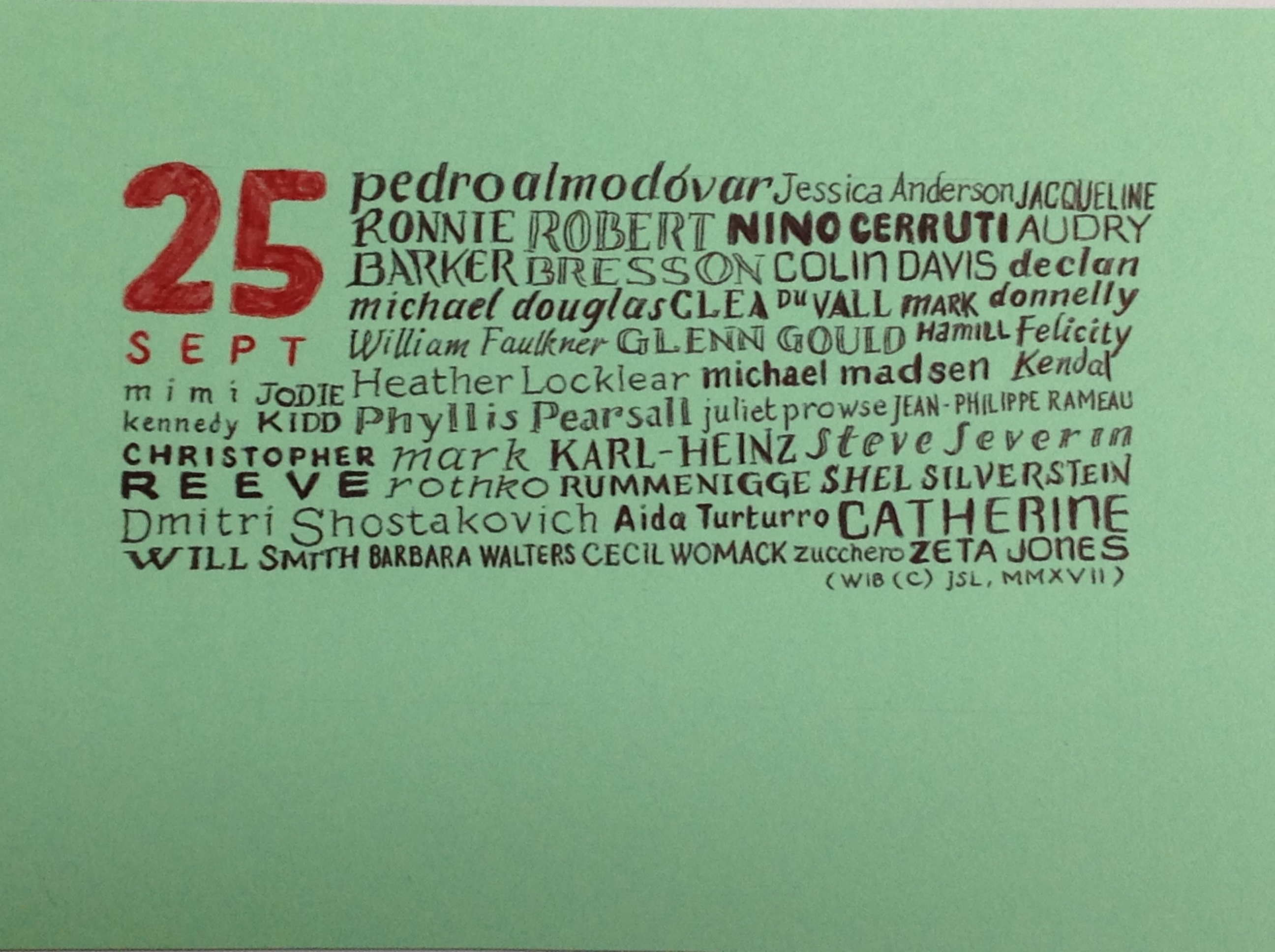
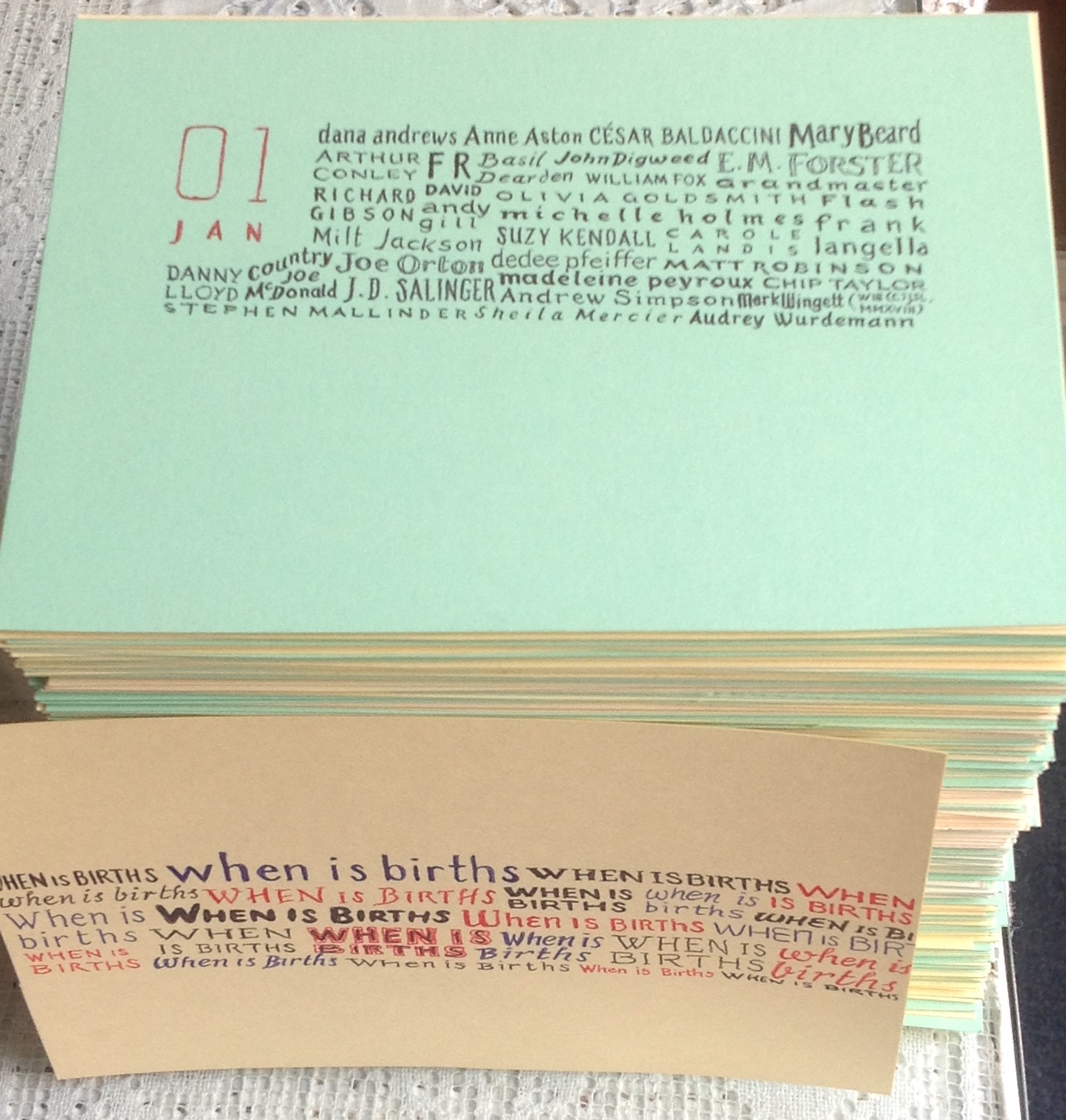
Just over a year ago, I created a daily account for social media platforms, which I came to name When Is Births. Every single morning, I have been posting a photograph of a card, filled with the names – sometimes as many as fifty – of prominent people born on the day in question. Some are household names, others relatively obscure. Some are very much alive and well, while others are long gone, but fondly remembered. I posted the very first one at 8am on Monday 25 September 2017. Now, over 10,000 names and nearly 366 entries later (because those with a 29 February birthday still count, even in a non-leap year), the one-year circuit has been completed.

Sometimes, an idea hits you in an instant, and you wonder where on earth it came from. Only later, stepping back, do you realise that idea is the sum total of several seemingly disparate elements, all of which have been bubbling in your subconscious. You often read about songwriters saying how their biggest hit was written in ten minutes, and while you don’t dispute that claim, that kind of flash of inspiration can be a culmination: a combination of life experience, revisiting obscurities or false starts, and as a reaction to what’s going on.

One Sunday afternoon, in early September 2017, while travelling back from London to my home in South Wales, I was thinking about Twitter, and how many people I knew on the platform (myself included) always seemed so jaded and miserable first thing in the morning. It wasn’t just that the news itself was depressing – we really ought to know some of the awful things that are going on in the world – but more that certain public parasites were capitalising on this misery and, through ignorance and hatred, sought to make money off the back of that negative energy. To a lot of us, it felt like a rank in-joke that had long become tedious and unfunny.

I wanted to do something else, but I wasn’t yet sure what it was. I knew I wanted something constructive, regular, challenging, but finite. Every day, if possible – and the day’s date seemed a logical starting point. A blog or a podcast seemed way too much graft for something that few people might sample, and certainly not every day. How about an image, though? I thought about many of the blogposts on this site, and how, rather than use photographs, I’d upload a specially created image, usually showcasing my handwriting skills in some way. I remembered one image in particular: a wall of almost 200 names of much-loved figures who had all died during 2016 representing all the deceased celebrities, from George Michael to Carrie Fisher, David Bowie to Victoria Wood, Prince to Leonard Cohen.

In about ten minutes, I’d worked out my new daily concept. Over the next couple of weeks before launch, I drew up dummy versions, tried to see which colour schemes worked, and which ones clearly didn’t. And I told almost nobody what it was. Instead, I just posted little teaser tweets to my Facebook and old Twitter account, which attracted 160 people even before the first post went live. By the end of 25 September, there were 300 followers; after five days, around 700. As the year is up, we’ve got nearly 2,400. Considering I am basically obscure, that’s not bad. (The name ‘When is Births’, by the way, is a nod to ‘When is bins?’, a question I once annoyed Toby Young with on Twitter, and which became the name of this blog in late 2016.)

IMG_1949I have to tell you, it’s nerve-wracking when you’re about to launch anything, especially when you know it’s going to take up a lot of your time. But I was right to say nothing ahead of launch day, I think. Because it would be an image, it seemed free of one specific interpretation. If someone wanted to just glance at it for a few seconds, that was fine; equally, you could read all the names and count up how many you recognised; you could even, if you wished, investigate the unfamiliar names, and seek out clips, songs and reading matter. I liked this most of all. And because everyone has a birthday, everyone gets a turn. Lastly, I chose to list the names for each day in alphabetical order, not least because it seemed the best way of accidentally ensuring amusing juxtapositions.
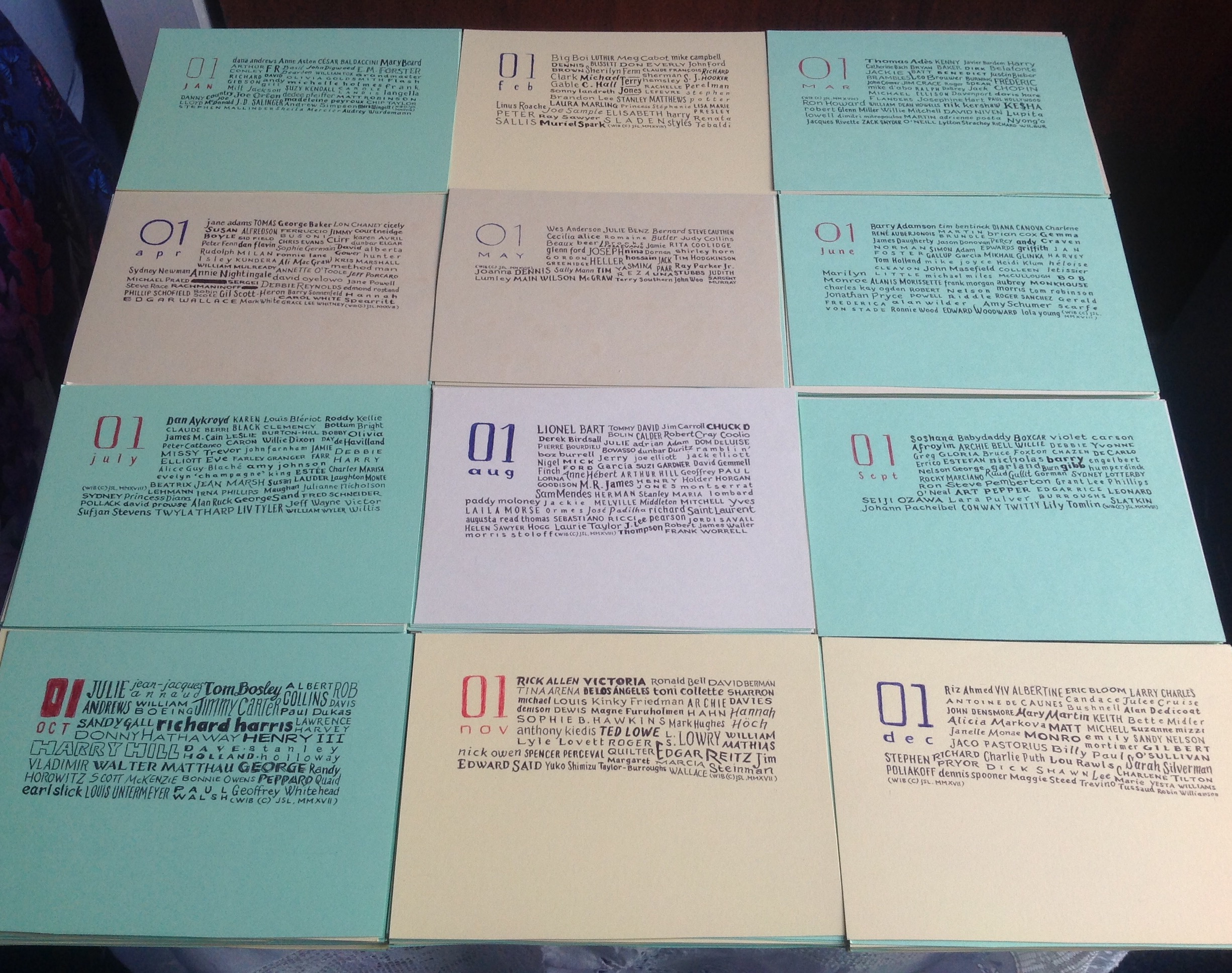

People have said some lovely things about the account. I’ve had so many people thank me, and tell me how it’s brightened their morning a bit. And from time to time, some of those people have said, ‘Do you intend to do anything with this idea?’

The answer is: yes, albeit in stages. The first part of the plan is to offer personalised cards (see below), written from scratch, where the recipient’s name is specially inscribed in the namewall. In time, I hope to mass-produce prints in some way, and maybe other spin-offs too, but in any case, the daily postings will continue, free, for the foreseeable future.

Finally, for now, a thank you to everyone who liked, everyone who retweeted, everyone who shared, everyone who said nice things, everyone who politely corrected or suggested omissions. I hope you feel it’s all been worth it.

Meanwhile, there will be something new in January 2019, and more on that when the time comes.

————–

The 366th and last When Is Births will be published on Monday 24 September, before the cycle starts again on Tuesday. A website will launch at some point in October 2018.

If you’re interested in purchasing a personalised A6 card, for £40 (postage free in the UK), please click here to email me, Justin Lewis.

Twitter @whenisbirths

Instagram @whenisbirths

Facebook: www.facebook.com/WhenIsBirths

IMG_2652 (Edited)

AND ANYONE ELSE WHO KNOWS ME

This week, BBC Radio 3’s always diverting Between the Ears series opened up an inventory of cassettes packed with the life and work of a man named Mark Talbot. For decades, Mark made his own radio shows, usually called ‘Second Side Up’, complete with records, phone-ins and interviews. But while the clips suggested him to be an articulate and slick host, he never became what you might call a ‘professional’ presenter on a national or even a local station. Instead, his programmes were specially and even individually made for members of his family, his friends and partners. It’s a melancholy but compelling half-hour about how the very act of communication can become an obsession. A kind of dialogue at one remove.

One piece of music I keep going back to is called “I’m 49” by Paddy McAloon, the songwriter and frontman with the group Prefab Sprout. It lies somewhere between electronic and orchestral music, with a yearning but resigned quality to it, but what gives it an extra devastating edge is in its use of speech samples, taken from late night radio conversations and phone-ins. The callers are unhappy and even desperate. At the close of the track someone (Paddy?) almost whispers ‘Just hold me’.

The genesis of the track, and indeed of the whole record, I Trawl the Megahertz, had come from a period of convalescence for McAloon; after eye surgery, he had to rest his sight, and so relied on radio and sound which sparked his creativity into making a solo record (his only one to date).

It’s a given that many radio listeners are lonely, especially at night. I find it a shame that more and more night-time radio is now automated or pre-recorded, even on a national station like BBC Radio 2 which recently dropped the much-loved Janice Long and Alex Lester.  There’s no shortage of stuff to listen to in the dead of night, but little of it is live and interactive. And in the small hours, people often need company. Even if it’s just to say hello to someone.

What the life and work of Mark Talbot suggests is that, sometimes, it’s not just a listener that needs support and an outlet. Sometimes it’s the presenter that might need it. And of course, you can’t award everyone national exposure but what ‘Second Side Up’ underlined is that everyone needs at some level to express themselves somehow and somewhere.

Thirty years ago or so, in my teens, I worked in radio for a bit, firstly as a volunteer at hospital radio and then at local radio. In the early stages of learning the ropes of broadcasting, you were advised to imagine you were addressing just one listener. At the time, I presumed this was to calm a novice’s nerves, but over time, I realised it was probably also to banish any delusions of celebrity that a budding presenter might be hoping for.

When it soon became clear, at least on hospital radio, that I had very few or indeed no listeners, I would occasionally amuse myself by making and recording programmes for my friends. Back then, I wasn’t sure why I did this, but I think I did it to sound more confident, or at least to find a context which gave me a reason to communicate. If it was just me, with no records or microphone, it felt like it wasn’t enough.

I was about to say that I don’t do that anymore, that those lonely years were a long time ago, but are they always? There are times when all that’s changed is the medium. Tweets have the concise economy of radio links, and you can be serious or silly, but sometimes I strain to come up with them because behind it is a terrible feeling of not being good enough, that everyone else is having a better time.

In a sense, on social media, we front our own shows: linking to playlists and video clips, announcing events, reacting, commenting. But what if we wake up in the morning and we have nothing to say, or nothing we can face admitting? You might be able to unleash one plaintive status update on Facebook, provided you offer the disclaimer that you’re over the worst now. But you can’t do it again. No-one, you assume, will want to read that.

At least with Twitter, you can do that a bit more often, but you feel it’s on the condition that you have to think of some witty metaphors along the lines of ‘I am wearing a grey hat made out of screaming wasps’. In other words, something that might distract people while you wear yourself out.

Maybe you need to talk to someone. In real life. Where ‘it’s really complicated’.


MAN’S LAUGHTER

file_000Maybe because it’s felt like the 24-hour news media has been laughing at us for months, but I’ve started to be plagued by the memory of a most disturbing record. ‘The Laughing Policeman’ by Charles Penrose is the aural equivalent of being poked in the ribs by The Sun. You rarely hear it nowadays, but in my childhood in the 1970s, Junior Choice on Radio 1 was still playing it. It was already fifty years old, yet no child I knew liked or enjoyed it, and I suspected that grown adults were writing in to troll us by requesting it.
Even now, it makes me feel queasy for several reasons. As an infant, I shunned an ITV children’s show with the same title, even though it featured Deryck Guyler off Sykes and whom I liked, because of its inevitable theme tune. If it came on the radio, I would make a quick getaway, defeated by a mixture of embarrassment (‘Stop doing it, this isn’t funny’) and alarm: ‘Why is he laughing, again and again? He doesn’t sound happy. Why?’

What did this police officer, one presumably in busy full-time employment, find so uproariously funny? Miscarriages of justice? Assuming he was ‘always on the beat’, what sort of weekly targets was he expected to meet? Did his laughter impede his ability to arrest potential suspects? (We discover, at least twice, that yes, it did.) Did his colleagues in the force suffer from other behavioural quirks, like the Crying Desk Sergeant or the Petrified Superintendant?

Is this the ultimate example in comedy of ‘You had to be there’? Because nothing, not Duck Soup, not Seinfeld, not even Three Up Two Down, is that funny. Nothing warrants four ferocious choruses of whooping and barking that makes Kriss Akabusi sound like Droopy the Dog. And it brings to mind another tiresome record that Junior Choice patronised: ‘I’ve Lost My Mummy’ by a now-disgraced Australian entertainer, which replaced the machine-gun laughter with furious mock-sobbing. Who on earth was this rubbish for?

‘The Laughing Policeman’ has no sincerity. It’s the cabaret at Trump Tower. You can imagine Nigel Farage miming to it; it doesn’t laugh with its eyes, only its lungs, a kind of physical exertion like clearing your throat. It’s laughing at nothing – whereas at least David Bowie’s ‘Laughing Gnome’ attempted puns with an ‘-ome’ suffix. One of my favourite bits of laughter in pop, though, is Bernard Sumner on New Order’s ‘Every Little Counts’ where he splutters over the line ‘I think you are a pig/You should be in a zoo’. Here the laughter sounds genuine – because he’s trying not to laugh.

If only ‘The Laughing Policeman’ were an isolated offence by Charles Penrose (aka Charles Jolly). But no, for this was a self-styled ‘laughing comedian’. Its B-side on its 1926 release, ‘Laughter and Lemons’ is, disconcertingly, a barrage of forced mirth over the Open All Hours music. There were, still, others: ‘The Laughing Major’, ‘The Laughing Ghost’, ‘The Laughing Monk’ (sadly not a Trappist one), and – a sure sign that someone will not shut up – a sequel: ‘Laughing Policeman Again’ in which the policeman finds a girlfriend who also laughs inanely. As that Glasgow Empire heckler perceptively said of Mike and Bernie Winters, ‘Oh fuck, there’s two of them.’

It seemed appropriate, in the week that Desert Island Discs celebrates 75 years on the radio, to check if anyone had ever chosen ‘The Laughing Policeman’. Four people have, including Twiggy and Hugh Grant, and I shudder to think of having that in your list of eight for ever more. What is it there to do – maybe it was to remind company-starved hermits of how to laugh? And it reminds me why I dislike that laugh certain comedians do: not the laughter of amusement, more the laughter of existence, tediously and constantly reminding you they’re still in the room while other people are speaking. At least Paul Whitehouse’s Chuck Perry character on the radio phone-in parody Down the Line has a point to his relentlessness: formless laughter simply at the inappropriate or even mundane subject under discussion.

It has given me an idea for a new TV drama series, though:

‘The Laughing Policeman’: Like Midsomer Murders but set in the fictional village of Hillarity. DI John Lafferty (played by, I dunno, Robson Green, it often is) tries to solve crimes of murder, except he can’t because he’s laughing. We don’t know why yet. Theme tune is ‘The Laughing Policeman’ but slowed down, like off a John Lewis advert, and sung by Emeli Sande. Repeated Fridays on ITV3. Be there.


SKETCH APOCALYPSE

fullsizerender2Desolation Jests is a new Radio 4 sketch comedy series which reunites the actor David Jason and the writer David Renwick. The last time the two worked together for radio was in 1980. Back then, Jason was a guest performer in the final episode of The Burkiss Way, a tirelessly inventive series in the vein of Monty Python, and scripted by Renwick and Andrew Marshall. It was, incidentally, the teenage Armando Iannucci’s favourite radio show. Jason’s one-off role in Burkiss was as an oleaginous continuity announcer who persisted with grovelling links regarding the Queen Mother’s eightieth birthday. Radio 4 panicked after its first broadcast, and the repeat a few days later snipped out all of Jason’s royal links, consequently running several minutes short. (It has never been repeated in full, but you can listen to it here.)
Neither David has made a new radio series since the early 1980s. Both became giants in television – Jason as Delboy Trotter, Skullion in Porterhouse Blue, Pa Larkin, and Detective Jack Frost, while Renwick continued his association with Andrew Marshall on Whoops Apocalypse, Hot Metal and Stuff with Alexei Sayle, before creating the hugely successful Victor Meldrew and Jonathan Creek.

In fact, Desolation Jests is Renwick’s first full series of anything since BBC1’s Love Soup. His pursuit of the perfect intricate plot in his television work has somewhat obscured how gloriously anarchic his sketch writing can be, so it’s a pleasure to announce that he’s revived that latter quality. Like Burkiss, Desolation Jests is all about the elaborate, conceptual spoof. In a distortion of Desert Island Discs (note the rhythmic similarity of the two titles), John Bird plays the Plomleyesque host and invites a guest to imagine that the world has been obliterated, that they are the last human being alive, and that they’ve been given the keys to the history of comedy. Which sketches would they choose? First to unlock the archive is the gangster Frankie ‘Flesh Eater’ Harris.

Demonstrating his versatility and superb grasp of pastiche, Renwick has of course created all the archive material, aided by Gareth Edwards’ sensitive production. Harris (Jason) revisits favourite sketches like the legendary ‘endoscopy scene’ from the Klutz Brothers’ classic ‘A Day at the Proctologists’, and a send-up of Mastermind from the 90s series ‘Fatman and Littlegirl’, itself a nod to Renwick’s own classic sketch on The Two Ronnies, in which a contestant’s specialist subject was to answer the question before last.

Renwick’s mastery of form and content has not deserted him, and completing the illustrious cast are Rory Bremner and Jan Ravens. Most encouragingly, his taste for silly character names and angry imagery remains, most notably in an item that imagines a more punitive Honours system, in which recipients are awarded a subscription to the Daily Express, or (in Kelvin Mackenzie’s case) deserved recognition as a health hazard.

The connection between Renwick and Jason stretches way back to October 1971 when the former began contributing to Radio 4’s weekly satirical series, Week Ending, in which the latter was already a cast member. Renwick was a 20-year-old reporter on the Luton News, and was not at university – unusual in an Oxbridge-dominated radio comedy world. When Ian Greaves and I wrote our exhaustive history of Week Ending, he stressed how important the show was to his development as a writer, especially when writing material for regular performers like Jason: ‘It was an early lesson that people are funnier than jokes.’

Forty-five years later, and Renwick is back writing for Jason. And it’s worth bearing this in mind – most comedy sketch shows are the work of several people. Rare is the comedy writer who is flexible and resourceful to shine in so many different styles, although there are a few: Victoria Wood, John Finnemore and (in his great Radio 4 series of monologic items, One) David Quantick. Now – belatedly – we can add David Renwick to that list.


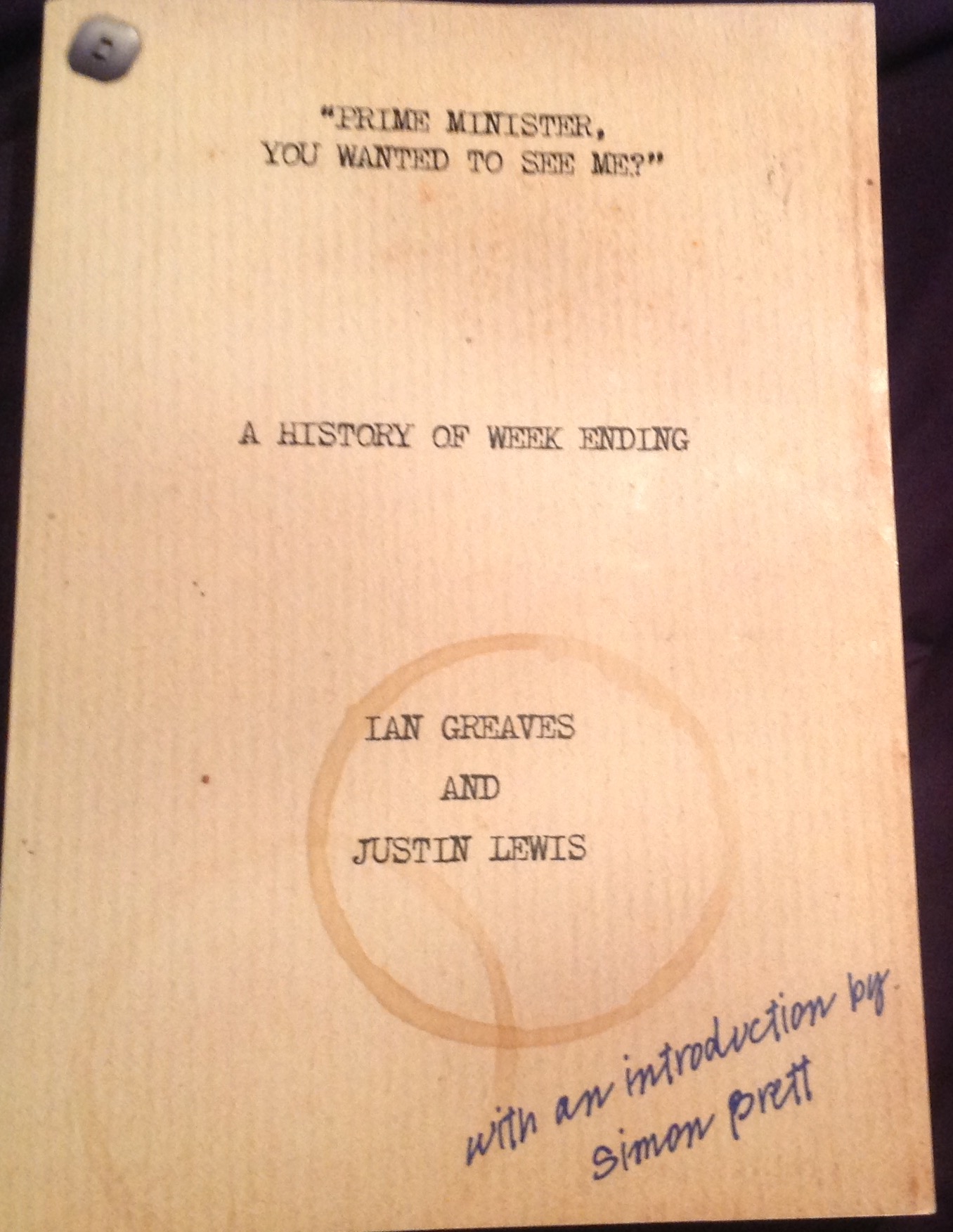
Desolation Jests is on Radio 4 on Tuesdays at 11pm, or on iPlayer. My 2008 book on the history of Week Ending, Prime Minister, You Wanted to See Me?, which I wrote with Ian Greaves, is available from here.


DON’T GO TO BED ANGRY

qt-panelWhen I first went on Twitter, probably around the middle of 2009, livetweeting disposable TV shows was an attraction of the site. Question Time was undoubtedly one of these. But it gradually became an endurance test where not even Twitter accompaniment could detract from its deathly formula of rehearsed quips, point-scoring and gassy pub opinions you hoped had been silenced with the progress of civilisation.

Question Time began in October 1979 on BBC1 and is likely to continue in its late Thursday slot, along with Andrew Neil’s cartoon series This Week, until we all die. Maybe it is intended to be a release, a cathartic summing up of the week’s talking points, but for many years, it’s felt like a groaning messageboard thread that cannot be locked. The current climate urgently needs a discussion programme heavy with explanation, detail and nuance, but Question Time’s lust for beige spectacle – yes, almost live from a civic hall and part-time theatre in Knobham – means that it both lacks the depth of a documentary and the pizzazz and glamour of a talk show.

Current affairs is complicated and god knows, we need experts to make sense of it all – not just to explain but to explain why it’s complicated. But there is no time for explanation on Question Time. The panel table must (must? really?) house five guests and a Dimbleby, plus an audience baying for blood and exposure. With a maximum of 10 minutes for most questions, there’s little room for much beyond upping the anger ante. No-one is really listening to each other, or even to themselves, and they spend a lot of the allotted time complaining that another subject is being ignored. (Though my favourite – as noted by a friend – is when people call for a discussion on immigration during a discussion on immigration.)

As we know, the loudest, most certain, most provocative voices dominate. The audience are bellowing eggs; the panel a queasy mix of reluctant ministers, frightful backbenchers and people off of Dragon’s Den. The glittery lift twat Neil Farridge is perhaps Question Time’s archetypal panellist these days; despite failing to win seven by-elections, his leathery pillar-box face and ashen racist patter has appeared 32 times on the programme (so far), and its producers know that, quite cynically, if he appears, their ratings will go up. You wish that more measured political voices would appear, and then you reason that the more measured wouldn’t want to do it. Why would they? I wouldn’t want to.

At some point about three years ago, I could stand Question Time no longer. It helped that Thursday nights now had a distraction for me: a weekly pub quiz, a more benign, harmless kind of question time. But my frustration with Question Time already ran deeper. You could laugh at, say, Jacob Rees-Mogg’s head, but then powerlessness took over, and then anger – and it seemed to me that going to bed angry was a bad idea. (So was waking up angry, and eventually, I dropped the Today programme like a boiling turd for the same reason.)

Anger is fine if it leads to explanation and analysis and understanding. But if Question Time used to manage these emotions properly and usefully, it no longer seems to bother. It and others like it confuse ‘balance’ with ‘extremism’. I would be more interested if more effort was taken to engage with the ‘don’t knows’, the ‘not sures’. Surely they are the ones who could inspire fruitful, expansive discussion. But in an environment where we are encouraged to create outrage or to react to it, subtlety is insufficient.

The problem may lie with the word ‘argument’ or ‘debate’. I prefer the word ‘discussion’ in which two or more people (but better if it’s only two) test each other’s viewpoints and their own. Listening to oneself is as important as listening to one’s ‘opponent’:

‘Am I making sense?’

‘Have I changed my mind, and can I admit it?’

‘Am I not sure, and can I admit it?’

Imagine if people said this kind of thing more often on Question Time or Any Questions or Today. Some call it dithering. I simply call it thinking.

ON HOT TAKES

146It’s still early days for this new blog. Design-wise, it’s far from ready – it’s like moving into a new house but you’re undecided on the decor or furnishings, and there’s that back room which urgently needs a floor. As for subject matter, I could have gone with a specific theme, but I felt uncomfortable with that. I decided that, after several years away from blogging, it would be best to just see what ideas came up and run with those. So, for a while at least, these pieces may have little in common. This in itself, though, feels exciting. You have to start somewhere, after all.

But while I don’t want to start laying down rules for what will and won’t feature, I hope to keep the ‘hot takes’ pieces to a minimum. There are too many columnists already, battling to be first with their opinions on why Eric Bristol ‘had a point’, why they always knew Dennis Trump would win but never bothered saying anything, and why ‘that thing you think you like is rubbish’ (copyright, The Guardian, most days). I have stopped reading the columnists. They are all useless. Even the good ones. They are as well. Yes.

We’re in an environment where instant reaction is key, where that tweet doesn’t have to be nuanced or thoughtful, just quick. (Guilty as charged, m’lud.) Yet sometimes it’s hard to have an instant reaction to something. Sometimes you’re simultaneously too close to the event, and too far away from it, to make any coherent sense of what’s going on.

Five years ago this afternoon, I was in a crematorium, saying goodbye to my brother. He had died two and a half weeks earlier, and I was one of a handful of people whose job was to pay tribute to him and his life. I hadn’t had long to write something, but was aware this was a golden opportunity to sum up a life, one curtailed cruelly early.

I have my eulogy written down somewhere. It may even be on the same laptop I’m typing these words on. I could go and look. But I somehow can’t. Because whatever I said that day was likely to have been filling space. I was the first to speak. I think I spoke for barely two minutes, a fraction of what the other speakers said. I can remember my voice cracking when I got to the bit that emphasised that he enjoyed a full, fruitful life despite narrowly missing his fortieth birthday by a matter of days. I can remember saying what extraordinary people his family were – though I may have left myself out of the list.

I do recall two things, though. One was that I couldn’t quite believe how many people were there: perhaps four or five hundred. Some were outside in the cold as the crematorium simply didn’t have enough space for seating.

The other thing I remember, while I squinted at an ocean of faces, was a soup of an alternative speech I was writing in my head. It went something like this:

 ‘What I’m reading out now is filler. This isn’t what I want to say at all, but I am in shock. I remember the joy and laughter but I can’t express that now, not yet. I remember the complications and occasional friction from our childhoods. But I doubt you want that today, either. And then there’s the illness he had, and – well – let’s not go there. It’s not that I have nothing to say. It’s just I can’t put it into words yet.  All I can do is to cling on to the words that I am capable of reading out, right now.’

I’m not suggesting for one moment that the other speakers’ eulogies were insincere. Far from it – I recognised and believed their anecdotes, stories and feelings far more profoundly than my own contributions. But whatever I really thought about the death of my brother would just have to wait. But even though I had nearly forty years of his life to draw upon, whatever I felt and thought about it still felt like a hot take, and my truer reactions would take time to surface.

These past five years, I may not have blogged publicly, but privately I’ve crammed notebooks with feelings, reflections and observations, often about the process of bereavement but also about other issues surrounding it. Truth be told, I felt uncomfortable sharing these matters with the wider world. It’s probably just as well I held back, because one of the trickiest things when sharing grief is knowing what to leave out.

Now, I have a better idea of what to leave out. Sometimes you just have to step back and wait, to see what you really think and feel about something. And I may revisit this subject again, but – come back! – not exclusively.


THEN WELCOME

There are two reasons why I constantly miss Chris Morris being a regular radio presence. One, inevitably, is for his comedy. During the 1990s, his output for the BBC on Greater London Radio, and then Radios 4, 3 and 1, marked him out as one of the medium’s true originators. Though justly acclaimed for his television work (The Day Today, Brass Eye) and latterly his feature film (Four Lions), I believe his comedy bones hail from radioland. And his radio shows – most famously On the Hour, co-created with Armando Iannucci – have been packed with heavily stylised packages of reportage (‘There’s been a large disaster at Bigg Street Station’) and fractured versions of tabloid headlines:

‘Dismantled Pope Found Sliding Along Road’

‘Left Wing Footballer Shoots Cat’

‘Brilliant Professor Unplugged By Careless Cleaner’

But there’s another reason I miss him. Chris Morris was, both as a technician and as a music lover, one of the finest radio DJs this country has ever produced. He had an extraordinary ability to mix the familiar with the unsung, every week offsetting his comedy content with an eclectic pile of records. His show was not in the vein of John Peel: the point wasn’t necessarily to unearth new bands; instead, he cherry-picked from the playlist, tossed in some neglected oldies and very occasionally unleashed the compellingly rank: Derek Jameson; Guy Mitchell’s comeback record ‘Have A Nice Day’, or Jimmy Tarbuck’s reading of ‘I Should Be So Lucky’. Beck, Gil Scott-Heron, R.E.M., Stereolab and Sly Stone – among countless, countless others – were all heard regularly.

His Radio 1 show ended on Boxing Day afternoon 1994 with a selection of highlights from his seven months on the station. Stunts created and performed with sidekick Peter Baynham included claiming to find the corpse of fellow DJ Johnnie Walker in an adjacent studio, and supposedly removing a shell from a tortoise. Another correspondent, roving reporter Paul Garner, was heard to bother a taxi driver in Cambridge almost towards dangerous breaking point. Macabre and hilarious, it forced the listener to wonder if their ears were deceiving them. ‘Did I really just hear that?’

It took nearly three years for Morris to return to Radio 1. Blue Jam, which began in November 1997, was hailed as a wild departure from his previous work – markedly slower in tone, nocturnal, desolate – but it retained several familiar hallmarks. Firstly, the sketch material (though now performed by actors like Kevin Eldon, Amelia Bullmore and Julia Davis) was still about escalating crises, but because of its post-midnight slot and context, these items felt more unsettling: almost contemporary ghost stories, anxiety dreams about parenthood, mortality, sex, identity, health and workplace competition. I’ve always reasoned that Blue Jam’s content – regarded as some of the most extreme to ever make it to British mainstream radio – is justified on the grounds that the dreams and nightmares we have in our lives are entirely unfiltered by censorship.

I used to have a ritual with my Blue Jam listening in the late 90s. I would turn off the light, get into bed, set a tape running and then listen in darkness, still giggling at the comedy. Some of it was alarming. Some of it, it must be said, was also spectacularly bloody stupid.  But what I also enjoyed about it was the music. Every week, it was like receiving a new compilation tape, where new dance tunes shared space with French or Japanese pop, or oldies like “I’m in Love with a German Filmstar” – a song you hear all the time now on 80s flashback shows or 6Music, but rarely in 1999. The comedy was ice-cold but intimate; in contrast, the music was often warm, full of reassuring colour and zest. Indeed, that’s why I was less fond of Blue Jam’s television incarnation. Jam, broadcast on Channel 4 in 2000, reused many of its ancestor’s items, but inevitably could not house full tracks of music, and the pace was affected accordingly.

As I’m writing this, Radio 4Extra is broadcasting the third and final run of Blue Jam (first broadcast early in 1999). Its sound collage of samples, sketches (with recurring loops as counterpoint) and full tracks, remains fresh, original, and quite unlike anything else. And it’s often funny. But while I miss Morris’s comedy on the air, I also miss his choice of music. I feel sure that 6Music must, by now, have tried to entice him back to radio – so far, without success. But it would be a shame if he never treated us to his playlists again. He wouldn’t even have to talk.

PLUG: There’s a book called No Known Cure: The Comedy of Chris Morris. Published by Palgrave Macmillan and the BFI in 2013, it’s a collection of original essays on Morris’s career to date from a variety of writers. My contribution to that book, an essay entitled ‘Rockarama Newsbanana’, is concerned with the way that Morris used music, as a DJ, composer and musician, to enhance his comedy.

You can buy the book here. And no, not all these blog posts will be trying to sell you stuff.