FLA 29: Shanine Salmon (31/08/2025)

Shanine Salmon - Theatre News Contributors | London Theatre ...

Shanine Salmon, a lively, knowledgeable and funny writer, quizzer, quiz question writer, theatregoer and theatre reviewer, is another friend I knew I wanted for First Last Anything. We were both on internet forums for years before we actually met, about 15 years ago. She is the very first person who ever commissioned me to do an art birthday card – this was in 2017 when I’d just started doing the When is Births daily birthday card series on the internet, and so began an intermittently profitable sideline project. Thank you, Shanine.

When Shanine and I spoke, via Zoom, one evening in August 2025, it had been a while since we’d had a proper chat, and so what follows has been carefully extracted from a three-hour gossipy ramble about what we’d both been up to lately. Expect some thoughts on Michael Jackson compilations and biopics, nepotism, quizzing and expanding one’s knowledge, and finally, the thorny and timely topic of AI-generated music, and whether or not it’s easy to spot. We hope you enjoy our conversation.

—-

JUSTIN LEWIS:

So tell me about your earliest memories of music and what you first remember hearing at home. It can be anything, anything at all.

SHANINE SALMON:

Apparently, as a baby toddler, in the late 80s, my mum would play vinyl records, because I’m quite old now. And I used to cry, I wasn’t someone who was naturally musical, apparently. The first album I remember listening to, on a loop, and feeling, ‘I want to listen to this’ was a NOW album, NOW 25, released in 1993. My mum was really shocked at how much suddenly I was into music, and I don’t think I was into anyone specifically. I just liked listening to that NOW album. It had the remix of Freddie Mercury’s ‘Living on My Own’ on it [which was a number one single the same month, August 1993]. And then certainly later, we had things like The Box [cable music TV channel 1992–2019], so that’s how I would get a lot of my new music, and then obviously through radio.

JUSTIN LEWIS:

In this run of FLA, I seem to have got guests born in the 80s, and what I realise is how many of them in their formative years saw TV channels continuously full of music videos. And that is the big difference between what I grew up with, where you would have pop programmes and you might see a video, but you didn’t see videos round the clock – you still had to listen to the radio. Did you have Sky or something like that?

SHANINE SALMON:

We had cable, which I don’t think we could afford! I feel like if it was MTV… my memories of MTV were then they started to move into programming rather than just videos. VH1, similarly – I got asked a question in a quiz: ‘Who sang “Love and Pride”?’, and because as a small child, I’d seen Paul King being a VH1 presenter, I couldn’t believe it was the same man. He was still a good-looking man, but he was so different to when he’d been in King 10 years earlier. Being ancient now, we’re losing that visual medium. One of the reasons I probably struggle to keep up with new music is I don’t have that visual reference.

And I stopped listening to the radio quite early on in my life – in my twenties when I felt that Radio 1 was just unlistenable. I had been big on my boy and girl bands. But I felt I lost touch with music when I had to start working full-time, in 2011. I was doing the sorts of job where you wouldn’t have the radio on. I think if my career had taken a different path and I had other sorts of job, maybe I would still listen. It was just really hard to access – and equally, smartphones were just coming out. I think I had iTunes and those kinds of things, but it was very difficult to work out ‘What is new out there?’ And keeping up with it, as well as doing an eight-hour day of work or whatever.

JUSTIN LEWIS:

It felt like around 2010, 2011, there was a bit of a dip, it felt like there wasn’t a lot going on.

SHANINE SALMON:

There wasn’t really. It was peak X Factor [era], so it took me a long time to really appreciate someone like One Direction, by which time they’d long broken up, and there was actually good stuff like Little Mix. So it wasn’t me consciously going against those since I was watching those programmes, but what X Factor released was usually quite dirgey and boring. And that would dominate Christmas.

JUSTIN LEWIS:

Well the Christmas charts are terrible now.

SHANINE SALMON:

Oh, who even cares?

JUSTIN LEWIS:

It’s the only time anybody looks at what’s number one anymore.

SHANINE SALMON:

It all went wrong [in 2015] when they moved the Sunday chart show, which I was obsessed with, to Fridays. Every Sunday it had been the proper countdown, and you didn’t know till the end what was number one. And when it moved to Fridays… There aren’t big shocks anymore.

JUSTIN LEWIS:

All the tension’s gone, hasn’t it?

SHANINE SALMON:

This is it. It’s not exciting to even listen to music, let alone buy music. I write quiz questions now, and if you’re going to contribute to writing quiz questions about music, to do ‘so and so charted’ – who cares? That isn’t how music works.

JUSTIN LEWIS:

When I was in my teens in the 1980s, at school, I would take in my tiny little portable radio on a Tuesday and at Tuesday lunchtime, just before one o’clock, Gary Davies on Radio 1 would announce the new Top 40. He’d play number 5, 4, 3, 2, then he’d count down the whole top 40 towards number one and would play the new number one. Which was really exciting, though it sounds ridiculous at this distance to say that now, but it seemed to mean everything at the time.

SHANINE SALMON:

You wouldn’t get a Blur/Oasis type war now.

JUSTIN LEWIS:

No, I don’t think you would.

—–

FIRST: MICHAEL JACKSON: HIStory: Past, Present & Future, Book I (Epic Records, double album, 1995)

Extract: ‘Off the Wall’

JUSTIN LEWIS:

I’m gonna ask you now about the first record you bought.

SHANINE SALMON:

Yes – this was not with my own money, but I chose it. It’s the double cassette of Michael Jackson’s HIStory, which was a combination of a ‘best of’ on the first cassette, and new stuff on the second…

JUSTIN LEWIS:

Which was officially called ‘HIStory Continues’, which I didn’t know at the time.

SHANINE SALMON:

No, I didn’t realise that. I just knew the good stuff was on tape one, and then… tape two, it’s alright.

JUSTIN LEWIS:

So it was the hits you went for?

SHANINE SALMON:

I think it was the hits, because my mum had Off the Wall, which is still as good as Thriller and Bad are. Yeah – Off the Wall is the one I still go back to. Particularly the single of ‘Off the Wall’- a sign of what he was capable of. And yeah, HIStory obviously comes at a weird time. It’s post-allegations, and so the second cassette is songs about that, so that isn’t fun to listen to even now, whereas the old stuff [is].

Just in the last few days, they’ve been talking about this Michael Jackson biopic [Michael] that was due to come out this year. It’s been delayed. It’s starring Jaafar Jackson, one of his nephews, as him, but while Michael Jackson is long dead, his estate are still controlling what is and isn’t said. But it’s going to be a four-hour film, right, which is insane, and they might have to split it into two films. But this isn’t like the Wicked film – I went to see it, didn’t think it was that good – but you have to see the second part of it to conclude it. But why would you go back to see a second part of this where you know what happened: he dies in the end, and he doesn’t get any justice and the people that accused him don’t get any justice.

In any case, you’ve already got Michael Jackson biopics, both good and bad. You’ve got The American Dream, the TV miniseries with the Queen of Music Biopic, Angela Bassett, which is what this sounds like, but not as good. Like, why would you do that? And then there’s a terrible one called Man in the Mirror (2004), made while he was still alive, which I watched years ago and then watched again in lockdown as apart of a Friday film flop group watch I was part of – one of the most cheaply made films that you will ever see.

But yeah, as a child, I used to be really scared of Michael Jackson, when I was about four or five, because there was a big gap, a scary four-year gap between Bad and Dangerous. When he came out with Dangerous, particularly the ‘Black and White’ video, he obviously got older, but he looked like a different, odd man.

JUSTIN LEWIS:

Also, the album titles get more and more extreme. So you’ve got Thriller – though it should really be called ‘Horror’ if you’ve got Vincent Price on it – then Bad, then Dangerous. What’s the next album going to be called? ‘Monstrous’?

SHANINE SALMON:

Yeah, he goes back to that theme with the final album, Invincible.

JUSTIN LEWIS

But I was listening to the second disc of HIStory, ‘HIStory Continues’, and realising how angry a lot of his records are. Even the really good ones.

SHANINE SALMON:

Yeah, the anger on ‘Scream’ works, because I think it’s a really good track with Janet. And the excitement, which you wouldn’t get now, about its music video – which doesn’t look that expensive but I think was the most expensive at the time. And him and Janet hadn’t duetted before, they’d had quite separate careers.

JUSTIN LEWIS:

Apart from… Janet’s on ‘P.Y.T.’, on Thriller. She’s one of the backing singers.

SHANINE SALMON:

But yeah, the anger on this record. ‘DS’, which is an attack on one of the attorneys and he’s changed the name very slightly. I think that’s as bad as it gets, and if you don’t really know who that man is, or anything about the allegations… yeah, the whole thing is very angry. It’s very righteous. Like, ‘Earth Song’’s awful.

JUSTIN LEWIS:

I’m quite relieved you’ve said that! [Laughter]

SHANINE SALMON:

It’s the worst song, not just the worst Michael Jackson song. But I quite like ‘Tabloid Junkie’, but it’s quite similar to stuff he’d done earlier, so a bit like ‘Price of Fame’ [originally intended for Bad] and ‘Leave Me Alone’ [which was on Bad]. That kind of vibe. But had he still been alive now, even after the Leaving Neverland documentary, that absolutely would not have been the end of him. It couldn’t have afforded to have been the end of him, but he wouldn’t have been making new music. He would still have been, I think, a big global star, he might have retreated a bit or just toured and hoped for the best.

But with HIStory, the ‘best of’ bit is great, the best of that period – but the second disc feels quite dated for 94, even in hindsight. Somebody said he was not working with the most up-to-date rappers. I think the Notorious B.I.G. is on one of the tracks. But then there’s things like the cover of Charlie Chaplin’s’ Smile’.

JUSTIN LEWIS:

Which he’d been talking about doing for years. And the cover of ‘Come Together’ – which had been in the vault for years [since 1986], and was that just because he owned the copyright for all the Lennon/McCartney songs at the time?

SHANINE SALMON:

I go back to the odd song: ‘They Don’t Care About Us’… ‘Stranger in Moscow’, actually. Recently, I’ve actually been listening more to some tracks from Blood on the Dance Floor, the remix album which grew out of tracks from HIStory.

JUSTIN LEWIS:

Were you buying singles as well at this time?

SHANINE SALMON:

After this, yeah. I remember going to Woolworths and buying ‘Slam Dunk (Da Funk)’ by Five. But I also had Backstreet’s Back by Backstreet Boys, the whole album. It was like peak-boyband era.

JUSTIN LEWIS:

Do you still regard that 90s pop period fondly? Have you read Michael Cragg’s book [Reach for the Stars]?

SHANINE SALMON:

Oh the one about S Club 7 and so on? That’s a really nice oral history, the best way to do it because most of the people involved are still alive. Rather than a book where it’s him coming at a ‘fan angle’. There’s lots of people being very shady and bitter – and you realise what a horrible time it was. Did you see the Boyzone documentary?

JUSTIN LEWIS:

I haven’t yet. I believe Louis Walsh comes out of it badly.

SHANINE SALMON:

It’s incredibly evil. These poor young men and the Stephen Gately story has this obvious tragedy to it, but even if he was still alive, it would still be really sad. They didn’t get on, they were kind of manipulated, and it’s not unique to Boyzone. Only now do I think we’re at a point where we knew this kind of stuff happened, and we’re willing to talk. The music is very nostalgic, but digging deeper, you realise there’s a lot of sadness and manipulation and abuse, and all sorts of things that were happening to get those songs out there.

——-

LAST: PHOENIX: Wolfgang Amadeus Phoenix (Ghettoblaster SARL, album, 2009)

Extract: ‘1901’

JUSTIN LEWIS:

Let’s move on to something that probably hasn’t got any allegations attached to it.

SHANINE SALMON:

Well, you say that – but Phoenix controversially, though it wasn’t controversial at the time – released an album in 2013 called Bankrupt, and they did the Coachella Festival, and they brought on R Kelly…

JUSTIN LEWIS:

Oh god.

SHANINE SALMON:

Performing a version of ‘Ignition’. And this was 2013, 2014, so people already knew about R Kelly and the allegations. And they said, ‘Oh, it’s all been disproven’ – and then obviously the Surviving R Kelly series came out (2019–23) and they had to release a statement saying, ‘Actually, sorry, we were wrong.’ So, all my music choices are fuelled by R Kelly’s base controversy.

But anyway, Phoenix. Adam Buxton used to host a thing called Bug [series of live events, which became a TV series for Sky], which was like a presentation of music videos – and that’s how I got into Phoenix, because he played the video for ‘Trying to Be Cool’, which came from Bankrupt. Which I thought was really good. I got into them, and then didn’t listen to them for years, but then got back into them just after their last album, Alpha Zulu (2022). I went to see them at Brixton Academy about two weeks before there was a horrible crush there, and so it closed for about a year.

But yeah, they’re French, French touch, they’re same era as Air. The guitarist Lauren Brancowitz used to be in a band with the future members of Daft Punk, called Darlin’ – and the review that Darlin’ got [‘a daft punky thrash’, a live review in Melody Maker] is how Daft Punk got their name.

JUSTIN LEWIS:

Doing the research for this, I discovered one of my favourite Air songs has Thomas Mars from Phoenix on it: ‘Playground Love’ [from The Virgin Suicides soundtrack]. I somehow had no idea that was him. Because it doesn’t sound like him singing at all.

SHANINE SALMON:

He’s not credited as Thomas Mars, is he? He’s called ‘Gordon Tracks’. I know my Phoenix! So anyway, I’ve got obsessed with them again, last couple of years, but they’ve been going a long time. United the first album was released in 2000.

JUSTIN LEWIS:

Some of their songs have enormous streaming stats, especially things off Wolfgang Amadeus Phoenix (2009).

SHANINE SALMON:

Yeah, which won the Grammy. ‘1901’, you don’t necessarily know it by that title, but you’ve probably heard it because it appears in Friday Night Dinner, quite randomly.

JUSTIN LEWIS:

That does show up a lot in that.

SHANINE SALMON:

That’s probably still my favourite album by them, but it takes me a while to get into their albums. There’s one album of theirs I didn’t like, and now I listen to a lot of songs from it. There’s still stuff of theirs I need to explore because they’ve got this big back catalogue.

JUSTIN LEWIS:

Feels quite exciting, though, when you discover a new band and they’ve done all this stuff you’ve never heard.

SHANINE SALMON:

And you realise they’re not that young anymore, but it doesn’t feel tired. They haven’t got some kind of weird Rolling Stones reputation. The Rolling Stones to me always seemed ancient. There’s a sense of tragicness to the Rolling Stones trying to stay relevant – whereas with Phoenix, I don’t know if it’s because they’re not British or American, but they’ve got this sort of ageless quality, it doesn’t sound like the stuff of old men, though I think they’re all 50, or approaching it.

JUSTIN LEWIS:

I think when people start out in bands now, and they’re taking it remotely seriously, they have to think in terms of a career. It’s hard to imagine the Rolling Stones starting and thinking, ‘We’re still going to be doing this in twenty years.’ Let alone sixty. Nobody could have guessed what rock’n’roll would become. Not even The Beatles could have dreamt of where they would get to, whereas now because they’ve seen what those groups have done, the triumphs and the mistakes, and they think, ‘Okay, how can we live our lives, and stay alive’ – which helps, but also doing other interesting things, maybe taking a break sometimes.

SHANINE SALMON:

There’s that joke in The Simpsons in the 90s when Lisa’s getting married, and it’s set ‘in the future’ in 2010 and the Stones are still touring, and it’s called the Steel Wheelchair Tour. But you’re saying about musicians taking a break. You’ve got a situation where Taylor Swift and Beyoncé are like throwing out albums, throwing out music, and that’s obviously how they like to work. But Phoenix are genuinely exciting, because they have at least a couple of years, if not four or five, between albums. There isn’t this kind of churning out with them. The next album, if they do one, will be their eighth, which is nothing, you know.

JUSTIN LEWIS:

They seem to be doing singles at the moment, or collaborations, remixes.

SHANINE SALMON:

Yes, they released ‘Odyssey’ with Beck, but they’re meant to be doing something with Lil Nas X in the studio. But I’ve never really been that involved in the fandom of waiting for an album, and despite following them sort of on and off for twelve years, this is the first time I’ve been wondering, ‘When’s the next album coming?’

And this leads me on – though she doesn’t sound anything like Phoenix – to Romy Mars, who’s Thomas Mars’ daughter, he’s had two daughters with Sofia Coppola. Romy Mars is this TikTok star nepo baby now, she’s good pedigree for a nepo baby because she’s related to Nicolas Cage, her father’s this musician… she’s related to everybody. She came to fame with this TikTok clip where she’d been grounded after trying to use her parents’ credit card to charter a helicopter for a friend. So it was this weird sketch, she was saying ‘Come and make vodka pasta sauce with me’, she’s got her babysitter’s boyfriend there. She says to him, ‘Do you remember the helicopter fiasco?’ and he’s like, ‘Do you mean “fiasca”?’ because it’s like ‘feminine’ – it’s really odd. It feels like she’s going to be like her mum and wants to direct films.

But then, maybe end of last year, she released her first single, I think she’s released four now. And even though I can’t relate to this 18-year-old nepo baby who’s clearly incredibly rich, it’s surprisingly good stuff. I think I like it because she’s clearly taking a lot of influence from her dad, vocally. And obviously there’s talk about how, to get into the music industry, you have to have a parent… all these gazillionaire parents who are funding studio time for their kids. She isn’t really doing much with her dad, though, as far as I know, she’s writing her own stuff.

JUSTIN LEWIS:

Yes, it’s quite good. She probably stood more of a chance with the work being good than, say, Brooklyn Beckham. Can you imagine if he’s got an album lined up? I guess that’s the point – it’s not just about having talented parents, it’s about having a particular vision. No disrespect to Victoria Beckham, who’s obviously become incredibly successful. And anyway, it’s not like the offspring of rich, famous people make uniformly terrible stuff. It doesn’t work like that – sure, they’ve got those connections, but they can actually do it as well.

SHANINE SALMON:

And historically, you would probably go into a field that your parent has been in, so you wouldn’t judge someone who was a doctor and whose dad had been a doctor. I’m not really sure how I ended up in the field I work in, but my mum didn’t really work, and I didn’t really know what jobs existed and how you got into them. It’s such a privilege to have that connection, that knowledge, to know you need to go to university and get these A levels, or do that apprenticeship… whatever it is. You only get that with knowledge, and I think younger people now have more access to that sort of knowledge: ‘I know “so and so” is a job. How do I get into that?’

I think it’s the nepo babies that don’t realise they’ve got the privilege, or play it down with, ‘Oh no, I’d have still been here.’ No you wouldn’t, because you wouldn’t have that knowledge! And you wouldn’t have had the money and time spent on you getting to the standard you are at. Even just being able to play an instrument. I don’t know how it is at schools now, but I started playing one, and then didn’t really finish it off. Where do you get that support, particularly when state schools don’t have the money to support and develop an interest or a talent. It wouldn’t surprise me if there are schools that don’t have music, or drama, or art.

JUSTIN LEWIS:

They’re just considered luxuries by some.

SHANINE SALMON:

They’re absolutely not, but we’re already seeing it through the drama school system. The top drama schools, it’s all probably going to be people who went to private schools that are able to do drama exams. I used to work at Trinity College London, administering the drama exams, and the majority were all private schools. There’d be the odd state school, and they’d get very excited about that, but that was because they were like one of two or three. The rest were all private school, or self-taught people. But I started that job over a decade ago, and at the time, I thought, ‘This is why you’ve got a situation where so many actors have been to Eton.’ There was a quizzing tournament against people who were in quizzing but who happened to be teachers, and one of the teachers worked at Eton, and they were all talking about how they had these inter-school competitions. So yeah, that’s still common. If you go to public school or private school, suddenly there are these opportunities because parents are happy to pay the school fees for the extra-curricular stuff.

But, like anything, you have to start people young. Take languages, in terms of learning languages, this country is a disgrace. The only way for most people to pick up multiple languages is that they’re in a household with them, because they heard it from birth. We should be teaching languages from the moment children enter the nursery, or infant school at the latest. To leave it till eleven or twelve like I had it is too late, unless you’re only going to be teaching me entirely in French.

But that’s why you’ve got the situation in the music industry where it feels like it’s dominated by people with privilege, and while it’s not impossible for those without those connections, it would take them a lot longer, and lots of talented people don’t make it. There’s no guarantee that you’re going to be found.

JUSTIN LEWIS:

When they opened the Brit School in 1990, one of the big ideas was that talent would be nurtured, but while it’s true that some very talented people have come out of it, the records all sound the same. I mean, some of them are fine, very accomplished.

SHANINE SALMON:

Yeah, Brit school is interesting. It’s in a really awkward bit of Croydon, in fact it’s Selhurst. It’s so hard to get to. But you have to be in or near London, which I’m going to say is a privilege. London is expensive. There was a story where someone I can’t with the context that someone had moved down from.the North of England so their child could attend the Brit School. Again, that’s privilege. So, even though on paper, ‘it’s accessible to everyone as long as they audition, and they’re very good’, it’s still London, and their parents still have to make sacrifices. And how many parents do they have?

—-

JUSTIN LEWIS:

I sort of know the answer to this, but I’ve sort of forgotten. How did you get into quizzing? Because you’ve appeared on a lot of TV quizzes. What was the first one you did?

SHANINE SALMON:

The first one I did was in the summer of 2007. It was National Lottery Jet Set, on BBC1, hosted by Eamonn Holmes. I have a picture – where I argue I look exactly the same even though I was 19 and I’m not anymore – of Eamonn Holmes standing behind me in a slightly menacing fashion, with his arms on my shoulders. And I post that whenever, inevitably, he does something ridiculous.

How did I get into it? I didn’t really watch game shows – I don’t really watch them now. I just like reading and knowing stuff, and the pressure of having to pull the answer out quickly. There’s no fun for me in having all the time in the world to answer the question because most people can do that. Oh, and you can win money, that was always attractive!  

I’m not good at crosswords. No word puzzles, I’ve been doing the one on LinkedIn called Cross Climb, I quite like that. But I could never do Countdown. What interests me is general knowledge, and particular areas that I’m interested in. I’ve always been bad at science and geography, from school, and didn’t pick up any interest in them as an adult.

JUSTIN LEWIS:

And your degree is history, is that right?

SHANINE SALMON:

History degree, very modern history. But between 2014 and 2021, I didn’t do quizzes, and I’m not sure why. I was doing a lot of temp work, and taking time off work would have been really difficult. And also I was going to the theatre a lot, which I wasn’t making any money from, but it was a big hobby, and still an area of interest.

But with recent quizzing, this came about in December 2019, just before everything went weird. Oliver Levy, who’s married to Paul Sinha, had been trying to get me into quizzing for years, and I was like, No, it’s for professionals. And the quizzing was always at weird locations, and I was quite a lazy person so I didn’t bother going! [Laughs] But people kept saying to me, ‘There’s not really many women in quiz, come along and join it’. So I agreed that when I got home, I’d sign up for the Summer Friendly League. And then obviously I forgot about it, but I was doing a lot of quizzes with friends during lockdown, and then finally during summer 2020, the Summer Friendly League of Quiz of London went online. So as with everything else at the time, I was doing it from my living room or bedroom. And I’ve been in the quiz community ever since, I’m on the Quiz of London Committee now. I do a lot of question writing.

And I started going on television again. The first thing I did was The Tournament [BBC2, hosted by Alex Scott] in 2021. In the first episode they’d ever recorded of it. It’s the only TV quiz I’ve won, and it still gets repeated – so everyone will tell me now that my episode is on again because I win. It was nice to win, but with television I’ve not had much luck. I’ve come close, but I’ve not won anything since.

JUSTIN LEWIS:

Would you agree it’s actually quite difficult to win TV quizzes, because it’s not just about knowing the answers, it’s about the strategy of whatever the format for that quiz is. You can’t always know in advance what strategies you’ve got to employ.

SHANINE SALMON:

Because of the quizzing I do, I don’t feel relieved if I recognise other players, or if I don’t recognise other players. Just because I don’t know them doesn’t mean they’re not better than me. And that’s what I’ve often had. There are people you’ve never come across before who are not in the quiz community, but are very naturally bright and intelligent and are probably doing lots of quizzing. So I agree – it’s very tough. There are all sorts of other circumstances. They’re very long days. I’m not a morning person, so if I have to get up at 7am for a briefing. You’re often in a hotel – most of the game shows are filmed outside London now, places like Belfast, Glasgow. But certainly in terms of competition and other factors, you can’t control those.

JUSTIN LEWIS:

They’re like job interviews, really!

SHANINE SALMON:

They are! And the whole process of just getting on them in the first place. The last one I did of these was Jeopardy with Stephen Fry [in September 2024]. I’ve done a couple of radio quizzes, last few years. I did Brain of Britain and also Counterpoint [Radio 4 music quiz].

JUSTIN LEWIS:

Remind me, did you get to the final of Counterpoint?

SHANINE SALMON:

I got to the semi-final, same with Brain of Britain. I managed in both cases to win my first heat, both of them a shock. I’m very good at thinking, ‘Oh who cares, it’s just a heat’ with quizzes. But at semi-final, I think, ‘Oh this is serious’ and then I sort of fall apart. With Counterpoint, I did read some classical music books, but they didn’t help me! But I’m not too bothered about those ones, cause there’s no money.

JUSTIN LEWIS:

There’s a trophy.

SHANINE SALMON:

But I’m always willing to try out a new quiz format. I’ve participated in development run-throughs [quizzes broadcasters are piloting to see if they work]. Development run-throughs are great if you want to do a game show but you don’t want to be on television and they pay you like £50 for three hours to see if the show works. I get on run-throughs a lot, because I’m great to have in front of a TV commissioner, who will think: ‘She’s a woman, she’s not white, she knows how to talk to people…’

JUSTIN LEWIS:

You don’t freeze on camera or under pressure.

SHANINE SALMON:

As much as I consider myself an introvert, I’m happy to talk, I’m great at having to run through, and I behave myself. And I’m always happy to give feedback, good or bad. But they’re so desperate for women on quizzes – I think that’s why Jenny Ryan [on The Chase] and Beth Webster [on Eggheads] and a few others have been rewarded because they were there when there were hardly any women. When you go to quiz events, there’s a lot more now.

JUSTIN LEWIS:

Do you have particular strategies you’re prepared to share about how to improve? What advice would you give to anyone wanting to get into this?

SHANINE SALMON:

It depends on how you learn. If you enjoy reading, there’s no shame. I am a history person, I’m a lifestyle person, I like sport. In a team quiz, that’s going to be really useful. So don’t feel you need to learn everything, but I would say, learn your level 1s, your easy science if you find it incredibly boring like I do. That stuff is going to stick, and that stuff is going to keep coming up – and it’s the stuff you should vaguely know anyway. But I don’t really have any personal tips. If you enjoy a hobby, you will get better at it, perhaps, but you can only do that by getting into it in the first place, and then hearing lots of different questions and different formats.

JUSTIN LEWIS:

From about 18 to 21, I worked in a record shop which tended towards heavy metal. It didn’t exclusively stock that, it did some indie, and a bit of dance, and we were on the panel of shops for the BBC Radio 1 and Top of the Pops chart. But I realised I would very quickly have to get more knowledgeable about it, as I wasn’t particularly a fan. You’d have to be vaguely on top of it, so I’d read Kerrang! every week, and gradually you’d work out who customers were asking for. It’s surprising how much of that has stuck in the memory. It’s not always just about what you already know, and it’s certainly not always about what you like.

SHANINE SALMON:

Yeah, for me it’s about lived experience. That’s far more exciting than having heard a question a million times before, or having read a book.

JUSTIN LEWIS:

Our mutual friend Simon Scott interviewed you once, and you were talking about how quizzing was finally adapting beyond the world of mainly white men, both in representation and in subject matter. Is that still improving?

SHANINE SALMON:

The league quizzing is still dominated by older white middle-class writers and edited by older white middle-class writers. So, as a result of going, ‘You can’t beat them, join them’, I’m learning that stuff, and then improving as a result. Television, I don’t know because I don’t watch as much television, but in my experience, beyond Tipping Point, most of the quiz shows are getting much harder. Pointless is harder. The Finish Line, when I did the second series, was much harder. Jeopardy was tough, but Jeopardy is always tough. The questions in that were pretty diverse, but there was stuff that suited me, like quite modern television, like The Wire. You wouldn’t really get that in a lot of daytime shows.

But yeah, you don’t see that much diversity in quiz casting. There was Dave Rainford on Eggheads, but he died. There’s Shaun Wallace and Paul Sinha on The Chase. Even with hosts now, Clive Myrie’s probably the biggest one, on Mastermind, there’s Amol Rajan on University Challenge, but both of those took the old white men to go, ‘I don’t want to do this anymore’ for them to make that change, they wouldn’t have willingly done that otherwise.

But where are the new formats? And then where are the new contestants? I do a lot of league quizzes that are based in India, where obviously Indian people are the majority. But there isn’t a racial barrier to quizzing – there shouldn’t be. I would say the biggest barrier is about where your parents are from. You have a lot of people who are white British passing, but actually, if your parents grew up in America, or Australia or any other places with their own cultures, they’re going to pass that on to you. You very rarely hear people saying, ‘My mum is why I’m in quizzing.’ Men and women always say, ‘Me and my dad would watch stuff together.’

There’s still this male dominance there. The non-white side is improving. But I whenever I try and kind of expand the canon with questions, it’s met with ‘What the hell is this?’ There was one I wrote: ‘What was the first film that Vincent Minnelli directed?’ And I paired that question with the title of another film, one that shared its title with a song. Both films from 1943.

JUSTIN LEWIS:

This feels like something I should know.

SHANINE SALMON:

It feels like you should? It’s Cabin in the Sky, 1943. It’s a Lena Horne film, it had Bill Robinson in, Cab Calloway, Fats Waller. It’s Minnelli’s first feature film, but it’s also the first feature film with an all-Black cast. So I think that’s quite notable. But it’s old cinema, there were a lot of things that made it a tough question. But you expand it by saying ‘There’s two notable films, and the other one was called Stormy Weather, which ties in with the song of the same name.’

JUSTIN LEWIS:

I suppose there’s the option to reverse the question. ‘Cabin in the Sky was the first feature film directed by who?’

SHANINE SALMON:

Yeah, but then you make the white man the answer!

JUSTIN LEWIS:

Oh god, how embarrassing is that. [Laughter] I just wasn’t thinking at all, there. Totally fell into the trap.

SHANINE SALMON:

And this is what keeps happening.

JUSTIN LEWIS:

I’m going to leave this in, to embarrass myself. [Laughter] Because it’s quite revealing, isn’t it?

SHANINE SALMON:

Because it’s not on your radar. Why would you want to watch this all-Black cast in a 1943 musical film?

JUSTIN LEWIS:

But what’s also shocked me about this is that I didn’t know the name of the film.

SHANINE SALMON:

Stormy Weather was a slightly easier question, because of the song, and Etta James had recorded it. So sometimes with a Level 4 question I do try and soften it a bit. But yeah, these are two films with an all-African-American cast released in 1943. That to me is notable at that time because obviously you’ve got segregation, and ‘Who was this film for?’, during wartime. So it’s a really interesting question.

JUSTIN LEWIS:

Was Carmen Jones around the same time? Or was that a couple of years later?

SHANINE SALMON:

[Checks] 1954. But that was the film. The stage musical was 1943. The musical’s around. But yeah, there’s this idea – and this is not a non-white or racial thing – this term we use called Ins for Him, questions about women’s interests, or things that women are going to be interested in. Make-up is a top subject, fashion – women-led hobbies etc, I’m loathe to say it, because of course men wear make-up! It’s a ridiculous thing to say. But you get round it by adding in a clue, so something like ‘This person shares their name with this sportsperson that you like’. 

JUSTIN LEWIS:

So you embellish the question.

SHANINE SALMON:

You embellish the question, to focus it on the thing that the man might know.

——

ANYTHING: Mc JHEY AND BLOW RECORDS: ‘Predador de Perereca’ (2025, Blow Records)

JUSTIN LEWIS:

I am still relatively ignorant on the issue of AI music. So were you consciously looking for this, or did this come looking for you?

SHANINE SALMON:

I don’t think I was aware of how prevalent it is. I still think I’m probably quite naive. But when you messaged me for this, asking, ‘What do you want to talk about, what’s interesting you at the moment?’, I thought of this, because this song is on my ‘liked songs’ list, which currently has 927 songs. Which makes it sound like I’m not very fussy, but…

JUSTIN LEWIS:

No, I’ve got a list like that as well!

SHANINE SALMON:

But most of my new music comes from hearing a song somewhere, which I Shazam, and then find it’s either actually really old, or on TikTok. Certain songs will trend, and I think PinkPantheress is trending with ‘Illegal’ at the moment, you’re going to hear that a lot. The more the algorithm [recognises] this is a really popular song and video, it’ll get more viewers. I’ll try and find the exact name…

JUSTIN LEWIS:

Was it the Blow Records track?

SHANINE SALMON:

It was my understanding that it was put on TikTok because the lyrics are quite suggestive, although it’s in Portuguese, so if you played it to your Portuguese-speaking parent they’d be really shocked, because it’s over what sounds like an 80s disco track. And you think, ‘This is a really good song, but I don’t remember hearing it before’… My understanding is that it’s a rap song that’s gone through a filter process to sound like it was made in the 80s. The lyrics are kind of a song, but instead of making something new out of something old (like Fatboy Slim’s remix of Cornershop’s ‘Brimful of Asha’), this is like putting ‘Brimful of Asha’ through the AI and seeing what it comes up with.

That’s what I think is the more tricksy element of AI, because you’re going to go, ‘Well, why wouldn’t some musician hear this song and remix it?’ but instead they’re putting lyrics through… There are various processes.

Last year, I went through a period of being quite obsessed with Udio [AI music generator]. You can give it prompts, as you would with any other language module. So you could say, ‘I want a song about going to the fish and chip shop in the style of… jazz, or whatever. And you’d probably get more out of it with a Pro version, but: you’d get a two-minute song. And if you’re a lyricist but you can’t or don’t sing, or you don’t read music, you can put your original lyrics through that, and it’ll create a song for you. And then you send it to an A&R department or whoever now listens to new music.

So I think it’s got the potential to be a bit more dangerous, and we’re already seeing that with the mysterious ‘group’ Velvet Sundown.

JUSTIN LEWIS:

Yes, Velvet Sundown. When I prepare for each of these interviews, I put together a long playlist of everything we’re likely to discuss, everything the guest has suggested, and maybe a few surrounding tracks as well. And I’ll put that on while I’m working on other things. And so when the Blow Records track came on, I’d forgotten it was on your list, and I found myself thinking, ‘This is rather good, who’s this?’ And that really confronted my prejudices as an old person but also as a ‘creative’ person, so to speak. Because I had assumed I could spot AI-driven music, and maybe I can’t.

SHANINE SALMON:

Yeah, that’s been my shock because it was all over TikTok, I just liked it as a song, and then someone said, ‘Hang on, I’ve deep-dived, this song didn’t exist beforehand, and it’s only just been uploaded, and actually, if you look into it further, they’re not claiming it is a song from the 80s.’ They put their name on it, and I think they have admitted that they ran it through some software. What it actually says about the artist: there’s nothing on Spotify saying, ‘This might be AI generated.’ Whereas with Velvet Sundown, I think they added something recently after they did an investigation. How did they describe it: [Reads from Spotify description]: ‘Synthetic music project, guided by human creative direction and composed voice and visualized with the support of artificial intelligence.’ But they’re saying, ‘We’re not trying to trick audiences, we’re still providing, we’re still going through a process to create music.’

JUSTIN LEWIS:

And ‘they’ve’ released three albums just this summer.

SHANINE SALMON:

As somebody who uses AI a lot in work, I find myself wondering, ‘Is using computers to enhance stuff bad?’ That whole T-Pain kind of autotune – nobody sings like that, that’s not natural. You use effects on music all the time. But where it crosses a line is, for instance, what technology you’d have used to remix the Blow Records song. Remixes have always happened – Fatboy Slim with Cornershop, the Julian Raymond mix of Freddie Mercury’s ‘Living on My Own’ – but it’s always been made clear that ‘this is a remix’, that they’ve been given the rights to the song, so off they go.

With AI, it’s not clear actually. Does someone have the right to that song, to those lyrics? And also the legal element, and what happens to those genuinely creative people now? Anyone now can just put something through a computer and create a song, but they haven’t got a musical bone in my body. Like that’s scary.

JUSTIN LEWIS:

When I was listening to a Velvet Sundown album, I found myself listening out for the lyrics first and foremost, which are actually bollocks. There’s all these references – I counted them up – to sky, light, fire, wind, all very elemental, lots of stuff about shadows and silence. It’s not really about anything. There’s a complete lack of humour.

SHANINE SALMON:

Yeah. But I think there are so many musicians out there like that. I think Lewis Capaldi seems quite a fun, interesting person, so why are his songs so boring? So with that, maybe you’ve got a generation of sad young men for whom that’s potentially relatable. But that article I shared with you from Associated Press [dated 31 July 2025], which was saying that actually there are certain words that keep turning up in AI songs… like ‘neon’.

JUSTIN LEWIS:

Oh my god, yeah, ‘neon’. And all these attempts at oxymorons like ‘silent voices’ as if it’s trying to sound deep. [Laughter] And then I found myself thinking of examples of terrible, vague lyrics being spouted by real human beings over the years.

SHANINE SALMON:

With the Velvet Sundown albums in particular, I was thinking earlier about [the Italian pianist and composer] Ludovico Einaudi, because his stuff often has these wishy-washy titles, and I wouldn’t have been surprised if all these Velvet Sundown tracks had [started as] instrumentals. I don’t know if that crosses a line. There is some input, but what I think is happening is: whatever software or hardware you’re running it through, it’s going, ‘Yeah, we wrote a song for you last time that had “neon” and weird oxymoron titles, so that’s what you want, you downloaded that, you were happy, I’m just going to keep giving you what you want, because you’ve done that on time.’

I mean, I use AI in my work, I create assessments. I’ve flirted with it for quiz writing, particularly when I’m compiling buzzer quizzes, to try and work out where things should go, and in what order. But I found I had to refine it so much that it’s not really worth doing. I’d love to know who’s behind this, and what are they filtering down – if anything? Like are they looking at the output and saying, ‘This is terrible, can you get rid of that lyric or change the tune slightly?’

JUSTIN LEWIS:

Yes, how much of it is going through the editing process later?

SHANINE SALMON:

Yes, it’s not so much ‘What is AI?’ as ‘Where is the human?’

—-

Shanine Salmon’s extensive archive of her theatre reviews, View from the Cheap Seat, can be found here: https://viewfromthecheapseat.com

You can follow Shanine on Bluesky at @braintree711.bsky.social, on What Was Twitter at @braintree_, and on Instagram as @shanine_salmon.

——

FLA PLAYLIST 29

Shanine Salmon
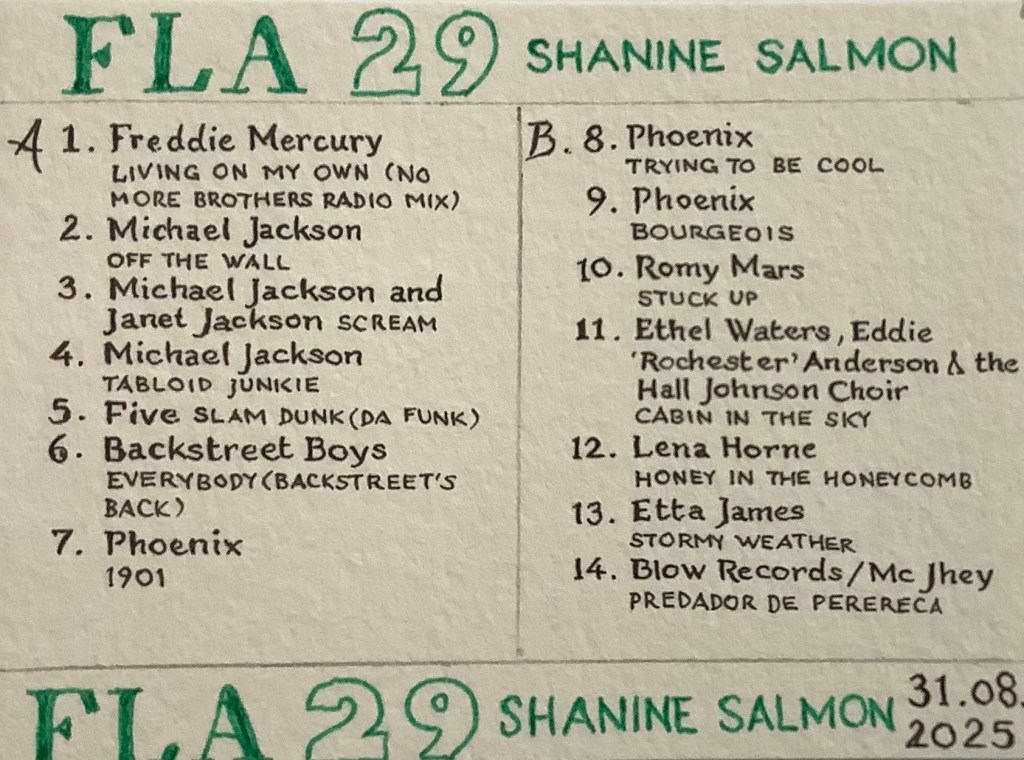
(For the time being, this site and project uses Spotify for the conversation playlists, but obviously I disapprove that Spotify doesn’t pay artists and composers properly, and other streaming platforms are available, as are sites to buy downloads and buy recordings. For consistency, you can also listen to the selections via YouTube (where available), and links are provided in each case, below.)

Thanks to Tune My Music, you can also transfer this playlist to the platform or site of your choice by using this link: https://www.tunemymusic.com/share/kyzUBBZp2k

Track 1:

FREDDIE MERCURY: ‘Living On My Own (No More Brothers Radio Mix)’: https://www.youtube.com/watch?v=SbWY5c-kJnw&list=RDSbWY5c-kJnw&start_radio=1

Track 2:

MICHAEL JACKSON: ‘Off the Wall’: https://www.youtube.com/watch?v=_BfcRjZn6y4&list=RD_BfcRjZn6y4&start_radio=1

Track 3:

MICHAEL JACKSON & JANET JACKSON: ‘Scream’: https://www.youtube.com/watch?v=0P4A1K4lXDo&list=RD0P4A1K4lXDo&start_radio=1

Track 4:

MICHAEL JACKSON: ‘Tabloid Junkie’: https://www.youtube.com/watch?v=loCFx_eelXE&list=RDloCFx_eelXE&start_radio=1

Track 5:

FIVE: ‘Slam Dunk (Da Funk)’: https://www.youtube.com/watch?v=pNMgraIeUJc&list=RDpNMgraIeUJc&start_radio=1

Track 6:

BACKSTREET BOYS: ‘Everybody (Backstreet’s Back)’: https://www.youtube.com/watch?v=xPsiB9GlgKQ&list=RDxPsiB9GlgKQ&start_radio=1

Track 7:

PHOENIX: ‘1901’: https://www.youtube.com/watch?v=dLawb_TKWXQ&list=RDdLawb_TKWXQ&start_radio=1

Track 8:

PHOENIX: ‘Trying to Be Cool’: https://www.youtube.com/watch?v=LXBUnNWeqzc&list=RDLXBUnNWeqzc&start_radio=1

Track 9:

PHOENIX: ‘Bourgeois’: https://www.youtube.com/watch?v=HcsIYlYJ45A&list=RDHcsIYlYJ45A&start_radio=1

Track 10:

ROMY MARS: ‘Stuck Up’: https://www.youtube.com/watch?v=DSobFLenJVw&list=RDDSobFLenJVw&start_radio=1

Track 11:

ETHEL WATERS, EDDIE ‘ROCHESTER’ ANDERSON & THE HALL JOHNSON CHOIR: ‘Cabin in the Sky’: https://www.youtube.com/watch?v=cezhs6G2B60&list=RDcezhs6G2B60&start_radio=1

Track 12:

LENA HORNE: ‘Honey in the Honeycomb’: https://www.youtube.com/watch?v=LmvVIlOmxpo&list=RDLmvVIlOmxpo&start_radio=1

Track 13:

ETTA JAMES: ‘Stormy Weather’: https://www.youtube.com/watch?v=VE5_fDmPt0w&list=RDVE5_fDmPt0w&start_radio=1

Track 14:

BLOW RECORDS / Mc JHEY: ‘Predador de Perereca’: https://www.youtube.com/watch?v=vRBu_RLBt1A&list=RDvRBu_RLBt1A&start_radio=1
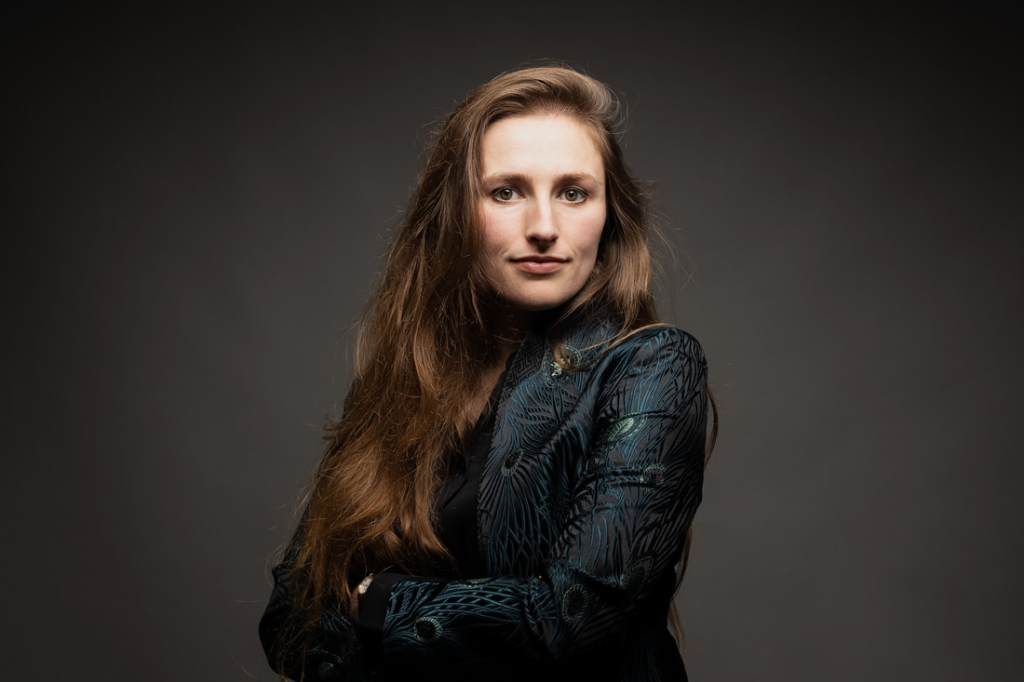
FLA 28: Dr Leah Broad (24/08/2025)

Picture (c) Monika Tomiczek

Since the day I started reading the author, broadcaster and musician Dr Leah Broad’s magnificent Quartet: How Four Women Challenged the Musical World in the early spring of 2023, I knew I wanted to talk to her for First Last Anything.

Quartet is an accessible, thoughtful biography of four of England’s foremost women composers. It has won several book awards (including a Presto Music Books of the Year Award in 2023, and the Royal Philharmonic Society Book Award in 2024), and has led to a series of concert events of talk and music called Lost Voices, in which the composers’ works were brought to life by Leah, the violinist Fenella Humphreys (who was the guest for FLA episode 5 in July 2022) and the pianist Nicky Eimer. 

With their overlapping lifespans covering a total of nearly 150 years, the four composers that Leah focused on for Quartet are Ethel Smyth (1858–1944), Rebecca Clarke (1886–1979), Dorothy Howell (1898–1982) and Doreen Carwithen (1922–2003). In our conversation, on Zoom one afternoon in August 2025, Leah explains why she chose these four women for the book, but we also talk about much besides – including the representation of women composers in educational syllabuses, at the 2025 BBC Proms, and for her forthcoming book project: women in music during World War II. Plus find out Leah’s first, last and wildcard music purchases. Leah was so generous with her knowledge, experience, expertise and time, and I found it all absolutely fascinating. I’m sure you will too.

——

JUSTIN LEWIS:

The first question is one I ask everybody. What music do you first remember being played in your home when you were growing up?

LEAH BROAD:

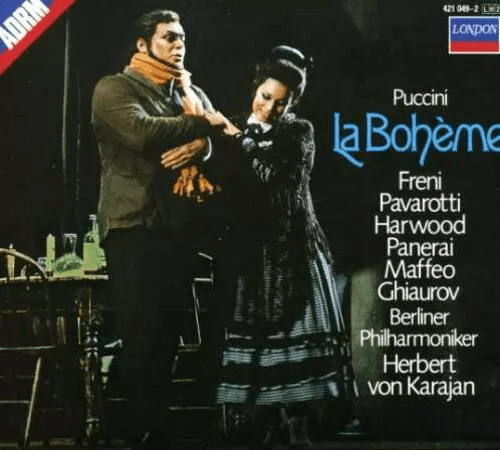
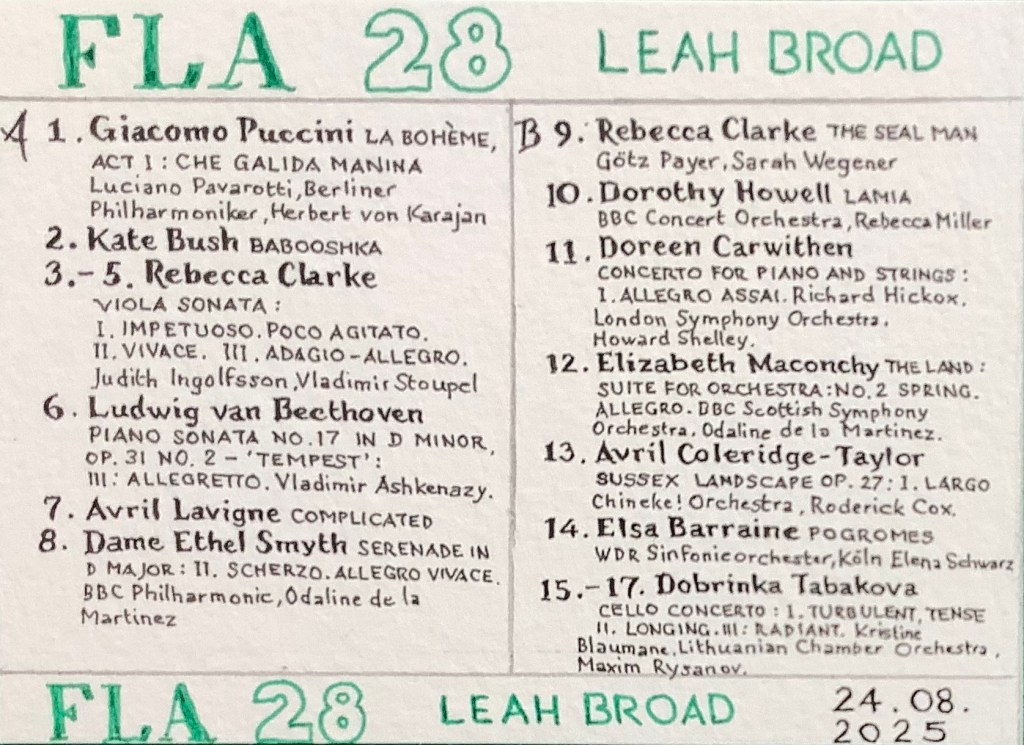
Oh, it was a highlights record. It was Highlights from [Puccini’s] La Boheme, on vinyl, with Pavarotti singing. I used to play this whenever there was a storm because I was really afraid of the storms, and so this was just really calming. My parents listened to mostly Kate Bush, Genesis, The The, and then they had some popular classics albums especially because my grandfather really loved classical music and so we got some of his vinyl as well.

So that’s what I remember, along with Kate Bush’s Lionheart, which my mum had. I guess when I grew up, there was nothing unusual about classical music. My family weren’t musicians. My dad had played drums before I was born, but nobody played an instrument while I was growing up. There was nothing classical musical background-wise there whatsoever, but it was just part of the music that I chose to listen to when I was little.

JUSTIN LEWIS:

It’s interesting that you have the pop and the classical in your life at the same time.

LEAH BROAD:

Yeah, my dad had once wanted to be a drummer, and so he had played professionally for a little while. So he was heavily into drumming before I was born. By the time I came along he was an estate agent for a while, and then he set up his own business, was small shop owner, but he still loved prog-rock. My mum was the biggest Kate Bush stan on the planet and for some reason I liked classical music – so I don’t know what happened there.

JUSTIN LEWIS:

Do you still keep up with pop as well as classical? Are you still into both?

LEAH BROAD:

Oh, do I!

JUSTIN LEWIS:

I presume it doesn’t feel like a big gap between the two.

LEAH BROAD:

To me, in terms of what I listen to, it just feels like I listen to music that I enjoy and I am quite happy seguing from like, Janelle Monáe to… Avril Coleridge-Taylor. Just what I happen to be listening to. In terms of cultures that surround this music, though, there are vast differences between the two. Classical music feels like it’s going through a period of change in terms of who both listeners and performers are. Very often you find out that for younger performers and younger listeners, there is no massive bridge between pop and classical. We all grew up like this, right? Pop, and classical, and everything else combined.

But particularly in the way that classical music is written about… the things that are written about female performers, by example, by classical music reviewers, are jaw-dropping compared to pop criticism. The type of language we see used about somebody like Yuja Wang [astonishing Chinese-born American piano virtuoso], for example. So much is written, derogatorily, about her short skirts and tight outfits. And I’m like, ‘Get your ass to a Taylor Swift concert and learn!’ It’s unacceptable.

JUSTIN LEWIS:

Are we talking about Norman Lebrecht here, by any chance?

LEAH BROAD:

It’s not just him. It is widespread, this sort of entrenched idea that classical music is special, and it shouldn’t be defiled by “slutty women”. It’s quite alienating. The idea that you’re disgracing yourself and the music if you wear a slightly short skirt, is just not something you’d see written by pop critics. There does feel like there’s a divide in the way the music is being thought about. Because narratives about reverence that come with classical music are just not present in pop.

JUSTIN LEWIS:

I’m about to have a new book published about a history of the 1980s in pop music [Into the Groove, out in October 2025] and one reason I wanted to do that is to try and reassess that decade in terms of the greater inclusivity we have now. And it’s really surprising quite how male it was. These were my formative years, so I didn’t really think about it too carefully at the time, but it’s as if the industry was, ‘We’ve got Kate Bush, we don’t need another’. Maybe Annie Lennox, both of whom absolutely brilliant, obviously. And funnily enough, the arrival of Madonna – I was just thinking then when you mentioned Yuja Wang – it became all about what she was wearing. After which there was this explosion of creative women pop stars.

LEAH BROAD:

Right. And it feels like classical music is almost having that moment now. Forty odd years later, right? We need our Madonna — maybe we’ve got her in the shape of Yuja Wang. And there are so many performers now who say, I’m going to wear whatever I want to wear. And also a more widespread understanding that women aren’t these alien creatures that are included only because you have to, because they’re singers. They’re an integral part of the fabric of classical music. But yeah, it feels like we’re having that realisation and it takes a long time for attitudes to change.

I really want to read your book, by the way, because this transition period just absolutely fascinates me. Talking about formative periods… I was born in 1991, and I was growing up with the Spice Girls. I remember them as pioneering feminists – and I look back now… I saw this interview with Victoria Beckham the other day. She was so painfully thin and had these issues around body image and eating and weight. And this interviewer asks, ‘Have you lost the weight you’re intending to? Have you lost the weight you wanted to?’ And she says, ‘Oh yes’, and then he gets out a pair of scales and goes, ‘Go on then – get on the scales and prove to me you’ve lost the weight.’ What?! We grew up with this! This was on TV, this was just the way that women and their bodies were treated. And here was one of the women I remember as being a powerful woman of the 90s being treated so disgracefully…

JUSTIN LEWIS:

I think the Spice Girls came along at a point when Britpop had been pretty male, there weren’t many women in Britpop, really. But the number of younger women I know who have all said, ‘Yes, I was a massive Spice Girls fan’ partly because visibility in itself was so important.

LEAH BROAD:

I was six or seven when the Spice Girls were coming out. We’d all sit in our little group listening to the new Spice Girls record, saying ‘Oh my god, they’re so good’, but it was really because they were the only people we saw in pop like that, and they were very unapologetic for who they were as well. I think that was really powerful for young women growing up. But now, there’s a flip side of realising that there were all these other narratives surrounding them that I don’t remember quite as well, but obviously will have been assimilating at the same time really problematic ideas about the way women are being treated and presented. We still have criticism talking about opera singers’ body weight and this kind of nonsense — in ten or fifteen years, we’ll look back on it and think, ‘That’s disgraceful.’

JUSTIN LEWIS:

When I was reading Quartet, even vaguely knowing that awful things had been written about women in music over the years, it was still quite astonishing to see them in print like that. But during the research for my book, I discovered two incredible things: the first solo female rapper to have an album of her own released was MC Lyte as late as 1988, and that the first ever female head of a major record company in Britain was Lisa Anderson at RCA and that was as late as 1989. So to look at the 80s through that prism, seeing how it was mostly men who were making those decisions about marketing. Even now, I can’t think of many women record producers who aren’t producing their own stuff. Are there many staff producers who are women? It’s very difficult to think of them.

LEAH BROAD:

There are statistics on this. The 2024 Misogyny in Music report  found that record production is still one of the most male-dominated areas of the industry, as are the more techie kind of jobs as well. It’s still a big problem.

JUSTIN LEWIS:

An album I was going to mention when you were talking about younger performers is Women by the violinist Esther Abrami – which came out this year.

LEAH BROAD:

I nearly mentioned her just then, yeah! Because she just did an Instagram post about comments she gets about wearing skirts that were too short.

JUSTIN LEWIS:

I did see that! That album is programmed in a refreshing way, it’s got a wide range of music, but it’s sequenced in such a way that it flows, there aren’t really gaps between the tracks, it has this pace to it, even though it has many different styles and moods.

LEAH BROAD:

A little like a concept album.

JUSTIN LEWIS:

Yes, and in fact it starts with ‘March of the Women’, composed by Ethel Smyth – who we’ll come to shortly – and it ends with a piece Abrami composed herself (‘Transmission’) and there’s an arrangement of ‘Flowers’, the Miley Cyrus song, and arrangements of work by film composers such as Anne Dudley and Rachel Portman, but also selections from women composers whose names were new to me [including Irene Delgado-Jiménez and Chiquinha Gonzaga].

This must be a very exciting period – perhaps frustrating at times – for you as a historian because there’s all this untapped material about women composers, that almost nobody knows about.

LEAH BROAD:

It’s incredibly exciting. Overwhelming sometimes, but incredibly exciting. There’s still a widespread lack of knowledge, and it’s surprising because there have been feminist musicologists around since the 60s, 70s, 80s, 90s… They did the groundwork, and I couldn’t do my work if they hadn’t been around preserving things, especially by 20th century composers who would otherwise have completely fallen off the radar. But prejudice — or ignorance — is still widespread. One question I get asked a lot is ‘Oh, but are there any good pieces by women?’ Or: ‘If they were good, wouldn’t I already know them?’ Or: ‘Oh my goodness, having read this book, I didn’t realise that women wrote music’. I think those thoughts are still there for so many reasons, but women are on the radar in a niche sub-section of classical music. But it can still feel quite surprising for some people that there are really good works by women.

Interestingly enough, I’ve experienced less surprise from literary readers that women write music, than from readers who think of themselves as classical music lovers. Classical music audiences can come with the belief, ‘Well I listen to a lot of classical music – therefore, if it was good, I’d have heard it already.’ Whereas literary audiences are more likely to say: ‘I don’t know much about classical music, but totally makes sense to me that women would have written music’. So it’s less surprising to them because they’re not coming with that backlog of knowledge.

Classical music readers are more likely to say: ‘What? What do you mean? There’s all this extra stuff I didn’t know about!’ So when you encounter new music by women I think you have to confront something, as a classical music listener, about prejudices in the industry, and admit the gaps in your own knowledge. That’s a really interesting difference in how readers have come to Quartet. They’ll often email me or come and talk to me after gigs. There’s a really marked different in terms of how surprised people are by women being composers.

JUSTIN LEWIS:

I started a music degree at university, in 1989, and I only did the first year – switched to English single honours after that – so it may be that I wasn’t fully paying attention, and I’m happy to acknowledge that could be a possibility! But I do not remember at any point in that year, and the same during A level, same in school orchestras, learning instruments… at no point ever in that period do I remember anyone mentioning a woman composer. And contrasting that with reading English at university – funny, given you just mentioned the literary world – where we were studying Jeanette Winterson or Alice Walker or Caryl Churchill, and it was quite a political course in many ways, obviously because we were doing a lot of contemporary study as well as the traditional canon.

But anyway. Nobody ever seemed to mention female composers then, and I was wondering if you, someone a lot younger than I am, did it occur to you that there didn’t seem to be any? Did that hit you quite early on?

LEAH BROAD:

No, no. I trained as a pianist, and I think the only piece by a woman I remember playing was by Pamela Wedgwood on the Grade V syllabus, a sort of jazz piece. The question: ‘Where are all the other women?’ didn’t really register. Because I did the Beethoven sonatas, I played Ravel, I was really into Debussy, these were the people I studied and you never saw women’s names on the lists of repertoire for all the big competitions. So I absorbed this narrative that the good composers were just men, and that’s just how it was.

At university, [studying music], there was an optional course on women composers. And I don’t want to say this, but it’s true: I did not take it because the general view was ‘Well the music on it isn’t very good but you have to know this stuff because it’s historically interesting about how women were treated.’ And I didn’t want people treating me differently because of my gender, I wanted to be taken seriously here. I think, as a teenage woman, I was very used to being sexualised all the time, growing up. I did not want my university experience to be marked by that, so I was not gonna take this course. I wanted to do the “serious” music that people respected. One of my dear, dear friends, a wonderful feminist, said, ‘Leah, you get on that course’, and we had a huge argument over it. I was like, ‘No, I do not want to be seen as a woman first and a thinker second – absolutely not. This is not for me.’

And then I was listening to BBC Radio 3 on my phone so I couldn’t see details about what was playing, and this piece of music came on, and I had to stop and find out who the hell wrote it. It was Rebecca Clarke, her Viola Sonata – and after that, I started looking up pretty much everything I could find by her. And it was really good! It did not fit what I’d been told about “women writing rubbish music but we study them because it’s politically important”.’ I was midway through my undergraduate degree by then, this was 2011, 2012, and I decided to start independently reading all this feminist literature about women and listening to the music. And luckily it coincided with this boom in recordings of women, and particularly more broadcasts of women on Radio 3, where they were incorporating women as Composer of the Week. So I could go through and listen to those.

JUSTIN LEWIS:

Yeah, it’s not just International Women’s Day with Radio 3, they seem to be committed all year round.

LEAH BROAD:

Exactly. Radio 3 have been really stellar. Right through the year, they programme an awful lot of music by women, they’ve been fantastic.

I’ve stopped teaching at university now – I write full-time – but I taught at Oxford for about ten years, and very often, when students came into my tutorials, it was the first time they would have encountered music by women, because I incorporated women in my courses, including in subjects that weren’t gender focused – like analysis, for example. And that felt just so disappointing, that you could still study music for so long and not have encountered women as composers. It’s especially disappointing for those women students who wanted to compose. Comparing when I started teaching, though, and when I ended, the students were so politically engaged that by the end of those ten years, they’d be coming to me and saying, ‘I want this on the syllabus’ and ‘Why aren’t you teaching THIS?’ So I have so much faith for the future. They know what’s what.

JUSTIN LEWIS:

So you were teaching undergraduates in this period?

LEAH BROAD:

Yes.

JUSTIN LEWIS:

I have a theory, which may not hold water, but I’ll say it anyway. Just after I did O level music, in the late 80s, they introduced the GCSE syllabus at school, and one of the new features of the GCSE syllabus was composition, which had never been part of the O level course at all. Do you think that the GCSE syllabus has enabled more young composers to emerge, simply because they’re encouraged to compose at an earlier stage?

LEAH BROAD:

Oh man. This is such a difficult topic because of all the defunding of music in schools. At the point where I left university teaching, the undergraduate entrance criteria were being changed so you didn’t have to have A level music, because so few state schools offered A level music that it would have been deeply exclusionary. So this is a problem that universities are having to deal with. A lot of people who would want to study music haven’t had the opportunity to study it at school – and so you can have these incredibly talented performers who somehow managed to learn music because they’ve had independent teaching, but would be excluded from university applications because their schools don’t offer A level music. And so in a sense, it’s immaterial what goes on to the GCSE syllabus if your school doesn’t have the resources to teach it.

JUSTIN LEWIS:

So that’s changed since, when, 2010? Was it better before that?

LEAH BROAD:

Well, music was not quite such a fringe subject as it’s now becoming in the UK. It’s deeply concerning.

JUSTIN LEWIS:

That’s just astonishing. I mean, clearly, I’ve not been paying the right kind of attention to that. But then I don’t have children, I don’t have that direct connection to education. When I was a teenager in the 80s, I was at a comprehensive in Swansea, quite a good one, we had a school orchestra, pretty good music department, so that was an option. But the idea you wouldn’t have those subjects anymore… education should fire the imagination a bit.

LEAH BROAD:

For classical music in particular, it takes money and time and resources to learn an instrument. Funding in schools is just so important, and being able to explore music, maybe try learning an instrument… that’s how most people get into loving music, through records, and trying out an instrument.

It’s really depressing, honestly… but in principle, having composition as part of the GCSE syllabus, as part of the A level syllabus is really important, and I’m really glad that the A level syllabus is changing as well to make sure there are musical examples by women. There was a campaign several years ago, by a student, her name was Jessy McCabe. She got women included on the A level syllabus, and it’s been increasing since then.

[In December 2015, McCabe’s campaign led to Pearson (who offer the Edexcel qualifications) altering its A level music specification to introduce five new set works by female composers: Clara Schumann, Rachel Portman, Kate Bush, Anoushka Shankar and Kaija Saariaho. McCabe’s campaign began when she noted that Edexcel’s list of 63 composers on its syllabus had not included a single woman.]

——

FIRST (1): VLADIMIR ASHKENAZY: Ludwig Van Beethoven – Favourite Piano Sonatas (Decca Records, double CD compilation, 1997)

Extract: Beethoven Piano Sonata No 17 in D Minor (‘Tempest’) – III. Allegretto

FIRST (2): AVRIL LAVIGNE: Let Go (Arista Records, album, 2002)

Extract: ‘Complicated’

JUSTIN LEWIS:

I didn’t think to ask you which Beethoven Piano Sonatas collection by Ashkenazy it was. There’s a box set which is about 9 hours long. But there’s also a selection.

LEAH BROAD:

It was a Decca double CD, all the big hit sonatas. So the Moonlight, the Appassionata, the Tempest, the Pathétique, the Pastoral, Waldstein and Les Adieux.

JUSTIN LEWIS:

And meanwhile you’ve got Avril Lavigne. Were both these albums around the same time? 2001, 2002?

LEAH BROAD:

Yeah, it must have been. I was about eleven. I had an Avril Lavigne phase, and I was going around with my arm-warmers and all my great big eye make up on, being like Avril Lavigne… and then turning up and playing the [Beethoven] Waldstein [Sonata No 21]! [Laughs] But that was me! I wanted to be a punk on weekdays and a classical musician on the weekends. And I didn’t really see any problem there, or discrepancy between those two. So yes – I was a piano-playing teenage goth.

JUSTIN LEWIS:

So what was it about Avril then?

LEAH BROAD:

The music first of all, I was so there for ‘Sk8er Boi’, I really loved that. And I wasn’t a girly girl, I was a bit of a tomboy – and so when she came out with this very grungy look, I was like, ‘That’s me with the baggy trousers and this great big black cardigan like on the front cover of the album.’ And I think she also had this slightly overwrought teenage angst that, frankly, I felt I could also explore in some of Beethoven’s piano sonatas!

JUSTIN LEWIS:

How interesting! These two sides inspiring the same sorts of reactions from you.

LEAH BROAD:

I just didn’t see any sort of barrier between the two, and so I was listening to both at the same time.

JUSTIN LEWIS:

Were you studying pop at school as part of the music course at all? Did you have to study a pop album?

LEAH BROAD:

I mean, it was pop music, but I think we did The Beatles and Jimi Hendrix. It wasn’t the stuff I was listening to. It was sort of like “worthy” pop that had been deemed appropriate for inclusion and ‘wouldn’t corrupt our youth now’ kind of vibe.

JUSTIN LEWIS:

Which Hendrix album was it?

LEAH BROAD:

I think it was just one song, ‘Little Wing’.  Maybe this was just one song that my teacher liked. I don’t know whether it was actually on the syllabus. And then there was Sergeant Pepper – we did more songs from that, but… god, you’re testing my memory now! Syllabuses take so long to catch up, right? I mean, what would I have been listening to? Christina Aguilera’s Stripped (2002) – but I don’t see ‘Dirrty’ anywhere on the GCSE syllabus!

JUSTIN LEWIS:

That might be a while away, I think!

LEAH BROAD:

There is still a kind of divide between music you study in school and music you listen to… and this is why I really like university. Very often tutors will be teaching on their passion projects, so they’re teaching about the stuff they listen to and enjoy. So a lot of my colleagues teach about Billie Eilish or drag, so stuff that’s much more contemporary.

JUSTIN LEWIS:

Music has this thing of going in and out of fashion. We’ll talk about this more in relation to Quartet but one thing that blew my mind – something I’m sure you’ve known for years – was a couple of years ago, when Petroc Trelawny was still on Radio 3 Breakfast, he happened to say one morning about how JS Bach’s music had barely been played after his death [in 1750]… until Felix Mendelssohn revived it in about 1830.

LEAH BROAD:

Yes, Bach’s a bit of a 19th century phenomenon.

JUSTIN LEWIS:

And that’s when I realised that almost nothing can escape the risk of going out of fashion. It’s a bit different these days because of recordings, but… I think you mentioned in Quartet about how Beethoven and Schubert were perpetually popular, but it was unusual for composers to have that kind of afterlife.

LEAH BROAD:

But with caveats, right? Because there were Beethoven pieces that were very popular, but also there was the Beethoven that was thought of as densely intellectual. And if you were going to programme that, you needed to break it up with some sort of musical filler and some nice songs – because otherwise the audience are going to get bored and scared and not turn up.

So, yes, Beethoven has always been popular but it depends which bits, and which audience as well. And that’s why he was so important at the start of the 19th century. He was this very intellectual composer who wrote music that sounded a bit like noise at first — so he was patronised by the tastemakers who wanted to show how clever they were by patronising this composer who wrote densely intellectual music that very few people could understand. So yes, he was very popular within certain circles, but it’s music that you aspire to, rather than music that you just GET – unless it’s ‘Fur Elise’ or the first movement of the Moonlight, pieces that take on a separate life outside of these smaller classical music audiences.

JUSTIN LEWIS:

I was interested, re-reading Quartet, to realise that after you’d suggested the Beethoven Sonatas to discuss, to read that the sonatas were also an obsession for the teenage Ethel Smyth. And I saw another parallel, again maybe unwitting, about how Rebecca Clarke would present pre-concert lectures about what she would play, and how you’ve been doing something similar with the Lost Voices live events you’ve been doing.

LEAH BROAD:

I probably have brought out things like that a little bit, because in the experience of writing up the book, I would often be reading these composers’ materials, reading what was important to them, and for the first time be able to relate to them. I read about Dorothy Howell and Doreen Carwithen and their going to the Royal Academy of Music to study, writing about their pre-concert nerves… and I’d remember my own nerves going up there for my audition… and I felt terrified too.

I think I never really felt as though it was important to me, or even mattered to me, that composers’ experiences felt even a little bit relatable to me. I liked the oddness of the people I wrote my PhD about – Sibelius, Ture Rangström and Wilhelm Stenhammar. When I read about Sibelius’s life, I was fascinated by it intellectually. But with some of the women in Quartet, there was an emotional connection that I hadn’t experienced previously. And I wonder what we’re missing by reducing our histories so hugely. Maybe there are other experiences that other people want to relate to as well, and those books need to be written.

JUSTIN LEWIS:

In fact, didn’t you win the Anthony Burgess Prize for a Sibelius essay? In The Observer newspaper maybe a decade ago.

LEAH BROAD:

Yes, I wrote a piece about his theatre music. I like the stuff that other people think is inconsequential! My PhD – here’s a niche subject for you – was about Nordic incidental music. And that was great fun because it opened up this different lens of thinking about Nordic composers. In a lot of the classical music literature, they were written about as peripheral Nordic northerners, defined in relation to this central, Germanic canon. But I felt: ‘OK, but what if we stand in the Scandinavian countries and look out?’ And then you find that they were really quite happy… yes, there was this anxiety about their relationship to Germany and France… but especially in the theatre, there was this abundance of creativity and experimentation. Nordic theatre was world-leading in this period, 1880 to 1930, the playwrights Ibsen and Strindberg were at the front of the theatrical avant-garde, and that’s who these composers were writing music for. Really redefining what theatrical music can do, and can be – and I loved it. And so when you start taking Sibelius’s music really seriously, it opens up new ways of thinking about his symphonies and his other music. And that led to this piece for the Anthony Burgess Prize. Which was very nice, doing that. That was great.

JUSTIN LEWIS:

How did your writing, then, start to move from academia towards articles and eventually books?

LEAH BROAD:

In my last year of undergraduate, I set up a review site called the Oxford Culture Review because I wanted a space for academics who were world leaders in their subjects to give their take on culture. So it was a place for long-form reviews by people who knew a lot about particular topics. Very often, when you get invited to review something, you’ve got 200 words, and you can give a brief impression, but you can’t mention ‘the producer has put so much work into this symbolism in the third act’ or whatever. And sometimes you need a longer form for constructive criticism. If something doesn’t work in a production, sometimes that’s the most useful criticism to get. Anyway, I set that up, and out of that, I was writing very regular cultural criticism. God knows why I decided to do that during my Masters and also my PhD. But, you know, I like to be busy!

And then I hit the end of my PhD, I had to decide what I wanted to do career wise. Making my work accessible and publicly relevant has been really, really important to me. I was always involved in access and outreach projects – from year one, as an undergraduate, I did all the open days and talks for schools, that was all so important to me. So when I was thinking about tanking years of my life into writing a book, I thought: ‘Do I want to write an academic monograph that costs several hundred pounds to buy that very few people are going to read and find it interesting?’ Maybe my mum won’t even find it interesting but she’ll read it dutifully!

JUSTIN LEWIS:

And so, with Quartet, did that start as the story of one composer which then became the stories of four composers?

LEAH BROAD:

While I’d been doing my PhD, I was accepted on to the BBC Radio 3 New Generation Thinkers programme and so my career was already moving in a more public direction. So, doing this broadcasting, I wondered, ‘What is the actual story that I think is important to tell and that a public readership might go for?’ I spoke to an agent, we talked through this list of book ideas, and I thought, I’d love to write one about women composers — but surely there’s no public readership for this, which publisher is going to take a punt on this? And he said, ‘No, Leah, that’s the book.’

We talked about what shape it should take, and we agreed that a group biography was right for various reasons – which I talk about in the introduction. Ethel Smyth would have been the person I would have done on her own because she’s definitely the best known, but she’s so unusual.

JUSTIN LEWIS:

I know it’s not all about the stories, but there are good stories about her. If this was a rock star’s biography, you’d be intrigued.

LEAH BROAD:

I really hope she gets a big public biography. She deserves it, desperately needs it. But I really wanted to show that music by women is more than Ethel Smyth because a lot of people have heard her name and said [Dismissively], ‘Don’t like her music. Women can’t write music.’ So I really wanted it to be more than her.

JUSTIN LEWIS:

We should probably explain all these four composers in turn, and your reasons for choosing them. Because their overlapping lifetimes cover a period from the 1850s to the 21st century. Would you like to introduce them, one by one?

LEAH BROAD:

Okay. Ethel Smyth is my first composer. She was an utterly extraordinary woman. She was a composer of six operas at a time when it was thought not just improbable, but biologically impossible for women to write great music. She had all of those operas staged in her lifetime. She was also a militant suffragette. She was imprisoned in Holloway for her militant suffrage action. She was lovers or friends with pretty much anybody interesting in the early 20th century, including Emmeline Pankhurst… Virginia Woolf, not lovers with her, but wanted to be. She really was a pioneering figure.

JUSTIN LEWIS:

Oscar Wilde’s brother [William] has a walk-on part in her story.

LEAH BROAD:

Oh yes, she was briefly engaged to Oscar Wilde’s brother! And then got bored of him, so turned him down! [Laughs]. What a hero! There are so many times now, if I’m feeling uncertain of myself, I think, ‘What would Ethel do?’ And then I don’t do that because I’d probably get banned! But I will do a more muted version, slightly more confident than how I’d instinctively be.

Rebecca Clarke is my second composer, also a viola player, and she is probably most famous for her Viola Sonata that she wrote in 1919. She was acknowledged as one of the pioneering modernist composers in Britain in the 1920s, and had a stellar career as both composer and performer.

My third composer is Dorothy Howell, a composer and pianist. She is definitely the quietest woman in Quartet. She was a Catholic composer, a lot of her choral music was written for the Catholic Church, although she was predominantly an orchestral composer. Her big pieces include Lamia – also from 1919 – an orchestral tone poem based on a poem by Keats which was a whirlwind success at the Proms where it was premiered. Her other big works include a Piano Concerto, which also premiered at the Proms with herself at the piano, a ballet called Koong Shee, and The Rock, a big orchestral work. And also some symphonic dances called Three Divertissements.

Doreen Carwithen, my final composer, the youngest of the four, was mainly a film composer, and also a very good pianist, but she didn’t have the same public career as Dorothy Howell. But I mean… I adore her music.

And the reason for these four… I don’t think you can accurately write a history of British music in the 19th or 20th century without including Ethel Smyth. It’s been done before, and I think it’s very wrong. And it’s led to the perception – Benjamin Britten promoted this narrative himself – that British opera before Britten was Purcell. No, actually! Ethel Smyth was a DBE, the first woman to be made DBE for composition. You know – she had three honorary doctorates in music. She was a celebrity, and her operas were really important to the story of British opera in the early 20th century.

So Ethel Smyth was always going to be in Quartet. She, Rebecca Clarke and Dorothy Howell made a very natural trio because in their lifetime they were thought of as the three leading women composers in Britain. They all pleasingly had very different personalities and were good at different things and so they lend themselves well to being the first three composers in Quartet. For the fourth composer, I kind of wanted to stretch into the 21st century… and it could have been so many people actually because there were so many women composing. It was almost Elizabeth Maconchy, but I really wanted somebody whose music was stylistically similar to that of the other three women. It already felt like an enormous book, and if I’d started writing about the stylistic change of modernism in the 20th century, it would be too massive.

JUSTIN LEWIS:

That felt like a different book?

LEAH BROAD:

That felt like a different book. And one day I hope to write about Elizabeth Maconchy, Grace Williams, Elisabeth Lutyens – and Ruth Gipps staunchly holding up her flag: ‘No modernism here!’ But I ended up choosing Doreen Carwithen because she was a film composer, still something that’s considered a bit unusual for women to do today. I wanted to show that actually there’s a precedent, that there’s this woman who was very successful in the 40s and 50s as a film composer.

JUSTIN LEWIS:

To the extent of composing the music for the Pathé documentary on Queen Elizabeth II’s Coronation in 1953.

LEAH BROAD:

Yes! And dubiously credited! She comes up as the ‘conductor [Adrian Boult]’s assistant’. So not quite completely uncredited, but she did write original music for that, she arranged all the pieces you hear on that soundtrack, and she had to do it extraordinarily quickly.

JUSTIN LEWIS:

Yes, didn’t it have to be in the cinema the following day, the following morning?

LEAH BROAD:

Yeah, because there was a kind of a competition between two production companies to see who could get their movie out first, because whoever did was going to make bank, basically. And so it was worth a lot of money to them to have a good composer who was quick. And she was the woman they trusted. And they were right – that film went out first. So she was really going places and.it seemed like an important story to tell as well because she did something that the other three women did not do. She married someone and wrote herself out of the narrative by promoting her husband [the composer William Alwyn], and I wanted a woman who represented that kind of story because it’s such a familiar trope.

JUSTIN LEWIS:

It’s interesting that Carwithen is the most recent of the four composers – if you’d known nothing about any of them, you might presume the earliest of the four composers would suffer that fate. In fact, it’s worked the opposite way – Smyth, the most apparently ferociously independent – is probably the best-known. The ones who have come since have fallen away from the limelight, often out of whatever was in fashion at time, or even conscious erasure.

Even with Smyth, after she died, her music wasn’t really performed very much anymore, and she was castigated for ‘not making it all about the music’. But to some extent as a pioneer, you have to put that personality forward.

LEAH BROAD:

Maybe this is going to sound off-tangent, but it’s not, I promise! I watched Oppenheimer, this huge behemoth of a biopic that really is about ideas and intellectualism. And I just thought it would be so nice to see a movie like that about a historical woman – but also it would probably be a bit of a lie. Because women having to fight against gender prejudice is such a definitive aspect of historical women’s experience that it would be very difficult to make that kind of film in parallel without it tackling gender dynamics. So it’s so frustrating for women like Smyth who desperately wanted it to just be about the music, but who found that she couldn’t, because people forced her to say, ‘Yes, okay, I’m a woman, let’s talk about that and then we can talk about the music’ – because she was always approached as a woman first and an artist second. She was so desperate to be taken seriously that she wanted to hide the fact that she was a woman at all. Her first works were out under the name ‘EM Smyth’ rather than ‘Ethel Smyth’. Because as soon as people realised she was a woman, that became the foregrounded thing. I don’t think she wanted to be exceptional as a woman; she wanted to be exceptional as a composer AND as a woman. It was impossible to be anything other than exceptional as a woman, and I think that’s why, when she kept hitting up against this, she was, ‘Alright then, I’ll meet you where you are forcing me. Yes, I’m a woman – what you going to do about it?’ Whereas other women, I think, just gave up and crumbled under that kind of relentless exceptionalism.

But definitely in her early life, she had no interest in being viewed as a woman at all. Given the constraints of her time, I think if she could have chosen her gender and just allowed herself to be viewed primarily for the quality of her music, she would have absolutely, without hesitation, dispensed with any gender.

JUSTIN LEWIS:

Yes – when her work first gets performed in public in England, at Crystal Palace in about 1890, there she is as ‘EM Smyth’ in the programme, but the crowd are euphoric, and they go even more nuts when she appears, to take her applause, and they see she’s a woman. That’s something to note, too – how often you mention premieres of these composers’ new works, and the public often really take to them, really like them.

LEAH BROAD:

Well, yeah – and I think this still persists as a kind of double conversation. As an example, take the Lost Voices tour [featuring music covered in Quartet] which I’ve been doing with Fenella Humphreys [violin] and Nicky Eimer [piano]. Audiences who have come to that have been so blown away by the music. What’s been particularly lovely is people often come up afterwards and say they like Dorothy Howell the most, but they’ve never had the opportunity to hear it before then.

JUSTIN LEWIS:

Would it be true to say that she’s the least recorded of the four of them?

LEAH BROAD:

Absolutely, for sure. And that’s changing. Rebecca Miller has been doing incredible work to promote Howell’s orchestral music, and has just brought out the premiere recording of her orchestral works [in 2024]. So little of Howell’s music was published during her lifetime, so it wasn’t recorded and then wasn’t broadcast. But Howell has this really accessible but quite restrained style that a lot of people really want to hear – at least people who’ve been speaking to me after the concerts.

JUSTIN LEWIS:

We should say that she tried to destroy a lot of her music while she was alive, and it was only the quick thinking of the people around her that saved all this. That must have been challenging to go through that archive.

LEAH BROAD:

Yeah, it was challenging both emotionally and physically – with a lot of it, her niece and nephew have done their best to preserve it as best they can. But it’s material that needs a professional archive, and archive conditions to be preserved because some of it’s on trace paper, on very old manuscript paper, and it will disintegrate if it’s not taken care of properly. So that’s an ongoing conversation. Also, it’s just so sad knowing that she suffered quite badly from depression at the end of her life, and a lot of that was to do with her music being completely ignored. There are fewer things sadder for composers than to know your music is going to die with you. And so, she thought, I’d better destroy it. Merryn, her niece, was telling me how she saw Dorothy ripping up her pages, and saying, ‘Come on, Dorothy, don’t be silly, nobody wants this.’ It’s just heartbreakingly sad, that prejudice around gender basically led to this.

JUSTIN LEWIS:

Quartet was published about two and a half years ago, March 2023. What are the most important developments you’ve noticed since its publication, and in terms of these four composers, are there particular recordings you can recommend to people?

LEAH BROAD:

Absolutely. The world premiere recording of Ethel Smyth’s second opera Der Wald with the BBC Symphony Orchestra and BBC Singers, and John Andrews conducting – that’s a big one. I’m so glad that has come out. Then: Rebecca Miller’s recording of Dorothy Howell’s Orchestral Works – that’s a big, important one. And the pianist Samantha Ege has just recorded Doreen Carwithen’s Piano Concerto – there are many more performances of the Carwithen, the piano concerto has really taken off. Pianists seem to love that. And when you look at the number of performances of Doreen Carwithen’s music in the last few years – really shooting up. Programmers, performers and audiences are all really embracing her, which is so encouraging to see.

JUSTIN LEWIS:

And Quartet seems to have crossed over to a readership who might not normally have read a book about classical music.

LEAH BROAD:

I hope so. It’s always hard talking about your own work! I’ve had some really lovely feedback from readers, and I know for sure it has reached people who didn’t know anything about classical music before coming to it. It’s lovely that people can come to classical music through this music by women. One person said to me: ‘Oh I discovered Beethoven through this!’ I wanted these women to be remembered and I wanted their music to be heard. It’s so important to get that music out there so people can make up their own minds about whether they like it or not.

JUSTIN LEWIS:

Are you able to say what your next book is about?

LEAH BROAD:

For sure. It’s about women in music in World War II. My composer of choice, and there’s only one in this next book, is Avril Coleridge-Taylor. And so there’s a world premiere recording of her Piano Concerto and Orchestral Works coming out in November. Again, John Andrews conducting, with the BBC Philharmonic, Samantha Ege on piano – my dream team.

JUSTIN LEWIS:

Avril Coleridge-Taylor, when I put her name into the streaming service search engine, almost nothing came up, I think I’m right in saying.

LEAH BROAD:

Yes, there’s one recording of ‘Sussex Landscape’ by the Chineke! Orchestra, and then there’s a transcription of two of her songs for cello and piano. Here endeth the lesson. Yeah, it’s a really tiny discography, and that was why it was so important to get this recording done. John and I have been working on a series of recordings of world premiere recordings of women’s compositions, and this is building off the one we did of Grace Williams’ Orchestral Works with the BBC Philharmonic [released in 2024]. So this Avril Coleridge-Taylor collection is coming out to coincide with the book – and I’ve got some other recording projects in the works as well to really get her publicly available, and a lot of that is going to involve publication because none of her orchestral works are published.

JUSTIN LEWIS:

That must feel so extraordinarily rewarding for you, that you are able to revive these people’s works, that might otherwise just never be covered.

——

LAST: WDR SINFONIEORCHESTER/ELENA SCHWARZ: Elsa Barraine: Symphonies 1 and 2 (CPO, album, 2025)

Extract: ‘Pogromes’

LEAH BROAD:

Because I’m writing about women in World War II at the moment. We’re so used to thinking about men as political thinkers and political writers and wartime composers who obviously responded to the war in their compositions. It would be odd if all these women living through World War II were not responding creatively in any way. Elsa Barraine was fascinating, she was one of the few French composers who really opposed the Occupation, and refused to perform under those conditions. She was arrested by the Vichy police and later she had to go into hiding – she was of Jewish descent.

Just an utterly fascinating and extraordinarily brave woman who wrote really interesting music – that, as you observed, has lapsed out of popularity. So I was utterly delighted to see this come out because I’d gone to look at her scores in Paris, I thought, Oh my God – this woman needs an outing.’ And here it is. Hurray!

JUSTIN LEWIS:

Obviously, Elsa Barraine has been performed at the Proms this year, 2025. and one of the things I’m putting at the end of this conversation is a playlist compilation of available works by women composers for this year’s Proms. Obviously not everything’s on there, although a surprising amount is.

LEAH BROAD:

Well, it’s not a surprise – for the reason that when programmers come to programme a piece, the first questions they ask are: ‘What’s the instrumentation?’, ‘Where’s the score?’ and ‘Where’s the recording?’ So they can hear whether it fits with the rest of a programme – and this is one of the biggest barriers with programming unusual works. If you have to say, ‘Well, actually, there’s no recording, the score’s in an archive, and I can tell you the instrumentation but you’ll need to run it to be able to work out the full timing and actually, the score’s in a bit of a mess’… that’s a huge lot of work when you could just google Beethoven’s Fifth, with the bonus that the performers already know Beethoven 5 because they’ve played it a hundred times before.

When Glyndebourne did Ethel Smyth’s The Wreckers [in 2022], they made their own edition. When [conductor] Odaline de la Martinez did The Wreckers at the Proms in 1994, she made her own edition. So that’s a huge barrier, because it’s a lot of work when multiple editions of Beethoven’s Fifth Symphony just come up for free on IMSLP [the International Music Score Library Project]. So it’s actually not a coincidence that performed works at the Proms have been recorded – it’s an important point. Recording this work is crucial to getting it performed because nobody programmes music they don’t know.

JUSTIN LEWIS:

Looking at what’s on at the Proms in summer 2025, and I’m asking this from very much an outsider’s perspective, but it still feels unusual to have music by women as the headlining work at a Prom. Obviously, there are women with their own Prom – Anoushka Shankar and St Vincent spring to mind this year – but it’s still relatively unusual in the classical world, would you agree?

LEAH BROAD:

Absolutely. I was so pleased when they did The Wreckers in 2022. I was like, Thank god. The Proms is a huge festival, they have more latitude than a lot of music festivals to take some risks with programming. But having said that they are trying to fulfil a lot of different competing wants, and I think headlining unusual or unfamiliar works to an audience is perceived as a bit of a risk financially, for a venue of that size. There’s still the practicality of bums on seats, which can be tricky because sometimes the weirdest things impact on whether an audience turns up – sometimes it’ll be too hot, or there’s a tube strike, completely unrelated to the music in question.

This is why I come back to recording and broadcasting as the fundamental base block for getting this music performed more broadly, because then people can go, ‘Oh I heard that on Classic FM, I liked it.’ And so then programmers are less scared that when they put on Doreen Carwithen’s Suffolk Suite, nobody’s going to turn up because they have no idea who Doreen Carwithen is. This is why I always look through the Proms programme and look for the women they are there – but the title will say, for instance, ‘Mahler’.

JUSTIN LEWIS:

Yes. You have to go to each event’s webpage and click on it to see the full programme, not just the headlining work. A good example of that was the other night, when they had Dvořák’s New World Symphony televised on BBC Four and that was how it was billed, but the first half of the concert also had three less-heard works: Adolphus Hailstok’s An American Port of Call, Jennifer Higdon’s blue cathedral, and Arturo Márquez’s Concierto de otoño for trumpet.

LEAH BROAD:

It was the same when I did the radio interval for the Prom [31 July 2025] with Elsa Barraine [Symphony No 2], Aaron Copland [Clarinet Concerto], Artie Shaw [Clarinet Concerto] and Rachmaninov’s Symphonic Dances. And Rachmaninov and Copland were the headlines. And it’s because everyone goes, ‘Oh! Rachmaninov’s Symphonic Dances! Yes, I’ll buy tickets for that’ – but then they can hear Elsa Barraine as well. What I love about the Proms programming is that I trust their promoters to know what they’re doing in terms of getting people there. But also they’re doing a great job of matching up works, and of not token-womaning in the programme (where you’d turn up to a concert, and there’s an aesthetically coherent programme – and then a piece by a woman that sounds completely different, it doesn’t bear any relation to the rest of the programme). That Prom I just mentioned was all World War II [era] music, or from roughly around that period. So it made sense as a programme.

Credit where it’s due, I think the Proms are doing a pretty good job of integrating women throughout the season, both contemporary and historical. They’ve done quite a lot recently – they’ve done some Ruth Gipps, they’ve done Avril Coleridge-Taylor – ‘A Sussex Landscape’, with the Ulster Orchestra in 2024… Yes, there’s still stuff to work on. When you look at the duration of pieces by women…

JUSTIN LEWIS:

Yes, that occurred to me. There’s a lot of ‘oh, there’s a work by a woman but it’s four minutes’.

LEAH BROAD:

Yes, concert openers, right? Exactly. But I think this stuff is a process, and fair enough, people need to go at a pace that is sustainable for them, financially, and take audiences with them. I think there’s a lot of fear about programming music by women because people are worried that audiences aren’t going to turn up. So I do want to give credit to venues and festivals that are pushing ahead and are putting this music on programmes. Overall they’re doing a really good job.

JUSTIN LEWIS:

It does feel, fingers crossed, this is not going to be treated like a fad. This is going to continue to evolve.

LEAH BROAD:

I hope so. See what happens in America, because a lot of funding comes from America. And if American private philanthropy starts being entirely redirected to US audiences and venues – because the public funding’s being stripped away – then the UK infrastructure gets impacted as well. Let’s see…

JUSTIN LEWIS:

Maybe I’m being a bit optimistic!

LEAH BROAD:

Put it this way, we aren’t going to lose all the stuff that has been done in the last few years, so if nothing else, there’s a lot more material available now for programming than there was 30 years ago.

JUSTIN LEWIS:

The Internet I’ve also found so helpful with gathering together so much information and material about some of these forgotten figures. Just in terms of realising how many women composers there have been in history. There are, it turns out, thousands and thousands.

LEAH BROAD:

But a lot of this is building on work that was done in the 70s and 80s by women like Sophie Fuller who did the Pandora Guide to Women Composers [published 1994], and she went round, she did this archival work, and she has interviewed the women, and she has bloody well gone and done the groundwork. Then there were these big volumes by these big pioneering musicologists of the 70s and 80s, Jane Bowers and Judith Tick, Women Making Music [first published 1986]. It’s because of them that a lot of these women’s names have persisted and so because of that work, we can now start to go and do way more archival work. Which is still really important. Digitisation is great — like the British Newspaper Archive, for example – what a bloody godsend to have all this digitised material! But I really want to stress that not everything is digitised. Sometimes there’s a perception that if it’s online, that’s all there is, that everything’s been uploaded and digitised now. But especially writing about World War II, this is super not-the-case. There is still so much to be said for going to an archive and looking at the material and getting down and dirty with the historical manuscripts, and with the material from the time. Because so much digitisation is really selective – you’ll sometimes find one random newspaper hasn’t been included for digitisation, for copyright or legal reasons or something odd.

One of the women I’m writing about [at the moment] was a Nazi musician. She was rehabilitated, almost, immediately after the war, and it’s now very clear that she was very important during the Nazi regime. Some of the press around her has been digitised – some of it really has not, and it’s incredibly revealing! So it’s still really important to do the archival stuff.

——

ANYTHING: DOBRINKA TABAKOVA: String Paths (ECM, 2013)

Extract: Cello Concerto (Kristine Blaumane, Lithuanian Chamber Orchestra, Maxim Rysanov):

I. Turbulent, Tense

II. Longing

III. Radiant

LEAH BROAD:

How did I even find this? I think I interviewed a conductor who’d been performing Dobrinka’s music, and she mentioned that her music was one of the things she’d most enjoy conducting. So I went and looked her up – and there is nothing she’s written I haven’t absolutely loved. I defy anybody to listen to the Cello Concerto on this disc and not just have their heart stop.

JUSTIN LEWIS:

I am going to buy this one. You actually said to me when we were discussing choices on email, when I asked about the ‘Anything’ category: ‘I think this one has to be String Paths.’ It was that emphatic!

LEAH BROAD:

Yes, I evangelise about this to anyone whenever I get the opportunity. My goodness, that particular album has got me through some pretty miserable times and it means a great deal to me. So whenever I’m asked to pick a piece that means a lot to me, it’s probably going to be that Cello Concerto. It’s just one of these pieces of music that has absolutely everything in it.

JUSTIN LEWIS:

I noticed that she’s used a lot of the musicians on these recordings she had been studying with at college in London [Royal Academy, Guildhall, King’s]… and I was thinking, How exciting that must be – to have composers and musicians collaborating in that way.

LEAH BROAD:

Collaboration is such a fruitful way of writing music for a lot of composers, right? It’s absolutely fundamental to what they do. Everything she writes is so emotionally driven and intellectually fruitful. And she has a way of kind of speaking to the audience – it just works for me.

JUSTIN LEWIS:

I’m so glad you introduced me to this because I did not know about her at all. This is one of the reasons I do these conversations – there’s always a new name in the choices I didn’t know before.

LEAH BROAD:

Brilliant! Another convert!

——

Leah Broad’s Quartet: How Four Women Changed the Musical World is published by Faber Books. Her forthcoming book on women in music during World War II will be published in early 2027, and you can read an extract from the book here: https://www.whiting.org/content/leah-broad#/.

You can read plenty more about Leah and her work at her website: https://www.leahbroad.com/

I also must recommend Leah’s Substack site, Songs of Sunrise, with a plethora of her essays, articles and material. Check it out here: https://leahbroad.substack.com/

You can follow Leah on social media: on Bluesky at @leahbroad.bsky.social‬, and on Instagram at instagram.com/leahbroad.

——

FLA 28 PLAYLIST

Leah Broad

(For the time being, this site and project uses Spotify for the conversation playlists, but obviously I disapprove that Spotify doesn’t pay artists and composers properly, and other streaming platforms are available, as are sites to buy downloads and buy recordings. For consistency, you can also listen to the selections via YouTube (where available), and links are provided in each case, below.)

Thanks to Tune My Music, you can also transfer this playlist to the platform or site of your choice by using this link: https://www.tunemymusic.com/share/hXx1vojBXq

Track 1:

GIACOMO PUCCINI: La Bohème: Act I: ‘Che Galida manina’

Luciano Pavarotti, Berliner Philharmoniker, Herbert von Karajan: https://www.youtube.com/watch?v=0DXtDcP4ESw&list=RD0DXtDcP4ESw&start_radio=1

Track 2:

KATE BUSH: Babooshka: https://www.youtube.com/watch?v=3NMhpI2-pLU&list=RD3NMhpI2-pLU&start_radio=1

Tracks 3–5:

REBECCA CLARKE: Viola Sonata

Judith Ingolfsson, Vladimir Stoupel.

  1. Impetuoso. Poco agitato: https://www.youtube.com/watch?v=pBKO8nwi1gQ&list=RDpBKO8nwi1gQ&start_radio=1
  2. Vivace: https://www.youtube.com/watch?v=xyHi9jGZWBI&list=RDxyHi9jGZWBI&start_radio=1
  3. Adagio – Allegro: https://www.youtube.com/watch?v=fDGkUELIW0k&list=RDfDGkUELIW0k&start_radio=1

Track 6:

LUDWIG VAN BEETHOVEN: Piano Sonata No. 17 in D Minor, Op. 31 No. 2 – ‘Tempest’:

Vladimir Ashkenazy:

III. Allegretto: https://www.youtube.com/watch?v=TQBBOZ8a0yg&list=RDTQBBOZ8a0yg&start_radio=1

Track 7:

AVRIL LAVIGNE: ‘Complicated’: https://www.youtube.com/watch?v=pjrBPHjCiuI&list=RDpjrBPHjCiuI&start_radio=1

Track 8:

DAME ETHEL SMYTH: Serenade in D Major: II. Scherzo. Allegro vivace:

BBC Philharmonic, Odaline de la Martinez: https://www.youtube.com/watch?v=Ka2bpiucgq4&list=RDKa2bpiucgq4&start_radio=1

Track 9:

REBECCA CLARKE: The Seal Man:

Götz Payer, Sarah Wegener: https://www.youtube.com/watch?v=hvztghVqQBU&list=RDhvztghVqQBU&start_radio=1

Track 10:

DOROTHY HOWELL: Lamia:

BBC Concert Orchestra, Rebecca Miller: https://www.youtube.com/watch?v=HySxRaxwlRU&list=RDHySxRaxwlRU&start_radio=1

Track 11:

DOREEN CARWITHEN: Concerto for Piano and Strings: I. Allegro assai:

Richard Hickox, London Symphony Orchestra, Howard Shelley: https://www.youtube.com/watch?v=mqbgm8KTVwg&list=RDmqbgm8KTVwg&start_radio=1

Track 12:

ELIZABETH MACONCHY: The Land: Suite for Orchestra: No. 2 Spring. Allegro:

BBC Scottish Symphony Orchestra, Odaline de la Martinez: https://www.youtube.com/watch?v=HIoKkaKIHO4&list=RDHIoKkaKIHO4&start_radio=1

Track 13:        

AVRIL COLERIDGE-TAYLOR: A Sussex Landscape, Op. 27: I. Largo:

Chineke! Orchestra, Roderick Cox: https://www.youtube.com/watch?v=JbT5NCaVgm0&list=RDJbT5NCaVgm0&start_radio=1

Track 14:

ELSA BARRAINE: Pogromes:

WDR Sinfonieorchester Köln, Elena Schwarz: https://www.youtube.com/watch?v=cazapIbpynQ&list=RDcazapIbpynQ&start_radio=1

Tracks 15–17:

DOBRINKA TABAKOVA: Cello Concerto:

Kristine Blaumane, Lithuanian Chamber Orchestra, Maxim Rysanov:

  1. Turbulent, Tense: https://www.youtube.com/watch?v=utujACA3xa4&list=RDutujACA3xa4&start_radio=1
  2. Longing: https://www.youtube.com/watch?v=Rv0EvERYsQI&list=RDRv0EvERYsQI&start_radio=1
  3. Radiant: https://www.youtube.com/watch?v=7vPQmm7eeQI&list=RD7vPQmm7eeQI&start_radio=1

APPENDIX: WOMEN COMPOSERS AT THE BBC PROMS, 2025 PLAYLIST

As I mentioned in the above conversation with Leah, I decided to compile a playlist of works from women composers which are being performed at the 2025 BBC Proms, where I could find recordings (not available in all cases, but should this change, I will add new recordings to the linked playlist, and to the list below).

(For the time being, this site and project uses Spotify for the conversation playlists, but obviously I disapprove that Spotify doesn’t pay artists and composers properly, and other streaming platforms are available, as are sites to buy downloads and buy recordings. For consistency, you can also listen to the selections via YouTube (where available), and links are provided in each case, below.)

Thanks to Tune My Music, you can also transfer this playlist to the platform or site of your choice by using this link: https://www.tunemymusic.com/share/DNyCxrxx6p

Track 1: CHARLOTTE SOHY (1887–1955): Danse mystique:

Orchestre National de Lyon, Nikolaj Szeps-Znaider: https://www.youtube.com/watch?v=nIFAVyEJtWo&list=RDnIFAVyEJtWo&start_radio=1

Tracks 2–4: GRAŻYNA BACEWICZ (1909–69): Concerto for String Orchestra:

Primuz Chamber Orchestra, Lukasz Blaszczyk

  1. Allegro: https://www.youtube.com/watch?v=hvYOwIEPrLI&list=RDhvYOwIEPrLI&start_radio=1
  2. Andante: https://www.youtube.com/watch?v=iITnM1ItrRk&list=RDiITnM1ItrRk&start_radio=1
  3. Vivo: https://www.youtube.com/watch?v=9KXDYTaDkAM&list=RD9KXDYTaDkAM&start_radio=1

Tracks 5–7: ELSA BARRAINE (1910–99): Symphony No. 2 “Voïna”:

WDR Sinfonieorchester Köln, Elena Schwarz:

  1. Allegro vivace: https://www.youtube.com/watch?v=OgFQgA2vzJc&list=RDOgFQgA2vzJc&start_radio=1
  2. Marche funèbre: https://www.youtube.com/watch?v=sx29-aPeGQU&list=RDsx29-aPeGQU&start_radio=1
  3. Finale: https://www.youtube.com/watch?v=LealxkhMDhU&list=RDLealxkhMDhU&start_radio=1

Track 8: GALINA GRIGORJEVA (b. 1962): Svjatki: V. Spring is Coming:

Else Torp, Estonian Philharmonic Chamber Choir, Paul Hillier: https://www.youtube.com/watch?v=2nEdpUzFMMw&list=RD2nEdpUzFMMw&start_radio=1

Track 9: AMY BEACH (1867–1944): Bal masque, Op 22:

Moravian Philharmonic Orchestra, Hector Valdivia: https://www.youtube.com/watch?v=LWds9q2md3o&list=RDLWds9q2md3o&start_radio=1

Track 10: GRACE WILLIAMS (1906–77): Elegy:

Royal Philharmonic Orchestra, Owain Arwel Hughes: https://www.youtube.com/watch?v=sWWjoX0KGqQ&list=RDsWWjoX0KGqQ&start_radio=1

Track 11: JENNIFER HIGDON (b. 1962): blue cathedral:

Atlanta Symphony Orchestra, Robert Spano: https://www.youtube.com/watch?v=dyOVPwYZR8w&list=RDdyOVPwYZR8w&start_radio=1

Track 12: MARIA HULD MARKAN SIGFÚSDÓTTIR (b. 1980): Oceans:

Iceland Symphony Orchestra, Daniel Bjarnason: https://www.youtube.com/watch?v=p_LJtQ2FMqo&list=RDp_LJtQ2FMqo&start_radio=1

Track 13: ANNA CLYNE (b. 1980): Restless Oceans:

Kanako Abe, Orchestre Pasdeloup: https://www.youtube.com/watch?v=TAwFdBo4yNk&list=RDTAwFdBo4yNk&start_radio=1

Track 14: CAROLINE SHAW (b. 1982): The Observatory:

BBC Symphony Orchestra, Dalia Stasevska: https://www.youtube.com/watch?v=zqMK-eeO9nQ&list=RDzqMK-eeO9nQ&start_radio=1

Track 15: ANOUSHKA SHANKAR (b. 1981): Stolen Moments: https://www.youtube.com/watch?v=3Kcdme8DLTs&list=RD3Kcdme8DLTs&start_radio=1

Track 16: ETHEL SMYTH (1858–1944): Komm, süsser Tod:

SANSARA, Tom Herring: https://www.youtube.com/watch?v=-DtTONu4KGo&list=RD-DtTONu4KGo&start_radio=1

Track 17: ALMA MAHLER (1879–1964): Licht in der Nacht:

Iris Vermillion, Royal Concertgebouw Orchestra, Riccardo Chailly: https://www.youtube.com/watch?v=QO2CgGsKuRM&list=RDQO2CgGsKuRM&start_radio=1

Track 18: AUGUSTA HOLMÈS (1847–1903): Andromede:

Staatsphilharmonie Rheinland-Pfalz, Samuel Friedmann: https://www.youtube.com/watch?v=e6TS_-wBc5M&list=RDe6TS_-wBc5M&start_radio=1

Track 19: MARGARET SUTHERLAND (1897–1984): Haunted Hills:

Melbourne Symphony Orchestra, Patrick Thomas: https://www.youtube.com/watch?v=gLhPqzXS68o&list=RDgLhPqzXS68o&start_radio=1

Track 20: HANNAH KENDALL (b. 1984): Weroon Weroon:

Pekka Kuusisto: [work currently not on YouTube]

Track 21: CAROLINE SHAW (b. 1982): Plan & Elevation: V. The Beech Tree:

Mari Samuelsen, Scoring Berlin: https://www.youtube.com/watch?v=hdO6rxBQomE&list=RDhdO6rxBQomE&start_radio=1

Track 22: RUTH GIPPS (1921–99): Death on the Pale Horse, Op. 25:

BBC Philharmonic, Rumon Gamba: https://www.youtube.com/watch?v=6x1ChTFr_Ck&list=RD6x1ChTFr_Ck&start_radio=1

Track 23: LILI BOULANGER (1893–1918): D’un matin de printemps:

BBC Philharmonic, Yan Pascal Tortelier: https://www.youtube.com/watch?v=5jW3mLOQ0Xc&list=RD5jW3mLOQ0Xc&start_radio=1

FLA 27: Ben Baker (17/08/2025)

I began as a fan of Ben Baker’s work, before I became a friend. I’m still a fan – should clarify that. For nearly twenty years now, I’ve been listening to and enjoying his various podcasts, which later expanded into more and more podcasts, books and radio shows. He currently presents on one of the best internet radio stations I know, Noisebox Radio, where his shows include the soon-to-return hour-long music show Middle-Aged Teenage Angst. He also co-hosts the podcast, ALFsplaining, a compelling episode-by-episode deep dive into the US 1980s sitcom ALF [which stands for Alien Life Form], a podcast returning for its third series this autumn. Plus he’s always working on projects. He’ll have hatched two or three just while you’ve been reading this paragraph.

The conversation that follows took place on Zoom one afternoon in early July 2025. As well as Ben’s reminiscences about his first, last and wildcard purchases and acquisitions, you can find out how the music of the mid-1990s (both in the charts and on the fringes) coalesced and became a teenage obsession for him. You will also discover why silliness in music holds a special place in his heart, and how an internet radio station aims to attract and hold its listenership. Plus! What is the first ever track in the history of FLA to be chosen by two separate guests?

I’ve just realised: FLA is ALF backwards. Coincidence? Probably.

—–

BEN BAKER:

The earliest memory of music I can remember is not so much listening to it as visual. My dad had this little red box of records and he had it for years and years – to the point where it was more and more taped up with brown parcel tape around the side. So as a kid, I was always digging through them, which I don’t think my dad appreciated. Because as a kid, I don’t think you’re quite delicate with that sort of thing. But I was fascinated with certain artwork. Bad Manners singles always had cartoons on them, or ‘Oxygene’ by Jean-Michel Jarre with the ‘skull in the earth’ thing which used to freak me out.

So I’ve got lots of visual memories in my very early years, but also my dad has several younger brothers, and they were obsessed with Madness. So my grandma’s house – my dad had moved out – had three sons there, always life going on, and ‘Our House’ reminds me of that. Genuinely, there was always something going on that was usually quite loud – and it does make me a little bit melancholy, that record. With certain Madness records, you don’t pick up on that different level till you’re older, even though they were young men themselves when they did a lot of this stuff. I have an actual Uncle Sam – confusing because obviously there is a Madness song called that.

JUSTIN LEWIS:

With both Bad Manners and Madness, it was very visual. ‘Special Brew’ by Bad Manners was maybe the fifth or sixth single I ever bought.

BEN BAKER:

They were kind of like 2-Tone without the sort of political stuff of say, the Specials. They were cartoons.

JUSTIN LEWIS:

It’s interesting that Bad Manners became massive when the Specials cut down on relentless touring and would only gig at weekends. So they moved away from ska, and Bad Manners filled that role of being gregarious. And well, there are about forty-two people in the group as well.

BEN BAKER:

This is the thing. You look back at Top of the Pops footage and with Buster Bloodvessel, you wonder, ‘How old is he?’ You look back and he’s like 21, 22. He’s not old at all, but he doesn’t look youthful, he looks like a 48-year-old brickie.

Later, in ’92, when Madness came back, my dad bought Divine Madness, the compilation. I hammered that, used to walk around listening to that all the time, for maybe a year. I remember saying to my dad at one point, ‘When did Madness go serious?’ – and he went, ‘They didn’t go serious, what are you on about?’ Because I’d got this impression listening to that compilation, in chronological order. If you go from ‘The Prince’ [1979] to ‘Waiting for the Ghost Train’ [1986], that is a huge leap in terms of themes and styles and emotional stuff. Coming back to ‘Our House’ and stuff like that, there’s a lot of melancholy… also ‘Yesterday’s Men’, ‘One Better Day’.

JUSTIN LEWIS:

It’s there as early as ‘Grey Day’, really.

BEN BAKER:

Yeah, yeah. Which is an extraordinary thing to be a top ten single.

JUSTIN LEWIS:

And ‘Embarrassment’ which I bought and had no idea it was about racism. But there’s often a very light touch to these songs – there’s that music hall tradition running through what they were doing as well.

BEN BAKER:

I think that’s why Madness are ace, because there are levels to them. There’s always something deeper there if you want it, and if you don’t, they’re still great pop songs.

—–

JUSTIN LEWIS:

Obviously, I know you a fair bit anyway, but just from listening to your shows on Noisebox Radio, and your various podcasts, and reading your books over the years, it’s clear that you’ve absorbed all this information and enthusiasm. But where does that drive come from? Before there was any internet, were you just watching and listening to as much as possible?

BEN BAKER:

Oh yeah, I used to love stuff like Boxpops [BBC2, 1988–91], the follow-on from Windmill [BBC2, 1985–87], which showed archive TV clips and old pop stuff. I would soak up anything that had old stuff in it, and I was very lucky that I grew up during a time when there was still a lot of old stuff on TV.

JUSTIN LEWIS:

Do you think TV’s the main thing, that all the other enthusiasms have come from that, like music?

BEN BAKER:

We got Sky quite early on, 1990. Someone literally came round and said, ‘Here, do you want to buy a second-hand dish and a receiver box?’ And my dad went, ‘Yeah, alright then’ because you didn’t need a subscription except for the films back then. There wasn’t a lot of kids’ stuff on there, so I’d find myself watching MTV a lot, just because the loud noises and flashing colours just drew me in, even though I wasn’t fully into music at that point. Music came from TV for me, definitely – which is ironic because I’m a radio person more than anything now.

—-

FIRST (1) – PARTNERS IN KRYME: ‘Turtle Power’ (SBK, single, 1990)

JUSTIN LEWIS:

So, the first record you were given, and the first record you bought, are very different matters. The first record you were given is the first record that has ever come up twice in this series. Which has really made me realise this must have been massive at the time. You know like how Desert Island Discs always seemed to have ‘The Lark Ascending’ on every few weeks? It now seems that every week, First Last Anything will have to have ‘Turtle Power’ by Partners in Kryme. [Laughter]

BEN BAKER:

‘Turtle Power’ is not from the Teenage Mutant Ninja Turtles cartoon, famously renamed Teenage Mutant Hero Turtles in the UK in case kids became this vast swathe of ninjas suddenly coming over the fields of schools everywhere. The BBFC under James Ferman were very nervous about ninja stuff, apparently. So obviously there was editing with it on television, big cartoon comics… but ‘Turtle Power’ is from the first Teenage Mutant Ninja Turtles film. You’ll remember that when I was ten, when you were ten, films didn’t come out the same time in America and the UK, you’d get six months delay here. I don’t know why, whether we were just reusing prints? But there was always six months. One of my favourite pieces of trivia of all-time is that Ghostbusters and Gremlins came out on the same day in America [8 June 1984]. And then… six months later [7 December 1984], they both came out the same day in London.

JUSTIN LEWIS:

Wow. So, in Britain, Ghostbusters was a Christmas film, right?

BEN BAKER:

Yeah, and Gremlins was because it is a Christmas film. But it came out in the summer in America.

JUSTIN LEWIS:

Suddenly this reminds me why the Ray Parker Jr ‘Ghostbusters’ theme went back up the charts round about Christmas ’84, having already been in the top 10 months before.

BEN BAKER:

But with the Turtles… Not only was I a big fan because I was nine years old and obviously susceptible to hype like any nine-year-old… but also it was something that felt just out of reach. ‘I want to see this film, but it’s so far away…’ You see this thing: ‘I want Turtles. Bring me the Turtles.’

Then, a couple of months before it came out in the cinema, a friend of my dad’s went, ‘Got that new Turtles film on a pirated tape.’ ‘Oh my God.’ So we all went round to his house that night to watch it. And remember, the size of screens in homes, even big screens, it would have been 18 inches maybe. It snowed a lot in that film… based on the air tracking. But the point was, I was watching it, and before most of my mates as well. So I’ve always got this fond memory of it.

JUSTIN LEWIS

I realised that ‘Turtle Power’ was doing what Tim Burton’s Batman had done [1989]: you take something quite cuddly from telly, and you remake it as a darker thing for the cinema.

BEN BAKER:

But also, in both of those cases, both came from comics that were darker anyway to begin with. So a lot of it was going back to basics.

I haven’t thought about ‘Turtle Power’ in a long while, but I’ve always liked that it’s a proper rap song. It’s not DJ Jazzy Jeff and the Fresh Prince. Because I loved De La Soul, DAISY Age, all that. Rap and hip hop was the first sort of music I really loved because it was so colourful and there were these big characters – MC Hammer who was obviously ridiculous, the Fat Boys, Heavy D and the Boyz. I think that was what I was drawn to initially. So Partners in Kryme was very much that. And ‘Do the Bartman’ – the second record I was given – was another one tied to hype. Again, because we had Sky early, I had actually seen and loved The Simpsons.

The radio was always there, though. When I was younger, my parents had some businesses – for example, they had a transport café – and so, the radio was always on in there. Always Radio 1, until about ’93 when my dad was in his early thirties, so he wasn’t super-old, but he felt Radio 1, 1FM as it became known, was not for him. So, my parents and me diverged at that point.

JUSTIN LEWIS:

Yes, Radio 1 became a ‘young person’s station’ at that point, reputedly 15 to 24-year-olds. So did your parents opt for commercial radio instead?

BEN BAKER:

Yes, they went to Virgin 1215 [which launched 30 April 1993] as a lot of people did at that time. Radio 2 wasn’t there with open arms for people coming away from Radio 1.

JUSTIN LEWIS:

A few years later [from 1996], Radio 2 started to become almost like Q magazine on the radio, but in 1993 it was still pretty MOR. Even though there were individual presenters I liked – Wogan, Martin Kelner, people like that.

But I’ve realised – there’s ten years between us, I’m ten years older – that your ‘generation’ had experienced a much more casually visual dimension to music than mine had. When I was a kid, rather than a teenager, there was some Saturday morning telly, there was Top of the Pops, but Old Grey Whistle Test was on after you went to bed, there was no Channel 4, and you might see a music act on a variety show but there weren’t many programmes – let alone whole channels like MTV.

BEN BAKER:

You look back at old ITV pop shows, like Get it Together and it’s like from a different universe: a man and an owl puppet singing along to ‘Gertcha’ or what have you.

JUSTIN LEWIS:

Have you ever seen the clip from Get It Together of Roy North the presenter singing ‘Swords of a Thousand Men’ by Tenpole Tudor? [Laughter] I think it’s the last series, 1981.

BEN BAKER:

It wasn’t automatically the best acts showing up.

JUSTIN LEWIS:

Although famously Bowie first turned up to do Starman not on Top of the Pops but on Lift Off with Ayshea Brough, a kids show in the afternoons. And the reason it’s generally forgotten is that the clip doesn’t exist in the archive.

BEN BAKER:

It’s like ‘We’ll do pop music, but our way of doing it, the safe, comfortable way that won’t upset you’, because this is still when telly was for the whole family.

JUSTIN LEWIS:

So the first record you bought – as opposed to the first record you were given – was 1995. So in those four or five years, what was going on? Were you still just listening and watching everything?

BEN BAKER:

My dad used to buy the NOW compilation tapes, and I used to just play them and play them and play them, in that kind of way where you don’t know that Side C is actually all dance stuff and Side D is old-school rock. NOW 19 was the first one I properly got into [spring 1991], and that’s got Hale & Pace’s ‘The Stonk’ on it, another early single of mine, and stuff like ‘G.L.A.D’ by Kim Appleby. I just remember it being a good fun mix of stuff. So I’d listen to those a lot, watch Top of the Pops, MTV Europe.

—–

FIRST (2): PULP: ‘Common People’ (Island, single, 1995)

JUSTIN LEWIS:

We were saying earlier about how Radio 1 went much younger in 1993, and then a year or two later, they changed all the producers as well, which is when it became a big youth station, probably the reason it’s still here now.

BEN BAKER:

Yes, and summer 1995 is the summer of me properly becoming a music fan. Literally having the radio on from the moment I got up, to the time I went to bed, and buying singles every single week from then on.

When Oasis announced this new tour [for summer 2025], there was such a scramble for people to say how much they didn’t like them to begin with – and that’s fair enough if you didn’t, there’s a lot to dislike about them – but for me, fourteen years old and with stuff like Definitely Maybe… it was an explosion. I’d not heard this sort of energy and excitement.

I don’t think you get it with [the second LP What’s the Story?] Morning Glory, that’s quite a safe, produced record, but if you go back and listen to Definitely Maybe… I mean, I’ve always said, if you listen to ‘Listen Up’ by Oasis, the B-side [to ‘Cigarettes and Alcohol’] and you don’t feel like ‘Bloody hell, this is something bigger’… You know, it’s a daft throwback, very T Rex-y, as a lot of their early stuff was a lot of big changing chords and stuff like that. It just felt different and exciting. And adding all the other acts who were labelled Britpop… it was a really good starter kit for someone like me who wanted to explore this more alternative side of music.

JUSTIN LEWIS:

Absolutely, and to have Radio 1 pushing that, and all sorts of other things too. You know, when I was fifteen, a decade earlier in the mid-80s, it couldn’t do it in the same way because it had to cater to everyone. It wasn’t entirely Radio 1’s fault – the BBC weren’t going to provide another pop station, and at that point Radio 2 which had co-existed as a popular station playing MOR but also finding room for Culture Club and Eurythmics, decided to go more MOR, and a result Radio 1 had to carry all pop music, 30 years’ worth at the time, a hell of a hard job. So, to have Radio 1 concentrating on the utterly contemporary in 1995; I just thought, thank God this has finally happened.

BEN BAKER:

It was a quiet revolution. I remember we finished school for the summer on the Friday, and on the Saturday, my uncle Sam – mentioned earlier – got married. It was a full wedding… I had to wear a monkey suit… and at the disco, the guy kept playing a lot of new records: ‘I’m a Believer’ by EMF and Reeves & Mortimer, ‘Alright’ by Supergrass was out at that point, Shaggy’s ‘In the Summertime’… and ‘Common People’.

JUSTIN LEWIS:

Quite unusual to have current records at a wedding reception disco.

BEN BAKER:

Well, they’re quite young. I suspect my uncle would have been thirty, late twenties? And he loved Oasis, so he probably said to the DJ, ‘Play a lot of indie stuff’. But I remember thinking, ‘I love this.’ That was the Saturday. On the Monday, Mum said, ‘Go to Boots, get the photos developed, if there’s any money left you can keep it.’ I had three quid left, so I went to Our Price and bought ‘Common People’ because it had been living in my head. On cassingle because I didn’t have a CD player at that point.

JUSTIN LEWIS:

What was on that? ‘Common People’ and ‘Underwear’? And was it the long version of ‘Common People’?

BEN BAKER:

It was the short version. Which is weird, because you don’t hear that now – nor do you hear the single version of ‘Disco 2000’ very often either, the Alan Tarney version.

JUSTIN LEWIS:

With the little talk over.

BEN BAKER:

But the time between ‘Common People’ and ‘Disco 2000’ that Christmas… that period in 1995 was the most exciting for me. The beauty of it is that, as much as I’d have loved all this stuff to be number one – Sleeper, Echobelly, The Wannadies, all these bands I was slowly getting into – it was better they weren’t, because it meant they were still mine. You know, ‘Common People’ got to number two, kept off by Robson and Jerome, wasn’t it?

JUSTIN LEWIS:

That’s right: ‘Unchained Melody’. [‘Common People’ spent two weeks at number two – in its second week, it outsold Michael and Janet Jackson’s ‘Scream’, the first new Jackson song in over three years.]

BEN BAKER:

It kind of fed into that underdog aspect, didn’t it? Probably in hindsight, it did a lot for them, and I think that’s why people have more instant love for Pulp, for example, than Oasis or Blur.

JUSTIN LEWIS:

Because Oasis and Blur had the number one singles.

BEN BAKER:

It feels like Pulp were always bronze, third place in that table. And it’s shifted a little bit in recent years, I think. But at one point Oasis were so far ahead in terms of success that no-one was ever going to catch them. And it’s the best thing really, actually – because music had to go somewhere else.

JUSTIN LEWIS:

And Pulp had to wait so long for success. Blur had some fairly early on, and then they wobbled a bit. Oasis became massive fairly quickly.

BEN BAKER:

Oasis never had a song not going top 40.

JUSTIN LEWIS:

‘Supersonic’ did go in at its highest position [#31, April 1994] and fell away quite quickly, but obviously everything kept going back in the charts later.

With Pulp, I know they’re South Yorkshire, and you’re West Yorkshire, but is the Yorkshireness of bands like them important to you? Obviously Terrorvision, who I know you love, are West Yorkshire.

BEN BAKER:

Pulp, not relevant in that way, I only discovered that later. Terrorvision are very local to me. I was born in the same hospital as Tony [Wright] from Terrorvision. Though there was like 13 years between us.

JUSTIN LEWIS:

Terrorvision had an excellent run of singles in the 1990s, and I don’t know where they get played now. Would 6Music play them, I wonder?

BEN BAKER:

I didn’t realise that this thing I was living through was going to be rewritten. There’s a ‘Britpop story’ now, which is ‘Oasis versus Blur’. Pulp was the third band, you know – and then the Spice Girls came along, which was a different thing.

But Terrorvision existed before Britpop. If anything, they’re part of Britrock, alongside people like Skunk Anansie and Feeder, but it never really caught on as a catch-all scene. And they’re part of the Britpop scene as well, with the Ocean Colour Scenes and Kula Shakers and Casts, but they stand out there like a sore thumb. Terrorvision did so many different kinds of songs – they were generally seen as ‘power-pop’ but they did ballads and proper heavy stuff and dancier stuff. Which is partly why they were never really pigeonholed. And if you can’t pigeonhole something now, it just disappears. So on radio, if a station like Absolute 90s played ‘Perseverance’ or ‘Oblivion’, I’d be very surprised, even though they were both big hits. ‘Perseverance’ was #5 in the UK. ‘Tequila’ got to #2. ‘Bad Actress’, #10. They had big hits for a short period of time, they were definitely a big deal.

JUSTIN LEWIS:

It’s quite refreshing when you get rock in the mix. You forget how big it got in the 90s sometimes. But rock, heavy rock certainly, has never quite been integrated with the rest of pop. And maybe the rock fraternity like that, it means it belongs to them.

BEN BAKER:

I had a big love for a few bands like Deftones, still like them a lot too. But I think Britpop killed off a type of indie music. The kind that would fit on Beechwood Music compilations [eg the much-loved Indie Top 20 compilations released between 1987 and 1997]. Bands that got to number 47, but still had a career because there was money in the record industry to keep things going.

JUSTIN LEWIS:

You’re probably familiar with that David Cavanagh book on the history of the Creation record label [My Magpie Eyes are Hungry for the Prize], and that point in 1993-ish when Sony buys a 49% share in the label, so they can still argue that they still are more indie than not-indie. But you can’t really be an indie label after that, anymore. Before that, if you were in the main charts, it was a bonus. But suddenly after Oasis, if you’re not in the main charts, it’s disastrous. But not everything can be Oasis.

BEN BAKER:

And people do forget a lot of the acts that Creation signed in the wake of Oasis – Heavy Stereo and stuff like that. I mean, one of my favourite bands of all time are Super Furry Animals who don’t feel like a Creation band at all.

JUSTIN LEWIS:

And if they do, they feel like earlier Creation because they were doing what they wanted to.

BEN BAKER:

But also having hit singles. Not massive hit singles – they never had a top ten hit, for example, but they had an #11 (‘Northern Lites’), a #13 (‘Golden Retriever’) and a #14 (‘Juxtaposed with U’). And they had a Welsh language album get to #11 [Mwng in 2000] – an extraordinary achievement to get that into the charts. I love that band, but again, because they weren’t top tier, they could keep doing what they wanted.

—–

LAST: PULP: More (Island, album, 2025)

Extract: ‘Got to Have Love’

JUSTIN LEWIS:

Their first LP for nearly 25 years. Has your perception of Pulp changed, do you think? Is it too early to say yet where it belongs in the Pulp canon?

BEN BAKER:

See, for me, when I found out Pulp were doing a new record, I was just excited. I was like, ‘I don’t care what it’s like.’ I adore His ‘n’ Hers, but I also adore This is Hardcore – and I like Different Class a lot, though I’ve never had quite the same love for that as the other two. So I was like, ‘Oh, whatever, it might be awful.’ With the first song, ‘Spike Island’, lots of people had opinions about the video because they went full AI, and they were sort of making a statement. I think the record of ‘Spike Island’ is much better, it took a listen or two. But the second song, ‘Got to Have Love’ – it was just bang! Straight away, classic. For me, it felt like their scrappier, early 90s stuff like ‘Countdown’, ‘My Legendary Girlfriend’, when they were working out how to make pop records, but it was still a bit weird.

It does feel like a continuation from the last album, We Love Life (2001) in a lot of ways. Like you’ve got songs like ‘Grown Ups’, like a sequel to ‘I Spy’, this six-minute song, and it’s all about not knowing what you’re doing in bed in the early days of a relationship, that kind of stuff. But it’s Pulp NOW, it’s not Pulp then. It’s Pulp in their sixties with lots of lyrics which are ‘ohh, we got old’.

JUSTIN LEWIS:

Well, of course, Pulp, very unfashionably, did a song about being old in 1997. ‘Help the Aged.’

BEN BAKER:

Absolutely.

JUSTIN LEWIS:

When Cocker would have been, 33, 34, I mean he’s only seven years older than I am. I think the fact that he in particular had to wait so long for their breakthrough success, it’s probably made him quite circumspect. People aren’t meant to suddenly become famous pop stars in their thirties. It didn’t even happen much then.

BEN BAKER:

The very early records haven’t aged well. I like their first album, It (1983), quite good, it’s not what we know as Pulp now, but it’s quite jangly pop, I’m very fond of it. I think that’s the key thing – I don’t need them to sound like any one era because they’ve had several.

JUSTIN LEWIS:

I’ve got used to the idea that sometimes bands I really love are gonna make records that I don’t like as much, and that’s absolutely fine. I’d rather they tried different things rather than stick to a formula.

—-

ANYTHING: FRANK SIDEBOTTOM: Frank Sidebottom Salutes the Magic of Freddie Mercury and Queen and Also Kylie Minogue (You Know… Her Off ‘Neighbours’) (In Tape, EP, 1988)

Extract (1): ‘I Should Be So Lucky’

Extract (2): ‘Love Poem for Kylie’

BEN BAKER:

When I first got into Frank Sidebottom, and then the Freshies, and discovering more about Chris Sievey, it was bit by bit because the information wasn’t all out there. My ‘anything’ choice for this is a cassette made for me in late 1996 by someone whose name I have sadly forgotten, I genuinely can’t remember. But Mum and Dad had a pub, I was in the pub with them, and someone said to me, ‘You’ve never heard Frank Sidebottom? I’ll do you a tape.’ Two days later, he came back with the tape and he didn’t say what any of it was. I later discovered it was [a compilation of] the Timperley EP in full (1987), his Medium Play mini-album (1990), and his brilliantly named Frank Sidebottom Salutes the Magic of Freddie Mercury and Queen and Also Kylie Minogue (You Know… Her Off ‘Neighbours’) EP (1988).

And I was transfixed, I was just in love – because I remembered Frank from Saturday morning kids’ TV stuff [notably CITV shows No 73, Motormouth, What’s Up Doc?], and he was always a bit freaky with the big papier mache head. It was its own world, in its own universe, and that’s what I continue to love about Frank. Long after Sievey’s gone [he died in 2010], he left us this world. I think Frank was meant to be in his mid-thirties, living at home with his mum, and she can’t find out he’s a pop star or she’ll go mad. And if you took this character the wrong way, it could be creepy. It could be a bit unsettling. But it wasn’t, it was just a big kid and people either loved that kind of enthusiasm or they completely didn’t. I do not think there is anybody in this world who doesn’t mind Frank Sidebottom. I think you love him, or you just don’t get him, and that’s Chris Sievey’s brain, I think.

There are so many things that have come out in stuff like Being Frank, the Chris Sievey story film, which I was a Kickstarter backer on and to the point where I actually backed £200 for it, and got a box of his old belongings from his brother. It was just stuff from his house, and his old records. There was like a Steve Austin wrestling figure in there, a rubber dinosaur, some 3D glasses, some old fanzines. It’s so crazy, it’s like his brain. There’s some Beatles stuff in there, some robot stuff, obviously a bunch of Frank stuff as well. It’s a fascinating slice of his brain.

JUSTIN LEWIS:

Sounds like he was like us. Spending his formative years building up this collection of stuff.

BEN BAKER:

Yes and no. Every report suggests he was a very impulsive man. Famously, he bought a ZX-81 home computer [made by Sinclair in the early 80s], which he programmed stuff on. A friend of ours, Rhys Jones has been doing a lot of research into this – Chris did this single called ‘Camouflage’ [1983], and on the B-side there are several programs for the ZX-81. But he only bought the computer because he’d been sent out to pay a bill, and he’d seen this in the shop, and bought that instead. Which is a great story, but I imagine living with that would have been absolutely horrendous.

JUSTIN LEWIS:

The world of Frank is so prolific, and I’m thinking it must have taken real commitment, and I suspect some bloodymindedness, to keep that going for that long. And the moment in 1985-ish where he must have decided, ‘I know! I’ll put a big papier mache head on, and cover “You Spin Me Round” by Dead or Alive and some other songs on a single.’ But that decision coincides with some completely different material he was recording – which eventually got released under the title Big Record. Now he would have been doing those two things at the same time, and the material for Big Record is completely sincere.

BEN BAKER:

Yes, he wrote proper pop songs as well, but no-one was ever really interested in that side of him. He was a huge Beatles obsessive, and that bleeds into Frank as well. Like Chris and his brother went to London when they were teenagers, and tried to get signed by Apple, and would make homemade tapes. I really envy that level of self-belief.

We don’t know, and never will, now, sadly, but every time you see footage of Chris Sievey, he’s like, ‘Of course, this is gonna be massive. I’m going to be a pop star. I’m back in computer games. Oh, now I’m Frank Sidebottom.’ You know – you get these impulsive acts but born out of ‘I can do this’.

JUSTIN LEWIS:

You never know what will catch on, though. Given we were just talking about Pulp, if you’d heard the first Pulp album in the mid-80s, hard to imagine that a decade later they’d be huge pop stars. I doubt even Pulp could have pictured it in quite that way.

But of course, one of the strangest moments in Frank Sidebottom’s career is when he’s part of the bill for the Bros Wembley Stadium concert in 1989 [along with Debbie Gibson, Inner City and the Beatmasters featuring Betty Boo].

BEN BAKER:

All they said to him was, ‘You can do anything you want to – just don’t do any Bros songs.’ And so he did a Bros medley [as Frank] and was booed offstage. He had the opportunity to play, but he couldn’t not do that. It’s so self-destructive.

JUSTIN LEWIS:

The first time I’d have ever heard him was when they played the ‘Frank’s Firm Favourites’ medley on Roundtable, the record review show, on Radio 1 [in Aug 1985]. The panel was Alannah Currie from the Thompson Twins, I think Richard Skinner was hosting. Can’t remember who else was on the panel now. But my memory is, they left the faders up while the record was playing, and the panel was just in hysterics. ‘What the hell is this?’, you know.

BEN BAKER:

This is the thing. Frank starts off as the Freshies’ biggest fan, that’s how it starts, he needs to be their biggest fan. And then you get these medleys of then-current songs, and that never really changed that much throughout the career. Songs that always end, ‘You know it is, it really is – thank you.’ Or a variation on that.

‘Frank’s Firm Favourites’ came out initially as a demo, and then he got signed to EMI for a couple of singles, and was allowed to restart their Regal Zonophone sub-label to put them out. And the medley form was huge at that time, but it’s not ‘Stars on 45’ although it’s also not the Portsmouth Sinfonia either. It’s somewhere between the two. He knows what he’s doing – it’s that Les Dawson thing, you’ve got to know how to play the right notes before you can play the wrong ones. And I think the joy of Frank Sidebottom is this bluster, this sheer enthusiasm, like John Shuttleworth. John doesn’t know he’s naff – John still thinks he’s writing songs that Bono wants to cover.

With ‘Frank’s Firm Favourites’, it would either have been number one or a flop, I don’t think there was a middle ground.

JUSTIN LEWIS:

It got to 97.

BEN BAKER:

So he gets three singles on Regal Zonophone, and his second one is ‘Oh Blimey It’s Christmas’ [#87 at Christmas 1985]. Which I love. We play that a lot on Noisebox Radio at Christmas time. It’s such a daft British thing because it is about a British Christmas, it’s about parties and getting drunk and cheap Christmas trees.

JUSTIN LEWIS:

There are various offshoots from this particular question, but I know you have a fascination with let’s say ‘novel’ music, unusual or funny. There are people out there who have a suspicion of ‘comedy songs’ but you’ve always liked them, right?

BEN BAKER:

Yeah. Part of doing radio as I do is getting a reaction to a record. Sometimes I’m playing an amazing record, just sublime, beautifully played, gorgeous harmonies. But sometimes, I’m just playing something ridiculous. And it’s not like I’m sat there like Mike Smash with his car horn. But I do have a love of the daft, or the less serious.

JUSTIN LEWIS:

I can see a line from Sidebottom to the humour of what you do. [Agreement] Obviously the influences are coming from all sorts of other places as well. But what made you start to think in terms of doing things like internet radio or writing? What happened there?

BEN BAKER:

I always loved comedy, and sketch shows in particular. The obvious influence on me, you can hear it a mile off, is Mark Radcliffe, particularly that ‘graveyard shift’ show on Radio 1, 10 till midnight, 1993–97. I only caught him towards the end of that run, but that had a big impact on me, not just because it was funny – and when you think of Mark and Lard now, you think of the afternoon show and the catchphrases and it’s much sillier – but the ‘graveyard’ show was a mixture of the silliness and the passion. He was so passionate about the records: ‘You should hear this.’ And so I think he definitely fed into my musical and comedy interests. Though I should also mention the first person I remember listening to a lot on Radio 1 in that way was Mark Tonderai [a regular night-time presenter in 1993–95], who went on to do a lot of comedy stuff [as a performer and producer]. I mean, he’s gone on to do much bigger things, obviously – he’s a director now [The Five, Doctor Who, many other things], but he did this period of Radio 1 when he was on late and I used to love that sort of thing.

In the back of my head, I always wanted to do that sort of thing on the radio, but I didn’t have the confidence necessarily to go through hospital radio, like you did. So I had to wait for a time where I could make my own thing. And the first-ever thing I did was… It was streaming, but my mate found this thing that you could broadcast off your computer. So we’d make a programme like an album, with tracks and songs in between. That was fine, it wasn’t particularly exciting, but I took the bits I liked from that, made a half-hour edit, and put it on my webspace for people to download. This was early 2002, before podcasts.

I’m not particularly proud of a lot of that early stuff – it’s a guy in his early twenties working out what makes him laugh. That’s perfectly obvious.

JUSTIN LEWIS:

We’ve all got to start somewhere.

BEN BAKER:

Certainly, in the 2000s, I got into doing a bit of internet radio. Someone once called one of my programmes the ‘Keighley Everett Show’ – I’m from Keighley in West Yorkshire – and that’s the biggest compliment I’ve ever had. It’s completely nonsense – I was too young to enjoy Kenny on the radio but he had this marvellous skill and, again, passion. Because he loves the records as well. It fuels everything and I think that’s me.

Now I’m on Noisebox Radio, I’m a founder member of this radio station, we’ve just hit our third anniversary. I’m head of programming, and my friend Steve Binnie is head of music. There’s not a lot of us, but we’re trying to do a radio station that we always wanted to do. And I like mixing the stuff up, so recording loads of trails and stings, all very nonsensical stuff that’s there to make me laugh.

JUSTIN LEWIS:

Do you think that there’s an element missing from a lot of music radio now? There seems to be an absence of humour or irreverence. But Noisebox doesn’t do that, it’s often very funny.

BEN BAKER:

I think there are people who are funny on the radio, but radio hasn’t got these slots anymore to accommodate them. Radio 2 has gone very personality based, so they can have a bit more of a waffle. Whether that’s pre-prepared or not, I really don’t know. But with Noisebox, the tagline I threw out for it is ‘It’s pop music for adults, but not necessarily grown-ups.’ Because I think there is a generation of people who are grown up, who still listen to music, still love music. But they also like silly, they want fun. They don’t want Q magazine-style or Jools Holland-style broadcasting.

JUSTIN LEWIS:

It can get too earnest. With some people, it’s like they had to find a religion and their religion is music.

BEN BAKER:

See, we talked about music growing up. There wasn’t a lot of it, but what there was, was presented as entertainment – and now it’s completely the opposite way. When you watch something like Later with Jools Holland, you’re meant to politely clap. It’s all a bit po-faced.

JUSTIN LEWIS:

Yes – and one of the strengths of internet and community radio is that freedom to try things, and have surprise elements. Of course, sometimes that can topple over into indulgence. How do you make sure that what Noisebox does avoids that risk?

BEN BAKER:

I am very conscious of that, both as a listener and as a presenter. I felt frozen out by 6Music when they made big changes, like when they put Mary Anne Hobbs on daytime. And I love Mary Anne, brilliant late-night broadcaster – Breezeblock on Radio 1 was absolutely fantastic – but they tried to replicate that in daytime, and it didn’t work at all, and I still think they’re chasing a listener who’s not there.

JUSTIN LEWIS:

Sometimes with 6Music during the day, I wonder if some of the listenership has got very easy working environments because I can’t really listen to it while I’m trying to do my job. Evenings and weekends – fine. But the daytime…

BEN BAKER:

I’m confident with the programming of Noisebox that we have playlist hours, a live hour – instant festival and all that stuff – so we mix it up, but I’m also very aware that people want a mixture. At the moment, I do an indie show called Middle-Aged Teenage Angst. The whole idea with that is: I’m an adult, but I’m still very much that teenager, still into noisy old records. I could do more hours, but I just like doing an hour. And this year, I’ve ended up doing a different theme each week, so it helps me narrow down selections – but it also means I’m not clashing with the shows that play alternative music on Noisebox. So I want 30% stuff you definitely know, 30% you might have forgotten, and the rest is wildcard, depending on the theme. But genuinely I’m conscious to avoid going down the path of, say, playing five songs back to back that someone doesn’t know. Or that there’s no recognition factor. Sometimes I might put a cover version in there, which they might not know, but they can find it interesting and have an opinion.

JUSTIN LEWIS:

You’re connecting with the listener.

BEN BAKER:

I think that’s really important. When anyone comes to do a show on Noisebox, I always say to them: ‘Look, the music’s obviously important, but without any passion and personality…’ The talking is why it’s a show, not a Spotify playlist, and that’s why I’ve no interest in generic hits radio. We’ll play a different song – there are other ELO songs besides ‘Mr Blue Sky’.

So it’s important that people do have that indulgence – you’ve got a slot, but if your personality is not in that show, it’s not really a show I think we should have on.

But also, it’s still a radio station, so it’s a bit of everything. There’s a show on after mine, Off the Chart [Tuesdays, 9–11pm], a popular 80s chart show, with two lovely guys. Absolutely fantastic. So I try and do a show which is complementary to anyone who might be listening to that… Towards the end of my show, I include recognisable stuff for those tuning in early for Off the Chart, because I want people to go, ‘Oh, that’s interesting. Maybe I’ll check this show out next week.’ Again, I think it’s finding that balance.

BEN BAKER:

I have different approaches to live and pre-recorded. Wth pre-recorded shows, I make sure I get all the art together, so I can be posting on Bluesky while we’re on. It is a balancing act. If I’m live, I can’t do that, so instead I’ll make a folder of maybe fifty songs, and I’ll only play twenty, but that gives me enough range to think about without it being a thousand songs or every single record on my computer.

JUSTIN LEWIS:

So you can have an instinct.

BEN BAKER:

Yeah. With pre-records, I used to wing them a lot more, but I’ve just found it more satisfying to plan. With Middle-Aged Teenage Angst – as I mentioned, I’ll have a theme each episode now: for instance, ‘Acts That Only Did One Album’, for whatever reason, or ‘Albums from 1995’ because it’s thirty years on. So it’s trying to find that right balance between songs you know, songs you don’t, or maybe a cover or two.

JUSTIN LEWIS:

But I think having an hour concentrates that. I know you’re a great believer in making something that’s packaged, whether it’s radio shows, or podcasts, and you will tighten up and cut stuff out.

BEN BAKER:

There are multiple strands of thinking when it comes to that. Some people love a five-hour podcast, some people don’t. Personally, I think it comes back to my days listening to radio comedy. They were half an hour, 45 minutes or an hour. It’s like there was a structure to them. And I still think in that kind of way, there is a beauty in that. I have a bit of a script now, I don’t write every single word out, but it means if I write it, I can go back and put some more jokes in there or do a silly thing there. And that makes it a lot quicker when I’m recording it.

I do this podcast with my friend John Matthews [aka @ricardoautobahn on social media] called ALFSplaining. We are online friends who decided to look back, episode by episode, at this American sitcom, ALF (1986–90), which turned out to be a lot better than we remembered it. We certainly didn’t go into it with irony or sneering intent. We intended to love it, and we have, and thankfully we’ve managed to interview lots of great people – Paul Gannon, Ruth Husko, Tim Worthington, Nina Buckley – but also we’ve managed to get a few people who actually worked on ALF, including ALF.

JUSTIN LEWIS:

Yes. It’s insane you’ve managed to get Paul Fusco, the voice and the creator of the puppet, but also people like Mike Reiss and Al Jean, who were writers on the show, and who went on to be showrunners on The Simpsons. Indeed, Al Jean still is.

BEN BAKER:

That’s entirely John’s work, because he’s one of them pop stars off of the charts [as member of Cuban Boys, Spray, Rikki & Daz, Pound Shop Boys]. He’s got more confidence now, so he just went to Mike Reiss and asked him, Hey, do you fancy talking about ALF? And he was like, ‘Oh, yeah, I never talk about all that. Brilliant.’ Again, it comes back to this structure, this putting things together. Having a certain timeframe in mind. There was so much more I could have asked Mike Reiss and Al Jean for hours and hours – they worked on Sledge Hammer!, It’s Garry Shandling’s Show, they created The Critic. But that’s not what ALFsplaining’s about.

JUSTIN LEWIS:

Is Noisebox actually looking for presenters at the moment or for contributors, and if so, what sort of thing might you be looking for?

BEN BAKER:

If you’ve got an idea, that’s what we want. We’ve had demos with people saying, ‘This is me, I’m someone, playing some music.’ It’s like, ‘Cool, but what’s your idea?’ We particularly like specialist shows, so if you have a speciality – not indie, that’s been taken – go away, make a demo for us, obviously include some music but don’t, for instance, play the full version of ‘This Corrosion’ and do a small link at the start and end, because we want to get an idea of you. That’s what we need.

JUSTIN LEWIS:

To give people an idea, some of the things you do… You have a show about international pop music, It’s a Small World. Louis Barfe’s Barfe Night, a Sunday night jazz show.

BEN BAKER:

There’s also Brand New Beats, playing spanking up-to-date music, FFS Live – which is a request show – or The Bitter Sound Experience, which is our new goth show. Amongst many others.

JUSTIN LEWIS:

Rhys Jones does a show about Welsh language pop…

BEN BAKER:

Which he’s actually expanded to Celtic music now, it’s called Celtic Connection. With all these shows, the people involved were saying, ‘This is something I know about.’ And I’m like, ‘That’s a show.’ It is that simple – I don’t hear that idea anywhere else. And even if I did hear that idea anywhere else, it’s not being presented by you.

——-

If you’re interested in suggesting ideas and possible shows to Noisebox Radio’s schedule, do contact them at hello@noiseboxradio.com.

Noisebox Radio is on every day – livestream it from here. Give it a go!: https://noiseboxradio.com

You can check out the Noisebox schedule here: https://noiseboxradio.com/schedule/ 

For all things Ben Baker and his various and varied output as writer, creator, podcaster and broadcaster, take a look here: https://linktr.ee/BenBakerBooks.

Upcoming is a new zine called MATAZINE, based on themes from the last series of Middle-Aged Teenage Angst. A new series of the show is likely to air in September 2025.

A third series of ALFSplaining, with Ben and his co-host John Matthews, will be back in October 2025.

On Bluesky, you can follow Ben at @benbaker.bsky.social, Noisebox Radio at @noiseboxradio.com and ALFsplaining at @alfsplaining.bsky.social

—–

FLA 27 PLAYLIST:

Ben Baker

(For the time being, this site and project uses Spotify for the conversation playlists, but obviously I disapprove that Spotify doesn’t pay artists and composers properly, and other streaming platforms are available, as are sites to buy downloads and buy recordings. For consistency, you can also listen to the selections via YouTube (where available), and links are provided in each case, below.)

Thanks to Tune My Music, you can also transfer this playlist to the platform or site of your choice by using this link: https://www.tunemymusic.com/share/RCJQPCkOri

Track 1:

MADNESS: ‘Our House’:

https://www.youtube.com/watch?v=KwIe_sjKeAY&list=RDKwIe_sjKeAY&start_radio=1

Track 2:

PARTNERS IN KRYME: ‘Turtle Power’:

https://www.youtube.com/watch?v=uxHWm_bGScY&list=RDuxHWm_bGScY&start_radio=1

Track 3:

DREAM WARRIORS: ‘My Definition Of A Boombastic Jazz Style’:

https://www.youtube.com/watch?v=jIF_jdrj5L0&list=RDjIF_jdrj5L0&start_radio=1

Track 4:

PULP: ‘Common People’:

https://www.youtube.com/watch?v=acKCgLseDC8&list=RDacKCgLseDC8&start_radio=1

Track 5:

TERRORVISION: ‘Perseverance’:

https://www.youtube.com/watch?v=bECD7ardHhA&list=RDbECD7ardHhA&start_radio=1

Track 6:

SUPER FURRY ANIMALS: ‘Arnofio / Glô In The Dark’:

https://www.youtube.com/watch?v=bTHw9pv00RA&list=RDbTHw9pv00RA&start_radio=1

Track 7:

PULP: ‘Got to Have Love’:

https://www.youtube.com/watch?v=-r30F2FI_nk&list=RD-r30F2FI_nk&start_radio=1

Track 8: 

PULP: ‘Grown Ups’: 

https://www.youtube.com/watch?v=WjIKF6Z_uXk&list=RDWjIKF6Z_uXk&start_radio=1

Track 9:

FRANK SIDEBOTTOM: ‘I Should Be So Lucky’:

https://www.youtube.com/watch?v=26GA-LnyYnU&list=RD26GA-LnyYnU&start_radio=1

Track 10:

FRANK SIDEBOTTOM: ‘Love Poem For Kylie’:

https://www.youtube.com/watch?v=DHasLuCJjus&list=RDDHasLuCJjus&start_radio=1

Track 11:

THE FRESHIES: ‘Wrap Up the Rockets’:

https://www.youtube.com/watch?v=tDl1osbZbZ4&list=RDtDl1osbZbZ4&start_radio=1

FLA 26: Gary Panton (10/08/2025)

Additional artwork (c) Dotty Sutton

I never know what people are going to choose for FLA, and this is part of the joy of doing it. Even when I’ve known the guest for some time, as with this episode’s collaborator.

I met Gary Panton in the early summer of 2007, when we were working in the same office, compiling TV listings information. Subsequently, we both worked in publishing, though usually in different places. We shared a similar sense of humour, and so I’m so pleased to see that Gary’s career as a children’s author has taken off so well this year, 2025. His first book, The Notwitches, published in early 2025, has been warmly received by many younger readers. His flair for daft, surrealistic humour has been acclaimed by some grown-up critics too: The Times newspaper likened The Notwitches’ dialogue to that of Blackadder and Python, admiringly calling it ‘a triumph of nonsense’; The Scotsman summed it up as ‘a madcap adventure’ and also drew attention to the book’s ‘fun-filled illustrations’ by Dotty Sutton – as did the i Paper, who called the result ‘irresistibly fun’.

With August 2025 seeing the publication of Gary’s second Notwitches book, Prison Break, I spoke to him on Zoom in early July of that year, to discuss some of the music that has fired his imagination over the years. In the conversation that follows, we touch on the influence of music in popular cinema during the 1980s and early 1990s (during Gary’s formative years), what it’s like to be a fan of a band for many years, and ultimately talked about what everyone simply won’t shut up about during the summer months: Christmas music.

——

JUSTIN LEWIS:

What sort of music was playing in the Panton household in your early life?

GARY PANTON:

I can remember my dad had quite a big music collection, quite a lot of vinyl. He was into the sort of stuff that I guess would be called ‘dad rock’ now – Dire Straits, quite a lot of Bob Dylan. My mum, I don’t think was ever that into music, but – I was thinking about this earlier – she had this exercise cassette, that plays music and someone gives out instructions over the top of it.

JUSTIN LEWIS:

Oh yes, they were called ‘Shape Up and Dance’ albums, some of them.

GARY PANTON:

And this one came with a massive poster that she used to lay out on the floor, and you had to move all the furniture to make room for it. She’d play the cassette, and me and my sister would be a nuisance in the background while she did these exercises. But it was weirdly all mid-tempo-to-slow songs on this, which you wouldn’t really exercise to now.

JUSTIN LEWIS:

Everything’s a ‘running playlist’ now!

GARY PANTON:

I can remember it being quite Motown-y stuff, like Lionel Richie. I really remember the song ‘Being With You’ by Smokey Robinson being on there, and I loved that when I was quite young. So, I don’t really remember my mum having much actual music other than that, but I just always associate her musical taste with that tape.

JUSTIN LEWIS:

I wonder if it’s the Shape Up and Dance with Felicity Kendal album from 1981? Features soundalike covers.

GARY PANTON:

Having just listened to some of this on YouTube, there’s a very good chance it is this! Surprised to hear it’s covers, though very convincing covers.

[We couldn’t track down the accompanying poster, regrettably. Or maybe we did:]

JUSTIN LEWIS:

Dads seemed to control the stereo in those days. I think that’s changed. I’ve noticed a pattern just doing this series, where the music mums liked in the past was sometimes not taken very seriously.

GARY PANTON:

I do remember my mum telling me a couple of times that there’s loads of songs that she loves, but she wouldn’t really be able to tell you who they’re by. She doesn’t have a favourite artist, she just likes lots of things.

JUSTIN LEWIS:

My mum’s like that.

GARY PANTON:

Which is the complete opposite of how I am with music because if I like any song, I just immediately want to know who it’s by. I want to know all the information about it. When it was physical music, I’d want it in my actual collection.

—–

JUSTIN LEWIS:

You were born about ten years after me, and one thing that occurred to me: your earliest musical memories, in the 1980s, are associated probably more closely with visual accompaniment. I mean, I remember the ‘Bohemian Rhapsody’ video on Top of the Pops for weeks on end, but pop groups rarely made proper videos in the 70s. Whereas pop video in the 80s…

GARY PANTON:

I was definitely very attracted to songs that came with a good video. And when we got Sky TV, which I guess would have been in the early 90s, I suddenly had access to music channels: MTV and VH1. I used to watch them all the time – a lot of my music knowledge comes from that because when the video was playing, the year and the album title would come up on screen.

As a kid I used to particularly love any song that came with an animated music video. So things like ‘Sledgehammer’ by Peter Gabriel, ‘The Motown Song’ by Rod Stewart and the Temptations, ‘Club at the End of the Street’ by Elton John… and the ultimate one was ‘Opposites Attract’ by Paula Abdul.

JUSTIN LEWIS:

With that last one, I seem to remember you mentioning on Twitter, some years back now, that with ‘Opposites Attract’ they don’t ever seem to discuss that it’s a cat.

GARY PANTON:

The whole song is built around them listing their differences, but at no point do they mention the key difference – she’s a real-life woman and he’s an animated cat. In that sense, they have quite a big ‘opposite’ there, which is going to make the relationship very difficult.

JUSTIN LEWIS:

It’s kind of like: ‘Never mind the smoking, you’re a drawing.’

GARY PANTON:

‘You’re two-dimensional. This is not gonna work.’ I’ve always wondered if the song was written with the video in mind. Maybe it was originally just meant to be a duet between any two singers, in which case you wouldn’t mention one of them being a cat. But then the cat comes into it and neither of them ever acknowledge it.

JUSTIN LEWIS:

The album had been out for quite a while, before that was a single. Was it MC Skat Kat?

[After our conversation, I discovered Skat Kat was indeed in the video, but the vocals on the track itself were from The Wild Pair, ie Bruce DeShazer and Marvin Gunn, previously of the band Mazarati, and therefore also backing singers on ‘Kiss’ by Prince!]

GARY PANTON:

Yeah. I do still love that song. It’s on one of my playlists – it came on in the car the other day, and this very conversation we’re having happened between me and my wife. And it’s around that time [1990] that I started buying my own music.

—–

FIRST: ORIGINAL SOUNDTRACK: Teenage Mutant Ninja Turtles (SBK, 1990)

Extract: Partners in Kryme, ‘Turtle Power’

GARY PANTON:

I was already right in the prime target market for Teenage Mutant Ninja Turtles… or Teenage Mutant Hero Turtles as it was called here.

JUSTIN LEWIS:

Yes, it was like Top Cat becoming Boss Cat all those years. I’m going to be absolutely transparent here about Teenage Mutant Ninja Turtles. I don’t think I have ever seen it – even when I was a student and it used to get shown on Going Live! every Saturday, that would be the twenty minutes when I’d go and shower or make breakfast. But with ‘Turtle Power’ – because I promise you that I really do try and listen to everything before we discuss the records – I was playing the soundtrack, and I assumed I knew ‘Turtle Power’. But when it came up, I had no memory of it sounding like this at all. My memory of it is some hybrid of [Bobby Brown’s] ‘On Our Own’ from Ghostbusters II, ‘What’s My Name’ by Snoop Doggy Dogg, ‘Do the Bartman’ [by The Simpsons] and bits of DJ Jazzy Jeff and the Fresh Prince. And yet this was number one for a whole month when I was working in record shops.

GARY PANTON:

It’s funny how the songs you just listed are basically the other songs I was considering for this. Definitely ‘On Our Own’, which I bought as a single. Anything that was connected to a film or a TV series. And I was obsessed with the Turtles. I would have pestered my parents for the T-shirts and the action figures, so obviously when I started to get into music, it was, like, of course I have to buy this soundtrack when it comes out.

JUSTIN LEWIS:

And the film which I haven’t seen either, but it was directed by Steve Barron who’d done Electric Dreams but also the ‘Take On Me’ video for A-ha.

I’m sure MC Hammer was a draw as well because he’s on this soundtrack, as is Ya Kid K, who’d been with Technotronic.

GARY PANTON:

MC Hammer was definitely a draw for me at that time. I guess in a way, if you were a kid, you could feel like you were listening to serious hip hop: ‘I’m liking some real music here, this isn’t just kids’ music.’ The film’s a bit like that as well because it has a much darker, more brooding tone about it than the cartoon series. Which is quite clever because as a kid, you feel like you’re watching something that’s a bit grown-up.

JUSTIN LEWIS:

Which is kind of what the Tim Burton Batman film had done the previous year [1989].

GARY PANTON:

Yes, it’s very, very along those lines.

JUSTIN LEWIS:

So did you have this sort of visual appreciation of music at this time, that it was about the video or film as much as the record? Because I know soundtracks are important to you… Back to the Future, Ghostbusters, and you also mentioned Beverly Hills Cop.

GARY PANTON:

Yes, a lot of the early albums I bought were these 80s and 90s soundtracks. Even now, I love all that stuff. It takes me back. It’s a nostalgic thing, but it also takes me back to something that I don’t think really exists anymore. I don’t think movie soundtracks are as much of a thing now.

Another thing you don’t really get in films now, and ‘Turtle Power’ is just one example of this, is a rap over the end credits that basically summarises the whole plot of the film. I think that peaked with Will Smith doing it for Men in Black and Wild Wild West, and maybe then people started to think it was a bit cheesy and stopped doing it, but it coincided with that emergence of hip hop into the mainstream, and so every film thought it had to have a rap in it.

JUSTIN LEWIS:

As you mentioned Will Smith, doesn’t The Fresh Prince of Bel-Air also explain the premise of the show over the opening titles?

GARY PANTON:

It does, yes.

JUSTIN LEWIS:

So when did you last put on the Teenage Mutant Ninja Turtles soundtrack?

GARY PANTON:

I listened to the ‘Turtle Power’ song literally just before we started, but I haven’t listened to the full soundtrack in a long time. I don’t think it’s available in full on streaming platforms. There’s a song on there called ‘9.95’ [by Spunkadelic, written by Dan Hartman and Charlie Midnight, also writers of James Brown’s ‘Living in America’], which I maintain is one of my favourite songs ever, and you just can’t get it anywhere. There might be a version on YouTube, but it’s not on any streaming platforms. I tried to find it on Apple Music and there’s a Chinese cover version of it (I think, as the group are from Hong Kong), but the original is really hard to find. It’s the same with the Ghostbusters soundtrack, I tried to listen to that recently, and there’s just a lot of songs that aren’t available to listen to on platforms anymore. I think that’s where owning a CD really still has a lot of value, because those songs are always yours to listen to and you’re not reliant on platforms keeping the music up there for you.

Spunkadelic: ‘9.95’

JUSTIN LEWIS:

A lot of soundtracks now are existing hits, but in those days, soundtracks would have songs written for the film, or songs donated by artists which wouldn’t fit on their albums. But they’d also have, usually near the end of Side 2, incidental music from the film.

GARY PANTON:

I absolutely love the main theme on the Back to the Future soundtrack. ‘Axel F’ from Beverly Hills Cop was a great one too. I think I also had the Crocodile Dundee soundtrack, and that had a cracking score. And one thing about all this is they’ve started bringing some of this stuff back. I watched the new Beverly Hills Cop film quite recently, and it basically has all the songs from the soundtracks of the first couple of films. Same with The Karate Kid – there’s the Cobra Kai series on Netflix and particularly in the first season of that, they play a lot of the music from the original film. Same with Ghostbusters – there’s a big nostalgic feel to all this stuff.

JUSTIN LEWIS:

I guess it stands to reason that the people running film studios are probably somewhere between your age and mine, and so they’re saying, ‘Let’s go back and reboot things that I liked when I was young.’

—-

JUSTIN LEWIS:

Tell me about The Notwitches, then, which is your first book for children.

GARY PANTON:

The Notwitches is a story about a little girl called Melanda Notwitch, who lives with her three aunts, who are just the most horrible people you’ll ever meet. She’s basically trapped with them, so she has a pretty terrible life, until there’s a knock at the door from a girl who claims she’s a witch. The witch promises Melanda that she knows a magic spell that can help her out of her predicament, but to complete the spell, they need one special magic ingredient. So they go off on a little quest to find this ingredient.

Obviously, they have to confront the aunts along the way, but they also meet lots of weird characters, goblins and monsters. And there’s a cat that can talk, but it can only say three words.

JUSTIN LEWIS:

I really really enjoyed reading it.

GARY PANTON:

Thank you.

JUSTIN LEWIS:

It’s in that grand tradition of children’s literature in being about outlandish and grotesque and humorous storytelling. Was that the kind of book you enjoyed reading as a kid yourself? Also, it feels quite filmic.

GARY PANTON:

I think Roald Dahl’s probably the obvious one. I was obsessed with Roald Dahl, particularly The Witches. I now read quite a lot of horror and ghost stories for adults but I still think the bit in The Witches with the little girl trapped in the painting is probably one of the scariest things I’ve ever read. So I loved anything that was a bit scary. But I was also into anything that was funny and silly. I used to love reading the Asterix books, Dr Seuss… just anything that would make me laugh. I think the influences for The Notwitches are a combination of books I read, TV series, funny films. It’s interesting you say it’s filmic, because I always wanted the book to be quite visual. It was always important to me that we’d be able to do things like play around with different fonts, and have the art really integrated into the story.

JUSTIN LEWIS:

I don’t have children, and my nephew is now sixteen so there’s no reason for me to seek it out naturally, but – and I don’t know how common this effect is in children’s literature now – I enjoyed how, with each double page, there’d be some kind of illustrative effect, even if it was just a cobweb in the corner, your illustrator Dotty Sutton would contribute as well. You’re not just reading text, you’re reading images as well.

GARY PANTON:

That was definitely what I wanted from the book. When I first spoke to the publisher, Chicken House, I told them that I really wanted this to be a visual experience, and I wanted there to be something that makes you laugh on every page. I need to give a shout-out to Dotty because she’s done such an incredibly good job. She’s one of the best illustrators around, and it feels a real privilege to have been able to work with such a talent on my very first book.

JUSTIN LEWIS:

How did you make contact with her?

GARY PANTON:

I said to the publisher, I really want this to feel anarchic and silly. Maybe 10% sweet and innocent, but 90% energetic and over-the-top and laugh-out-loud funny. I basically wanted the visual equivalent of the humour of someone like Rik Mayall. We looked at a few different illustrators and they were all really good, but the thing that stood out with Dotty’s work was that it just had that humour. You can tell she’s a really funny person who understands comedy. I didn’t give her much instruction at all, she just knew how to make the art funny.

JUSTIN LEWIS:

So did you send her the text for her to illustrate around it?

GARY PANTON:

Basically, yes. There were maybe only two or three places where I had specific things that I asked for. Most of the rest of it just came out of Dotty’s own head, even down to how the characters look. Some of the characters don’t get described in much detail in the text, so she’s just come up with a lot of that herself.

JUSTIN LEWIS:

And when she came back with the illustrations, did it make you tweak the text at all, or made you rethink anything?

GARY PANTON:

That happened a couple of times. In Book 2, which is coming out shortly, one of the new villains has a quiver of arrows on his back. That wasn’t mentioned anywhere in the text, but when I got that sketch back from Dotty, I just found it so funny that he wears that for no reason. So I tweaked the text to mention that in the description of him. But for the most part, when I see Dotty’s art, I don’t want her to change anything. It goes straight into the book as it is.

JUSTIN LEWIS:

Not to be too restrictive about it, but did you have a readership age group vaguely in mind?

GARY PANTON:

Not at all. You know what? I wouldn’t even really say I wrote it specifically as a children’s book. I just wrote what I wanted to write. I wanted to write something funny and quite surreal, and for it to be illustrated, and the silliness of the humour makes it very child-friendly – so all of those things make it a children’s book. But I don’t particularly write with kids in mind or adults in mind. I just write what I find is funny. When I was first looking for an agent and I was showing it around, a couple of them actually said that they thought it was something adults would like to read. But the problem is that would put it in a genre that doesn’t really exist. Illustrated comedy stories for adults aren’t really a thing in literature, at least not in a big way.

Another big influence on The Notwitches was TV comedy, especially The Mighty Boosh. Originally I was trying to come up with a way for Melanda, as the lead character, to end up in a really weird, surreal world. But when you try to do that, you spend four or five chapters just having her finding a portal, going into a portal, getting sucked into this other world… and then you need to find a way for her to get back out of it. And then one night I was watching a few episodes of The Mighty Boosh, and I realised that those characters are already in this really ridiculous, surreal world, and it never needs to be explained. People just go with it. So I never really say in The Notwitches what this world is, or why it’s so weird, but kids just get it straight away.

JUSTIN LEWIS:

With a second Notwitches book, Prison Break, out imminently, did you write the first one realising that it might have legs and you might be able to write a sequel or even a series? Or did your publisher encourage you?

GARY PANTON:

A bit of both really. The first book works as a self-contained story, but it finishes with an open-ended suggestion that there’s another adventure coming, and that suggestion was always there from the very first draft. And I always had in mind that, if there was a second story, it would be about Melanda trying to find her parents. So the publisher made it a two-book deal with the agreement that Book 2 would be a second Notwitches book rather than a different story. And they delayed the publication of the first one to give me time to write the second one, so that I would be able to release them both quite quickly. Because obviously when you’re writing kids’ books, children are going to grow up quickly. And if I wait two or three years between books, the readers of the first book will have moved on to something else and they won’t be into it anymore. So speed is quite important with a children’s series.

I found writing the second book a lot of fun because I love re-visiting those characters. In this one, Melanda is trying to break her parents out of a prison for witches, but in order to do that she has to get into the prison first. So the first half of the story is about her trying to get into the prison, and the second half is about her trying to get back out of it. It gave me a lot of opportunity to riff on various prison movie cliches along the way, which I loved.

It’s a really interesting experience writing a sequel. I always thought it would be easier because you’ve established the world and its rules, but actually that’s what makes it harder because you have to stick to those rules and can’t just make it up as you go along in the same way that you did with Book 1.

JUSTIN LEWIS:

In the acknowledgements for the first Notwitches book, I noticed you said you’d originally taken this idea to a writing group. So what were you writing before that?

GARY PANTON:

I’ve written all sorts of things over the years. I started out as a football journalist for a while. That was when I was a student. I got paid £20 to go to Scottish Premier League football matches, and I used to sit and count shots on target, shots off target, all that stuff, so that they had the stats at the end of the game. And I’d write the little short match reports that would be used in Match magazine, if anyone remembers those. I also did a little bit of live music journalism for the Sunday Mail. My main memory of that is that they refused to give me any sort of press pass, which meant a couple of times I turned up to gigs and the people at the venue didn’t believe who I was. They thought I was just someone trying to blag my way in, which always made it really awkward. I also did a few celebrity interviews over the years, lots of writing for magazines, and I worked in TV listings for a while too.

JUSTIN LEWIS:

Which is how we met, working together!

GARY PANTON:

And then I ended up working in publishing, and through that I started doing a little bit of freelance children’s writing, which was mainly nonfiction, things like picture books, lift-the-flap books for preschool age. A little bit of activity stuff, books for The Beano and Hey Duggee, and that kind of thing. I still do freelance writing on Hey Duggee books, and also Bluey books. I did some Danger Mouse stuff as well when the series made a comeback a few years ago.

JUSTIN LEWIS:

It’s really weird to interview your friends and discover they’re working on things you didn’t know about!

GARY PANTON:

But I’d always really wanted to do my own thing. The thing is, when you’re writing for a brand, you have to follow their rules pretty tightly. You have to be respectful to other people’s characters. And I increasingly really wanted to create something of my own, that I could push a bit further. Something I could make a bit more disgusting and revolting and over-the-top – all that sort of stuff that I find funny.

JUSTIN LEWIS:

It sounds like you’ve had some very good write-ups for the book. You’ve done lots of school events for kids, is that right?

GARY PANTON:

Yeah, me and Dotty have been going around schools doing little shows and signings. We did the Borders Book Festival a couple of weeks ago, which was an amazing experience. It’s actually fairly rare for an author and illustrator to even meet, let alone do these things together, so it’s been really good that the two of us have formed this little partnership. Hopefully that will continue. I was reading an Amazon review of the book where someone described it as an author-illustrator partnership that reminded them of Roald Dahl and Quentin Blake and that was really the best compliment I think I could ever receive.

But to go back to your previous question about the writing group, working in children’s media definitely helped me with writing the book. You pick up so many little hints and tips about what kind of characters are going to be successful. And taking the Notwitches idea to that writers’ group was really good for me because I sometimes find writing with no deadline can be a bit of a struggle. With that group, we would meet up every couple of weeks and read each other’s work, and then we’d all discuss it together. Everyone was so nice that there wasn’t that much criticism, so I don’t know if creatively it helped that much, but it definitely helped from the point of view of getting me to actually sit and write a thing.

JUSTIN LEWIS:

I think that’s half the battle, though. I honestly do. If you’ve got a deadline.

GARY PANTON:

It must have been eight or nine years ago that I was in that group and first started writing what became The Notwitches. I abandoned it for a while after that, but during COVID I decided to give it a proper go because I was sitting at home a lot, and I thought, I might as well try to finish it. It was a struggle at times but I’ve learned to just keep writing until the ending comes to me. Once I get to that point I can always go back and edit the earlier bits so that they work with the ending. I don’t plan any of the stories that I write, because I find that when I try to plan, nothing comes to me. Whereas if I just write and keep going, the ideas will come. I don’t know if you’ve read On Writing by Stephen King…

JUSTIN LEWIS:

I have – although not for a while.

GARY PANTON:

I found that really useful. He says: don’t worry what the plot is, or what the themes are, or the meaning. Just write and see what comes out – and that’s very much what I decided to do. I think you’ve got to be finding out the story as you go along. It’s like reading someone else’s book or watching a film and not knowing what’s coming next – I don’t usually know what’s coming next when I write, but I have the power to control it, which is a brilliant feeling to have.

—–

LAST: DEACON BLUE: The Great Western Road (Cooking Vinyl, 2025)

Extract: ‘People Come First’

JUSTIN LEWIS: 

Obviously I knew Deacon Blue were still going and I knew they were still touring, and obviously we’re having this conversation only about ten days after the death of their keyboard player, James Prime. But they’ve been together for 40 years, and I hadn’t quite realised that they’ve made all these new albums especially over the past ten years.

GARY PANTON:

It’s quite hard now to know the last thing you either bought or listened to, because you’ve just got everything coming at you, but actually this was the last physical album I bought. Because I otherwise never buy physical albums anymore – I stream my music like everyone else. But I used to be really into collecting music. And the one concession I made when I left physical music behind was to carry on collecting Deacon Blue’s music. I have everything they’ve done – bootlegs, all the albums, all the singles, everything Ricky Ross has ever done as a solo artist, which is seven or eight albums. I’ve been to see them live more times than I can remember. And with this new album, although I’ve streamed it loads of times, I’ve not even taken the cellophane off the physical CD, because I don’t have a CD player now. But it’s just important for me to have it in that collection.

JUSTIN LEWIS:

So when did you first get into them, then?

GARY PANTON:

I probably didn’t discover them until they actually broke up, which was around ‘94.

JUSTIN LEWIS:

Yes, there was a greatest hits album at that time, called Our Town. And I’d known their first two albums quite well [Raintown, When the World Knows Your Name] but I didn’t really know the ones after that.

GARY PANTON:

In a lot of ways, I’m too young for Deacon Blue. When I go to the shows, I’m generally one of the youngest adults there. The audience tends to be people older than me and their kids, but I’m the generation in between. For a lot of people, Deacon Blue were their ‘student band’ in the 80s, but I’m about ten years too young for that. But yeah, that ‘greatest hits’ album you mentioned…

JUSTIN LEWIS:

That was your way in?

GARY PANTON:

Yeah, I played that a lot. Probably bought that before I knew they’d split up. But then, I often like music about 10 years after it’s been popular. It’s the same with Britpop – I was never into it in the 90s, even though I was a teenager at the time and I was probably right in the middle of the target market for it. Whereas now I actually quite like a lot of it. I don’t know what it is – it’s maybe similar to the movie thing in that it taps into my love of nostalgia … I like my music to be old!

In the late 90s, a few years after Deacon Blue split up, I was at uni in Stirling, and I started buying up their old stuff in the local record shops: second hand singles, previous albums. And then in 2001, they got back together, and I’ve been going to their gigs pretty regularly since then. They’re the band I always come back to, the one I listen to the most. The sound has changed quite a lot over the years, since the days of ‘Real Gone Kid’ and ‘Fergus Sings the Blues’. They’re not going to do that kind of thing again, I don’t think. But I think the new songs still do have quite a similar sound to Raintown, which was the first album.

JUSTIN LEWIS:

Raintown seems to be the one that everyone agrees on as the best one, or do you think there’s a better one?

GARY PANTON:

I would say so. I mean, it’s weird – Raintown didn’t really have any hit singles. Most of the hits were from the second album, When the World Knows Your Name – that’s got ‘Real Gone Kid’, ‘Wages Day’, ‘Fergus Sings the Blues’, the more uptempo poppy stuff. But now, if you watch them live, the ones that get the warmest reception are the Raintown ones, especially ‘Dignity’ obviously.

JUSTIN LEWIS:

Of course, and that did nothing when it first came out. Number one hundred and something! Eventually got in the top 20 when the greatest hits came out, but you still think of it as being much bigger, don’t you?

GARY PANTON:

Yeah, I believe their most successful chart single was the cover of Bacharach and David’s ‘I’ll Never Fall in Love Again’. Which I think got to number two.

JUSTIN LEWIS:

Behind Bombalurina!

GARY PANTON:

For a band who I generally think of as writing all their own stuff, it’s amazing that the biggest single was a cover.

JUSTIN LEWIS:

Although I think the reason for that is Deacon Blue are a good example of an ‘albums band’ and it was never on an album at the time, it was a stand-alone single EP. But it is interesting how a lot of people, when they first get into a band or like them belatedly, buy the greatest hits and decide that’s enough for them. Whereas you presumably heard something in those hits where you thought, I want to investigate more of this.

GARY PANTON:

Yeah, as someone who often got into bands after they were popular, a lot of the music that I’m into came through hearing greatest hits albums and then wanting more.

I think with Deacon Blue, with the new stuff, they’ve definitely matured a lot in their sound. But I would say there’s a sort of unique Deacon Blue sound – country meets blue-eyed soul meets what seems to be a very Scotland-specific yearning for better times. Quite similar to Del Amitri, who I also like.

JUSTIN LEWIS:

Did you know Justin Currie has a memoir coming out shortly? [The Tremolo Diaries, published by New Modern Books on 28 August 2025]

GARY PANTON:

Oh I’ll be up for that. One of me and my wife’s first dates was a Justin Currie concert.

JUSTIN LEWIS:

Oh how fantastic.

GARY PANTON:

I really love Justin Currie’s solo material in particular. In his solo shows he does a lot of the Del Amitri stuff, but just acoustically and on his own. Love love love Justin Currie.

Something I’ve just remembered is that my parents had an album of ‘the greatest Scottish hits’, and that had ‘Somewhere in my Heart’ by Aztec Camera’ – another favourite band – on there, and ‘Always the Last to Know’ by Del Amitri. There was probably some Deacon Blue on there too. I don’t think I was ever specifically liking music because it was Scottish, but I just seemed to gravitate towards a lot of these bands.

I have seen Roddy Frame once, I guess it must have been about 15 years ago. He actually did play ‘Somewhere in my Heart’ when I saw him. It was just him on his own in one of the West End Theatres in London, which was quite an unusual venue. But yeah, it was great.

JUSTIN LEWIS:

I was going to ask if the Scottish connection was important with these bands, because you’re from… is it Perth?

GARY PANTON:

I’m from Perth, yeah. Del Amitri are from Glasgow. Deacon Blue are basically from Glasgow, although Ricky Ross is from Dundee.

JUSTIN LEWIS:

Is there a famous band from Perth? I’m trying to think.

GARY PANTON:

There’s the Average White Band’s singer Alan Gorrie.

JUSTIN LEWIS:

That’s a good one!

GARY PANTON:

And also, Fiction Factory, who did ‘Feels Like Heaven’. That’s basically it as far as I know.

—–

ANYTHING: VARIOUS ARTISTS: It’s Christmas (EMI, compilation, 1992)

Extract: Cliff Richard: ‘Mistletoe and Wine’

JUSTIN LEWIS:

We’re recording this on the first of July, by the way. This is a Christmas hits compilation from 1992, which I remember well because I was working at HMV as a Christmas temp (and went on to be full-time there for a while). Now – why have you chosen this?

GARY PANTON:

I mean, to give it a bit of context, I’m a massive Christmas fan.

JUSTIN LEWIS:

You’ve got all its records. All its posters, everything.

GARY PANTON:

Yeah. I’m trying to collect everything Christmas ever did.

JUSTIN LEWIS:

You’re like that bloke in the papers who has Christmas dinner every day!

GARY PANTON:

I’m not a religious person at all. But the cultural side of Christmas is something I just love: Christmas movies, Christmas books, Christmas food, going to Christmas markets. All of that stuff, so I think Christmas music obviously goes hand in hand with all of that. I think this compilation was one that my parents had, and I remember me and my sister just playing it all the time. It’s kind of ‘ground zero’ in terms of Christmas collections because it’s before a lot of the other stuff has taken off. It’s a lot more common now for artists to bring out Christmas songs, but these feel like the original Christmas pop hits to me.

JUSTIN LEWIS:

It’s a very interesting selection. It’s before the Pogues were on all Christmas compilations ever. And it’s pre-‘All I Want for Christmas is You’ so there’s no Mariah. But the big selling point for me on this one is Kate Bush’s ‘December Will Be Magic Again’, which is not even on streaming as we speak.

GARY PANTON:

I think this was like my introduction to the idea of Christmas songs as being one body of work. You keep coming back to them every year, unlike any other music. There’s a specific time of year when you listen to these precise songs, and it’s like a genre of its own, even though it contains completely different genres. I would never listen to these outside Christmas, which actually can be a problem because I’ve got so much of this stuff on my Apple music account that if I ever have it play random favourites, it’ll throw things up like ‘Fairytale of New York’ in July, which I don’t want to hear. I want to keep it special for Christmas.

JUSTIN LEWIS:

So you don’t occasionally try and see if it works at another time of year? Because I have a Slade compilation on my iPod, and when I play it from time to time, I do not skip ‘Merry Xmas Everybody’. Because to me, for a lot of the year, it doesn’t sound like a Christmas record, it sounds evergreen.

And at Live Aid, and we’re speaking in the run-up to the 40th anniversary, the Wembley side of the concert ended with a group rendition of ‘Do They Know It’s Christmas?’ In July. And in fact, that Band Aid single nearly got back in the top 100 after that concert.

GARY PANTON:

One thing I love about Christmas records is there are songs that really have nothing to do with Christmas, but as long as they’re marketed in the right way, everyone just happily accepts them as being festive. Two of my favourites are East 17’s ‘Stay Another Day’, and ‘Never Had a Dream Come True’ by S Club 7, both of which are only Christmas songs, really, because they wear warm jackets in the videos.

JUSTIN LEWIS:

And they’re in the charts at Christmas. Or they overdub sleigh bells on to the backing.

GARY PANTON:

Even ‘The Power of Love’ by Frankie Goes to Hollywood – I’m not sure what’s Christmassy about that.

JUSTIN LEWIS:

The video, really, I think. So at what point do you bid farewell to Christmas music? Do you do as the radio does and stop on Boxing Day, or do you keep going till Twelfth Night?

GARY PANTON:

I have quite a long period of Christmas music, but it does basically stop on Boxing Day. I’ll introduce it in the last week of November, so that I can get a good four or five weeks out of it.

JUSTIN LEWIS:

So, with this compilation, if you had to choose one or two from it, what would you go for?

GARY PANTON:

You know what? You might hate this, but I quite like a bit of ‘Mistletoe and Wine’, and I quite like Shakin’ Stevens’ ‘Merry Christmas Everyone’. My general feeling is that Christmas is the great leveller for music, there’s not really any room for snobbery. I mean, if you look at this album, there’s Lennon and McCartney – both have got songs on here – but there’s Shakin’ Stevens too. At Christmas, it doesn’t really matter who these people are. They’re all just bunged together into one great big mix.

JUSTIN LEWIS:

So does that mean when you’re listening to this, are you thinking of the artists particularly or just thinking of it as being a particular mood?

GARY PANTON:

I’m not that fussed about who the artist is. I mean, for most of the year I can’t bear Cliff Richard, so I guess it’s definitely that Christmas association with ‘Mistletoe and Wine’ that turns it into a regular listen for me. I draw the line at ‘Saviour’s Day’, though.

JUSTIN LEWIS:

I often think with Cliff, he’s like Elvis and Diana Ross in that some of his records are great, and some of them are terrible but he seems to have no quality control at all. But do you think, as a whole, the Christmas pop songs have become the new Christmas carols? Because you don’t really hear Christmas carols so much now unless you actually hear the Nine Lessons and Carols or go to church.

GARY PANTON:

No, I mean, I really like Christmas carols. I really like brass bands at Christmas time as well. I love all that stuff.

JUSTIN LEWIS:

On the subject of playing Christmas records out of season: when Danny Baker used to present Morning Edition, the daily breakfast show on BBC Radio 5 (before it became Radio Five Live), there was one morning [25 May 1992] and it was a bank holiday and he was just playing records under the banner of ‘What if rock’n’roll had never been invented’. And he proceeded to play, on a warm early summer’s morning, with no announcement, no wink, nothing, the Ronettes’ ‘Sleigh Ride’, from off A Christmas Gift for You. And it sounded absolutely amazing. Sometimes these things work in any context, against the odds.

——

Gary Panton’s The Notwitches is available now as a paperback and ebook from Chicken House Books. The second book in the series, The Notwitches: Prison Break is published in the same formats on 14 August 2025.

You can order Gary’s books through this link to a variety of outlets: https://garypanton.co.uk/books/

Gary and Dotty will be doing book-signings and draw-alongs at the following Waterstones stores in Scotland:

  • Waterstones Perth, Saturday 16 August, 11am
  • Waterstones St Andrews, Saturday 23 August, 11am
  • Waterstones Edinburgh Fort Kinnaird, Saturday 6 September, 12pm

Keep an eye on Gary’s social media for other events that are yet to be announced:

Bluesky: @garypanton.co.uk

Instagram: @garypanton

FLA 26 PLAYLIST:

Gary Panton

(For the time being, this site and project uses Spotify for the conversation playlists, but obviously I disapprove that Spotify doesn’t pay artists and composers properly, and other streaming platforms are available, as are sites to buy downloads and buy recordings. For consistency, you can also listen to the selections via YouTube (where available), and links are provided in each case, below.)

Thanks to Tune My Music, you can also transfer this playlist to the platform or site of your choice by using this link: https://www.tunemymusic.com/share/BdxXrgoAQI

Track 1:

SMOKEY ROBINSON: ‘Being With You’:

https://www.youtube.com/watch?v=KTC5NYSBhts&list=RDKTC5NYSBhts&start_radio=1

Track 2:

PAULA ABDUL WITH THE WILD PAIR: ‘Opposites Attract’:

https://www.youtube.com/watch?v=xweiQukBM_k&list=RDxweiQukBM_k&start_radio=1

Track 3:

PARTNERS IN KRYME: ‘Turtle Power’:

https://www.youtube.com/watch?v=uxHWm_bGScY&list=RDuxHWm_bGScY&start_radio=1

Track 4:

HI TEK 3 FEATURING YA KID K: ‘Spin That Wheel’:

https://www.youtube.com/watch?v=SrOVoplyjCI&list=RDSrOVoplyjCI&start_radio=1

Track 5:

HAROLD FALTERMEYER: ‘Axel F’:

https://www.youtube.com/watch?v=Qx2gvHjNhQ0&list=RDQx2gvHjNhQ0&start_radio=1

Track 6:

THE OUTATIME ORCHESTRA: ‘Back to the Future Overture’:

https://www.youtube.com/watch?v=w8ONn5GdwTs&list=RDw8ONn5GdwTs&start_radio=1

Track 7:

PETER BEST: ‘Theme from Crocodile Dundee’:

https://www.youtube.com/watch?v=-G8Jea83AVQ&list=RD-G8Jea83AVQ&start_radio=1

Track 8:

WILL SMITH: ‘Wild Wild West’:

https://www.youtube.com/watch?v=_zXKtfKnfT8&list=RD_zXKtfKnfT8&start_radio=1

Track 9:

DEACON BLUE: ‘People Come First’:

https://www.youtube.com/watch?v=iaYoU5lLMK0&list=RDiaYoU5lLMK0&start_radio=1

Track 10:

DEACON BLUE: ‘Dignity’:

https://www.youtube.com/watch?v=I1g32-9-OG8&list=RDI1g32-9-OG8&start_radio=1

Track 11:

JUSTIN CURRIE: ‘My Soul is Stolen’:

https://www.youtube.com/watch?v=Cmf5DTypcZg&list=RDCmf5DTypcZg&start_radio=1

Track 12:        

AZTEC CAMERA: ‘Somewhere in My Heart’:

https://www.youtube.com/watch?v=kbaF8jLCxtc&list=RDkbaF8jLCxtc&start_radio=1

Track 13:

CLIFF RICHARD: ‘Mistletoe and Wine’:

https://www.youtube.com/watch?v=rZCEBibnRM8&list=RDrZCEBibnRM8&start_radio=1

Track 14:

SHAKIN’ STEVENS: ‘Merry Christmas Everyone’:

https://www.youtube.com/watch?v=N-PyWfVkjZc&list=RDN-PyWfVkjZc&start_radio=1

Track 15:

BAND AID: ‘Do They Know It’s Christmas?’:

https://www.youtube.com/watch?v=RH-xd5bPKTA&list=RDRH-xd5bPKTA&start_radio=1

FLA 25: Matthew Rudd (03/08/2025)

Matthew Rudd pic (c) Jamie Stephenson

If you work Mondays to Fridays, Sunday nights don’t have a good reputation. They’re about winding down the weekend, and about preparing for another week of grindstone. Creeping into the late Sunday night routine in recent years, though, has been a reassuring but often adventurous radio show, tapping into a generation’s nostalgia for the 1980s. For two hours every week, from 9pm UK time, Forgotten 80s gathers together listeners’ requests for the underplayed and the undervalued from all kinds of pop music genres.

Forgotten 80s’ creator, presenter and producer is Matthew Rudd, who has worked in radio for 30 years, initially at stations in the North of England including Hallam FM in Sheffield, Viking FM in Hull, and Stockport’s Imagine FM.

But he has since reached a national audience via Q Radio and since 2013, Absolute 80s, the decade-specific offshoot of Absolute Radio, and it was my pleasure to invite him on to First Last Anything to launch this third series of conversations on music. Over two Zoom sessions in June 2025, we discussed how he puts Forgotten 80s together, how it all came about, and how it continues to link together a loyal band of listeners on a variety of social media platforms every Sunday.

Matthew also talked to me about how he first got into music, about a band who put his home city of Hull on the map, although Hull was already generally on maps obviously, and about some of the other acts who have floated his musical boat down the years. We hope you enjoy our conversation.   

—–

JUSTIN LEWIS:

Let’s start with the question I ask everyone. What music would have been playing in your house in your formative years?

MATTHEW RUDD:

I was raised in East Yorkshire and my parents are both from East Yorkshire. I love my parents dearly, but I’ve always felt they were brought up in a period where so much exciting stuff was going on and it completely passed them by. Either because they didn’t get access to it, but more likely because of the influence of their own parents; I think that they were told ‘this isn’t for you’ and therefore ‘stay away from it’.

My dad was born in 1940 and my mum in 1942, both still with us, and so both teenagers when Elvis Presley came along. The immediate reaction of their own parents was ‘this is not good’ – you know, like all parents are with new stars. But of course this was more than that – the advent of rock’n’roll, the beginning of what we would now call a modern world.

My dad’s only experience of music – I don’t know this for certain – was hearing a transistor radio while he was at work, as a motor mechanic, fixing a car. Most places where they’re providing a service and the customer has to stay for a while or the service involves the staff being in the same place for a long time, they’re going to have the radio on in the background, and I don’t think that was any different back in the 50s and 60s.

My mum, though, did notice stuff. Her parents were much more musically minded, they liked going dancing between the wars, when they first met and then, after the war when my mum and my auntie were little, they didn’t have a lot of money, but they treated themselves by going to a dance club. But also my granddad was always into Perry Como. And so, the very first record I remember in the house – I was preschool, so 76/77 – was a Perry Como LP. Couldn’t tell you what it was called, but it had ‘It’s Impossible’ on it.

JUSTIN LEWIS:

He had that revival, that second little run of hits in the 70s, didn’t he, that and ‘And I Love You So’.

MATTHEW RUDD:

Now my granddad died in 1991; he was nearly 80. We’re almost 35 years later and my mum who’s now in her 80s, still says, ‘Oh, my favourite was always Perry Como.’ And I’m like, ‘Yeah, but it was his music.’

Later, when I was a teenager, I found this 7-inch singles box stowed away somewhere. There was Elvis Presley’s ‘Rock-A-Hula Baby’, the double A-side with ‘Can’t Help Falling in Love’ (1961). Now, neither of my parents remembers buying it. So whose was it, where did it come from? And did they have anything to play it on? I’m convinced my granddad on my dad’s side, who died when I was ten, would not have had a record player. But there was also a copy of Louis Armstrong’s ‘What a Wonderful World’ (1968), and the other albums included a Leo Sayer album [Leo Sayer, 1978], with the Buddy Holly song ‘Raining in My Heart’ on it… and Arrival by ABBA (1976). And I remember my mum was particularly keen on one of that album’s tracks, ‘When I Kissed the Teacher’.

But, apart from that Perry Como LP, I’ve never known who owned these records. I’m guessing it’s my mother, though my dad is not a music ignoramus. He’s a good singer. And this is something that he will be known for, by every member of his family all his life – he knows the first line to every single song that’s ever been recorded – and no more.

So to answer your question about the music that I grew up with, I had to learn about it myself and I learned more from my elder brother – same age as you, born 1970, and a completely fervent and loyal rock fan – who went to a Motörhead gig at Hull City Hall at the age of 13.

He had a friend who was a year older, really into heavy rock. Motörhead were on tour. His mate got two tickets – and he wanted to go, obviously – but he’s 13 and it’s Motörhead, they’ve been massive with ‘Ace of Spades’ et al, and it’s Hull City Hall in the middle of the city centre, on a school night. And he was allowed to go on one condition: that my dad drove him there, parked outside the City Hall and stayed there for however long the gig was – two hours, whatever. And then, when the gig’s over, Dad expects his first-born son to be out of the door and straight back into the passenger seat immediately. And that’s exactly how it transpired.

That he was allowed to go to that, though, is amazing. My mum would have made the final decision, but it’s a tribute to my dad because he had a father who really did not rate anything about the modern world and didn’t actually rate his son very much. They had a very difficult, awkward relationship, which only got better when he left home and got married and produced grandchildren with his surname. That was important.

Meanwhile, my mum’s younger sister, my auntie, is a baby boomer, born in 1946. My granddad had been out to war. And like an awful lot of couples, as soon as my grandparents reunited, when the war was over, another child was soon on the way. So when The Beatles became really prominent, she was 16 years old.

In 1963 or ‘64, my auntie got tickets to go and see The Beatles, at the old ABC cinema on Ferensway. So she’s 17 or 18, but she’s living at home. And my grandma just said, ‘You’re not going’. And that was it. That was the end of the debate. Nowadays, there’d be bartering, bargaining, pleading, third party gets involved. But: no. My auntie’s always been quite generous about it – ‘Well, it’s just the way things were, so I didn’t go’ – but I can’t help but think she never forgave my grandma for that. Because the Beatles never came back to Hull.

——

FIRST (1): SHAKIN’ STEVENS: ‘This Ole House’ (Epic Records, single, 1981)

MATTHEW RUDD:

I was not quite eight years old, so clearly Shakin’ Stevens was going to appeal to me. I was the right age for purchasing this record, with the help of my parents. Every major city has a local record store of great repute, and ours in Hull was called Sydney Scarborough. The address was ‘under the City Hall, Hull’, and that was enough. And I think that’s where my mum had gone to buy it for me.

That was my first record that I had bought for me. And over the next year or two, Mum would continue to buy the odd record for me, from town.

——-

FIRST (2): HOWARD JONES: ‘What is Love?’ (WEA Records, single, 1983)

MATTHEW RUDD:

But the first record that I bought myself was Howard Jones, ‘What is Love?’, in January ’84-ish. It got to number two, his biggest hit. And 1984… I can’t put into words how important that year was for me.

JUSTIN LEWIS:

That sounds like my 1980. Pop music became everything.

MATTHEW RUDD:

Well, there is this phenomenal period between the summer of 1980 and the end of 1981 where so many artists who defined the whole decade had their first hits – it’s incredible. You’ve got UB40, Joy Division, OMD, The Cure, Spandau Ballet, Linx, Ultravox, Bad Manners, Adam and the Ants in the second half of 1980, and then look at 1981: The Teardrop Explodes, Toyah, Duran Duran, Visage, Kim Wilde, Altered Images, Level 42, Depeche Mode, ABC, Human League, Freeez, Echo and the Bunnymen, Japan, U2, Imagination, Haircut 100, Soft Cell, Fun Boy Three… it almost goes on forever. I was seven and eight years old, I only noticed bits and bats, and didn’t see any bigger picture, and just liked Shakin’ Stevens because I was a child. If I’d been 11 then I don’t know how I would have
kept up, but I’d have had a good go.

And by the beginning of 1984, I’d started to be quite obsessed with the Top 40. I’d listen to the new chart on Tuesday, six o’clock [Radio 1, Peter Powell]. And that obsession came from the first Now That’s What I Call Music album, which was incredibly heavily advertised at the end of ‘83. And on that album was Howard Jones with ‘New Song’, which I’d seen him do on Top of the Pops.

By the time I started secondary school in September ‘84, I began to become known for my pop obsession, and also get slightly teased for it – but in particular my Howard Jones obsession had gone through the roof. I got the Human’s Lib album on cassette for my birthday – my grandma, the one who wouldn’t let my auntie go to see The Beatles, still managed to get herself to HMV and buy that for me.

I interviewed Howard Jones, in 2013, not long after I joined Absolute 80s. I was such a fanboy. It’s a good interview, I’m pleased with it – but I sound like somebody who knows slightly too much about him! He’s a lovely man, which is one of the reasons I liked him – he wasn’t controversial, but for 1983, ’84, he still looked relevant. He was a bit older, of course – he was twenty-eight when he had his first hit. He was a classically trained musician who ditched his boring square piano, and got this massive synth stack. He ditched his normal hairdo from his prog rock days, and his music teaching days and spiked it and turned it orange. And he found this mime artist geezer, Jed, with a bald head and stuck some chains on his wrist and said, you know, ‘Act like a div in front of me and let’s see what happens’. What can I say? I was ten years old and looking for somebody to idolise, and there he was.

JUSTIN LEWIS:

And you have something in common with him. Because obviously you’ve worked on overnight radio shifts…

MATTHEW RUDD:

Yes. He used to go to Piccadilly Radio in Manchester and he wasn’t allowed to use his real name because of something to do with the Musicians’ Union or something like that.

JUSTIN LEWIS:

He was billed as John Howard.

MATTHEW RUDD:

Well, his real name is John Howard Jones. His real first name is John. He studied at the Royal Northern College of Music in Manchester… And he used to go into what was then called Piccadilly Radio – became Key 103 later – and do songs on the overnight show.

JUSTIN LEWIS:

Apparently a psychedelic version of ‘Lucy in the Sky with Diamonds’.

MATTHEW RUDD:

Well he was a big prog man.

JUSTIN LEWIS:

Tell me how you got into radio, then.

MATTHEW RUDD:

I had two obsessions as a child. One was music and one was football. I wasn’t a musician and I wasn’t a good enough footballer, [but I was] so determined that these things were going to rule my adult life as much as my childhood. So I decided to go into journalism, because in any case, I was also quite a news and current affairs junkie. I took A levels in both English subjects and then after sixth form I went to Darlington College of Technology and did the NCTJ pre-entry certificate in newspaper journalism.

Prior to that, in 1989, when I was sixteen, I joined Kingstown Hospital Radio in Hull, at the Kingston General Hospital, which isn’t there anymore, but which was the original hospital radio station in England, started by a guy called Ken Fulstow (1920–83), who came up with the idea of setting up a radio station within a hospital to play music and requests and give messages to patients. [In 1969, Fulstow helped to set up NAHBO (the National Association of Hospital Broadcasting Organisations) and became its vice-president.] I learned the craft there, eventually well enough to get onto Hallam FM in Sheffield [1996]. Meanwhile, after I did my newspaper journalism qualification, I was a newspaper journalist, living in Huddersfield, and I worked for a news agency doing news and sport. But I was also doing what they called RSLs, Restricted Service Licences, which were 28-day FM stations handed out by the Radio Authority to people who wanted to put on a station in a town where the Radio Authority were considering advertising a permanent licence. So you basically got this opportunity to run your own 28-day radio station, see if it works, see what the reaction was. And then when the licence was advertised, you could apply for it permanently.

JUSTIN LEWIS:

Isn’t that how the original XFM [now Radio X] got started?

MATTHEW RUDD:

Yeah, that’s right.

JUSTIN LEWIS:

So where did the format of Forgotten 80s, your Sunday night show, come from, then? Because it began – and this is how I first became aware of you – as something called Q the 80s.

MATTHEW RUDD:

At the turn of the 21st century, in commercial radio, most FM stations, certainly ones that were targeting the slightly older adult contemporary audience, 25-to-44 year olds, would always have an 80s show. Friday evening, kickstart the weekend, nonstop 80s for four hours. And it was: ‘Come On Eileen’, ‘Don’t You Want Me’, ‘Don’t Leave Me This Way’, ‘The Only Way is Up’, etcetera etcetera. Every week. Which was taking the piss out of the people with a liking and a memory of this era because they were just playing the stuff that got overplayed in the first place. I mean, most commercial radio to this day (outside the one I work for) still thinks that Depeche Mode only had one hit single in the 1980s.

JUSTIN LEWIS:

‘Just Can’t Get Enough’, presumably.

MATTHEW RUDD:

Yes. At the time, Q Radio was run by an old chum of mine from Hallam FM called James Walshe, who was also the programme director of Kerrang! Radio, and Q was in the same building. Some Kerrang! presenters used to host voicetracked shows on Q, their own little pet projects, because nobody was calculating who was listening so they could put on whatever they liked that fitted in with the idea of what a Q magazine reader was.

So I emailed James with a treatment for a three-hour eclectic 80s show, Q the 80s, listed about half a dozen 80s songs, and I promise you, I got an e-mail back within 45 seconds saying, ‘When can you start?’ There was no money in it. I never got paid for Q the 80s, and I did 138 shows [September 2010 – April 2013], Sunday nights 6 till 9. I was still working for a living as a full-time presenter on stations all around the north as a freelancer, but I had this chance now to put together my own 80s programme, showing my image of who I was as a listener and as an adolescent.

Because I had been obsessed with music in the 80s, listening to everything, but not necessarily liking everything. But with my radio sensibilities, I knew that what the presenter likes isn’t necessarily what the listener will like, and vice versa. I persuaded myself that you can put on what you don’t like because somebody out there will really appreciate it because they do like it.

In fact, the biggest influence on both Q the 80s and then Forgotten 80s was a brilliant local show called Good Times, Great Oldies, hosted by a guy called Tim Jibson, who passed away earlier this year. He did it on BBC Radio Humberside, then on Viking Radio when they launched in the mid-80s, and then with his wife producing, much later on KCFM, the station that he ran which launched in Hull in 2007 (and I was on the launch team of that). I have no idea how they actually picked the music from different eras, 50s through to 80s, maybe the odd 90s track… but there would be detailed research on the songs and that made all the difference, plus they were often choosing less obvious songs from quite well-known artists. I’ve always wanted to be somebody who wants to pass on the basic facts about a record, or something they didn’t already know about the song in question. I got that inspiration from this show, and it was a big precursor to what I’ve done since.

When we started Q the 80s, we had a tiny cult audience almost entirely on social media because, Q wasn’t using RAJAR, so it had no calculation of audience figures. It wasn’t on DAB, you could only listen to Q on Freeview and online, and this is before smart speakers and before apps – so it was only on Freeview and its own website.

JUSTIN LEWIS:

And this is when I started listening, quite soon after it began. It started to trend well on social media, especially Twitter – did that surprise you?

MATTHEW RUDD:

Yeah, massively. I mean it. It thrilled me to bits because it was the only type of radio I wanted to do at this stage. I was otherwise eking out a living covering other people’s programmes on standard commercial radio and just phoning it in, you know, show and go as they call it.

JUSTIN LEWIS:

Then, in 2013, the Q the 80s format was tweaked for Forgotten 80s, on Absolute 80s. Tell me how that came about. 

MATTHEW RUDD:

Q Radio was coming to a halt, but the format of Q the 80s was mine. My name was above the door as the producer, as well as the presenter – and I was desperate for that to continue. And Absolute said yes, you can continue that. I was giving up the industry at this point because I was retraining – and suddenly I’d been offered the biggest gig of my career.

Initially Forgotten 80s had no profile, it had to start somewhere – so I was quite cautious with music choices. When I joined in 2013, the station was only three and a half years old, and DAB was still fairly fledgling as a platform. We started to get more traffic when we put the show on a Mixcloud page after broadcast, and then eventually the app and smart speaker technology gave us more platforms to aid the show’s growth.

There’s only room for 24 tracks in a two-hour show, but I will get upwards of 150 requests a week, on e-mail alone, as well as all the stuff that comes in on social media during and after the show has been on. And then there’s all the stuff that comes in later, on the socials, with people who consume the show via Listen Again.

JUSTIN LEWIS:

For people who may not know the show, we should probably explain that it’s not just a standard 80s show, is it? Forgotten 80s, as its name suggests, treads a slightly different path.

MATTHEW RUDD:

It’s an 80s programme but it plays an awful lot that otherwise doesn’t get onto standard ‘80s radio. One or two selections scrape through on the Absolute 80s daytime schedule or during the rest of the weekend, but the vast majority of tracks don’t get on the station’s peak slots, and certainly not on other 80s stations, certainly not mainstream ones.

The opening night for Forgotten 80s was 26 May 2013, which was two days after my 40th birthday – the symmetry is wonderful. So every year, we do an anniversary show. This year, we’d done 12 years in May, we did songs that got to number 12 in the charts – a wide range of things… ‘Tower of Strength’ by The Mission; ‘Ever So Lonely’ by Monsoon; ‘Thinking of You’ by The Colour Field; ‘Easier Said Than Done’ by Shakatak.

But with Forgotten 80s I made sure I had features from day one. In fact, from the beginning of this year, I revived the one we started with, an hourly feature called ‘The Nobody’s Diary’, where we play singles from artists who charted between number 41 and number 100 but never actually made it to the Top 40, the route into the Radio 1 chart show and potentially Top of the Pops. ‘The Nobody’s Diary’ was the one feature I brought with me from Q the 80s.

JUSTIN LEWIS:

What are some of the other ones you’ve done? There have been several, haven’t there?

MATTHEW RUDD:

With ‘When Will I Be Famous?’, we’d play acts who became really big but whose initial singles flopped. ‘Dreaming of Me’ by Depeche Mode, for example, that sort of thing.

Then we did a couple of tie-ins with the retro chart shows that precedes us in the Absolute 80s schedules: Sarah Champion doing two 80s singles charts from 4 till 7, and Chris Martin doing the equivalent albums charts from those same two years from 7 till 9. So we’d find a couple of records that didn’t make those Top 40 singles charts or weren’t in the Top 20 album charts.

Another time, we did ‘Calling America’, selections from the Billboard Hot 100 from that week in two different years that never made the charts here – some of the stuff there never even got a UK release.

With ‘Flaunt the Imperfection’, people picked album tracks from two favourite albums of the 1980s. And finally last year, we did ‘Song for Whoever’ – cover versions released in the 1980s. Most of these features ran for two years at a time, though ‘Song for Whoever’ was just a year – and now we’ve gone back to ‘The Nobody’s Diary’.

JUSTIN LEWIS:

Do people suggest features to you from time to time?

MATTHEW RUDD:

They have done. ‘B-sides’ is one. I also get a lot of suggestions for ‘12-Inch Versions’.

JUSTIN LEWIS:

I remember suggesting that one myself, very early on! You explained why not, and I understood.

MATTHEW RUDD:

Because if you take a song that people already may not like very much, and then play the seven-minute version, which takes forever to start, you’re just going to piss people off. It’s too divisive.

JUSTIN LEWIS:

A surprising number of 12-inch versions are terrible, it must be said. Long for the sake of it, sometimes.

MATTHEW RUDD:

And we’ve had people suggesting a ‘novelty records feature’, which is a straight no. My first executive producer of Forgotten 80s, Martyn Lee, was incredibly supportive – he said: ‘As long as you’re not ridiculous.’ And by that, I think he meant: Don’t play any novelty records.

I get requests for novelty records all the time, but I’m not going to play them, partly because ultimately it’s my head on the block, but also because it’s counterproductive. The person who wants them: fine. But everyone else is going to go, ‘What’s he playing this shit for?’ And they’ll switch off. I can’t afford for that to happen. And I wouldn’t blame them for switching off, because I’d do the same. 

JUSTIN LEWIS:

What is a novelty record, then? How would you define that?

MATTHEW RUDD:

If it’s designed to make people laugh, or if it’s an obvious parody, or if the artist is very obviously not taking it seriously. I’ve played the odd one which people say is a novelty record – the one that always comes up which I’m now looking forward to seeing on your playlist at the end of this is ‘John Kettley (Is a Weatherman)’ by A Tribe of Toffs (1988). A teenage band having a go, mentioning lots of celebrities, and it’s all a bit playful. It’s not offensive, it’s funny but it’s not laugh out loud – just random celebrities and random rhyming.

But there’s a ‘mini campaign’ on Facebook for ‘Seven Tears’ by the Goombay Dance Band [#1, 1982]. [JL gasps] Yeah, exactly. Your reaction says it all. But generally, I’m not complaining. Long-time listeners know what I’m going to play and what I’m not and they get it completely.

——

LAST: BROTHERS OSBORNE: ‘Might as Well Be Me’ (from Brothers Osborne album, EMI Records Nashville, 2023)

JUSTIN LEWIS:

Not to be confused with the bluegrass act the Osborne Brothers, especially popular in the 60s and 70s, this is the Brothers Osborne, an entirely different act – and current, too.

MATTHEW RUDD:

I was listening to Planet Rock, and what I like about it as a radio station is that they take the word ‘rock’, and they look at every single subgenre with the word ‘rock’ in it – they’ll play hard rock, soft rock, prog rock, spandex rock, glam rock, Celtic rock, roots rock, a little bit of punk rock, and then they’ll play an awful lot of country rock. And that’s where these guys come in, because Planet Rock played this song, ‘Might as Well Be Me’. I thought it was great. I don’t know anything about them, it’s just two brothers, obviously American. Ultimately, with Planet Rock, if it’s got a guitar and a raucous vocal and a heartfelt lyric or whatever else, they think, ‘Our listeners are going to like it.’

JUSTIN LEWIS:

When we were setting this up, you acknowledged that you’re not listening to a lot of contemporary stuff, instead tending towards music that’s unfamiliar to you from different eras. And you mentioned that that started to kick in maybe about 15 years ago. It occurred to me that coincides with the creation of Q the 80s. So do you think that the 80s shows have necessitated you doing more listening research, or did you in any case find you were getting less satisfaction from new music – or both?

MATTHEW RUDD:

Well, certainly I was doing the research for the shows because it’s the professional thing to do. There are always going to be gaps in your knowledge and when somebody requests an unfamiliar song, you go off and look down the usual Spotify or YouTube rabbit holes and find a million other things at the same time…

But also, by 2013, by the time I came off daily commercial radio, it was my own choice. I lost a lucrative nightclub gig thanks to the premises closing which meant that my DJ work was no longer paying the bills on its own. I did love being on the radio, I loved prepping, the geeky side of it, working the desk, hitting the news on time, doing all the professional things. But the music – and a lot of jocks of this era will tell you this, depending on the station you’re on – was incidental. And repetitive. Your own taste never came into it – never does with formatted commercial radio, you play what you’re told, and you play it in that order…

JUSTIN LEWIS:

And with that frequency too.

MATTHEW RUDD:

Yes. And I was only forty, but I just felt too old for the majority of stuff. I didn’t mind most of it, but I can’t say I loved any of it. One genre that I’ve always found a struggle is R&B and that was dominating radio playlists. An awful lot of new music was R&B. Even the new music that wasn’t R&B was being pushed to one side. And there’s plenty of good R&B and I used to love playing it if I was doing a more modern club night – because I knew the audience would like it. There are records like ‘Yeah!’ by Usher, which I will always turn up if I hear it. But the majority of it was insipid, bland, boring – and I just didn’t like it. And unfortunately, it really dominated radio playlists at the turn of the century.

——

ANYTHING (1): THE HOUSEMARTINS: London 0 Hull 4 (Go! Discs album, 1986)

Extract: ‘Happy Hour’

MATTHEW RUDD:

I don’t know how much airplay they got before ‘Happy Hour’ – but that video became part of the psyche, and it became national as much as it became local. But I’d never seen them live – I was too young, and also, I always lived in the East Riding, so the city centre and the music venues were always at least a bus ride away. And I think my dad had, by now, gone beyond the stage of ferrying his lads into town to watch bands anymore. Plus, it was a different era for me, I was doing other things in the evening. I was a competitive swimmer and that dominated things.

JUSTIN LEWIS:

So how quickly did you get round to buying this album? It came out at the end of June 1986, just as ‘Happy Hour’ was in the top three. 

MATTHEW RUDD:

I’m pretty certain I saved my pocket money, and bought the cassette – cassettes were just handier and you could play them in the car. And I bought it in the summer holidays, so if it came out in June, I got it within a month or so. But I’d heard about the Housemartins not from the teenage music press that I read but from the local paper – they were in the Hull Daily Mail all the time, and were interviewed on BBC Radio Humberside. They were playing the Adelphi, still a very famous venue. Paul Heaton lived around the corner from it for years – even at his most famous in the Beautiful South, he was still living on Grafton Street and talking about the Grafton pub and the Adelphi Night, the Adelphi Music Club, still a brilliant going concern to this day.

JUSTIN LEWIS:

It’s very interesting to see, in that period, ’85–88, even at the height of their fame, they’re talking to the local press, the Hull Daily Mail, much more than the national press. When they decided to stop, Norman Cook did quite a long interview with the paper, and you get a completely different side of them to how they ended up being marketed in the national media, in which they were portrayed as first ‘wacky’ and then attacked for daring to have opinions on things. The ‘Happy Hour’ video, and it’s brilliant, does unfortunately and unwittingly pigeonhole them as The Wacky Housemartins. And of course, on this album – they’re not that at all.

MATTHEW RUDD:

No, they’re not. They’re ‘wacky’ because of that video, but that video is a massive pisstake of people in the City, making too much money and being obnoxious and being unpleasant to bar staff, especially female members of staff. London 0 Hull 4 is wonderful – nearly every song is brief but the lyrics hit you hard, and the musicality is fantastic. Only ‘Lean On Me’ goes on for any length of time, and that’s more an epic piano track.

JUSTIN LEWIS:

And ‘Flag Day’’s a very different arrangement on the album to how it was as the single, their first single which Norman wasn’t on. Ted Key, the original bassist, is on that. Norman joined after that.

MATTHEW RUDD:

‘Think for a Minute’ was like ‘Flag Day’ in that it was very different in arrangement when released as a single. I don’t remember hearing ‘Flag Day’ as a single – it didn’t chart, and therefore it fell by the wayside. ‘Sheep’, my first experience of them, nearly made the Top 40. But ‘Happy Hour’ was when I realised I liked them, and they remain a favourite band. And that album means so much to me because they’re ours.

Hull’s musical history – and there’s half a million people here – is not considered outstanding. That’s not to say there weren’t great people making music from here; they just never got the breaks or got the chance. Whatever, you know… life happened for them, presumably. We did have David Whitfield [light operatic tenor, was #1 for 10 weeks in 1954 with ‘Cara Mia’], whose granddaughter was in the year below me at school. Joe Longthorne, brilliant entertainer, was from Hull. Mick Ronson – now more revered in the city than I think he ever was when he was alive. There’s a stage in Queen’s Gardens named after him, a memorial in East Park and a mural on a wall in Cranbrook Avenue, in the middle of the student belt. 

JUSTIN LEWIS:

Do you claim Everything But the Girl as Hull, as obviously they were at university there?

MATTHEW RUDD:

Oh yeah, because they formed there. The Housemartins, similarly – Paul Heaton’s formative years were spent in Manchester, Peterborough and Sheffield – and then he moved to Hull where the Housemartins formed. But Everything But the Girl – who famously took their name from a local furniture shop in the city, a shop I used to walk past every week to get to the hospital radio station – are one of the three bands from Hull who Paul Heaton claimed were better than the Housemartins because they used to label themselves ‘the fourth best band in Hull’.

JUSTIN LEWIS:

Red Guitars were one of the other two, I think, and…?

MATTHEW RUDD:

The Gargoyles. I’m assuming Kingmaker hadn’t formed at that point. But also, the Housemartins called themselves Christian socialists. They had the little crucifixes shaved into their heads. How religious they really were, I don’t know. But they combined Christian values with left-wing politics. And whether you agreed with them or not, it was just completely infectious.

I can’t put into words just how much my class at school talked about that album over the rest of 1986. And at the end of the year, when ‘Caravan of Love’, which wasn’t on the album, got to number one… you could have asked the Lord Mayor of Hull to give everybody a day off work and he would probably have said yes. It was that important, Justin. I can’t emphasise it enough – their impact on the reputation of a city that still hasn’t got, hasn’t had for a long time, a good reputation, even though most people who say that Hull’s a shithole have never been there.

They’re still revered around here, the Housemartins. They’ll never get back together again – not properly anyway. I remember publicly saying I’d hope they would reconvene after Hull got awarded the City of Culture status for 2017, but it never happened, although Paul and Jacqui Abbott did a gig at Craven Park, home of one our rugby league teams, during that year. They were supposed to reform when the Adelphi had a big anniversary a couple of years ago and they nearly managed it. But Norman got delayed and had to pull out. Paul, Stan and Dave Hemingway were there. But then Norman did Glastonbury, didn’t he, last year, with Paul, playing ‘Happy Hour’. I’d have loved to have seen Stan and Dave there as well.

—–

ANYTHING (2): JESUS JONES: Doubt (Food Records, 1991)

Extract: ‘Trust Me’

MATTHEW RUDD:

The first time I knew about Jesus Jones was ‘Info-Freako’, great record, which just missed the Top 40 in ’89. And then ‘Real Real Real’ came out [spring 1990] and I just thought, What a brilliant song. It’s no more scientific than that! I bought this album, on CD, I had a CD player by then, early 91, while I was doing my A levels. I went to Sydney Scarborough again, and bought that and Mixed Up by The Cure on the same day. I had a part-time job in a pizza takeaway at this stage, so I had a little bit more money, bit more disposable income, and saved for a CD player and then started getting CDs.

Doubt is still a great album. It opens with this two-minute jam, ‘Trust Me’, which starts with this little sound of a door opening or something. And then in the background, a voice: ‘Trust me, I know what I’m doing.’ And then immediately this noise starts up. They actually put a warning on the album notes that some of the music could cause damage to speaker equipment! Some of the songs had been deliberately recorded slightly louder than the recommended level for recorded music played on stereo systems or hi-fis. And ‘Trust Me’ is so loud – it’s a noise but it’s a musical noise. Adrian Edmondson always said that the Sex Pistols were the best punk band because they made the best noise and I know what he means.

The second song is ‘Who? Where? Why?’, a much better version than the one that came out as a single. A guitar part that bangs you right between the ears. And that was a track that I could play at full volume on my hi-fi. I made a point of it, especially when I was a student in Darlington and had my own digs, I loved blasting that. And coming straight after ‘Trust Me’… it was a loud, relentless, unforgiving guitar song, but with a with a singer, with a melody, with an electronic element. I liked that Jesus Jones were a fusion band, electronic as well as guitar led, which attracted me more than bands like the Stone Roses, who I’ve never really had much time for. Although I also liked Inspiral Carpets because I love the organ motif on most of their records, and they had the best singer of the era in Tom Hingley.

Also, on Doubt, later on, you get ‘Right Here Right Now’, Mike Edwards’ effort at talking about the revolutions in Eastern Europe at the end of the 80s. The fall of Romania. The split of Czechoslovakia into two separate states. Lech Walesa had done his job in Poland, the fall of the Berlin Wall, and of course the breakup of the USSR in the early 90s.

JUSTIN LEWIS:

Which was not a particularly big hit here, but was massive in America [#2 on Billboard, in fact].

MATTHEW RUDD:

And at the end of the album there’s this song called ‘Blissed’, their kind of ambient track, with bleeps on it that sounds a bit like the pips on the radio.

JUSTIN LEWIS:

I was very interested to discover that while making this album they’d been listening to the KLF’s ambient album, Chill Out. That and Janet Jackson.

MATTHEW RUDD:

There’s not a lot of ambience on the album – ‘I’m Burning’ is one, ambient but still a sort of fusion track.

JUSTIN LEWIS:

But there are quite a few samples. And I think when they were doing remixes as well, they were really interested in all that, I think they got a lot of inspiration from Pop Will Eat Itself and people like that.

MATTHEW RUDD:

They were influenced by dance music, but they had guitars in their hands as well and as songwriters and as performers they could marry the two. In turn, Jesus Jones heavily influenced EMF, who were younger, a little bit less mature, more tabloid fodder.

JUSTIN LEWIS:

Also massive in America, briefly [‘Unbelievable’ was a US #1 single].

MATTHEW RUDD:

Yeah, at the same time – the two bands became sort of touring mates.

—-

JUSTIN LEWIS:

How do you put each Forgotten 80s together, then?

MATTHEW RUDD:

When it comes to picking the music, for the main body of the show, I have three rules.

The first rule – and it has to be my decision in the end – is that the record in question is underplayed. The show’s called Forgotten 80s, but if you’ve been listening for ten years or more, nothing’s forgotten anymore, because I’ve kind of played everything. So ‘underplayed’ is a better word now – a song from the 1980s that you think doesn’t get on the radio often enough, if at all. That’s the first rule, kind of the main rule.

The second rule: to guarantee that we don’t get too much repetition, so that the artists are spread around in the various genres and that the individual years are evened out, there’s always a thirty-show gap between each play of a song. Once I’ve played the song, I have to wait at least thirty shows – usually longer, depending on requests – before I’ll play it again.

And the third rule: no artist is repeated two weeks in a row. So I wouldn’t play, say, Ultravox two weeks running – although when it comes to solo careers of group members, I could play Midge Ure – or Visage for that matter.

But mainly, it’s about gut feeling: ‘Those two tracks will sound good together.’ It’s about mixing it up and representing as many people as possible who put requests in.

JUSTIN LEWIS:

And you really do mix genres up – not always to everyone’s satisfaction! There was a running joke that certain listeners would announce they were putting the bins out whenever a heavy metal record would start, but I quite enjoy that element, not least because it evokes what an 80s top 40 chart was like. Heavy metal was part of the mix.

MATTHEW RUDD:

Yeah, though I have a soft spot for those tracks because they bled through my bedroom walls throughout my childhood via my brother’s collection. People also do the bins joke with a lot of dance records from the end of the 80s. But I’ve got the nerve to play almost anything – as long as there are no obscenities – if it fits those three rules. I do like a mad segue, and they often get picked up by people on the socials – my most memorable one was putting The Fall next to Elaine Paige and Barbara Dickson, and then imagining the number of programme directors throughout my career who were obsessed with pigeonholing and compartmentalising music and presenters and audiences that would now be tearing their hair out! But nobody at Absolute has ever come to me after a show and told me not to do something again.

Generally, I’m not one who dislikes. Of 1980s bands, I’m known for not liking Simple Minds and New Order, but between them, they’ve been played on the show 124 times in over 600 shows. As we’re speaking, I’m putting show 627 together. So about a fifth of the shows have featured at least one of those two groups. Because people ask for them and I’m not quite so pompous to say, ‘Well, I don’t like that band, so I’m not going to play their record.’

JUSTIN LEWIS:

The request element of it is very important. Because, especially via social media… you’ve created a community through that show, there’s no question about it.

MATTHEW RUDD:

Well, we’ve had one Forgotten 80s wedding. I think at least two other couples have got together through the show, if not got married. But the weirdest thing, though, which I still can’t get my head around: every year, maybe twice a year, some listeners have a tweet-up or meet-up. They meet in a pub somewhere and do karaoke and quizzes – and these are all people who largely didn’t know each other. They’ve come together because they’ve met on social media through this tatty two-hour show that appears on their radios at the end of the weekend. It’s brilliant. It’s a huge, magnificent compliment – but it’s also a bit of a mindblower.

I count my blessings literally every week, because – something that isn’t always known and certainly isn’t common within the industry – not only do I present this show, I produce it as well. It’s the most privileged job in radio, as far as I’m concerned.

—–

You can hear Forgotten 80s with Matthew Rudd every Sunday on Absolute 80s between 9 and 11pm (UK time). You can stream Absolute 80s here: https://radioplayer.planetradio.co.uk/ab8, or tune in via your DAB radio.

Here’s how you can get involved in suggesting tracks for the show:

Via the Facebook page ‘Forgotten 80s – Requests.

Or email Matthew via Absolute Radio here: matthew.rudd@absoluteradio.co.uk

Before you do that, take a look at the Forgotten 80s blog, with details of every show’s set list since it began in 2013: https://forgotten80s.blogspot.com/.

And search ‘matthewjrudd’ on Spotify to find playlists of every Forgotten 80s feature, and most of the show’s special editions.

Check out the archive of Disco Dancing 80s, a show Matthew sold around commercial and community stations a few years back. The tracks chosen were selected from the Disco/Club charts in the music press during the 1980s. The shows (50 editions, arranged chronologically and all anniversary based) are available to listen to here: https://www.mixcloud.com/DD80s/

Matthew is also a columnist for Classic Pop magazine: https://www.classicpopmag.com/

Finally, please consider donating to Matthew’s favourite charity: Parkinson’s UK – https://www.parkinsons.org.uk

Follow Matthew on Bluesky at @matthewjrudd.bsky.social

——

FLA PLAYLIST 25:

Matthew Rudd

Spotify playlist link: https://open.spotify.com/playlist/5iv1pSVvbqiqpSuCPJ3yTu?si=e13576b945554b3d

(For the time being, this site and project uses Spotify for the conversation playlists, but obviously I disapprove that Spotify doesn’t pay artists and composers properly, and other streaming platforms are available, as are sites to buy downloads and buy recordings. For consistency, you can also listen to the selections via YouTube (where available), and links are provided in each case, below.)

Thanks to Tune My Music, you can also transfer this playlist to the platform or site of your choice by using this link: https://www.tunemymusic.com/share/KMEXs4aWEH

Track 1: PERRY COMO: ‘It’s Impossible’:

https://www.youtube.com/watch?v=X8yzk5wuNTk&list=RDX8yzk5wuNTk&start_radio=1

Track 2: ELVIS PRESLEY: ‘Rock-a-Hula Baby’:

https://www.youtube.com/watch?v=nMIdBzQcsy8&list=RDnMIdBzQcsy8&start_radio=1

Track 3: ABBA: ‘When I Kissed the Teacher’:

https://www.youtube.com/watch?v=8dW8XRt5-hY&list=RD8dW8XRt5-hY&start_radio=1

Track 4: MOTORHEAD: ‘Ace of Spades’:

https://www.youtube.com/watch?v=PMavhk16FJU&list=RDPMavhk16FJU&start_radio=1

Track 5: SHAKIN’ STEVENS: ‘This Ole House’:

https://www.youtube.com/watch?v=dRvcrWGUmR4&list=RDdRvcrWGUmR4&start_radio=1

Track 6: HOWARD JONES: ‘What Is Love?’:

https://www.youtube.com/watch?v=w34vnz_LEX4&list=RDw34vnz_LEX4&start_radio=1

Track 7: DEPECHE MODE: ‘Dreaming of Me’:

https://www.youtube.com/watch?v=DeRezaKB_os&list=RDDeRezaKB_os&start_radio=1

Track 8: A TRIBE OF TOFFS: ‘John Kettley (Is a Weatherman)’:

https://www.youtube.com/watch?v=XJRdsqMvBgE&list=RDXJRdsqMvBgE&start_radio=1

Track 9: BROTHERS OSBORNE: ‘Might As Well Be Me’:

https://www.youtube.com/watch?v=rCuNc3XfFVA&list=RDrCuNc3XfFVA&start_radio=1

Track 10: USHER featuring LIL JON, LUDACRIS: ‘Yeah!’:

https://www.youtube.com/watch?v=GxBSyx85Kp8&list=RDGxBSyx85Kp8&start_radio=1

Track 11: THE HOUSEMARTINS: ‘Happy Hour’:

https://www.youtube.com/watch?v=I9-_0RJYGl0&list=RDI9-_0RJYGl0&start_radio=1

Track 12: THE HOUSEMARTINS: ‘Caravan of Love’:

https://www.youtube.com/watch?v=ehfiQd7lcPY&list=RDehfiQd7lcPY&start_radio=1

Track 13: JESUS JONES: ‘Trust Me’:

https://www.youtube.com/watch?v=CK3C9XZcTbM&list=RDCK3C9XZcTbM&start_radio=1

Track 14: JESUS JONES: ‘Who? Where? Why?’ (Album Version):

https://www.youtube.com/watch?v=fidPRriWTrQ&list=RDfidPRriWTrQ&start_radio=1