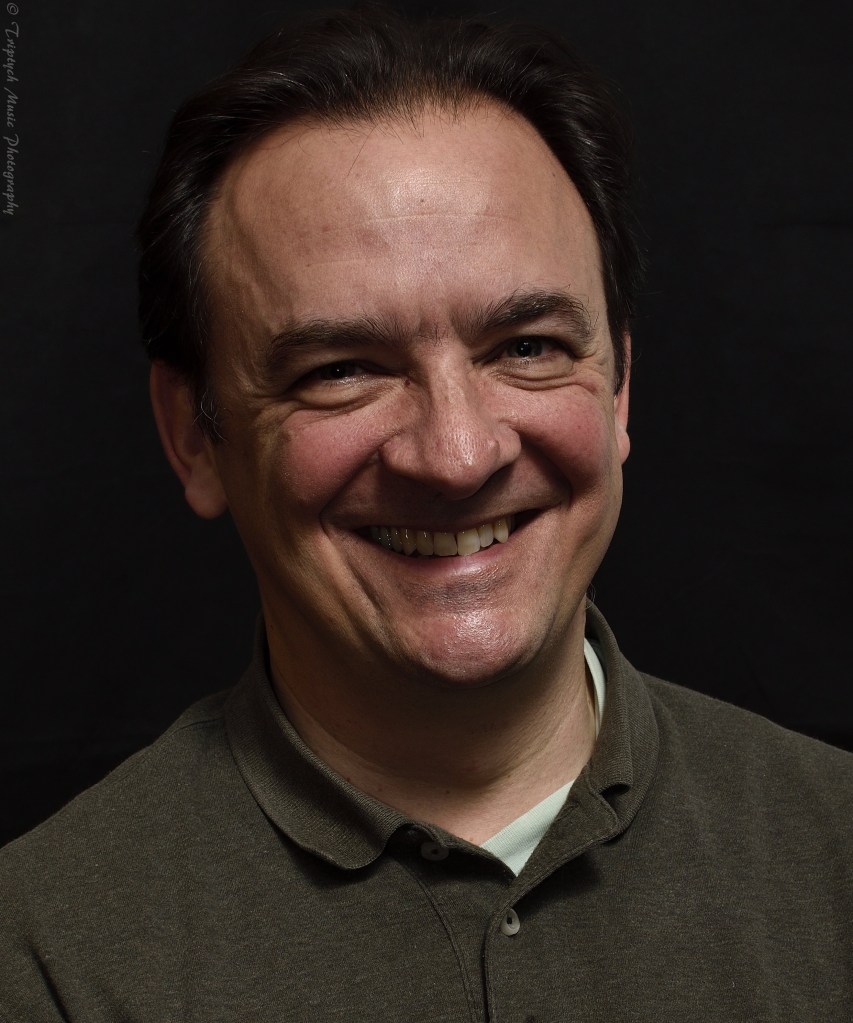
FLA 4: Philip Clark (19/06/2022)

(c) Nina Hollington

In March 2020, almost the last event I went to for ages was the London-based launch of Philip Clark’s tremendous Dave Brubeck biography, A Life in Time, which subsequently won the Presto Jazz Book of the Year 2020. It’s been a while since we last met in person for a cup of tea to talk about music of all kinds, culture and other stuff, but in the spring of 2022 we did at least manage to do this over Zoom. During our conversation, not only did Philip discuss his First/Last/Anything choices, but also talked to me about his career in music, journalism and writing, including the beginnings of his next book on the music and culture of New York.


PHILIP CLARK

My dad is a painter. He studied at the Royal College of Art during the early 1960s with Peter Blake. Ian Dury was in his tutor group. He had, and still has, an impressive record collection and, when I was a kid, I didn’t recognise any musical divisions. I’d grab Schubert and try it out, I’d grab John Coltrane, I’d grab Bob Dylan. And my dad also had Stockhausen and Schoenberg, The Byrds, and for reasons he could never quite explain, lots of Jack Teagarden, the Classic jazz trombonist. Another item he had that really changed the course of my life was Dave Brubeck’s Time Out, which he painted to every night. The family mythology insists that I used to run into his studio and dance to ‘Blue Rondo à la Turk’, from the age of three or four. So that was the music that immediately resonated with me. My dad’s records seemed very exotic – sleeve notes about recording studios in New York and unpronounceable German names with a gazillion syllables. Although I grew up in 1980s Sunderland so pretty much anything seemed exotic.


JUSTIN LEWIS

So all this music seemed to carry equal weight at home, but then you’d go to school and it wasn’t like that at all. Never mind pop music, not even jazz would be on a syllabus. Do you remember there were furious complaints in the Radio Times, when Duke Ellington was Radio 3’s This Week’s Composer in the mid-80s [1985, in fact]? People not just saying, ‘Well, jazz isn’t really my thing’, but being actively furious.


PHILIP CLARK

And assuming that anyone would care they don’t like Ellington. That’s hilarious. There’s a lot of that in the classical world. Classical music should really open your mind, you should never stand still. But sometimes it narrows people’s minds. People focus on the thing they like with laser precision, which is fine, but they can lose sight of a wider culture picture. The classical world at the moment seems fixated on the idea of the ‘neglected’ composer, but without much critical discourse about why some composers dropped off the end of history. Hearing a lot of this stuff, I think, ‘yes’, history wasn’t wrong to cast someone like Ruth Gipps into the wilderness. I’ve talked to opera critics who have no interest I could discern in anything that happened before Mozart or after Alban Berg. Let alone any vocal traditions from other cultures, or traditions that grew up in the twentieth century alongside opera, jazz or rock singing for instance. How anyone could be interested in the art of singing and not be mesmerised by Bob Dylan’s voice – the sheer sound of it, and how it operates – is beyond me.


JUSTIN LEWIS

You’re that little bit younger than me – what do you remember about the music curriculum at school?


PHILIP CLARK

I remember an anthology of music that attempted to draw a line from the Renaissance onwards, but then petered out in the twentieth century. No Boulez, Stockhausen or even a relatively approachable composer like Britten. A bit of The Beatles, I think – ‘Eleanor Rigby’, which we were told with great fanfare used a string quartet and I thought, ‘So what’. There was an attempt to squeeze Indian music into the syllabus, but with a Western transcription of Indian music. Why they couldn’t bung on an original Ravi Shankar record, I don’t know. But I had a fantastic music teacher who knew he had to cover the syllabus but, at the same time, was listening to me improvise on the piano, me trying to copy Brubeck and Thelonious Monk. He started feeding me Bartok and Varèse, and those records opened things up exponentially.


Later I did music ‘A’ level at Newcastle College and one of my best friends there was the conductor John Wilson, who I hooked up with again once I’d moved to London in 1994: we happened to be living in the same neighbourhood. I’ve fond memories of that time. I was composing. I was also a pianist, and then I was a percussionist, playing in various wind orchestras and brass bands. I became very aware that music is good at teaching you to become a social animal. Playing in youth orchestras was the first time I’d met girls, outside my own family.


JUSTIN LEWIS

Yeah, it was one of the best things for me as a teenager. Orchestra was half-boys, half-girls, roughly.


PHILIP CLARK

You know you’re part of a collective, you’re responsible for your tiny little bit, and if you screw up, it affects everybody else, and that’s an important lesson. As a pianist you are on your own, but playing percussion, your sense of rhythm has to snap into place. Where you place the second beat of the bar really matters. Playing percussion was the best step I ever took in terms of developing my musicianship.


FIRST: LEONARD BERNSTEIN: West Side Story (1985, Deutsche Grammophon)

Extract: ‘Cool’

JUSTIN LEWIS

Talking of collaboration, it’s a good moment to talk about Leonard Bernstein’s mid-1980s recording of West Side Story. In preparation for this, I rewatched the ‘Making Of’ documentary with Bernstein and Kiri te Kanawa and José Carreras. And I don’t think I’d seen it since it had been on, originally. [Omnibus, BBC1, 10/05/1985: Kiri Te Kanawa – The Making of West Side Story Documentary – YouTube]


PHILIP CLARK

It’s just astonishing, isn’t it? My music teacher at the time brought it into school on a VHS tape. I was thirteen. It was the last day of term. Seeing Bernstein, this guy in a red jumper… He seemed like a magician. Making all these musicians pull these tricks, shouting at them when they got it wrong, the ecstatic joy when everything slotted into place. I was transfixed.


JUSTIN LEWIS

When I watched it, I’m not sure I’d even seen the original film at this point, but I still felt I knew all the songs. And the orchestra on the recording of this was a contracted orchestra, they hadn’t worked together before, right?


PHILIP CLARK

They were handpicked players that Bernstein knew from the New York scene, from the New York Philharmonic and elsewhere. The question West Side Story raises immediately: what exactly is it? You need a good classical string section, but then, can a classical trumpeter really nail those jazz parts? Not necessarily. So immediately you’re into the idea of creating, by necessity, a piece-specific ensemble, which I find really interesting.


JUSTIN LEWIS

And Bernstein himself using the word ‘funky’ to describe the work.


PHILIP CLARK

Well, he’s right!


JUSTIN LEWIS

Because you can’t categorise it, and why would you want to, obviously!


PHILIP CLARK

Throughout my life, I’ve been interested in music where precisely you don’t know what it is. An argument about West Side Story persists – ‘is it a musical, is it an opera?’ But not being able to define it opens up the space musically. The fact that Bernstein, in his symphonies, and also Tippett and Messiaen in theirs, were willing to pose the question, ‘But can this be a symphony; and if it’s not, what is it?’, seemed more intriguing to me than composers adding to a pile of recognisable pieces called ‘symphonies’, like they’re buying into a franchise.


JUSTIN LEWIS

The documentary is a brilliant, accessible way of showing you the method and the process. There’s not that much interviewing outside the recording session, they just let the session speak for itself, but in one bit Kiri te Kanawa says about how Bernstein was setting the tempo himself, and she says, ‘It’s like having a Mozart in the room.’ A luxury you don’t get that often, and another reason why living composers are so essential because they know how it should be played, or at least are there to guide you.


PHILIP CLARK

Bernstein has been heavily criticised for getting the tempo ‘wrong’ and there was a controversy about Carreras having the wrong voice to sing the part. Whatever. But when I was in New York a couple of months ago, to beat the jet-lag on the second night, I went to see the new film of West Side Story.


JUSTIN LEWIS

Oh – which I still haven’t seen yet!


PHILIP CLARK

The only cinema showing the film was on 65th and Broadway, where Lincoln Centre is, and practically the first thing you see in the film is an old New York street sign for 65th and Broadway, because West Side Story is set where the Lincoln Center is now. When you see the songs in context, the whole piece knits together. There are some songs – like ‘I Had a Love’ – which I wouldn’t necessarily listen to outside that context – but then others that I would. Apparently, ‘Cool’ was inspired by Bernstein going to a jazz club and hearing the alto saxophonist Lee Konitz, who was very famous for inventing long improvisational lines that curled around each other. The piece is layered like a cultural lasagne. There’s Latin stuff, and Bernstein’s incredibly specific use of jazz – he doesn’t just use a generic jazz style – he’s very careful about the different types of jazz he alludes to. Then there’s Stravinsky, there’s Copland, and you can almost trace every single note back to some other source, to Mahler and even Gilbert and Sullivan. Yet it all sounds like Bernstein. I’m still very attracted to composers who allow different musics to coexist within a piece. Bernstein uses that augmented fourth in the opening bars of West Side Story as a motif throughout the whole thing, a real unifying anchor, with a rigour that would have made Schoenberg proud.


JUSTIN LEWIS

And what did West Side Story lead to next, for you?


PHILIP CLARK

Anything with Bernstein’s name on it, I hoovered it up: Mahler, Beethoven, Stravinsky, Bach, Elliott Carter, his various collaborations with jazz musicians. When I interviewed Will Self, he told me that from his own parents’ record collection, he liked the Schubert String Quintet and the Miles Davis Quintet the most. So he thought the music he liked was ‘quintets’. Every record with the word ‘quintet’, he sought it out, no matter what it was. I was the same with Bernstein. I’d scour the second-hand record shops.


JUSTIN LEWIS

You’re trying to make patterns, I suppose.


PHILIP CLARK

You don’t really have the connecting tissue to work with at that age, especially pre-internet. Bernstein was definitely a starting point then, and remains hugely important to me now, in terms of being a conceptual thinker who was able to put different sorts of music together, without fusing them. If a piece is chugging along in a recognisable style, throwing something else into the mix creates a fantastic tension, and why resolve that tension? West Side Story resolves harmonically, sort of, at the end, but in another way it’s a mess – and I don’t mean ‘mess’ pejoratively. The different styles stick out, attack each other. Then if you think of what the piece is about…


JUSTIN LEWIS

Because the city is a complicated, interesting ‘mess’ of styles.


PHILIP CLARK

And gang tensions within a city, and I feel that cities aren’t really about resolutions. Fundamentally, I have to say, I dislike musicals. When Sondheim died, I tried a couple of things, but I had to switch them off. So mawkish and emotionally manipulative, a peculiar, faked profundity. I’m not that interested in music that tells a story. I’m into in music because of sound, and the least interesting about West Side Story for me is the plot. What really interests me is the deeper story of what’s going on in the body of the orchestra, inside the fabric of the music, and how Bernstein builds conversations between different styles of music. Bernstein’s Mass, first performed in 1971, is a real pivot moment for twentieth-century music. At the beginning it sounds like Luciano Berio, with atonal electronic fragments dispersed around the speakers, and then, suddenly, a guitar chord leads into a song that’s pure Simon and Garfunkel; and there’s marching bands, rock bands, jazz bands, atonal orchestral writing and carefully worked out montage and collage. Every-fucking-thing is there, and in terms of compositional consistency it doesn’t even begin to work. But that’s not what Bernstein was trying to achieve. It’s a meta-modernist construction of different styles that I find very truthful.


When I was in the thick of writing music journalism, I became known as someone who wrote a lot about central European modernism – Boulez, Stockhausen, Xenakis, Kagel, Ligeti, Lachemann, Cardew, Messiaen, Donatoni et al – and when I’d write about my love of Bernstein some people would think I’d lost the plot. I even had emails on the subject: I remember an especially condescending one from a leading British composer, who shall remain nameless, who told me I was letting the side down. Well, screw him. Bernstein fits the pattern: a composer not just ‘doing’ music but asking questions about what music can be. What happens when you put the fabric of music under the microscope, and investigate it?


—-

LAST: MORITZ WINKELMANN: Beethoven/Lachenmann (Hänssler Classics, 2022)


Extract: ‘Marche fatale’ (Version for piano)

PHILIP CLARK

Radio 3 was, of course, an education in itself. It was through Radio 3 I first heard about, for instance, Morton Feldman and Peter Maxwell Davies, and also Michael Finnissy who would later become my teacher. I’d tape Music in Our Time programmes, what Radio 3 called their new music programme during the 1980s and ‘90s, obsessively. And I also discovered Helmut Lachenmann through Radio 3. I was immediately drawn to his soundworld, although it was only when I did my undergraduate degree at Huddersfield University that I was able to lay my hands on some scores and properly grapple with Lachenmann’s music and approach.


Lachenmann, like Bernstein – not a sentence you’ll hear often – is interested in questions of musical identity. He is famous for orchestral textures that whisper and seem to exist on the very point of crumbling, as though making a point that structures composers have inherited from the nineteenth century, even the earlier twentieth century, can no longer stand up for themselves. Lachenmann’s music is at the same time very elemental, but also incredibly refined and strikingly beautiful, like a fine-spun thread. He has unpicked ideas of conventional instrumental technique; conventional technique might dictate that a violinist puts their finger at a certain position on the fingerboard to produce a certain note or effect. But what happens if the same violinist puts their finger one millimetre to the left? What does that do to the sound? That is the wildest of simplifications of course, but think about a situation in which Lachenmann asks, say, thirty violinists in an orchestral piece to play one of these extended techniques. If just one of them puts their finger in slightly the wrong place, this carefully worked-out sound is lost. So Lachenmann deals in a whole other sort of preciseness.


JUSTIN LEWIS

It’s surprising how just changing something just a tiny bit, in any artform, can result in something new.


PHILIP CLARK

By imposing yourself in the cracks of normal technique a new kind of musical experience can be found. Improvisers know this, and jazz musicians know this, and rock guitarists who distort sound know this. In Lachenmann’s other piece on this disc, ‘Wiegenmusik’, the music seems to inhabit the resonances and the sustains rather than the hitting of the notes, which becomes somewhat incidental.


JUSTIN LEWIS

Of Lachenmann’s work I only know the two pieces on this disc, so far, both of which I really liked. What would be a good orchestral piece that demonstrates something like what you mention?


PHILIP CLARK

His piano concerto, ‘Ausklang’, would be one. It’s a mammoth fifty-minute piece for piano and a massive orchestra. There are a few moments when it erupts, but most of it dwells in a hinterland between moderately soft and moderately loud – soft louds, and loud softs – with intensely subtle deviations of texture and sound. It took him decades to work all that stuff out, and it’s a real triumph of what someone can do with musical notation. You take relatively conventional annotation, tweak it a bit, and get musicians to behave in a completely different manner and change their habits. Fantastic.


—-


JUSTIN LEWIS

So how did you get into writing about music in the first place?


PHILIP CLARK

I had rent to pay! I was a composer, I had a teaching job for a year which I absolutely hated, and then I won a composition competition held by Classic CD magazine. This was before email, so I faxed the editor of Classic CD to say, Dave Brubeck – who I already knew a little bit – is touring the UK, and I’d be interested in interviewing him, if he’d like an article. He said yes. To this day I remain convinced he thought I was somebody else and got the names muddled. Anyway, I submitted the article and then he rang a week later and said, ‘What are you doing for us next month?’ So I wrote a piece about Charles Mingus and it snowballed from there. Classic CD led to a magazine called Jazz Review, which led to The Wire, which led to Gramophone; and years later to newspapers and, eventually, the London Review of Books. I was starting to make a living, and then a decent living, but that was never my intention.


JUSTIN LEWIS

I wanted to ask you about the kind of music criticism you’ve written. I sort of understand how pop music criticism works – I’ve done that a little bit myself – but I wouldn’t know how to write your kind of analysis, especially about a new piece of music.


PHILIP CLARK

Depends really. I wrote about a lot of standard classical repertoire during one period, which requires a very different approach from new composition or improvised music. With standard repertoire, there are certain givens about whether, say, Simon Rattle does Brahms 3 slower or faster than Herbert von Karajan. He either does it faster or he does it slower, and that’s that. And from those givens you have to extrapolate interpretative ideas about how a conductor is dealing with a piece; how they are dealing with structure, and the relationships of material within a movement. Is the conductor working within a tradition? Is the conductor trying to push a piece away from the tradition with which it’s most associated, taking a revisionist view? Are they being faithful to the music? Are they disrupting the music?


Then there are technical questions. How successfully are they balancing the sound within the orchestra. Can you hear everything? Some composers, though, think in terms of layering the orchestration, each layer adding to the whole. Is the conductor simply emphasising a melody line, and losing everything else?


But with a new piece, all that becomes secondary. Hearing a premiere, I want to be entranced by the composer’s inner-imagination. Is he or she merely re-mapping – or simply cribbing – some model that already exists? Using familiar landmarks, in exactly the place where you would expect to hear them? Or is this composer trying to do something more daring, really challenging their own pre-conceptions, dancing with the unknown?


Harrison Birtwistle, who died a few weeks ago, his ‘Tragoedia’, essentially his Opus 1, encapsulates everything he did over the next fifty years, like he wrote one big piece from the 1950s to the end of his life, observing the same material from a million different angles, finding things that work in microcosm in one piece which he then allowed to blossom in the next piece. With ‘Tragoedia’ everything is in there: orchestration, harmony, the way the harmony informs a structure. I’ve been dealing with Elliott Carter’s music again recently after a long time. The music he wrote during the late 60s, you hear him grappling with his material, like he’s trying to find the technique he needs to write the piece through the experience of writing the piece: the ‘Concerto for Orchestra’ and ‘Double Concerto for Piano and Harpsichord’ in particular. By the mid-70s, though, he’s worked out the music he wants to write, and of course it works, and the technique is supremely fluid, but I find the pieces far less engaging, and sometimes just boring.


One of the reasons I stopped doing classical music journalism was that, after twenty years, I came to care less and less whether Rattle’s Brahms 3 is faster than George Szell’s. There are bigger cultural issues with which to deal. At a time when classical music is being squeezed inside all sorts of culture wars, and major labels are issuing absolute crap that masquerades as classical music, and the prevailing culture often seems positively hostile – let’s not even mention that dipstick Nadine Dorries and her attacks on the BBC, and the asset-stripping of arts courses from schools and universities – the classical music press here often feels dismally supine and unengaged, carrying on like it’s business as usual. Where’s the anger? The itch to question where classical music has come to stand within our culture compared with where it was even twenty years ago? If I was them, if my whole life was about classical music, I’d be worried and want to take some sort of stand.

 —–


ANYTHING: DAVE BRUBECK: We’re All Together Again for the First Time (1973, Atlantic)

Extract: ‘Truth’

JUSTIN LEWIS

Let’s talk about your Dave Brubeck book, A Life in Time. Award-winning, acclaimed and rightly so. In the introduction, you mention you were in Spain on holiday. There’s something about buying a record on holiday – I think often your mind is somewhere else.


PHILIP CLARK

Yes, it was a family holiday. I was 16 or so. We had just visited the Salvador Dali Museum in Figueres, and I’d bought this cassette in a second-hand record shop nearby, which we put on in the car. And the sound and energy of the first track, called ‘Truth’, pulled me right in. I’ve thought about and analysed and intellectualised what the music does since – probably too much! – but back then it was: ‘Shit! What is this?’


JUSTIN LEWIS

When I was listening to it, it felt like a very long way from what I thought I knew about the earlier recordings.


PHILIP CLARK

Yes and no. If you go back to the Brubeck of the mid-50s, when he was recording for Fantasy Records, before moving to Columbia, the Fantasy guys were quite happy to record concerts and release them more or less unedited. Those early records contained huge, long improvisations – a quarter of an hour on standards like ‘These Foolish Things’ and ‘The Way You Look Tonight’. Brubeck’s solos are extraordinary, the way he darts between romanticism, Bartók-like clusters and stride piano – finding ways to allow different things to coexist within a piece of music. His disjoints, his mismatches and the cross-cutting between different styles stood in complete contrast to the bebop pianists – who were all about sustaining the flow of the energy and keeping the momentum on the move.


Dave’s solo in ‘Truth’ opens in very strict jazz time, then, after a little while, the left hand deviates just slightly, and then the left hand and the right hand move apart. Countable time and pulse fizzle out and he ends up floating on a slipstream of sound. The harmony accrues clusters of notes and Dave’s chords get thicker and denser, and the pulse crumbles even further, and a point is reached where you think, he just can’t go any further. Yet he keeps on pushing further and further – obstinately and wilfully. When we got home from holiday, I ran to the piano and started testing these same kinds of clustery sounds, making them for myself. When I played them to my piano teacher she was absolutely horrified. ‘Those sounds don’t exist’ – those were her exact words. Yet I had recorded proof that they did, and that indeed I could do them. Within a week of hearing that Brubeck record, I was checking out Cecil Taylor and John Coltrane and Albert Ayler and Ornette Coleman. Free jazz opened up for me. And also Stockhausen and Boulez and Varèse; just the sound of that Dave Brubeck record changed everything for me.


JUSTIN LEWIS

And obviously on that same record there’s a much longer version of ‘Take Five’ than most people will be familiar with.


PHILIP CLARK

Sixteen minutes. The first ‘Take Five’ from 1959 established a white canvas for future explorations. They just about managed to get through it in ‘59. It’s edited very heavily. Dave puts the vamp down to keep the quartet together, and sounded rather nervous doing so, because it kept falling apart. But that 1972 version, in contrast, is positively anthemic. The same vamp that had been holding the piece together in 1959… as soon as he starts playing it, the audience go crazy. ‘Take Five’ is in E flat minor, and Dave, in his solo, plays in the major over the chords. The left hand keeps the ‘five’ going, but he’s superimposing four and three over the top. Really he’s playing everything but 5/4 and E flat!


That performance roars towards a fantastic drum solo by Alan Dawson. Joe Morello, the drummer during the years of the ‘classic’ Dave Brubeck Quartet, came out of big band and swing. But Alan Dawson, who essentially took Joe’s place, was more of a free jazz drummer by instinct. Before joining Dave, he’d played with Sonny Rollins and Jaki Byard, and brought a free jazz energy to the Brubeck group. Listen to the way he plays against Dave’s vamp at the beginning. He spring-loads the beat – like he’s on tiptoe. By the 70s, Dave could do whatever he wanted with ‘Take Five’. So long as he played that vamp at the beginning, he could play as free as he liked. I asked Dave later, ‘Do you ever get tired of playing it?’ And he said, ‘No, it becomes a gauge of where we are as a group every night.’ Every night, they’d view it from a different angle. He knew how to keep it fresh.


JUSTIN LEWIS

It’s an ideal position to be in, though to have a piece like that where you can play it every night and you’ll never get bored of it because there’s always something interesting and fun in it.


PHILIP CLARK

It’s infinitely flexible. That oscillating two-chord vamp – you can do anything with it – put anything against it. It’s going to work.


—-


JUSTIN LEWIS

You’re very interested, aren’t you, in how all these elements coexist in the context of a city.


PHILIP CLARK

Indeed. Take London, in the mid-1960s, for instance. I’m passionately interested in free improvisation, this British musical movement that emerged around 1964/1965, mainly in London, although other things were happening around the country. In 1965, you have the start of AMM – Eddie Prévost, Keith Rowe and various other people – who were all interested in jazz, but also trying to come up with an authentic homegrown idea of what improvised music in this country could be. They workshopped their music at the Royal College of Art. In Covent Garden, there was a little venue called the Little Theatre Club, which is where the Spontaneous Music Ensemble found its feet, and they were, again, trying to deal with the aftermath of jazz. The guitarist Derek Bailey came to London at the same time, who also came out of jazz, but also Anton Webern. All this activity is happening around free improvisation. But around the same time, in Muswell Hill, The Kinks were starting – and they were dealing with this exact same question. How to place American culture within a British or London context. If you’re interested in The Kinks, how could you not be interested in free improvisation. Equally, if you’re interested in free improvisation, how can you not be interested in The Kinks? Yet very few people seem interested in both, but these are the connections I’ve always tried to make in my journalism and in my work.


JUSTIN LEWIS

Not only have you just worked with Dave Davies of The Kinks on his new autobiography, but also that you’re currently working on another book, this time about New York with a vast array of figures, that draws on different styles, different periods, but is designed to explore a big city of culture and how it can be all sorts of things.


PHILIP CLARK

It’s called ‘Sound and The City’ and it’s about what makes New York sound like New York, and not Paris, Berlin or London.


JUSTIN LEWIS

Or even another American city.


PHILIP CLARK

Indeed. The book deals with external factors like immigration, geology and architecture, which turn out not to be external at all. Edgard Varèse arrived from France, where all the music he wrote was destroyed – we don’t know any of it – but the impression left from contemporary reports is that it was hyper-romantic Richard Strauss, perhaps with a few illegal harmonies and sexy flourishes. Then he arrived in New York in 1916, and immediately became interested in the sound of sirens. But he didn’t use the orchestra to replicate or evoke a siren; he literally took the siren from the sidewalk and slammed it into the orchestra. The exterior becomes the interior. The physicality of New York imposes itself on people’s understanding of what they think music is and changes it. John Cage, Debbie Harry, Ornette Coleman, Television, Meredith Monk, William Parker: how are all these different musical personalities unified by the experience of New York, that’s what I’m exploring. I said earlier that I don’t believe cities are about resolution, but they are places where different musics find space to exist. I’m six months into what will be a three-year writing project, but already I’m gaining understanding of an underlying attitude towards music-making in New York; I’m beginning to perceive a lineage between say, Varèse and Wu-Tang Clan, and that attitude is more important than musical idiom or style.


JUSTIN LEWIS

I can remember getting The Best of Blondie for Christmas when I was 11, and there was this free poster, which went straight on the wall, of Debbie Harry wearing a T-shirt which read, ANDY WARHOL IS BAD, and I had no idea who Andy Warhol was at that point, but it immediately gave Blondie even more hidden depths. And it turned out that she had quite a past, she was already nearly 35. She had this music career going back to the late 60s, the world of psychedelia.


PHILIP CLARK

And after Blondie ended the first time, Harry started doing a lot of freeform jazz vocal improvisation, with the Jazz Passengers. Absolutely fantastic. The whole Blondie persona was just chucked out the window. Cross-fertilisation does happen in other cities, and that’s for other books, but with New York, the physical experience of being in that city does something to musicians’ sense of structure and pacing and the material they use. I want to find the unifying thread that links Edgard Varèse to hip hop, John Cage to Lou Reed. In Manhattan you’re forced to deal with this overload of sound, whether you want to or not. You’re on a compressed landmass, with these big buildings. The geology means they can sit there. So I’m not going to say the city is built on rock ‘n’ roll – but it is certainly built on rock! [Laughter]


Philip Clark’s Dave Brubeck: A Life in Time is published by Headline.  He worked with Dave Davies on his new autobiography, Living on a Thin Line, which was published in July 2022.

Philip’s next book, which we discussed at some length during our conversation, is titled Sound and the City, and is due for publication in September 2026. See here for an article he wrote when he visited New York as part of the book’s background research: https://blogs.bl.uk/americas/2022/04/sounds-of-new-york-city.html

He is represented by Curtis Brown: curtisbrown.co.uk/client/philip-clark.

You can follow Philip on Bluesky at @musicclerk.bsky.social.

—-

FLA PLAYLIST 4

Philip Clark
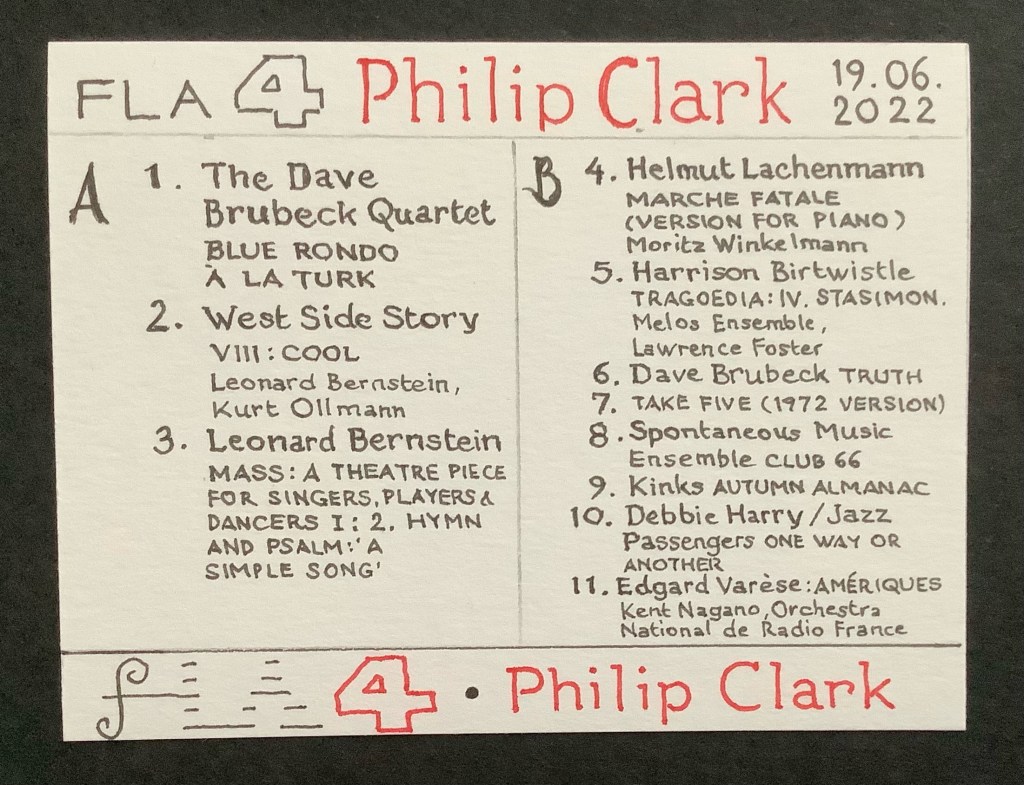
(For the time being, this site and project uses Spotify for the conversation playlists, but obviously I disapprove that Spotify doesn’t pay artists and composers properly, and other streaming platforms are available, as are sites to buy downloads and buy recordings. For consistency, you can also listen to the selections via YouTube (where available), and links are provided in each case, below.)

Track 1: THE DAVE BRUBECK QUARTET: Blue Rondo à la Turk: https://www.youtube.com/watch?v=vKNZqM0d-xo

Track 2: LEONARD BERNSTEIN / KURT OLLMANN: West Side Story: VIII. Cool: https://www.youtube.com/watch?v=-w_7oM3Ohs4

Track 3: LEONARD BERNSTEIN: Mass: A Theatre Piece for Singers, Players and Dancers I:

2. Hymn and Psalm: ‘A Simple Song’: https://www.youtube.com/watch?v=VEcgy5vUtHI

Track 4: HELMUT LACHENMANN: ‘Marche fatale (Version for Piano)’

Moritz Winkelmann (piano): https://www.youtube.com/watch?v=kDXOBeckLpo

Track 5: HARRISON BIRTWISTLE: Tragoedia: IV. Stasimon

Melos Ensemble, Lawrence Foster: https://www.youtube.com/watch?v=GMwVxNxKHK8&list=PLB0TfWlJAdxZ3Zyu042uAZZIsnS7ldkdV&index=138


Track 6: DAVE BRUBECK: Truth: https://www.youtube.com/watch?v=n7E_AaGa9cE

Track 7: DAVE BRUBECK: Take Five (1972 version): https://www.youtube.com/watch?v=Gt9sLIqQUkA

Track 8: SPONTANEOUS MUSIC ENSEMBLE: Club 66: https://www.youtube.com/watch?v=Gz1xWcusg48

Track 9: THE KINKS: Autumn Almanac: https://www.youtube.com/watch?v=N3VDATV6dmY

Track 10: DEBBIE HARRY, JAZZ PASSENGERS: One Way or Another: https://www.youtube.com/watch?v=t-xODrjOtnU

Track 11: EDGARD VARESE: Varèse: Amériques: Kent Nagano, Orchestra National de Radio France: https://www.youtube.com/watch?v=P6E3pD8Uhtg

 

FLA 3: Meryl O’Rourke (12/06/2022)

 Joining me in this episode is the comedy writer and performer Meryl O’Rourke. As well as being a mainstay on the stand-up circuit and writing for other performers (notably Frankie Boyle), Meryl has created and developed two one-woman shows, Bad Mother… (2011), and 2019’s Vanilla.

Vanilla is a very funny and thought-provoking show about sexuality – especially female sexuality – in the modern age, and is still available to live-stream at https://nextupcomedy.com/programs/meryl-orourke-vanilla

Meryl and I recently had an entertaining and wide-ranging chat about the defining music in her life. In addition to discussing her First/Last/Anything choices, she talked to me about music at funerals, why 80s pop could be even more politically charged than you thought, and the thorny issue of sexual representation and imagery in current mainstream music – which is a major theme of Vanilla.   


CW: The middle section of this conversation contains some discussion about sexual behaviour and representation, relating specifically to music videos and lyrical content, pressurisation and consent. We both realised that it was near-impossible to have this discussion without mentioning certain explicit sexual acts and terms, and so some of these appear. Like all the other conversations in this series, it has been edited with the co-operation of the guest, but this is mostly for reasons of length and not content. Please also note the second of the three YouTube links, for the Megan Thee Stallion clip, is NSFW.

 —-

MERYL O’ROURKE

I don’t think my house was musical at all when I was a child! Now you’ve asked… Hmm… My parents were both comedy and literature fans. With music my dad liked, I have zero idea. He died when I was seven, and he was very ill from when I was about four, too ill to properly play with me, he could just sit in his chair. So, yeah, the music I associate with him would be when I would dance to the theme tunes he liked. So, The Rockford Files, I mean, of course, that’s some damn funky music… and When the Boat Comes In. He wasn’t from Newcastle, he was Irish…well…he was from Brixton, but he was so ghettoised amongst Irish people that he had an Irish accent, despite not being born there. So he used ‘mammy’ rather than ‘mum’, so When the Boat Comes In reminded him of the Irish dialect: ‘Dance to your daddy/Sing to your mammy’. Whereas my mum didn’t listen to music for pleasure. I remember her liking novelty things like ‘Telephone Man’ [by Meri Wilson]. Comedy songs.


JUSTIN LEWIS

I know that before you ever became a professional comedian, you were – like me – a big fan of comedy in your teens. But unlike me, you were able to go to live recordings in London of various radio and TV comedy shows.


MERYL O’ROURKE

Yes! I have totally lived my life backwards. The last concert I went to was an 80s festival. But in the actual 80s, when all my friends were going to see Spandau Ballet, I was going to Radio 4 recordings like an old lady. The Paris Studio, off Piccadilly in London, where BBC radio comedy shows were recorded. My mum was a huge comedy fan, as I say, but while you couldn’t take a child to stand-up, you could go to the Paris at fourteen – and it was free! We got tickets for everything when I was 14, 15, but the big one was Radio Active.


JUSTIN LEWIS

I loved Radio Active too. For those who don’t know or don’t remember, it was this very funny pastiche on Radio 4, of a local radio station, starring Helen Atkinson Wood, Angus Deayton, Geoffrey Perkins, Phil Pope and Mike Fenton Stevens. Which had lots of spoof jingles, and parodies, and pop group pastiches, and which later became KYTV on BBC2 in the 1990s.


MERYL O’ROURKE

I fell desperately in love with Phil Pope, who did the music for Radio Active and Spitting Image, and who was also in Who Dares Wins, a late night Channel 4 TV comedy show. I know he was an unusual choice for a first love, but he would chat to me after recordings and, well, he’s no odder than Tony Hadley who, frankly, looked like someone shaved a bull and took it to Dorothy Perkins. So I guess, in the 80s I regarded the people in Radio Active, Who Dares Wins, Spitting Image, as if they were pop stars. I mean Phil and Mike had a number 1 with ‘The Chicken Song’ during that time, so I WAS hanging out with pop stars! Spandau weren’t getting any number one singles by ’86 – SO WHO’S THE WEIRD GIRL NOW, STEPHANIE?


JUSTIN LEWIS

In the days before mass-produced video and DVD, there was a lot of merchandise for comedy: tie-in books, LPs… And all those shows did them. The HeeBeeGeeBees made albums! We should say the HeeBeeGeeBees were this group on Radio Active, involving Phil, Mike and Angus, who did parodies of all the big pop groups of the day – The Bee Gees, Status Quo, The Police, Duran Duran, etc – and Mike Fenton Stevens has mentioned that they got to tour Australia in the early 80s, and were practically treated like a real pop group, did loads of television, were playing rock venues. Especially as a lot of the real pop bands rarely toured extensively out there.


MERYL O’ROURKE

I think if you asked Phil Pope, ‘What are you?’, he would say, ‘A musician, who became an actor.’ I don’t think he’d even refer to himself as a comedian. He was a musician who was skilled at parody and became a comedy actor through that experience and association.


—-


MERYL O’ROURKE

I always feel awkward when I’m asked about first album, because the first one I bought was Rattle and Hum, but that was because Mum was a librarian, and so she would just bring everything home. So it wasn’t the first thing I LIKED. The big thing Mum brought home was a Depeche Mode album, in fact it was a greatest hits cassette [The Singles 81–85]. It’s meant to be very non-muso to have greatest hits albums, isn’t it?


JUSTIN LEWIS

Greatest hits albums are fine! I’m a big defender of them. And anyway, in the case of Depeche Mode, lots of their singles weren’t on albums anyway.


MERYL O’ROURKE

‘See You’ was the first time I heard a record that made my whole body react, that made me lie down on my bed and let it wave over me. Which Martin Gore had written when he was fifteen, I think. It’s Martin Gore’s ‘Careless Whisper’.


JUSTIN LEWIS

We’re talking about this not long after the very sad, sudden death of Andy Fletcher.


MERYL O’ROURKE

When Fletch died, I kept returning to ‘Shake the Disease’ which is about feeling that you’re always saying the wrong thing, and hoping the person you’re with loves you enough to forgive you for being a bit of a twat. That still speaks massively to me! And Gore constantly returns to that theme. ‘Enjoy the Silence’ on Violator is exactly the same theme. It’s quite interesting for a professional lyricist to constantly return to ‘I say stupid stuff – therefore, can I just not speak?’ Martin is quite known for the odd embarrassing lyric: ‘A career, in Korea, being insince-ere’ …but I guess because he kept writing about hating words, we, in the fan base, forgave him.


JUSTIN LEWIS

There’s an interesting distance in that Martin is the lyricist, but he usually isn’t the singer. That’s Dave Gahan’s job. Like when you hear an Elton John song, you half-forget Elton didn’t write the words – it’s usually Bernie Taupin doing that. And at some level you know that, but you don’t think about it when you hear the song.


MERYL O’ROURKE

I’m constantly trying to link Elton John’s songs to his homosexuality, completely forgetting that the lyricist wasn’t gay. But in Martin’s case it was because Dave was already the lead singer, when Vince Clarke formed the group – though I’m a Depeche purist, very much Anno Vince. And Dave is almost quite a stereotypical frontman. Depeche Mode sort of channel through him, in a way. Some frontmen get annoyed by the fact that they are just looked at, as in ‘you look good and you sound good’ and it’s forgotten often they do write and play, but Dave is a conduit. His deep voice contrasts so well with the binky bonky electronica. Dave was very sexual, his hips would rotate throughout every song. One reason I stopped going to see them live… I went to see the ‘Songs of Faith and Devotion’ tour in the 90s, when we didn’t know Dave was on heroin, and he spent the whole show lying on the floor! He just lay on the stage. For one thing, I thought, ‘I’m here for the hips mate’ and on a practical level, if you’re standing at a gig, you can’t see somebody who’s lying down! Dave was hunkier, but it was Martin I got the crush on because of his brain.


Martin did soundscapes, that really felt like they enveloped you. Whenever I hear ‘Enjoy the Silence’, I remember my mum shouting, ‘Surely a song called “Enjoy the Silence” shouldn’t be listened to so loud!?’ A lot of bands, you have to turn the volume up, but with them, it’s about being immersed in a soundscape. One of my favourites, ‘Stripped’, starts with the sound of a car engine being turned on and engine just ticking over, which becomes the percussion of the song. ‘Stripped’ is one of Martin Gore’s many allegorical songs, along with ‘Master and Servant’, where he’s singing about sex, but he’s actually singing about capitalist society.


Rediscovering and properly listening to 80s music, I’ve noticed that because Thatcher was so censorious, a lot of the bands did songs that you thought were about sex but were actually about capitalism, like Heaven 17’s ‘Temptation’, ‘Labour of Love’ by Hue and Cry etc. Apparently even ‘Land of Make Believe” by Bucks Fizz is about Thatcherism!. Martin Gore was obsessed with two things – sex and industrialisation – so ‘Stripped’ is partly about ‘let me see you take your clothes off’ but the whole lyric is ‘I don’t want you watching television’, ‘I don’t want you with your earphones in’, “I want to be in a forest’, ‘I don’t want any of this horrible noise.’ And a lot of that came from them living in this very urban landscape of Basildon. When Fletch died, Alison Moyet tweeted, ‘We lived on the same council estate from the age of ten.’ So they lived in these very crowded situations, which is why Depeche Mode became a keyboard band. They were rehearsing in each other’s houses, and they couldn’t use acoustic instruments because the neighbours would complain. They could put headphones on and not upset their mums and dads.

FIRST: U2: Rattle and Hum (Island Records, 1988)

Extract: ‘Desire’

MERYL O’ROURKE

I remember thinking, ‘I need to just stop taping things from the library’. I was at a garage or motorway service station – ‘I am older now, I have some money, and I should probably buy this.’ So the impact of finally buying an album for the first time didn’t feel as special as it might have been for other people. I even remember thinking, ‘I need a “first album”.’


JUSTIN LEWIS

Were you a U2 fan anyway?


MERYL O’ROURKE

With ‘Desire’, I liked that sigh at the start. I like alliterative music, stuff that sounds like what it’s doing. It’s called ‘Desire’ so I’m going to sound desirous. I like a track to do what it says on the tin. You know that wave of sad songs that sound happy? They piss me off!


JUSTIN LEWIS

If you’re going to convey doom, use doom.


MERYL O’ROURKE

With U2, you can hear the passion in the music. And like Depeche Mode, U2 are now not just unfashionable but derided. This trope of ‘how terrible it would be for U2 to do a surprise concert’.


JUSTIN LEWIS

Or drop a free album on to your iPod.


MERYL O’ROURKE

I often think the hatred of U2 comes not actually from the music but from how the band behaves. The things Bono says, etc.  My second boyfriend was a big muso, was at the Hacienda every weekend, and he hated U2, so I had to kind of keep it secret. But I don’t think anyone can deny the passion and popularity of the music.


JUSTIN LEWIS

My main issue with them then, although this has largely dissipated now, many years ago, was that they were so ubiquitous. And in the sixth form, at school, they had this kind of image of ‘this is real music’. So I perhaps unfairly held them responsible for that.


MERYL O’ROURKE

Well, what’s ‘real music’? I liked both U2 and Depeche Mode, they both made noises that made my body react. If I’ve got my eyes shut, and the music’s making my body react, then I like it. What instruments you’re playing that on is less important to me. The Edge is hitting a guitar string or Martin’s hitting a shopping trolley – am I dancing? Yes.


—-

LAST: MEGAN THEE STALLION:

‘Thot Shit’ (1501 Certified/300 Records, 2021) (NSFW)


MERYL O’ROURKE

This was my last download because I played it as the audience walked in for Vanilla. I thought I’d hate it because the publicity was all her arse, but then I watched the video and it’s hilarious, it’s her saying, ‘We all have arses’, and the video is endless, haunting, relentless arse. Megan’s style of rapping is relentless and monotonous – it’s not melodic, it’s almost like percussion. ‘Thot Shit’ doesn’t go up or down or have a middle-eight, it’s just, ‘This is relentless, this is relentless, this is relentless’. I really like that. The problem is, the video has nothing to do with the lyrics, AS EVER.


JUSTIN LEWIS

The style and content of contemporary music videos is a major theme of Vanilla, which people can now live-stream. I was trying to think of a way of summing up the show – shall I have a go? To me, it discusses the generation gap between your formative years as a growing sexual being, and now looking at the world through the eyes of your children about the same subjects. Are you okay with that?


MERYL O’ROURKE

That’s a theme in it, yes. As an overriding theme, it’s about whether female sexuality is liberating or oppressing. People tell us constantly that being very sexual is liberating, but our actual experience of that can be very oppressive, and it’s often used against us. I mean that’s what the ‘Thot Shit’ video is about: ‘accept it, get over it’. Vanilla is about the bullshit we’re told about sex, especially about female sexuality, and especially what young girls are told. So there’s a lot of stuff about music videos and lyrics that are just bullshit.


In the show, I talk about how now there’s some choreo where women put their hands round their necks because we’re meant to be into choking. Even if you are into choking, that’s the most dangerous method! With sex, there’s this really weird disconnect, there seems to be no desire to do things properly or safely. If you said, ‘I’m really into scuba diving’, that would imply that you were PADI-registered [laughter], that you’d had a few training sessions. But with ‘I’m really into choking’ – well, have you looked up how to do it safely, and which things not to do, because some things can kill you? Or have you just copied ‘WAP’?


JUSTIN LEWIS

As Vanilla does reference music video and pop songs, you’ve had to keep revising and updating the show. I first saw it during the first lockdown, online, in about April 2020, which predated the song ‘WAP’.


MERYL O’ROURKE

There’s no point still talking about Little Mix getting their bits out at the BRITS when it’s a year later – pop music moves by so fast, and I had to talk about ‘WAP’. And all this stuff about how they’re the first female rappers to rap about sex! No they’re not! Salt-N-Pepa made an entire career out of rapping about sex but it’s like they’ve been erased. Sometimes I think they must have upset Stalin. When you go through their lyrics, Salt-N-Pepa were pretty explicit: ‘He keeps me open like a seven-eleven’ [from ‘Whatta Man’].


In ‘WAP’ they talk about being choked, tied up, spat on – and at the same time, we’re saying to people, ‘This is liberating’. I understand the nuance of ‘It’s liberating to say I’m submissive’ but we’re not telling young people that. We’re telling them, ‘You are dominant when you’re submissive’. But there are never any dominant songs by women about tying up the men. When I was researching, I asked people if they could think of any songs where the man is tied up. And we literally had to go back to the fifties: Elvis Presley’s ‘Teddy Bear’. And could you believe I was so distant from Depeche Mode I’d forgotten about ‘Master and Servant’! Which is absolutely about Martin being submissive. He was very visibly submissive – he would wear bondage gear on stage. He’d cause shock wearing black nail varnish, and now Little Mix wear bottomless leather harnesses and we put them on little kids’ sticker sets?


JUSTIN LEWIS

I also remember about three years ago, you were tweeting about Stormzy’s record ‘Vossi Bop’ and it being played at breakfast time on Radio 1.


MERYL O’ROURKE

Oh, you remember that! I phoned Radio 1, such a Karen.


JUSTIN LEWIS

As someone who’s now unarguably middle-aged and clearly not the main target audience, I sometimes hear records like this and think, ‘What do I do with this?’ Whereas the fourteen-year-old me would have imagined me celebrating it as ‘the new “Relax”’ or whatever.


MERYL O’ROURKE

But it’s horrible.


JUSTIN LEWIS

It is. And apparently there are two versions of ‘Vossi Bop’, an uncensored and a clean version, but even the clean version appears to have a line about ‘giving a facial’ in the chorus. I suppose that there’s an argument for saying that’s not swearing, but…


MERYL O’ROURKE

I think being the mother of a teenager helps in these situations. When I phoned Radio 1, the woman I spoke to was also middle aged, and I said to her: ‘As middle-aged women, we might think Stormzy’s singing about putting on a mudpack and some cucumber over his eyes… but the teenagers know exactly what he’s talking about.’ People seem to feel that the most urgent issue with ‘…that’ is not questioning why as an act it’s become so mainstream, but giving it a name that means it can be discussed at breakfast. That seems to have been the main priority here.


But also, in the lyrics, he’s facialising this girl as a punishment, because she was ugly and she was somebody else’s girlfriend. The thing is, I didn’t want to be disappointed in Stormzy. I love Stormzy [agreement], he’s south London, and I’m south London. There’s a rap bit where he mentions a bus route that I use – it’s so exciting when he mentions things that I know about. And politically, too – the stuff he said after Grenfell. So I didn’t want to complain about him: ‘Hang on a minute, that is the chorus of your song, and it’s being played at breakfast time on Radio 1?’ But at what point can we say, ‘This is not okay’? Because every time we do say, ‘This is not okay’, we’re told we’re being oppressive.


There’s a bit in the show where I talk about J-Lo’s very explicit Superbowl show, and I have to make it very clear that I’m not slut shaming. She mooned the world’s children, and she knows that’s not okay, because if you did it out of the window of a school bus you would get detention. And we’re so obsessed now with looking after these adult women’s sexualities that we are completely forgetting about the children who are their fanbase.


I find Megan Thee Stallion difficult, because I am fifty-one and I’m surprised by how much I love her. But I was watching Ellen one day, and there was a bit where Megan visited a children’s hospital, and you think, ‘Mate! You rap about wanting someone to tie you up and fuck you. Don’t go to a children’s hospital!’ I really admire the artists like Rihanna and Miley Cyrus who have both said, ‘I am not here for your children. Do not bring your children to my concert.’ And then I see people like Megan Thee Stallion and Nicki Minaj who are very explicit – they’re welcoming kids to their concert. It makes me… uncomfortable. We don’t have that line anymore – and a lot of Vanilla is asking to have that line back. You know, 9pm. It’s impossible, so we have to find a new 9pm.


JUSTIN LEWIS

Watching that Megan Thee Stallion video, it occurred to me how rarely I actually watch music videos now. If I hear ‘Sledgehammer’ or ‘Take on Me’ or ‘Ashes to Ashes’, it’s impossible for me to hear those songs without picturing the videos. I am quite removed now. I may listen to lots of new music, but I don’t really watch new music. But it sounds like you do. Now, is that because you have children?


MERYL O’ROURKE

It’s because I was writing Vanilla. And I don’t write without researching. And if I’m going to write about what our children are experiencing, then I need to find out what it is.


JUSTIN LEWIS

With ‘Thot Shit’, I’ll probably have to flag it with NSFW in the link.


MERYL O’ROURKE

Which by the way: if you watch it on YouTube, there is no way to stop your child from watching it.


JUSTIN LEWIS

No age restriction! I know, I was surprised.


MERYL O’ROURKE

A huge problem I have with female music videos is they pretend sex is political, to make it ‘okay’, but just by mushing it all together unnaturally – which I suppose is the essence of sex. Ha-ha. I talk about ‘God is a Woman’ where the video is quite deep and has a lot of feminist imagery – Ariana Grande with a huge hammer smashing a glass ceiling. But the song is just about shagging. The premise of the song is: She is so good in bed, you will forget the existence of a patriarchal god. I mean, she says she’s good in bed, she can’t even wrap her tongue round a consonant…


And then you go on to ‘Run the World (Girls)’ by Beyoncé. Which has very feminist lyrics, but the video is just Beyoncé rolling around in dirt, in her knickers. And people might say, ‘Well it’s feminist to do that’, but it’s naïve to think that’s not distracting people away from the lyrics. But to show you actually on your hands and knees in your pants, jerking about, whilst you’re singing about equal pay… You know very well that men are not watching that video thinking, Wow – I really must increase the wages of my female staff.


JUSTIN LEWIS

Yes, if there’s that many levels of irony to get to that point, the message hasn’t really succeeded.


MERYL O’ROURKE

‘Run the World (Girls)’ is very clever, in its knowledge of what men and women are aroused by. So men, biologically respond to images, women to conversation. We might not like it, but it’s science. So Beyoncé is managing to excite both genders. The lyrics are having a conversation, bigging up women – ‘Look at what you’ve done, and you can do this and this and this’ – but the movements are saying to her male fans, ‘Look at how sexy I am.’ So both groups of fans are aroused, and both groups of fans enjoy the song but possibly whilst totally ignoring the other’s reasons. One of the things we forget about the music business is, it’s fucking clever. You are constantly being manipulated by every single successful pop group, including the ones you love.


JUSTIN LEWIS

And the people behind them. That’s fascinating – the different messages different audiences are getting.


MERYL O’ROURKE

I think a lot of younger pop stars are groomed. They’re constantly told, ‘You want this.’ In the Jesy Nelson documentary, she has this dual thing in her head, wanting to be beautiful and being told, ‘In your underwear, you are powerful.’ But at the same time, she doesn’t feel powerful.


JUSTIN LEWIS

So she’s been told what to do.


MERYL O’ROURKE

There’s a bit in the making of one of the Little Mix videos, and Jesy Nelson’s being cinched into a corset, and she says, ‘I hope that the girls who watch this don’t think this is comfortable.’ But they do because the band spend a lot of time talking about how powerful their clothes make them feel. She was getting up at five in the morning to wash her hair and do her make-up so that her boyfriend never saw her without her hair done or her make-up done. It was heartbreaking. These levels of ‘want’ – ‘we want this’, well… do you want it ALL the time? I want to look beautiful now and then, for that day, but I don’t want to get up at 6am, so that I have to look like that all the time. A lot of younger pop stars are being told, ‘You are very powerful when you do this, when you wear as little clothing as possible.’ So they say to their fans, ‘This will make YOU powerful.’


JUSTIN LEWIS

It’s like they say, ‘We want to do this’, but really it’s ‘There are people who need me to do this.’


MERYL O’ROURKE

The trouble with publicising Vanilla is I can’t really talk on radio stations about the music videos my daughter was watching. Like just now, we were saying, for this interview, ‘Can we say “facialising”?’ Because us old people are still living in a nine o’clock watershed world. I’m sorry, but kids don’t live in that world. They’re on TikTok, on YouTube. We are adults but we’re not having the conversation that children are having. Children are accessing this stuff, so if we can’t implement physical censorship, we have to start prizing euphemisms, rapping like Salt-N-Pepa did.


JUSTIN LEWIS

A revival of innuendo, perhaps?


MERYL O’ROURKE

Yeah, it’s almost as if ‘Push It’ wasn’t about hill-starting a Morris Minor…


——-

ANYTHING: JOHNNY DRILLE FEATURING AYRA STARR: ‘In the Light’ (Mavin Records, 2021)


MERYL O’ROURKE

I am the kind of white, middle-class, handwringing liberal who is quite worried about how much I’m allowed to like Afrobeat.


JUSTIN LEWIS

Although it’s not as if it’s in the mainstream, is it, in this country?


MERYL O’ROURKE

Johnny Drille is incredible. His music is beautiful, beautiful love songs. I always refer to him as the African Ed Sheeran. And his voice is almost too perfect. I think he won the Nigerian version of The Voice or something like that [Project Fame West Africa, in 2013]. There is literally no reason why he shouldn’t be played on Radio 2, let alone on 6Music that does world music. That he’s not world famous is a disgrace. He’s a balladeer. Though! On his new album, he’s got this song about the government in which he employed a death metal artist – it’s hilarious there’s suddenly this guy shouting ‘TTAAKKEE IITT BBAACCKKK’. His stuff is beautiful, beautiful though. And he released the new album by having a pyjama party, with a brass section on stage, with all his teenage fans wearing onesies, even his manager is wearing one. There’s something about his music that’s both passionate and sexual but also accessible. Your kids could listen to it. You don’t worry about those teen fans.


JUSTIN LEWIS

You’d think that, given the rise of K-pop and J-pop and lots of Latin music… that there’d be more global music superstars from Africa, but there haven’t been many.


MERYL O’ROURKE

Fela Kuti, and he’s from… how long ago?


JUSTIN LEWIS

Youssou N’Dour – again, though, from years ago.


MERYL O’ROURKE

And the thing is, Afrobeats is a very specific part of African music. It’s a particular beat. Johnny Drille sings ballads. They’re not all actually Afrobeats. It’s like if you took every musician from Brooklyn, and called them a rapper because they’re from Brooklyn – even if they’re playing classical music. And it’s a whole continent, Africa – it’s like calling any music from Britain ‘Europop’.


I discovered Johnny Drille because he did a duet with Simi, who I’d already been listening to. She is quite interesting as an artist. She’s married to Adekunle Gold, who’s quite hard Afrobeats and playlisted on 1Xtra in this country. And she apparently produces most of his music. She, though, has a very cute voice, she has a song called ‘Gone for Good’, with these delightful little trills in her voice. And ‘Jamb Question’ about street harassment which is hilarious – she just makes fun of the guy who’s harassing her. ‘Jamb Question’ is slang for not just ‘stupid question’ but ‘the stupidest question’. He’s asking her things like ‘Did I go to school with your brother?’ and it’s sarcastic but still very sweet.


But recently she brought out a single, ‘Woman’, and it’s much harder and political. She swears on her new album.  A lot of her male fans have been like, ‘How have you written this angry song when you’re such a sweet girl?’ ‘Woman’ is literally about women being whatever they like and they’re telling you can’t change. Missed. The. Point. She’s very opinionated about the industry. As a personality, as a spokesperson, in terms of navigating herself through this industry, she’s very interesting.


——-


MERYL O’ROURKE

When my mum died in 1995, our rabbi was on holiday, the rabbi my mum had grown up with was too ill, and the rabbi I had grown up with, Rabbi Julia Neuberger, was on a book tour. My mum wasn’t religious but we started going back to synagogue when Julia was there, I think she was the first female rabbi to have her own congregation. So my mum started going back to synagogue as a feminist statement. But I didn’t want a stranger taking my mum’s funeral – that just seemed wrong, and I’d seen it go wrong before. So Julia just talked me through doing it on the phone, how to take a funeral. In 1995, that was very unusual. But it was nice – I can see why people do it now.


Mum not being a big music fan made choosing the music easier! I knew her favourite songs were ‘Can’t Take My Eyes off You’ by Andy Williams and ‘Somethin’ Stupid’ by Frank and Nancy Sinatra. For the service, I’d planned the music to just be ‘Somethin’ Stupid’, but the funeral director said to me, ‘It’s difficult to time exactly when we’re going to start… walking down the aisle? That sounds like a wedding! But… that…’


So at the service we just played the whole album – Nancy’s greatest hits – on a loop, for people as they come in. But because Lee Hazlewood’s music was really gothic, it was perfect! My mum was actually carried in to ‘Friday’s Child’, which is so depressing, so deeply miserable. It’s got the perfect beat, this really slow 1950s bluesy swing beat! ‘Hard luck is her brother, her sister’s misery’ – so it was a suitably dramatic gothic entrance. Nancy’s very chatty on Twitter and I did actually get to say to her, ‘Your greatest hits album was played at my mum’s funeral’, and she was like, ‘I’m …sorry??’  


Meryl O’Rourke’s Vanilla is still livestreaming at: https://nextupcomedy.com/programs/meryl-orourke-vanilla

Meryl continues to perform stand-up sets all over Britain. Check her social media or ents.24 for latest news.

In November 2024, the first reading took place of Meryl’s play Thrown by Giants, at the Arts Depot in North Finchley, London. The play was inspired by her mother and grandmother’s experiences of the internment camps on the Isle of Man in the 1940s. A further table read of this play will be taking place at The Glitch in London SE1 on Wednesday 16 July 2025. When tickets become available, I will add a link here.

You can follow Meryl on most social media platforms – just search for @MerylORourke, although on TikTok you can find her as @MerylOR.


FLA Playlist 3

Meryl O’Rourke

(For the time being, this site and project uses Spotify for the conversation playlists, but obviously I disapprove that Spotify doesn’t pay artists and composers properly, and other streaming platforms are available, as are sites to buy downloads and buy recordings. For consistency, you can also listen to the selections via YouTube (where available), and links are provided in each case, below.)

Track 1: Royal Northern Sinfonia/Alex Glasgow: Dance to Your Daddy: https://www.youtube.com/watch?v=Edl8b_efyNU

Track 2: Meri Wilson: Telephone Man: https://www.youtube.com/watch?v=TuiDjROPR0s

Track 3: HeeBeeGeeBees: Meaningless Songs: https://www.youtube.com/watch?v=T-gZKRKNy4w

Track 4: Depeche Mode: See You: https://www.youtube.com/watch?v=zuWQitNlvf0

Track 5: Depeche Mode: Stripped: https://www.youtube.com/watch?v=qU8UfYdKHvs

Track 6: Depeche Mode: Master and Servant: https://www.youtube.com/watch?v=IsvfofcIE1Q

Track 7: U2: Desire: https://www.youtube.com/watch?v=z8rQ575DWD8

Track 8: Megan Thee Stallion: Thot Shit: https://www.youtube.com/watch?v=KynkMn5Hv3Q (NSFW)

Track 9: Salt-N-Pepa, En Vogue: Whatta Man: https://www.youtube.com/watch?v=5vgV_dVkXN4

Track 10: Beyoncé: Run the World (Girls): https://www.youtube.com/watch?v=VBmMU_iwe6U

Track 11: Johnny Drille featuring Arya Starr: In the Light: https://www.youtube.com/watch?v=SrPv3xoTnTU

Track 12: Johnny Drille: Lies (To Whom It May Concern): https://www.youtube.com/watch?v=nX7Gwitq_kg

Track 13: Simi: Jamb Question: https://www.youtube.com/watch?v=xYDXuk4s5Mc

Track 14: Simi: Woman: https://www.youtube.com/watch?v=udnkr-pMRa8

Track 15: Nancy Sinatra: Friday’s Child: https://www.youtube.com/watch?v=LUpPOugzhos

FLA 2: Suzy Norman (05/06/2022)

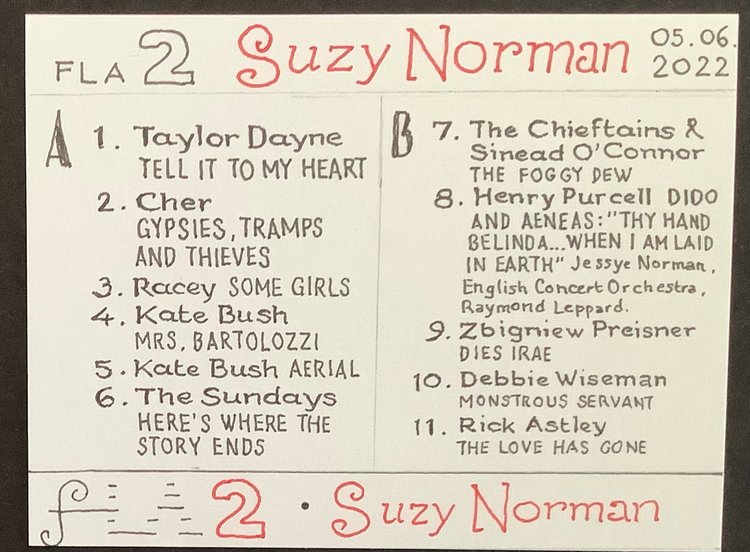
Painting, photography, acting, poetry, novel writing and singing – Suzy Norman does the lot. We first encountered each other online nearly 15 years ago when both of us had other blogs (don’t look for them, they’re not there anymore), and whenever we meet or talk, we regularly find ourselves discussing music, writing and general creativity.

In April and May 2022, we had a couple of conversations, encompassing not just her First/Last/Anything selections, but also the sound of silence in the big city, the physicality of music, and getting into trouble in GCSE music class. Suzy has an excellent singing voice, and often cannot help bursting into a song at the mention of its title. Maybe this should have been a podcast after all.

——

 SUZY NORMAN

I’m interested in how what you’re into develops. At any age. When I was younger, before the age of twelve – I was really into anyone female: Clare Grogan, Toyah, I loved Hazel O’Connor… And then I really, really liked boys, so… Duran Duran, Adam Ant, the handsome ones.. And then, I was just going all over the place, really. Tina Turner and Taylor Dayne, I really loved Cher – ‘Gypsies, Tramps and Thieves’…


JUSTIN LEWIS

The belters.


SUZY NORMAN

Yeah. I liked a lot of joyful stuff. But in tandem, I loved REM and even started listening to things like Mudhoney. Mudhoney and Taylor Dayne!


JUSTIN LEWIS

If you like leftfield stuff but you like chart stuff as well, you can never get bored. I’ve never understood why people take musical tribalism into adulthood… And I didn’t even really understand it at school. The peer pressure thing – never quite got it.


SUZY NORMAN

My older brother’s always had quite a forceful personality, so he’s always influenced me more than my sister – but did he influence me, or is it just that I had to listen to a lot of his stuff? The Jam. Or Madness. The ‘boys’ stuff. Which I still don’t particularly like, to this day – but you just heard it a lot, didn’t you?


JUSTIN LEWIS

I’ve come round to The Jam a bit more, I can separate it now, but the people who liked The Jam at school were the ones telling you they were always better than the pop music you were listening to.


SUZY NORMAN

Ye-e-es. I loved the Police, though.


JUSTIN LEWIS

I quite liked The Jam, but I liked lots of other groups too. And people were the same with The Smiths for a bit, weren’t they? ‘This is the only group that matters.’ One aim of this series is to remove the remnants of shame of music.

FIRST: RACEY: ‘Some Girls’ (RAK Records, Single, 1979)

JUSTIN LEWIS

In terms of age, your first record purchase is going to be hard to beat for future guests. Short of them being a baby! You were, what… four?


SUZY NORMAN

This is the weirdest thing. I have corroborated this with my mum and dad, that I couldn’t have been four, and yet I remember buying it, but then I think, do I misremember buying it? But I did buy it. That’s how early I was into music. At that age, you’re not influenced by anyone – it’s just the cheesy stuff that you like. Like Racey.


JUSTIN LEWIS

So you went out and bought that yourself? Can you remember where you got it from?


SUZY NORMAN

Woolworths, Chepstow High Street. My dad took me. I had money left over from Christmas, I suppose.


JUSTIN LEWIS

Have you heard it recently?


SUZY NORMAN

Yes, I listened to it again last week. It’s alright! [Starts singing chorus] I mean it sounds dead old-fashioned, like the fifties.


JUSTIN LEWIS

Do you know who covered ‘Some Girls’ a couple of years later? Barry Manilow.


SUZY NORMAN

Good old Bazza.


JUSTIN LEWIS

Sounds like the same backing track!


SUZY NORMAN

I was also three years old when ‘Mull of Kintyre’ came out, ‘77. And I adored it. My auntie bought it for me, actually, as a little single – I literally wore a hole in it. I remember getting the record, and being excited because it was my first record. My mum says that I was just obsessed with it. I used to be in love with Paul McCartney, when I was about seven, I had delusions I was going to marry him.


JUSTIN LEWIS

This is the reason I’ve gone with first last anything rather than favourite record. The trouble with favourite record is it pressurises people to think what sums them up. But if you say, What’s your first record, people could fib about it, but on this, I’m not judging anyone’s choices, because it makes for a more interesting chat.


SUZY NORMAN

I’ve always liked a lot of old shit! [Laughs]


JUSTIN LEWIS

So have I. I think there’s a lot of truth in that Noel Coward quote, ‘the potency of cheap music’. The things that make memories flood back to you are often quite disposable. ‘Give It Up’ by KC and the Sunshine Band, there’s almost nothing to it, about twenty words in the whole song. But that’s the sound of a holiday I had when I was about thirteen. When you look back on days gone by, sometimes what you remember are records you hated at the time. That mindset of, I like this record, or, I hate this record, gets less simple as you get older.


SUZY NORMAN

I think holidays are important to the memory because they’re so visceral. The first time we went abroad, we went camping in the south of France in 1982. And that was when ‘Come on Eileen’ was around – so that song, for my entire family, represents France. Also, ‘Tainted Love’. And the Minipops, which was a single on the jukebox on the campsite.

LAST: KATE BUSH: Aerial (EMI Records, CD, 2005, remastered 2018)

Extract: ‘Aerial’

SUZY NORMAN

I just think she’s a genius! And the older I get, the more I think there’s no-one else like her, and there never will be. I love the fact she does kooky stuff. But I wasn’t really into her until I got married, I think Phil, my husband, probably got me into her. We had the Hounds of Love album, with ‘Cloudbusting’ on it, and I think we’ve got another earlier album – Lionheart. I really liked those two, and then it was announced that she had a new album out.


JUSTIN LEWIS

It was her first new one for twelve years. The structure of Aerial is quite similar to Hounds of Love – the 24-hour cycle. I thought of you, when I was preparing for this, because in terms of subject matter and vocabulary, Kate Bush takes all these little bits of inspiration from literature and art and history and music itself. On Aerial alone, there’s references to songs like ‘Little Brown Jug’, ‘Autumn Leaves’ – there’s even a bit of the title track where the laughter echoes ‘The Laughing Policeman’.


SUZY NORMAN

I love that laughter and I love the birdsong. And being a visual person, I love the videos, they date brilliantly. They’re fascinating to watch – she’s really interested in dance and choreography.


JUSTIN LEWIS

I get the impression she never wanted to be famous, she just wanted to get to a point where she had a studio to make new music. ‘I don’t have to tour, I can just put out a record whenever I’m ready to, and make sure it’s as good as I can possibly make it.’


SUZY NORMAN

I think, on a personal level, she’s enigmatic, and I like that. I’m really intrigued by people who keep themselves to themselves – like Julie Christie does. I just love people where you don’t know what they do. Do they even do anything?


JUSTIN LEWIS

Supposedly the first disc of Aerial – we should say it’s a double album – is a collection of unrelated songs, but I’m not quite so sure. A lot of it is about family – there’s a song about her son, one about the passing of her mother – but then there’s a song all about the decimal placings of pi. Can you just sing numbers? Can you sing the phone book? And ‘Mrs Bartolozzi’ – a song literally about doing the laundry. Making art out of something apparently mundane.


SUZY NORMAN

Can you imagine trying to write a song about our mostly banal days? I can’t. I was listening to Aerial a lot when I was recovering from an operation – and I couldn’t really get out of bed, I was almost paralysed – but I was thinking of movement: acrobats and people dancing and twirling. And I just couldn’t wait to put my leggings on and stretch because I do dance around quite a lot at home, and it’s an important part of my yoga practice as well – I just wanted to stretch, and that album sounds like stretching.


JUSTIN LEWIS

You don’t often hear Kate Bush’s music discussed that much in relation to the physicality of the music. But there’s a lot of rhythm in what she does, always.


SUZY NORMAN

I love her song ‘The Dreaming’, the one with the dijeridu on it. I wanted to call my second novel The Ground is Full of Holes ‘The Dreaming’. I was set on that for a couple of years, in fact. So I must have been thinking about her when I was writing that, in a way. But I decided not to do that because it wasn’t original enough. But that was the working title of it for about four years.


My first novel, Duff, was initially called ‘The Edge of Rain’, and it was shortlisted for quite a major prize, the Dundee International Book Prize. Which was very encouraging to me. But I went back over it a year later, and I changed a lot of it, made it a lot more light-hearted. The essence was the same, but it turned into a little bit of a romcom, a slightly episodic novel where a man is trying to get his wife back, and to do so, he suggests a road trip from Wales up to Scotland. So that’s the premise.


The Ground is Full of Holes is also about a marriage breaking down, but it has a mature theme, I feel it goes deeper. I find first-person writing much easier, much freer – which is how I wrote Duff – but I wanted to challenge myself so this one was third person, omnipresent, or third person close [ie concentrating on one character, but written in third person].


JUSTIN LEWIS

As we’re talking about music and sound, how do you approach those elements – and maybe even silence – in your writing?


SUZY NORMAN

I feel that my books are quite silent anyway. But I do put certain sound under a microscope. For example, there’s a scene in The Ground is Full of Holes when one of the key characters, who’s an anaesthetist, is sat in an adjoining room to the operating theatre and he’s listening to the sounds going on in there. I find that kind of thing really interesting, and I wanted to try and make that come alive on paper because it’s a nice contrast to his isolation. The cut and thrust of his responsibilities next door, which he’s actually ignoring at that point.


There’s some semi-autobiographical and musical references in that book, too. I chose The Sundays, ‘Here’s Where the Story Ends’, because it was very evocative of me being a teenager, and I was seeing this guy – and that was the song I remember playing on his radio in his room.


My books are very quiet, but I feel that’s intentionally so – because I live in quite a quiet world myself. I live in Central London, but I do my damnedest to make my life as simple and quiet as I possibly can.


JUSTIN LEWIS

What struck me, reading The Ground is Full of Holes, was the feeling of quiet in the big city. With a city like London, you think of bustle and traffic, and a lot of this felt like nocturnal silence.


SUZY NORMAN

I think that’s the kind of London I would like to live in. This is what I experienced in lockdown, a beautiful experience, you know. I wonder what it would be like for me to live somewhere quiet. I think I might find that very strange. I think I would rather create my own quiet in a noisy environment rather than the other way round.


JUSTIN LEWIS

It’s nice to be able to make that choice.


SUZY NORMAN

Yes. I feel I have control over how busy I want to be. If I want to step out of my flat into a busy street, then I can. I worry about that option not being available at all, and the feel of the city is very energising. And to take that away might feel a little glum – I’ve never done it as an adult, I’ve never lived outside of a city as an adult. So I feel that a lot of what I create is my own fantasy of silence.


JUSTIN LEWIS

The way that we use music now in the twenty-first century: if we want noise we can find it, but we don’t have to have it. That control of whether it’s on or off. Whereas, years and years ago, where music wasn’t a constant soundtrack – in fact, it was even quite hard to find sometimes. Sure, there was Radio 1 but that was all there was! And the idea of music or noise you wanted on tap. And now, it’s tempting to think, There’s too much noise – but you can choose now.


SUZY NORMAN

You can turn it off.


JUSTIN LEWIS

Just to go full circle with titles: you mentioned you originally titled the novel ‘The Dreaming’, linking back to Kate Bush. But where is the actual title The Ground is Full of Holes from?


SUZY NORMAN

It’s an Edna O’Brien quote. I say ‘quote’ – it’s in a novel of hers. Because Irish literature is my thing.


JUSTIN LEWIS

Would your passion for Irish literature extend to Irish music?


SUZY NORMAN

Very much so, yeah. I’m not an expert on it at all. But I listen to it rather a lot.


JUSTIN LEWIS

Irish rock, Irish folk?


SUZY NORMAN

Oh, definitely not rock, although I love Van Morrison. Yeah, folky stuff. I don’t admit to it, because it’s a bit naff (Laughs) but I love it. The Dubliners, The Chieftains. It’s all fiddle-dee-dee.


JUSTIN LEWIS

And you’ve been to Ireland a number of times?


SUZY NORMAN

Probably more than anywhere else.


JUSTIN LEWIS

Have you sat in pubs while this music was being performed live?


SUZY NORMAN

Yes, I have. In Dingle, and in Galway as well. I love the sound of the music. I love the drums. It’s a romantic thing. It’s an Ireland that doesn’t exist anymore, only exists in pubs. Even though I would never have experienced this Ireland even when it did exist, even if it existed ever. But that’s the power of music, isn’t it? You can imagine an Ireland that’s something else, I suppose. Rather than the reality. The history is another thing I’ve had to educate myself about, partly because we’re not taught about it in schools. It’s the whole picture. They’re highly intelligent, creative people. They have a lovely vocabulary, that we perhaps don’t have over here sometimes. And that might stem back to going to church… The Irish people I’ve met have quite a forcefulness to them, a confidence about the language they use, the diction they use, which is interesting to me.

ANYTHING: JESSYE NORMAN: Henry Purcell – Dido and Aeneas: ‘Dido’s Lament (When I Am Laid in Earth)’ (Philips, CD, 1986)

JUSTIN LEWIS

It sounds like this was the moment for you when you properly connected with classical music.


SUZY NORMAN

I can’t believe how old it is, basically! [It was composed in the 1680s.] But it has this slightly modern tint to it – Sinead O’Connor could record it. And I guess the lyrics are very clear and very raw. And I just thought, What a wonderful thing to have at your funeral. I just love it. Salome Haller’s version, I heard first of all, and I’ve heard many versions since – but Jessye Norman’s is best, for me. She’s incredible. I heard her before I saw her, and I was actually surprised to discover that she was Black. I had no idea.


JUSTIN LEWIS

She’s been quite a role model for many performers since, especially in the States.


SUZY NORMAN

I’d assumed it was mostly a white woman’s game.


JUSTIN LEWIS

I think it’s changed quite a bit, especially recently. Why classical music is still here at all is due to people looking forward. One reason it stalled in the public consciousness was that, unlike popular music, which had this linear progression, the popular perception of classical music was: you get to the twentieth century, and… then what? Whereas it’s living and breathing. But you would have to be listening to a fair bit of Radio 3 and attending concerts to know how much is there. If you said to a lot of people, Name ten composers, they might name one or two after 1900. But generally, they’re going to go, Bach, Beethoven, Mozart etc…


SUZY NORMAN

When I was writing every day, I listened to a lot of Radio 3. I discovered how much I loved opera! But my introduction to classical music is very often through TV drama as well. There’s this brilliant piece of music from The Crown – it’s when Princess Margaret gets married. ‘Dies irae’ by Zbigniew Preisner. That blew me away too. Again, it’s very slow, and very sad. Debbie Wiseman’s Wolf Hall soundtrack… is beautiful, and I listen to that quite regularly. So not so much radio now, but a hell of a lot of TV drama. I’ll hear something, look it up, find out more about that composer or whatever. That tends to be how I do it.


JUSTIN LEWIS

But that constant Radio 3 listening was from when you were writing pretty much every day.


SUZY NORMAN

Yeah.


JUSTIN LEWIS

And I think when you are doing anything like that, you’ve got a routine in place, you’ve got your writing head on. Radio 3 has this element of surprise about it, but not one that’s going to put you off your stride, when you’re working.


SUZY NORMAN

It’s lovely, it’s like going into a library, and you don’t know what you’re going to get, but something will be on display in the main entrance… that’s what the radio is. You don’t really get that with Spotify because you have to select what you want to listen to. Unless you listen to a playlist, but in general I wouldn’t trust anyone else’s playlists! (Laughs)


JUSTIN LEWIS

Just on that point of how much you like melancholy music… has that always been the way?


SUZY NORMAN

It depends on the mood I’m in. The last ten years, I’ve probably listened to more upbeat music, quite a lot of pop music, things like Justin Bieber. But before then, it was sad stuff… sad Bob Dylan and Neil Young. Maybe I was a bit sadder then. But now, maybe life’s a bit more to be celebrated, though that said, I am listening to more sad music once again – but because I find it very relaxing and beautiful, for no other reason than that.


JUSTIN LEWIS

Recently, I went to see a piano duet recital in Cardiff. They played Schubert’s Fantasie in F, devastating piece it was, almost the last thing he wrote, might have been the last thing he wrote actually. It’s got this finale of doom to it, but as with a lot of sad music, it is life affirming – ‘I am overjoyed to be here listening to this now’.


SUZY NORMAN

It’s: We’re all mortal. And we’re here to reflect on the sadness of life. To be a complete human being – it’s not all fun fun fun.


JUSTIN LEWIS

I wonder if that’s why classical music – particularly in the past – slightly failed with a lot of younger people because as you get older, you realise that a lot of this music is about being an adult. Which is not to say pop music can’t be about that.


SUZY NORMAN

You have to have experienced loss, you have to have experienced disappointment. Nick Cave – he’s had a lot of tragedy the past ten years. But it’s still great music. I wouldn’t say it’s better for it. But it’s good enough.


JUSTIN LEWIS

Yes, it’s what you can do with the material that life has given you. And if you’re a real artist, it’s about trying to reflect that as honestly and as imaginatively as possible.


 —–


SUZY NORMAN

I grew up in south Wales, but for a while, I went to school in Princes Risborough [in Buckinghamshire] which is not far from London. So there were lots of wonderful experiences which I didn’t have in my Welsh school. Things like playing clarinet in the orchestra in the House of Lords, and seeing theatre in London… It wasn’t a great school but they did have a lot of extra-curricular stuff like that. And I really made the most of it, I think.


When I moved back to Wales, I dropped the clarinet… but I did choose GCSE Music – for only one year because I dropped out. It’s a shame that happened because I loved it, we studied The Beatles’ Help! as a form, we learned how to conduct a song, that’s when we learned about middle-eights, intros, all that. And I am a singer, so I was a confident singer.


JUSTIN LEWIS

Did you sing solo?


SUZY NORMAN

I did. I remember singing ‘That Ole Devil Called Love’ with the teacher on piano and me singing.


JUSTIN LEWIS

I’ve heard you sing that informally. But did you ever try songwriting?


SUZY NORMAN

I did actually write some songs in my mid-twenties. I’ve always been creative in that sense. I’d just got back from Australia, where I’d spent a year, and I was staying with my parents while I was saving up enough money to not live with them anymore. So I had a lot of quiet evenings when I just did that. I wrote about four, on guitar, and recorded them on a tape player. But god knows where they’ve gone. I didn’t notate them.


But here’s why I dropped GCSE Music after a year. We had a homework task, which was to compose a song, and even though I could play about ten chords on the guitar – which as we know is enough to write millions of songs – could I be bothered? No, I couldn’t. So I took this filler track from a Rick Astley album – one where I thought, ‘Well, no-one’s going to give me an A+ for this.’ It was called ‘The Love Has Gone’. I thought it would go under the radar. I went in and I sang it acapella, and the music teacher took me into a side room. And she said, ‘Suzy I’ve got to tell you – I’m really impressed with this, in fact I think it’s the best one in the class.’ And then she pressed ‘play’ on her tape player… and it was Rick Astley.


JUSTIN LEWIS

That is brutal.


SUZY NORMAN

It’s malicious! (Laughs) It’s a really sadistic way of doing it. I was mortified. So I never finished the course. My parents never noticed. I don’t think they even knew I’d been doing Music GCSE! So I didn’t have to explain myself.


JUSTIN LEWIS

Parents weren’t involved with their kids that much in those days, were they. They didn’t know what we were doing. Can I put that Rick Astley song on your First Last Anything playlist?


SUZY NORMAN

Definitely! It’s the story of my life in a playlist…


—–


Suzy Norman’s two novels, Duff and The Ground is Full of Holes, are published by Patrician Press. You can find them both here: Suzy Norman books and biography | Waterstones

You can follow Suzy on Twitter at @suzynorman.


—–

FLA Playlist 2

Suzy Norman

(For the time being, this site and project uses Spotify for the conversation playlists, but obviously I disapprove that Spotify doesn’t pay artists and composers properly, and other streaming platforms are available, as are sites to buy downloads and buy recordings. For consistency, you can also listen to the selections via YouTube (where available), and links are provided in each case, below.)

Track 1: TAYLOR DAYNE: Tell It to My Heart: https://www.youtube.com/watch?v=Ud6sU3AclT4

Track 2: CHER: Gypsies Tramps and Thieves: https://www.youtube.com/watch?v=uuA_gCMiw0E

Track 3: RACEY: Some Girls: https://www.youtube.com/watch?v=JY3pkagVP64 


Track 4: KATE BUSH: Mrs Bartolozzi: https://www.youtube.com/watch?v=tRiJ1xrZQ80

Track 5: KATE BUSH: Aerial: https://www.youtube.com/watch?v=vCw796Qz4M0

Track 6: THE SUNDAYS: Here’s Where The Story Ends: https://www.youtube.com/watch?v=slNYveNnQTg

Track 7: THE CHIEFTAINS & SINEAD O’CONNOR: The Foggy Dew: https://www.youtube.com/watch?v=jrrO4I-E8oY

Track 8: HENRY PURCELL: Dido and Aeneas, Z 626: Act 3: ‘Thy hand, Belinda… When I Am Laid in Earth’

Jessye Norman, English Chamber Orchestra, Raymond Leppard: https://www.youtube.com/watch?v=jOIAi2XwuWo

Track 9: ZBIGNIEW PREISNER: Dies irae: https://www.youtube.com/watch?v=2ADFroKeDlw


Track 10: DEBBIE WISEMAN: Monstrous Servant: https://www.youtube.com/watch?v=QHhzribmXoc


Track 11: RICK ASTLEY: The Love Has Gone: https://www.youtube.com/watch?v=V8AvyCpCVJI

FLA 1: Lev Parikian (29/05/2022)

(c) ADRIAN CLEVERLEY

It was such a privilege to have Lev Parikian as my first guest on this series of conversations. He is a birdwatcher, an author, a musician, and a conductor, as well as one of the finest, most dryly funny tweeters I know.

One morning, in April 2022, we talked about his musical background and career, and about his First/Last/Anything musical choices, which encompass: one of the best-loved pop groups; a formidable and imaginative soloist and collaborator; and a pioneering composer in the world of animation.

We also discussed some of his experiences as a conductor, but we began by talking about his father Manoug Parikian (1920–87), one of the most celebrated British classical musicians of his day.


LEV PARIKIAN

My dad was a violinist, so my early life was listening to him play the violin very, very well indeed.  One of my memories is of sitting cross-legged on the floor of his music room, just listening to him practise. So that obviously goes in at a kind of deep level. There were times when he was away and not around, but at other times, he would be rehearsing with other very fine musicians, so there was music being made to a greater or lesser degree quite often.

And we had a record player, you know, so 33s and 45s and 78s, on which there would be things like Colin Davis Conducts the Highlights of The Marriage of Figaro, or Beethoven 9 conducted by… Karl Böhm, I think it was. But interestingly my dad wasn’t a recording fetishist; he made recordings, though not as many as he might have done, and he recorded quite a lot for BBC Radio 3, a lot of which has been deleted over the years. But when those were broadcast on the radio, he’d record them on reel-to-reel tapes. So, from the parental side of things, it was very much a classical upbringing.

But I was a child, this was the early 70s, and my brother is four years older than me, so I’d get influences from him, and we’d listen to Radio 1 and the Top 40 on Sunday afternoons. Later, by around 1977/78, my brother was very into new wave and punk, and played bass in a band, and I was twelve, thirteen, and had been listening to things like Genesis’s The Lamb Lies Down on Broadway. So suddenly I’m listening to Siouxsie and the Banshees and The Clash and the Ramones, and listening to John Peel at night, thinking, Okay, this is good music. And then my brother suddenly did a complete right turn, and started listening to funk and soul – and that has really stuck with me, I remain a big fan.


JUSTIN LEWIS

Were there crossovers between your parents’ taste in music and yours? Did your dad ever poke his head round the door, and go, That’s rather good?


LEV PARIKIAN

He never did that. I do remember that on Thursday evenings, he would sit down with us to watch Top of the Pops. He didn’t really go for it. And then, in my teens, I was getting into jazz. We had had these eight-track cartridges for car journeys – one by Louis Armstrong, and one by Herb Alpert and His Tijuana Brass – so I got it into my head: ‘Oh! He likes jazz.’ But I started getting into more outré, difficult jazz, and when Carla Bley (certainly more ‘difficult’ than Louis Armstrong!) was on the telly late one night on BBC2, I assumed because Dad listened to Louis Armstrong, he’d be well into Carla Bley. But he said, ‘I don’t really like it.’

Dad’s musical tastes really were straight classical. Mozart was revered above all else. But he was also a great champion of contemporary British classical composers.


JUSTIN LEWIS

So did he commission people with new works?


LEV PARIKIAN

He did – there were some commissions that were written with him in mind as a soloist: Sandy Goehr, Elizabeth Maconchy – and Hugh Wood (1932–2021), who died recently. Dad recorded his violin concerto in the early 70s, and while Hugh was writing it, he basically came on holiday with us! He was a bit Douglas Adams with deadlines. ‘If we spend two weeks with him, then he will have to [finish it].’


JUSTIN LEWIS

You didn’t have to lock him in his room, did you?


LEV PARIKIAN

No, we didn’t have to have a bodyguard for him, like Adams did! But I remember, much later on, ten, fifteen years later, Hugh wrote something for my dad’s piano trio, and that literally came page by page. Hugh was a lovely man. When I started conducting, with the Brent Symphony, our local amateur orchestra, he used to come to my concerts. This was at the church on the St John’s Wood roundabout, which was his local church. And after the first half he would come into the vestry, where I was changing, knock on the door, and say, ‘Very good, very very good…. So far…’ [Laughter] Puppy-like enthusiasm, but: ‘I’ve got my eye on you’. He became a friend of mine after Dad died. As I grew up, we kept in touch.

FIRST: ABBA: ‘Waterloo’ (Epic Records, Single, 1974)

JUSTIN LEWIS

So, where do ABBA fit into all this, then? How did you get to buy ‘Waterloo’ as your first record?


LEV PARIKIAN

1974, I was nine years old, and I had pocket money, and they had probably just won Eurovision, and it was being played everywhere, and I wanted to have my own record. We had some things knocking about that my parents had bought. But that’s not the same, you know.


JUSTIN LEWIS

It’s a decision you’ve made.


LEV PARIKIAN

‘This is my record.’ That ABBA choice has stuck with me, those early records of theirs I think of as my favourites. They can really divide people – I know people who say, ‘Oh god, they’re so tedious’ or ‘I hate that big sound’, but I always found them incredibly life-affirming and uplifting. I had no idea how they made that sound, and how they constructed their songs – but something about it definitely stuck.


JUSTIN LEWIS

Yes, the arrangements. I’ve come to realise that one of my obsessions is with arrangements, and yet it’s the aspect that is often overlooked. People tend to discuss lyrics, or the tune…


LEV PARIKIAN

Sometimes harmonies, ‘that’s a beautiful chord progression’, or the hook or ‘the middle eight’s brilliant’. For an obvious example with ABBA: ‘Dancing Queen’. The decisions that they make at every stage of recording that song, of how they’re going to build the sound. It’s multi-tracked, all sorts of things are producing that big, bright, completely infectious sound, and it’s quite hard work to build something like that. It’s not just going into the studio and playing and recording it and that’s what comes out. Instead, it’s voicing this, and doubling that line, even quadrupling it.


JUSTIN LEWIS

You know what one of the inspirations for ‘Dancing Queen’ was? It was that George McCrae record, ‘Rock Your Baby’.


LEV PARIKIAN

There’s nothing original under the sun, is there?! And around the same time as ‘Waterloo’, there was Cozy Powell. ‘Dance With the Devil’. And I just loved the rhythm of it, the drums.


JUSTIN LEWIS

Well, you became a percussionist…


LEV PARIKIAN

This is all foreshadowing! I was eight, so it obviously started somewhere. Because I was playing the piano a little bit, in a desultory kind of way. I started with the violin when I was four or five and that was a dead loss. Listening to my dad doing it, and thinking, Well I’m never going to be able to do that.

But with percussion, in the first instance, I think I got a term’s worth of free lessons because they were starting it up. I went to the local prep school in Oxford, I’d been singing in the choir, and they’d started teaching percussion lessons. I thought, A term of free lessons – great, and I get to hit things.

During my teens, I was dabbling with a drum kit – not well, but enjoying it – and I was playing timpani and percussion in orchestras. And then there was a sort of moment of revelation – I was about to do A levels, had been doing no work at all, was predicted really bad results. And I was playing in a concert, playing the timps and thought, Oh – this is good. I like doing this. I was already 17, 18. So I wanted to get into music college, but realised how good you have to be, to get in. So there was a period of hiatus, in between leaving school and going on to the Royal Academy. Playing in a jazz band with friends in Oxford where I lived – but also trying to get into music college to do classical percussion.


JUSTIN LEWIS

Let’s talk about conducting. How did you make the leap from being a musician to being a conductor?


LEV PARIKIAN

I was studying at the Royal Academy of Music, and I wanted to be a freelance orchestral timpanist, percussionist, whatever. They’d also just started a jazz course there, and I was dabbling in that, and playing in the big band, but when you’re playing timpani and percussion, especially in the classical repertoire, you’ve got a lot of bars’ rest, a lot of time sitting around. So you could either be pissing around, which I did a lot, or just gazing into the distance. Or observing the orchestra and the conductor, and I don’t think I did it consciously, but I think I must have noticed the difference that conductors make.

We played Mahler’s First Symphony, and Colin Davis came to conduct it, and we’d been playing other stuff – not just with student conductors, but with the regular conductors of the Academy. And you just suddenly go: This sounds like a different orchestra. They’re the same people that were playing last Tuesday but suddenly it sounds like a better orchestra. How did that happen? Because it’s just one person at the front. So there was an interest there.

But also, I remember an earlier conversation with my mum, when I was going through my terrible teen years of doing nothing at all. I wanted to give up playing piano – I wasn’t getting anywhere, wasn’t doing any practice, and [my parents] were paying for my lessons and it was just kind of pointless. And my mum said, ‘Well if you’re not enjoying it, then obviously you shouldn’t be doing it, but it’s a shame because I think it’ll come in useful – because I think you’re going to be a conductor.’ And this is when I was fourteen.


JUSTIN LEWIS

That’s fascinating.


LEV PARIKIAN

Yes, it is, but I don’t know whether that implanted the seed in my head or whether she had the foresight… Whether she turned me into a conductor via a time machine, you know?


JUSTIN LEWIS

Have you ever analysed what you had that turned you into a conductor? Did people ever say, or have you worked out what you had?


LEV PARIKIAN

I don’t know. They might have seen that I was not dedicated enough to really master an instrument [laughs]. I was dedicated to playing percussion in orchestras, which is a slightly different thing. I think, also at that time the idea of being a solo percussionist – multipercussion and marimba and so on – was very fledgling and niche. But I just think they probably they spotted some sort of musical curiosity.

Being a drummer in a band meant being the driver of things, and I suppose that links to conducting. And in the same way that a really good drummer drives without being obtrusive, then a really good conductor will do a similar sort of role.

I also remember when I was about sixteen, I became fascinated by Stravinsky’s Rite of Spring, by the sound of it, the size of it. My dad had a shelf full of miniature scores, and he had a score of that. I couldn’t read scores at all and a lot of it’s really complex, but there’s one bit which is just kind of repeated chords, changing a few notes at a time, and I just played that over and over again at the piano, reading the different staves. So it was clear that I was interested in orchestras and that was the direction that it could go.


JUSTIN LEWIS

Studying music at A level was the first time I’d ever really seen full scores of things, which you’d follow as you listened. Prior to that, as a soloist or an orchestral player, you’d mostly only see your own part. Obviously you were listening to what else was going on and you’re watching the conductor or whatever, but you never really saw or heard what the conductor sees or hears, which is basically everything. As a conductor, you’re a director, but it’s like being a film director.


LEV PARIKIAN

Yes. And part of the job, if you’re equating it to directing a film or theatre, is to tell the whole story. There are different techniques at your disposal. On a pragmatic level, you’re the one that’s best placed to hear everything, because you’re standing in a position where the musicians are around you, and you don’t have an instrument underneath your ear. So you’re in the position that’s closest to what the audience is hearing. Often the job is just to make sure that the balance is right – it’s a producer’s job.


JUSTIN LEWIS

With the baton, it’s like you’ve got this series of faders.


LEV PARIKIAN

And of course the better the orchestra, the better their ability to do that for themselves and so the better your ability has to be. Obviously there’s spotting mistakes and correcting rhythms and encouraging certain facets of the music by what you say and what you do. But a lot of it is boringly pragmatic, in a sense! [Laughter] It seems kind of unromantic to say it – it’s so easy to think of the conductor as some sort of magician, with the tailcoat and a wand. What we do is so intangible, people might think, Oh it’s some sort of magic.

There is obviously an element of inspiration, personality on the music. But if you take away a conductor from most orchestras, even amateur ones that I mostly work with, you’ll see they can play pretty well without a conductor. Especially if the music is familiar, and it doesn’t have complex tempo changes, they can play pretty well at least 85, 90 per cent of the time, without a conductor. But then your job is to know: What is that 10 per cent? How can you add to it?  


JUSTIN LEWIS

With non-professional or amateur orchestras, by the way – do we say ‘amateur’?


LEV PARIKIAN

‘Non-professional’ can encompass students and youth orchestras and so on as well. ‘Amateur’ is fine – a good thing in my view because it comes from ‘to love’ in Latin. Although, also as an amateur cricketer myself, I understand the connotations of the word amateur!

LAST: FENELLA HUMPHREYS: Caprices (Rubicon CD, 2022)

(Extract: Niccolo Paganini: Caprice No. 24 in A Minor. Fenella Humphreys (violin))

JUSTIN LEWIS

This was one of my recent purchases too. It’s phenomenal, a collection of solo violin works, but I hadn’t realised it was crowdfunded.


LEV PARIKIAN

I was one of the crowdfunders. I have probably worked with Fenella more than any other soloist over the last ten years at least. So we’re friends, and we’ve always got on really well musically and socially – but I was thinking about what makes me want to keep working with her as an artist. She plays the violin brilliantly, that’s the first thing, but what makes her playing special is that blend of intellectual rigour and showpersonship – I don’t know if that’s really a word, and it’s clumsy, but you know what I mean – so she’s a performer.

There’s also that word ‘collegiate’, she’s a great collaborator. She gets the amateur orchestra ethos –she always plays with the musicians who happen to be in the room. She understands what we’re doing.

And Fenella is flexible and spontaneous, with strong musical ideas, and as a conductor and collaborator, I never worry, working with her, ‘Oh god, is this going to be okay? There are moments that in a spontaneous way can be quite exhilarating, but you just feel like you’re in safe hands and so you can just relax, and know that the musicians in the room play better as a result. And I think that’s quite a rare thing.


JUSTIN LEWIS

I first became aware of her when she was performing concerts from her home during lockdown. And then I discovered her recordings. I find it fascinating how some musicians just find a way to your heart. Because, obviously, there are loads of brilliant violinists but there are ones who you find really, really special, and you think, I really want to hear them play that concerto. And she’s one of them. (And that doesn’t mean the others aren’t good!) But I see the range and volume of repertoire she performs at concerts, and it’s completely different stuff at each one. Now, is that common? I don’t get the sense it is. 


LEV PARIKIAN

Well, she’s pretty driven!


JUSTIN LEWIS

She must have the most incredible memory for a start.


LEV PARIKIAN

And it’s not that she’s taking these things on, and going to give them half measure. And my treat – and this applies to any concerto accompaniment – is I get to stand right next to it. There’s something quite special about standing next to a really good musician when they’re playing. And for me obviously the violin is extremely important because a good violin sound has been in my head for 50 years from my dad, so even though I don’t play myself, you know it when you hear it. And she’s got it in spades.


JUSTIN LEWIS

So with the Caprices album itself, I mean. What stands out for you? Can we discuss the sequencing? There’s so much variety.


LEV PARIKIAN

What’s great to see is so many young, contemporary, and living composers in there. It’s slightly disconcerting to see birthdates from the 1990s.


JUSTIN LEWIS

Yes, that keeps the ego in check. But with a number of names on that, I think, I must check more of their work out. And some surprising choices too. And Paganini himself, who I think sometimes gets a rough ride, gets dismissed as fluff.


LEV PARIKIAN

‘It’s all flashy.’


JUSTIN LEWIS

But I certainly don’t think that’s true of the 24 Caprices. I first properly heard them when I was about eighteen – I borrowed a CD out of the library, I think it was Michael Rabin’s version. First you hear the fireworks, and then…


LEV PARIKIAN

There is depth there, yes, and they are incredibly difficult and technical. They could just be this monumental technical exercise: ‘I can play these sixths, I can play the thirds, I can play the octaves…’ But to actually make a coherent musical piece, I think that’s an art as well. And that’s true of all 24 of them.


JUSTIN LEWIS

Fenella’s performance is just fearless. Completely liberated. And as well as the inclusion of the 24th Caprice, probably Paganini’s most famous piece of music, you get a sequence of brand new variations of that theme, each one contributed by a contemporary composer or artist. All extraordinary in their different ways. Rounding off with a gypsy jazz interpretation composed by Seonaid Aitken. 


LEV PARIKIAN

Yes, the ordering on the disc is interesting. It’s great to see some people I know a little bit and have heard before and have followed their careers. It’s seeing her playing all this new music and just saying: this is great music and it all lives together. Like her Bach to the Future discs, this is innovative, interesting programming for a CD – it makes sense as an album. Listening through this with shuffle turned off is rewarding. It’s not just a case of: Here’s a nice one, and oh here’s another nice one.

ANYTHING: SCOTT BRADLEY: Tom and Jerry and Tex (Apple Music, digital download album, 2010)

Extract: ‘Tom and Jerry: Downbeat Bear’ (1956)

JUSTIN LEWIS

Obviously I’m familiar with the music of Tom and Jerry.


LEV PARIKIAN

If someone said, ‘Tom and Jerry music’, you can hear the shape of it, the feel of it, the character of it. In the 70s it felt like Tom and Jerry was on every afternoon. And the Christmas one, every year, and they were funny and brilliant, and fast and slapstick.


JUSTIN LEWIS

Did you know that before BBC1 started showing Tom and Jerry, April 1967, it had never been on television before, not in Britain anyway. Just cinema.


LEV PARIKIAN

Really? That’s fascinating. And because you watched the credits, you’d see Fred Quimby’s name, the producer, with that little flourish on the Y. And the name of Scott Bradley, who composed the music for all of them. 

I don’t know a lot about composing music for cartoons, but what was brilliant about it, even at the time, was how the music fitted and dictated the action on the screen. You’d get BANG and what sounded like a swanee whistle but was actually two clarinets going up on a glissando, in semitones – or playing ‘the Petrushka chord’, I now understand! I was watching one of them earlier, ‘Putting on the Dog’, and there’s just a tiny little thing on the trombone when it goes boooeerrroom, and it’s the glissando bar from Stravinsky’s Firebird.


JUSTIN LEWIS

That’s a defining cartoon, ‘Putting on the Dog’. Certainly musically.


LEV PARIKIAN

He uses twelve-tone techniques in that as well. So he does Schoenberg – ‘here’s a bit of Schoenberg, but you don’t know it’s Schoenberg’ – and he’s got the Petrushka chord, twelve-tone stuff, and a bit of the Firebird, as well as these popular songs in great zippy arrangements.


JUSTIN LEWIS

You can hear ‘Old McDonald’ in there, and I noticed there was one Tom and Jerry cartoon called ‘Downbeat Bear’ from 1956, which seems to have not only a section of The Blue Danube in it, but also – fleetingly – ‘Rock Around the Clock’, which had just come out.


LEV PARIKIAN

And it all happens in two seconds, and it’s gone. And it’s all completely associated with the action on the screen, so it’s not him showing off, he’s demonstrating how to portray that moment of slapstick on the screen in music, which is all played with breathtaking brilliance by a group of twenty musicians. I know people who played in the John Wilson Orchestra who did that compilation at the Proms [2013]. And they said, ‘You have no idea how hard this is. This is the hardest music I’ve ever played in my life.’

JUSTIN LEWIS

I was watching the clip – rows of string players playing for their lives.


LEV PARIKIAN

And you don’t even realise it, because you’re watching Tom and Jerry. If I ever need to be cheered up, then that Proms clip is seven or eight minutes of pure joy.


JUSTIN LEWIS

I love that this music is so light on the face of it, and playful, but played seriously and absolutely straight. Have you ever had to conduct anything like cartoon music?


LEV PARIKIAN

For years, I had this idea we should play Tom and Jerry music live to the cartoon. But as far as I could find out there was no way to get hold of the musical materials – if they even existed at all. So the idea never came to fruition. But luckily John Wilson was rather more committed to the idea than me!


JUSTIN LEWIS

The Proms performance is a compilation, isn’t it. Helpfully itemised on YouTube.


LEV PARIKIAN

I’d still love to do it, but you need players of the highest calibre.


—-


JUSTIN LEWIS

As a conductor, what do you think is the biggest misconception about the profession?


LEV PARIKIAN

A lot of people simply don’t understand what a conductor does, why they exist, and what is difficult about it. And I include in that, not just non-musicians but also musicians – and also, dare I say it, some conductors. [Laughter] With a violinist, it’s obvious what the job is – you play the violin. With a writer, you write books, or plays, or sketches or whatever. But with a conductor, it’s not entirely clear what they’re doing and what would happen if you took the conductor away.

Do you remember the programme Maestro (2008)?


JUSTIN LEWIS

In which celebrities learned to conduct an orchestra.


LEV PARIKIAN

Yes, David Soul, and Goldie… and Sue Perkins won it, and they had the BBC Concert Orchestra playing. I know a few people who play in that orchestra, and one of them told me: ‘Obviously they’re making it for telly so it’s a broken-up process, but the one thing they never did at any stage was to just take all the conductors away and allow us musicians to play by ourselves without a conductor.’ Just to show people that this is what an orchestra can do – so the job of the conductor, especially as the playing level gets higher, becomes more about the ears, and is about how to get a group of people to play better – by whatever means that takes.


JUSTIN LEWIS

Reality TV covering music generally can be a problem, because it’s never about music, it’s about television. A completely different thing.


LEV PARIKIAN

They had quite a big audience on BBC2, and it was an opportunity to slightly demystify what the job is, but it didn’t seem to me that they really did that. And I can’t remember how many conductors they had on the panel, but they had orchestral musicians on the panel, so the focus was on the relationships between the mentors and the pupils, and the journey of the pupils. But it kind of underestimated its audience – it never actually addressed what they were doing and why. It never explained, ‘This is why this gesture doesn’t work, and why this gesture does work’, you know?


—–


JUSTIN LEWIS

We touched on this earlier, but in the 70s, you had pop over there, jazz over there, classical over there. They were like islands that weren’t connected. And now – they’ve almost connected round the back somewhere.


LEV PARIKIAN

I think this is a good thing, and speaking as a bloke in my mid-fifties, I’ve noticed that younger musicians in general I think are much more into cross fertilising in what they’re exposed to, the things they play, the things they listen to. That’s definitely changed since I was young.

At the Royal Academy in the early 80s, when I was studying timpani and percussion in orchestras, I was also interested in jazz. I was listening to quite a lot of funk and I remember listening to Level 42 quite a bit – partly because of Mark King’s bass playing. Their drummer, Phil Gould studied percussion at Royal Academy of Music a few years before me, and apparently, what happened – he’d put together a kit from a suspended cymbal and a snare drum and other bits, and started playing around, and the reaction was, ‘We don’t do that here.’

Meanwhile, this jazz course had been started by Graham Collier, who had also been instrumental in starting the [big band/orchestra] Loose Tubes. So that was a fledgling thing that I was well into, and I know several musicians, friends of mine who were also there as classical players, but were also in big bands and small bands. And nowadays I think it’s just taken for granted that classical musicians will not just be interested in Mozart and Beethoven.


JUSTIN LEWIS

When I used to go to concerts, when younger, I used to find it quite a difficult experience in that I didn’t feel like I belonged there. To go now, you feel much more welcome. There isn’t that formalised restriction anymore. Sometimes, the musicians now will talk to you, introduce the music they’re going to play.


LEV PARIKIAN

For some players that can be quite a daunting thing. I do talk to audiences at concerts, sometimes very briefly, but fairly recently, I did a film music concert, with nine big pieces of film music, each one of them benefiting from an introduction. And for the last two minutes of any piece I’m conducting, my mind is already thinking: Okay. What am I going to say about the next piece? I didn’t want to do that nine times, so I thought of Neil Brand, because we were doing [Bernard Herrmann’s] Vertigo suite, which is his favourite thing – he’s done a whole thing on his YouTube channel about it. I thought, What this needs is Neil Brand telling us what the music is doing before we play it. It was brilliant – it just took the pressure off me, and he was focused on communicating the music.

But yes, musicians talking to audiences, even if we just say, ‘Uh, hello, thanks for coming. It’s lovely to see you all. I hope you enjoy this. It’s eight minutes long.’ [Laughter]


Lev Parikian’s book, Light Rains Sometimes Fall, was published in paperback in 2022. His other books include Music to Eat Cake By, Into the Tangled Bank, and Why Do Birds Suddenly Disappear?

Since our conversation, Lev’s superb and highly acclaimed book Taking Flight was published by Elliott and Thompson in May 2023, and was shortlisted for the Royal Society Science Book Prize.

He also writes a lot about birds, and his regular Six Things round-up at his Substack: levparikian.substack.com

Much more at levparikian.com, and you can find him on Bluesky as @levparikian.bsky.social.

———————

FLA Playlist 1

Lev Parikian

(For the time being, this site and project uses Spotify for the conversation playlists, but obviously I disapprove that Spotify doesn’t pay artists and composers properly, and other streaming platforms are available, as are sites to buy downloads and buy recordings. For consistency, you can also listen to the selections via YouTube (where available), and links are provided in each case, below.)

Track 1: WOLFGANG AMADEUS MOZART: Violin Concerto No. 1 in B-Flat Major, K.207: I. Allegro moderato

Manoug Parikian, Orchestra Colonne, Walter Goehr: https://www.youtube.com/watch?v=bgQHvH-cWMI

Track 2: HUGH WOOD: Violin Concerto No. 1, Op. 17: II

Manoug Parikian, Royal Liverpool Philharmonic Orchestra, David Atherton: https://www.youtube.com/watch?v=Kpmlo7D3uyY

Track 3: ABBA: Waterloo

https://www.youtube.com/watch?v=Sj_9CiNkkn4

Track 4: COZY POWELL: Dance with the Devil

https://www.youtube.com/watch?v=7IpfZnBvBF0

Tracks 5, 6, 7: IGOR STRAVINSKY: Le Sacre du Printemps (1947):

Introduction / Adoration of the Earth / The Augurs of Spring / Dances of the Young Girls / Ritual of Abduction

Pierre Boulez, Cleveland Orchestra

(Track 5): https://www.youtube.com/watch?v=3gfnF6gdNi8

(Track 6): https://www.youtube.com/watch?v=Pc1wX7MTRaI

(Track 7): https://www.youtube.com/watch?v=LvQ1aTlPqe8

Track 8: NICCOLO PAGANINI: Caprice No. 24 for Solo Violin

Fenella Humphreys: https://www.youtube.com/watch?v=6Vx-jsXx4h4

Track 9: SEONAID AITKEN: Paganini Caprice No. 24 for Solo Violin Variation: Gypsy Jazz:

Fenella Humphreys: https://www.youtube.com/watch?v=y11pZfeMdII

Track 10: SCOTT BRADLEY: Tom and Jerry: Downbeat Bear

https://www.youtube.com/watch?v=rRBU0nS9W4A&t=58s

Track 11: SCOTT BRADLEY: Tom and Jerry at MGM

Performed live by the John Wilson Orchestra, BBC Proms, 26 Aug 2013

https://www.youtube.com/watch?v=kYrUWfLlYI0

Track 12: BERNARD HERRMANN: Vertigo – Prelude and Rooftop

https://www.youtube.com/watch?v=RPSZuzW5IG0


Track 13: STUART HANCOCK: Violin Concerto: I. Andante maestoso – Andante semplice:

Jack Liebeck, BBC Concert Orchestra, Lev Parikian

https://www.youtube.com/watch?v=oireCP8yLrE

FIRST LAST ANYTHING: ABOUT

Conversations about Music

with Justin Lewis

About First Last Anything

This isn’t a podcast. It’s a textcast.

A series of conversations about music with people who make music, think about music, or simply love music. Or a combination of them.

I decided on a format that was a shift away from ‘all-time favourite records’, like turning one’s collection into a museum piece. I thought it might be more interesting to focus on not only the past but the present. Not only, where you’ve been with music, but also where you might be now. And where you might be going.

And so FIRST LAST ANYTHING came into being. (The working title was The First The Last My Anything, after the Barry White song, but that seemed a bit cumbersome.)

The rules – they’re not even ‘rules’ exactly – are so simple. I invite guests to select:

FIRST – The first record they bought (or remember buying)

LAST – The most recent record they bought (or downloaded)

ANYTHING – A wildcard selection, but broadly speaking: a record that expanded their taste or opened a door in music, or just something they changed their mind about.

Then we talk about those, and other matters relating to their life so far consuming music.

That’s it.

Between May and September of 2022, the first run of First Last Anything welcomed sixteen special guests.

A further eight special guests appeared for a second run in June to August 2023.

There are plans for a third run later in 2025. In the meantime, all 24 conversations will be reuploaded at this new location, and can be found under the category of First Last Anything.

Hope you enjoy them.

Justin Lewis

May 2025